wayground logo

Free Printable Worksheets

Font size

S
M
L
XL
Worksheets

Final Exam 2021 Sem 2 Practice Test

Total questions: 143

Worksheet time: 5hrs 46mins
Name
Class
Date
1.

Gradualism means Natural Selection would normally happen over many generations and very

a)

slowly

b)

quickly

c)

in space

d)

beyond time

2.

Genetic diversity in a species makes long term survival of some members

a)

impossible

b)

improvable

c)

more likely

d)

less likely

3.

Average phenotypes are favored in the environment, while extremes have lower survival rates.

a)

seasonal selection

b)

distruptive selection

c)

directional selection

d)

stabilizing selection

4.

Two populations of the same species are separated by land barriers like rivers or mountains.

a)

geographical isolation

b)

temporal isolation

c)

adaptive ratiation

d)

behavioral isolaton

5.

The extreme population phenotypes are favored by the environment.

a)

Disruptional (Diversifying) Selection

b)

Directional Selection

c)

Stabilizing Selection

d)

All of the above

6.
When experimenting with the growth of a plant, a scientist uses three (of the same type of) plants, two different fertilizers, equal light, and equal water. What type of variable is the fertilizer?
a)
Dependent
b)
Independent
c)
Control
d)
Compound
7.
An experiment is performed on plants to see how different liquids affect plant growth. Each plant in the experiment is given a different liquid; water, apple juice, or milk. Each plant has the same amount of soil, sunlight, and listens to the same music. In this investigation, what is the dependent variable?
a)
Type of plant
b)
Water, apple juice, milk
c)
Plant growth
d)
Color of the plant's leaves
8.
What is the purpose of a dichotomous key?
a)
to find a common ancestor
b)
to show the evolution of organisms
c)
to show relationships between organisms
d)
to identify organisms
9.
A dichotomous key for insects is given. To what order does an insect with two pairs of scaly wings belong?
a)
Coleoptera
b)
Heteroptera
c)
Diptera
d)
Lepidoptera
10.
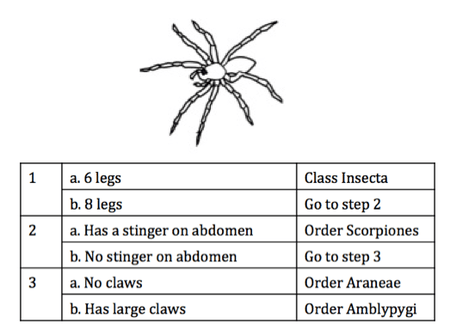
An illustration and a dichotomous key are given. What is the correct classification for this organism?
a)
Class Insecta
b)
Order Amblygygi
c)
Order Araneae
d)
Order Scorpiones
11.

A student discovers an arachnid without a segmented abdomen, and legs longer than its body. The student uses the dichotomous key below to identify it. Which arachnid has the student found?

a)

Whip Scorpion

b)

Wind Scorpion

c)

Daddy long legs

d)

Scorpion

12.

A student discovers an arachnid with a segmented abdomen, long legs, and a tail with no stinger.

The student uses the dichotomous key below to identify it.

1. a) Abdomen segmented.............go to 2

b) Abdomen not segmented ......go to 4

2. a) Abdomen with tail....................go to 3

b) Abdomen without tail...............go to 5

3. a) Tail with stinger..........................Scorpion

b) Tail without stinger.....................Whip scorpion

4. a) Legs longer than body.............Daddy Long Legs

b) Legs not longer than body……….Wind scorpion

5. a) Covered with spines .......................Mite

b) Few spines.....................................Tick

a)

Whip Scorpion

b)

Daddy Long Legs

c)

Mite

d)

Tick

13.

The main function of stomata is to

a)

capture sunlight

b)

protect leaves from insects

c)

allow gases to move rapidly in/out of leaves

d)

release sugars into the atmosphere

14.

________________ are consumers that eat ONLY PLANTS.

a)

Herbivores

b)

Carnivores

c)

Omnivores

d)

Producers

15.
A living organism that puts materials from dead  plants and animals back to the soil is called a ____________?
a)
carnivore
b)
decomposer
c)
herbivore
d)
omnivore
16.

Which category of organism cannot make its own food?

a)

Autotroph

b)

Heterotroph

17.
Barnacles create home sites by attaching themselves to whales. This neither harms nor benefits the whales.  What kind of relationship is this?
a)
Mutualism 
b)
Parasitism 
c)
Commensalism 
18.
A relationship between two organisms in which both organisms benefit. 
a)
Mutualism 
b)
Competition
c)
Parasitsm 
d)
Commensalism 
19.
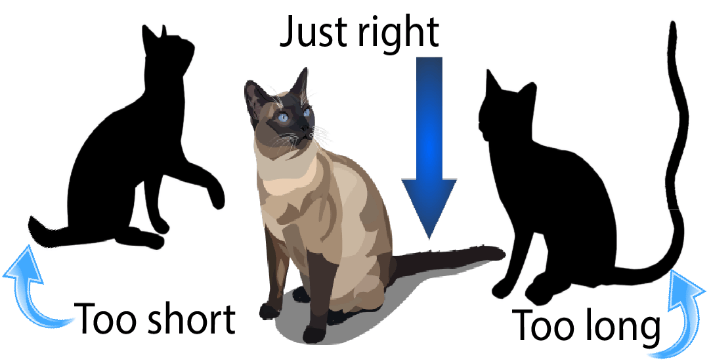
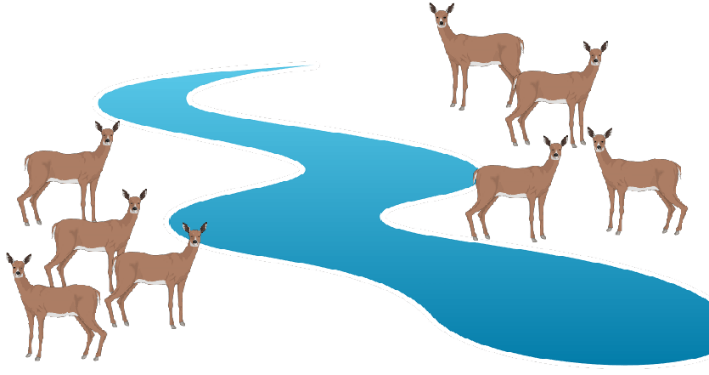
What type of selection is depicted in the picture? 
a)
stabilizing 
b)
directional 
c)
disruptive 
d)
the answer is not here
20.
What type of selection?
a)
Directional 
b)
Stabilizing
c)
Disruptive
21.

Grass plants in a population range in height from 6 cm to 25 cm. The short plants receive little sunlight, and the tall plants are eaten by grazing animals. Which statement best describes the effect of natural selection on the grasses?

a)

Because average height grass plants are favored, stabilizing natural selection is occurring.

b)

Because average height grass plants are favored, disruptive natural selection is occurring.

c)

Because tall grass plants are favored by the animals that eat grass, directional selection is occurring.

d)

Because short and tall grass plants are favored, normal natural selection is occurring.

22.

the selection pressure favors the extreme phenotypes, dividing the population into 2 distinct groups

a)

directional selection

b)

stabilizing selection

c)

geographic selection

d)

disruptive selection

23.
What is photosynthesis?
a)
The process in which humans eat their food
b)
When a photographer takes a photo.
c)
To get your pictures from the photo lab.
d)
The process in which plants make their food.
24.
Structures that are inherited from a common ancestor are homologous.
a)
True
b)
False
25.
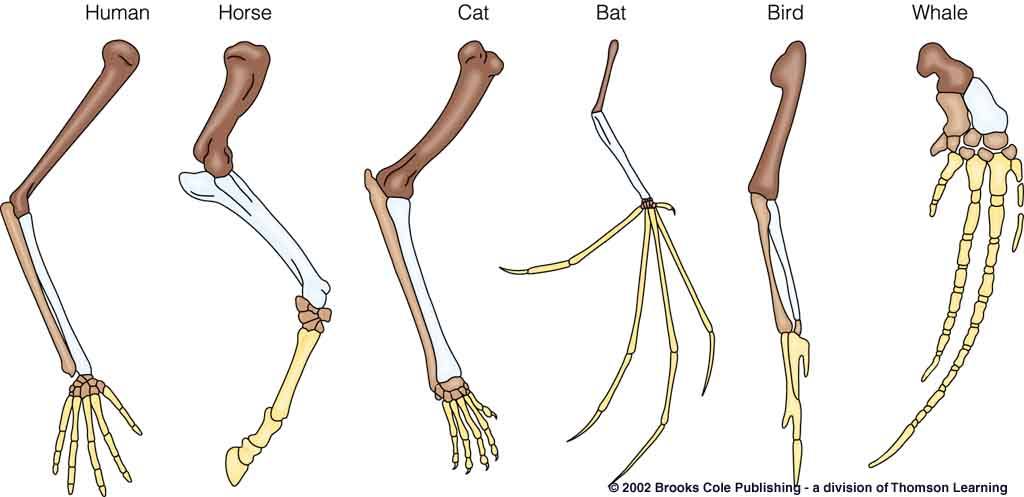
Humans, birds, whales, and lizards all have similar arm bones. What is the reason for this?
a)
The function of these bones is the same in all animals
b)
They live in similar environments
c)
They have a common ancestor
d)
All organisms resemble humans
26.
Bird wings and butterfly wings are an example of
a)
Homologous structure
b)
Analogous structure
c)
Mimicry
d)
Camoflague
27.

Evolved from the same ancestor, but have different functions

a)

Homologous structures

b)

Analogous structures

c)

Vestigial structures

d)

All of the above

28.

Evolved from different ancestors, but due to living in similar environments have a similar function.

a)

Homologous structures

b)

Analogous structures

c)

Vestigial structures

d)

All of the above

29.

An anatomical feature that no longer seams to have a purpose in the current form of an organism

a)

Homologous structure

b)

Analogous structure

c)

Vestigial structure

d)

None of the above

30.

Which of the following are vestigial structures humans have? Select all that apply.

a)

Appendix

b)

Tailbone

c)

Forearm bones

d)

Goosebumps

31.

Whales have pelvic bones. What type of structure does this best represent?

a)

Homologous structure

b)

Analogous structure

c)

Vestigial structure

d)

None of the above

32.
The structures shown are_________
a)
homologous
b)
heterologous
c)
analogous
d)
vestigial
33.

What

type

of structure?

a)

Homologous

b)

Analogous

c)

Embryological

d)

Vestigial

34.

What

type

of structure?

a)

Homologous

b)

Analogous

c)

Embryological

d)

Vestigial

35.

What

type

of structure?

a)

Homologous

b)

Analogous

c)

Embryological

d)

Vestigial

36.

How is comparative embryology used as evidence for evolution?

a)

The similarities in development across organisms show how they are related.

b)

The development of embryos shows evolution occurring in organisms before birth.

c)

The similarities of embryos shows that all organisms used to once look like each other.

d)

Comparative embryology is not used as evidence for evolution.

37.

Human embryos have gill slits during development. What is the best explanation for this?

a)

Humans are technically considered fish in the earliest stages of development.

b)

This is how all embryos breathe before lungs develop.

c)

It is a common mutation found in most vertebrate species.

d)

It is an ancestral trait preserved in an organism's development.

38.
Why are advantageous traits more likely to be passed onto offspring?
a)
Because they are more likely to survive and reproduce.
b)
Because they come from dominant alleles.
c)
Because they come from recessive alleles.
d)
Because the trait is an acquired phenotype.
39.

What word describes a trait that helps an organism survive in its environment?

a)

natural selection

b)

mutation

c)

camouflage

d)

adaptation

40.
The differences among a species, like different bird beaks, are called
a)
genes.
b)
variations.
c)
traits.
d)
theories.
41.
Which best describes the role of mutations in natural selection?
a)
Mutations help an organism to better survive in their environment
b)
An organism may acquire a helpful mutation by interacting with the environment
c)
A mutation may result in an adaptive trait that makes an organism more likely to survive and reproduce
d)
Organisms with certain traits are more likely to win competitions for mutations
42.
Why do frogs and other organism reproduce so many eggs or offspring?
a)
so that their babies can have friends to play with
b)
the more offspring the more likely the offspring will survive
c)
the more offspring the less likely offspring will survive 
d)
the more offspring the less competition
43.
Which organisms are most likely to survive?
a)
the best adapted
b)
the fastest
c)
the strongest
d)
the most domesticated (tamed)
44.
Domesticated dogs are an example of:
a)
Natural Selection
b)
Selective Breeding
45.
Choose which scientist corresponds best with the statement: 
acquired characteristics are inherited
a)
Darwin 
b)
Lamarck
46.
_______ believed that organisms develop traits needed for survival and that traits that were unused would become weaker and gradually disappear. 
a)
Darwin
b)
Lamarck
c)
Mendel
d)
Watson
47.
A structure or organ that seems to serve no purpose, but resembles structures with functional roles in other organisms are called ____________. 
a)
Necessary Structures
b)
Homologous Structures
c)
Vestigial Structures 
d)
Ancestry Structures
48.
Looking at the similarities in development between different organisms would be an example of which piece of evidence?
a)
Palentology
b)
Embryology
c)
Cytology
d)
Structure Analysis
49.
Charles Darwin’s observation that finches of different species on the Galápagos Islands have many similar physical characteristics supports the hypothesis that these finches 
 
a)
have the ability to interbreed.
b)
acquired traits through use and disuse.
c)
all eat the same type of food.
d)
descended from a common ancestor.
50.

Domesticated dogs are an example of:

a)

natural selection

b)

artificial selection

c)

darwin selection

d)

lamarck selection

51.

1. The process of choosing parent organisms for desired characteristics is called

a)

natural selection

b)

Artificial selection

c)

random selection

d)

genetic manipulation

52.
Choose which scientist corresponds best with the statement: 
variations within populations
a)
Darwin 
b)
Lamarck
53.
Choose which scientist corresponds best with the statement: 
acquired characteristics are inherited
a)
Darwin 
b)
Lamarck
54.

Due to stress, large numbers of female lemmings miscarry their young and fail to reproduce.

a)

Density-Dependent

b)

Density-Independent

55.

Many fish die due to a drastic change in water temperature.

a)

Density-Dependent

b)

Density-Independent

56.

An extensive drought in the plains threatens wildebeest, giraffe, zebra, and springbok populations.

a)

Density-Dependent

b)

Density-Independent

57.

Which of the following is a density-dependent limiting factor?

a)

human activities

b)

unusual weather

c)

competition

d)

natural disaster

58.
Which of the following is a density-independent limiting factor?
a)
natural disaster
b)
predation
c)
disease
d)
parasitism
59.

Which of the following are examples of a density independent factors?

a)

forest fire

b)

seasonal cycles

c)

storms

d)

disease

60.

Which of the following are density dependent factors?

a)

competition for resources

b)

predation

c)

disease

d)

natural disasters

61.
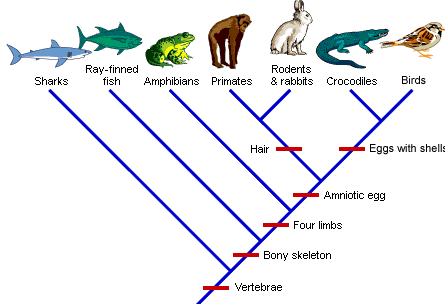
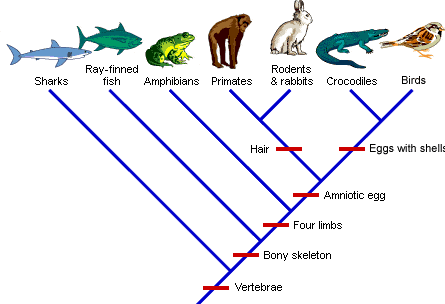
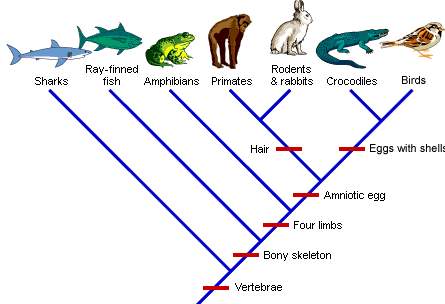
According to this cladogram, sharks are MOST closely related to which organism? 
a)
Amphibians
b)
Ray finned fish
c)
Crocodiles
d)
Birds
62.
According to this cladogram, birds are LEAST related to: 
a)
Amphibians
b)
Sharks
c)
Ray Finned Fish
d)
Crocodiles
63.
Cladograms are constructed by grouping organisms together based on their____________ characteristics.
a)
shared
b)
different
c)
similar
d)
opposite
64.
Which two orgainsms have hair? 
a)
Sharks & Ray Finned Fish
b)
Primates & Rodents
c)
Birds & Crocodiles
d)
Rabbits & Birds
65.

Which species is most closely related to species C?

a)

A

b)

B

c)

D

66.

Why did the number of white peppered moths decrease so much by 1895?

a)

they did not blend in with the trees and birds ate them

b)

they tasted better to the birds than the black moths

c)

they were easier to reach on the trees

d)

white moths flew away to find better trees to blend in with

67.
The term that best describes why the moth population changed color over time
a)
adaptation
b)
natural selection
c)
mutation
d)
predator-prey
68.
Natural selection is the process by which
a)
change occurs in the genetic characteristics of individuals that live together in an environment from one generation to another
b)
organisms with traits well-suited to their environment reproduce at a greater rate than less well-adapted organisms in the same environment
c)
use and disuse of a characteristic leads to evolutionary change
d)
baseball players pass on the trait for strong arm muscles to children
69.
How much Energy moves on to the next level in the pyramid after some energy go to Waste, Use, & Heat
a)
40%
b)
10%
c)
5%
d)
20%
70.
What do the arrows show in a food chain picture?
a)
They always point to the smallest animals.
b)
They point to the animal that tastes the best.
c)
They always point to the producers.
d)
They point in the direction that energy is flowing.
71.

What is most likely the first thing to result from having fewer field mice in the food chain pictured here?

a)

The snakes would have to find another food source.

b)

The plants that make seeds would decrease in number.

c)

The eagles would have to fly away to a location.

d)

The mice would eat many more kinds of seeds.

72.
Use the diagram to answer the question.
The Mayfly is a food source for which 3 organisms?
a)
Frog, Dragon Fly and snake
b)
Frog, trout and dragon fly
c)
Frog, salamander and trout
d)
Frog and phytoplankton
73.

Click on the image to make it larger-- Choose all that apply: The hawk gets energy from...

a)

mouse

b)

rabbit

c)

wildflowers

d)

snake

74.
Limiting factors are sometimes helpful because they can keep the population from getting too large.
a)
True
b)
False
75.
Food, water, sunlight, shelter, and space are resources that are  __________.
a)
limiting factors
b)
wet
c)
messy
d)
found in rocks
76.
If the population of a certain predator increases, there is often _______ its prey
a)
a decrease the population of
b)
an increase of the population of 
c)
great news for its prey of
d)
no  impact found on
77.
Any thing or organism that regulates the size of a population of another organism is known as __________.
a)
a limiting measure
b)
a limiting factor
c)
factorization
d)
materialization of precipitation
78.

What happens if a population grows past its carrying capacity?

a)

The population keeps growing

b)

The population starts to die off

c)

The entire species will go extinct

d)

The carrying capacity just increases

79.
Which of the following would INCREASE the carrying capacity of an ecosystem?
a)
increase in predators
b)
disease
c)
increase in available food
d)
drought
80.

Mimicry means:

a)

A tree that has pink flowers in the spring

b)

When one living thing looks like a different kind of living thing

c)

A way an animal blends in with its environment

81.

Which picture is an example of mimicry?

a)
b)
82.
What is the correct equation for cellular respiration?
a)
6O2 + C6H12O6 -> 6CO2 + 6H2O + Energy
b)
6O2 + C6H12O6 + Energy -> 6CO2 + 6H2O
c)
6CO2 + 6H2O -> 6O2 + C6H12O6 + Energy
d)
6CO2 + 6H2O + Energy -> 6O2 + C6H12O6
83.

Which behavior is genetically based and NOT linked to past experiences?

a)

innate behavior

b)

habituation

c)

operant conditioning

d)

classical conditioning

84.

A _________ is defined as a way an animal responds to a stimulus.

a)

response

b)

instinct

c)

attitude

d)

behavior

85.
When animal learns to ignore harmless stimuli like a scarecrow, what type of learning is this? 
a)
innate learning
b)
classical conditioning 
c)
habituation 
d)
trial and error learning 
86.

What is the mechanism of imprinting?

a)

Learning

b)

Instinctive

c)

Genetic

d)

Mutual

87.
This type of behavior develops during an organisms lifetime. They are not born with it.
a)
Learned Behavior
b)
Innate Behavior
c)
Reflex
d)
Instinct
88.
Salmon knowing which stream they were hatched in is an example of this type of behavior.
a)
Imprinting
b)
Conditioning
c)
Insight
d)
Trial and Error
89.
A flash flood carried a raft of Amazon ants away from their original population. There is enough distance between the two groups, that they will never meet in nature again. What type of reproductive barrier is this?
a)
behavioral isolation
b)
temporal isolation 
c)
gametic isolation
d)
geographic isolation 
90.

Albert’s squirrel and the Kaibab squirrel are distinct subspecies that live on opposite sides of the Grand Canyon. They were once one species, but now differ significantly, including fur coloring.

a)

Geographic isolation

b)

Behavioral isolation

c)

Temporal isolation

91.
What is the study of organisms at the early stages of development?
a)
DNA studies
b)
embryology 
c)
extinction
d)
fossil record
92.
Two organisms that are closely related would have
a)
very similar DNA sequence
b)
exactly the same DNA sequences
c)
no proteins in common
d)
completely different DNA sequence
93.

What is Evolution?

a)

When only people change.

b)

When people change from a monkey to a person.

c)

The process by which different kinds of living organisms are thought to have developed and diversified from earlier forms during the history of the earth.

d)

When animals change to a human.

94.

What are the Five Principles of Natural Selection?

a)

Overproduction, Variation, Competition, Adaption, Extinction

b)

Overproduction, Competition, Extinction, Evolution, Adaption,

c)

Overproduction, Variation, Competition, Adaption, Evolution

95.

What did Charles Darwin think when he saw the Finches?

a)

He thought they were smart

b)

He thought they were the same species

c)

He thought they were pretty

d)

He thought that they had a common ancestor

96.
the process in which populations change over time
a)
basketball
b)
natural selection
c)
evolution
d)
mutation
97.
A lion makes more cubs than the Sahara Desert can support (there's not enough prey around), so only a few of the cubs survive to become adults. They live on to reproduce.
Of the four parts of natural selection, which is this an example of?
a)
overproduction
b)
genetic variation
c)
selection
d)
adaptation
98.
Nature has a way of causing organisms that inherit advantageous traits to survive and reproduce more successfully than the ones that don't. This process is known as...
a)
natural selection
b)
genetic variation
c)
adaptation
d)
overproduction
99.
What is a mass extinction?
a)
When all the species in a particular area on earth suddenly go extinct
b)
When multiple species from all over the earth suddenly go extinct 
c)
When one species goes extinct due to habitat changes
d)
When all life on earth is wiped out 
100.

Biotic can be defined as

a)

the living parts of an environment

b)

non-living parts of an environment

c)

rocks and water

d)

snakes and water

101.
What is the function of ATP in living things?
a)
provides energy for cells
b)
stores genetic information
c)
provides structure in the nucleus
102.
What is the mode of inheritance shown here?
a)
Autosomal Dominant
b)
Autosomal Recessive
c)
Sex Linked Recessive
103.
What is the mode of inheritance shown here?
a)
Autosomal Recessive
b)
Sex Linked
c)
Autosomal Dominant
104.
What is the mode of inheritance shown here?
a)
Autosomal Recessive
b)
Autosomal Dominant
c)
Sex Linked
105.
What is the mode of inheritance shown here?
a)
Autosomal Recessive
b)
Autosomal Dominant
c)
Sex Linked
106.

A woman has type B blood and her husband has type O blood. What must be the woman's genotype, if they have a child with type O blood?

a)

IB i

b)

IB IB

c)

ii

d)

type B blood

107.
If two parents are heterozygous for type A blood, what is the probability that their offspring would have type O blood?
a)
100 %
b)
75%
c)
50%
d)
25%
108.
If one of your parents is blood type A and the other is type B, which of the following blood types would you likely be?
a)
O
b)
AB
c)
A or B
d)
Any
109.

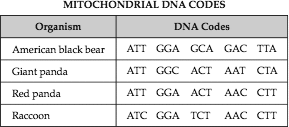
What conclusions can be made based on this table shown?

(Which animals have the most similar sections of DNA?)

a)

the American black bear and the giant panda are most closely related

b)

the giant panda and the red panda are most closely related

c)

the red panda and the racoon are the most closely related

d)

the giant panda and the racoon are most closely related
110.
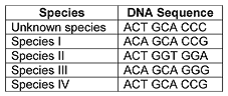
According to this data, the unknown bacterial species is most closely related to: 
a)
Species I
b)
Species II
c)
Species III
d)
Species IV
111.

What pigment absorbs sunlight for photosynthesis?

a)

chloroplast

b)

thylakoid

c)

grana

d)

chlorophyll

112.
What pigment absorbs sunlight for photosynthesis?
a)
chloroplast
b)
thylakoid
c)
grana
d)
chlorophyll
113.
Where does the energy for ATP come from? 
a)
Nucleic Acid
b)
Protein
c)
Lipid
d)
Carbohydrate
114.

What occurs inside of a cell while it performing the process of respiration?

a)

Sugar is broken down to generate adenosine triphosphate (ATP) molecules that are used for energy

b)

The negative charge inside of the cell is used to increase the concentration chemicals inside of the cell.

c)

Light reactive chemicals combine carbon dioxide (CO2) and water to form glucose molecules that are stored as food.

d)

The cell membrane forms around air bubbles to create a vacuole that is used to separate the oxygen from the rest of the air.

115.
The purpose of cellular respiration is to 
a)
make water
b)
make ATP
c)
make glucose
d)
make  oxygen
116.

Abiotic can be defined as?

a)

An organism that is alive

b)

Non-living parts of the environment

c)

Living Parts of the environment

d)

A new kind of Pokemon that lives with Pikachu

117.

Different finch species have beaks of different shapes and sizes. What do these beak differences tell us?

a)

Differences in beak shapes tell us that all the finches eat the same type of food

b)

Different finch beak shapes are evidence that all Galapagos finches shared a common ancestor a long time ago

c)

Different finch beak shapes are evidence that over time, finch species adapted to different food sources on the islands

d)

Different finch beak shapes are evidence that several finch species with different beak shapes came to the Galapagos Islands form the mainland

118.

Genetic evidence supports which of the following explanations for the presence of 13 different finch species on the Galapagos Islands?

a)

Each of the 13 species was founded by the independent migration of a different species from the mainland to the islands.

b)

Many years ago, more than 13 different species of birds migrated to the islands. The current 13 finch species are the only species that survived.

c)

It's not clear based on the DNA evidence whether the 13 species arose from a single migration of one species or multiple migrations of several species from the mainland to the islands.

d)

Many years ago, a small population of a single finch species migrated to the islands and evolved into the current 13 species.

119.

Selective breeding is...

a)

a process to create an organism with desired traits from parents with those desired traits

b)

natural method of producing offspring with desired traits

c)

creating a new species

d)

making organisms reproduce during times of stress

120.
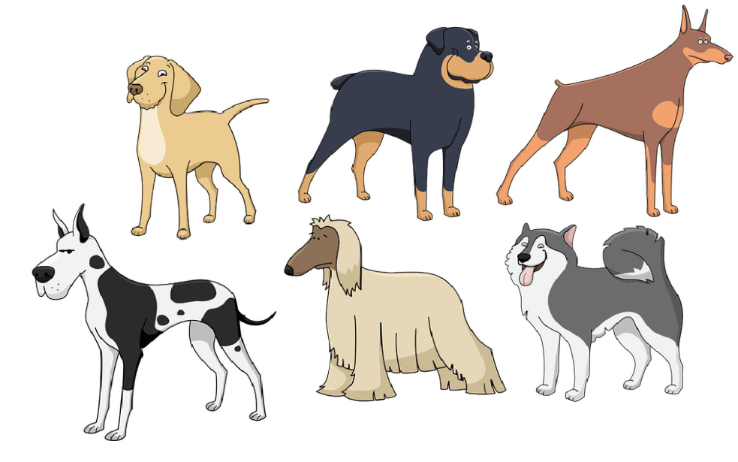
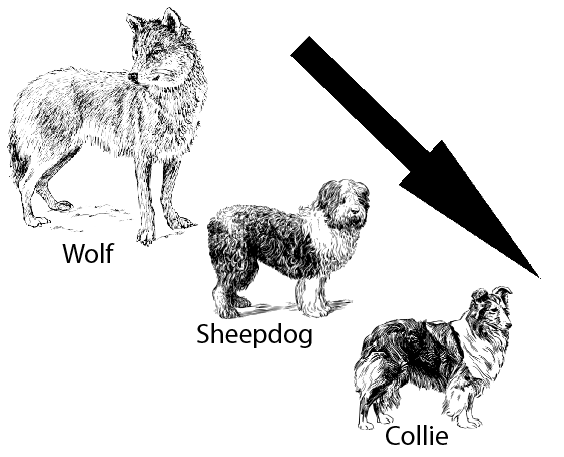
Evidence shows that the wolf is the ancestor to all of the breeds of dogs shown below. How did this variation arise in a relatively short period of time?
a)
A.  Genetic manipulation
b)
Natural selection
c)
Random chance
d)
Selective breeding
121.
Charles Darwin’s observation that finches of different species on the Galápagos Islands have many similar physical characteristics supports the hypothesis that these finches 
 
a)
have the ability to interbreed.
b)
acquired traits through use and disuse.
c)
all eat the same type of food.
d)
descended from a common ancestor.
122.
Which statement is part of Darwin’s theory of evolution by natural selection? 
a)
More offspring are produced than can possibly survive.
b)
The organisms that are the fittest are always largest and strongest. 
c)
The number of offspring is not related to fitness.
d)
Acquired characteristics that are inherited are the cause of evolution.
123.
Which of these is an example of natural selection?
a)
The largest animal in a population will have more opportunities for reproduction.
b)
Several species of organisms work together so that they all succeed.
c)
One species takes all the resources in an environment leaving none for others.
d)
Organism that are best suited to an environment tend to survive and reproduce more often.
124.
Which of the following explains adaptation.
a)
An individual organism changes to meet its needs in the environment. These changes pass down to their offspring.
b)
The species as a whole changes their characteristics.
c)
Beneficial traits allow organism to survive and pass on those traits
d)
New characteristics arise in a species as needed.  If these traits are helpful, they are passed down.
125.
Which of the following removes carbon from the atmosphere?
a)
Combustion
b)
Respiration
c)
Photosynthesis
d)
Death
126.

How do animals get carbon?

a)

By eating plants and or other animals.

b)

They absorb it from the atmosphere.

c)

From the ground

d)

They do not get carbon from anywhere.

127.
What process occurs when coal (fossil fuel) is used for energy?
a)
Decomposition
b)
Combustion
c)
Pressurization 
d)
Respiration 
128.
Which of the following removes carbon from the atmosphere?
a)
Combustion
b)
Respiration
c)
Photosynthesis
d)
Death
129.
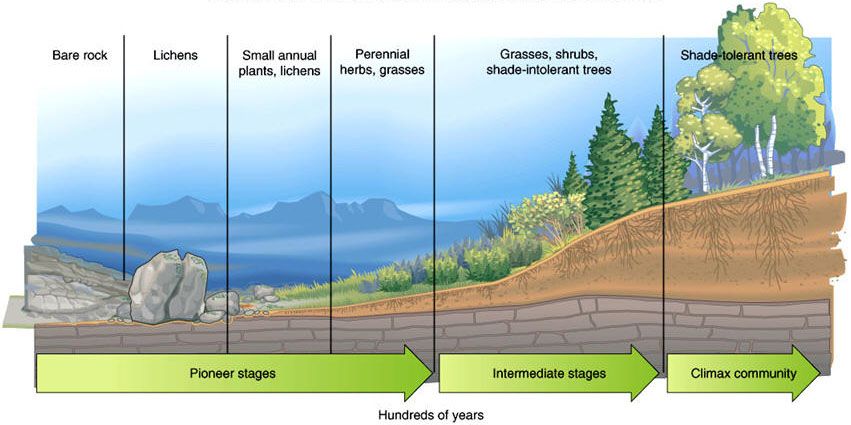
succession that occurs in an area where soil is already present
a)
ecological succession 
b)
primary succession 
c)
secondary succession
d)
pioneer speciles
130.
succession that occurs in an area with no soil
a)
ecological succession 
b)
primary succession 
c)
secondary succession
d)
pioneer speciles
131.

The picture shows what type of succession?

a)

primary

b)

secondary

c)

tertiary

d)

quadanary

132.

Succession type?

a)

primary succession

b)

secondary succession

c)

tertiary succession

d)

variable succession

133.

Recently, scientists have been able to use ___________to find common proteins and amino acids to determine how closely related species are.

a)

DNA

b)

Vestigial structures

c)

Fossils

d)

Homologous structures

134.
Two organisms that are closely related would have
a)
very similar DNA sequence
b)
exactly the same DNA sequences
c)
no proteins in common
d)
completely different DNA sequence
135.
What does Darwin's theory of evolution suggest?
a)
species change over time
b)
extinct species are not related to living species
c)
different species can interbreed
d)
animals that look alike are most closely related
136.
Comparing human hemoglobin of chimpanzees, horses, kangaroos, and chickens, reveal that humans have the fewest amino acid differences with 
a)
Kangaroos
b)
Horses
c)
chickens
d)
chimpanzees
137.
The hypothesis that evolution of a species occurs in periods of rapid change separated by periods of little or no change is called
a)
divergence
b)
gradualism
c)
punctuated equilibrium
d)
isolation
138.
The hypothesis that evolution of a species occurs gradually over time as a slow and constant process is known as
a)
speciation
b)
punctuated equilibrium
c)
gradualism
d)
microevolution
139.
Which of the following statements best reflects the evolutionary importance of the figures pictured?
a)
New genetic instructions have been disregarded in the evolution of vertebrates.
b)
Early in development, vertebrate embryos show no evidence of common ancestry.
c)
All adult vertebrates retain pharyngeal pouches (gills).
d)
The evolutionary history of organisms is seen in the way embryos develop.
140.
What is the term for a feature that allows an organism to survive better in its environment?
a)
variation
b)
adaptation
c)
homologous structure
d)
vestigial structure
141.

Individuals with intermediate traits are more likely to survive and reproduce

a)

stabilizing selection

b)

directional selection

c)

adaptive radiation

d)

disruptive selection

142.

Tall kelp have a distinct advantage over shorter kelp in receiving needed sunlight in their ocean environment

a)

directional selection

b)

disruptive selection

c)

stabilizing selection

d)

sexual selection

e)

artificial selection

143.

individuals with alleles for an extreme type are more likely to survive and reproduce

a)

stabilizing selection

b)

directional selection

c)

disruptive selection

d)

genetic drift