
 Worksheets
Semester 1 Review
Total questions: 143
Worksheet time: 4hrs 30mins
Name
Class
Date
1.
What does not produce carbon dioxide?
a)
Photosynthesis
b)
Burning Fossil Fuels
c)
Animal respiration
d)
Plants decaying
2.
Which process converts carbon in the form of sugar into carbon dioxide gas?
a)
Bioremediation
b)
Photosynthesis
c)
Respiration
d)
Transpiration
3.
A molecule of sugar that is a product of photosynthesis and a reactant in cellular respiration.
a)
Water
b)
Oxygen
c)
Glucose
d)
Carbon Dioxide
4.
Which of the following is the correct equation for PHOTOSYNTHESIS?
a)
CO2 + light + H2O --> O2 + Sugar
b)
CO2 + sugar + H2O --> O2 + light
c)
O2 + light + H2O --> CO2 + Sugar
d)
CO2 + O2 + H2O --> Light+ Sugar
5.
What are the products of photosynthesis?
a)
water and carbon dioxide
b)
oxygen and glucose
c)
oxygen and carbon dioxide
d)
oxygen and water
6.
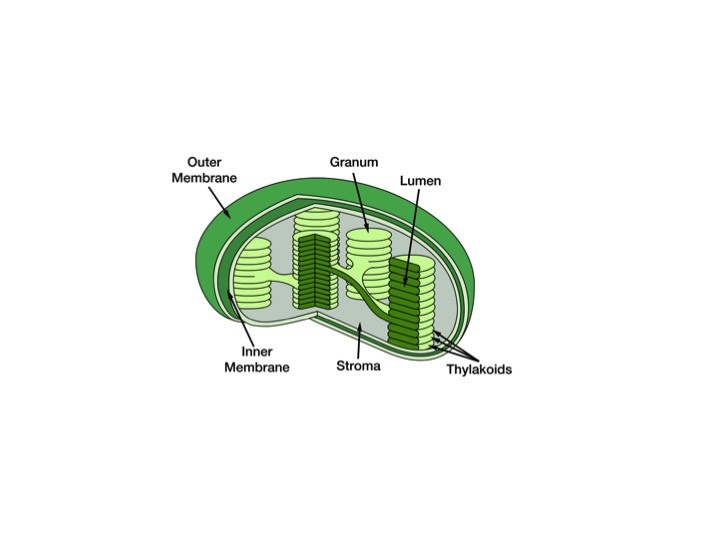
Chloroplasts are...
a)
Structures of animal cells to produce ATP
b)
Organelles where lipids are elaborated
c)
Specialized structures of plants where food is made
d)
Waste organelle of plants
7.

Use the diagram to answer the question. Between which parts of the molecule must the bonds be broken to form an ADP molecule?
a)
A and B
b)
A and C
c)
B and C
d)
C and D
8.
The reactants of photosynthesis are
a)
sugar and water.
b)
sugar and oxygen.
c)
carbon dioxide and water.
d)
carbon dioxide and oxygen.
9.

Which of the following structure is where cellular respiration occurs in the cell?
a)
nucleus
b)
cytoplasm
c)
mitochondria
d)
vacuoles
10.
What are the reactants in the equation for cellular respiration?
a)
oxygen and lactic acid
b)
carbon dioxide and water
c)
glucose and oxygen
d)
water and glucose
11.
Which of the following is the correct equation for RESPIRATION?
a)
6CO2 + 6H2O --> 6O2 + C6H12O6
b)
6CO2 + C6H12O6 + 6H2O --> O2
c)
6O2 + 6H2O --> 6CO2 + C6H12O6
d)
C6H12O6 + 6O2 ---> 6H2O + 6CO2 + ATP
12.

Which statement reflects one of the major components of the cell theory?
a)
All living things are multi-cellular.
b)
Organs are the basic unit of structure and function for all living things.
c)
All cells come from previously existing cells.
d)
Every organism has a reproductive system to ensure survival of the species.
13.

An animal cell has the following except a/an...
a)
Centriole
b)
Lysosome
c)
Cell Wall
d)
Endoplasmic reticulum
14.
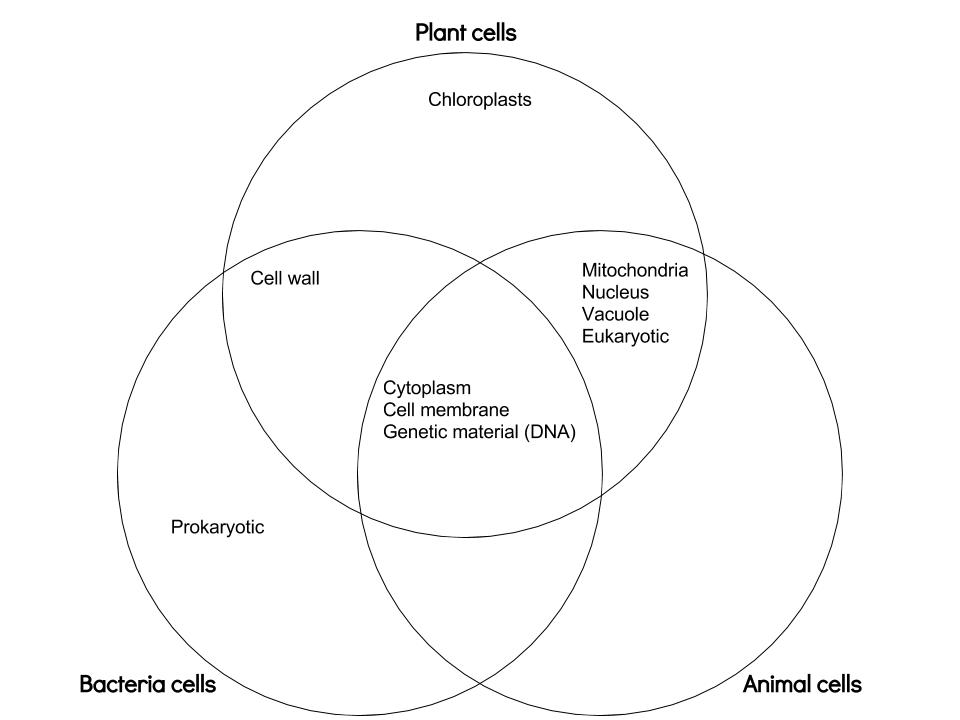
Observe the Venn diagram. Which structures do both prokaryotic and eukaryotic cells have in common?
a)
cell membrane, cytoplasm, genetic material (DNA)
b)
cell wall
c)
mitochondria, nucleus, vacuole
d)
chloroplasts
15.
what's the difference between prokaryotes vs. eukaryotes?
a)
Prokaryotes have nucleus
b)
Eukaryotes do not have a nucleus
c)
Prokaryotes have a cell wall
d)
Eukaryotes do have a nucleus
16.
a single celled organism is called
a)
multicellular
b)
bicellular
bicellular
bicellular
c)
polycellular
d)
unicellular
17.
A human should have _____ chromosomes inside.
a)
46
b)
23
c)
92
d)
64
18.
If the Diploid number of Carrots is 18, the haploid number is
a)
18
b)
9
c)
27
d)
36
19.

Which process and type of resulting cells are represented?
a)
mitosis, gametes
b)
mitosis, body cells
c)
meiosis, gametes
d)
meiosis, body cells
20.
Which of these cells would be produced through meiosis?
a)
skin cells
b)
liver cells
c)
brain cells
d)
sperm cells
21.
Crossing over helps promote
a)
male genotype
b)
genetic variation
c)
DNA replication
d)
mitosis
22.

When an area of a chromatid is exchanged with the matching area on a chromatid of its homologous chromosome, _________________ occurs
a)
crossing over
b)
mutation
c)
meiosis
d)
fertilization
23.
Which sex chromosomes would indicate a typical human male?
a)
XX
b)
X
c)
XY
d)
XXY
24.

Fruit fly body cells have 8 chromosomes. After meiosis, you would expect a resulting fruit fly daughter cell to have ...
a)
16 chromosomes.
b)
46 chromosomes.
c)
8 chromosomes.
d)
4 chromosomes.
25.

The stages of mitosis in order
a)
Metaphase, Anaphase, Prophase, Telophase
b)
Prophase, Anaphase, Metaphase, Telophase
c)
Prophase, Metaphase, Anaphase, Telophase
d)
Anaphase, Prophase, Telophase, Metaphase
26.
90% of the cell's life is spent during what stage?
a)
Prophase
b)
Anaphase
c)
Metaphase
d)
Interphase
27.
Chormatids are found in
a)
Meiosis I
b)
Meiosis II
28.
Homologous Chromosomes are found in
a)
Meiosis I
b)
Meiosis II
29.
type of reproduction of meiosis
a)
sexual
b)
asexual
30.
products of meiosis are genetically
a)
different
b)
identical
31.
With mitosis you get ___, _________ cells, but with meiosis, you get ___, ____________.
a)
4, different, 2, identical
b)
4, identical, 2, different
c)
2, different, 4, identical
d)
2, identical, 4, different
32.

Which would be found in the cell of a sunflower plant but not in the cell of a chicken?
a)
cell wall
b)
vacuole
c)
mitochondria
d)
cell membrane
33.
Cells are the basic unit of _________.
a)
life
b)
atoms
c)
matter
d)
the nucleus
34.
Which process is used to make mRNA from the DNA in the nucleus?
a)
transcription
b)
translation
c)
replication
35.
Which RNA bases would pair with TACGAA in transcription?
a)
AUGCUU
b)
ATGCTT
c)
GCATCC
d)
GCAUCC
36.
Where does transcription take place?
a)
nucleus
b)
cytoplasm
c)
ribosome
37.
How many amino acids are coded for by this sequence of nucleotides:
ATG GGA ACT CCA
ATG GGA ACT CCA
a)
4
b)
2
c)
6
d)
12
38.

What is occurring in this picture?
a)
Translation
b)
Replication
c)
Translocation
d)
Transcription
39.

The process represented in the diagram produces a molecule that is complementary to the template strand of DNA. What type of molecule is produced?
a)
New DNA
b)
Polypeptide
c)
Messenger RNA
d)
Carbohydrate
40.
what does mRNA do?
a)
carry info from genes to ribosomes
b)
carry amino acids to ribosomes
c)
help with RNA splicing
d)
make up ribosomes
41.

DNA codes for...
a)
cholesterol
b)
proteins
c)
fatty acids
d)
a sandwich
42.

DNA is found in ALL cells.
a)
True
b)
False
43.
Choose the nucleotide sequence of the RNA strand that would be complementary to the following strand:
GTAGTCA
GTAGTCA
a)
UATUAGA
b)
ACGACTG
c)
CAUCAGU
d)
CATCAGT
44.

What is the correct amino acid sequence for the mRNA code AUGCCAGUAUGA
a)
Met-Pro-Ala-Val
b)
Met-Pro-Val
c)
Tyr-Gly-His
d)
Tyr-Gly-Arg-His
45.
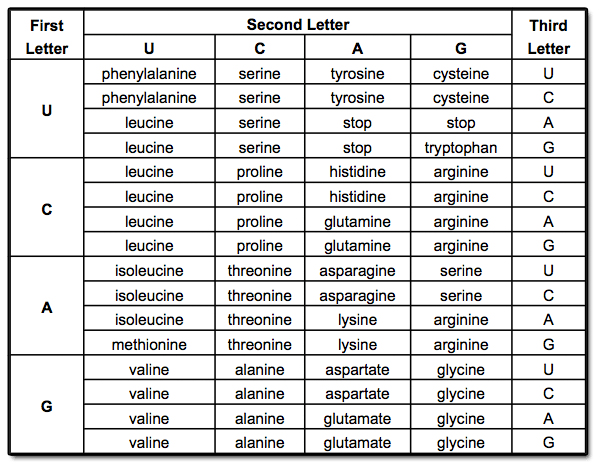
What amino acid is represented by the codon UUA?
a)
Phenylalanine
b)
Tyrosine
c)
Leucine
d)
Stop codon
46.

What genotype would go in box 3?
a)
BB
b)
Bb
c)
bb
47.

What genotype would go in box 2?
a)
BB
b)
Bb
c)
bb
48.

What is the genotypic ratio here?
a)
25% blue eye 75 % brown eye
b)
BB = 25% Bb = 50% bb = 25%
c)
BB= 50 % bb = 50%
d)
All brown eye
49.

What are the possible genotypes for this cross?
(Click the picture to see it without the text)
(Click the picture to see it without the text)
a)
TT = 25% Tt= 50% tt=25%
b)
all tall
c)
TT= 75% tt = 25%
d)
Tt = 100%
50.
B - black, b - brown. Two black mice mate and have some black and some brown mice. What is the genotype of the parents?
a)
BB x Bb
b)
BB x bb
c)
Bb x Bb
d)
Bb x bb
51.
What is a dominant allele?
a)
A trait that is always shown (capital letter)
b)
A trait that can be hidden (lower case letter)
c)
Alleles that are the same
d)
Alleles that are different
52.
Dominant or recessive?
tt
tt
a)
Dominant
b)
Recessive
53.

This type of inheritance pattern shows BOTH traits in possible offspring at the same time
a)
complete dominance
b)
incomplete dominance
c)
co-dominance
d)
dominant pattern
54.
Snap dragon color is a incomplete dominant trait. A red flower (RR) is crossed with white flower (rr)? What color are flowers that are Rr?
a)
Red
b)
Red and White
c)
White
d)
Pink
55.
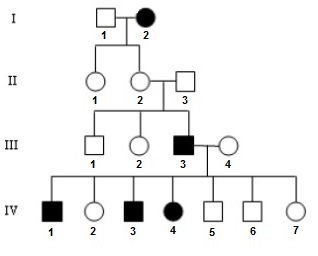
This pedigree represents the inheritance of hemophilia in this family. How many of the females have the hemophilia trait?
a)
8
b)
5
c)
2
d)
3
56.

Is this trait (the shaded individuals) dominant or recessive?
a)
dominant
b)
recessive
57.

In the second generation-how many people are carriers of the trait?
a)
2
b)
3
c)
5
d)
6
58.

Which gender can be carriers of colorblindness and not have it?
a)
Just males
b)
Just females
c)
Both genders
59.
Proteins are made of monomers called ___________
a)
Nucleotides
b)
Monosaccharides
c)
Amino Acids
d)
Glycerol and fatty acids
60.
_________ are composed out of carbon (C), hydrogen (H), oxygen (O), nitrogen (N), and phosphorus (P)
a)
Carbohydrates
b)
Lipids
c)
Proteins
d)
Nucleic Acids
61.
DNA and RNA are examples of
a)
Carbohydrates
b)
Lipids
c)
Proteins
d)
Nucleic Acids
62.
Waxes, oils and fats are examples of
a)
Carbohydrates
b)
Lipids
c)
Proteins
d)
Nucleic Acids
63.
Monosaccharides are monomers of
a)
Carbohydrates
b)
Lipids
c)
Proteins
d)
Nucleic Acids
64.
Glycerol and fatty acids are the monomers of
a)
Carbohydrates
b)
Lipids
c)
Proteins
d)
Nucleic Acids
65.
The organic compounds that have many structural purposes and are used in many processes within the
cell are called ____________________.
cell are called ____________________.
a)
Carbohydrates
b)
Lipids
c)
Proteins
d)
Nucleic Acids
66.

Which macromolecule is shown?
View Figure 1 (if not visible)
View Figure 1 (if not visible)
a)
lipid
b)
protein
c)
nucleic acid
d)
carbohydrate
67.
What is the function of nucleic acids?
a)
store genetic information
b)
store energy (long-term)
c)
store energy (short-term)
d)
build skin, hair, nails, muscles
68.

Which macromolecule is shown?
View Figure 2 (if not visible)
View Figure 2 (if not visible)
a)
lipid
b)
protein
c)
nucleic acid
d)
carbohydrate
69.

Which macromolecule is shown?
View Figure 4 (if not visible)
View Figure 4 (if not visible)
a)
lipid
b)
protein
c)
nucleic acid
d)
carbohydrate
70.

Which macromolecule is shown?
View Figure 3 (if not visible)
View Figure 3 (if not visible)
a)
lipid
b)
protein
c)
nucleic acid
d)
carbohydrate
71.
What type of macromolecule are enzymes?
a)
Protein
b)
Carbohydrate
c)
Lipid
d)
Nucleic Acid
72.
Which of the following organic compounds is the main source of energy for living things?
a)
carbohydrates
b)
lipids
c)
nucleic acids
d)
proteins
73.
Carbohydrates are made of...
a)
C H O
b)
C H O N
c)
C H O N P
d)
C H O N S
74.
This is one job proteins do NOT have in the body
a)
insulation
b)
structure for tissues and organs
c)
speed up chemical reactions
d)
transport things through cell membrane
75.
Which macromolecule stores energy, insulates us, and makes up the cell membrane?
a)
lipids
b)
proteins
c)
carbohydrates
d)
nucleic acids
76.
What suffix (word ending) is used in the names of most carbohydrates?
a)
-ase
b)
-nic
c)
-ose
d)
-yme
77.
Monomer is to Macrocolecule like ___ is to ____
a)
Building is to Bricks.
b)
Brick is to Building.
c)
Carpenter is to Building.
d)
Building is to Carpenter.
78.

What type of macromolecule is being represented in this image?
a)
carbohydrate
b)
lipid
c)
protein
d)
nucleic acid
79.

The following is a diagram of the product of protein synthesis. This protein is a chain of a certain molecule. The molecule labeled Z is most likely classified as
a)
Amino acid
b)
Polypeptide
c)
Glycerol
d)
Sugar
80.

A solvent is...
a)
substance into which the solute dissolves
b)
a compound being dissolved
c)
a substance that does not dissolve
d)
None of the above
81.
Why does Ice float?
a)
It is less dense than in liquid form.
b)
It is more dense than in liquid form.
c)
It has more surface tension
d)
None of the above
82.

A water strider can skate along the top of a pond because:
a)
covalent bonds result in water cohesion
b)
hydrogen bonds result in water cohesion (surface tension)
c)
water striders have adapted to take advantage of water cohesion
d)
low surface tension of water
83.

What word describes when water is attracted to other substances?
a)
cohesion
b)
adhesion
c)
capillary action
d)
surface tension
84.

Bonds between water molecules are called
a)
Covalent bonds
b)
Ionic bonds
c)
Polar bonds
d)
Hydrogen bonds
85.
Water is polar because...
a)
The unequal sharing of electrons gives the water molecule a slight negative charge near its oxygen atom and a slight positive charge near its hydrogen atoms.
b)
The molecule has two poles, at which the it is colder than other regions of the molecule.
c)
The unequal sharing of electrons gives the water molecule a slight negative charge near its hydrogen atoms and a slight positive charge near its oxygen atom.
d)
The water molecule is neutral.
86.

Water is known as the universal solvent.
a)
True
b)
False
87.

A molecule with electrically charged areas is called a _______________.
a)
magnet
b)
polar molecule
c)
solution
d)
electrical molecule
88.
Which statement best describes an effect of the low density of frozen water in a lake?
a)
When water freezes, it contracts, decreasing the water level in a lake.
b)
Water in a lake freezes from the bottom up, killing most aquatic organisms.
c)
When water in a lake freezes, it floats, providing insulation for organisms below.
d)
Water removes thermal energy from the land around a lake, causing the lake to freeze.
89.
Water binding with water
a)
Adhesion
b)
Cohesion
c)
Ability to dissolve substances
d)
High specific heat
90.

What property of water helps to moderate earth's temperature?
a)
adhesion
b)
chohesion
c)
Specific heat capacity
d)
Latent heat of vaporization
91.
Many fish and aquatic plants can survive a cold winter because the layer of ice that forms at the top of the lake insulates the water below and prevents the lake from freezing solid. What unique property of water contributes to this effect?
a)
Water absorbs heat when it evaporates and forms a gas
b)
Water expands and becomes less dense when it freezes.
c)
Water molecules completely separate into ions in solutions.
d)
Water forms hydrogen bonds with ions and other polar substances.
92.

In Florida, daytime and nighttime temperatures usually only differ by 5 to 10°C, while temperatures in the desert often differ by as much as 40°C. What role does water play in keeping temperatures in Florida from fluctuating dramatically?
a)
Bodies of water store heat during the day and release it at night which keeps temperatures steady
b)
Humid air releases heat as it rises, keeping temperatures constant
c)
Evening rain brings heat from the upper atmosphere back to Earth
d)
Water cools the land around it so that it never gets as hot as a desert.
93.

What property of water allows water to travel up the stems of plants in a process called capillary action?
a)
Adhesion
b)
Cohesion
c)
Both
94.

Using this image, what organelle is C?
a)
Cell Wall
b)
Mitochondria
c)
Large Cell Vacuole
d)
Chloroplast
95.
What organelle is called the "powerhouse" of a cell?
a)
Endoplasmic Reticulum
b)
Nucleus
c)
Mitochondria
d)
Nucleolus
96.
What is the function of the vacuole?
a)
Sac that stores water, nutrients, and waste products
b)
Sac filled with digestive chemicals
c)
Jelly-like substance within the plasma membrane
d)
stack of membranes that packages chemicals
97.

I store water in both plant and animal cells. What am I?
a)
cytoplasm
b)
ribosomes
c)
vacuole
d)
lysosomes
98.
Where does photosynthesis occur?
a)
mitochondria
b)
stomata
c)
xylem
d)
chloroplast
99.
What is the function of nucleus?
a)
Structure that organizes motion of chromosomes.
b)
Structure that contains DNA and directs the cell
c)
Membrane that surrounds and protects the cell
d)
Stack of membranes that packages chemicals
100.

I make proteins for the cell. What am I?
a)
ribosome
b)
mitochondria
c)
chloroplast
d)
lysosome
101.
What can only be found in plant cells?
a)
Cell membrane
b)
Vacuole
c)
Chloroplast
d)
Mitochondrion
102.
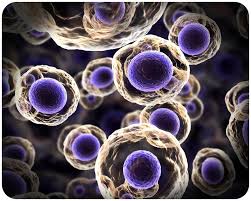
The two kinds of cells are Prokaryotes and Eukaryotes. How are they different?
a)
Prokaryotes have a nucleus.
b)
Eukaryotes have a nucleus.
c)
Prokaryotes are plant cells.
d)
There is no difference.
103.

What cell part is NOT found in all cells?
a)
Cell Wall
b)
Cell Membrane
c)
Cytoplasm
d)
Genetic Material
104.

Complex cell. Can be plant or animal. Contains membrane bound organelles.
a)
Eukaryotic Cell
b)
Prokaryotic Cell
c)
Bacteria
d)
Blood cell
105.
This organelle takes food and turns it into ENERGY for plant and animal cells.
a)
Chloroplast
b)
Mitochondria
c)
Lysosome
d)
Ribosome
106.

Which part of the cell is often called "the brain of the cell"?
a)
nuclear membrane
b)
endoplasmic reticulum
c)
nucleus
d)
mitochondria
107.
In what organelle is the genetic material found inside?
a)
Endoplasmic Reticulum
b)
Golgi Complex
c)
Nucleolus
d)
Nucleus
108.
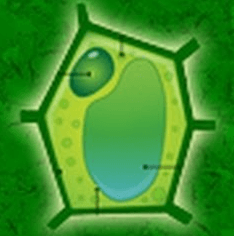
A rigid layer that lies outside the cell's membrane is...
a)
Cytoskeleton
b)
Cilia
c)
Cell Wall
d)
Flagella
109.
What is an example of a single-celled organism?
a)
bacteria
b)
plants
c)
animals
d)
humans
110.
What is the cell membrane made of?
a)
Lipid bilayer
b)
phospholipid bilayer
c)
Proteins
d)
Carbohydrates
111.
Osmosis is the movement of _____ across a membrane.
a)
food
b)
energy
c)
oxygen
d)
water
112.
Which is true about active transport?
a)
It requires energy
b)
it does not require energy
c)
It moves substances down the concentration gradient
d)
it moves material from high to low concentration
113.

The cell below is in a _________ solution.
(Figure 5)
(Figure 5)
a)
Hypotonic
b)
Hypertonic
c)
Isotonic
114.

The cell below is in a _____________ solution.
(Figure 4)
(Figure 4)
a)
Hypertonic
b)
Hypotonic
c)
Isotonic
115.
A cell in an isotonic solution will
a)
swell
b)
shrink
c)
stay the same size
d)
impossible to tell
116.
A cell in a hypotonic solution will
a)
swell
b)
shrink
c)
stay the same size
d)
impossible to tell
117.
what are two types of passive transport?
a)
endo and exocytosis
b)
cookies and milk
c)
active and passive
d)
Osmosis and diffusion
118.
The most important organelle in cell transport
a)
E.R.
b)
cytoplasm
c)
nucleus
d)
cell membrane
119.
Which term means "water-fearing"?
a)
Adhesion
b)
Polar
c)
Hydrophilic
d)
Hydrophobic
120.

The diagram is an example of
(Figure 3)
(Figure 3)
a)
diffusion
b)
active transport
c)
osmosis
d)
equilibrium
121.

This is a diagram of...
(Figure 2)
(Figure 2)
a)
exocytosis
b)
active transport
c)
osmosis
d)
equilibrium
122.

What type of transport is represented by figure "C"
(Figure 1)
(Figure 1)
a)
Active Transport
b)
Facilitated Diffusion
c)
Protein Transport
d)
Osmosis
123.

Protein...
a)
A
b)
B
c)
C
d)
D
124.

Hydrophobic region of the cell membrane?
a)
E
b)
B
c)
C
d)
A
125.

Hydrophilic portion of cell membrane?
a)
A
b)
C
c)
D
d)
E
126.
A molecule that diffuses down a concentration gradient goes from an area of ______ concentration into an area of ______ concentration.
a)
high, low
b)
low, high
c)
passive, active
d)
active, passive
127.
Which of the following complementary base pairs are correct?
a)
A - T
b)
A - G
c)
T - C
d)
G - U
128.
Before the cell divides, what process needs to happen?
a)
Transcription
b)
Translation
c)
Replication
d)
Protein synthesis
129.

Which RNA bases would pair with TACGAA in transcription?
a)
AUGCUU
b)
ATGCTT
c)
GCATCC
d)
GCAUCC
130.

Which process is used to make mRNA from the DNA in the nucleus?
a)
transcription
b)
translation
c)
replication
131.

Which of the following best describes a DNA molecule?
a)
double helix
b)
contains ribose
c)
made of amino acids
d)
contains Uracil
132.
The DNA sequence ATCAGCGCTGGC is part of a gene. how many amino acids are coded for by this message?
a)
4
b)
8
c)
12
d)
20
133.

What is the function of mRNA?
a)
Carries genetic message from DNA to cytoplasm
b)
Transfers amino acids from cytoplasm to ribosome
c)
Stores genetic information in the nucleus
d)
Links amino acids to form protein
134.

What is the function of the ribosome?
a)
Carries genetic message from DNA to cytoplasm
b)
Transfers amino acids from cytoplasm to ribosome
c)
Stores genetic information in the nucleus
d)
Reads mRNA and links amino acids to form protein
135.
Where is this sequence of bases from? U G U U G G C C A
a)
RNA
b)
DNA
c)
PROTEIN
d)
Impossible to know
136.

Which amino acid does the codon GCA code for?
a)
ala (alanine)
b)
met (methionine)
c)
arg (arginine)
d)
val (valine)
137.
Genetic info flows in one direction. Which best represents this flow?
a)
DNA-protein-RNA
b)
Protein-RNA-DNA
c)
RNA-protein-DNA
d)
DNA-RNA-protein
138.
Genetic info flows in one direction. Which best represents this flow?
a)
DNA-protein-RNA
b)
Protein-RNA-DNA
c)
RNA-protein-DNA
d)
DNA-RNA-protein
139.

What structure of this molecule binds with the mRNA molecule?
a)
Amino Acid
b)
rRNA
c)
Anticodon
d)
Codon
140.

Which phase of which process does this picture show?
a)
Transcription
b)
Translation
c)
Replication
141.
Which phase of which process does this picture show?
a)
Transcription
b)
Translation
c)
Replication
142.

What process is occurring in this photo?
a)
Transcription
b)
Translation
c)
mRNA is matching with amino acids
d)
tRNA is transcribing the DNA
143.
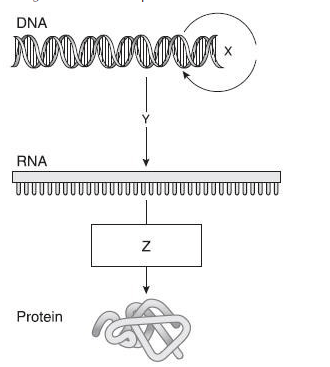
A diagram of a cellular process is shown below. Which of the following identifies the process shown at point X?
a)
Translation
b)
Translocation
c)
Replication
d)
Transcription
100 %

