wayground logo

Free Printable Worksheets

Font size

S
M
L
XL
Worksheets

Biology STAAR Benchmark Review

Total questions: 142

Worksheet time: 2hrs 14mins

Name
Class
Date
1.

Any nonliving component of a ecosystem

a)

Population

b)

Abiotic Factor

c)

Ecosystem

d)

Biology

2.
A __________ includes all living and non-living things in an environment. 
a)
population
b)
niche
c)
abitotic
d)
ecosystem
3.
All organisms of the same species living in the same area.
a)
Population
b)
Community
c)
Ecosystem
d)
Organism
4.
All of the different biotic organisms found in the same area.
a)
Organism
b)
Population
c)
Community
d)
Ecosystem
5.

Any living component of an ecosystem

a)

Abiotic Factor

b)

Population

c)

Biotic Factor

d)

Biome

6.

A living thing made of multiple organ systems

a)

organism

b)

molecule

c)

organ

7.

a group of similar cells that perform a common function

a)

organ

b)

tissue

8.

a group of organs that work together to perform body functions.

a)

cell

b)

organ

c)

organ system

9.
Which of the following is the correct order of organization in living things from most basic (simple) to most complex?
a)
a.  Organism, cell, tissue, organ, organ system
b)
a.  Organ system, organ, tissue, cell, organism
c)
a.  Cell, tissue, organ, organ system, organism
d)
a.  Cell, organ, tissue, organ, organism, organ system
10.
How nitrogen is "fixed" into useable form for plants
a)
only through action of bacteria
b)
only through lightning
c)
through action of bacteria & lightning
d)
through photosynthesis
11.
Nitrogen fixing bacteria, lives in nodules on the root of a plant called
a)
Broccoli
b)
Legumes
c)
Beats
d)
Carrots
12.

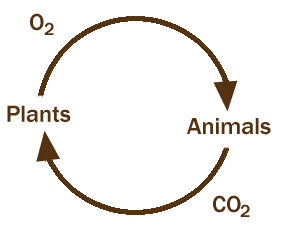
Which describes the relationship between plants and animals in the carbon cycle?

a)

Plants produce and release oxygen that animals need

b)

Plants produce and release carbon dioxide that animals need

c)

Animals produce and release oxygen that plants need

d)

Animals produce oxygen that plants turn into carbon dioxide

13.

How does carbon in a grass plant get into a lion?

a)

The lion eats an antelope that ate the grass

b)

Carbon from grass doesn't end up in a lion.

c)

The lion absorbs the carbon given off by transpiration

d)

The lion breathes in carbon given out by the plant
14.
The average temperature of the surface of Earth has increased approximately 1°C in the past century. Which reason best explains this increase in temperature?
a)
lower levels of ozone in the atmosphere
b)
lower levels of nitrogen in the atmosphere
c)
higher levels of carbon dioxide and other greenhouse gases in the atmosphere
d)
higher levels of oxygen in the atmosphere
15.
Which statement is true about the carbon dioxide-oxygen cycle?
a)
animals breathe in nitrogen and release oxygen which is used by plants
b)
animals breathe in oxygen and release carbon dioxide which is used by plants
c)
animals breathe in nitrogen and release carbon dioxide which is used by plants
d)
animals breathe in carbon dioxide and release oxygen which is used by plants
16.

What molecules do plants produce using nitrogen?

a)

fats

b)

proteins

c)

sugars

17.

Which kind of organisms are decomposers?

a)

Bacteria and Fungi

b)

Fungi and Insects

c)

Bacteria and Insects

d)

Fungi and fruit trees

18.

Which is a synonym for an autotroph?

a)

heterotroph

b)

consumer

c)

producer

19.
What are animals called in a food chain?
a)
Producers
b)
Consumers
c)
Decomposers
d)
Plants
20.

Click on the image to make it larger-- Choose all that apply: The hawk gets energy from...

a)

mouse

b)

rabbit

c)

wildflowers

d)

snake

21.

Click on the image to make it larger-- Choose the living things that are producers...

a)

wildflowers

b)

rabbit

c)

snake

d)

grass

22.

Click on the imgae to make it larger-- Choose the herbivores in the food web....

a)

hawk

b)

mouse

c)

rabbit

d)

snake

23.

A ____________________ shows how energy is passed from one living thing to another...

a)

ecosystem

b)

food chain

c)

habitat

24.
What does a food web represent?
a)
All connections of energy flow throughout all organisms in a ecosystem.
b)
The specific ways that mutualism is carried out.
c)
A single pathway or energy flow between organisms. 
d)
How carnivores get their food. 
25.

Bears eat berries and salmon. Bears are ...

a)

producers

b)

carnivores

c)

omnivores

26.
Cattle egrets forage (feed) in fields among cattle. The egret gets easy access to flying insects stirred up by the cattle, and the cattle don't care if they are there or not.
a)
mutualism
b)
commensalism
c)
competition
d)
parasitism
27.
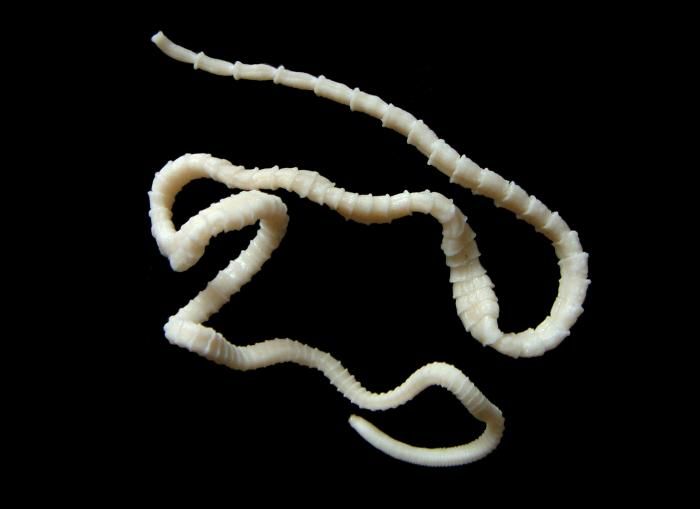
A tapeworm and a cat have this type of relationship.
a)
mutualism
b)
parasitism
c)
commensalism
d)
competition
28.
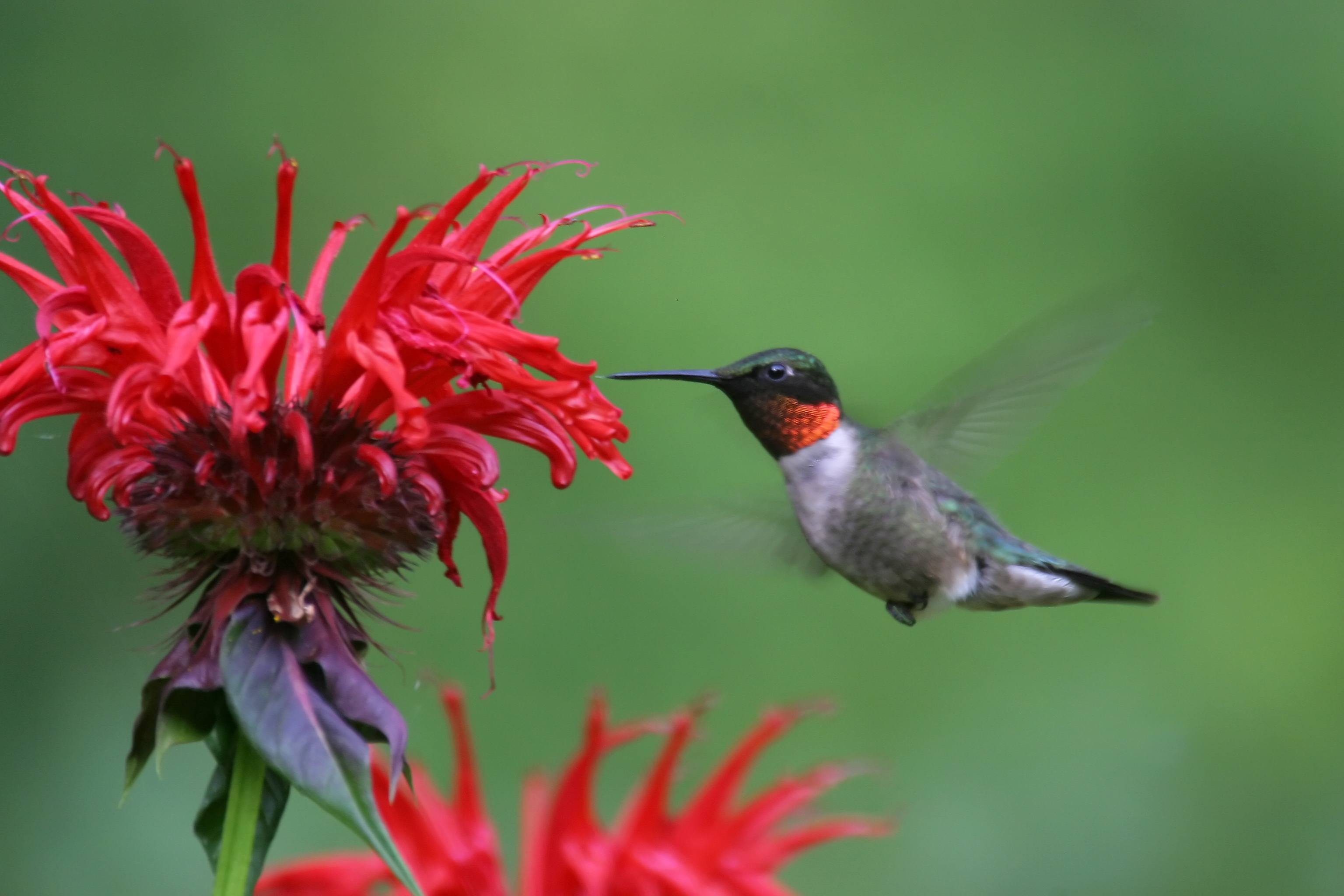
What type of symbiosis?  Hummingbirds feed on nectar from flowers.  The flowers are pollinated by hummingbirds as they move from flower to flower.
a)
commensalism
b)
mutualism
c)
parasitism
d)
predation
29.

_______ occurs when two organisms are trying to acquire or get the same resources.

a)

Symbiosis

b)

Competition

c)

Predation

d)

Collaboration

30.

_______ occurs when 1 organisms kills and eats another for food.

a)

Symbiosis

b)

Competition

c)

Predation

d)

Collaboration

31.

Which type of succession occurs on freshly formed on barren land?

a)

Primary Succession

b)

Secondary Succession

32.

Which of the following is something that can create new land?

a)

Snow

b)

Rain

c)

Volcanic Eruption

d)

Wind

33.

What do we call the first species that colonize a new area?

a)

Foreign Species

b)

Pioneer Species

c)

Intraspecies

d)

Interspecies

34.

Which of the following are examples of pioneer species? (select all that apply)

a)

Maple Tree

b)

Grass

c)

Lichens

d)

Moss

35.

Which type of succession occurs after some kind of natural disaster wipes out most of the vegetation in a habitat?

a)

Primary Succession

b)

Secondary Succession

36.

What is the main difference between primary and secondary ecological succession?

a)

Primary begins WITHOUT soil; Secondary begins WITH soil

b)

Primary is the first state and secondary is the second stage

c)

Primary builds plant community; secondary builds animal community.

d)

Primary begins WITH soil; Secondary begins WITHOUT soil

37.

What is an example of an area that is likely to undergo primary succession?

a)

Glaciers melt and leave exposed rock

b)

Plants die from drought and decompose

c)

Land is bulldozed and soil remains

38.

What is the term that describes a steady and stable community?

a)

peak community

b)

turf community

c)

climax community

d)

disturbed community

39.

A bear has which of the following adaptations?

a)

estivation

b)

hibernation

c)

"playing possum"

d)

mimicry

40.

Birds migrate south for the winter.

a)

Anatomical (Physical) Adaptation

b)

Behavioral Adaptation (Instinct)

c)

NOT an Adaptation (Learned Behavior)

41.

An inherited (DNA) trait that helps a living thing survive is called an _______.

a)

trait

b)

adaptation

c)

survive

d)

reproduce

42.
A lion has pointed teeth to help it tear meat off of the bone.
a)
Behavioral Adaptation
b)
Structural Adaptation
43.

Characteristics to help an organism survive and reproduce are called ____________________________.

a)

features

b)

flexibility

c)

adaptations

d)

structures

44.

Bright colors on a male bird helps

a)

flying

b)

mate attraction

c)

catching prey

45.
The colors & patterns on a turtles shell help it blend in with the forest floor.  This is:
a)
hibernation.
b)
behavior.
c)
migration.
d)
camouflage.
46.

Why are advantageous traits more likely to be passed onto offspring?

a)

Because they are more likely to survive and reproduce.

b)

Because they come from dominant alleles.

c)

Because they come from recessive alleles.

d)

Because the organism knew it needed that trait, survives, and passes it on.

47.

Mutations are a change in what?

a)

DNA

b)

tRNA

c)

protein

d)

rRNA

48.
The differences among a species, like different bird beaks, are called
a)
genes.
b)
variations.
c)
traits.
d)
theories.
49.
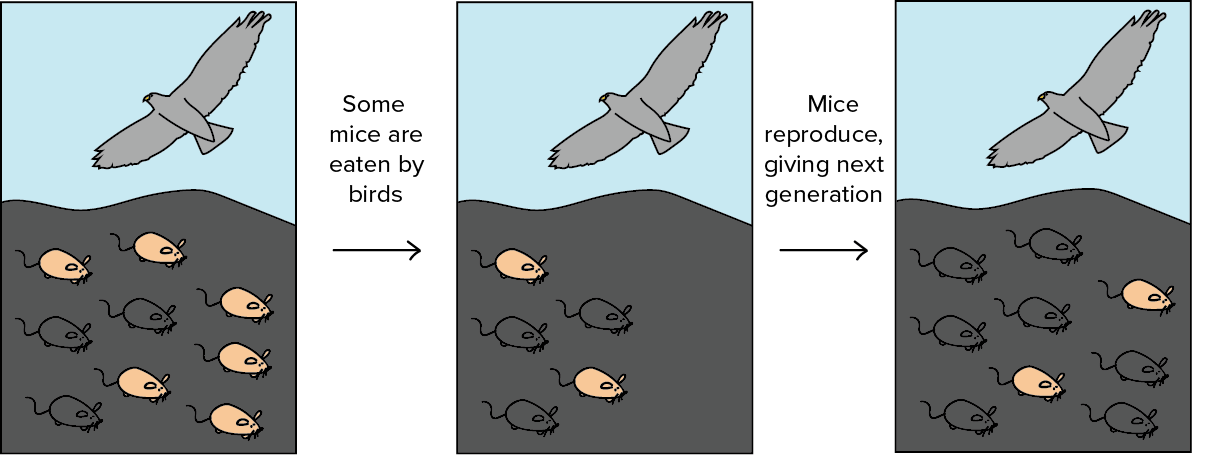
Why is the mouse population changing over time?
a)
The light mice can reproduce more successfully than the dark mice
b)
The hawks eat more dark mice than light mice because the dark mice taste better
c)
The hawks eat more light mice than dark mice because they can see the light mice more easily
d)
The hawks eat more dark mice than light mice because they can see the dark mice more easily
50.
What process is being shown in this image?
a)
Variation
b)
Natural Selection
c)
Selective Breeding
d)
Homeostasis
51.

Which best describes the role of mutations in natural selection?

a)

Mutations help an organism to better survive in their environment

b)

An organism may acquire a helpful mutation by interacting with the environment

c)

A mutation may result in a beneficial trait that makes an organism more likely to survive and reproduce

d)

Organisms with certain traits are more likely to win competitions for mutations

52.
Why do frogs and other organism reproduce so many eggs or offspring?
a)
so that their babies can have friends to play with
b)
the more offspring the more likely the offspring will survive
c)
the more offspring the less likely offspring will survive 
d)
the more offspring the less competition
53.
Which organisms are most likely to survive?
a)
the best adapted
b)
the fastest
c)
the strongest
d)
the most domesticated (tamed)
54.
Genetic drift is change in the allele frequency of a population due to...
a)
random chance
b)
natural selection
c)
non-random mating (sexual selection)
d)
artificial selection
55.
This mechanism of evolution occurs when individuals migrate between populations.
a)
Extinction
b)
Gene flow
c)
Genetic drift
d)
Natural Selection
56.

All of the genetic information found in a population.

a)

population

b)

genetic drift

c)

evolution

d)

gene pool

57.
A change in the genetic composition of a population as a result of descending from a small number of colonizing individuals is called:
a)
founder effect
b)
bottleneck
c)
genetic drift
d)
gene flow
58.
Natural selection states that organisms are best suited for their environment if they ____________ and ____________.
a)
Survive and Reproduce
b)
Survive and Predate
c)
Survive and Parasitize
d)
Survive and Adapt
59.
Gene Flow tends to ___________ genetic variation (diversity)
a)
Increase
b)
Decrease
c)
Stabilize
d)
Exaggerate 
60.
What do we call change over time?
a)
Evolution
b)
Natural Selection
c)
Natural Variation
d)
Speciation
61.

What is another name for natural selection?

a)

survival of the smartest

b)

survival of the fastest

c)

survival of the biggest

d)

survival of the fittest

62.

Which of the following is an example of the bottleneck effect?

a)

Cheetah populations reach their lowest levels with reduced diversity and as they rebound are so genetically similar they appear to be inbred.

b)

Affected individuals with blue skin can trace their ancestry back to one of the first settlers in the region.

c)

The environment of a fox population changes and over time foxes who are white survive and pass on their genes to their offspring.

d)

Humans choose two dogs they like the characteristics of and breed them together.

63.

Which category of classification has the largest variety of organisms?

a)

genus

b)

phylum

c)

species

d)

kingdom

64.

What is the order of the taxonomic levels from least specific to most specific?

a)

Kingdom, Family, Species, Order, Class, Phylum, Genus

b)

Kingdom, Phylum, Class, Order, Family, Genus, Species

c)

Species, Order, Kingdom, Family, Genus, Phylum, Class

d)

Species, Genus, Family, Order, Class, Phylum, Kingdom

65.
Organisms in this smallest taxonomic group share many characteristics.
a)
domain
b)
kingdom
c)
species
d)
class
66.
Term given to describe the 2 name naming system is:
a)
dichotmous key
b)
binomial nomenclature
c)
2 scientific names
d)
binomial key
67.
Which organisms are closely related? 
a)
American badger and leopard
b)
coyote and gray wolf
c)
european otter and leopard
d)
coyote and american badger
68.
Which biomolecule is made of nucleotides and contain you DNA?
a)
Carbohydrate
b)
Lipids
c)
Protein
d)
Nucleic Acid
69.
Which biomolecule has sugars and starches?
a)
Lipids
b)
Proteins
c)
Carbohydrates
d)
Nucleic Acid
70.
Which biomolecule functions include enzymes­ which speeds the rate of chemical reactions, structural components in cells, mechanical functions in muscles and cytoskeleton, cell signaling, and immune response; provides structure and helps with chemical reactions 
a)
Protein
b)
Lipids
c)
Carbohydrate
d)
Nucleic Acid
71.
Which biomolecule includes fats, such as triglycerides, oils, waxes, and steroids (cholesterol); insoluble in water; provides energy storage, insulation, part of cell membrane, and hormones 
a)
Nucleic Acid
b)
Lipids
c)
Carbohydrate
d)
Protein
72.
What is the monomer for a protein?
a)
Monosaccharide
b)
Triglyceride
c)
Amino Acid
d)
Nucleotide
73.
Lipids are made up of which of the following?
a)
glycerol and fatty acids tails
b)
glycerol and monolipids
c)
fatty acids and phosolipids
d)
amino acids and nucleotides
74.
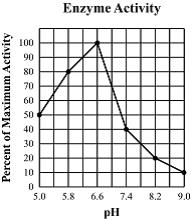
Which of the following conclusions can be drawn from this graph?
a)
The optimum pH of the enzyme is 6.6.
b)
The optimum pH of the enzyme is 5.8
c)
The enzyme’s activity increases as pH increases 5.0 to 9.0
d)
The enzyme’s activity is greater around pH of 8.0 .
75.
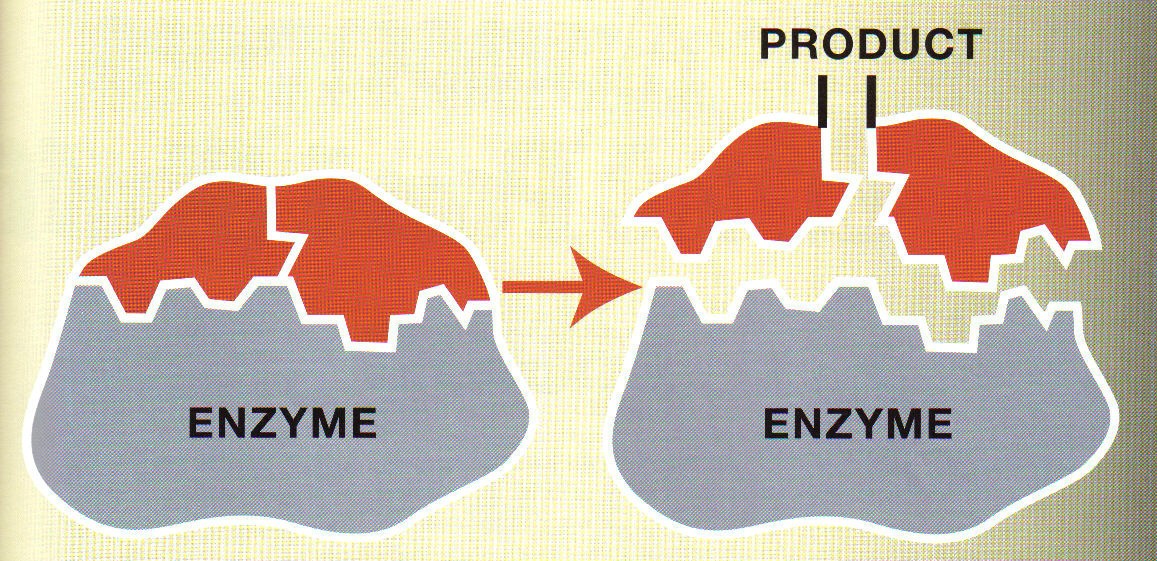
Enzymes are...
a)
nucleic acids
b)
proteins
c)
lipids
d)
carbohydrates
76.
What is the function of an enzyme?
a)
enzymes break themselves into small pieces
b)
enzymes slow down chemical reactions
c)
enzymes speed up chemical reactions
d)
enzymes combine products to form reactants 
77.
Enzymes speed up reaction rates by changing...
a)
Activation Energy
b)
pH
c)
Hydrogen Bonds
d)
Kinetic Energy
78.
What type of cell has a nucleus? 
a)
eukaryotic
b)
prokaryotic 
79.

Plant and animal cells are examples of

a)

prokaryotic cells

b)

eukaryotic cells

80.

Which of the following is only found in EUKARYOTIC cells?

a)

nucleus

b)

DNA

c)

cell membrane

d)

ribosomes

81.

PROKARYOTIC cells do NOT have

a)

membrane bound organelles

b)

cell membrane

c)

DNA

d)

ribosomes

82.

Which type of cell developed first?

a)

Prokaryotic Cells

b)

Eukaryotic Cells

83.

Bacteria is an example of a(n)

a)

prokaryotic cell.

b)

eukaryotic cell.

84.

Which of the types of transport are passive?

a)

A only.

b)

A and B only.

c)

B and C only.

d)

C only.

85.
When particles move from areas of high concentration to areas less concentrated, this has taken place.
a)
diffusion
b)
mitosis
c)
endocytosis
d)
photosynthesis
86.
What process occurs when WATER diffuses across a membrane?
a)
endocytosis
b)
mitosis
c)
osmosis
d)
nuclear fission 
87.
When both inside and outside of a cell have the same amount of water it is said that the cell has reached a state of ___________.
a)
osmosis
b)
equilibrium
c)
diffusion
d)
hypertonic
88.
What type of transport is occurring in Part C of the diagram shown?
a)
Active Transport
b)
Osmosis
c)
Facilitated Diffusion
d)
Diffusion
89.

Leaves and stems growing towards the sunlight exhibits what kind of tropism?

a)

geotropism

b)

phototropism

c)

gravitropism

d)

autotropism

90.

In a germinating seed, the downward growth of roots and the upward growth of leaves and stems are the plant's response to what?

a)

water

b)

osmosis

c)

sunlight

d)

gravity

91.

What process causes a plant to wilt in response to too much or too little water?

a)

Dehydration

b)

Transpiration

c)

Respiration

d)

Photosynthesis

92.

What are xylem?

a)

series of tubes that carry water from roots to the leaves

b)

series of tubes that carry water from leaves to the atmosphere

c)

series of tubes called roots

d)

series of tubes call leaves

93.

What must be present to start photosynthesis?

a)

Chlorophyll

b)

Sunlight

c)

Chlorophyll & Sunlight

d)

None of the above

94.

The growth response to touch

a)

Thigmotropism

b)

Geotropism

c)

Phototropism

d)

Hydrotropism

95.

The diaphragm links the respiratory to the muscular system because...

a)

it is made of skeletal muscle tissue that helps you breath.

b)

it is made of smooth muscle tissue that helps you breath.

c)

it is made of cardiac muscle tissue that helps you breath.

96.

The digestive and respiratory rely on the ___ systems to transport needed materials to the cells.

a)

circlatory and excretory

b)

circulatory and muscular

c)

nervous and digestive

d)

nervous and skeletal

97.

The digestive and respiratory systems pair together to ...

a)

bring carbon dioxide and wastes to cells for diffusion.

b)

bring oxygen and wastes to cells for diffusion.

c)

bring oxygen and nutrients to cells for cellular respiration.

d)

bring carbon dioxide and nutrients to cells for cellular respiration.

98.

Why are the lungs, the major organ of the respiratory system, also considered an excretory organ?

a)

They get rid of carbon dioxide, a cellular waste

b)

They get rid of oxygen, a cellular waste

c)

They get rid of urea, a cellular waste

d)

They get rid of salt, a cellular waste

99.

How do the skeletal and circulatory systems relate to each other?

a)

Bone marrow produces blood.

b)

The heart is made of cardiac muscle tissue.

c)

The heart is held in place in the chest by ligaments.

d)

The blood brings carbon dioxide and glucose to the cells of the bones.

100.

What organs make up your nervous system?

a)

Mouth, esophagus, stomach

b)

Brain, stomach, small intestine

c)

Brain, spinal cord and nerves

d)

Lungs, diaphragm and stomach

101.

What is a major role of the endocrine system?

a)

release hormones to control many body functions

b)

digest and absorb food

c)

transport nutrients through the blood

d)

first line of defense from infection

102.

The single deadliest entity on Earth is the ______________.

a)

bacteria

b)

bacteriophage

c)

antibiotic

103.

Influenza is caused by a ___________________.

a)

virus

b)

bacteria

c)

prion

104.

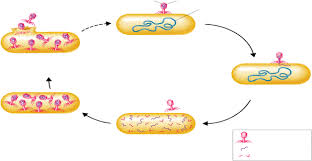
When a virus enters a cell and it immediately makes copies of itself this is called _______________________________.

a)

remediation

b)

replica

c)

replication

105.

Viruses are surrounded by a protein coat known as a

a)

Capsid

b)

Capsule

c)

Enzyme

d)

Nucleotide

106.
Is a virus considered living or non-living?
a)
Living
b)
Non-Living
c)
Neither
107.
Why do scientists classify viruses as non-living?
a)
They DO respond to a stimulus
b)
They need a host's energy because they do not have their own energy 
c)
They produce wastes
d)
They are really small 
108.
Which viral life cycle allows viral genetic material to lay dormant while the host cell reproduces?
a)
lytic
b)
mitosis
c)
lysogenic
d)
S phase
109.

Which viral life cycle kills its host cell by lysing (bursting)?

a)

Lysogenic Cycle

b)

Lytic Cycle

c)

Binary Fission

d)

Conjugation

110.
What occurs during G1?
a)
Checkpoint after S phase
b)
Chromosomes line up at the equator.
c)
The cell grows and develops.
d)
Spindle fibers separate chromosomes to opposite poles of the cell. 
111.

After mitosis, the cytoplasm and organelles are divided between the two new forming cells in a process called

a)

centriole

b)

chromatin

c)

cytokinesis

d)

centromere

112.

This process is the programmed death of a cell

a)

stem cell

b)

regulation

c)

apoptosis

d)

cytocide

113.
DNA is replicated during ______ of the cell cycle.
a)
G1
b)
S
c)
G2
d)
G0
114.
In which stage of the cell cycle is the cell preparing for division? 
a)
G1
b)
S
c)
G2
d)
M
115.
Name the phase:
a)
Anaphase
b)
Telophase
c)
Metaphase
d)
Prophase
116.

What stage of mitosis is depicted here

a)

Prophase

b)

Metaphase

c)

Anaphase

d)

Telophase

117.

The correct order of mitosis is...

a)

prophase, metaphase, anaphase, telophase

b)

metaphase, telophase, anaphase, prophase

c)

prophase, metaphase, telophase, anaphase

d)

anaphase, prophase, telophase, metaphase

118.
What is the product of translation?
a)
DNA
b)
mRNA
c)
tRNA
d)
proteins
119.

The Process of creating RNA from DNA

a)

Transcription

b)

Translation

c)

Replication

120.

In RNA the base T is replaced with

a)

U

b)

G

c)

C

d)

A

121.
What is the template for mRNA?
a)
DNA
b)
tRNA
c)
rRNA
d)
proteins
122.
Which two processes are involved in protein synthesis?
a)
Replication and Transcription
b)
Replication and Translation
c)
Transcription and Translation
123.
What are the three base segments of mRNA called?
a)
anticodons
b)
codons
c)
triplets
124.
Transcribe the following sequence of DNA into RNA:
AAG   CTT   TGC
a)
TTC  GAA  ACG
b)
UUC  GAA ACG
c)
TTC  GUU  UCG
d)
UUC  GUU  UCG
125.
Cytosine always pairs with
a)
Adenine
b)
Thymine
c)
Uracil
d)
Guanine
126.
What are the three components of a nucleotide?
a)
sugar, hydrogen, nitrogen base
b)
sugar, oxygen, nitrogen base
c)
sugar, phosphate, nitrogen base
d)
sugar, phosphate, protein
127.
What type of gene mutation has occurred here? 
T-G-A-C-C-A
T-G-A-C-C-A-A
a)
Base Substitution
b)
Base Deletion
c)
Base Insertion
d)
Frameshift 
128.
What type of gene mutation has occurred here? Normal-
AGA-TTC-ATA-GCG
Mutant-
AGA-TTC-AAT-AGC-G
a)
deletion frameshift
b)
insertion frameshift
c)
substitution
d)
nonsense
129.
DNA molecule segment is : TTACGCAAG
The mutated DNA segment is TTACGCAAC. This is an example of ___ mutation.
a)
Base Substitution
b)
Base Insertion
c)
Base Inversion
d)
Translocation
130.
A mutation that does NOT show up through protein function is called
a)
deletion mutation
b)
inversion mutation
c)
silent mutation
d)
transverse mutation
131.
Two organisms that are closely related would have
a)
very similar DNA sequence
b)
exactly the same DNA sequences
c)
no proteins in common
d)
completely different DNA sequence
132.
The forelimbs of penguin, alligator, bat, human are which of the following?
a)
homologous structures
b)
vestigial structures
133.
The diagram above shows an embryo of different vertebrates at different stages of development. Which field of study would support the similarities in development as evidence for evolution?
a)
comparative biochemistry
b)
paleontology
c)
comparative biogeography
d)
comparative embryology
134.
Which evidence of common ancestry is being studied in this visual?
a)
biogeography
b)
fossil record
c)
anatomical homology
d)
molecular homology
135.

The mineralized remains of organisms, showing how long-dead organisms lived and how their bodies were structured

a)

law of superposition

b)

sedimentary layers

c)

fossils

d)

petrification

136.

Scientific law that states fossils located in deeper sediment layers are older than ones deposited in layers closer to the surface

a)

law of superposition

b)

diversity

c)

chronological order

d)

petrification

137.

Fossils are often found in sedimentary rock. In undisturbed sedimentary rock, where would the oldest fossils be found?

a)

the bottom layer

b)

the middle layer

c)

the top layer

138.

Identify leaf F

a)

Cydonia

b)

Magnolia

c)

Aesculus

d)

Fraxinus

e)

Ilex

139.

Based on the dichotomous key, which bird is Certhidea? (Slender = thin; stout= round)

a)

Bird W

b)

Bird X

c)

Bird Y

d)

Bird Z

140.
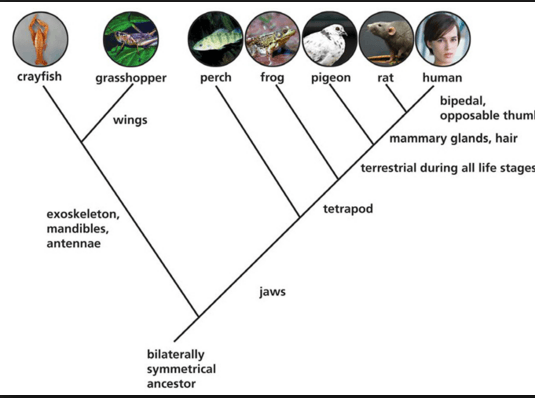
Which trait do only humans have, according to the cladogram?
a)
jaws
b)
mammary glands & hair
c)
terrestrial during all life stages
d)
bipedal & opposable thumbs
141.
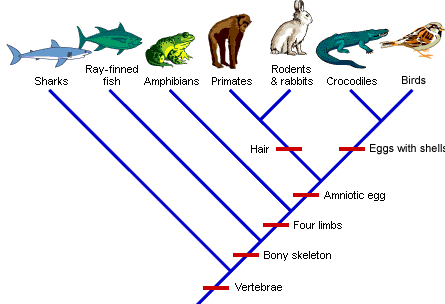
What trait separates sharks from ray-finned fish?
a)
Vertebrae
b)
Bony skeleton
c)
Four limbs
d)
None
142.
According to this cladogram, birds are LEAST related to: 
a)
Amphibians
b)
Sharks
c)
Ray Finned Fish
d)
Crocodiles