
 Worksheets
EOC Review 1
Total questions: 137
Worksheet time: 2hrs 0mins
Name
Class
Date
1.

Which of the following is the smallest unit as shown on the metric ruler below?
a)
centimeter
b)
kilometer
c)
millimeter
d)
hectometer
2.
If a laboratory fire erupts, immediately
a)
notify your instructor
b)
run for the fire extinguisher
c)
throw water on the fire
d)
open the windows
3.
If a lab experiment is not completed, you should
a)
make up some results
b)
come in during lunch and finish while eating lunch
c)
sneak in after school and work alone
d)
discuss the issue with your instructor
4.

a)
beaker
b)
graduated cylinder
c)
erlenmeyer flask
d)
test tube
5.

a)
beaker
b)
erlenmeyer flask
c)
graduated cylinder
d)
test tube
6.

a)
beaker
b)
graduated cylinder
c)
erlenmeyer flask
d)
test tube
7.

To be read accurately, one must place a graduated cylinder on a flat surface and measure at the bottom of the _______________ curve.
a)
Centrifugal
b)
Capillary
c)
Meniscus
d)
Infinity
8.

What is measured with a graduated cylinder?
a)
Passage of time
b)
Distance from one thing to another
c)
Weight of an object
d)
Volume of liquid
9.
The _________________ is used to simply hold or approximately measure a liquid.
a)
scale
b)
test tube
c)
beaker
d)
thermometer
10.
What is special about graduated cylinders?
a)
They hold large quantities of liquid safely
b)
They measure small amounts very accurately. We use them when precision is important.
c)
They allow us to examine the liquid, we use them when looking for suspended solids.
d)
They are easily heated. We use graduated cylinders to heat liquids
11.
In a scientific experiment, how many independent variables should be tested at the same time?
a)
None
b)
One
c)
Two
d)
Three or Four
12.

Which of these is a beneficial effect of bacteria?
a)
the breakdown of cellulose
b)
survival in hot, acidic environments
c)
production of billions of offspring per day
d)
conjugation as a means of sexual reproduction
13.
Which of the following “organisms” is considered to be an exception to the cell theory?
a)
bacteria
b)
viruses
c)
amoeba
d)
yeast
14.
A student named Lu is about to leave the lab area where she has been working with chemicals. What is the last activity she should perform before she leaves the lab area?
a)
put away her equipment
b)
wash her hands
c)
wash the tabletop
d)
clean the glassware
15.
When a virus infects a bacterium, what does the virus inject into the cell?
a)
viral nucleic acid
b)
capsid proteins
c)
hormones
d)
tail fibers
16.
Unlike prokaryotic cells, eukaryotic cells have the capacity to
a)
assemble into multicellular organisms
b)
establish symbiotic relationships with other organisms
c)
obtain energy from the Sun
d)
store genetic information in the form of DNA
17.

As represented in the diagram below, bacteria have cell walls like plant cells do.
Unlike the plant cell walls, however, the bacterial cell wall is made of which of the following?
Unlike the plant cell walls, however, the bacterial cell wall is made of which of the following?
a)
Peptidoglycan and amino acids
b)
Cellulose and starches
c)
Chitin and fats
d)
Cellulose and sugars
18.
A type of cell that can exist in a broad range of environmental conditions, can rapidly multiply, and lacks a nucleus is known as what type of cell?
a)
animal
b)
eukaryotic
c)
plant
d)
prokaryotic
19.

The function of the cell organelle circled below is to produce energy.
What is the name of this organelle?
What is the name of this organelle?
a)
Golgi apparatus
b)
Mitochondrion
c)
Nucleus
d)
Endoplasmic Reticulum
20.
Lyme disease can be transmitted from ticks by a spirochete called Borrelia burgdorferi, causing a rash followed by flu-like symptoms. Which of the following approaches is MOST effective in the treatment of Lyme disease?
a)
herbicides that destroy the grass where ticks live
b)
pesticides that destroy the ticks that are infected
c)
vaccinations in people that already have the disease
d)
antibiotics to destroy the bacteria that cause the disease
21.

Which kingdom has representatives with the following characteristics?
a)
Protista
b)
Fungi
c)
Plantae
d)
Animalia
22.

A.I. Oparin and J.B.S. Haldane each suggested that Earth’s oceans once contained large amounts of organic molecules that eventually gave rise to precells. What is Oparin and Haldane’s idea historically known as?
a)
big bang theory
b)
cell theory
c)
primordial soup model
d)
evolutionary model
23.
Fungi have filamentous bodies, are heterotrophic, and have cell walls that contain chitin. Which of these are examples of fungi?
a)
bacteria
b)
molds
c)
algae
d)
amoebas
24.

What best describes the genetic material shown in photograph B.
a)
The chromosomes are in anaphase
b)
The chromosomes are in metaphase
c)
DNA is possibly being replicated
d)
The genetic material is around the poles and cytokinesis is occurring
25.

Which of the following are true of the cell cycle?
a)
The cell spends most of its time dividing
b)
The cell spends most of its time growing
c)
Replication of DNA occurs at M
d)
Cells enter G0 after M
26.

When is DNA replicated during the cell cycle?
a)
During the G1 phase
b)
During the G2 phase
c)
During the S phase
d)
During the M phase
27.

What best describes the genetic material shown in photograph E.
a)
The chromosomes are in anaphase
b)
The chromosomes are in metaphase
c)
DNA is possibly being replicated
d)
The genetic material is around the poles and cytokinesis is occurring
28.
Which cell part is present in eukaryotic cells, but not in prokaryotic cells?
a)
cell membrane
b)
cell wall
c)
cytoplasm
d)
nucleus
29.
Which of the following is a possible result of a disruption in the cell cycle?
a)
cancer
b)
photosynthesis
c)
cellular respiration
d)
protein synthesis
30.
Which organic macromolecules are composed of chains of amino acids that join to form the structural components of organisms?
a)
carbohydrates
b)
nucleic acids
c)
proteins
d)
lipids
31.

What does the peak of the dotted line represent?
a)
energy of the products
b)
reaction progress
c)
activation energy without a catalyst
d)
activation energy with a catalyst
32.
Cell have several mechanisms for regulating their internal environments. Which of these mechanisms involved in maintaining homeostasis requires energy?
a)
osmosis
b)
diffusion
c)
active transport
d)
passive transport
33.
Which of the following is the only characteristic shared by living cells and viruses?
a)
the presence of carbohydrates
b)
the ability to reproduce
c)
the presence of the nucleic acid
d)
a cell membrane
34.
Which is the only structure you would expect to see when examining a prokaryotic cell with a compound microscope?
a)
nucleus
b)
chloroplast
c)
cell membrane
d)
mitochondria
35.
Which of the following correctly describes the reactants involved in cellular respiration?
a)
oxygen and carbon dioxide
b)
carbon dioxide and glucose
c)
glucose and water
d)
oxygen and glucose
36.
Which of the following best describes cellular respiration?
a)
external breathing
b)
the breakdown of sugar to release energy in cells
c)
the movement of water from outside a cell to inside the cell
d)
the removal of water from a cell
37.
Which statement about enzymes is true?
a)
Enzymes are consumed during a chemical reaction.
b)
Enzymes provide energy to activate a chemical reaction.
c)
Enzymes provide a site where reactants can combine.
d)
Enzymes increase the concentration of reactant particles.
38.
A compound is analyzed and found to have the chemical formula C6H12O6. What type of macro molecule is this substance?
a)
protein
b)
lipid
c)
carbohydrate
d)
nucleic acid
39.

This cell is undergoing mitosis. What stage of mitosis is shown?
a)
prophase
b)
metaphase
c)
anaphase
d)
telophase
40.
During strenuous exercise, body temperature increases. The body responds to the increase in temperature by sweating, which helps to reduce the body temperature. Which is demonstrated in this situation?
a)
excretion
b)
metabolism
c)
homeostasis
d)
synthesis
41.
Before mitosis begins, which happens before the nucleus starts dividing?
a)
The cytoplasm separates.
b)
The DNA replicates.
c)
The sister chromatids separate.
d)
The homologous chromosomes cross over.
42.
What is the function of autotrophs in the carbon cycle?
a)
to use oxygen to produce glucose
b)
to take in excess water
c)
to use carbon dioxide to produce glucose
d)
to feed on herbivores
43.
Two different populations of birds live in the same area and eat the same types of food. Which most likely describes the relationship between these two populations of birds?
a)
competition
b)
mutualism
c)
parasitism
d)
predator-prey
44.
What will most likely happen if the human population continues to grow at current rates?
a)
There will be fewer natural resources available for future generations.
b)
There will be an increase in nitrogen levels in the atmosphere.
c)
There will be a decrease in water pollution.
d)
There will be an increase in the number of strong hurricanes.
45.
A sea turtle has washed up on a remote section of a beach. This is known as a “stranding.” Stranding occurs when a dead, sick or injured sea turtle washes up on the shoreline. Which statement best explains why “stranding” should be reported immediately to local authorities?
a)
The information can be very useful to biologists and managers who are trying to protect the species.
b)
The information can be very useful to protect sea turtles from predators.
c)
The information can be very useful to local fishermen who try to catch fish that sea turtles eat.
d)
The information can be very useful to tourists who may want to keep sea turtles as pets.
46.
A strand of DNA has these bases:
AGC CAT GTA TAC What is the complementary DNA strand?
AGC CAT GTA TAC What is the complementary DNA strand?
a)
ACG GAT CTA TAG
b)
TCG GTA CAT ATG
c)
TGC CTA GAT ATC
d)
UCG CUA CAU AUG
47.
Which statement best describes the relationship that exists among proteins, DNA, and cells?
a)
Proteins combine to produce cells, which produce DNA
b)
Proteins are made up of DNA, which determines the cells that are produced.
c)
DNA is made up of proteins, which tell a cell how to function.
d)
Cells contain DNA, which controls the production of proteins.
48.
Why is meiosis important for sexual reproduction?
a)
It allows the zygote formed from fertilization to have triple the chromosome number of the organism.
b)
It allows gametes to have twice the original number of chromosomes of the organism.
c)
It allows gametes to have half the original number of chromosomes of the organism.
d)
It allows the zygote formed from fertilization to have half the original number of chromosomes of the organism.
49.
Which process produces the most variation within a species?
a)
Asexual reproduction
b)
Sexual reproduction
c)
mitosis
d)
cloning
50.
Which technique would most likely be used by forensic scientists?
a)
gene cloning
b)
gene therapy
c)
DNA fingerprinting
d)
karyotyping
51.
Which is one reason scientists produce transgenic organisms?
a)
to create new species of organisms
b)
to control microorganisms in the soil
c)
to prevent habitats from being destroyed
d)
to treat certain types of diseases
52.
What are the subunits of DNA and their function?
a)
nucleotides that store information
b)
monosaccharides that provide quick energy for the cell
c)
lipids that store energy and provide insulation
d)
proteins that provide the building blocks for the structural components of organisms
53.
The use of pesticides on crops has been a common farming practice for decades. What has been the greatest effect of natural selection through the use of pesticides on certain insect populations?
a)
Natural selection has been altered because the insects and their predators are killed.
b)
The rate of selection is increased because the pesticides do not kill the insects that are naturally resistant to it.
c)
The rate of selection has decreased because the pesticides kill only young insects.
d)
The pesticides have altered natural selection by causing the insect DNA to spontaneously mutate.
54.
What is the difference between the full classification of organisms and their scientific names?
a)
The full classification of organisms and their scientific names vary in different countries.
b)
The scientific names of organisms include the order and family of the organisms, but the full classification includes only the species name
c)
The full classification of organisms will include more categories of organisms than their scientific names.
d)
The scientific names of organisms include a single nomenclature, but the full classification includes various nomenclatures.
55.
What type of organic molecules are enzymes?
a)
carbohydrates
b)
lipids
c)
nucleic acids
d)
proteins
56.
A freshwater plant is placed in a container of saltwater. What will most likely happen to the cells of the plant?
a)
They will swell because water will move into them.
b)
They will swell because salt will move into them
c)
They will shrink because water will move out of them.
d)
They will shrink because salt will move out of them.
57.
How does the amount of energy resulting from fermentation compare with that of aerobic respiration?
a)
Aerobic respiration results in less energy.
b)
Aerobic respiration results in more energy.
c)
Each process results in equal amounts of energy.
d)
Each process results in variable amounts of energy.
58.

This diagram shows a plant cell. Which structure is found in a plant cell but is absent in an animal cell?
a)
1
b)
2
c)
3
d)
4
59.
Which best explains why muscle cells are different from blood cells?
a)
A mutation occurs during the development of muscle cells but not in blood cells.
b)
Different genes are activated in muscle cells than in blood cells.
c)
Muscles cells experience different environmental influences than blood cells.
d)
Muscle cells are produced by the brain, but blood cells are produced by the heart.
60.
During which phase of the cell cycle is the cell growing and preparing for cellular division?
a)
cytokinesis
b)
anaphase
c)
prophase
d)
interphase
61.
The males of a bird species do a “dance” and “sing a song” each spring. What is the main purpose of these behaviors?
a)
to scare off young birds
b)
to imprint young birds
c)
to clean their feathers
d)
to attract female birds
62.
The yucca plant releases a strong scent at night when the yucca moth is active. The yucca moth, attracted by the scent, gathers pollen from the yucca flower. The yucca moth then deposits her eggs and the pollen on another plant. This ensures that the plant will be cross-pollinated and that the yucca moth larvae have a steady food supply. Which relationship does this BEST illustrate?
a)
commensalism
b)
mutualism
c)
parasitism
d)
predation
63.
What will most likely be the result if all of the mitochondria are removed from a plant cell?
a)
It will be unable to carry out respiration.
b)
It will lose water through osmosis.
c)
It will break down ribosomes in the cell
d)
It will be unable to photosynthesize.
64.
A researcher is studying a particular disease-causing agent. The agent has a protein coat, but it lacks a nucleus, contains no other organelles, and can reproduce only when it is inside an animal cell. The researcher should classify the agent as which of the following?
a)
A bacterium
b)
A fungus
c)
A virus
d)
A protist
65.
Which pair of structures best shows that plant cells have functions different from animal cells?
a)
Cytoplasm and mitochondria
b)
Chloroplasts and cell wall
c)
Ribosome and golgi
d)
Nucleus and cell membrane
66.
Energy for most chemical reactions in cells is supplied by which of the following molecules?
a)
DNA
b)
ATP
c)
RNA
d)
Hemoglobin
67.
Meiosis is the process by which gametes are produced. In which of the following human organs would meiosis occur?
a)
Liver
b)
Stomach
c)
Testis
d)
Lungs
68.

Why are there less air bubbles as the plant is place further away from the light source
a)
because cellular respiration decreases when there is less light
b)
because the light independent reaction decreases when there is less light
c)
because photosynthesis decreases as a plant is moved further away from a light source
d)
the wavelength increases as a plant is placed further away from a light source
69.
How are cellular respiration and photosynthesis related, in terms of energy?
a)
The energy captured in photosynthesis is used to power cellular respiration.
b)
The energy transformed in cellular respiration is used to power photosynthesis.
c)
Photosynthesis and respiration perform the same task in terms of energy transformation
d)
Energy is not involved in either photosynthesis or cellular respiration.
70.
Two different species of bacteria are examined. Scientists find that species X always produces CO2 and H2O during cellular respiration. Species Y always produces ethyl alcohol and CO2. Which conclusion can be made from these observations?
a)
Only species Y is aerobic.
b)
Only species Y is anaerobic
c)
Both species X and Y are aerobic.
d)
Both species X and Y are anaerobic.
71.
The part of the enzyme that the substrate bonds to is called the _____.
a)
active site
b)
activation energy
c)
bond site
d)
peptide bond
72.
How do enzymes work?
a)
Slow down chemical reactions
b)
Prevent chemical reactions from working
c)
increase the activation energy
d)
speed up chemical reactions
73.
Which biomolecule is responsible for insulation and long-term energy storage?
a)
Protein
b)
Nucleic Acid
c)
Lipid
d)
09Carbohydrate
74.
Which biomolecule is made of amino acids?
a)
Nucleic Acid
b)
Carbohydrate
c)
Protein
d)
Lipid
75.
Which biomolecule contains fats, oils, and waxes?
a)
Proteins
b)
Nucleic Acid
c)
Lipids
d)
Carbohydrate
76.
Which biomolecule's monomer (or building block) is nucleotides?
a)
Lipids
b)
Proteins
c)
Carbohydrate
d)
Nucleic Acid
77.
Which biomolecule's monomer (or building block) are monosaccharides?
a)
Lipids
b)
Proteins
c)
Carbohydrate
d)
Nucleic Acid
78.
Which biomolecule's monomer (or building block) is glycerol and fatty acid?
a)
Lipids
b)
Proteins
c)
Carbohydrate
d)
Nucleic Acid
79.
Which of these is most likely an enzyme? (Based on the suffix)
a)
Sucrose
b)
Galactose
c)
Fructose
d)
Amylase
80.

What type of cell is shown?
a)
Eukaryotic because it has a nucleus
b)
Eukaryotic because it lacks a nucleus
c)
Prokaryotic because it has a nucleus
d)
Prokaryotic because it lacks a nucleus
81.
The process through which the monosaccharides are joined together to form a polysaccharide is known as what?
a)
dehydration synthesis
b)
linking
c)
catabolic reacting
d)
enzymatic hybridization
82.
Which class of biomolecules includes DNA and RNA?
a)
carbohydrates
b)
lipids
c)
proteins
d)
nucleic acids
83.
Which class of biomolecules is considered the main structural molecule? This same class also makes up enzymes..
a)
carbohydrates
b)
lipids
c)
proteins
d)
nucleic acids
84.
Which class of biomolecules include fats, oils, and steroids?
a)
carbohydrates
b)
lipids
c)
proteins
d)
nucleic acids
85.
Which class of biomolecules include monosaccharides, disaccharides, and polysaccharides?
a)
carbohydrates
b)
lipids
c)
proteins
d)
nucleic acids
86.
What might a scientist observe when looking at cancer cells?
a)
Cancer cells will become stuck in the G1 on phase and will not enter the S phase
b)
Cancer cells will go through the S phase twice
c)
Cancer cells will continuously repeat the cell cycle and will not enter a resting phase
d)
Cancer cells will not undergo cytokinesis
87.
Which of these requires ATP?
a)
osmosis
b)
diffusion
c)
active transport
d)
stasis
88.
What is the movement of molecules or solutes from an area of high concentration to an area of low concentration?
a)
osmosis
b)
active transport
c)
merging
d)
diffusion
89.
Which statement most correctly describes the difference between viruses and a bacteria?
a)
Bacteria are pathogens and viruses are not.
b)
Bacteria have a nucleus and viruses do not.
c)
Bacteria can spread throughout the body and viruses cannot.
d)
Bacteria are living and viruses are not.
90.

What is the name and importance of the molecule shown in the picture?
a)
fatty acid tail; makes up the fat found in butter
b)
phospholipid; makes up cellular membranes
c)
triglyceride; makes up animal lard
d)
cellulose; makes up the cell walls of plants
91.
This organelle contains enzymes that help digest and break down unwanted cellular materials.
a)
Golgi body
b)
lysosome
c)
endoplasmic reticulum
d)
vacuole
92.
This organelle would NOT be found in animal cells.
a)
cell membrane
b)
nucleus
c)
lysosome
d)
chloroplast
93.
This organelle packages proteins for export from the cell.
a)
Golgi apparatus
b)
endoplasmic reticulum
c)
ribosome
d)
lysosome
94.
Cellular energy is produced in the membrane of this organelle.
a)
endoplasmic reticulum
b)
chloroplast
c)
mitochondria
d)
lysosome
95.

What type of cell is shown?
a)
eukaryotic
b)
prokaryotic
c)
bacterial
d)
protist
96.
Proteins are assembled within this cell organelle.
a)
nucleus
b)
Golgi apparatus
c)
lysosome
d)
ribosome
97.

How would you describe this evolution?
a)
Homologous structure
b)
Analogous structure
c)
Structural adaption
d)
Functional adaption
98.
Which of the following ideas proposed by Lamarck was later found to be incorrect?
a)
Acquired characteristics can be inherited
b)
All species are descended from other species
c)
Living things change over time
d)
There is a relationship between an organism and its environment
99.
A population moving from on place to another.
a)
speciation
b)
geographic isolation
c)
genetic drift
d)
migration
100.

a bird that can easily outcompete other birds for food and that can produce many eggs has a high
a)
life expectancy
b)
mutation rate
c)
fitness
d)
adaptability
101.

Which of the following is an example of a vestigial structure?
a)
the wings of a red-tailed hawk
b)
The dorsal fin of a whale
c)
The fins of sharks
d)
the wings of an ostrich
102.
Physical separation of a population, leading to speciation.
a)
reproductive isolation
b)
geographic isolation
c)
speciation
d)
gene pool
103.

Two organisms that are closely related would have
a)
very similar DNA sequence
b)
exactly the same DNA sequences
c)
no proteins in common
d)
completely different DNA sequence
104.

An illustration and a dichotomous key are given. What is the correct classification for this organism?
a)
Class Insecta
b)
Order Amblygygi
c)
Order Araneae
d)
Order Scorpiones
105.

What trait separates sharks from ray-finned fish?
a)
Vertebrae
b)
Bony skeleton
c)
Four limbs
d)
None
106.

According to the phylogenetic tree shown, What traits do crocodiles and amphibians have in common?
a)
Vertebrae and hair
b)
Four limbs and amniotic eggs
c)
Bony skeleton and vertebrae
d)
Amniotic eggs and hair
107.
Algae, seaweed and protozoa belong to kingdom:
a)
Protista
b)
Animalia
c)
Plantae
d)
Fungi
108.
Viruses are:
a)
eukaryotes
b)
prokaryotes
c)
both
d)
neither
109.

Largest number of individuals of a population that the environment can support:
a)
carrying capacity
b)
primary succession
c)
denitrification
d)
mutualism
110.
As you move upward, from level to level, in an energy pyramid, energy _____.
a)
increases by 10%
b)
decreases by 10%
c)
stays the same
d)
increases exponentially
111.

Symbiotic relationship in which one organism is harmed while the other one benefits:
a)
mutualism
b)
commensalism
c)
parasitism
d)
niche
112.
Organism that makes its own food by using sunlight or chemicals; another word for autotroph:
a)
biome
b)
producer
c)
consumer
d)
herbivore
113.

SB2d. 12.The following diagram shows a mutation that occurs in the hemoglobin gene to produce a recessive genetic disorder called sickle cell anemia.
Which of the following statements best describes why the change in only one DNA base of the hemoglobin gene results in a different protein product of the gene?
Which of the following statements best describes why the change in only one DNA base of the hemoglobin gene results in a different protein product of the gene?
a)
the change prevents mRNA from being made
b)
the change alters the amino acid sequence of the protein
c)
the change causes the blood cells to divide in an uncontrolled way
d)
the change creates a second strand of mRNA for each RNA molecule
114.

SB2d. The original mRNA strand has 3 triplets:
AUG-AUU-CAC
Which of the following mutations causes the LEAST amount of harm to the cell?
AUG-AUU-CAC
Which of the following mutations causes the LEAST amount of harm to the cell?
a)
AUG-AUC-AC
b)
AUU-AUU-CAC
c)
AUG-AUC-CAC
d)
AUG-CAU-UCA-C
115.
SB2c. When gametes are produced from a parent cell during normal meiosis, which of the following describes the number of chromosomes in each resulting cell?
a)
Each resulting cell has the same number of chromosomes as the parent cell.
b)
Each resulting cell has twice the number of chromosomes as the parent cell.
c)
Each resulting cell has one-half the number of chromosomes as the parent cell.
d)
Each resulting cell has one-fourth the number of chromosomes as the parent cell.
116.
SB2d. A mutation is least likely to affect a cell when the mutation:
a)
reverses the order of bases in a DNA strand
b)
allows the total number of bases in a DNA sequence to remain the sam
c)
replaces a base with its complementary base
d)
produces a triplet that codes for the same amino acid as the original triple
117.

SB2c. What you see, or the physical appearance.
a)
Genotype
b)
Phenotype
c)
Homozygous
d)
Heterozygous
118.
SB2c. A scientist is trying to discover a new treatment to stop lung cancer cells from dividing. In the cancer cells, which of these processes will stop if the treatment is successful?
a)
mitosis
b)
meiosis
c)
binary fission
d)
genetic recombination
119.

The chart shows the embryos and adult forms of animals from different classification groups. What do the embryos suggest about these three animals?
a)
The animals are not related.
b)
The animals share a common ancestor and are therefore related
c)
Fish are more closely related to humans than are chickens.
d)
Fish and chickens ar closely related, but humans are not related to either fish or chickens.
120.
Which of these is required for natural selection?
a)
All individuals of a population must be identical.
b)
There must be a small number of individuals in a population.
c)
There must be variation among the members of
d)
An individual must be forced out of its natural habitat.
121.
Who is the father of evolution?
a)
Darwin
b)
Mendel
c)
Newton
d)
Einstein
122.
The cause of artificial selection is…
a)
The environment
b)
Humans
c)
Mutation
d)
Gene Flow
123.
When the DNA of an organism is altered it is referred to as…
a)
Mutation
b)
Gene Flow
c)
Genetic Drift
d)
Sexual Selection
124.
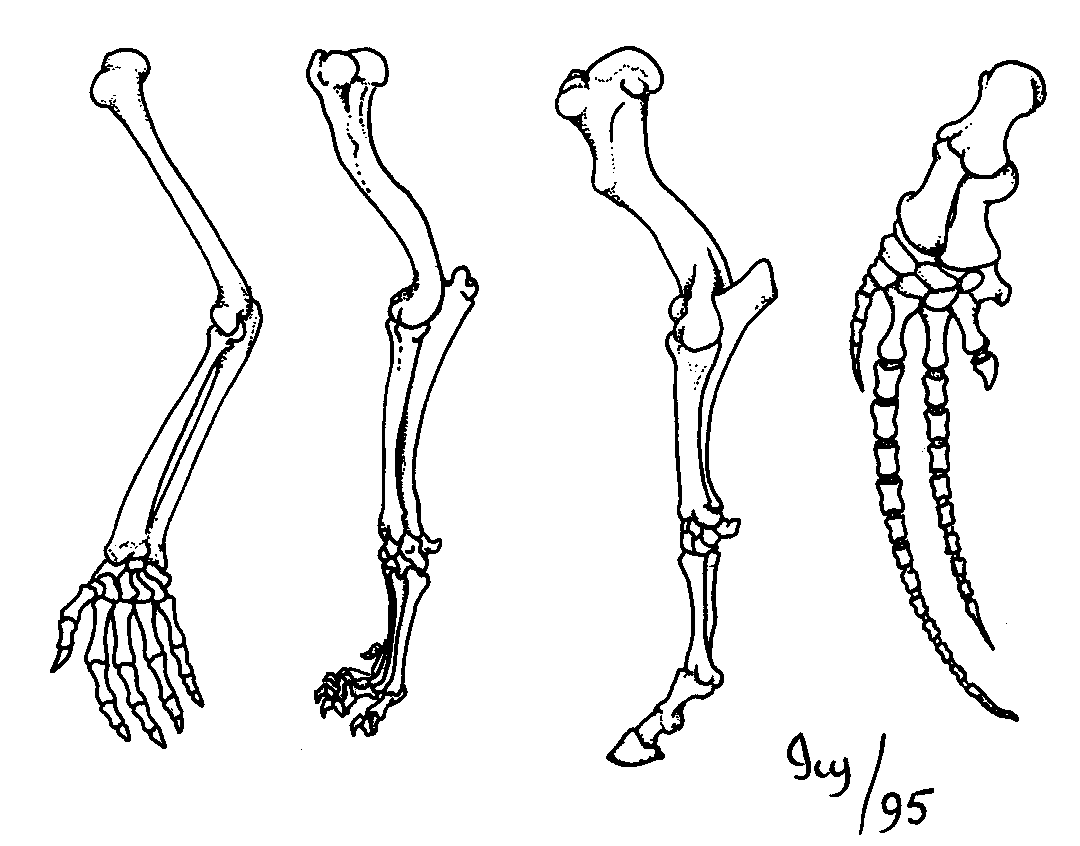
Structures with the same parts have different functions; suggests that organisms share a common ancestry
a)
vestigial structures
b)
homologous structures
c)
adaptive radiation
d)
fossil
125.

Some organisms that share a common ancestor have features that have different functions, but similar structures. These are known as
a)
vestigial structures
b)
analogous structures
c)
homologous structures
d)
fossil structures
126.
The process by which populations slowly change over time is called__________
a)
selective breeding
b)
adaptation
c)
sepeciation
d)
evolution
127.

What type of structures are these?
a)
homologous
b)
vestigial
c)
analogous
d)
fossil
128.

The diagram shows fossils in different rock layers. Which of these statements about the age of these fossils is most likely correct?
a)
Fossil A and C are the same age
b)
Fossil B is older than fossil C
c)
Fossils A is older than fossil B
d)
Fossil D is older than fossil C
129.

Two organisms that are closely related would have
a)
very similar DNA sequence
b)
exactly the same DNA sequences
c)
no proteins in common
d)
completely different DNA sequence
130.

Which layer is the oldest
a)
B
b)
A
c)
E
d)
C
131.
What does Darwin's theory of evolution suggest?
a)
species change over time
b)
extinct species are not related to living species
c)
different species can interbreed
d)
animals that look alike are most closely related
132.

Which best describes these fossils?
a)
The oldest fossils can be found on the lower layers
b)
The oldest fossils can be found at the top layers
c)
The youngest fossils are always found on the bottom layers
d)
You can not tell the age of any of these fossils
133.

What is this an example of?
a)
diversity of species
b)
variation
c)
vestigial structures
d)
DNA studies
134.
What is an organism that has similar characteristics and can reproduce?
a)
species
b)
organism
c)
embryology
d)
vestigial
135.

Which species’ DNA is most similar to the DNA of the toothed whale?
a)
Hippopotamus
b)
Baleen Whale
c)
Grazing Mammals
d)
Camels
136.

Which of the following is a term for a group of similar organisms that can reproduce fertile offspring?
a)
individual
b)
population
c)
species
d)
fossil
137.
The ability of an organism to survive and reproduce in its specific environment
a)
diversity.
b)
evolution
c)
adaptation
d)
fitness
100 %

