wayground logo

Free Printable Worksheets

Font size

S
M
L
XL
Worksheets

Topic 2 Biology

Total questions: 135

Worksheet time: 4hrs 48mins

Name
Class
Date
1.

Which category of organisms is correctly described in this table?

a)

A

b)

B

c)

C

d)

D

2.
Stem cells are ____________________.
a)
cells that grow uncontrollably
b)
undifferentiated and can turn into any type of cell
c)
those that never go through cell division
d)
differentiated cells that do one job
3.
Stem cells can be obtained from _________.
a)
embryos
b)
some adult tissues
c)
umbilical cord blood
d)
all of the above
4.
Which of the following cells is UNdifferentiated or UNspecialized?
a)
cardiac muscle cell
b)
nerve cell
c)
liver cell
d)
stem cell
5.
Stem cells are used to __________.
a)
make clones
b)
create new species of animals
c)
make babies
d)
grow different types of tissues
6.
What is the difference between embryonic stem cells and adult stem cells?
a)
Embryonic can differentiate into more cell types than adult
b)
Adult only turn into blood, while embryonic turn into many things.
c)
Adult can differentiate into more cell types than embryonic
d)
Adult grow bigger than embryonic
7.
Which is true about embryonic stem cells?
a)
They no longer divide; their cell type is set and cannot change.
b)
They can develop into only one type of cell.
c)
They can become any cell type in the body.
d)
They are found in adults.
8.
Adult stem cells can also be referred to as ______________.
a)
somatic stem cells 
b)
embryonic stem cells 
c)
starter cells 
d)
IPS cells 
9.
What does "multipotent" mean?
a)
able to divide and make one kind of cell
b)
able to divide and make all different types of cells
c)
able to divide and make multiple (but not all) types of cells 
d)
cannot divide
10.
What does "pluripotent" mean?
a)
able to divide and make all different types of cells
b)
not able to divide
c)
can only divide and make one cell type 
d)
if it divides, it will make a cancerous tumor
11.

What is true of induced pluripotent stem cells?

a)

They can be turned/forced into other types of cells.

b)

They can't be turned into other types of cells.

c)

They can be turned back into their original type of cell.

d)

all of the above

12.
Scientists can reprogram skin cells to act like stem cells.  True or False? 
a)
True 
b)
False 
13.

Which is something that can stem cells can repair/cure?

a)

sports injuries

b)

certain diseases like Parkinson's disease, multiple sclerosis, and diabetes

c)

bone marrow in cancer patients

d)

all of the above

14.

Is the use of adult/somatic stem cells generally controversial in the US today?

a)

No

b)

Yes

15.

Is the use of embryonic stem cells controversial in the US today?

a)

Yes

b)

No

16.

Why is the use of embryonic stem cells controversial?

a)

The embryos are destroyed in the process of extracting the stem cells.

b)

People consider their use as destroying a life.

c)

They are taken from little kids, which is painful.

d)

They are put into a different person.

17.
Neural stem cells from the brain can differentiate into... 
a)
only specialized brain cells .
b)
specialized brain cells and specialized skin cells. 
c)
all types of specialized cells. 
d)
only specialized blood cells. 
18.
Which of the following is NOT a source for stem cells?
a)
umbilical cord blood 
b)
early embryos 
c)
sperm and eggs 
d)
certain adult tissues 
19.
Why might stem cell research lead to a cure for diabetes?
a)
Stem cells can be used to grow pancreas cells that produce insulin.
b)
Stem cells can create babies that have normal functioning pancreases.
20.
What process best explains how muscle cells and nerve cells can develop from the same fertilized egg?
a)
genetic engineering
b)
survival of the fittest
c)
differentiation
d)
selective breeding
21.
Which best explains why muscle cells are different from blood cells?
a)
Muscle cells are produced by the brain, but blood cells are produced by the heart. 
b)
Different genes are activated in muscle cells than in blood cells. 
c)
Muscles cells experience different environmental influences than blood cells. 
d)
A mutation occurs during the development of muscle cells but not in blood cells. 
22.
What is the first phase of Mitosis?
a)
Prophase
b)
Metaphase
c)
Anaphase
d)
Telophase
23.
What phase of mitosis is occuring in the picture?
a)
Prophase
b)
Metaphase
c)
Cytokinesis
d)
Telophase
24.
In which phase does the cell spend most of it's life?
a)
Interphase
b)
Nuclear Division
c)
Telophase
d)
Mitosis
25.
DNA will condense into...
a)
Centromeres
b)
Chromosomes
c)
Nuclei
d)
Spindle fibers
26.
What phase of mitosis is pictured?
a)
Metaphase
b)
Telophase
c)
Prophase
d)
Anaphase
27.
Which of the following is NOT occuring during interphase?
a)
Cell growth
b)
DNA being copied
c)
DNA condensing
d)
Two new cells are made
28.
The process by which the nuclear material is divided equally between two new cells
a)
mitosis
b)
cancer
c)
spindle
d)
centromere
29.
Why would it be important to replicate DNA before a cell divides in mitosis or meiosis?
a)
In order for genetic information to be transferred into daughter cells.
b)
In order for the cell to be able to increase in size.
c)
In order for the DNA to be contained in the nucleus.
d)
In order for the cell to re-order the DNA sequencing in the new cells.
30.
Name the phase:
a)
Prophase
b)
Metaphase
c)
Anaphase
d)
Telophase
31.
Which phase comes NEXT?
a)
prophase
b)
metaphase
c)
anaphase
d)
telophase
32.
Structure A refers to the _____.
a)
chromatid
b)
chromosome
c)
centromere
33.
Fruit fly body cells have 8 chromosomes. After mitosis, you would expect a resulting fruit fly daughter cell to have -
a)
16 chromosomes.
b)
46 chromosomes.
c)
8 chromosomes.
d)
4 chromosomes.
34.
Before cells can divide, what must be copied?
a)
mitochondria
b)
cytoplasm
c)
DNA
d)
Cell Wall
35.
These structures pull the spindle fibers and attached chromosomes to opposite ends of the cell.
a)
Spindle fiber
b)
Centriole
c)
Nucleus
d)
Centromere
36.
Structure (b) is a ____.
a)
chromosome
b)
chromatid
c)
centromere
37.
Name the previous phase.
a)
Prophase
b)
Metaphase
c)
Anaphase
d)
Telophase
38.
What process does a multi-cellular organism use to replace its damaged body cells?
a)
mitosis
b)
meiosis
c)
replication
d)
transcription
39.
Which of these lists presents the stages of the cell cycle in the correct order?
a)
interphase, mitosis, cytokinesis
b)
cytokinesis, mitosis, interphase
c)
mitosis, interphase, cytokinesis
d)
interphase, cytokinesis, mitosis
40.

What is this phase of Mitosis?

a)

Prophase

b)

Metaphase

c)

Anaphase

d)

Telophase

41.

Meiosis is the _____.

a)

division of sex cells

b)

division of body cells

42.

Which best identifies what plants receive from sunlight?

a)

Energy

b)

Nitrogen

c)

Oxygen

d)

Sugars

43.

Which do plants need for photosynthesis?

a)

Sunlight

b)

Oxygen

c)

Pollen

d)

Bees

44.

Which form of reproduction, in animals, is the most common on Earth?

a)

Asexual

b)

Sexual

c)

Fragmentation

d)

Vegetative propogation

45.

Multiple factors influence the reproductive success of an animal. Select all that apply.

a)

genetics

b)

weather conditions

c)

availability of food

d)

protection from predators

46.

Which type of reproduction produces the greatest amount of genetic variation in offspring?

a)

Sexual

b)

Asexual

c)

Binary fission

d)

Budding

47.

Which type of reproduction involves two parents?

a)

Asexual

b)

Sexual

c)

Fragmentation

d)

Budding

48.

Asexual reproduction would be the most favorable if the population had an opportunity to grow quickly?

a)

True

b)

False

49.

In internal fertilization, fertilization occurs

a)

inside of a protective capsule, like a cocoon.

b)

inside the mother's body.

c)

outside the mother's body.

d)

it varies species to species

50.

An example of a courtship behavior that can increase a male's reproductive success is

a)

A male gorilla displays strength and vocalizations to females.

b)

A group of birds flies to a new location with more food resources.

c)

A chimpanzee learns to use a tool by watching another chimpanzee.

d)

Male and female robins sit on their eggs to keep them warm until they hatch.

51.

Which of these best describes successful animal behaviors?

a)

They are only instinctive and genetic.

b)

They are influenced by genes and experience.

c)

They are beneficial for survival and reproduction.

d)

They involve thinking, reasoning, and problem solving.

52.

If I tell you that you scored at the 55th percentile on your final exam, you would know:

a)

55% of the class scored the same or worse than you did

b)

You earned a 55% on the exam

c)

You failed the exam

d)

45% of the class scored worse than you did

53.
The 75th percentile is also know as the
a)
median
b)
third quartile
c)
1st quartile`
d)
interquartile range
54.

The Median is also referred to as

a)

the 25th Percentile

b)

the 50th Percentile

c)

the 75th Percentile

d)

the 100th Percentile

55.
In order to find the median, the data must be sorted from least to greatest first.
a)
True
b)
False
56.
A data set can have more than one mode
a)
True
b)
False
57.
When an egg is first fertilized it is known as 
a)
a nucleus
b)
an embryo
c)
a zygote
d)
a fetus
58.
Where does the implantation occur and the zygote develop?
a)
in the uterus
b)
in the ovary
c)
in the vagina
d)
in the fallopian tube
59.
The developing embryo is connected to the placenta by
a)
the spinal cord
b)
the umbilical cord
c)
the amniotic fluid
d)
the developing nerves
60.
Week 9/ 10 the baby acquires features and is then referred to as
a)
an embryo
b)
a fetus
c)
a zygote
d)
a newborn
61.
Approximately how many weeks after fertilization is baby is ready to be born ?
a)
17 to 24
b)
24 to 36
c)
22 to 48
d)
40 to 42
62.
When the blastocyst attaches to the lining of the uterus, this is known as
a)
fertilization
b)
ovulation
c)
implantation
d)
mitosis
63.
Which is the correct order?
a)
embryo, fetus, zygote
b)
fetus, zygote, embryo
c)
embryo, zygote, fetus
d)
zygote, embryo, fetus
64.
The union of a sperm and egg is called
a)
fertilization
b)
embryo
c)
implantation
d)
trimester
65.
What happens when a fertilized egg splits into two?
a)
Fraternal twins
b)
Identical twins
c)
Nothing, you just have one baby. 
d)
Triplets
66.
The important gases, carbon dioxide and oxygen, enter and leave the leaf through the
a)
upper epidermis
b)
phloem
c)
stomata
d)
guard cells
67.
Which of the following is the correct equation for PHOTOSYNTHESIS?
a)
CO+ light + H2O --> O+ Sugar
b)
CO+ sugar + H2O --> O+ light
c)
O2 + light + H2O --> CO+ Sugar
d)
CO+ O2 + H2O --> Light+ Sugar
68.
What is the pigment in chloroplasts that performs photosynthesis?
a)
Chlorosynthesis
b)
Chlorophyll
c)
ADP
d)
Electron Transport
69.
Which of the following is an example of a HETEROTROPH?
a)
Grass
b)
Algae
c)
Lemon Tree
d)
Bear
70.
Most plants appear green because chlorophyll
a)
absorbs green light.
b)
absorbs violet light.
c)
does not absorb green light.
d)
does not absorb violet light.
71.
In which  organelle does photosynthesis occur?
a)
mitochondria
b)
stomata
c)
xylem
d)
chloroplast
72.
What gas is being released during photosynthesis
a)
sulfur
b)
carbon dioxide
c)
oxygen
d)
hydrogen
73.

Mitosis is also referred to as...

a)

cellular multiplication

b)

cellular subtraction

c)

cellular addition

d)

cellular division

74.

Mitosis starts with one cell and ends with...

a)

one cell

b)

two cells

c)

three cells

d)

four cells

75.

What best explains the role of cellular division?

a)

to grow, develop, and repair tissue

b)

to eliminate unneeded cells

c)

to produce egg and sperm cells

d)

to eliminate waste from your body

76.
What is cell differentiation?
a)
Process by which cells produce more cells
b)
Process by which cells become specialized
c)
Process by which cells become unspecialized
d)
Process by which cells die
77.
What is one goal of cellular differentiation/specialization?
a)
To create specialized cells to help organism maintain homeostasis.
b)
To many cells.
c)
To make stem cells
d)
to make single celled organisms
78.
what is the role of stem cells in the body 
a)
fight against infection 
b)
provide specialized roles in the body 
c)
used for fertility treatment 
d)
they produce new specialized cells in the body to replace old cells that are used up 
79.
Stem cell research is controversial because in involves?
a)
social issues
b)
ethical issues
c)
educational issues
d)
economical issues
80.

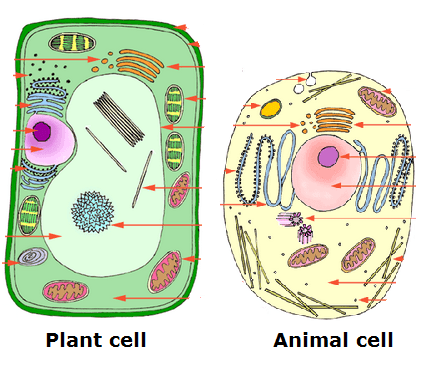
What distinguishes a plant cell from an animal cell? (How do you tell them apart) Hint: There's 3 ways (Check all 3)

a)

Central Vacuole

b)

Mitochondria

c)

Cell Wall

d)

Ribosomes

e)

Chloroplasts

81.

Our bodies use this Bio-molecule as it's building material. Often found in meats, eggs, and dairy products.

a)

Carbohydrates

b)

Proteins

c)

Lipids

d)

Baconidis

82.

Cellular Respiration occurs within me and I am in BOTH plant and animal cells. I am a....

a)

Nucleus

b)

Golgi Body

c)

Cytoskeleton

d)

Mitochondria

83.

I like to be thought of as the "storage bubble" for both plant and animal cells. I am a...

a)

Cell Membrane

b)

Cytoskeleton

c)

Vacuole

d)

Endoplasmic Reticulum

84.

I provide plant cells their rigid shape. I am the...

a)

Basketball that Nic Quarne left in Mr. Woller's room last week

b)

Cytoskeleton

c)

Cell Membrane

d)

Cell Wall

85.

Animal and Plant Cells are...

a)

Shopkoytes

b)

Eukaryotes

c)

Prokaryotes

d)

The building blocks of non-living things
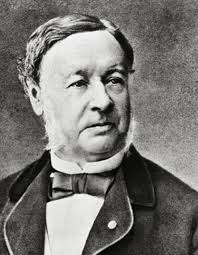
86.
Which of the following scientists concluded that all animals are made of cells?
a)
Rudolf Virchow
b)
Matthais Schleiden
c)
Robert Hooke
d)
Theodor Schwann
87.
Which of the following scientists was the first to observe bacteria?
a)
Anton van Leuwenhoek
b)
Matthais Schleiden
c)
Robert Hooke
d)
Theodor Schwann
88.
The invention of the microscope made it possible for people to discover and learn about
a)
Plants
b)
Skin 
c)
Animals 
d)
Cells
89.
Rocks are not living because
a)
they never move
b)
they aren't needed for humans
c)
they are not made of cells
d)
they don't break down
90.
Which scientist did NOT contribute to the cell theory?
a)
Anton Van Leeuwenhoek
b)

Robert Hooke
c)
Albert Einstein 
d)

Matthias Schleiden
91.
Who looked at cork and named the cell?
a)
Robert Hooke
b)
Van Leeuwenhoek
c)
Robert Brown
d)
Francesco Redi
92.

All living things are made up of

a)

Prokaryotic Cell

b)

Eukarytoic Cells

c)

Either prokaryotic or eukaryotic cells

93.

Enzymes are an example of

a)

Lipids

b)

Carbohydrate

c)

Protein

d)

Nucleic Acid

94.
What is the purpose  of an enzyme?
a)
give permission for the reaction
b)
raise activation energy
c)
speed up reactions
d)
control how many reactions occur
95.
Each enzyme only has 1 substrate that will fit its active site.  What is this called?
a)
reusable
b)
catalyst
c)
specific
d)
fragile
96.
Any substance that is acted upon by an enzyme is called a(n)?
a)
Coenzyme
b)
Substrate
c)
Vitamin
d)
Polypeptide
97.
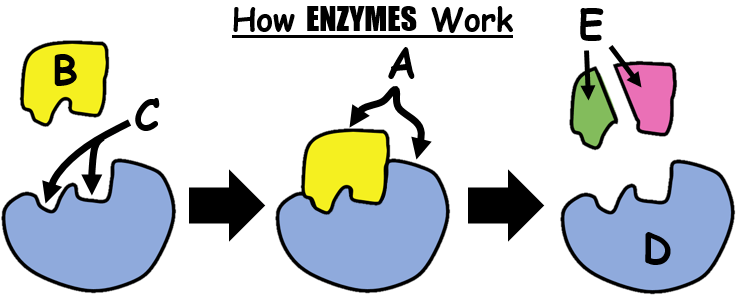
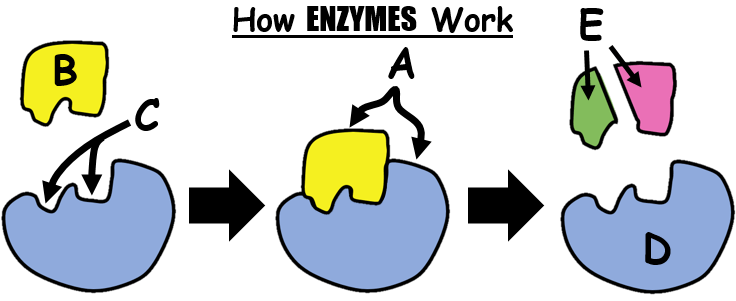
Letter D...
a)
active site
b)
enzyme
c)
substrate
d)
products
98.
Letter C...
a)
active site
b)
enzymes
c)
substrate
d)
products
99.
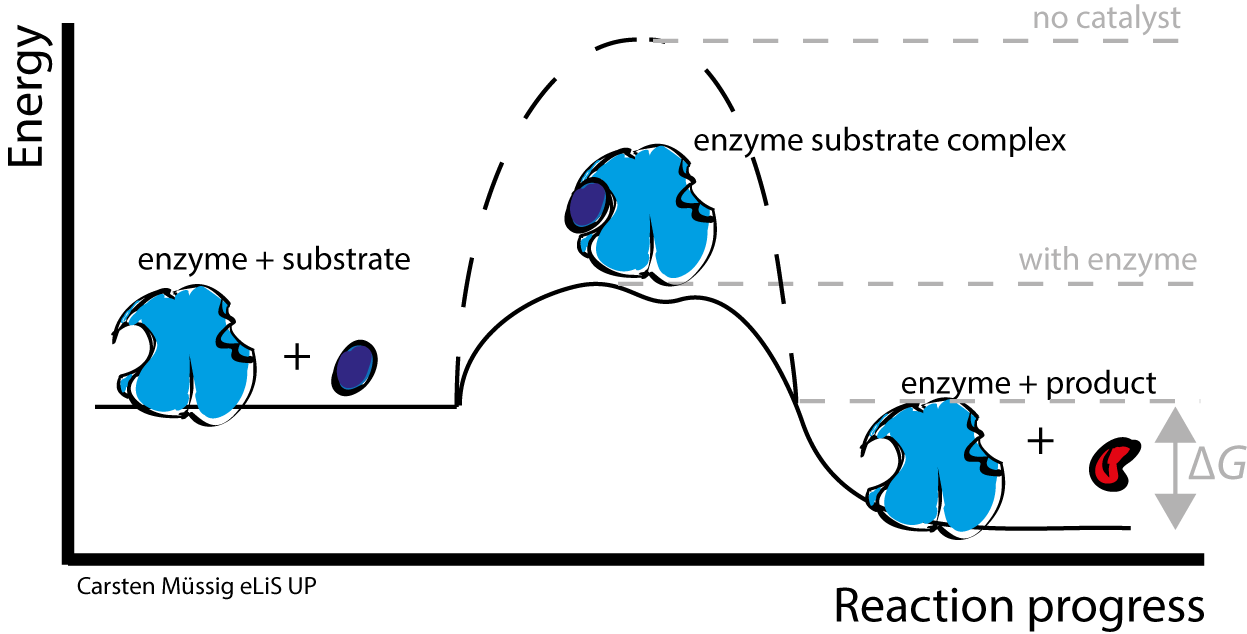
An enzyme speeds up a reaction by
a)
lowering the activation energy.
b)
raising the activation energy.
c)
releasing energy.
d)
absorbing energy.
100.

What type of neuron is A?

a)

Sensory

b)

Inter

c)

Motor

101.

What type of neuron is B?

a)

Sensory

b)

Inter

c)

Motor

102.

What type of neuron is C?

a)

Sensory

b)

Inter

c)

Motor

103.

Name an effector in this diagram.

a)

A

b)

B

c)

D

d)

E

e)

F

104.

An example of a reflex action includes

a)

Touching a butterfly

b)

Brushing your hand against the side of your body

c)

Touching a hot stove

d)

Your legs moving as you walk

105.

In a reflex arc, the sensory neuron leads to the ___________ and the motor neuron leads to the __________

a)

Spinal cord, CNS

b)

CNS, muscle

c)

Spinal cord, muscle

d)

Muscle, CNS

106.

Reflex actions are important because

a)

They provide a quick, involuntary response

b)

They prevent injury

c)

They are essential to the survival of organisms

d)

All of the above

107.

Which type of neuron causes a muscle to contract in a reflex arc?

a)

Motor Neuron

b)

Sensory Neuron

c)

Interneuron

d)

Effector

108.
The part labelled 1 is white in colour what is it that gives this colour?
a)
Bone
b)
Fat (myelin)
c)
Tendons
d)
Membrane
109.
Salivary glands are an example of ...
a)
A receptor
b)
A relay
c)
A detector
d)
An effector
110.
What is the neuron found only in the spinal cord?
a)
Relay
b)
Sensory
c)
Motor
d)
Reflex
111.
What is the average time for a human to react to visual stimuli?
a)
0.25s
b)
0.80s
c)
0.10s
d)
0.95s
112.
What neuron is this?
a)
Relay
b)
Motor
c)
Reflex
d)
Sensory
113.
Part 2 is the cell body, where is this found?
a)
In the dorsal root ganglion
b)
In the spinal cord
c)
In the skin
d)
In bone
114.
What neuron is this?
a)
motor
b)
sensory
c)
relay
d)
reflex
115.
What makes up the CNS
a)
brain and spinal cord
b)
brain and neurons
c)
brain
d)
spine and neurons
116.
What does the P in PNS stand for?
a)
Peretal 
b)
Peripheral 
c)
Poetal
d)
Prevalent 
117.

What's in the picture?

a)

synaptic vesicles

b)

neurotransmitters

c)

presynaptic neuron

d)

postsynaptic neuron

e)

synaptic cleft

118.

What's in the picture?

a)

synaptic vesicles

b)

neurotransmitters

c)

presynaptic neuron

d)

postsynaptic neuron

e)

synaptic cleft

119.

What's in the picture?

a)

synaptic vesicles

b)

neurotransmitters

c)

presynaptic neuron

d)

postsynaptic neuron

e)

synaptic cleft

120.

What's in the picture?

a)

synaptic vesicles

b)

neurotransmitters

c)

presynaptic neuron

d)

postsynaptic neuron

e)

synaptic cleft

121.

Chemicals released into a cleft when an action potential reaches the terminal are called.....

a)

ligand gated ion channels

b)

synaptic vesicles

c)

neurotransmitters

d)

voltage gated ion channels

122.

Which pattern shows how signals are transmitted from the presynaptic neuron to the post synaptic neuron

a)

electrical --> electrical

b)

electrical --> chemical

c)

chemical --> electrical --> chemical

d)

electrical --> chemical --> electrical

123.

Which side of the synapse contains neurotransmitters?

a)

presynaptic

b)

postsynaptic

c)

both

124.

Which side of the synapse contains ligand-gated ion channels?

a)

presynaptic

b)

postsynaptic

c)

both

125.

What causes the release of neurotransmitters into the cleft?

a)

an action potential reaches the terminal

b)

ligand gated ion channels open

c)

excititory neurotransmitters bind to ligand gated ion channels

d)

an action potential on the post synaptic neuron triggers nearby voltage gated ion channels

126.

Drugs have their effects because they

a)

mimic some neurotransmitters

b)

cause neurotransmitters to be released without a signaling action potential

c)

block the re-uptake of some neurotransmitters

d)

cause action potentials to move in reverse along the axon

127.

A neuron : gland / muscle synapse is associated with....

a)

sensory neurons

b)

motor neurons

128.
The long, fiber like part of a neuron which the cell sends information to receiving neurons
a)
axon 
b)
dendrite
c)
axon terminal
d)
gene
129.
A network of branches coming from individual cells.  They carry information and electrical signals in the brain and nervous system
a)
axon
b)
axon terminal
c)
dendrite
d)
neuron
130.
This insulating material forms a layer, around the axon of a neuron.  It enables electrical signals to travel down the axon at higher speeds.
a)
neuron
b)
myelin sheath
c)
dendrite
d)
neurotransmitter
131.
A chemical produced by neurons that carries messages to other neurons
a)
myelin sheath
b)
neurotransmitter
c)
axon
d)
axon terminal
132.
The tiny gap between neurons where nerve impulses are sent from one neuron to another.  It is where communication occurs between an axon and dendrite
a)
synapse
b)
axon terminal
c)
impulse
d)
myelin
133.
How many nerve cells does the brain contain?
a)
100 million
b)
86 billion
c)
86 million 
d)
100 billion
134.
What is the brain made of?
a)
Nerve tissue
b)
Brain tissue
c)
Cortex tissue 
d)
Stem tissue
135.

Myelin, an insulating material, is found in

a)

cell bodies

b)

dendrites

c)

axon terminals

d)

Schwann cells