
 Worksheets
LE Regents Essentials
Total questions: 135
Worksheet time: 1hrs 8mins
Which of the following is recommended as the best way to prepare for the Living Environment Regents Exam?
Get a good night's sleep and eat a healthy breakfast and lunch.
Study all night and skip breakfast to save time.
Only review your notes the morning of the exam.
Eat a large dinner and stay up late studying.
How many questions are on the Living Environment Regents Exam, and how are they divided among the different parts?
Approximately 80-85 questions divided into multiple choice and short answer sections across five parts.
Exactly 100 questions, all multiple choice.
About 50 questions, mostly short answer.
Over 90 questions, with only lab-based questions.
Which items are you allowed to bring to the Living Environment Regents Exam? Select all that apply.
Black ink pen
Pencil and eraser
Simple 4-function calculator
Graphing calculator
Electronic devices other than calculator
What should you do if you make a mistake on your answer sheet during the Living Environment Regents Exam?
Draw one X through the mistake and then write the new answer.
Erase the mistake completely and write the new answer.
Use white-out to cover the mistake and write the new answer.
Leave the mistake and continue without correcting it.
Where should you write your answers for Part B-2, Part C, and Part D of the Living Environment Regents Exam?
In the test booklet.
On the answer sheet.
On a separate piece of paper.
On the exam cover.
Which of the following is NOT allowed during the Living Environment Regents Exam?
Graphing calculator
Simple 4-function calculator
Black ink pen
Pencil and eraser
What is homeostasis?
A balanced state in an organism's body.
A process that only occurs in plants.
A type of chemical reaction in cells.
A form of cellular respiration.
Which of the following best describes dynamic equilibrium in living organisms?
A balanced state created by many small, opposing changes.
A state where nothing changes in the organism.
A process that only occurs during sleep.
A type of chemical reaction.
Which of the following are considered basic life processes in living organisms? Select all that apply.
Nutrition
Cellular respiration
Synthesis
Excretion
Photosynthesis
Which inorganic molecule is most common in living things and is needed for chemical reactions and dissolving substances for transport?
Water (H2O)
Carbon dioxide (CO2)
Oxygen (O2)
Nitrogen (N2)
Which process uses oxygen to release energy from glucose in most organisms?
Cellular respiration (aerobic)
Photosynthesis
Fermentation (anaerobic)
Protein synthesis
Which of the following statements about nitrogen is correct?
Nitrogen is the most common gas in air and is needed to make protein and nucleic acids.
Nitrogen is used by plants to make glucose during photosynthesis.
Nitrogen is a waste product of cellular respiration.
Nitrogen is needed for cellular respiration in all organisms.
What does the pH scale measure?
How acidic or basic a substance is, ranging from 0.0 to 14.0.
The amount of water in a solution.
The number of enzymes in a cell.
The amount of oxygen in the air.
Which of the following are functions of carbohydrates in living organisms? Select all that apply.
Provide energy
Store energy in plants (starch)
Make up cell membranes
Act as catalysts
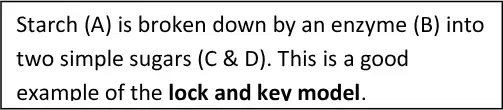
Refer to the diagram showing starch (A) being broken down by an enzyme (B) into two simple sugars (C & D). What model does this process illustrate?
The lock and key model, where the enzyme fits with the substrate to catalyze a reaction.
The sliding filament model, where proteins slide past each other.
The fluid mosaic model, describing cell membranes.
The double helix model, describing DNA structure.
Which of the following are important functions of proteins in the body? Select all that apply.
Act as enzymes to control chemical reactions
Form part of cell membranes
Attack foreign pathogens as antibodies
Store genetic information
Which of the following statements is NOT part of the cell theory?
All living things are made of one or more cells.
Cells carry out all life processes.
All cells come from preexisting cells.
Viruses are made of cells.
Which structure is responsible for controlling the cell and containing hereditary material such as chromosomes, genes, and DNA?
Nucleus
Mitochondrion
Ribosome
Vacuole
Which organelle is known as the powerhouse of the cell because it provides usable energy in the form of ATP?
Mitochondrion
Chloroplast
Nucleus
Cell wall
Which of the following is found ONLY in plant cells and algae cells, and is responsible for carrying out photosynthesis?
Chloroplast
Mitochondrion
Ribosome
Nucleus
Which of the following is NOT a function of the cell membrane?
Separates the cell interior from the outer environment
Controls what enters and leaves the cell using membrane proteins
Contains hereditary material such as DNA
Has receptor molecules that pick up signals from other cells
Which process describes the movement of substances from an area of high concentration to an area of low concentration and does NOT require energy?
Diffusion
Osmosis
Active transport
Photosynthesis
Which of the following statements about viruses is correct?
Viruses are not made of cells and do not carry out all life processes.
Viruses are made of cells and carry out all life processes.
Viruses are considered true living things by most biologists.
Viruses can reproduce on their own without a host.
Place the following levels of biological organization in order from smallest to largest: organ, cell, tissue, system.
Cell, tissue, organ, system
Tissue, cell, organ, system
System, organ, tissue, cell
Organ, system, cell, tissue
Which organelle is responsible for making proteins by joining amino acids?
Ribosome
Vacuole
Nucleus
Mitochondrion
Which of the following is NOT an activity for which organisms take in nutrients?
Growth
Repair of damaged tissue
Cellular respiration
Excretion
Which process involves breaking down nutrients (polymers) into smaller molecules (monomers) so they can be absorbed into the blood and cells?
Ingestion
Digestion
Photosynthesis
Respiration
Carbohydrates such as starches are digested into which type of monomer?
Fatty acids
Amino acids
Simple sugars
Proteins
Which statement best describes autotrophic nutrition?
Organisms consume nutrients from other organisms.
Organisms take inorganic molecules and convert them into organic nutrients.
Organisms break down polymers into monomers.
Organisms digest food in the stomach.
Which of the following are examples of heterotrophs? Select all that apply.
All animals
All fungi
Some bacteria
Plants
Which group of organisms breaks down dead matter and waste, playing an important role in recycling nutrients?
Carnivores
Herbivores
Omnivores
Decomposers
Which substances are required for photosynthesis to occur?
Sunlight
Water (H2O)
Carbon dioxide (CO2)
Oxygen (O2)

Refer to the diagram showing starch being broken down by enzyme X into two simple sugars. What is the role of enzyme X in this process?
Enzyme X builds starch from simple sugars.
Enzyme X breaks down starch into simple sugars using the lock and key model.
Enzyme X transports sugars into the cell.
Enzyme X digests proteins into amino acids.
Which of the following are waste products of photosynthesis?
Water (H2O)
Oxygen (O2)
Carbon dioxide (CO2)
Glucose (C6H12O6)

In the diagram showing two views of a leaf and its internal structure, what is the function of the guard cells labeled X?
Guard cells open and close the stomata to control gas exchange and prevent the plant from drying out.
Guard cells transport food and water throughout the plant.
Guard cells perform photosynthesis.
Guard cells digest nutrients.
Which molecule do all cells use for energy?
Glucose
Oxygen
ATP
Carbon dioxide
Which statement is true about photosynthesis and cellular respiration?
Photosynthesis and cellular respiration are the same reaction.
Photosynthesis and cellular respiration are opposite reactions that help cycle oxygen, carbon, hydrogen, and water through the environment.
Only animals perform cellular respiration.
Only plants perform photosynthesis.
What is the best definition of evolution?
Gradual change over time
Sudden appearance of new species
A process that only affects animals
A change that happens in a single generation
Which statements about Charles Darwin are correct? Select all that apply.
He was not the first to think of evolution, but he figured out how it works mostly.
He knew about genes and DNA and how mutations work.
He did not know about genes or DNA, so he could not know about mutations.
He was the first person to study evolution.
According to the modern theory of evolution, which of the following are true? Select all that apply.
Earth is 4.5 billion years old and is constantly changing.
Natural selection is the mechanism that causes species to change.
All species can adapt to any environment and never become extinct.
New traits arise in a species from mutations and genetic recombination.
Which of the following is an example of an environmental change that can lead to evolution?
Change in climate
Inheritance of acquired traits
Sudden appearance of new organs
All individuals in a species changing at once
Does a change in temperature or climate directly cause evolution in a species?
No, environmental change does not itself force a species to change its inherited characteristics.
Yes, any environmental change will cause a species to evolve immediately.
Yes, but only if the species is large enough.
No, because species never change.
Which of the following are basic steps in natural selection? Select all that apply.
Overproduction: Too many offspring are produced.
Competition: Offspring must struggle to survive and reproduce.
All offspring are identical to their parents.
Variations: Members of a species are different from each other due to sexual reproduction, genetic recombination, and mutations.
What does 'survival of the fittest' mean in the context of natural selection?
Offspring who inherit helpful variations are, on average, better able to get resources, escape predators, and find mates.
Only the strongest animals survive, regardless of their traits.
All offspring survive equally well in any environment.
Fitness means being the fastest runner in a group.
Which statement best explains why populations evolve and not individuals?
Traits are inherited randomly, and it is only by looking at the entire population that you see 'fit' traits become more common.
Each individual can choose to adapt to its environment.
Individuals evolve new traits during their lifetime.
Populations do not change over time.
What is the result when two populations can no longer breed together, even when brought together?
They are considered new species.
They become extinct immediately.
They will always interbreed again.
They remain the same species forever.
What is the correct way to write the scientific name of an organism?
Genus name followed by species name, with genus capitalized and species lowercase
Species name followed by genus name, both capitalized
Genus name followed by species name, both capitalized
Species name followed by genus name, both lowercase
Which statement best describes what evolutionary trees show?
The relationship between living species and extinct species
The physical appearance of different species
The diet of extinct species
The migration patterns of living species
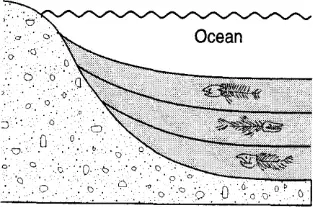
Based on the diagram showing fossil layers under the ocean, which statement is most accurate?
Deeper fossils are typically older than those above them
Fossils in the top layer are always the oldest
All fossils are found in the same layer
Fossils in the bottom layer are always the youngest

Which of the following is true about homologous structures?
They are similar body parts modified to perform different functions, indicating a common ancestor
They are identical body parts in unrelated species
They are body parts that serve the same function in all species
They are body parts that have no function
Which of the following is an example of direct observation of evolution?
Bacteria evolving resistance to antibiotics
Plants growing taller in sunlight
Birds migrating south for winter
Fish swimming in schools
Why should you NOT say that bacteria 'become immune' to antibiotics?
Because bacteria evolve resistance, not immunity
Because antibiotics make bacteria stronger
Because bacteria are always immune to antibiotics
Because antibiotics do not affect bacteria
Which statement about evolution is correct?
Individual organisms do not evolve; only populations can evolve
Individual organisms evolve to fit their environment
Species evolve traits because they need them
Individual organisms can go extinct
Why did giraffes evolve long necks, according to evolutionary theory?
Giraffes with longer necks were better able to get food than short neck giraffes
Giraffes needed long necks to reach leaves
Giraffes were given long necks by nature
Giraffes evolved long necks because they wanted them
What is the process called in which a single cell divides to increase the number of cells in the human body?
Mitosis
Diffusion
Peristalsis
Respiration
Which of the following statements about the zygote is correct?
The zygote contains all the genes needed to become a complete organism.
The zygote is made up of many specialized tissues.
The zygote is formed by the process of diffusion.
The zygote is responsible for digesting food.
Which of the following best describes the main job of the immune system?
To protect the body against pathogens
To produce energy for the body
To transport oxygen throughout the body
To digest food for the body
Which of the following is a correct definition of a pathogen?
An organism that causes a disease
A protein made by white blood cells
A type of white blood cell
A harmless substance that triggers allergies
Which of the following are types of pathogens? Select all that apply.
Viruses
Bacteria
Parasites
Antibodies
What is the main function of antibodies in the immune system?
To attack pathogens by binding to them
To transport oxygen in the blood
To digest food in the stomach
To produce insulin for blood sugar control
Why must blood types be matched before receiving a blood transfusion?
Because the immune system will attack blood with the wrong antigen as foreign
Because the body cannot produce enough antibodies
Because white blood cells will destroy all antigens
Because vaccines are only effective with matched blood types
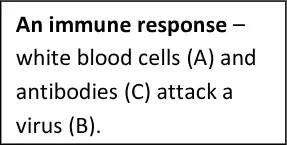
Refer to the diagram showing an immune response, where white blood cells (A) and antibodies (C) attack a virus (B). What is the role of the antibodies in this process?
They tag the virus for destruction by white blood cells
They produce insulin to control blood sugar
They transport oxygen to the virus
They destroy healthy cells in the body
Which statement about vaccines is correct?
A vaccine contains a dead or weakened pathogen to trigger immunity
A vaccine contains only a tiny part of a pathogen
A vaccine cures diseases by killing pathogens directly
A vaccine is a type of antibiotic used against bacteria
Which of the following statements about antibiotics is true?
Antibiotics are effective only against bacteria, not viruses
Antibiotics can cure viral infections
Antibiotics are used to make antibodies
Antibiotics are injected to provide immunity
Which disease is caused by a virus that weakens the immune system and is spread through bodily fluids?
AIDS
Cancer
Diabetes
Asthma
What is the main function of the excretory system?
To remove waste produced by the cells of the body
To transport oxygen to the cells
To produce hormones for the body
To control reflexes and impulses
Which substances are excreted by the lungs?
Carbon dioxide and water vapor
Urea and salt
Sweat and heat
Toxins and dead red blood cells
Which organ filters wastes out of the blood and controls the amount of water in your body?
Kidneys
Liver
Skin
Lungs
What is the correct term for the process by which the body gets rid of feces?
Elimination
Excretion
Filtration
Absorption
What is the role of hormones in the body?
To regulate the body by acting as chemical messages
To filter toxins from the blood
To carry oxygen to tissues
To control reflexes
Which statement best describes how hormones are transported in the body?
Hormones are carried from glands to target tissues by the blood
Hormones travel through nerves to target tissues
Hormones are absorbed directly by cells from the environment
Hormones are stored in the liver until needed
Which hormone is produced by the pancreas to control blood sugar levels?
Insulin
Adrenaline
Testosterone
Estrogen
Which statement about the Lock and Key Model is correct?
Receptor molecules in the cell membrane can only accept molecules of the correct shape
Any hormone can bind to any receptor molecule
Receptor molecules are only found in the liver
Hormones can change their shape to fit any receptor
Which two body systems work together to control the body?
Nervous and endocrine systems
Digestive and immune systems
Excretory and circulatory systems
Muscular and respiratory systems
Which of the following is an advantage of asexual reproduction?
One parent can quickly provide large numbers of offspring.
Two parents provide variations in offspring, but the process is slower.
It always results in genetic variation among offspring.
It requires finding a mate before reproduction can occur.
What is a disadvantage of sexual reproduction?
It requires two parents and happens more slowly because a mate must be found.
It produces no variation among offspring.
It quickly provides large numbers of offspring.
It only occurs in unicellular organisms.
Which statement best describes the chromosome number in daughter cells produced by mitosis?
The number and types of chromosomes in the daughter cells are the same as in the parent cell.
The daughter cells have half the number of chromosomes as the parent cell.
Each daughter cell has double the chromosomes of the parent cell.
The chromosome number varies randomly in the daughter cells.
Which of the following is true about meiosis? Select all that apply.
It produces gametes used in sexual reproduction.
Each cell divides twice to produce four different haploid cells.
The chromosome number in daughter cells is halved compared to the parent cell.
It is used for growth and repair of damaged tissue.
What is a diploid cell?
A cell with sets of chromosomes in pairs.
A cell with half the normal number of chromosomes and no pairs.
A cell that is always a gamete.
A cell that divides twice to produce four daughter cells.

According to the diagram comparing mitosis and meiosis, what happens to the number of chromosomes during meiosis?
The number of chromosomes is halved in meiosis.
The number of chromosomes stays the same in meiosis.
The number of chromosomes doubles in meiosis.
The number of chromosomes is random in meiosis.
Why is variation among offspring important in sexual reproduction?
Variation increases the chances of survival in changing environments.
Variation always leads to harmful mutations.
Variation makes all offspring identical to their parents.
Variation is only important in asexual reproduction.
Which organ produces and stores sperm in the male reproductive system?
Testes
Penis
Vas deferens
Urethra
What is the main function of testosterone in the male body?
It is the male sex hormone made in the testes
It is the fluid that carries sperm
It is the tube that transfers sperm
It is the cell that fertilizes the egg
Which statement about eggs in the female reproductive system is correct?
Females are born with all the eggs they will ever have
Eggs are produced throughout a female's life
Eggs are smaller than sperm
Eggs are made in the uterus
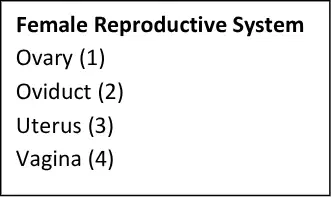
Refer to the diagram of the female reproductive system. Which structure is labeled as '3'?
Ovary
Oviduct
Uterus
Vagina
Where does fertilization usually occur in the human female reproductive system?
Oviduct/Fallopian tube
Uterus
Ovary
Vagina
What is the correct sequence of early development after fertilization?
Zygote, cleavage, embryo, implantation, fetus
Cleavage, zygote, embryo, fetus, implantation
Zygote, embryo, cleavage, fetus, implantation
Embryo, zygote, cleavage, fetus, implantation
What is the main function of the placenta during pregnancy?
Transfers nutrients and oxygen from mother to fetus
Produces eggs for the fetus
Stores waste from the fetus
Forms the umbilical cord

Refer to the diagram of later development. Which structure is labeled as '6'?
Placenta
Amniotic sac
Umbilical cord
Fetus
Why is the fetus vulnerable to substances such as alcohol and drugs during development?
Organs and systems are still developing
The fetus eats solid food
The blood of mother and fetus always mixes
The fetus produces its own nutrients
Where does fertilization of the egg by the sperm occur in humans?
In the uterus
In the oviduct or Fallopian tube
In the mother's stomach
In the ovary
How many chromosomes do humans have in total?
23
46
44
22
What is an allele?
A type of chromosome
A gene for a particular protein
An option for a gene or trait, such as coat color in cats
A pair of chromosomes
Which statement best explains why males are more likely to have sex-linked traits like color blindness?
Males have two X chromosomes, so they have more genes.
Males have only one X chromosome, so a recessive trait on the X cannot be hidden by a dominant gene.
Males have more chromosomes than females, so they have more traits.
Males have two Y chromosomes, so they have fewer genes.

The diagram shows a karyotype with 23 pairs of human chromosomes, with the last pair labeled X and Y. What does this indicate about the individual?
The individual is female.
The individual is male.
The individual has a genetic disorder.
The individual has extra chromosomes.
Each gene codes for a particular protein. What else can affect how a trait appears, according to the material?
Only the gene itself
The environment, such as temperature
The number of chromosomes
The shape of the chromosome
What is the shape of a DNA molecule?
A straight ladder
A double helix, which resembles a twisted ladder
A single strand
A circle
Which bases pair together in DNA?
A pairs with G, T pairs with C
A pairs with T, C pairs with G
A pairs with U, C pairs with G
A pairs with C, T pairs with G
Which of the following are true about protein synthesis? Select all that apply.
A codon is a sequence of three bases in DNA.
Each codon represents a specific amino acid.
Proteins are assembled in the nucleus.
The order of amino acids determines the shape and function of a protein.
What is the role of mRNA in protein synthesis?
It copies the DNA code for a gene in the nucleus and carries it to the ribosome.
It brings amino acids to the ribosome by matching bases with mRNA.
It assembles amino acids into proteins in the nucleus.
It determines the shape of the protein.

The diagram shows the process of protein synthesis. DNA is transcribed into mRNA, and tRNA brings the correct amino acids to form a protein. According to the diagram, which amino acid is coded by the mRNA sequence GGA?
Proline
Methionine
Aspartic Acid
Glycine
Which of the following statements about mutations is correct?
Mutations can only be passed on if they occur in reproductive cells such as sperm or egg.
Mutations can be passed on if they occur in any cell of the body.
Mutations are always harmful and cause death.
Mutations only occur due to viruses.
Which of the following are common mutagenic agents that can cause mutations? Select all that apply.
Radiation
Chemicals
Viruses
Water
What is the main difference between gene mutations and chromosome mutations?
Gene mutations affect a single gene, while chromosome mutations affect many genes at once.
Gene mutations are always lethal, while chromosome mutations are not.
Chromosome mutations only occur in plants, while gene mutations occur in animals.
Gene mutations are caused by viruses, while chromosome mutations are caused by bacteria.
Down's syndrome is caused by which of the following genetic changes?
Inheriting an extra chromosome 21
A missing base in a gene
A mutation caused by a virus
A change in the shape of a protein
Which statement best describes selective breeding (artificial selection)?
Humans breed organisms to produce offspring with desired traits.
Organisms are genetically engineered to have new genes.
Bacteria are used to make human hormones.
Chromosomes are photographed to diagnose diseases.
Which of the following are examples of products made using genetic engineering in bacteria? Select all that apply.
Insulin for diabetics
Human growth hormone
Juicy strawberries
Red tomatoes
What is the purpose of karyotyping in genetic technology?
To photograph an organism's chromosomes and identify chromosome disorders such as Down syndrome.
To create banded patterns based on DNA sequence length.
To insert new genes into bacteria.
To breed organisms with desired traits.
Which statement corrects a common mistake about genes and proteins?
Genes carry the instructions to make protein. The genes are made of DNA (a nucleic acid).
Genes and DNA are made of protein.
Amino acids and nucleic acids are the same thing.
Proteins are the building blocks of DNA.
Which term describes the role an organism plays in its environment, including how, when, and where it obtains food?
Niche
Habitat with specific feeding times and locations
Competition for resources
Symbiosis between species
What is the main difference between a producer and a consumer in an ecosystem?
A producer makes its own nutrients from simple molecules, while a consumer obtains nutrients by feeding on other organisms.
A producer competes for resources, while a consumer does not.
A producer is always a plant, while a consumer is always an animal.
A producer recycles nutrients, while a consumer stores nutrients.
Which statement best explains what happens when two species try to fill the same niche in an ecosystem?
Usually only one species occupies the niche at any one time, and resources are divided to reduce competition.
Both species will always share the niche equally without competition.
The species will become decomposers to avoid competition.
Competition will result in both species going extinct.

Refer to the food web diagram showing mountain lion, snake, hawk, frog, cricket, deer, rabbit, mouse, grasses, and trees. Which organism is most likely to be a producer in this food web?
Trees
Rabbit, which eats plants and is eaten by hawks
Snake, which feeds on smaller animals
Mountain lion, which is at the top of the food web
Which of the following is an example of symbiosis where both organisms benefit?
A bee and a flower working together for mutual benefit
A parasite harming its host
A mountain lion hunting a deer
A decomposer recycling nutrients from dead organisms
Which factor is considered abiotic in an ecosystem?
Temperature
Gray squirrel
Earthworm
Maple tree
What is the carrying capacity of an ecosystem?
The largest population an ecosystem can support
The total number of species in an ecosystem
The amount of energy available to producers
The number of abiotic factors present
Why are ecosystems with low diversity considered less stable than those with high diversity?
Ecosystems with low diversity take longer to recover from environmental changes and are less stable.
Ecosystems with low diversity have more producers than consumers.
Ecosystems with low diversity recycle energy more efficiently.
Ecosystems with low diversity have more abiotic factors.
Which of the following is the primary reason humans have a negative impact on the environment?
The human population is growing, which places a greater demand on resources such as food, water, and space.
Humans use too many pesticides, which pollute the environment.
Humans do not recycle enough materials, leading to more waste.
Humans plant too many trees, which changes the ecosystem.
Which actions are examples of ways humans can reduce or repair damage to the environment? Select all that apply.
Recycling wastes
Using cleaner resources such as solar or wind energy
Clear cutting forests
Passing laws to control pollution
Which of the following is a negative effect of industrialization on the environment?
Increases use of resources and pollution
Reduces acid rain
Decreases human population
Increases biodiversity
What is the main cause of acid rain?
Burning fossil fuels, releasing sulphur and nitrogen into the air
Cutting down trees in rainforests
Using too much water for farming
Planting non-native species in new areas
Which statement best describes the process of ecological succession?
One community is gradually replaced by another until a climax community is established.
A climax community is destroyed and never returns.
All organisms in a community remain the same over time.
Succession only occurs in aquatic environments.

Refer to the diagram showing the stages of ecological succession from bare field to hardwood forest. Which stage comes immediately before the pine forest stage?
Shrub stage
Grass stage
Hardwood forest stage
Climax community stage
Which of the following are negative effects of loss of biodiversity? Select all that apply.
Ecosystems are less stable
Humans lose potential resources
Increased soil fertility
More stable food webs
Which of the following is NOT a cause of habitat loss?
Planting native plants in rainforests
Industrialization
Farming
Increasing human population
Which of the following is a correct action to help prevent depletion of the ozone layer?
Use safer chemicals instead of CFCs
Burn more fossil fuels
Increase use of refrigeration coolants containing CFCs
Release more sulphur into the air
Which of the following is a major cause of global warming?
Increased emissions of greenhouse gases from fossil fuels, especially carbon dioxide (CO₂)
Decreased use of alternative energy sources such as solar power
Reduction in the amount of carbon dioxide in the atmosphere
Increased planting of trees worldwide
Which of the following is a negative effect of global warming?
Loss of habitat and species due to climate change
Increased biodiversity in all regions
Decrease in greenhouse gas emissions
More stable weather patterns worldwide
What is one action that can help reduce global warming?
Using cleaner technologies and alternative energy sources
Increasing the use of fossil fuels for energy production
Cutting down more forests to make space for agriculture
Releasing more carbon dioxide into the atmosphere
What is a possible negative effect of introducing new species (also known as invasive or alien species) to an environment?
New species may outcompete native wildlife
Native species will always adapt to the newcomers
The environment will become more stable
All species will benefit equally
Which method can help control the population of introduced species?
Using biological controls such as natural predators and disease
Allowing the new species to spread without intervention
Removing all native species from the area
Increasing tourism in the affected region
Which statement about energy in ecosystems is correct?
Energy can never be recycled in ecosystems
Energy is recycled in ecosystems just like carbon and nitrogen
Energy is stored in the soil by decomposers
Energy is only used by autotrophs
Which of the following statements about decomposers is correct?
Decomposers are a type of heterotroph that obtain food by decaying dead organisms
Decomposers are autotrophs because they grow in the soil
Decomposers produce their own food through photosynthesis
Decomposers do not play a role in nutrient cycling
Select all correct definitions from the options below:
Observation: What is seen or measured
Inference: A conclusion based on observation or evidence
Hypothesis: A prediction based on available evidence
Theory: An explanation of natural events that is supported by strong evidence
Placebo: A group being tested or receiving a special treatment
Which of the following best describes a control group in a controlled experiment?
A group that should be identical to the experimental group in every way except it does not receive the new treatment
A group that receives a sugar pill or other fake treatment
A group that is being tested or receiving a special treatment
A group that always receives the new treatment

