wayground logo

Free Printable Worksheets

Font size

S
M
L
XL
Worksheets

137 2nd Semester FInal Review

Total questions: 139

Worksheet time: 2hrs 1mins

Name
Class
Date
1.
the base that pairs with Thymine in DNA
a)
adenine
b)
guanine
c)
helicase
d)
nucleotide
2.
nitrogen base that pairs with guanine
a)
adenine
b)
cytosine
c)
nucloetide
d)
deoxyribose
3.
A five-carbon sugar found in DNA.
a)
ribose
b)
guanine
c)
deoxyribose
d)
helicase
4.
The shape of DNA.
a)
double helix
b)
nucleotide
c)
DNA polymerase
d)
single stranded
5.
monomer of nucleic acid; consisting of a sugar, phosphate, and nitrogen base
a)
nucleotide
b)
guanine
c)
deoxyribose
d)
DNA
6.
DNA is copied during
a)
Translation
b)
Transcription
c)
Reproduction
d)
Replication
7.
DNA replication results in two DNA molecules,
a)
each one with two original strands
b)
each one with two new strands
c)
each one with one new strand and one original strand
d)
one with two new strands and the other with two original strands
8.
Which sequence of DNA bases would pair with this partial strand
ATG TGA CAG
a)
ATG TGA CAG
b)
TAC ACT GTC
c)
GTA AGT GAC
d)
CAT TCA CTG
9.
Why does DNA replication have to occur?
a)
So that it can fix any mistakes the cell made during division
b)
So that the cell can get bigger
c)
So that each new cell will have a full set of chromosomes after mitosis
d)
So that each cell has a back-up copy of its DNA
10.
Where does DNA replication take place?
a)
Nucleus
b)
Ribosome
c)
Cytoplasm
d)
Golgi Body
11.
Which of these is a function of DNA?
a)
Replicate Cells
b)
Create a genome
c)
Store Genetic Information
d)
Change in accordance with the environment
12.
In RNA, Uracil pairs with ______. 
a)
cytosine
b)
adenine
c)
guanine
d)
thymine
13.
The process to go from DNA to mRNA is _______
a)
translation
b)
transcription
c)
replication
14.
The process to go from mRNA to a protein is called ____
a)
transcription
b)
rRNA
c)
replication
d)
translation
15.
DNA holds the code for
a)
lipids
b)
carbohydrates
c)
protein
d)
sugar
16.
Choose the nucleotide sequence of the RNA strand that would be complementary to the following strand: 
GTAGTCA
a)
UATUAGA
b)
ACGACTG
c)
CAUCAGU
d)
CATCAGT
17.
The main function of tRNA is to...
a)
carry a message that, when translated, forms proteins
b)
form a portion of ribosomes
c)
string together complementary RNA and DNA strands
d)
bring amino acids from the cytoplasm to the ribosomes
18.
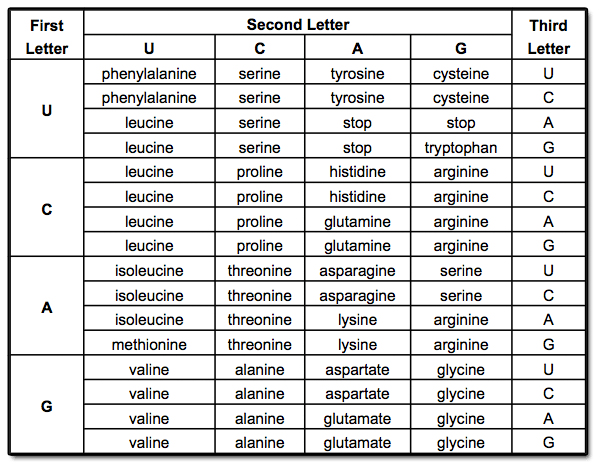
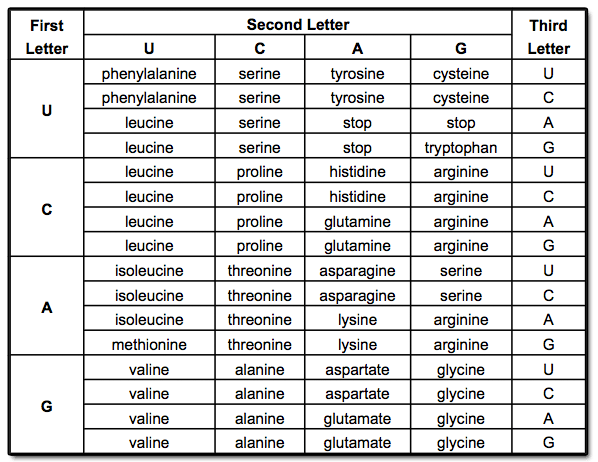
What amino acid is represented by the codon UUA?
a)
Phenylalanine
b)
Tyrosine
c)
Leucine
d)
Stop codon
19.
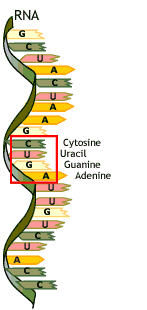
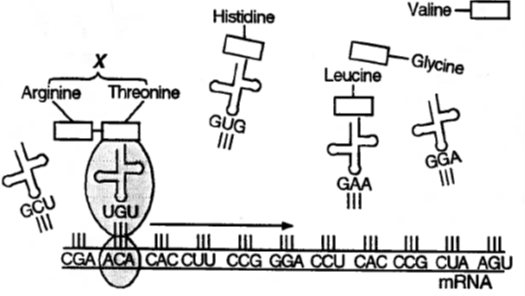
What process is going on in this photo? 
a)
Transcription 
b)
Translation 
c)
Replication 
d)
All the above 
20.
What is the location in the cell for translation?
a)
nucleus
b)
mitochondria
c)
ribosome
d)
chloroplast
21.
What is the location in the cell for transcription?
a)
nucleus
b)
cytoplasm
c)
ribosome
d)
mitochondria
22.
What is the correct amino acid sequence for the mRNA code AUGCCAGUAUGA
a)
Met-Pro-Ala-Val
b)
Met-Pro-Val
c)
Tyr-Gly-His
d)
Tyr-Gly-Arg-His
23.
original chromosome
ABC-DEF
mutated chromosome
AC-DEF
This is a _____________ mutation.
a)
frameshift
b)
point
c)
deletion
24.
original chromosome
ABC-DEF
mutated chromosome
ABBC-DEF
a)
duplication
b)
point
c)
frameshift
25.
original chromosome
ABC-DEF
mutated chromosome
AED-CBF
a)
duplication
b)
translocation
c)
inversion
26.
Are all mutations bad?
a)
Yes
b)
No
27.
What is a codon?
a)
It is a three letter section of bases that are read by ribosomes to stamp amino acids into a protein
b)
They are the codes on the DNA (hence "code-on"
c)
It is a type of mutation that occurs when there has been a substitution, deletion or insertion.
d)
It is a made up word for this quiz. Nice try, Wampler.
28.
Why are insertion and deletion (frameshift) mutations so harmful?
a)
They change all of the codons from the mutation on down the line, which changes the amino acid sequence
b)
They insert things that an organism doesn't need.
c)
They often delete things that organisms need.
d)
Insertion and deletions are not any more harmful than substitution mutations.
29.
WHY must we use RNA if we already have genetic code in DNA?
a)
RNA is portable and can be read by the ribosome
b)
RNA is more accurate than DNA
c)
The cell needs a backup code and uses RNA
d)
DNA and RNA can be used interchangeably 
30.
Where does transcription take place?
a)
nucleus
b)
ribosome
c)
cytoplasm
d)
smooth ER
31.
_______ is made during transCription and ________ is made during transLation.
a)
mRNA / a protein
b)
a protein / mRNA
c)
Ribosome / Nucleus
d)
mRNA / tRNA
32.
Which of the following is NOT a type of RNA
a)
rRNA
b)
mRNA
c)
aRNA
d)
tRNA
33.
Changes is DNA sequences that affect genetic information are known as
a)
replications
b)
mutations
c)
transformations
d)
translations
34.
Genotype refers to the ...
a)
physical expression of the genes
b)
the possible combination of alleles in a gene
c)
whether an allele is dominant or recessive
d)
how an organism will appear
35.
The man who studied genetics and came up with genetics is
a)
Watson
b)
Crick
c)
Mendel
d)
Darwin
36.
An offspring will receive how many alleles from each parent to determine a specific trait?
a)
one
b)
two
c)
three
d)
five
37.
What is a phenotype
a)
The genetic make up (code)
b)
The physical trait
38.

having two of the same alleles for the trait (sometimes called purebred).

a)

homozygous

b)

hetrozygous

c)

protein

d)

chromosome

39.

having two different alleles for a trait (sometimes called hybrid).

a)

protein

b)

homozygous

c)

heterozygous

d)

genotype

40.
An allele whose trait only shows up when no dominant allele is present.
a)
hidden allele
b)
dominant allele
c)
recessive allele
d)
present allele
41.
This is an example of what?
a)
Complete dominance
b)
Incomplete dominance
c)
Codominance
d)
None of the above
42.
Term for homozygous organisms that display two dominant phenotypes at the same time
a)
codominance
b)
incomplete dominance
c)
multiple alleles
d)
linked genes
43.
One form of a gene is called_______________
a)
a DNA
b)
a Phenotype
c)
a trait
d)
an allele
44.
What is the genotype of a person with type A blood, who had a father with type O blood?
a)
AB
b)
AO
c)
AA
d)
OO
45.
Which is a true statement about people with the genotype AB for blood type? 
a)
They can have only type O children
b)
Two of the alleles are codominant (equally expressed).
c)
They exhibit a type O phenotype 
d)
 They are homozygous for blood type A
46.
The genotype for O blood is a great example of a 
a)
recessive genotype
b)
dominant genotype
c)
codominant genotype
d)
incompletely dominant genotype
47.
If a gene is found only on the X chromosome and not the Y chromosome, it is said to be what?
a)
sex-linked trait
b)
polygenic trait
c)
codominant trait
d)
incomplete dominance trait
48.
What would indicate a normal human male?
a)
XX
b)
X
c)
XY
d)
XXY
49.
Hemophilia is a recessive x-linked disorder.  Which genotype represents a female who is a carrier for hemophilia?
a)
XHXh
b)
XhXh
c)
XHXH
d)
XhY
50.
Colorblindness is an X-linked disorder. Can a male ever be a carrier for this disorder?
a)
Yes
b)
No
51.
Colorblindness is a recessive x-linked trait.
Which genotype represents a male with normal vision?
a)
XNXN
b)
XYN
c)
XNY
d)
XnY
52.
Colorblindness is a recessive x-linked disorder.
Which genotype represents a female who is colorblind?
a)
XNXn
b)
XnXn
c)
XNXN
d)
XnY
53.
Meiosis produces cells with a haploid or diploid number of chromosomes?
a)
Haploid
b)
Diploid
54.
Gametes have haploid or diploid number of chromosomes?
a)
Haploid
b)
Diploid
55.
What happens in Meiosis that causes the cells produced to be unique?
a)
Metaphase 2
b)
Interphase
c)
Splitting of Cytoplasm
d)
Crossing Over
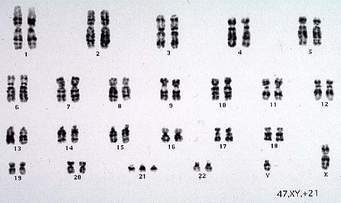
56.
Based on the Karyotype shown, at which chromosome pair can we identify a genetic disorder? 
a)
Chromosome pair 5
b)
sex chromosomes
c)
Chromosome pair 21
d)
There are no chromosomal disorders
57.
This image shows a mutation where the DNA does not divide equally. What is this mutation called?
a)
Point
b)
Nondisjunction 
c)
Substitution
d)
Silent 
58.
Is this trait (the shaded individuals) dominant or recessive?
a)
dominant
b)
recessive
59.
How are individuals III-2 and II-4 related?
a)
Cousins
b)
Dad and Daughter
c)
Uncle and Niece
d)
Grandpa and Granddaughter
60.
Examine the pedigree. The allele for the presence of a widow’s peak is dominant. Therefore, we can tell from the chart that in the couple labeled 2:
a)
the male is heterozygous and the female is homozygous.
b)
the male is homozygous and the female is heterozygous.
c)
the male is homozygous and the female is homozygous.
d)
the male is heterozygous and the female is heterozygous.
61.
Which statement correctly describes meiosis?
a)
cells divide only once
b)
meiosis does not occur in reproductive cells
c)
the cells produced at the end of meiosis are genetically identical to the parent cell
d)
The cells produced at the end of meiosis contain half the number of chromosomes as the parent cell
62.
The process of crossing over occurs in what phase of meiosis?
a)
anaphase 1
b)
prophase 1
c)
prophase 2
d)
telophase 1
63.
Which of these cells would be produced through meiosis?
a)
skin cells
b)
liver cells
c)
brain cells
d)
sperm cells
64.
The chromosomes that pair up during meiosis, are called __________ chromosomes.  
a)
homozygous 
b)
asexual
c)
homologous
d)
genes
65.
Why do we need meiosis?
a)
To double the number of chromosomes going into sex cells
b)
To halve the number of chromosomes going into sex cells
c)
To triple the number of chromosomes going into sex cells
d)
To not change the number of chromosomes going into sex cells
66.
Which of the following is NOT a gamete?
a)
egg
b)
sperm
c)
skin cell
d)
all of the above are gametes
67.
What phase is represented?
a)
metaphase 1
b)
metaphase 2
c)
anaphase 1
d)
anaphase 2
68.
Before cells can divide, what must be copied?
a)
mitochondria
b)
cytoplasm
c)
DNA
d)
Cell Wall
69.
Humans have ________ pairs of chromosomes.
a)
21
b)
23
c)
46
d)
None of the above
70.
In the S stage of interphase_______________
a)
the cell grows
b)
the nucleus divides
c)
the cell membrane divides
d)
the DNA is replicated
71.
The cell spends most of it's life in ________________.
a)
mitosis
b)
cytokinesis
c)
Interphase
d)
None of the above
72.
What is a series of events a cell goes through as they grow and divide?
a)
Cell Division
b)
Cell Cycle
c)
Cytokinesis
d)
Mitosis
73.
Put the following stages of mitosis in order: anaphase, prophase, metaphase, and telophase. 
a)
prophase, metaphase, telophase, anaphase
b)
prophase, anaphase, metaphase, telophase
c)
prophase, metaphase, anaphase, telophase
d)
prophase, telophase, metaphase, anaphase
74.
Why would it be important to replicate DNA before a cell divides in mitosis or meiosis?
a)
In order for genetic information to be transferred into daughter cells.
b)
In order for the cell to be able to increase in size.
c)
In order for the DNA to be contained in the nucleus.
d)
In order for the cell to re-order the DNA sequencing in the new cells.
75.

How can a person's muscle cells have the same exact DNA sequences as their nerve cells even though the look and perform completely different?

a)

The two different cells become mutated

b)

The proteins expressed in each cell are different

c)

They actually have different DNA in the two types of cells.

d)

The genome of the different cells changes

76.
Change over time...
a)
Evolution
b)
Nucleotide 
77.
What is the study of organisms at the early stages of development?
a)
DNA studies
b)
embryology 
c)
extinction
d)
fossil record
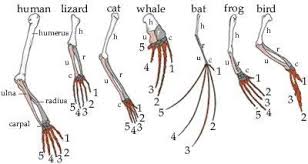
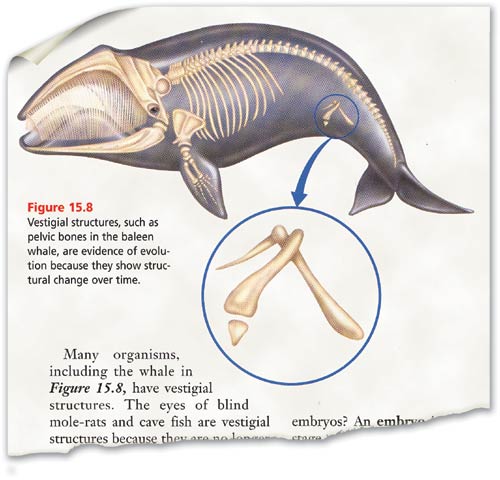
78.
What is this an example of?
a)
vestigial structures
b)
embryology
c)
homologous structures
d)
fossil record
79.
What is a change in an organism that allows for it to survive in its environment?
a)
homologous
b)
vestigial
c)
variation
d)
adaptation
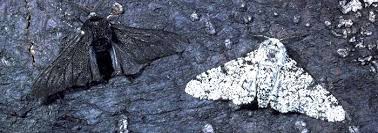
80.
Predict which moth would increase in population
a)
light 
b)
dark
81.
Two organisms that are closely related would have
a)
very similar DNA sequence
b)
exactly the same DNA sequences
c)
no proteins in common
d)
completely different DNA sequence
82.
Which of the following is an example of a vestigial structure?
a)
the wings of a red-tailed hawk
b)
the hind limbs of a house cat
c)
the fins of sharks
d)
the tailbone of a human
83.
Genetic differences between organisms of the same species
a)
Variation
b)
Adaptation
c)
Behavior
d)
Environment
84.
In natural selection, the selective agent is the
a)
humans
b)
mutations
c)
breeders
d)
environment
85.
The table shows the survival rate of two types of beetles in the same environment over a period of three years.  

Which statement about the beetles in this environment is best supported by the data?
a)
Brown beetles have a shorter life cycle than green beetles have
b)
Green beetles are more fit for their environment than brown beetles
c)
 brown beetles are undergo more unfavorable mutations than green beetles
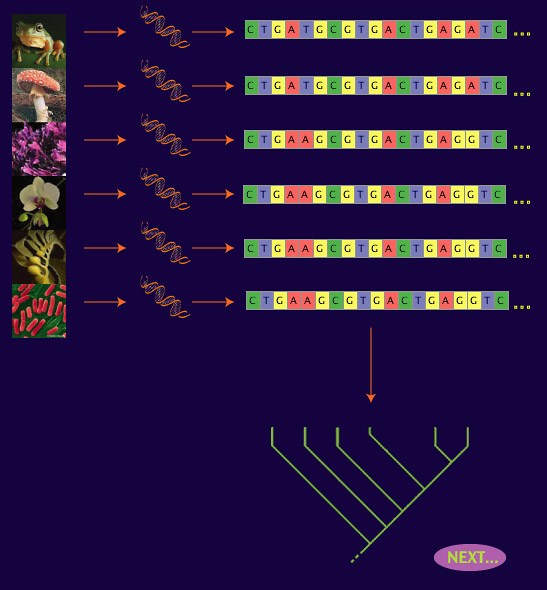
86.
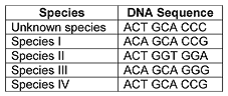
According to this data, the unknown bacterial species is most closely related to: 
a)
Species I
b)
Species II
c)
Species III
d)
Species IV
87.
Darwin referred to this as survival of the fittest. Over time, it results in changes in the inherited characteristics of a population. 
a)
Natural Selection
b)
Genetic Variation
c)
Survival of the Fittest
88.
Same function, different structure
a)
Vestigial Structures
b)
Analogous Structures
c)
Homologous Structures
d)
Adaptation
89.
The diagram shows fossils in different rock layers. Which of these statements about the age of these fossils is most likely correct?
a)
Fossil A and C are the same age
b)
Fossil B is older than fossil C
c)
Fossils A is older than fossil B
d)
Fossil D is older than fossil C
90.
what did Charles Darwin observe in finch populations of the Galapagos Islands off the coast of South America?
a)
different species on different islands
b)
all species on one of the islands
c)
identical species on all the islands
d)
the same species as North America
91.
A flash flood carried a raft of Amazon ants away from their original population. There is enough distance between the two groups, that they will never meet in nature again. What type of reproductive barrier is this?
a)
behavioral isolation
b)
temporal isolation 
c)
gametic isolation
d)
geographic isolation 
92.
The term for the formation of new and distinct species over the course of evolution is...
a)
speciation
b)
biological species concept
c)
reproductive barrier
d)
natural selection
93.
What is a species? 
a)
A group of organisms that can mate with each other and produce fertile offspring. 
b)
A group of organisms that can mate and produce offspring even if those offspring are infertile.
c)
A group of organisms that genetically are very different from each other. 
d)
Indivual organisms that live in the same environment. 
94.
Genetic drift is a process that causes---
a)
The genetic makeup of an entire population to disappear
b)
The genetic makeup of an entire population to be altered
c)
Organisms to better adapt to their environment
d)
Organisms to have the same DNA as their parents
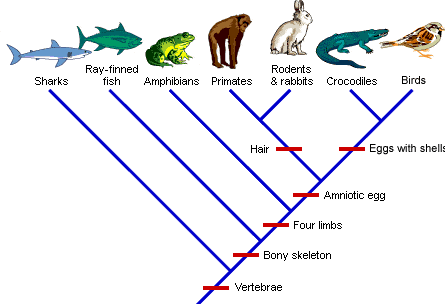
95.
According to this cladogram, sharks are MOST closely related to which organism? 
a)
Amphibians
b)
Ray finned fish
c)
Crocodiles
d)
Birds
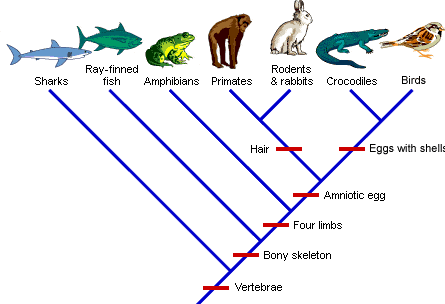
96.
Which two orgainsms have hair? 
a)
Sharks & Ray Finned Fish
b)
Primates & Rodents
c)
Birds & Crocodiles
d)
Rabbits & Birds
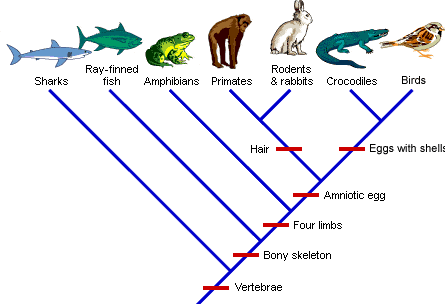
97.
According to this cladogram, birds are LEAST related to: 
a)
Amphibians
b)
Sharks
c)
Ray Finned Fish
d)
Crocodiles
98.
The smallest unit of life that can sustain itself is called...
a)
an organism.
b)
the biosphere.
c)
a population.
d)
a community.
99.
What is it called when a group of the same organisms living together in the same place at the same time?
a)
An organism
b)
A population
c)
A community
d)
A biome
100.
What are groups of different populations living togther in the same place at the same time called?
a)
An organism
b)
A population
c)
A community
d)
A biosphere
101.
What is it called when you have groups of different populations along with their abiotic factors?
a)
An organism
b)
A population
c)
A community
d)
An ecosystem
102.
The temperate decisuous forest, the tropical rain forest, the desert, and the tundra are all examples of...
a)
the biopshere.
b)
biomes.
c)
ecosystems.
d)
communities.
103.
Temperature, light, air, water, and soil are all  _____  parts of the environment
a)
alive
b)
biotic 
c)
abiotic
d)
living
104.

All living things or organisms in an ecosystem are

a)

None

b)

biotic factors

c)

abiotic factors

105.
What is an autotroph?
a)
an organism that can make their own food. 
b)
an organism that cannot make their own food
c)
Herbivore
d)
Omnivore
106.
Which term is synonymous (means the same thing) with consumer?
a)
autotroph
b)
heterotroph
c)
consumer
d)
decomposer
107.
Which of the following is an accurate food chain?
a)
Owl, Grasshopper, Grain
b)
Bird, Fox, Rabbit
c)
Carrot, Rabbit, Fox
d)
Grass, Mice, Bird
108.

Organism that eats both plants and animals

a)

Herbivore

b)

Carnivore

c)

Omnivore

d)

Vegetarian

109.
A frog eats a fly. The frog and fly are demonstrating ________.
a)
mutualism
b)
competition
c)
predator/prey
d)
parasitism
110.

In this Food Web Pyramid Which type of consumer gets only 10% of the energy stored in plants?

a)

Herbivore

b)

Carnivore

c)

Omnivore

d)

Secondary Consumer

111.
A living organism that puts materials from dead  plants and animals back to the soil is called a ____________?
a)
carnivore
b)
decomposer
c)
herbivore
d)
omnivore
112.

Example of a density dependent factor

a)

Natural Disaster

b)

Disease

c)

Climate

d)

Temperature

113.

Example of a density independent factor

a)

Natural Disaster

b)

Disease

c)

Resource Availability/Competition

d)

Predators

114.

A factor that decreases the population or keeps it from increasing

a)

Limiting Factor

b)

Food Surplus

c)

High Birth Rate

d)

Carrying Capacity

115.
What is the carrying capacity of the following graph?
a)
1000
b)
8000
c)
800
d)
600
116.
If the death rate is ______ than the birth rate then the population will ____________.
a)
Greater/Increase
b)
Greater/Decrease
117.
If the birth rate is _________ than the death rate then the population will ____________.
a)
Greater/Increase
b)
Greater/Decrease
118.
Red-billed oxpeckers are birds that feed on parasites found on an impala. The impala gets rid of parasites and the red-billed oxpeckers get a yummy dinner. This is an example of _______.
a)
commensalism
b)
mutualism
c)
neutralism
d)
competition
119.
A relationship between two organisms in which one organism benefits and the other is harmed.
a)
Mutualism 
b)
Competition
c)
Parasitsm 
d)
Commensalism 
120.
A relationship between two organisms in which one organism benefits and the other is unharmed
a)
Mutualism 
b)
Competition
c)
Parasitsm 
d)
Commensalism 
121.
A relationship between two organisms in which both organisms benefit. 
a)
Mutualism 
b)
Competition
c)
Parasitsm 
d)
Commensalism 
122.
Barnacles create home sites by attaching themselves to whales. This neither harms nor benefits the whales.
a)
Mutualsim 
b)
Parasitism 
c)
Commensalism 
123.
the process by which a new community forms where no community lived before 
a)
resource
b)
invasive (non- native) species
c)
primary succession
d)
competition
124.
the first organisms that appear in an ecological community
a)
ecological succession 
b)
primary succession 
c)
secondary succession
d)
pioneer speciles
125.
What functions describes this graph?
a)
Linear
b)
Exponential
c)
neither
126.
An area where an organism finds food, shelter and water in a specific arrangement
a)
niche
b)
biosphere
c)
biome
d)
habitat
127.
Autotrophs make up the _______ level in all ecosystems.
a)
First
b)
Second
c)
Third
d)
Fourth
128.
What is the original source of almost all energy in most ecosystems?
a)
carbohydrates
b)
sunlight
c)
water
d)
carbon
129.
If there is 1000 Kcal available in the producers in trophic level 1, how much energy is available in the herbivores in trophic level 2?
a)
10 Kcal
b)
1 Kcal
c)
100 Kcal
d)
1000 Kcal
130.
What might happen if you remove a primary consumer from the ecosystem?
a)
There would be more food for secondary consumers.
b)
The number of primary consumers would increase.
c)
The number of plants would increase.
d)
The number of secondary consumers would increase.
131.
Which is correct?
a)
the independent variable is distance
b)
the dependent variable is distance
132.
On a graph, which axis shows the independent variable?
a)
x-axis
b)
y-axis
c)
neither
d)
it changes
133.
On a graph, which axis shows the dependent variable?
a)
x-axis
b)
y-axis
c)
neither
d)
it changes
134.
What does biodiversity mean?
a)
Only one species in an area.
b)
The different amount of species in an area
c)
All abiotic life
d)
Nitrogen fixation
135.
The sugar in RNA is ____________________.
a)
deoxyribose
b)
ribose
136.
In living things, this is a system that regulates its internal environment and tends to maintain a stable, constant condition such as body
a)
homeostasis
b)
symbiosis
c)
contractile vacuole
d)
cytoplasmic streaming
137.
Which organic compounds are formed by a sugar bonded to a phosphate and a nitrogenous base?
a)
lipids
b)
proteins
c)
nucleic acids
d)
carbs
138.
I am helpful for long-term energy storage. What am I?
a)
A bodybuilder
b)
A lipid
c)
A carb
d)
A protein
139.
What is cellular respiration?
a)
the breakdown of glucose  to release ATP
b)
the breakdown of glucose to release NADH
c)
the breakdown of glucose to release FADH
d)
the breakdown of glucose to release carbon