wayground logo

Free Printable Worksheets

Font size

S
M
L
XL
Worksheets

IS5 Midterm

Total questions: 141

Worksheet time: 2hrs 10mins
Name
Class
Date
1.
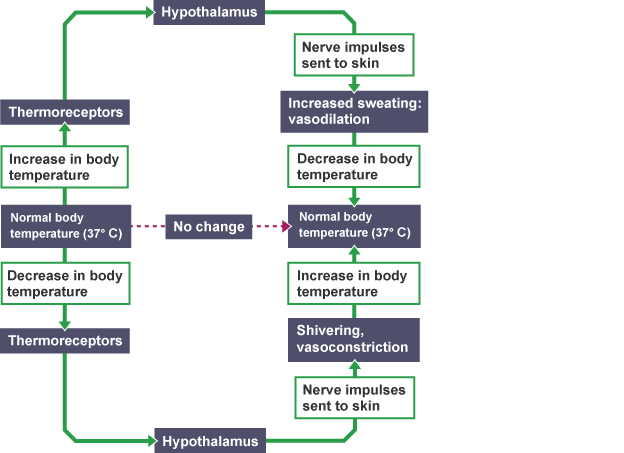
If the environment gets cold, we will often shiver in order to:
a)
keep body temperature the same as the external temperature
b)
decrease body temperature
c)
increase body temperature
d)
regulate blood pressure
2.
Homeostasis in the human body is often maintained by a: 
a)
neutral feedback loop 
b)
solar feedback loop
c)
positive feedback loop
d)
negative feedback loop
3.
The "cause" for something to happen is the
a)
response
b)
effect
c)
stimulus
d)
homeostasis
4.
The "effect" of a given stimulus is the...
a)
response
b)
stimulus
c)
cause
d)
result
5.
a body system that controls and coordinates all body activities through electric impulses/messages between brain, spinal cord and nerves.
a)
endocrine system 
b)
nervous system
c)
nerve
d)
neuron
6.
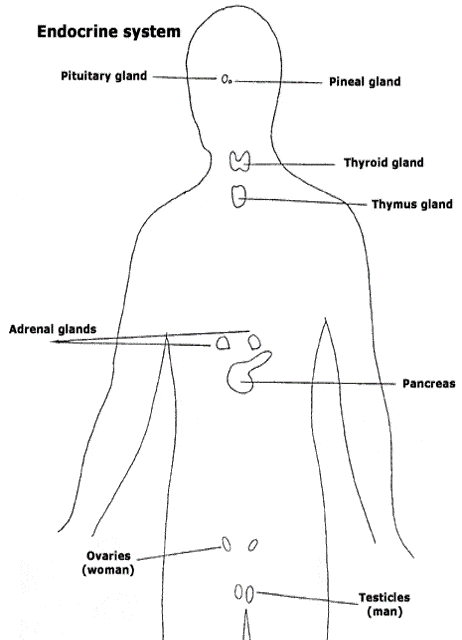
a body system that controls growth and homeostasis by secreting hormones from glands.
a)
skeletal system
b)
nervous system
c)
endocrine sytem
d)
integumentary system
7.
chemical made by glands that tell cells to make something or respond in some way.
a)
acid
b)
enzyme
c)
perspiration
d)
hormone
8.
Name the levels of organization in the human body in order from smallest to largest:
a)
Tissue, organ, organ system
b)
Organ system, tissue, organs, cells
c)
Cells, tissue, organs, organ system
d)
Cells , organs, tissue, organ system
9.
What transports substances around the body?
a)
Blood
b)
Sweat
c)
Tears
d)
Urine
10.
What is the evaporation of a liquid to cool the body?
a)
Shivering
b)
Sweating
c)
Vasodilation
d)
Vasoconstriction
11.
What is involuntary contractions of voluntary muscles to warm up?
a)
Shivering
b)
Sweating
c)
Vasodilation
d)
Vasoconstriction
12.
Which of the following is an example of positive feedback to indirectly maintain homeostasis?
a)
the chemical reactions involved in blood clotting
b)
your blood vessels dilate and you begin to sweat in response to elevated body temperature
c)
your blood vessels constrict and you begin to shiver in response to low body temperature
d)
your coach compliments you on your performance in practice
13.
Homeostasis
a)
allows for a wildly fluctuating internal environment
b)
is impossible in vertebrates
c)
is the maintenance of a relatively stable internal environment and often incorporates a form of feedback regulation
d)
is the maintenance of a relatively stable external environment and often incorporates a form of feedback regulation
14.
Positive feedback is when the change caused by the stimulus is
a)
decreased
b)
non existant
c)
increased
d)
changes constantly
15.
When you are cold, you shiver and your blood vessels contract, which warms you up. When you are hot, you sweat and your blood vessels expand, which cools you down.  
a)
Positive Feedback Response
b)
Negative Feedback Loop 
16.
Water diffusing with the concentration gradient from high water concentration to low water concentration across a cell membrane is....
a)
Facilitated Diffusion
b)
Simple Diffusion
c)
Active Transport
d)
Osmosis
17.
Which diagram represents an organ?
a)
#1
b)
#2
c)
#3
d)
#4
18.
Which is the largest structure?
a)
Cells
b)
Tissue
c)
Organ
d)
Organism
19.
What type of feedback loop is shown?
a)
Positive
b)
Neutral
c)
Negative
20.
What type of feedback loop is shown?
a)
negative
b)
neutral 
c)
positive
21.
Negative Feedback Loops:
a)
amplify processes
b)
prevent small changes from getting larger
c)
are initiated during childbirth
d)
are found only in plants
22.
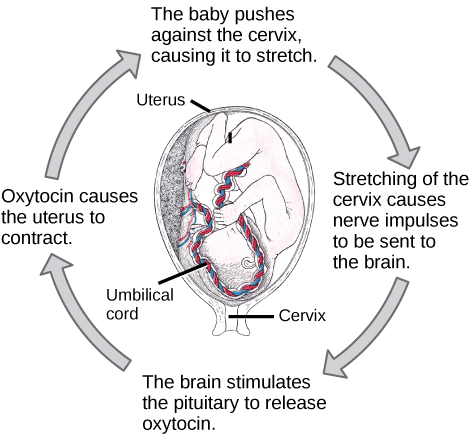
The process of childbirth is an example of:
a)
negative feedback loop
b)
positive feedback loop
23.
Rapid growth during puberty causes your body to release more and more growth hormones. As you grow, more and more growth hormones are released until puberty is reached, and then the hormones stop.
a)
Positive Feedback Response
b)
Negative Feedback Loop 
24.
If the calcium in your blood decreases below homeostasis levels, a gland in the brain will sense the decrease and send a chemical message to your bones. Your bones will release calcium into the blood, bringing blood calcium levels back up.
a)
Positive Feedback Response
b)
Negative Feedback Loop 
25.
As you get dehydrated, your blood becomes thicker and harder to pump. Your kidneys will respond by stopping urine production, sending the water from urine into your bloodstream to thin your blood back to normal level.
a)
Positive Feedback Response
b)
Negative Feedback Loop 
26.
You put a cell into a solution, the cell grows. Is the solution hypotonic or hypertonic to the cell? 
a)
hypertonic
b)
hypotonic
c)
isotonic
d)
not enough information
27.
The cell below is in a _________ solution.
a)
Hypotonic
b)
Hypertonic
c)
Isotonic
28.
The cell below is in a _____________ solution.
a)
Hypertonic
b)
Hypotonic
c)
Isotonic
29.
This egg has shrunk, what type of solution was it placed in?
a)
hypotonic solution
b)
hypertonic solution
c)
isotonic solution
d)
active transport
30.
What type of solution is this cell in?
a)
Isotonic
b)
Hypertonic
c)
Hypotonic
d)
diffused
31.
What type of solution is this cell in?
a)
Isotonic
b)
Hypertonic
c)
Hypotonic
d)
diffused
32.
What type of solution is this cell in?
a)
Isotonic
b)
Hypertonic
c)
Hypotonic
d)
diffused
33.

What is DIFFUSION?

a)
b)
c)
d)
34.

What is OSMOSIS?

a)
b)
c)
d)
35.

Your friend secretly sprays perfume 10 feet away. Soon you can smell the perfume because of...

a)

Diffusion

b)

Osmosis

c)

Equilibrium

d)

Concentration

36.
The joining of a sperm cell and an egg cell is called...
a)
Fertilization
b)
Labor
c)
Zygote
d)
STOP ASKING ME THESE IMPOSSIBLE QUETSIONS!!
37.

Which of the following sequences represents the correct order of events in the formation of a human fetus?

a)

Zygote → Blastocyst → Embryo → Fertilization

b)

Fertilization → Zygote → Blastocyst → Embryo

c)

Blastocyst → Embryo → Differentiation → Zygote

d)

Fertilization → Growth → Differentiation → Zygote

38.
Which of the following is true of a zygote?
a)
It forms into a blastocyst
b)
It is an unfertilized egg
c)
It produces haploid male gametophytes
d)
It is made up of only one cell
39.
The diagram below shows a cellular process that occurs in organisms.
What is the name of this process?
a)
meiosis
b)
mitosis
c)
endocytosis
d)
phagocytosis
40.
The diagram below shows homologous chromosomes during prophase I of meiosis
Which of the following correctly describes the process being illustrated?
a)
mutation in which the DNA content of the gene is altered
b)
segregation of sister chromatid
c)
condensation and segregation of alleles
d)
crossing-over in which alleles are exchanged
41.
This is the hollow sphere that contains a clump of cells which develops into the baby. These cells are Embryonic Stem Cells
a)
fertilization
b)
zygote 
c)
blastocyst 
d)
egg
42.
Gametes are haploid
a)
True
b)
False
43.
What are the tiny structures that carry out jobs inside cells called?
a)
membranes
b)
nucleus
c)
organelles
d)
animalicules
44.
This structure controls what can enter and leave a cell.
a)
Nucleus
b)
Cytoplasm
c)
Cell Membrane
d)
Golgi Body
45.
What is a stem cell?
a)
a cell that has a stem
b)
an unspecialized cells from which differentiated cells develop 
c)
cells that are found in plant stem
d)
cells that are found in bacteria only
46.
All organisms start life as__________?
a)
a developed embryo
b)
a blastocyst 
c)
one cell
d)
pluripotent cells 
47.
structure A is?
a)
inner cell mass
b)
totipotent cell
c)
 white blood cell
d)
a blastocyst
48.
Why might stem cell research lead to a cure for diabetes?
a)
Use stem cells to grow pancreas cells that make insulin
b)
Use stem cells to make babies that do not have diseases
49.
What are iPS cells, and what do they mean to stem cell research?
a)
Induced purpose stem cells, mean embryo cells were made into adult-like cells
b)
Induced purpose stem cells, mean adult cells were reversed to baby cells
c)
Induced pluripotent stem cells, mean adult cells were made into embryo-like cells
d)
Induced pluripotent stem cells, mean cells were totipotent and are now pluripotent
50.
What is the difference between embryonic stem cells and adult stem cells?
a)
Embryonic stem cells can differentiate into more cell types than adult stem cells
b)
Adult stem cells are pluripotent, just like embryonic stem cells
c)
Adult stem cells can differentiate into more cell types than embryonic stem cells
d)
Adult stem cells grow bigger than embryonic stem cells
51.
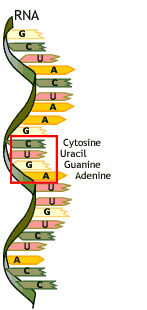
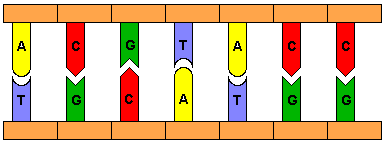
In RNA, Uracil pairs with ______. 
a)
cytosine
b)
adenine
c)
guanine
d)
thymine
52.
The process to go from DNA to mRNA is _______
a)
translation
b)
transcription
c)
replication
53.
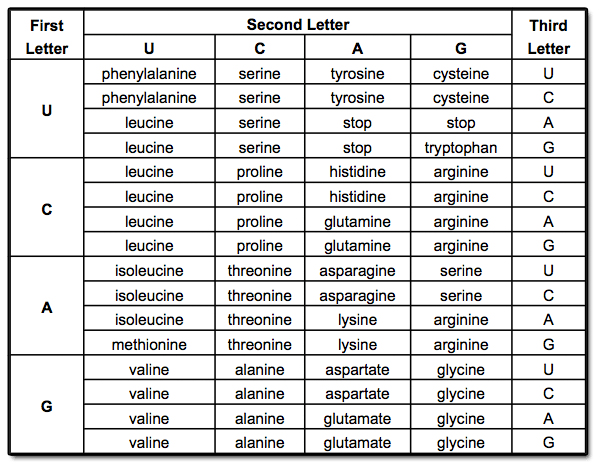
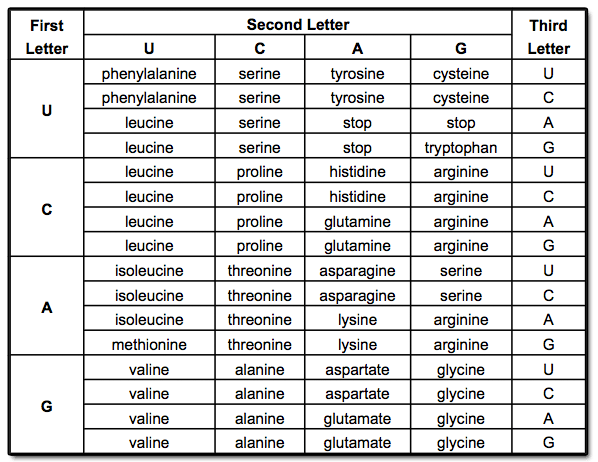
What amino acid is represented by the codon UUA?
a)
Phenylalanine
b)
Tyrosine
c)
Leucine
d)
Stop codon
54.
Which component of DNA determines the traits of an organism? 
a)
Nitrogen Bases
b)
Sugar-Phosphate Backbone
c)
Hydrogen bonds
55.
What is the location in the cell for transcription?
a)
nucleus
b)
cytoplasm
c)
ribosome
d)
mitochondria
56.
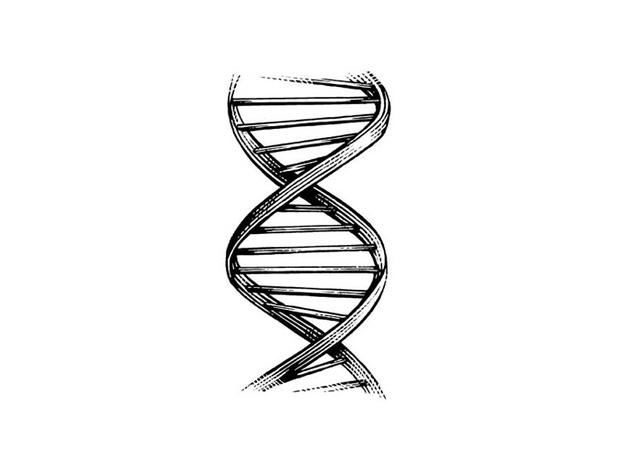
DNA has a _____________ structure. 
a)
double helix
b)
single strand
c)
ring 
d)
chain
57.
In DNA, Adenine pairs with ___________. 
a)
Guanine
b)
Cytosine
c)
Thymine
d)
Uracil
58.
What is the correct amino acid sequence for the mRNA code AUGCCAGUAUGA
a)
Met-Pro-Ala-Val
b)
Met-Pro-Val
c)
Tyr-Gly-His
d)
Tyr-Gly-Arg-His
59.
How many amino acids are coded for by this sequence of nucleotides:
ATG GGA ACT CCA
a)
4
b)
2
c)
6
d)
12
60.
The enzyme that produces RNA in Transcription is called
a)
RNA Polymerase
b)
DNA Polymerase
c)
Transcriptase
d)
RNA Intrase
61.
tRNA molecules match the mRNA codons with a(n):
a)
Codon
b)
Anti-Codon
c)
Intron
d)
Methylated Cap
62.
The codon 5'-UAC-3' would have an anti-codon match:
a)
3'-AUG-5'
b)
3'-TAC-5'
c)
5'-AUG-3'
d)
5'-CAU-3'
63.
When the Ribosome reaches ________________ the process of translation stops
a)
Stop Codon
b)
Okazaki Fragment
c)
Terminator
d)
taq Polymerase
64.
Translation is a process that produces
a)
mRNA
b)
Protein
c)
Polypeptide Chains
d)
tRNA
65.
RNA contains which bases?
a)
adenine, guanine, uracil, cytosine
b)
thymine, guanine, cytosine, uracil
c)
thymine, uracil, cytosine, guanines
d)
adenine, uracil, guanine, thymine
66.
21 nucleotides will provide how many codons?
a)
3 amino acids
b)
5 amino acids
c)
7 amino acids
d)
9 amino acids
67.
What type of mutation occurs, when a base is subtracted from the sequence? 
a)
Deletion
b)
Insertion
c)
Substitution 
68.
Which of the following are monomers of proteins?
a)
monosaccharides
b)
nucleotides
c)
amino acids
d)
fatty acids
69.
What is one characteristic that is true about both DNA and RNA?
a)
single stranded
b)
contain genes
c)
have the base uracil
d)
used as a template
70.
A boy inherits genes for tallness, but his growth is limited as a result of poor nutrition. This is an example of - 
a)
environmental influence on gene expression 
b)
expression of a hidden trait
c)
an inherited disorder
71.
Why are insertion and deletion (frameshift) mutations so harmful?
a)
They change all of the codons from the mutation on down the line, which changes the amino acid sequence
b)
They insert things that an organism doesn't need.
c)
They often delete things that organisms need.
d)
Insertion and deletions are not any more harmful than substitution mutations.
72.
This type of substitution codes for a stop codon
a)
Missense
b)
Nonsense
c)
Silent
d)
Deletion
73.
A type of substitution in which no  amino acids change is called 
a)
Missense
b)
Nonsense
c)
Silent
d)
Deletion
74.
What genetic disorder causes the body to produce unusually thick mucus in the lungs and intestines? 
a)
Cystic Fibrosis
b)
Sickle Cell
c)
Down Syndrome
d)
Hemophilia
75.
What does Cystic Fibrosis affect?
a)
The brain, the lymph nodes, and the immune system.
b)
The heart, the lungs, and the circulatory system
c)
The intestines, the pancrease, and the lungs
d)
Nerves and arteries
76.
A prion is a kind of protein.
a)
True
b)
False
77.
A prion is not properly ___________.
a)
folded
b)
baked
78.
Does the structure (shape) of a protein affect the function (what it does)?
a)
Yes
b)
No
79.
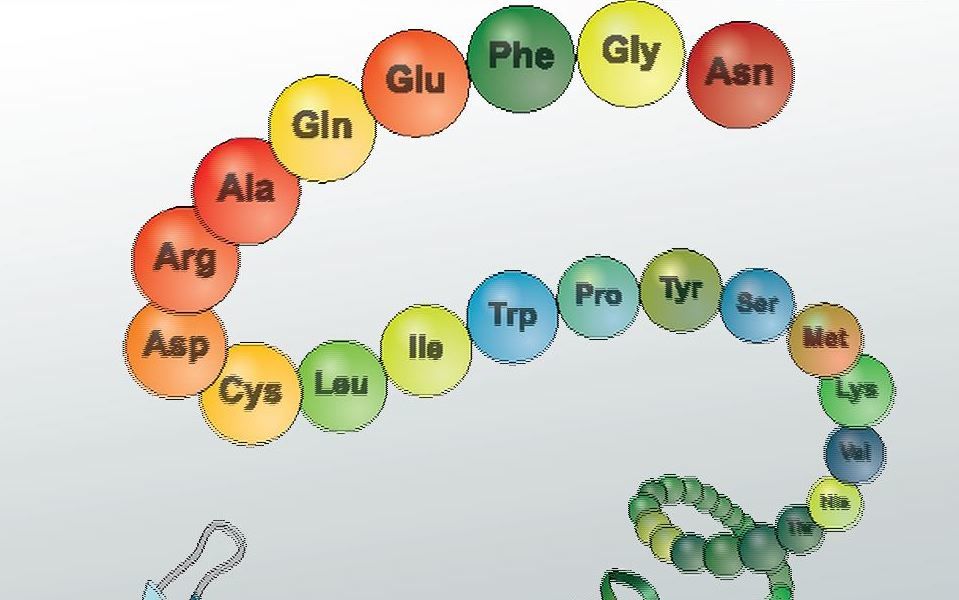
The name of the initial chain of monomers in a protein is called.....
a)
polypeptide
b)
polysaccharide
c)
polyester
d)
polynucleotide
80.
Which process is shown?
a)
diffusion
b)
repiration
c)
recombination
d)
translation
81.
What is the relationship between a protein, the cell, and DNA?
a)
DNA is produced by protein which is produced in the cell
b)
Protein is composed of DNA which is produced in the cell
c)
DNA controls the production of protein in the cell
d)
A cell is composed of DNA and protein
82.
The diagram shows the process of
a)
Transcription
b)
Translation
c)
Replication
d)
Mitosis
83.
Which of the following mutations would be MOST likely to have a harmful effect on an organism?
a)
a deletion of three nucleotides near the middle of a gene.
b)
a single nucleotide deletion in the middle of an intron.
c)
a single nucleotide deletion near the end of a coding sequence.
d)
a single nucleotide insertion downstream of, and close to, the start of the coding sequence.
84.
Which enzyme is responsible for adding nucleotides?
a)
Topoisomerase
b)
DNA Polymerase
c)
Ligase
d)
Primase
85.
In what phase of the cell cycle does DNA replication take place?
a)
G1
b)
S
c)
G2
d)
M
86.
If the percentage of DNA is made of 30% Thymine, what is the correct percentage of Guanine?
a)
30
b)
15
c)
20
d)
60
87.
Replicate the following strand of DNA: 
AATCATGGA
a)
AATCATGGA
b)
TTAGTACCT
c)
UUAGUACCU
d)
GGATAUCUA
88.
The enzyme that unzips the DNA to prepare for replication
a)
helicase
b)
replicase
c)
polymerase
d)
synthase
89.
The nucleic acid DNA is composed of
a)
sugar, protein, and nitrogenous bases.
b)
protein, nitrogenous bases, and phosphate.
c)
nitrogenous bases, phosphate, and RNA.
d)
sugar, phosphate, and nitrogenous bases.
90.
During what phase of the cell cycle does the cell prepare for mitosis?
a)
G1 phase
b)
S phase
c)
G2 phase
d)
M phase
91.
where can totipotent cells be found?
a)
heart cells
b)
bone marrow
c)
inner cell mass
d)
fertilized egg
92.
Which  is of the following is not an example of cell differentiation? 
a)
Stem cells from bone marrow develop into blood cells
b)
Bone marrow cells are used to repair damage to heart tissue
c)
a leaf cell divides as a plant leaf grows
d)
A fertilized egg develops limbs and a hand
93.
Medical researchers are interested in stem cells because they?
a)
are found in all types of tissues
b)
can produce different cells types
c)
are highly specialized
d)
are found only in embryos
94.
The process by which cells become specialized is known as?
a)
stem cell research
b)
embryonic development 
c)
totipotent cell strucutre
d)
cell differentiation 
95.
What is a stem cell?
a)
a cell that has a stem
b)
an unspecialized cells from which differentiated cells develop 
c)
cells that are found in plant stem
d)
cells that are found in bacteria only
96.
Adult stem cells are?
a)
mutlipotent
b)
pluripotent
c)
totipotent
d)
isopotent 
97.
Which best explains why muscle cells are different from blood cells?
a)
Muscle cells are produced by the brain, but blood cells are produced by the heart. 
b)
Different genes are activated in muscle cells than in blood cells. 
c)
Muscles cells experience different environmental influences than blood cells. 
d)
A mutation occurs during the development of muscle cells but not in blood cells. 
98.
This type of cell sends messages throughout the body in the form of electrical impulse.
a)
nerve cell
b)
sperm cell
c)
muscle cell
d)
skin cell
99.
This type of cell carries oxygen throughout the body.
a)
gamete
b)
platelet
c)
white blood cell
d)
red blood cell
100.

controls the opening or closing of pores to allow gas exchange

a)

chloroplasts

b)

guard cells

c)

xylem

d)

phloem

101.
What makes Stem Cells different from differentiated (specialized) cells?
a)
Stem cells are smaller than differentiated cells
b)
differentiated cells have just one job - Stem cells can become any type of cell
c)
Stem cells contain more DNA than differentiated cells
d)
differentiated cells divide faster than stem cells
102.
The ___________ is the basic unit of life
a)
organ
b)
cell
c)
atom
d)
tissue
103.
A group of tissues that work together to perform a similar function is called_____. (Examples include the heart, lungs or stomach)
a)
cells
b)
tissues
c)
organs
d)
organ system
104.
 A group of cells that have similar functions? Examples are nervous, epithelial, muscle and connective
a)
cells
b)
tissues
c)
organs
d)
atoms
105.
Organs that work together to perform a related function is called _____________?
a)
cells
b)
tissues 
c)
organ system
d)
organs
106.
When many organ systems work together it can form...
a)
organ
b)
cells
c)
organ system
d)
organism 
107.
This is a example of........ 
a)
organ system
b)
cells
c)
organ
d)
tissue
108.
This is a example of ........
a)
cell
b)
organ system
c)
organ
d)
tissue
109.
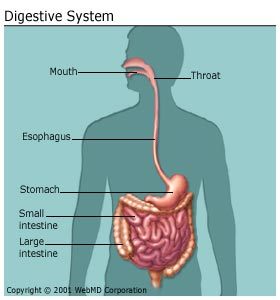
The brain is a part of which organ system?
a)
nervous
b)
skeletal
c)
muscular
d)
digestive 
110.
The lungs and the kidneys are examples of
a)
cells
b)
organs
c)
tissues
d)
organ systmes
111.
a)
Cell
b)
Tissue
c)
Organ
d)
Organ System 
112.
Which of the following are listed in the correct order?
a)
Cells- Tissues- Organs- Organ Systems
b)
Cells-Organs-Tissues- Organ Systems
c)
Organs-Organisms-Animals-World
d)
Cells- Organs- Organisms- Tissues
113.
Which of the following is an example of an organ system?
a)
A heart and brain
b)
A lung
c)
Hair
d)
A skeleton
114.
Muscle tissue
a)
Is tissue that functions in lining and covering
b)
Is tissue involved in protecting, supporting, and binding together other body tissues
c)
Is tissue that contracts and shortens to produce movement 
d)
Tissue that receives and conducts electrochemical impulses from one part of the body to another
115.
Connective tissue is
a)
The tissue that supports, and binds together other body tissue
b)
Tissue that is the lining and covering tissue of the body
c)
Tissue that contracts and shortens to produce movement
116.
Epithelial tissue is
a)
Bone, cartilage,dense connective tissue, loose connective tissue, and blood
b)
Highly specialized tissue that contracts or shortens to produce movement
c)
Lining and covering tissue of the body
117.
Nervous tissue
a)
Tissue that is responsible for lining and covering 
b)
Tissue responsible for protecting, supporting, and binding together other body tissues
c)
Tissues that contracts and shortens to produce movement
d)
Tissue that receives and conducts electrochemical impulses from one part of the body to another
118.
CRISPR can change DNA in humans and animals.  What did scientists look at to help them create CRISPR?
a)
Sheep cloning
b)
Palindromic repeats
c)
Common Cold
d)
Bacteria fighting off viruses
119.
In a punnet square where are the parent alleles written?
a)
Top and inside the boxes
b)
Only on the left and right side of the boxes. 
c)
outside of the boxes (top and left side)
d)
All on the top side of the boxes
120.
Each one of the boxes on the Punnett Square represents what probability of an offsprings' genotype?
a)
25%
b)
1%
c)
10%
d)
0%
121.
Aa, DD, bB, yy are all examples of
a)
genotypes
b)
phenotypes
122.
AA and Aa always show up as
a)
dominant
b)
recessive
123.
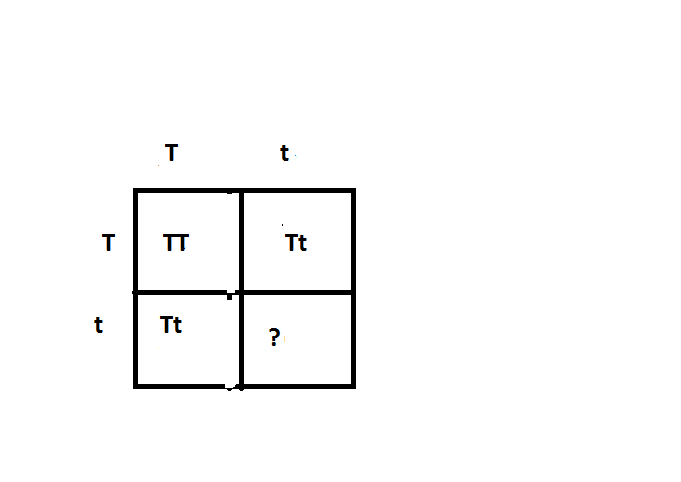
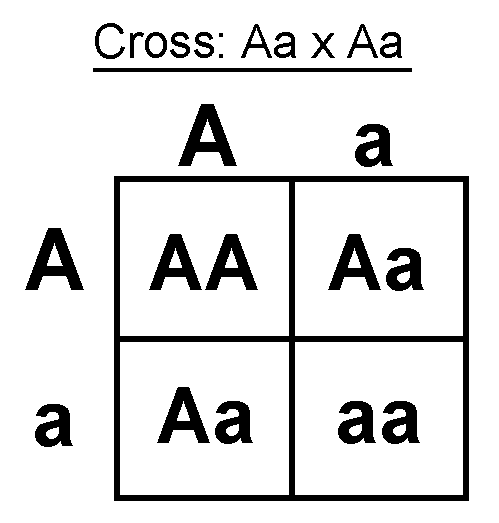
T - tall and t = short
In the punnett square below, what belongs in the missing square
a)
tt
b)
Tt
c)
Bb
d)
TT
124.
What is the phenotype of the offspring? (A-Brown hair; a-blond hair) 
a)
50 % Brown Hair and 50% Blond Hair 
b)
25 % Brown Hair and 75% Blond Hair 
c)
75 % Brown Hair and 25% Blond Hair 
d)
0% Brown Hair and 100% Blond Hair 
125.
How many alleles (letters) do each person carry for a trait?
a)
1
b)
2
c)
3
d)
4
126.
Aa is
a)
homozygous
b)
heterozygous
127.
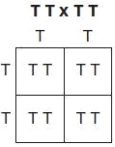
What ratio of the offspring from the cross shown will be homozygous recessive for the  trait of tallness? 
a)
0 in 4
b)
1 in 4
c)
2 in 4
d)
4 in 4
128.
In a flowering plant species, red flower color (R) is dominant over white flower color (r). What is the genotype of any red-flowering plant resulting from this species?
a)
rr
b)
R
c)
RR
d)
RR or Rr
129.
This is an example of ___________?
a)
Incomplete dominance
b)
Co-Dominance
130.
This is an example of ___________.
a)
 Incomplete Dominance
b)
 Codominance
131.
What type of inheritance do two alleles have if their traits blend together? 
a)
Incomplete Dominance
b)
Co-Dominance
132.
A calico cat shows both the traits for orange fur and black fur. What kind of allele expression is this?
a)
Incomplete Dominance
b)
Co dominance
133.
This is an example of ___________.
a)
Incomplete Dominance
b)
Codominance
134.
Which of the following is not an assumption required for Hardy-Weinberg equilibrium?
a)
Random mating
b)
No mutations
c)
Population size must fluctate
d)
No selection is occuring
135.
In the Hardy-Weinberg theorem, p refers to what?
a)
The frequency of the dominant allele.
b)
The frequency of the homozygous genotype.
c)
The frequency of the recessive allele.
d)
The frequency of the homozygous dominant.
136.
What is the best explanation for a population being described as an evolutionary unit?
a)
Population can evolve, not individuals
b)
Natural selection only involves individuals, not populations
c)
Genetic changes only occur in populations
d)
A population's gene pool remains the same throughout time
137.
The Hardy-Weinberg Model is?
a)
Available at local hobby stores and retailers throughout the Greater Cleveland area.
b)
A mathematical tool that biologists can use to predict allele frequencies and determine whether or not evolution is occurring within a population.
c)
Always occurring within populations of organisms in nature.
d)
Only useful in the lab and cannot be practically applied to real-world populations of organisms.  
138.
Which of the following is NOT a condition for Hardy-Weinberg Equilibrium?
a)
No mutations
b)
Random Mating
c)
No natural selection
d)
No offspring
139.
What does the Hardy-Weinberg equilibrium measure?
a)
changes in allele frequencies
b)
numbers of mutations
c)
goodness of fit
d)
genetic diversity
140.
When a population is in Hardy-Weinberg Equilibrium.  What is not happening to the species?
a)
Survival
b)
Reproduction
c)
Death
d)
Evolution
141.

If global climate changed to no snow where the snowshoe hare lives, what will probably happen to the snowshoe hare's fur color in the winter (after several generations)?

a)

The fur will stay white

b)

The fur will be brown all year

c)

The snowshoe hare will not be affected at all

d)

The fur will be light brown.