wayground logo

Free Printable Worksheets

Font size

S
M
L
XL
Worksheets

Protein Synthesis Test- CP Biology

Total questions: 143

Worksheet time: 2hrs 48mins

Name
Class
Date
1.
The mRNA leaves the ________ to find the ribosome to make proteins.
a)
cell
b)
nucleotide
c)
nucleus
2.

Which organelle is the location where protein is made?

a)

Ribosome

b)

Nucleus

c)

Cytoplasm

d)

Nucleotide

3.

Which organelle is the location where protein is made?

a)

Ribosome

b)

Nucleus

c)

Cytoplasm

d)

Nucleotide

4.

During transcription, this type of ribonucleic acid is responsible for copying the DNA and brining it out of the nucleus.

a)

tRNA

b)

mRNA

c)

rRNA

d)

dRNA

5.

When these bond together, they form a protein

a)

Amino Acids

b)

Peptide Bonds

c)

Ribose

d)

Nucleotides

6.

These building blocks consist of a sugar, phosphate, and nitrogen base.

a)

Ribose

b)

Nucleotide

c)

Gene

d)

Protein

7.

Which of the following is the complementary mRNA sequence to this DNA strand: AACTGAA

a)

UUGACUU

b)

TTGACTT

c)

AACTGAA

d)

AACUGAA

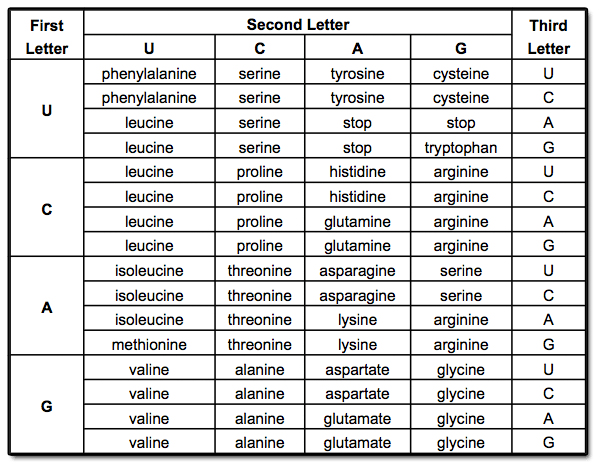
8.
The process to go from mRNA to a protein is called ____
a)
transcription
b)
rRNA
c)
replication
d)
translation
9.
What amino acid is represented by the codon UUA?
a)
Phenylalanine
b)
Tyrosine
c)
Leucine
d)
Stop codon
10.
A sugar, a phosphate group, and a nitrogen base form the building blocks of which organic compound?
a)
carbohydrates
b)
nucleic acids
c)
lipids
d)
proteins
11.
Which of the following is the template for the production of RNA within a cell?
a)
DNA
b)
protein
c)
ATO
d)
carbohydrate
12.

Genetic informstion flows in one direction. Which best represents this flow?
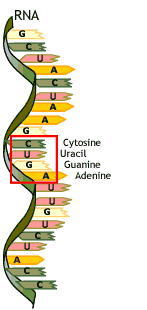
a)
DNA-protein-RNA
b)
Protein-RNA-DNA
c)
RNA-protein-DNA
d)
DNA-RNA-protein
13.
In RNA, Uracil pairs with ______. 
a)
cytosine
b)
adenine
c)
guanine
d)
thymine
14.

Why must transcription occur where DNA can be found?

a)

because DNA can't leave

b)

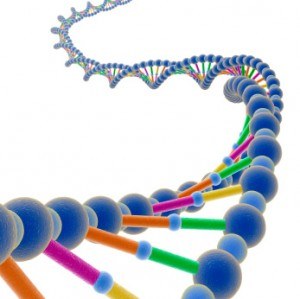
because ribosomes are in the nucleus

c)

because DNA polymerase is found there

d)

because helicase unzips the DNA

15.
What is the location in the cell for translation?
a)
nucleus
b)
mitochondria
c)
ribosome
d)
chloroplast
16.
Which two processes are involved in protein synthesis?
a)
Replication and Transcription
b)
Replication and Translation
c)
Transcription and Translation
17.
Which of the following molecules is made during transcription?
a)
DNA
b)
tRNA
c)
protein
d)
mRNA
18.
Which of the following bases is found only in RNA?
a)
Adenine
b)
Guanine
c)
Thymine
d)
Uracil
19.
Which form of RNA carries amino acids from the cytoplasm to the ribosome?
a)
amino RNA
b)
ribosomal RNA
c)
transfer RNA
d)
messenger RNA
20.
Transcribe the following sequence of DNA into RNA:
AAG   CTT   TGC
a)
TTC  GAA  ACG
b)
UUC  GAA ACG
c)
TTC  GUU  UCG
d)
UUC  GUU  UCG
21.
What would be the complementary DNA strand for the following nucleotide sequence?
TCG ATA CGA
a)
AGC ATA GCT
b)
AGC TAT GCT
c)
AGC UAU GCU
d)
UGC TUT GCT
22.

Proteins are chains of amino acids bonded together. Which is the correct sequence for making proteins?

a)

Information is DNA is transferred into RNA and then made into protein

b)

Information in DNA is formed into protein directly.

c)

Information in RNA mutates into DNA and then is made into protein

d)

Information in RNA uses thermal energy to make protein

23.
Cytosine always pairs with
a)
Adenine
b)
Thymine
c)
Uracil
d)
Guanine
24.
Which organelle is DNA usually found in?
a)
cell membrane
b)
vacuole
c)
ribosome
d)
nucleus
25.
Genetic info flows in one direction. Which best represents this flow?
a)
DNA-protein-RNA
b)
Protein-RNA-DNA
c)
RNA-protein-DNA
d)
DNA-RNA-protein
26.
The process to go from DNA to mRNA is _______
a)
translation
b)
transcription
c)
replication
27.
The process to go from mRNA to a protein is called ____
a)
transcription
b)
rRNA
c)
replication
d)
translation
28.
What amino acid is represented by the codon UUA?
a)
Phenylalanine
b)
Tyrosine
c)
Leucine
d)
Stop codon
29.
Which of the following cell types is formed by meiosis?
a)
muscle cells
b)
skin cells
c)
sperm cells
d)
blood cells
30.
Which statement correctly describes meiosis?
a)
Cells divide only once.
b)
Meiosis does not occur in reproductive cells.
c)
The cells produced at the end of meiosis are genetically identical to the parent cell.
d)
The cells produced at the end of meiosis contain half the number of chromosomes as the parent cell.
31.
Which best describes the process shown?
a)
nondisjunction
b)
mitosis
c)
independent assortment
d)
crossing over
32.
If an intestinal cell in a butterfly contains 24 chromosomes, a butterfly egg would contain ____ chromosomes.
a)
3
b)
6
c)
12
d)
24
33.
A male shark has 40 chromosomes in each of its sex cells. How many would be present in its body cells?
a)
20
b)
40
c)
80
d)
160
34.
The haploid number of chromosomes for humans is ____.
a)
46
b)
43
c)
23
d)
26
35.
How many times in meiosis does the cell divide?
a)
2
b)
4
c)
3
d)
1
36.
The result of meiosis is ______.
a)
two diploid cells
b)
two haploid cells
c)
four diploid cells
d)
four haploid cells
37.
Which process produces the most variation within a species? 
a)
mitosis
b)
cloning
c)
meiosis
d)
asexual reproduction
38.
The fertilized egg is termed a/an _____.
a)
gamete
b)
allele
c)
homolog
d)
zygote
39.
In mitosis cells are genetically _______, but in meiosis cells are genetically ______.
a)
diverse, identical
b)
identical, diverse/different
40.

Mitosis makes sure that all daughter cells are _____.

a)

genetically identical, diploid

b)

genetically identical, haploid

c)

genetically diverse, diploid

d)

genetically diverse, haploid

41.
If a diploid organism has a genome consisting of 22 chromosomes, its gametes will have ___ chromosomes
a)
44
b)
22
c)
11
d)
20
42.

The process of decoding a mRNA message into a protein is known as ...

a)

transcription

b)

translation

c)

replication

d)

prescription

43.

Genetic information is transcribed from nucleotide sequences from __________ to __________.

a)

mRNA, DNA

b)

DNA, mRNA

c)

DNA, tRNA

d)

tRNA, mRNA

44.

How many bases long is a single codon?

(a)  

45.

Proteins are made by joining amino acids together into long chains called ...

a)

polypeptides

b)

amino acids

c)

nucleic acids

d)

carbohydrates

46.

In mRNA, what does each codon specify?

a)

a nucleotide

b)

an amino acid

c)

an enzyme

d)

an intron

47.

True or false

Ribosomes use the sequence of codons in mRNA to assemble amino acids into polypeptide chains.

a)

True

b)

False

48.

The specific amino acids in a polypeptide and the order in which they are joined determine ...

a)

the properties of a nucleic acid

b)

the properties of a protein

c)

the properties of a ribose sugar molecule

49.

How many different amino acids does the genetic code contain?

a)

3

b)

64

c)

20

d)

23

50.

Where does translation take place?

(a)  

51.

A codon cannot specify more than one amino acid.

a)

True

b)

False

52.

Each tRNA molecule has three unpaired bases, collectively called the ...

a)

codon

b)

anticodon

c)

polypeptide

53.

What is the central dogma of molecular biology?

a)

RNA -> DNA -> Protein

b)

Protein -> RNA -> DNA

c)

DNA -> RNA -> Protein

d)

DNA -> Protein -> RNA

54.

The way DNA, RNA, and proteins put together genetic information into action in cells is ...

a)

transciption

b)

gene suppresion

c)

gene replication

d)

gene expression

55.

When is a polypeptide complete?

a)

When a ribosome reaches a anticodon.

b)

When a ribosome reaches a stop codon.

c)

When introns are removed from the mRNA molecule.

56.

How confident are you in your knowledge of protein synthesis?

a)

Not confident, yet. I need to study more and ask for help.

b)

Somewhat confident, but I need to study to learn more.

c)

I am confident in my knowledge and ready for the test!

d)

I am so confident that I could teach my peers about it!

57.

In what process is mRNA synthesized?

a)

Transcription

b)

Translation

c)

DNA Replication

d)

Mitosis

58.
The mRNA leaves the ________ to find the ribosome to make proteins.
a)
cell
b)
nucleotide
c)
nucleus
59.

Why must transcription occur in the nucleus?

a)

because DNA can't leave the nucleus

b)

because ribosomes are in the nucleus

c)

because DNA polymerase is found there

d)

because helicase unzips the DNA

60.

How are DNA and RNA different? (CHECK ALL THAT APPLY)

a)

Only DNA can leave the nucleus

b)

RNA contains Thymine; DNA contains Uracil

c)

DNA is double stranded, RNA is a single stranded

d)

DNA contains Thymine, RNA contains Uracil

61.

Which organelle contains rRNA and reads the mRNA to synthesize a protein?

a)

Ribosome

b)

Nucleus

c)

Cytoplasm

d)

Nucleotide

62.

Choose the sequence of the mRNA strand that would match up with to the following DNA strand:

GTACAT

a)

CATGTA

b)

GAUCUA

c)

CAUGUA

d)

CUTGTU

63.

What brings the amino acids to the ribosome to assemble a protein?

a)
mRNA
b)
tRNA
c)
rRNA
d)

DNA

64.

How many nucleotides code for 1 amino acid?

a)

1

b)

2

c)

3

d)

4

65.

When these bond together, they form a protein

a)

Amino Acids

b)

Peptide Bonds

c)

Ribose

d)

Nucleotides

66.
The process to go from mRNA to a protein is called ____
a)
transcription
b)
rRNA
c)
replication
d)
translation
67.

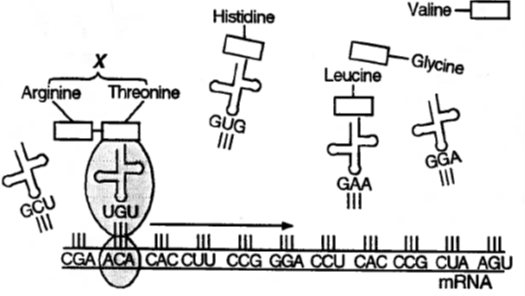
Which anticodon would be placed in spot #2

a)

GGC

b)

CCA

c)

GGA

d)

GGT

68.

Which process does this diagram illustrate?

a)

transcription

b)

DNA replication

c)

translation

69.

What determines the shape and function of a protein?

a)

The sequence of amino acids

b)

The type of ribosome that assembles the protein

c)

The cell that manufactures the protein

70.

True or False: mRNA contains anticodons and tRNA contains codons.

a)

True

b)

False

71.

How can a mutation in the DNA sequence result in NO change to the protein that is made?

a)

There are multiple codons that can code for the same amino acid and result in the same protein

b)

There is always a change in the protein when a mutation occurs

c)

Only the mRNA is used in protein synthesis so a mutation in the DNA would have no effect on the protein

72.

During Transcription, DNA is converted into ____

a)

mRNA

b)

tRNA

c)

rRNA

d)

a Protein

73.

During Translation, mRNA is converted into a _______

a)

DNA

b)

Protein

c)

tRNA

d)

rRNA

74.

the tRNA carries an

a)

Amino Acid

b)

Polysaccaride

c)

Lipid

d)

DNA

75.

Many amino acids and put together and folded up to form a ______

a)

Protein

b)

DNA strand

c)

mRNA strand

d)

Carbohydrate

76.

During transcription, DNA is converted in mRNA inside the _______.

a)

Cell Membrane

b)

Ribosome

c)

Nucleus

d)

Cytoplasm

77.

During Translation, mRNA finds a ________ to make a protein.

a)

Nucleus

b)

Ribosome

c)

Amino Acid

d)

Mitochondria

78.

Which nitrogen base is in the DNA, but is NOT in the mRNA?

a)

Thymine

(T)

b)

Cytosine

(C)

c)

Guanine

(G)

d)

Adenine

(A)

79.

Match the DNA codon ATC to the correct mRNA codon.

a)

UAG

b)

AUC

c)

TAG

d)

UUG

80.

Match the DNA codon GCA to the correct mRNA codon

a)

CCU

b)

GCT

c)

CGU

d)

CGA

81.

Match the mRNA codon UUA to the correct tRNA anti-codon

a)

AAT

b)

AAU

c)

AUA

d)

ATA

82.

Use your codon chart to match the mRNA CUU to the correct amino acid

a)

VAL

b)

TYR

c)

LEU

d)

PHE

83.

Use your codon chart to match the mRNA ACU to the correct amino acid.

a)

Thr

b)

Ala

c)

Val

d)

Gly

84.

Amino Acids are built up to make_______

a)

DNA

b)

mRNA

c)

Lipids

d)

Proteins

85.

Amino acids form a polypeptide chain that is then folded up to form a protein, what type of bond holds together a polypeptide chain?

a)

Hydrogen Bonds

b)

Polypeptide Bonds

c)

Nitrogen Bonds

d)

Carbon Bonds

86.

Use your codon chart to find the amino acid that codes for AGU

a)

Tyr

b)

Gly

c)

Arg

d)

Ser

87.

Use your codon chart to find the amino acid that codes for the mRNA codon GCA

a)

Thr

b)

Ala

c)

Pro

d)

Ser

88.

Use your codon chart and find the amino acid that codes for the mRNA codon UAA

a)

Phe

b)

Tyr

c)

START

d)

STOP

89.

Ribosomes make ________

a)

DNA

b)

Proteins

c)

Amino Acids

d)

Lipids

90.

Use your codon chart to figure out what amino acid codes for the mRNA codon AUG

a)

START

(Met)

b)

Ile

c)

Val

d)

Leu

91.

Amino Acids form a __________ ____ that is then folded into a protein

a)

Polypeptide Chain

b)

Protein Chain

c)

Carbohydrate

d)

Deoxyribose Nucleic Acid

92.

The process of converting DNA to mRNA is called?

a)

Translation

b)

Trinscription

c)

Replication

d)

Respiration

93.

Where does TRANSCRIPTION occur?

a)

Nucleus

b)

Ribosome

c)

Cytoplasm

d)

Mitochondria

94.

Why must transcription occur where DNA can be found?

a)

because DNA can't leave

b)

because ribosomes are in the nucleus

c)

because DNA polymerase is found there

d)

because helicase unzips the DNA

95.

How many codons equals 1 amino acid?

a)

1

b)

2

c)

3

d)

4

96.

How many nucleotides equal 1 amino acid?

a)

1

b)

2

c)

3

d)

4

97.

TRANSCRIBE this DNA sequence: TACGTTACT

a)

AUGCAAUGA

b)

ATGCAATGA

c)

AUGGATUGA

d)

TACGTTACT

98.

Which of the following are differences in the structure between RNA and DNA

a)

DNA uses deoxyribose sugar, RNA uses sugar ribose

b)

DNA pairs Adenine with Uracil, RNA pairs Adenine with Thymine

c)

DNA is a double helix, RNA is a single helix

d)

DNA pairs Adenine with Thymine, RNA pairs Adenine with Uracil

99.

Which organelle is the location where protein is made?

a)

Ribosome

b)

Nucleus

c)

Cytoplasm

d)

Nucleotide

100.

When these bond together, they form a protein

a)

Amino Acids

b)

Peptide Bonds

c)

Ribose

d)

Nucleotides

101.
What is the term for a three-nucleotide sequence that codes for an amino acid?
a)
base
b)
codon
c)
amine
d)
serine
102.
The process to go from mRNA to a protein is called ____
a)
transcription
b)
rRNA
c)
replication
d)
translation
103.
Does the order of amino acids in a protein matter?
a)
YES!
b)
NO!
104.
In RNA, Uracil pairs with ______. 
a)
cytosine
b)
adenine
c)
guanine
d)
thymine
105.
What process is going on in this photo? 
a)
Transcription 
b)
Translation 
c)
Replication 
d)
All the above 
106.
What is the location in the cell for translation?
a)
nucleus
b)
mitochondria
c)
ribosome
d)
chloroplast
107.
How many amino acids are coded for by this sequence of nucleotides:
ATG GGA ACT CCA
a)
4
b)
2
c)
6
d)
12
108.
The enzyme that produces RNA in Transcription is called
a)
RNA Polymerase
b)
DNA Polymerase
c)
Transcriptase
d)
RNA Intrase
109.

How many amino acids will FIFTEEN codons code for?

a)

three

b)

five

c)

fifteen

d)

thrity

110.
Which two processes are involved in protein synthesis?
a)
Replication and Transcription
b)
Replication and Translation
c)
Transcription and Translation
111.
Which of the following molecules is made during transcription?
a)
DNA
b)
tRNA
c)
protein
d)
mRNA
112.
Which of the following bases is found only in RNA?
a)
Adenine
b)
Guanine
c)
Thymine
d)
Uracil
113.
Which form of RNA carries amino acids from the cytoplasm to the ribosome?
a)
amino RNA
b)
ribosomal RNA
c)
transfer RNA
d)
messenger RNA
114.
What are the three base segments of mRNA called?
a)
anticodons
b)
codons
c)
triplets
115.
Transcribe the following sequence of DNA into RNA:
AAG   CTT   TGC
a)
TTC  GAA  ACG
b)
UUC  GAA ACG
c)
TTC  GUU  UCG
d)
UUC  GUU  UCG
116.
What would be the complementary DNA strand for the following nucleotide sequence?
TCG ATA CGA
a)
AGC ATA GCT
b)
AGC TAT GCT
c)
AGC UAU GCU
d)
UGC TUT GCT
117.
Which of the following terms means that in each molecule of DNA made during replication there is one original strand and one new strand?
a)
Antiparallel
b)
Semi-conservative
c)
Complementary base-pairing
118.

Proteins are chains of amino acids bonded together. Which is the correct sequence for making proteins?

a)

Information is DNA is transferred into RNA and then made into protein

b)

Information in DNA is formed into protein directly.

c)

Information in RNA mutates into DNA and then is made into protein

d)

Information in RNA uses thermal energy to make protein
119.
Which of the following best describes a DNA molecule?
a)
double helix
b)
contains ribose
c)
made of amino acids
d)
contains Uracil
120.
Cytosine always pairs with
a)
Adenine
b)
Thymine
c)
Uracil
d)
Guanine
121.
Which organelle is DNA usually found in?
a)
cell membrane
b)
vacuole
c)
ribosome
d)
nucleus
122.
In DNA, Adenine bonds with ______________.
a)
Guanine
b)
Thymine
c)
Cytosine
d)
Adenine
123.
What does DNA stand for?
a)
Deoxyribonucleic acid
b)
Denitrogenous acid
c)
Deribonucleic acid
d)
Diribonucleic acid
124.
In a molecule of double-stranded DNA, the amount of Adenine present is always equal to the amount of
a)
cytosine
b)
guanine
c)
thymine
d)
uracil
125.
What are the three components of a nucleotide?
a)
sugar, hydrogen, nitrogen base
b)
sugar, oxygen, nitrogen base
c)
sugar, phosphate, nitrogen base
d)
sugar, phosphate, protein
126.

A change in a DNA sequence(order) that affects genetic information.

a)

Recessive trait

b)

Mutation

c)

Allele

127.
The enzyme that unwinds the DNA to prepare for replication
a)
helicase
b)
replicase
c)
polymerase
d)
synthase
128.
Why does DNA replicate?
a)
To create another copy for the new cell
b)
To create a duplicate copy in case the original gets damaged
c)
To create a new copy to replace the damaged original
129.

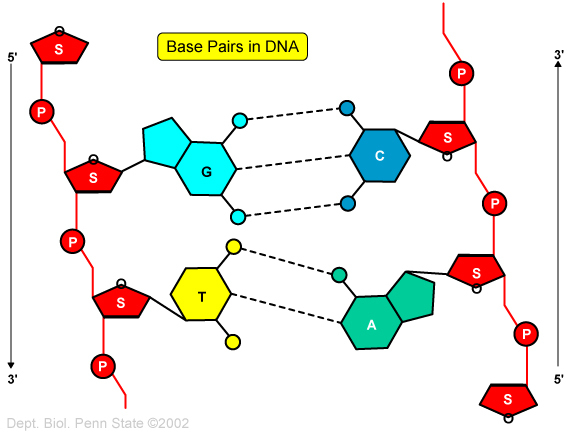
Name this structure

a)

double helix

b)

nucelotide

c)

twisted ladder

d)

hydrogen bond

130.
Nitrogenous bases are joined by which type of bond?
a)
polar bonds
b)
ionic bonds
c)
covalent bonds
d)
hydrogen bonds
131.
Genetic info flows in one direction. Which best represents this flow?
a)
DNA-protein-RNA
b)
Protein-RNA-DNA
c)
RNA-protein-DNA
d)
DNA-RNA-protein
132.
The process to go from DNA to mRNA is _______
a)
translation
b)
transcription
c)
replication
133.
The process to go from mRNA to a protein is called ____
a)
transcription
b)
rRNA
c)
replication
d)
translation
134.
What amino acid is represented by the codon UUA?
a)
Phenylalanine
b)
Tyrosine
c)
Leucine
d)
Stop codon
135.
What process is going on in this photo? 
a)
Transcription 
b)
Translation 
c)
Replication 
d)
All the above 
136.
What is the three base sequence of mRNA that codes for a single amino acid?
a)
Anticodon
b)
Codon
c)
Protein
137.
How many amino acids are coded for by this sequence of nucleotides:
ATG GGA ACT CCA
a)
4
b)
2
c)
6
d)
12
138.
Which change below would result in a different Amino Acid? 
3'-GCT-5'
a)
GTT
b)
TCT
c)
TCC
d)
GCA
139.

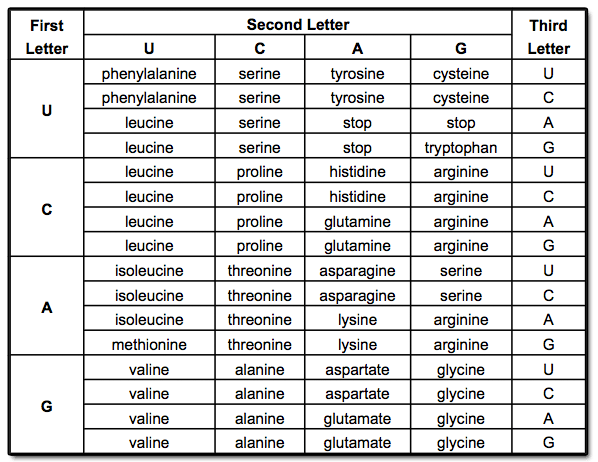
What amino acid is represented by the codon AUG?

a)

Phenylalanine

b)

Methionine

c)

Leucine

d)

Stop codon

140.

If the DNA sequence of a gene is TAC CCC GGA GAG, what mRNA sequence will be produced in transcription?

a)

RNA Polymerase

b)

AUG GGG CCU CUC

c)

ATG GGG GGT GTG

d)

AUG GGG CCU CUG

e)

AUG CCG GCA CGG

141.

What amino acid would be added to the protein being formed during translation if the mRNA codon reads "CCU?"

a)

Isoleucine

b)

Stop

c)

Methionine

d)

Proline

142.
What is the correct amino acid sequence for the mRNA code AUGCCAGUAUGA
a)
Met-Pro-Ala-Val
b)
Met-Pro-Val
c)
Tyr-Gly-His
d)
Tyr-Gly-Arg-His
143.

What is the correct amino acid sequence for the mRNA code AUG GCA AAC CGU

a)

Met-Ala-Asn-Ala

b)

Met-Ala (because the third codon codes for STOP)

c)

Ileu-Ala-Asn-Ala

d)

Met-Ala-Asn-Arg

e)

Ileu-Ala-Asn-Ala