wayground logo

Free Printable Worksheets

Font size

S
M
L
XL
Worksheets

Biology 1st Semester Review

Total questions: 139

Worksheet time: 2hrs 4mins

Name
Class
Date
1.
A series of steps used by scientists to solve a problem or answer a question. 
a)
scientific method
b)
recipe
c)
data collection
d)
metric system
2.
A testable explanation to a problem that has not yet been tested. 
a)
data
b)
theory
c)
hypothesis
d)
fact
3.
This variable in an experiment is the one being changed by the scientist. 
a)
dependent variable
b)
independent variable
c)
data
d)
control group
4.
An experiment is performed on plants to see how different liquids affect plant growth. Each plant in the experiment is given a different liquid; water, apple juice, or milk. Each plant has the same amount of soil, sunlight, and listens to the same music. In this investigation, the independent variable is ...
a)
The type of plant
b)
The amount of sunlight
c)
The type of music
d)
The type of liquid
5.
Dependent variable means
a)
the scientist controls what to test
b)
educated guess
c)
ask a question
d)
what is being measured
6.
If you increase the amount of spinach you eat, then you will increase the iron in your blood. 
What's the dependent variable?
a)
increase the amount of iron in your blood
b)
spinach you eat
7.
If I ride my bike to school instead of walking, then I will get to school faster. What is the dependent variable?
a)
True
b)
How fast you get to school
c)
Riding a bike or walking
d)
False
8.
You will want your experiment to have ____ independent variable(s) in it for the experiment to be valid.
a)
1
b)
2
c)
3
d)
4
9.
A scientist hypothesizes the the temperature at which an alligator's egg is incubated will determine whether the alligator will be male or female. The independent variable is
a)
the male alligators
b)
the incubator
c)
the gender of the alligator
d)
the temperature
10.
In this graph, what is the independent variable? 
a)
Population
b)
Day
c)
Species 5
11.
In this graph, what is the dependent variable? 
a)
Walla Walla Island
b)
Time
c)
Number of Deer
12.
A group of the same type of organisms living in the same place at the same time.
a)
threatened species
b)
populations
c)
community
d)
limiting factor
13.
temperature
a)
biotic
b)
abiotic
14.
bacteria
a)
biotic
b)
abiotic
15.
Is sunlight an abiotic or biotic factor? 
a)
abiotic
b)
biotic
16.
A nonliving element in an ecosystem is an 
a)
animal
b)
abiotic factor
c)
biotic factor
d)
organism
17.
Which of the following is not a biotic factor?
a)
mushroom
b)
air
c)
elephant
d)
coyote
18.
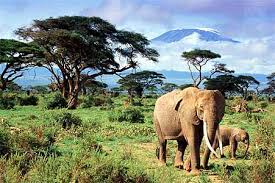
What are the biotic factors in this image?
a)
sunlight, elephants, and grasses
b)
sunlight, water,  and air
c)
elephants, plants, trees 
19.
Used for short term (quick) energy.
a)
carbohydrates
b)
lipids
c)
proteins
d)
nucleic acids
20.
Provides long term energy and insulation,
a)
lipids
b)
carbohydrates
c)
nucleic acids
d)
proteins
21.
Contains DNA and RNA
a)
lipids
b)
carbohydrates
c)
proteins
d)
nucleic acids
22.
Contains a phosphate, sugar and nitrogen base
a)
nucleic acid
b)
lipid
c)
carbohydrate
d)
protein
23.
Building blocks of the body, hair , muscles etc.
a)
protein
b)
nucleic acid
c)
lipids
d)
carbohydrates
24.
Is found in the cell membrane as a bilayer. 
a)
lipids
b)
protein
c)
nucleic acid
d)
carbohydrate
25.
Identify the macromolecule in the picture
*GLUCOSE
a)
lipid
b)
protein
c)
nucleic acid
d)
carbohydrate
26.
Identify the macromolecule in the picture.
* look at the R.....
a)
carbohydrates
b)
lipids
c)
proteins 
d)
nucleic acids
27.
Identify the macromolecule in the picture
* cholesterol and triglycerides
a)
carbohydrate
b)
protein
c)
lipid
d)
nucleic acid
28.
Identify the macromolecule in the picture
a)
carbohydrate
b)
lipid
c)
protein
d)
nucleic acid
29.
__________ are nucleic acid functions
a)
store & transfer genetic info
b)
store & create energy
c)
structure & energy for cells
d)
membrane structure and nutrient transfer
30.
___________ are some functions of lipids.
a)
storing energy and  cell membrane structure
b)
providing actin & providing myosin
c)
cellulose structure and digestive assistance
d)
storing & transferring genetic info
31.
Cellulose is a type of ____________
a)
carbohydrate
b)
nucleic acid
c)
lipid
d)
protein
32.
________ are the main components of fats and oils.
a)
lipids
b)
amino acids
c)
nucleic acids
d)
carbohydrates
33.
These organic molecules are used by the body to store and release energy.
a)
Carbohydrates
b)
Lipids
c)
Proteins
d)
Nucleic Acids
34.
These organic molecules are used by the body to store the genetic code.
a)
Carbohydrates
b)
Lipids
c)
Proteins
d)
Nucleic Acids
35.
These organic molecules are used by the body for long term storage of energy and make up the structure of cell membranes.
a)
Carbohydrates
b)
Lipids
c)
Proteins
d)
Nucleic Acids
36.
Sugars usually end in....
a)
-ose
b)
-ace
c)
-ats
d)
-ids
37.
Amino acids are the monomers of
a)
Carbohydrates 
b)
Lipids
c)
Proteins 
d)
Nucleic Acids
38.
What is the purpose  of an enzyme?
a)
give permission for the reaction
b)
raise activation energy
c)
speed up reactions
d)
control how many reactions occur
39.
Where do substrates bind on an enzyme?
a)
voltage-gated channels
b)
surface receptor
c)
calcium channels
d)
active site
40.
What is a substance called if it speeds up a chemical reaction?
a)
reusable
b)
catalyst
c)
specific
d)
fragile
41.
When electrons are shared between two atoms, the bond formed is
a)
ionic
b)
covalent
c)
hydrogen
d)
peptide
42.
A substance with a pH of 4 is considered a(n)
a)
base
b)
neutral
c)
acid
43.
The energy needed to start a reaction
a)
activation energy
b)
adhesion energy
c)
chemical energy
d)
cohesion energy
44.
Which property makes water molecules stick to other water molecules?
a)
adhesion
b)
cohesion
c)
capillary action
d)
polarity
45.
These are called the "quick energy" foods
a)
carbohydrates/sugars
b)
protein
c)
fats/lipids
d)
nucleic acids
46.

Monomer is to Macrocolecule like ___ is to ____

a)

Building is to Bricks.

b)

Brick is to Building.

c)

Carpenter is to Building.

d)

Building is to Carpenter.

47.
What word describes when water is attracted to other substances?
a)
cohesion
b)
adhesion
c)
capillary action
d)
surface tension
48.
The attraction that causes water and other liquids to form drops on thin films is called ________________. This is also water’s ability to be attraction to other water molecules.
a)
adhesion
b)
capillary action
c)
cohesion
d)
surface tension
49.
What property of water helps to moderate earth's temperature?
a)
adhesion
b)
chohesion
c)
Specific heat capacity
d)
Latent heat of vaporization
50.
Why does ice float?
a)
As water freezes, it expands and its density decreases.
b)
As water freezes, it takes up more hydrogen from the atmosphere, causing it to have a greater buoyancy.
c)
As water freezes, air becomes trapped between the hydrogen bonds of water molecules.
d)
As water freezes, it takes up more oxygen from the atmosphere, causing it to have a greater buoyancy.
51.
What two elements make up water?
a)
Helium and oxygen
b)
Hydrogen and oxygen
c)
helium and carbon
d)
oxygen and carbon
52.
tendency of molecules of the same kind to stick to one another
a)
cohesion
b)
adhesion
c)
solution
d)
polar molecule
53.
Water striders can walk across the surface of calm water. Their feet push the surface of the water down slightly, but they do not break the surface. Why?
a)
The insects are light enough so they do not break the hydrogen bonds holding the water molecules together
b)
The insects actually use their wings to hover slightly above the water’s surface and they only skim it with their feet.
c)
The insect’s feet are non-polar, so they are repelled by the polar water molecules and are pushed away from the water’s surface.
d)
The insects are small enough to see the individual water molecules, so they are able to step carefully from one molecule to the next
54.
Which of the following is the smallest unit of life that can carry out all life functions?
a)
the mitochondria
b)
the vacuoles
c)
the nucleus
d)
the cell
55.
Cell organelles that are responsible for digesting food, worn out organelles and other cellular wastes are called ___________________.
a)
Mitochondria
b)
Vacuoles
c)
Lysosomes
d)
Chlororplasts
56.
What is one basic function of the vacuoles?
a)
circulating oxygen
b)
producing food
c)
controlling cell processes
d)
storing water
57.
Chloroplasts in plant cells allow the plant to perform a function that animal cells cannot do.  What is the main function of the chloroplasts found in plant cells?
a)
to absorb light energy and manufacture food
b)
to remove waste materials by active transport
c)
to manufacture chemical energy from food
d)
to control the shape of the cell
58.
All cells need energy to function.  Which cell organelle is responsible for producing energy in the cell?
a)
chloroplasts
b)
mitochondria
c)
nucleus
d)
vacuoles
59.
What is the function of a cell wall?
a)
to protect and support the cell
b)
to perform different functions in each cell
c)
to prevent water from passing through it
d)
to prevent oxygen from entering the cell
60.
In what part of the plant cell does the process of photosynthesis take place?
a)
nucleus
b)
mitochondria
c)
chloroplasts
d)
vacuoles
61.
Cells with a nucleus and membrane-bound organelles are called ____________________.
a)
prokaryotes
b)
eukaryotes
c)
bacteria
d)
protists
62.
Which of the following is not part of the cell theory?
a)
cells must contain DNA 
b)
all living things are made from cells
c)
cells can only come from other cells
d)
cells are the basic unit of life
63.
I make proteins for the cell. What am I?
a)
ribosome
b)
mitochondria
c)
chloroplast
d)
lysosome
64.
You might think of me as the trash collector or recycler is maybe more accurate. What am I?
a)
cytoplasm
b)
lysosme
c)
vacuole
d)
ribosome
65.
I am a protein packaging and shipping machine! Who am I?
a)
vacuole
b)
ribosome
c)
endoplasmic reticulum
d)
golgi apparatus
66.
I store water in both plant and animal cells. What am I?
a)
cytoplasm
b)
ribosomes
c)
vacuole
d)
lysosomes
67.
I am only found in a plant cell. What am I?
a)
cell wall
b)
mitochondria
c)
cytoplasm
d)
chloroplast
68.
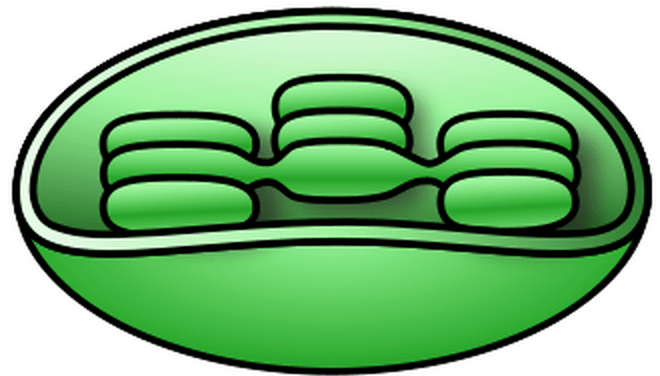
What is this?
a)
mitochondria
b)
lysosomes
c)
chloroplast
d)
endoplasmic reticulum
69.
What does this structure do?
a)
supports the cell
b)
cell's control center
c)
converts energy to food
d)
makes proteins
70.
What is the picture
a)
ribosome
b)
nucleus
c)
cell wall
d)
mitochondrion
71.

Which of the following is a characteristic of both Eukaryotic and Prokaryotic cells?

a)

ribosomes

b)

nucleus

c)

membrane bound organelles

d)

simple

72.
Prokaryotic cells include bacteria.
a)
True
b)
False
73.
Which type of cell?
a)
Prokaryote
b)
Eukaryote
74.
Which of the following is found inside a prokaryote?
a)
cytoplasm
b)
DNA
c)
ribosomes
d)
all of these
75.
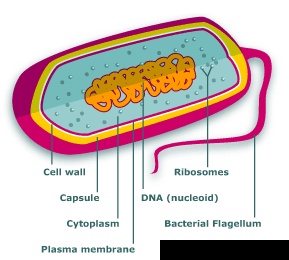
What kind of cell is this?
a)
Eukaryotic
b)
Prokaryotic
76.
All cells come from other...
a)
cells 
b)
plants 
c)
nucleus 
d)
microscopes 
77.
Plants and animal cells are examples of ___ cells 
a)
prokaryotic cells 
b)
eukaryotic cells 
78.
Bacteria are
a)
Prokaryotic Cells
b)
Eukaryotic Cells
c)
Animal Cells
d)
Plant Cells
79.
Your cells are
a)
Eukaryotic Cells
b)
Prokaryotic Cells
c)
Beautiful
d)
Plant Cells
80.
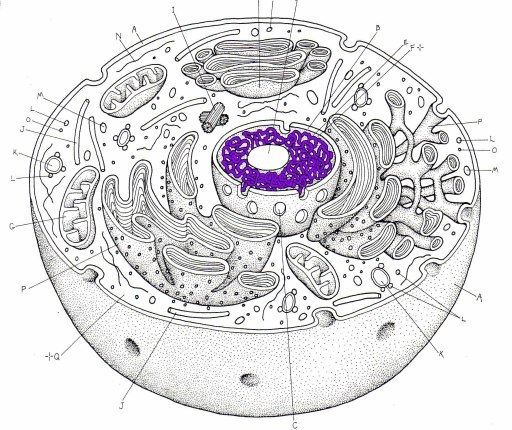
Using this image, what organelle is D?
a)
Endoplasmic Reticulum
b)
Flagella
c)
Rough ER
d)
Smooth ER
81.
Using this image, what organelle is G?
a)
Vacuole
b)
Flagella
c)
Rough ER
d)
Nucleus
82.
Using this image, what organelle is N?
a)
Centrioles
b)
Cell Membrane
c)
Golgi Apparatus
d)
Ribosome
83.
Using this image, what organelle is C?
a)
Cell Wall
b)
Mitochondria
c)
Large Cell Vacuole
d)
Chloroplast
84.
Using this image, what organelle is G?
a)
Cell Wall
b)
Mitochondria
c)
Vacuole
d)
Chloroplast
85.
Using this image, what organelle is E?
a)
Cell Wall
b)
Nucleus
c)
Vacuole
d)
Chloroplast
86.
Using this image, what organelle is A?
a)
Cell Wall
b)
Large Central Vacuole
c)
Mitochondria
d)
Chloroplast
87.
What is the difference between rough and smooth ER?
a)
There is no difference.
b)
Plants have rough ER, animals have smooth ER.
c)
What type of injuries the Doctors treat.
d)
Rough has ribosomes, smooth does not.
88.
This is a picture of
a)
Cell wall
b)
Cell membrane
c)
chloroplast
d)
mitochondria
89.
How does a cell maintain homeostasis?
a)
Regulates what enters and leaves the cell
b)
Flexibility
c)
Protective barrier
d)
Structure and support
90.
The cell membrane is selectively permeable, which means...
a)
All materials can enter and leave the cell
b)
Certain things can enter while others cannot
c)
The cell manually sorts through all materials
d)
Only certain cells can interact with the cell.
91.
A can of air freshener is sprayed in the opposite side of the room.  Ten minutes later you start to smell the scent.  This is an example of 
a)
diffusion
b)
active transport
c)
endocytosis
d)
osmosis
92.
What is it called when molecules move across the cell membrane from an area of high concentration to an area of low concentration through a carrier protein?
a)
Diffusion
b)
Osmosis
c)
Active Transport
d)
Facilitated Diffusion
93.
Controlling what goes into or out of the cell without energy is called
a)
active transport
b)
endocytosis
c)
passive transport
d)
exocytosis
94.
What is homeostasis?
a)
How the body releases oxygen
b)
Passive transportation 
c)
How the body regulates itself for survival
d)
Active transport
95.
What is the difference between active and passive transport?
a)
Active does not need energy and passive uses ATP (energy)
b)
Active uses ATP (energy) and passive does not need energy
c)
Active stores transport proteins and passive releases 
d)
Active uses hormones and passive does not 
96.
Against the concentration gradient
low to high
uses energy/ATP
a)
facilitated diffusion
b)
osmosis
c)
active transport
d)
simple diffusion
97.
This picture represents what type of cell transport?
a)
endocytosis
b)
exocytosis
c)
osmosis
d)
passive transport
98.
A cell will _____________________ in a hypertonic solution.
a)
swell
b)
shrink
c)
will not change
d)
will explode
99.
A cell will __________________ in a hypotonic solution.
a)
swell and perhaps burst (lyse)
b)
shrink
c)
the size of the cell will not change
d)
the size of the cell will change from large to small and from small to large
100.
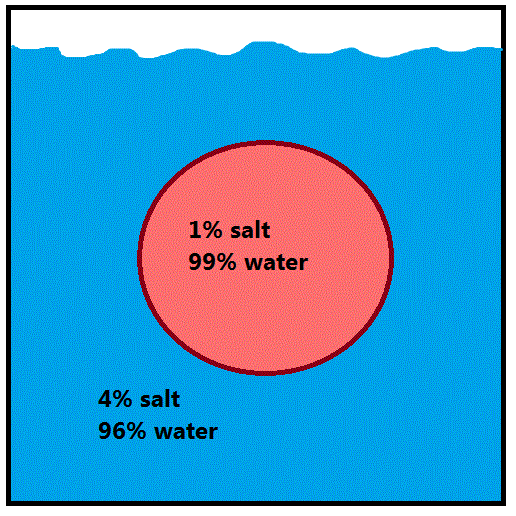
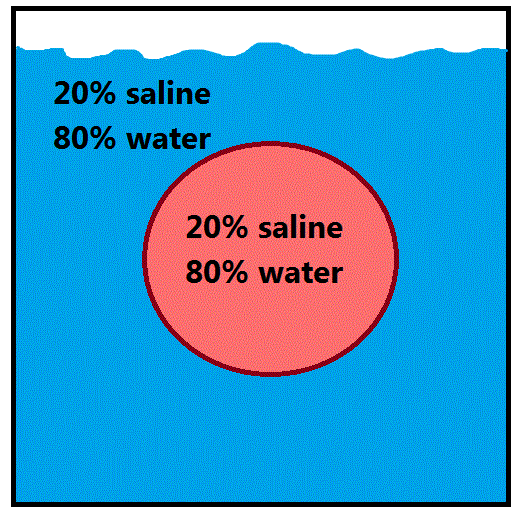
The cell below is in a _____________ solution.
a)
Hypertonic
b)
Hypotonic
c)
Isotonic
101.
The cell below is in a _________ solution.
a)
Hypotonic
b)
Hypertonic
c)
Isotonic
102.
Where will the water go?
a)
Into the cell
b)
Out of the cell
c)
Equally in & out - it's isotonic
d)
There is no water
103.
Mr. Slug was salted. Where was there more solute immediately after salting?
a)
Outside of the slug
b)
Inside of the slug
c)
There was no solute anywhere
104.
A blood cell is placed into the jar, as seen. Where will the water go?
a)
Into the cell
b)
Out of the cell
c)
Equally in & out - it's isotonic
d)
The water is a lie
105.
 If a cell containing 5% salt is placed into a glass of water with 20% salt, the water is _______ compared to the cell.
a)
hypertonic
b)
hypotonic
c)
isotonic
106.
 An animal cell placed in a hypertonic (salty) solution will
a)
Stay the same
b)
Shrink- get smaller
c)
Swell- get bigger
107.
With what 3 letters do enzymes typically end?
a)
-ose
b)
-ase
c)
-ese
d)
-tic
108.
What is a substance called if it speeds up a chemical reaction?
a)
reusable
b)
catalyst
c)
specific
d)
fragile
109.
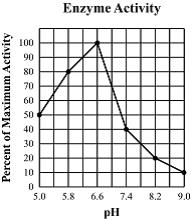
Which of the following conclusions can be drawn from this graph?
a)
The optimum pH of the enzyme is 6.6.
b)
The optimum pH of the enzyme is 5.8
c)
The enzyme’s activity increases as pH increases 5.0 to 9.0
d)
The enzyme’s activity is greater around pH of 8.0 .
110.
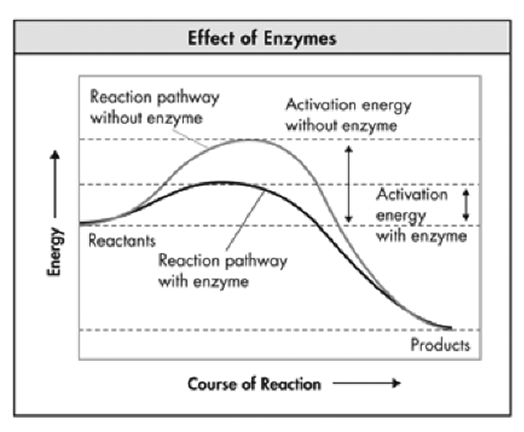
The graph shows how enzymes affect reactions in cells. Which statement best summarizes the information shown in the graph?
a)
Enzymes increase the energy of the reactants.
b)
Enzymes decrease the energy level of the products.
c)
Enzyme decrease the activation energy of the reaction.
d)
Enzymes reverse the direction of the reaction.
111.
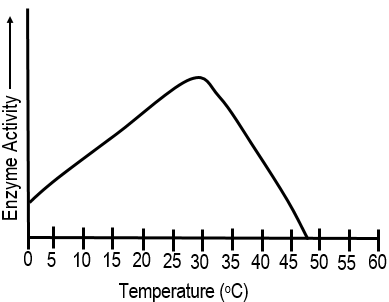
Based on the graph, what is the optimal temperature for this enzyme? 
a)
15oC
b)
40oC
c)
30oC
d)
35oC
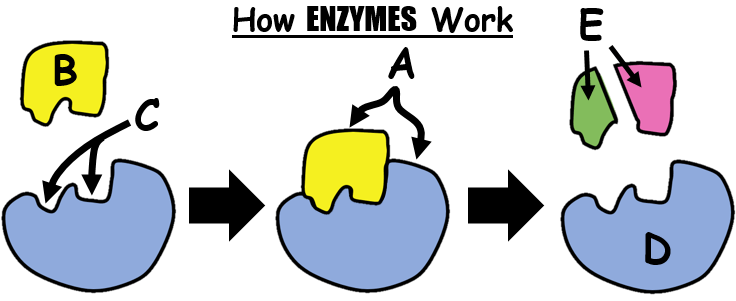
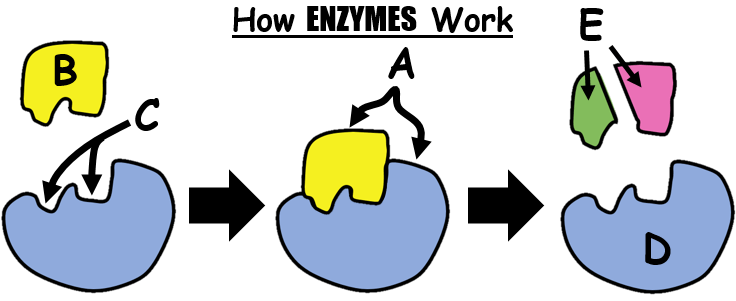
112.
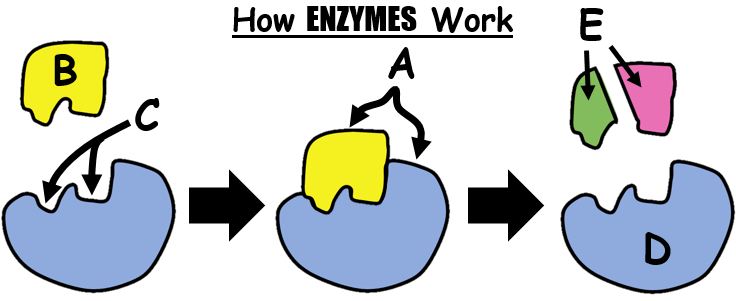
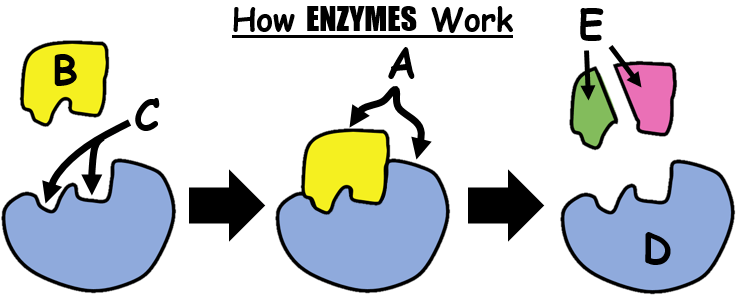
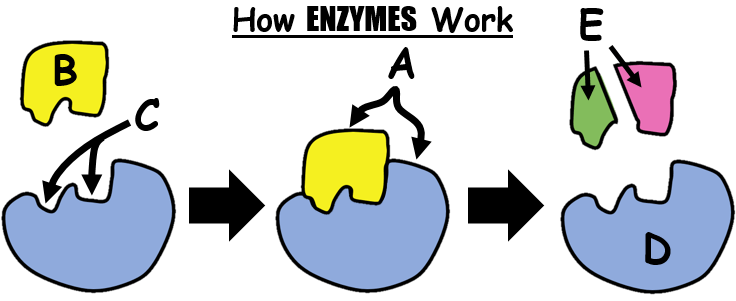
In the diagram, what is letter A? 
a)
product
b)
substrate
c)
enzyme-substrate complex
d)
active site
113.
What happens when enzymes are heated to a high temperature?
a)
The enzymes die.
b)
The shapes of the enzyme are altered denature
c)
The enzymes' amino acid sequence changes.
d)
The enzymes remain the same
114.
The current model of enzyme action is referred to as the...
a)
Induced Fit Model
b)
Lock & Key Model
c)
Singer-Nicolson Model
d)
Davson-Danielli Model
115.
Letter D...
a)
active site
b)
enzyme
c)
substrate
d)
products
116.
Letter B...
a)
active site
b)
enzyme
c)
substrate
d)
products
117.
Letter C...
a)
active site
b)
enzymes
c)
substrate
d)
products
118.
Letter E...
a)
active site
b)
enzyme
c)
substrate
d)
products
119.

Starting with Gap 1, what is the correct order of the cell cycle?

a)

G1 > G2 > S > M

b)

G1 > S > G2 > M

c)

G1 > M > S > G2

d)

G1 > S > M > G2

120.

Starting with Gap 1, what is the correct order of the cell cycle?

a)

G1 > G2 > S > M

b)

G1 > S > G2 > M

c)

G1 > M > S > G2

d)

G1 > S > M > G2

121.

What happens during G1?

a)

The cell grows and carries out normal functions

b)

The DNA in the cell is copied

c)

The cell grows a little bit more

d)

The cell divides itself

122.

What happens during S?

a)

The cell grows and carries out normal functions

b)

The DNA in the cell is copied

c)

The cell grows a little bit more

d)

The cell divides itself

123.

What happens during G2?

a)

The cell grows and carries out normal functions

b)

The DNA in the cell is copied

c)

The cell grows a little bit more

d)

The cell divides itself

124.

What happens during M?

a)

The cell grows and carries out normal functions

b)

The DNA in the cell is copied

c)

The cell grows a little bit more

d)

The cell divides itself

125.

What is the acronym we use to remember the order of the phases of mitosis?

a)

AMPT

b)

TAPM

c)

MAPT

d)

PMAT

126.
The absorption of nutrients is determined by...
a)
The cell's volume
b)
The cell's surface area
c)
The cell's ribosomes
d)
The cell's DNA
127.

During what phase of Mitosis do the chromosomes line up in the Middle

a)

Metaphase

b)

Prophase

c)

Telophase

d)

Anaphase

128.

PMAT helps us remember the correct order of the phases of Mitosis. Which of the following has the phases of Mitosis in the correct Order

a)

Interphase, Mitosis, Cytokinesis

b)

Prophase, Metaphase, Anaphase, Prophase

c)

Anaphase, Telophase, Prophase, Telophase

d)

Prophase, Metaphase, Anaphase, Telophase

129.

Where do you find checkpoints in the cell cycle?

a)

Only after G1 and G2

b)

Only after S phase

c)

Only after G2

d)

After each phase

130.

What is the purpose of the checkpoints in the cell cycle? Select all that apply:

a)

To regulate the process and check for abnormalities

b)

Prevent water from entering the cycle

c)

Prevent unhealthy cells from continuing on the the cycle

d)

Prevent uncontrolled growth

131.

Cancer is defined as the

a)

uncontrolled division of mutated cells

b)

normal division of cells

c)

normal DNA replication

d)

abnormal ATP synthesis

132.

A ________________is a critical point where stop and go signals can regulate the cycle

a)

tumor

b)

checkpoint

c)

growth factor

d)

oncogene

133.

Any substance that is known to cause cancer is called a

a)

Pathogen

b)

Biopsy

c)

Carcinogen

d)

Retrovirus

134.
Tumors are...
a)
A big fatty lump
b)
mass of abnormal cells that can grow uncontrollably
c)
Something that sticks out from your body
d)
It's not a tumor
135.
a)
Anaphase
b)
Cytokinesis
c)
Telophase
d)
Metaphase
136.
a)
Cytokinesis
b)
Interphase
c)
Anaphase
d)
Metaphase
137.
a)
Anaphase
b)
Cytonkinesis
c)
Interphase
d)
Prophase
138.
a)
Cytokinesis
b)
Anaphase
c)
Telophase
d)
Prophase
139.

DNA is a recipe for your genes. What happens when your DNA is exposed to Sunlight (UV Rays)

a)

You are blessed by zeus

b)

You sparkle like the vampires in twilight

c)
Increased resistance to sunlight
d)
Mutations and potential skin cancer