
 Worksheets
Comprehensive Genetics Review
Total questions: 138
Worksheet time: 2hrs 33mins
Name
Class
Date
1.
Aa, DD, Bb, yy are all examples of
a)
genotypes
b)
phenotypes
c)
parents
d)
physical traits
2.
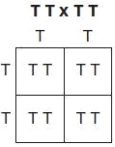
What ratio of the offspring from the cross shown will be homozygous recessive for the trait of tallness?
a)
0 in 4
b)
1 in 4
c)
2 in 4
d)
4 in 4
3.
Which of the following genotypes is homozygous dominant?
a)
A
b)
Aa
c)
AA
d)
aa
4.
Which of the following genotypes is heterozygous?
a)
Bb
b)
BB
c)
bb
d)
B
5.
In a flowering plant species, red flower color (R) is dominant over white flower color (r). What is the genotype of any red-flowering plant resulting from this species?
a)
rr
b)
R
c)
RR
d)
RR or Rr
6.
Which of the characteristics is a lion least likely to pass on to its offspring?
a)
fur color
b)
length of tail
c)
scars on leg
d)
body size
7.
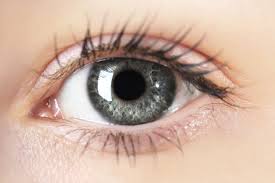
What you see, or the physical appearance.
a)
Genotype
b)
Phenotype
c)
Homozygous
d)
Heterozygous
8.
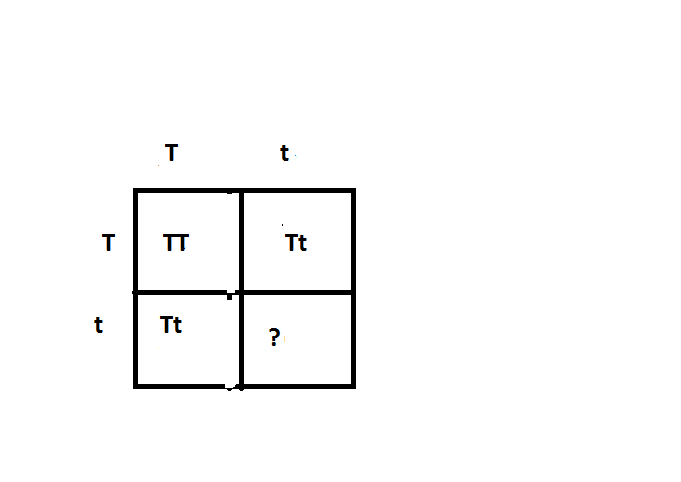
T - tall and t = short
In this Punnett square, what belongs in the missing square
In this Punnett square, what belongs in the missing square
a)
tt
b)
Tt
c)
Bb
d)
TT
9.
B = brown eyes
b = blue eyes
What is true about these two brothers that have brown eyes?
One has genotype BB the other Bb.
b = blue eyes
What is true about these two brothers that have brown eyes?
One has genotype BB the other Bb.
a)
they have same phenotype and genotype
b)
they have different genotypes and phenotypes
c)
they have same phenotype but different genotypes
d)
they have same genotype but different phenotypes
10.
Which of the following is a phenotype?
a)
Aa
b)
red hair
c)
heterozygous
d)
DNA
11.
What gender has an X and a Y chromosome?
a)
male
b)
female
c)
transgender
d)
all of the above
12.
How many alleles (letters) do each person carry for a trait?
a)
1
b)
2
c)
3
d)
4
13.
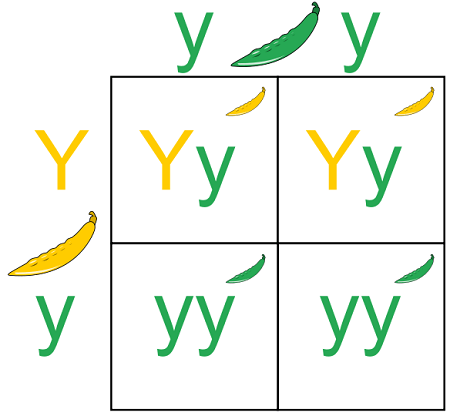
Which choice best represents the genotypic ratio of this cross?
a)
1 Yy: 2 yy
b)
2 Yy: 2 yy
c)
3 Yy: 1 yy
d)
1 Yy: 3 yy
14.
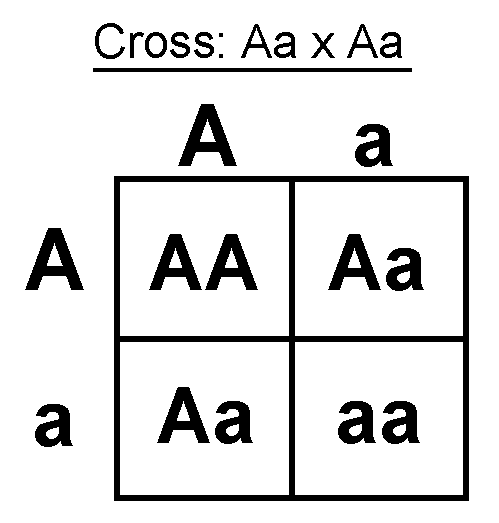
What is the phenotypic percentage of the offspring? (A-Brown hair; a-blond hair)
a)
50 % Brown Hair and 50% Blond Hair
b)
25 % Brown Hair and 75% Blond Hair
c)
75 % Brown Hair and 25% Blond Hair
d)
0% Brown Hair and 100% Blond Hair
15.
If you have a male with large wings (DD) and a female with small wings (dd). What allele stands for large wings?
a)
D
b)
d
c)
Dd
d)
dd
16.
A tall plant (TT) is crossed with a tall plant (Tt). What is the genotypic ratio?
a)
2 TT: 2 Tt
b)
1 TT: 2 Tt
c)
2 TT: 1 Tt : 1 tt
d)
4 tt : 0 other
17.
A green pea plant (GG) is being crossed with a green pea plant (Gg). What is the phenotypic ratio?
a)
100 % rainbow
b)
50% yellow and 50% green
c)
100% green
d)
100% yellow
18.
A homozygous dominant brown mouse is crossed with a heterozygous brown mouse (tan is the recessive color).
a)
100 % tan
b)
100 % brown
c)
50 % brown and 50% tan
d)
75 % brown and 25 % tan
19.

If green is dominant over purple, then what is the genotype for this individual?
a)
Purple
b)
Green
c)
GG
d)
gg
20.

This is an example of ___________.
a)
Incomplete Dominance
b)
Codominance
c)
Polygenic Inheriance
d)
Multiple Alleles
21.

What pattern of inheritance is shown in this image?
a)
Codominance
b)
Incomplete dominance
c)
Polygenic
d)
Multiple Alleles
22.

This type of inheritance pattern shows BOTH parent traits in possible offspring at the same time
a)
codominance
b)
incomplete dominance
c)
multiple alleles
d)
simple dominance
23.

If you cross a red snapdragon with a white snapdragon, only pink snapdragons will be produced. What type of inheritance pattern does this follow?
a)
Complete Dominance
b)
Incomplete Dominance
c)
Codominance
d)
Polygenic
24.

This shows...
a)
Incomplete Dominance
b)
Codominance
c)
Complete Dominance
d)
Simple Dominance
25.
Brown fur color is dominant over black fur color. Which of the following is the actual genotype of ALL of the offspring in the next generation of this cross for fur color?
AA x aa
AA x aa
a)
AA
b)
Aa
c)
aa
d)
brown fur
26.
If the parents are Ao and Bo genotypes for the ABO blood group, their children could include which of the following genotypes?
a)
Ao,Bo, AB, and oo only
b)
Ao, Bo and AB only
c)
Types A & B blood
d)
Blood types AB & O
27.
Mom is Ao and Dad is BB - what blood types are possible in offspring?
a)
AB and A
b)
AB and B
c)
AB & O
d)
A & B
28.

Jim has type AB blood. His dad could be type O.
a)
True
b)
False
29.
If a father is AA and a mother is AB, what is the probability for a child with AB blood?
a)
0%
b)
25%
c)
50%
d)
75%
30.
One baby is heterozygous for brown eyes. One baby is homozygous for brown eyes. What is true about these two babies?
a)
They have the same phenotype but different genotypes
b)
They have different phenotypes and genotypes
c)
They'll have all blue eyed kids
d)
They have blue eyed parents
31.

An organism's _______ describes its genetic composition. An organism's _______ describes its appearance or observable characteristics.
a)
phenotype; genotype
b)
species; heredity
c)
heredity; species
d)
genotype; phenotype
32.
Cross two homozygous plants
(RRYY x rryy)
R = round seeds, r = wrinkled seeds Y = yellow seeds, y = green seeds
What percent of the offspring will have Round and Yellow seeds?
(RRYY x rryy)
R = round seeds, r = wrinkled seeds Y = yellow seeds, y = green seeds
What percent of the offspring will have Round and Yellow seeds?
a)
0%
b)
25%
c)
50%
d)
100%
33.

What genotype is missing from this Punnett Square?
a)
RrYy
b)
RRYY
c)
rryy
d)
RrYY
34.

Assume mom's gametes are on the left, what is her genotype?
a)
TTZz
b)
TtZz
c)
ttZZ
d)
TtZZ
35.
In guinea pigs, black hair is dominant to white hair and short hair is dominant to long hair. What would be the phenotype of a guinea pig with the genotype Bbss?
a)
Black hair,short hair
b)
Black hair, long hair
c)
White hair, short hair
d)
White hair, long hair
36.

Based on this Punnett square, what fraction of the offspring will have wrinkled, yellow seeds?
a)
9/16
b)
3/16
c)
1/16
d)
16/16
37.

This type of inheritance pattern is a BLEND of both traits.
a)
Incomplete Dominance
b)
Complete Dominance
c)
Codominance
d)
Sex-Linked
38.
If a red flower and white flower are crossed, but a pink flower is produced, this is an example of
a)
incomplete dominance
b)
codominance
c)
complete dominance
d)
autosomal
39.
Snapdragon flowers come in red, pink and white. What type of inheritance is this?
a)
Complete Dominance
b)
Incomplete Dominance
c)
Codominance
d)
Sex-Linked
40.

If you cross a black chicken with a white chicken, only checkered chickens would be produced. What kind of inheritance pattern does this follow?
a)
Incomplete Dominance
b)
Codominance
c)
Simple dominance
d)
Multiple alleles
41.

This is an example of ___________.
a)
Incomplete Dominance
b)
Codominance
c)
Simple dominance
d)
Polygenic inheritance
42.

A whitish calico cat shows both the traits for orange fur and black fur. What kind of allele expression is this?
a)
Incomplete Dominance
b)
Codominance
c)
Complete dominance
d)
Sex-Linked
43.

This is an example of ___________?
a)
Incomplete dominance
b)
Codominance
c)
Complete dominance
d)
Sex-Linked inheritance
44.

When different traits are crossed and both are expressed in an organism at the same time
a)
Codominance
b)
Gene expression
c)
Intermediate Inheritance
d)
Incomplete Dominance
45.

What goes in box 1
a)
AABb
b)
AABB
c)
aabb
d)
AaBb
46.

What gamete possibilities could come from this parent's genotype?
a)
AB, AB, aB, aB
b)
Ab, AB, Ab, ab
c)
Ab, Ab, Ab, Ab
d)
AB, aB, ab, aB
47.
What gamete possibilities could come from this parent's genotype: AAbb?
a)
AB, AB, aB, aB
b)
Ab, AB, Ab, ab
c)
Ab, Ab, Ab, Ab
d)
AB, aB, ab, aB
48.
What gamete possibilities could come from this parent's genotype: AABb?
a)
AB, Ab, AB, Ab
b)
Ab, AB, Ab, ab
c)
Ab, Ab, Ab, Ab
d)
AB, aB, ab, aB
49.
In humans, having dimples is dominant over not having dimples. If both parents are heterozygous for dimples, what is the likelihood that their children will have dimples?
a)
25%
b)
50%
c)
75%
d)
100%
50.
Unfortunately, Huntington's Disease is a dominant disorder whose symptoms do not appear until mid- to late - thirties. If a woman heterozygous for Huntington's marries a man who does not have Huntington's, what is the likelihood that their children will have the disorder?
a)
25%
b)
50%
c)
75%
d)
100%
51.
If a black sheep mates with a white sheep, their offpsring will all be GREY. This is an example of which type of inheritance?
a)
Incomplete Dominance
b)
Codominance
c)
Sex-Linked Inheritance
d)
Recessive Inheritance
52.
In sheep, wool color can be black, white or (heterozygous) grey. If a black sheep mates with a grey sheep, what would be the expected probabilities of their offspring?
a)
100% Black
b)
75% Black, 25% White
c)
25% Black, 50% Grey, 25% White
d)
50% Black, 50% Grey
53.
Red tulips when crossed with white tulips produce (heterozygous) pink tulips. This is an example of which type of inheritance?
a)
Multiple Allele Blood Types
b)
Sex-Linked
c)
Incomplete Dominance
d)
Codominance
54.
Red tulips when crossed with white tulips produce (heterozygous) pink tulips. If two pink tulips are crossed, what would be the expected outcomes for the offspring?
a)
100% Pink
b)
50% Red, 50% White
c)
50% Red, 50% Pink
d)
25% Red, 50% Pink, 25% White
55.
A black cat when crossed with a tan cat produced a heterozygous "tabby" cat. Tabby cats have both black AND tan coloring. If two tabby cats are crossed, what would be the expected GENOTYPE ratio for their offspring?
a)
0:1:0
b)
1:0:1
c)
1:2:1
d)
1:1:0
56.
A black cat when crossed with a tan cat produced a heterozygous "tabby" cat. Tabby cats have both black AND tan coloring. This is an example of which type of inheritance?
a)
Codominance
b)
Dominant/Recessive Inheritance
c)
Sex-Linked Inheritance
d)
Incomplete Dominance
57.
An individual with type A blood marries an individual with type B blood and yet they have a child with type O blood. What must be the genotypes of the parents?
a)
AO and BO (IAi and IBi)
b)
AA and BB (IAIA and IBIB)
c)
AB and AB (IAIB and IAIB)
d)
OO and BB (ii and IBIB)
58.
Two individuals, both with type O blood, marry and have children. Which of the following best explains why all of their children will have type O blood?
a)
The O allele is carried on the X chromosome.
b)
The O allele is codominant.
c)
The O allele is recessive.
d)
The O allele is dominant.
59.
A man with type AB blood marries a woman with heterozygous type A blood. What would be the expected probabilities for their children?
a)
25% Type A, 50% Type AB, 25% Type B
b)
50% Type A, 50% Type AB
c)
75% Type A, 25% Type B
d)
50% Type A, 25% Type AB, 25% Type B
60.
The allele for colorblindness is a recessive, sex-linked trait carried on the X chromosome. If a female is colorblind, what does this mean for any sons she may have?
a)
There is too little information, it depends on who she marries.
b)
All of her sons will have normal vision.
c)
All of her sons will be colorblind.
d)
All of her sons will be carriers for colorblindness.
61.
The allele for colorblindess is a recessive, sex-linked trait carried on the X chromosome. A colorblind male marries a homozygous normal vision female. Which of the following statements would be true regarding their children?
a)
All male children will be colorblind.
b)
All female children will be colorblind.
c)
All male children will be carriers for colorblindness.
d)
All female children will be carriers for colorblindness.
62.
The allele for colorblindess is a recessive, sex-linked trait carried on the X chromosome. If a female is a carrier for colorblindess and marries a colorblind male, what would be the expected outcomes for their children?
a)
50% normal vision, 50% colorblind
b)
25% normal vision, 75% colorblind
c)
75% normal vision, 25% colorblind
d)
100% colorblind
63.

How many children did I-3 and I-4 have?
a)
2
b)
3
c)
4
d)
5
64.

The shaded individuals in the pedigree represent those with the expressed _____________ trait.
a)
Recessive
b)
Dominant
c)
Codominant
d)
Incomplete Dominant
65.

In guinea pigs, black hair is dominant to white hair and short hair is dominant to long hair. What is the PHENOTYPE RATIO for the offspring of two heterozygotes for both traits?
a)
9:3:3:1
b)
1:1:1:1
c)
4:2:2:5
d)
8:2:2:4
66.

In guinea pigs, black hair is dominant to white hair and short hair is dominant to long hair. What are the original genotypes of the PARENTS in this particular dihybrid cross?
a)
Bbss x bbSs
b)
bbSs x BBss
c)
BbSs x BbSs
d)
BBSS x bbss
67.

What is the gender of the individual whose karyotype is seen in the image?
a)
Male
b)
Female
68.

What is the chromosomal condition of the individual whose karyotype is seen in the image?
a)
Turner's Syndrome (monosomy 23)
b)
Trisomy 21 (Down Syndrome)
c)
Trisomy 13
d)
Trisomy 18
69.

What is the chromosomal condition of the individual whose karyotype is seen in the image?
a)
Trisomy 21 (Down Syndrome)
b)
Trisomy 13
c)
Trisomy 18
d)
Klinefelter's Syndrome
70.

How many generations are represented in this pedigree?
a)
1
b)
2
c)
3
d)
4
71.
Why is this pedigree for a recessive trait (instead of dominant)?
a)
Significantly more than 50% are affected
b)
The trait skips generations
c)
Significantly less than 50% are affected
d)
The trait doesn't skip generations
72.

How many generations are shown in this pedigree?
a)
1
b)
2
c)
3
d)
4
73.
What type of trait is shown by this pedigree?
a)
Autosomal Dominant
b)
Autosomal Recessive
c)
Sex-Linked Dominant
d)
Sex-Linked Recessive
74.

What type of trait is shown by this pedigree?
a)
Autosomal Dominant
b)
Autosomal Recessive
c)
Sex-Linked Dominant
d)
Sex-Linked Recessive
75.

What type of trait is shown by this pedigree?
a)
Autosomal Dominant
b)
Autosomal Recessive
c)
Sex-Linked Dominant
d)
Sex-Linked Recessive
76.

What type of trait is shown by this pedigree?
a)
Autosomal Dominant
b)
Autosomal Recessive
c)
Sex-Linked Dominant
d)
Sex-Linked Recessive
77.

What type of trait is shown by this pedigree?
a)
Autosomal Dominant
b)
Autosomal Recessive
c)
Sex-Linked Dominant
d)
Sex-Linked Recessive
78.

How many kids did the mother and father from the first generation have?
a)
2
b)
4
c)
5
d)
6
79.

How are individuals I-2 and III-5 related?
a)
Grandpa and grandson
b)
Mom and son
c)
Uncle and nephew
d)
Grandma and grandson
80.
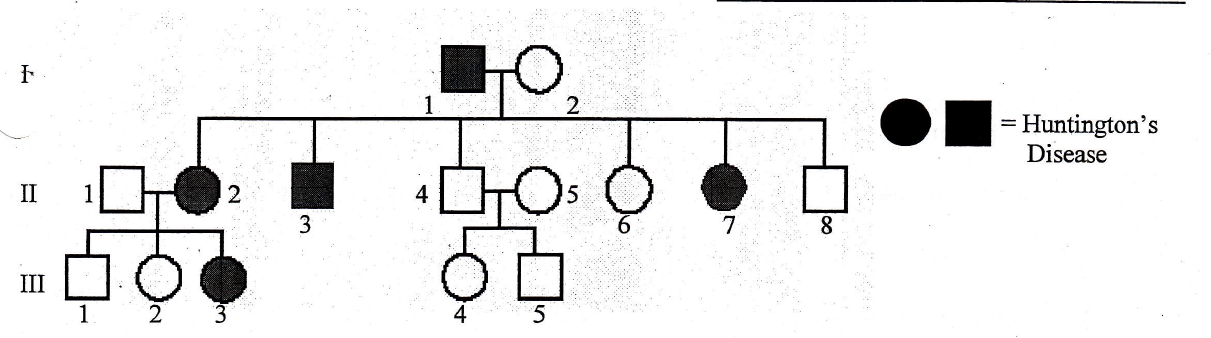
There are no carriers for Huntington's Disease, you either have it or you don't. Is Huntington's disease caused by a dominant or recessive trait?
a)
Dominant
b)
Recessive
81.

Huntington's Disease is a dominant trait.
What is the correct genotype for individual I-2?
What is the correct genotype for individual I-2?
a)
HH
b)
Hh
c)
hh
d)
H_
82.

What type of trait does this pedigree show?
a)
Autosomal Dominant
b)
Autosomal Recessive
c)
Sex-Linked Dominant
d)
Sex-Linked Recessive
83.

In the blood type Punnett square shown, what is the probability the offspring will inherit each blood type?
a)
50% A, 25% B, 0% AB, 25% O
b)
25% A, 50% B, 25% AB, 0% O
c)
50% A and 50% B
d)
25% AB, 50% A, 25% O
84.
Which gender is more likely to inherit an X-linked, recessive trait and why?
a)
Females b/c they have 2 X chromosomes
b)
Males b/c they have only 1 X chromosome
c)
Females b/c they have no Y chromosome
d)
Males b/c their Y chromosome is smaller than the X chromosome
85.
Which gender can never inherit a Y-linked trait?
a)
Females
b)
Males
86.
If a male shows a recessive X-linked trait, which parent did he receive the allele from?
a)
Mom
b)
Dad
c)
Grandpa
d)
Grandma
87.
A trait that is controlled by many genes is called:
a)
Polygenic
b)
Sex-linked
c)
Completely dominance
d)
Regulatory
88.
What is a good example of a polygenic trait in humans?
a)
Height
b)
Red-green colorblindness
c)
Tongue Rolling
d)
Flower color
89.
What is a good example of a sex-linked trait in humans?
a)
Skin color
b)
Wavy hair
c)
Blood clotting (Hemophilia)
d)
Eye color
90.
Which gender cannot be a carrier of an X-linked, recessive trait?
a)
Males
b)
Females
91.

In the sex-linked Punnett square shown, Xh is the allele for hemophilia. What percentage of SONS would you expect to be hemophiliac?
a)
25%
b)
75%
c)
100%
d)
50%
92.
In the sex-linked Punnett square shown, Xh is the allele for hemophilia. What percentage of DAUGHTERS would you expect to be hemophiliac?
a)
25%
b)
100%
c)
0%
d)
50%
93.
Hemophilia is a sex-linked recessive trait found on the X chromosome. Complete a cross between a woman who is a carrier and a man who is normal.
What are the chances, if they have a daughter, that she is a carrier?
What are the chances, if they have a daughter, that she is a carrier?
a)
100%
b)
75%
c)
50%
d)
25%
94.
If a male has an affected x chromosome for a sex-linked trait such as colorblindness, where did he get the chromosome from?
a)
His father
b)
His mother
95.
When would a female have a 100% chance of inheriting a sex-linked trait?
a)
She inherits an affected X chromosome, but only from her mother
b)
She inherits an affected X chromosome from both mother and father.
c)
Mother and father both pass on recessive alleles on somatic chromosomes.
d)
Mother and father both pass on dominant alleles on somatic chromosomes.
96.
How are incomplete dominance and codominance different from a normal Mendelian cross?
a)
There is no difference
b)
The heterozygous genotype has a unique phenotype
c)
There is no heterozygous genotype
d)
There is only one phenotype regardless of genotype.
97.
If a colorblind male marries a woman who is a carrier, what percentage of their FEMALE children will be colorblind?
a)
0%
b)
25%
c)
50%
d)
100%
98.
Which set of parents can most likely produce a child with type O blood?
a)
one parent with homozygous type A blood, and the other parent with homozygous type B blood
b)
one parent with heterozygous type A blood, and the other parent with type O blood
c)
one parent with type AB blood, and the other parent with type O blood
d)
A one parent with type AB blood, and the other parent with type A blood
99.
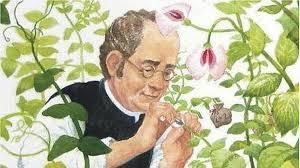
Who is the father of genetics?
a)
Charles Darwin
b)
Gregor Mendel
c)
Dimitri Mendeleev
d)
Hans Krebs
100.

The genotypes of the affected son and daughter at the bottom of this pedigree...
a)
could be homozygous dominant
b)
could be homozygous recessive
c)
could be heterozygous
d)
Can't tell
101.
What do we use pedigrees for?
a)
To look at families
b)
To make determinations about the offspring
c)
To track traits in families
d)
Nothing
102.

Why do all the daughters in Generation II carry the colorblind gene?
a)
Because mom passed on the gene.
b)
Because dad passed on the X chromosome.
c)
Because their brother has it.
d)
Because their brother gave it to them.
103.

Give the genotype for person III-3
a)
GG
b)
Gg
c)
gg
104.

What is the mode of inheritance shown here? (white shapes = affected)
a)
Recessive
b)
Sex Linked
c)
Dominant
105.

What do half colored symbols represent?
a)
The individual is a carrier (heterozygous).
b)
The individual expresses the trait.
c)
The individual has both recessive alleles.
d)
The individual has both dominant alleles.
106.

Looking at this pedigree, how many family members have the disease?
a)
4
b)
7
c)
All
d)
None
107.
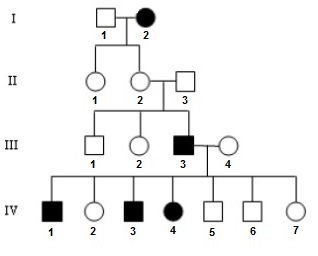
If hemophilia is a sex-linked recessive trait, what genotype would individual I-2 have?
a)
XBXb
b)
XbXb
c)
XBY
d)
XbY
108.

Is it possible for individual IV-2 to be a carrier? Why?
a)
No, because her parents don't have the trait.
b)
No, because she doesn't have the trait.
c)
Yes, because her siblings have it.
d)
Yes, because her parents are carriers.
109.
Does this pedigree show a dominant or recessive trait?
a)
Dominant
b)
Recessive
110.
Does this pedigree show a sex-linked or autosomal trait?
a)
sex-linked
b)
autosomal
111.

What type of trait is shown in the pedigree?
a)
Autosomal Recessive
b)
Sex-Linked Recessive
c)
Autosomal Dominant
d)
Sex-Linked Dominant
112.
If UNAFFECTED parents have an AFFECTED child, this is an indication that the trait is
a)
dominant
b)
recessive
113.
If the trait SKIPS a generation, it is an indication that the trait is
a)
dominant
b)
recessive
114.
If AFFECTED males have AFFECTED sons,
a)
the trait is probably autosomal.
b)
the trait is possible sex-linked.
115.
If a trait is more likely to appear in one sex over the other,
a)
the trait is probably sex-linked.
b)
the trait is probably autosomal.
116.

What type of heredity is shown in the pedigree?
a)
Sex-Linked Dominant
b)
Sex-Linked Recessive
c)
Autosomal Dominant
d)
Autosomal Recessive
117.

What type of heredity is shown in the pedigree?
a)
Sex-Linked Dominant
b)
Sex-Linked Recessive
c)
Autosomal Dominant
d)
Autosomal Recessive
118.

What type of heredity is shown in the pedigree?
a)
Sex-Linked Dominant
b)
Sex-Linked Recessive
c)
Autosomal Dominant
d)
Autosomal Recessive
119.

What type of heredity is shown in the pedigree?
a)
Sex-Linked Dominant
b)
Sex-Linked Recessive
c)
Autosomal Dominant
d)
Autosomal Recessive
120.

What is the genotype of the mother?
a)
BB
b)
bb
c)
Bb
d)
BB or Bb
121.
Colorblindness is a recessive sex-linked trait. If B = normal & b = colorblind, which genotype represents a female with colorblindness.
a)
XBXB
b)
XBXb
c)
XbXb
d)
XbY
122.
All males receive their X chromosome from their ________.
a)
mother
b)
father
c)
brother
d)
sister
123.
Which of the following could be the genotype of a carrier?
a)
BB
b)
Hh
c)
tt
d)
DD
124.

This pedigree shows what pattern of inheritance?
a)
Autosomal Dominant
b)
Autosomal Recessive
c)
Sex-linked Dominant
d)
Sex-linked Recessive
125.

What is the genotype of the father?
a)
AA
b)
aa
c)
Aa
d)
AA or aa
126.
What would indicate a normal human male?
a)
XX
b)
X
c)
XY
d)
XXY
127.
What is the most likely mode of inheritance shown here? (white shapes = affected)
a)
Recessive
b)
Sex Linked
c)
Dominant
128.

What is the mode of inheritance shown here?
a)
Autosomal Dominant
b)
Sex Linked Recessive
c)
Autosomal Recessive
d)
Sex Linked Dominant
129.
If hemophilia is a sex-linked recessive trait, what genotype would individual III-3 have?
a)
XbX
b)
XbXb
c)
XbYb
d)
XbY
130.
If a trait SKIPS a generation, it is an indication that the trait is....
a)
dominant
b)
recessive
c)
incompletely dominant
d)
co-dominant
131.
If a trait is more likely to appear in one sex over the other......
a)
the trait is probably sex-linked.
b)
the trait is probably autosomal.
c)
the trait is probably co-dominant
d)
the trait if probably incompletely dominant
132.

By looking at this karyotype you can determine that this person ______ ________.
a)
has Downs Syndrome (trisomy 21)
b)
has Monosomy X (Turners Syndrome)
c)
is normal
d)
has Trisomy 13(Patau Syndrome)
133.

How many chromosomes are shown in a normal human karyotype?
a)
2
b)
12
c)
25
d)
46
134.
Chromosome that is not a sex chromosome
a)
Chromosome
b)
Autosome
c)
Sex Chromosome
d)
Homologous pair
135.
Photograph of chromosomes grouped in ordered pairs
a)
pedigree
b)
Punnett Square
c)
Venn Diagram
d)
Karyotype
136.

What can you determine about this person based on their karyotype?
a)
They have Downs Syndrome (trisomy 21)
b)
They have Turner's Syndrome (monosomy X)
c)
They have trisomy 13
d)
They are completely Normal
137.

What can you determine about this person based on their karyotype?
a)
They have Turner's Syndrome (Monosomy X)
b)
They have Downs Syndrome (trisomy 21)
c)
They are normal
d)
They are male
138.
If a gene is found only on the X chromosome and not the Y chromosome, it is said to be what?
a)
sex-linked trait
b)
polygenic trait
c)
codominant trait
d)
incomplete dominance trait
100 %

