wayground logo

Free Printable Worksheets

Font size

S
M
L
XL
Worksheets

DNA Review

Total questions: 140

Worksheet time: 3hrs 9mins

Name
Class
Date
1.
Who is responsible for producing this image?
a)
Francis Crick
b)
James Watson
c)
Rosalind Franklin
d)
Watson and Crick
2.
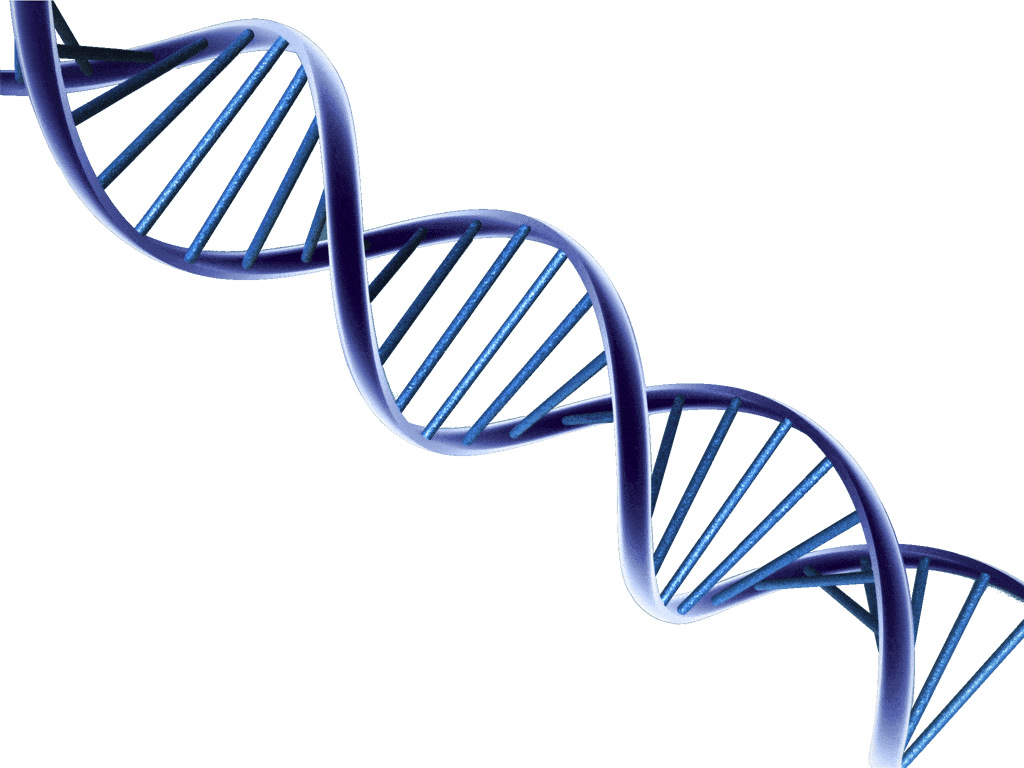
What does this image show?
a)
Double helical structure of DNA
b)
Triple Helical Structure of DNA
c)
Double helical structure of RNA
d)
Triple Helical Structure of RNA
3.
How did Rosalind Franklin's photo 51 affect the work of Watson and Crick?
a)
It was used to determine the physical structure of DNA
b)
It was used to identify the four bases that make up DNA
c)
It was used to determine the theory of independent assortment
d)
It was used to show DNA was the molecule of inheritance
4.
What did Erwin Chargaff conclude from his experiments?
a)
Nitrogen bases are held together by peptide bonds
b)
A and T, C and G always occur in equal amounts
c)
Proteins are the carriers of genetic information
d)
C and G rarely occur in eukaryotic organisms
5.
What did Erwin Chargaff conclude from his experiments?
a)
Nitrogen bases are held together by peptide bonds
b)
A and T, C and G always occur in equal amounts
c)
Proteins are the carriers of genetic information
d)
C and G rarely occur in eukaryotic organisms
6.
What was Watson and Crick's main scientific accomplishment?
a)
Building the first accurate model of DNA
b)
Isolating strains of pneumonia causing bacteria
c)
Determining base pairing rules
d)
Discovering the process of genetic transformation
7.
From his work with mice and pneumonia-causing bacteria, Frederick Griffith discovered what?
a)
Replication
b)
Transcription
c)
Transformation
d)
Translation
8.
By using radioactive isotopes, Hershey and Chase were able to conclude that _____ is the carrier of genetic information.
a)
DNA
b)
Protein
c)
Carbohydrate
d)
Lipid
9.
The work of Erwin Chargaff allowed Watson and Crick to determine the rules of.......
a)
protein synthesis
b)
transcription
c)
hydrogen bonding
d)
nitrogen base pairing
10.
Rosalind Franklin's "Photo 51" allowed Watson and Crick to determine the _______ of DNA.
a)
Shape
b)
Backbone
c)
Nitrogen bases
d)
Hydrogen bonds
11.
The work of scientists including Griffin, Avery, Hershey & Chase, and Franklin helped us to determine that _______ are responsible for carrying genetic material.
a)
Amino Acids
b)
Proteins
c)
Nucleic Acids
d)
Carbohydrates
12.
Who was responsible for the experiment depicted by the image?
a)
Martha Chase
b)
Watson and Crick
c)
Frederick Griffith
d)
Rosalind Franklin
13.
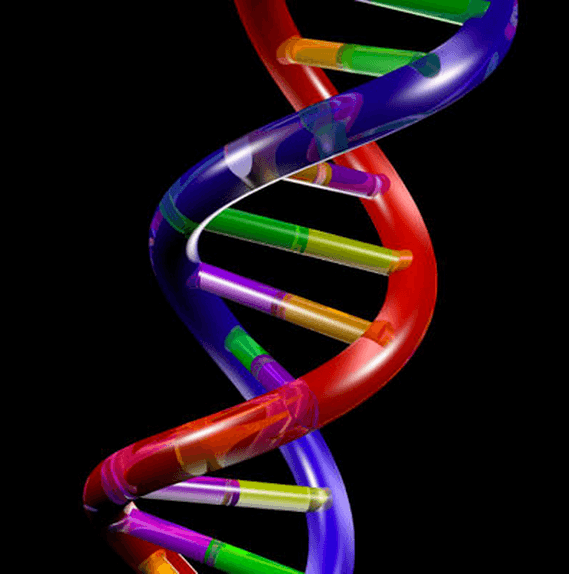
Who was responsible for the model shown?
a)
Oswald Avery
b)
Watson and Crick
c)
Erwin Chargaff
d)
Rosalind Franklin
14.
This scientist(s) found a "transforming principle" that changed harmless bacteria into harmful bacteria
a)
Mendel
b)
Avery
c)
Chargraff
d)
Griffith
15.
Scientist(s) who used chemical analysis to show that the genetic material in bacteria was DNA
a)
Griffith
b)
Hershey & Chase
c)
Mendel
d)
Avery
16.
In the early 1900s, most scientists thought it was _____________ that carried traits form parent to offspring. 
a)
Carbohydrates
b)
Lipids
c)
Proteins
d)
DNA
17.
Avery added an enzyme known to break down proteins to his extract, and saw that the bacteria were ____________________
a)
still transformed
b)
not transformed
c)
all killed
d)
all sick
18.
Avery added an enzyme known to break down DNA to his extract, and saw that the bacteria were __________________
a)
still transformed 
b)
not transformed
c)
all sick
d)
all killed
19.
By using radioactive isotopes, Hershey and Chase were able to conclude that __ is/are the carrier(s) of genetic information.
a)
nucleic acid
b)
Proteins
c)
Carbohydrates
d)
Lipids
20.
The work of scientists including Griffin, Avery, Hershey & Chase and Franklin helped us to determine the __ are responsible for carrying genetic material.
a)
Amino Acids
b)
Proteins
c)
Nucleic Acids
d)
Carbohydrates
21.
Griffith discovered that
a)
DNA is different than RNA.
b)
adenine = thymine.
c)
bacteria can transfer DNA.
d)
DNA is the genetic molecule.
22.
What organism was Griffith using when he discovered that a harmless strain of bacteria could transform into a lethal strain of bacteria?
a)
pea plants
b)
fruit flies
c)
bacteriophages
d)
mice
23.

Who FIRST showed that DNA was the transforming factor?

a)

Griffith

b)

Avery

c)

Chargaff

d)

Franklin

24.
What did Avery use to destroy proteins, lipids, and carbohydrates to show that DNA was the transforming factor?
a)
Bacteriophages
b)
X-ray diffraction
c)
Enzymes
d)
Radioactive isotopes
25.
Which scientists used viruses and radioactive isotopes to definitively prove that DNA, and not protein, was the molecule of heredity?
a)
Griffith and Avery
b)
Chargaff and Franklin
c)
Watson and Crick
d)
Hershey and Chase
26.
Which two radioactive isotopes were used to label the DNA and protein components of viruses called bacteriophages?
a)
Nitrogen and Phosphorus
b)
Phosphorus and Sulfur
c)
Nitrogen and Sulfur
27.
Histones are 
a)
proteins wound up in DNA
b)
critical to maintaining the shape of chromosomes
c)
aid in the tight packing of DNA
d)
all of these 
28.
Autosomes are
a)
chromosomes found in autotrophs, only
b)
chromosomes that automatically correct all errors in the DNA
c)
chromosomes that determine traits other than sex
d)
chromosomes that determine the sex of the individual
29.
The number of nucleotides in a human cell is about
a)
3000
b)
300,000
c)
3 million
d)
3 billion
30.

An organism's reproductive cells, or sex cells, are called _____.

a)

bacteria

b)

prokaryotes

c)

gametes

d)

pathogens

31.

A _______ is a segment of DNA that codes for a specific protein or RNA molecule.

a)

gene

b)

gamete

c)

chromosome

d)

chromatid

32.

A _________ is DNA tightly coiled around proteins.

a)

gene

b)

chromosome

c)

trait

d)

mutation

33.

How many chromosomes does a human body cell have, total?

a)

48

b)

46

c)

23

d)

47

34.

Chromosomes that are paired by size and content are called _______ chromosomes.

a)

homeostasis

b)

homologous

c)

matching

d)

sister

35.

Body cells are also called _________ cells.

a)

normal

b)

prokaryotic

c)

pathogens

d)

somatic

36.

The 23rd pair of chromosomes that do determine the sex of an individual are called ___________.

a)

sex chromosomes

b)

autosomes

c)

homologous

d)

genes

37.

The 2 female sex chromosomes are ___.

a)

XY

b)

XX

38.

The 2 male sex chromsomes are _____.

a)

XY

b)

XX

39.
Which sequence of DNA bases would pair with this partial strand
ATG TGA CAG
a)
ATG TGA CAG
b)
TAC ACT GTC
c)
GTA AGT GAC
d)
CAT TCA CTG
40.
Which of the following best describes a DNA molecule?
a)
double helix
b)
contains ribose
c)
made of amino acids
d)
contains Uracil
41.
Which of the following units are repeatedly joined together to form a strand of DNA?
a)
amino acids
b)
nucleotides
c)
fatty acids
d)
polysaccharides
42.
In a molecule of double-stranded DNA, the amount of Adenine present is always equal to the amount of
a)
cytosine
b)
guanine
c)
thymine
d)
uracil
43.
Adenine bonds with ______________.
a)
Guanine
b)
Thymine
c)
Cytosine
d)
Adenine
44.
Guanine bonds with ______________.
a)
Adenine
b)
Guanine
c)
Cytosine
d)
Thymine
45.
Why is DNA important?
a)
it is very small and very complicated
b)
it's in everything
c)
it serves as the blueprint for traits of all living things
d)
because we eat it every day for energy
46.
What determines the code, or information, of a DNA molecule?
a)
the shape (structure) of the nitrogen bases
b)
the order (sequence) of the nitrogen bases
c)
the color of the nitrogen bases
d)
the frequency (number) of nitrogen bases
47.
Which 2 molecules form the sides (backbone) of the DNA ladder?
a)
deoxyribose sugar and adenine
b)
deoxyribose sugar and a hydrogen bond
c)
deoxyribose sugar and the nucleus
d)
deoxyribose sugar and phosphate
48.
Which organelle is DNA usually found in?
a)
cell membrane
b)
vacuole
c)
chloroplast
d)
nucleus
49.
Nitrogenous bases are joined by which type of bond?
a)
polar bonds
b)
ionic bonds
c)
covalent bonds
d)
hydrogen bonds
50.
Replicate the following strand of DNA: 
AATCATGGA
a)
AATCATGGA
b)
TTAGTACCT
c)
UUAGUACCU
d)
GGATAUCUA
51.
The enzyme that unzips the DNA to prepare for replication
a)
helicase
b)
replicase
c)
polymerase
d)
synthase
52.
DNA replication results in two DNA molecules,
a)
each one with two original strands
b)
each one with two new strands
c)
each one with one new strand and one original strand
d)
one with two new strands and the other with two original strands
53.
order of replication
a)
3, 2, 1, 4
b)
2, 1, 4, 3
c)
2, 3, 1, 4
d)
3, 4, 1, 2
54.
A process in which DNA has the unique ability to make an exact copy of itself.
a)
Replication
b)
Translation
c)
Transcription
55.
What is the correct complimentary strand for the following DNA?ATCGAG
a)
TACGAG
b)
ATCGAG
c)
TAGCTG
d)
TAGCTC
56.
The drawing shows the structure of what molecule?
a)
A DNA molecule
b)
A lipid molecule
c)
A carbohydrate molecule
d)
A protein molecule
57.
What are the three components of a nucleotide?
a)
sugar, hydrogen, nitrogen base
b)
sugar, oxygen, nitrogen base
c)
sugar, phosphate, nitrogen base
d)
sugar, phosphate, protein
58.
If a strand reads:
3' A A A T T T C 5'
The matching strand would read...
a)
5' T T T A A A G 3'
b)
3' T T T A A A G 5'
c)
5' A A A T T T C 3'
d)
3' U U U A A A G 5'
59.
Polymerase is able to replicate the new DNA ______ along the leading strand.
a)
continuously
b)
only in short fragments
c)
very slowly
d)
prokaryotically
60.
A DNA nucleotide contains all of the following, except...
a)
Deoxyribose
b)
Phosphate group
c)
Nitrogenous base
d)
Cholesterol
61.
What is the shape of DNA?
a)
Double helix
b)
Triple helix
c)
Flat, bilayer
d)
Three-pronged rigid ladder
62.
DNA replication turns one strand of DNA into two new strands of DNA. What percent of each new strand is the old strand?
a)
Half of each new DNA is the old DNA
b)
The old strand of DNA was digested, so none
c)
The new DNA is entirely made up of the old DNA
d)
About every sixth base comes from the old DNA
63.
Sometimes, DNA is called "semi-conservative." Why might this be?
a)
The old strand is "conserved" and used to make the new strands
b)
Uracil is "conserved" in that it is only used to make the new strands
c)
ATP is "conserved" via the usage of facilitated diffusion
d)
Ligase is "conserved" in that it is denatured by the process
64.
If the percentage of DNA is made of 30% Thymine, what is the correct percentage of Guanine?
a)
30
b)
15
c)
20
d)
60
65.
Replicate the following strand of DNA: 
AATCATGGA
a)
AATCATGGA
b)
TTAGTACCT
c)
UUAGUACCU
d)
GGATAUCUA
66.
A scientist observes a base sequence of AGCTAGCTAGCT.  Which of the following would be the complimentary strand?
a)
TGCATGCATGCA
b)
TCGATCGATCGA
c)
TAGCTAGCTAGC
d)
TTAAGGCCTTCC
67.
The bonds that hold the two strands of DNA together come from...
a)
the attraction of phosphate groups 
b)
strong bonds between  bases and sugars
c)
carbon to carbon bonds in the sugar
d)
weak hydrogen bonds between the bases
68.
What is responsible for holding the two strands of the DNA double helix together?
a)
hydrogen bonds
b)
alleles
c)
London dispersion forces
d)
deoxyribose sugars
69.
What are the 4 nitrogen bases?
a)
adenine, thymine, cytoplasm, and guanine
b)
adenine, thymine cytosine, and guanine
c)
adenine, thymine, cytosine, and gylcerol
d)
adenine, thymine, cytosine, and glucose
70.
Which organelle is DNA usually found in?
a)
cell membrane
b)
vacuole
c)
chloroplast
d)
nucleus
71.
Describes the twisted ladder-like shape of a DNA molecule
a)
Nitrogen Base
b)
Hexagon
c)
Double Helix
72.
What term names the process during which DNA is copied prior to cell division?
a)
DNA polymerase
b)
DNA replication
c)
DNA regneration
d)
DNA redistribution
73.
After analyzing a sample of DNA, a scientist recorded the data shown in the table. What percentage of the DNA sample is cytosine?
a)
22%
b)
25%
c)
28%
d)
56%
74.
Name this structure
a)
double helix
b)
nucelotide
c)
twisted ladder
d)
hydrogen bond
75.
Which RNA bases would pair with TACGAA in transcription
a)
AUGCUU
b)
ATGCTT
c)
GCATCC
d)
GCAUCC
76.
Where does transcription take place?
a)
nucleus
b)
cytoplasm
c)
ribosome
77.
True or false:  RNA is double-stranded.
a)
true
b)
false
c)
it depends on the type
78.
Which is a difference between DNA and RNA
a)
RNA is double stranded
b)
RNA is not made of nucleotides
c)
RNA contains Uracil instead of Thymine
d)
RNA does not contain a sugar
79.
Which process is used to make mRNA from the DNA in the nucleus?
a)
transcription
b)
translation
c)
replication 
80.
Which of these bases does not exist in RNA?
a)
C
b)
T
c)
U
d)
A
81.
DNA codes for...
a)
cholesterol
b)
proteins
c)
fatty acids
d)
a sandwich
82.
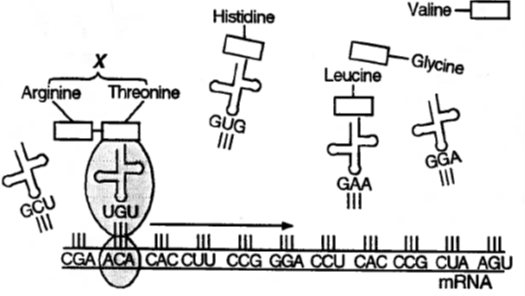
What is occurring in this picture?
a)
Translation
b)
Replication
c)
Translocation
d)
Transcription
83.
Which process is used to copy DNA in the nucleus?
a)
replication
b)
transcription
c)
translation
84.

DNA contains the template to make RNA

a)

True

b)

False

85.

What enzyme does transcription use?

a)

DNA polymerase

b)

ligase

c)

RNA polymerase

d)

helicase

86.

Which RNA forms part of the ribosomes?

a)

tRNA

b)

mRNA

c)

rRNA

87.

Which RNA carries the message?

a)

mRNA

b)

rRNA

c)

tRNA

88.

Which RNA brings amino acids?

a)

rRNA

b)

tRNA

c)

mRNA

89.

The goal of transcription is to make RNA.

a)

True

b)

False

90.
A triplet of mRNA is called a
a)
codon
b)
anticodon
c)
amino acid
d)
peptide bond
91.
Which of the following statements is true?
a)
DNA is single-stranded
b)
RNA is single-stranded
c)
DNA contains uracil
d)
RNA contains deoxyribose
92.

RNA A pairs with?

a)

g

b)

4

c)

u

d)

t

93.
I include the bases guanine, cytosine, and adenine.
a)
DNA
b)
RNA
c)
Both DNA and RNA
94.

Transcription converts a gene into a double stranded molecule.

a)

True

b)

False

95.

What is the correct order to make a protein?

a)

Protein, DNA, RNA

b)

RNA, DNA, Protein

c)

DNA, RNA, Protein

d)

Protein, RNA, DNA

96.
How does RNA differ from DNA?
a)
RNA contains uracil and deoxyribose
b)
RNA contains ribose and thymine
c)
RNA contains uracil and ribose
d)
RNA contains adenine and ribose
97.
How would the DNA sequence GCTATA be transcribed to mRNA?
a)
GCUAUA
b)
CGATAT
c)
CGAUAU
d)
GCUTUT
98.
The process by which the genetic code of DNA is copied into a strand of RNA is called
a)
translation
b)
transcription
c)
transformation
d)
replication
99.
Which of the following describes RNA?
a)
RNA is usually double-stranded and contains the base thymine
b)
RNA is usually single-stranded and contains the base uracil
c)
RNA is longer than DNA and uses five bases to encode information
d)
RNA is made in the nucleus of eukaryotic cells and stays there to carry out its functions
100.

Transcribe the following DNA sequence:


AAT TAG GGC TCG

a)

AAT TAG GGC TCG

b)

TTA ATC CCG AGC

c)

UUA AUC CCG AGC

d)

TTU UTC CCG UGC

101.
Replicate the following strand of DNA: 
AATCATGGA
a)
AATCATGGA
b)
TTAGTACCT
c)
UUAGUACCU
d)
GGATAUCUA
102.
What is Transcription?
a)
The making of tRNA from a DNA segment.
b)
The making of an rRNA strand from a DNA segment.
c)
The making of an mRNA strand from a DNA segment.
d)
IDK. I just want the semester to be over...
103.
What type of macro-molecules are DNA and RNA?
a)
Protein
b)
Carbohydrate
c)
Nucleic Acid
d)
Lipid
104.
Which of the following would be a nucleotide found in DNA
a)
Ribose + phosphate + uracil
b)
Deoxyribose + phosphate + uracil  
c)
Deoxyribose + phosphate + adenine
d)
Ribose + phosphate + adenine
105.
Using the codon identify the amino acid sequence:
AUG-CCA-GUA-GGG-UAA
a)
MET-HIS-ALA-GLY-STOP
b)
MET-PRO-GLY-VAL-STOP
c)
MET-PRO-VAL-GLY-STOP
d)
MET-THR-SER-ASP-STOP
106.
What is this a picture of?
a)
mRNA
b)
tRNA
c)
rRNA
d)
pRNA
107.
Which amino acid is made from the RNA codon UUA?
a)
Phenylalanine
b)
Leucine
c)
Serine
d)
Tyrosine
108.
What is the relationship between a protein, the cell, and DNA?
a)
DNA is produced by protein which is produced in the cell
b)
Protein is composed of DNA which is produced in the cell
c)
DNA makes RNA which produces protein in the cell
d)
A cell is composed of DNA and protein
109.
Process in which amino acids are assembled into proteins at the ribosome?
a)
Translation
b)
Transcription
c)
Meiosis
d)
Replication
110.
Which structure reads the mRNA codons?
a)
Nucleus
b)
Ribosome
c)
Golgi Body
d)
Enzyme
111.
If the mRNA sequence is AGA UUU CGA GCC,
what is the complementary tRNA anticodons?
a)
AGA TTT CGA GCC
b)
UCU AAA GCU CGG
c)
TCT AAA GCT CGG
d)
UCU AAA CGA GGG
112.
Where in the cell does translation take place?
a)
Nucleus
b)
DNA
c)
Chloroplast
d)
Ribosome
113.
What type of molecule is the end product of translation?
a)
Glucose
Glucose
b)
Fatty Acid
c)
Glycogen
d)
Protein
114.

What is the correct sequence of protein synthesis?

A. tRNA brings amino acids to the ribosome

B. DNA molecules serve as the templates for mRNA.

C. mRNA molecules move to ribosomes.

D. Polypeptides are formed on ribosomes.

a)

A-B-C-D

b)

B-C-A-D

c)

C-B-A-D

d)

D-B-A-C

115.

Overall, protein synthesis consists of these steps

a)

DNA synthesis, RNA synthesis and transcription

b)

transcription and translation

c)

DNA synthesis, transcription and translation

116.
What is the correct amino acid sequence for the mRNA code AUGCCAGUAUGA
a)
Met-Pro-Ala-Val
b)
Met-Pro-Val
c)
Tyr-Gly-His
d)
Tyr-Gly-Arg-His
117.
What amino acid is represented by the codon AUG?
a)
Aspartic Acid
b)
Histidine
c)
Glutamine
d)
Methionine
118.
What amino acid is represented by the codon CAG?
a)
Aspartic Acid
b)
Histidine
c)
Glutamine
d)
Methionine
119.
Which code does NOT cause transcription to stop?
a)
UGA
b)
UAA
c)
UAG
d)
UGG
120.

When using your codon chart, what sequence can you use to find the correct amino acid?

a)

DNA

b)

mRNA

c)

tRNA

d)

Any of these will do

121.

How many codons: AAU GCG AUG

a)

9

b)

1

c)

3

d)

15

122.

How many nucleotides? AAU GCG AUG

a)

9

b)

3

c)

1

d)

15

123.
ATCAGTGAT A codon is a sequence of three nucleotides that code for an amino acid. If the DNA sequence shown here goes through transcription and translation, how many amino acids will result from this sequence?
a)
5
b)
4
c)
2
d)
3
124.
What process is going on in this photo? 
a)
Transcription 
b)
Translation 
c)
Replication 
d)
All the above 
125.
What is the correct amino acid sequence for the mRNA code AUGCCAGUAUGA
a)
Met-Pro-Ala-Val
b)
Met-Pro-Val
c)
Tyr-Gly-His
d)
Tyr-Gly-Arg-His
126.
What amino acid is represented by the codon UUA?
a)
Phenylalanine
b)
Tyrosine
c)
Leucine
d)
Stop codon
127.

Which of the following answer choices correctly identifies each molecule in the above diagram?

a)

1 - mRNA, 2 - tRNA, 3 - ribosome

b)

1 - tRNA, 2 - mRNA, 3 - ribosome

c)

1 - tRNA, 2 - ribosome, 3 - mRNA

d)

1 - ribosome, 2 - tRNA, 3 - mRNA

128.

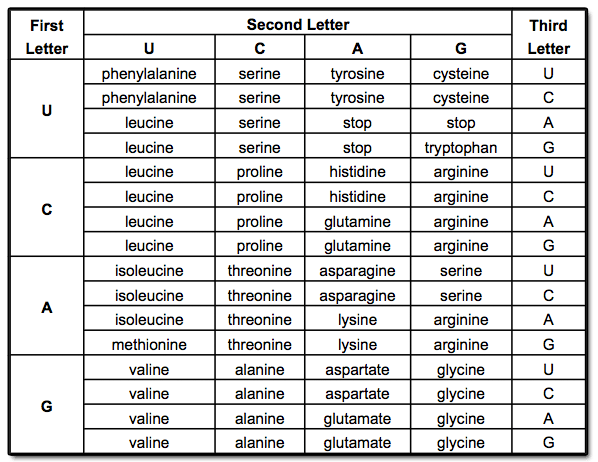
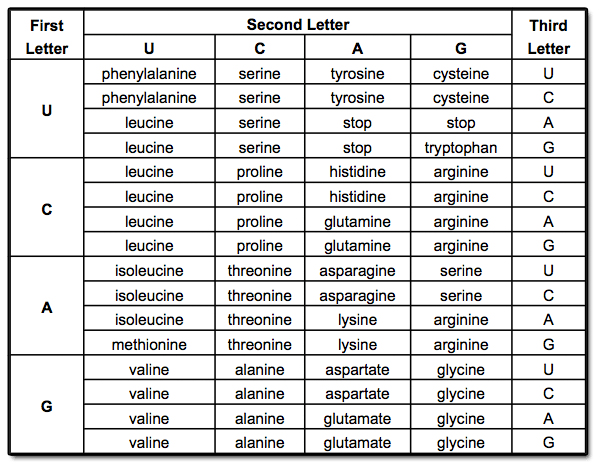
Use your CODON CHART to answer the following question.


What amino acid is codded for by the codon GCA?

a)

serine

b)

alanine

c)

arginine

d)

proline

129.

Use the CODON CHART to answer the following question.


What amino acid is coded for by the codon CAG?

a)

histidine

b)

tyrosine

c)

valine

d)

glutamine

130.

Use the CODON CHART to answer the following question.


Which of these codons would NOT result in the production of a protein being stopped?

a)

UAA

b)

UGA

c)

UAG

d)

UGG

131.

Which of the following codons will code for aspartic acid?

a)

AAU

b)

GAG

c)

GAU

d)

UGG

132.

Use the CODON CHART to answer the following question.


CCG UUG ACC GCG


What is the sequence of amino acids that will be translated from the mRNA above?

a)

proline - threonine - alanine - luecine

b)

proline - leucine - threonine - alanine

c)

proline - phenylalanine - tyrosine - arginine

d)

arginine - leucine - threoinine - alanine

133.

Use your codon chart to answer the following question:


GCG ACU AAA UUU


What is the sequence of amino acids that will be translated from the mRNA above?

a)

alanine - lysine - phenlalanine - alanine - threonine

b)

alanine - phenlalanine - threonine - lysine

c)

alanine - threonine - phenlalanine - lysine

d)

alanine - threonine - lysine - phenlalanine

134.

Use your codon chart to answer the following question:


UAU ACG GCU CCA


What is the sequence of amino acids that will be translated from the mRNA above?

a)

tyrosine - alanine - proline - threonine

b)

threonine - tyrosine - alanine - proline

c)

tyrosine - threonine - alanine - proline

d)

tyrosine - proline - alanine - threonine

135.

Use your codon chart to answer the following question:


AGC UUC AUC GCG


What is the amino acid sequence from the mRNA above?

a)

serine - phenlylalanine - isoluecine - alanine

b)

serine - phenlylalanine - alanine - isoluecine

c)

serine- alanine - phenlylalanine - isoluecine

d)

serine - phenlylalanine - isoluecine - arginine

136.

Use your codon chart to answer the following question:


AUG AGA ACG CCG


What is the amino acid sequence from the mRNA above?

a)

methionine - arginine - proline - threoinine

b)

methionine - alanine - threoinine - proline

c)

methionine - arginine - threoinine - proline

d)

methionine - proline- arginine - threoinine

137.
DNA molecule segment is : TTACGCAAG
The mutated DNA segment is TTCGCAAG. This is an example of ___ mutation.
a)
Substitution
b)
Deletion
c)
Insertion
d)
Inversion
138.
Normal-
GAG-CTC-GAC-AGA
Mutant
GAG CTC-CAC-AGA

a)
no mutation
b)
substitution
c)
insertion
d)
deletion
139.
Are all mutations bad?
a)
Yes
b)
No
140.
What are the three types of mutation? 
a)
Insertion, Deletion, Subsitution
b)
Deletion, Newstion, Subsitution 
c)
Newstion, Deletion, Insertion 
d)
Insertion, Newstion, Substitution