wayground logo

Free Printable Worksheets

Font size

S
M
L
XL
Worksheets

Semester 1 Review

Total questions: 142

Worksheet time: 2hrs 16mins

Name
Class
Date
1.
Pick the true statement about cellular organization:
a)
cells working together make tissues
b)
cells working together make organs
c)
tissues working together make organ systems
d)
organs working together make cells
2.
Which is the most complex of the choices below?
a)
cell
b)
tissue
c)
organ
d)
organ system
3.
What is the most basic unit of life?
a)
cell
b)
tissue
c)
organ
d)
organ system
4.
It is hot outside. You start sweating. In this case, the hot weather is the...
a)
stimulus
b)
response
c)
cause and effect
d)
responder
5.
Which of these is not true about all organisms?
a)
all living things have many cells
b)
all living things need water
c)
all living things respond to stimuli
d)
all living things reproduce
6.
Which choice shows the levels of organization in order from LARGEST to smallest.
a)
organism, organ system, organ, tissue, cell
b)
cell, tissue, organ, organ system, organism
c)
organism, cell, organ system, tissue, organ
d)
cell, cell, cell, cell, cell
7.
When a baby kitten becomes an adult cat, this is an example of...
a)
energy metabolism
b)
growth and development
c)
response to stimuli
d)
having cells
8.
Which kind of living things have DNA in their cells?
a)
producers
b)
consumers
c)
decomposers
d)
Trick question! All living things have DNA in their cells 
9.
A baby goat looks just like its parents. This is because of the concept of...
a)
homeostasis
b)
heredity
c)
energy metabolism
d)
cellular organization
10.
Your body shivers when you are cold. This is because of the concept of...
a)
homeostasis
b)
heredity
c)
energy metabolism
d)
cellular organization
11.
Proteins are made of monomers called ___________
a)
Nucleotides
b)
Monosaccharides
c)
Amino Acids
d)
Glycerol and fatty acids
12.
The element _______is found in all of the organic compounds.
a)
Iron
b)
Nitrogen
c)
Carbon
d)
Oxygen
13.
DNA and RNA are examples of 
a)
Carbohydrates
b)
Lipids
c)
Proteins
d)
Nucleic Acids
14.
Nucleotides are monomers of
a)
Carbohydrates
b)
Lipids
c)
Proteins
d)
Nucleic Acids
15.
Monosaccharides are monomers of
a)
Carbohydrates
b)
Lipids
c)
Proteins
d)
Nucleic Acids
16.
Waxes, oils and fats are examples of
a)
Carbohydrates
b)
Lipids
c)
Proteins
d)
Nucleic Acids
17.
Glycerol and fatty acids are the monomers of
a)
Carbohydrates
b)
Lipids
c)
Proteins
d)
Nucleic Acids
18.
The organic compounds that have many structural purposes and are used in many processes within the
cell are called ____________________.
a)
Carbohydrates
b)
Lipids
c)
Proteins
d)
Nucleic Acids
19.

Which macromolecule is shown?

a)

lipid

b)

protein

c)

nucleic acid

d)

carbohydrate

20.
What is the function of nucleic acids?
a)
store genetic information
b)
store energy (long-term)
c)
store energy (short-term)
d)
build skin, hair, nails, muscles
21.

Which macromolecule is shown?

a)

lipid

b)

protein

c)

nucleic acid

d)

carbohydrate

22.
What type of macromolecule are enzymes?
a)
Protein
b)
Carbohydrate
c)
Lipid
d)
Nucleic Acid
23.
Which of the following organic compounds is the main source of energy for living things?
a)
carbohydrates
b)
lipids
c)
nucleic acids
d)
proteins
24.
Carbohydrates are made of... 
a)
C H O
b)
C H O N
c)
C H O N P
d)
C H O N S
25.
Lipids are made of... 
a)
C H O
b)
C H O N
c)
C H O N P
d)
C H O N S
26.
Proteins are made of... 
a)
C H O
b)
C H O N
c)
C H O N P
d)
C H O N S
27.
Which macromolecule stores energy, insulates us, and makes up the cell membrane?
a)
lipids
b)
proteins
c)
carbohydrates
d)
nucleic acids
28.
This is one job proteins do NOT have in the body
a)
insulation
b)
structure for tissues and organs
c)
speed up chemical reactions
d)
transport things through cell membrane
29.
What are the four macromolecules?
a)
proteins, nucleic acids, carbohydrates, and lipids
b)
monosaccharides, lipids, polysaccaharides, and proteins
c)
RNA, DNA, proteins, and carbohydrates
d)
proteins, DNA, RNA, and steroids
30.
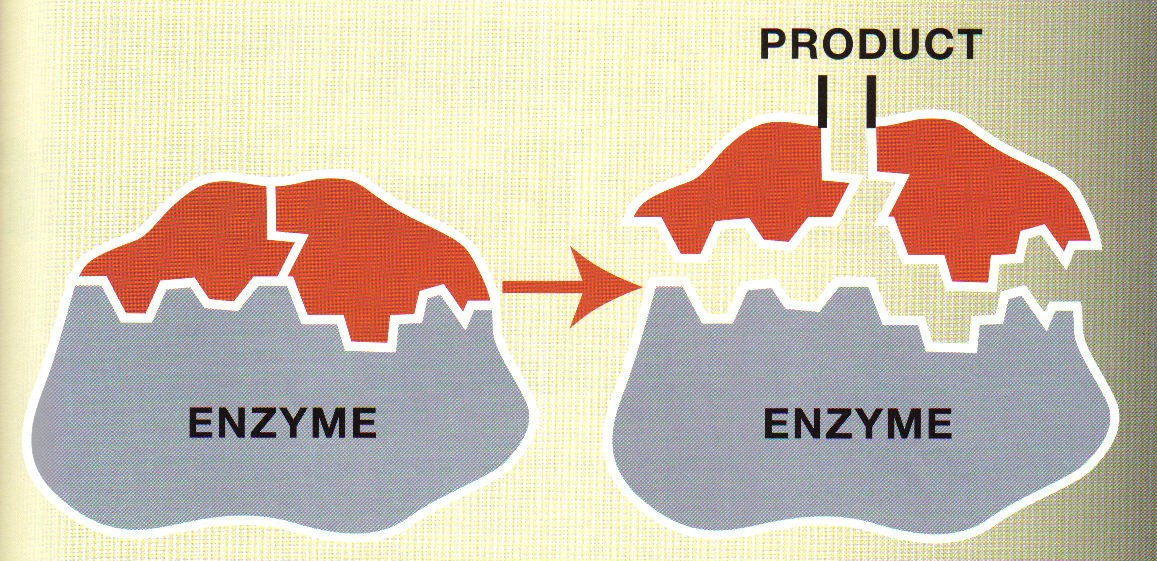
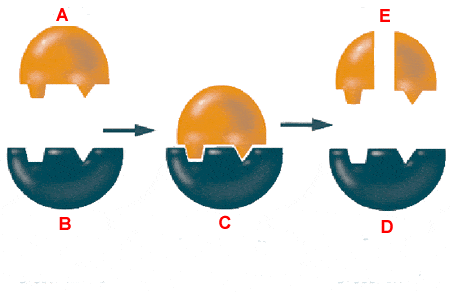
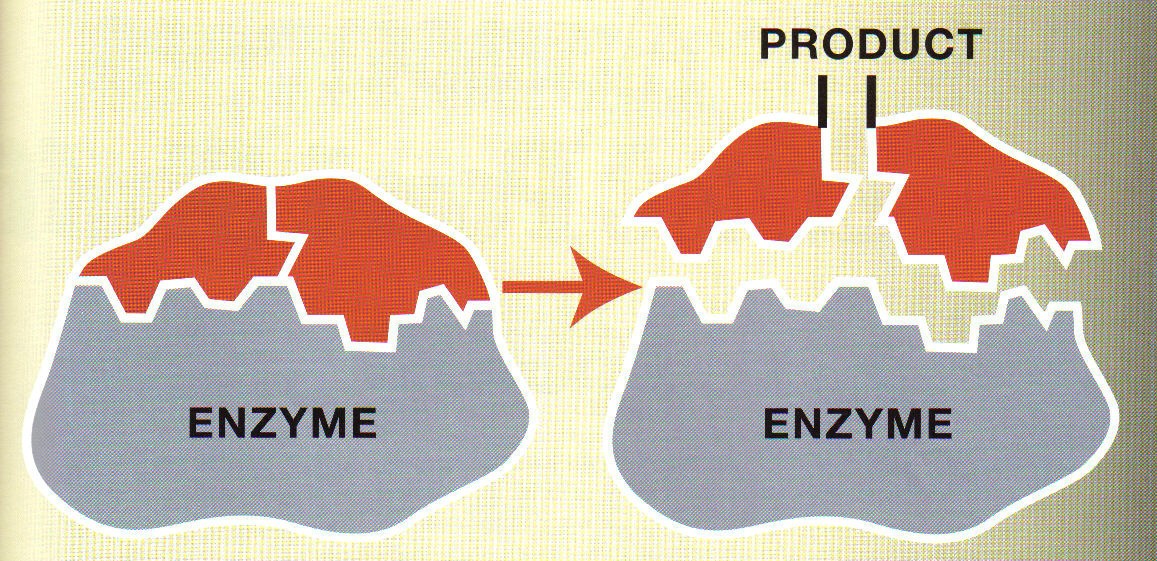
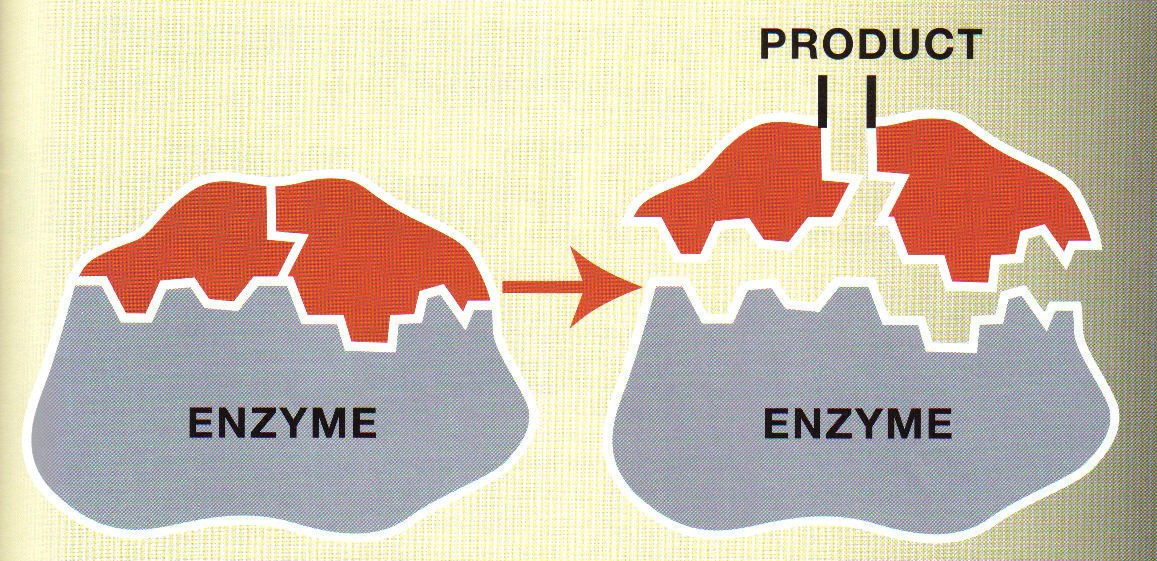
The area that the substrate fits into on the enzyme is called the:
a)
Active Site
b)
Allosteric Site
c)
DiSulphide Bridge
d)
β-Pleated Sheet
31.
Enzymes catalyze reactions by ___________ Activation Energy.
a)
Increasing
b)
Decreasing
32.
Enzymes speed up reaction rates by changing:
a)
Activation Energy
b)
pH
c)
Hydrogen Bonds
d)
Kinetic Energy
33.
The molecule an enzyme is working on is called the:
a)
Substrate
b)
Solvent
c)
Allosteric Inhibitor
d)
CoEnzyme
34.
Which of the following is found in plant cells but not in animal cells? 
a)
Cytoplasm
b)
Mitochondria
c)
Cell Wall 
d)
Ribosomes 
35.
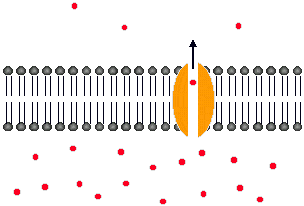
What part of the cell membrane is the arrow pointing to? 
a)
phospholipid
b)
carbohydrate chain 
c)
protein channel 
d)
amino acid 
36.
Which diagram best represents the cell membrane 
a)
a
b)
b
c)
c
d)
d
37.
What plant organelle is used to make sugars?
a)
Cell wall 
b)
Mitochondria 
c)
Chloroplast 
d)
Vacuole
38.
What cell function would be affected if the Golgi apparatus is damaged? 
a)
Exporting Proteins
b)
Storage of water and waste
c)
Production of Energy 
d)
Cell divison
39.
What structure in the cell contains most of the cells genetic information? 
a)
A. rough Endoplasmic Reticulum 
b)
B. mitochondria 
c)
C. nucleus 
d)
D. cytoplasm 
40.
Paramecium and Euglena are both eukaryotes because 
a)
Both have a cell membrane
b)
Both have a nucleus 
c)
Both are single-celled organisms
d)
Both have ribosomes 
41.
Which organelle is responsible for the movement of molecules throughout the cell?
a)
Ribosomes
b)
Nucleus 
c)
Vesicle
d)
Mitochondria
42.
Which structure is not present in animal cells? 
a)
Chloroplast
b)
Cell membrane 
c)
Cytoplasm 
d)
Nucleus 
43.
What is the primary function of the cell's selectively permeable membrane? 
a)
Regulate energy production 
b)
Keeps the cell's shape
c)
Control what enters and leaves the cell
d)
Maintain a free flow of molecules
44.
What does this single-celled organism use to move? 
a)
Pseudopodia
b)
Flagella
c)
Cilia
d)
Mitochondria 
45.
Which structures are found in every living cell?
a)
cell membrane and cytoplasm
b)
chloroplasts and mitochondria
c)
a cell wall and nucleus
d)
chloroplasts and cell wall
46.
Which cell structure is found in plant and animals cells and controls what can come into or leave a cell?
a)
cell membrane
b)
cytoplasm
c)
nucleus
d)
vacuole
47.
Cell organelles that are responsible for digesting food, worn out organelles and other cellular wastes are called ___________________.
a)
Mitochondria
b)
Vacuoles
c)
Lysosomes
d)
Chlororplasts
48.
All cells need energy to function.  Which cell organelle is responsible for producing energy in the cell?
a)
chloroplasts
b)
mitochondria
c)
nucleus
d)
vacuoles
49.
What is the function of a cell wall?
a)
to protect and support the cell
b)
to perform different functions in each cell
c)
to prevent water from passing through it
d)
to prevent oxygen from entering the cell
50.
Cells with a nucleus and membrane-bound organelles are called ____________________.
a)
prokaryotes
b)
eukaryotes
c)
bacteria
d)
protists
51.
Which of the following is not part of the cell theory?
a)
cells must contain DNA 
b)
all living things are made from cells
c)
cells can only come from other cells
d)
cells are the basic unit of life
52.
Where are proteins made?
a)
Golgi body
b)
Mitoichondria
c)
Chromosomes
d)
Ribosomes
53.
A group of tissues that work together to perform a similar function is called_____. (Examples include the heart, lungs or stomach)
a)
cells
b)
tissues
c)
organs
d)
organ system
54.
Organs that work together to perform a related function is called _____________?
a)
cells
b)
tissues 
c)
organ system
d)
organs
55.
An organism made of one cell is called
a)
unicellular
b)
multicellular
56.

Which has ribosomes?

a)

Prokaryote

b)

Eukaryote

c)

both

57.
Has cytoplasm
a)
Prokaryote
b)
Eukaryote
c)
both
58.
What is the function of the mitochondria?
a)
Structure that manufactures ribosomes
b)
Structures that converts nutrients to energy
c)
Stack of membranes that packages chemicals
d)
Structure that contains DNA and directs the cell
59.
The two kinds of cells are Prokaryotes and Eukaryotes. How are they different?
a)
Prokaryotes have a nucleus.
b)
Eukaryotes have a nucleus.
c)
Prokaryotes are plant cells.
d)
There is no difference.
60.
What cell part is NOT found in all cells?
a)
Cell Wall
b)
Cell Membrane
c)
Cytoplasm
d)
Genetic Material
61.
What is this?
a)
mitochondria
b)
lysosomes
c)
chloroplast
d)
endoplasmic reticulum
62.
What is an isotonic solution?
a)
When solutions are in equilibrium 
b)
When the solution has more solute 
c)
When the solution has less solute 
d)
Has a greater pressure 
63.
Water will move INTO a cell in a(n) _______ solution
a)
Hypertonic
b)
Hypotonic
c)
Isotonic
d)
Gravy
64.
The cell below is in a _________ solution.
a)
Hypotonic
b)
Hypertonic
c)
Isotonic
65.
The cell below is in a _____________ solution.
a)
Hypertonic
b)
Hypotonic
c)
Isotonic
66.
Movement of particles through the cell membrane
 from high to low
a)
diffusion
b)
photosynthesis
c)
mitochandria
67.
Against the concentration gradient
low to high
uses energy/ATP
a)
facilitated diffusion
b)
osmosis
c)
active transport
68.
Allows certain molecules or ions to pass through it by diffusion and doesn't allow others.
a)
protein
b)
semi-permeable membrane
c)
isotonic
69.
Particles are too large to enter the membrane.
Need help from channel proteins.
No energy
a)
active transport
b)
passive transport
c)
facilitated diffusion
70.
Diffusion of water across a cell membrane
high to low.
a)
osmosis
b)
active transport
c)
protein channel
71.
Engulfs large molecules inside the membrane.
uses energy
a)
exocytosis
b)
endocytosis
c)
protein channel 
72.
Movement of large substances outside of cell. 
Uses energy. 
a)
exocytosis
b)
endocytosis
c)
photosynthesis
73.
Particles move from high to low.
Doesn't need energy
a)
passive transport
b)
facilitated transport
c)
active transport
74.
which way would the purple molecules move through the semi permeable membrane?
a)
From the  A side  to the B-side
b)
From the B side to the A side
c)
none of the purple molecules would move
75.
What is this image?
a)
cell membrane
b)
proteins
c)
carbohydrates
d)
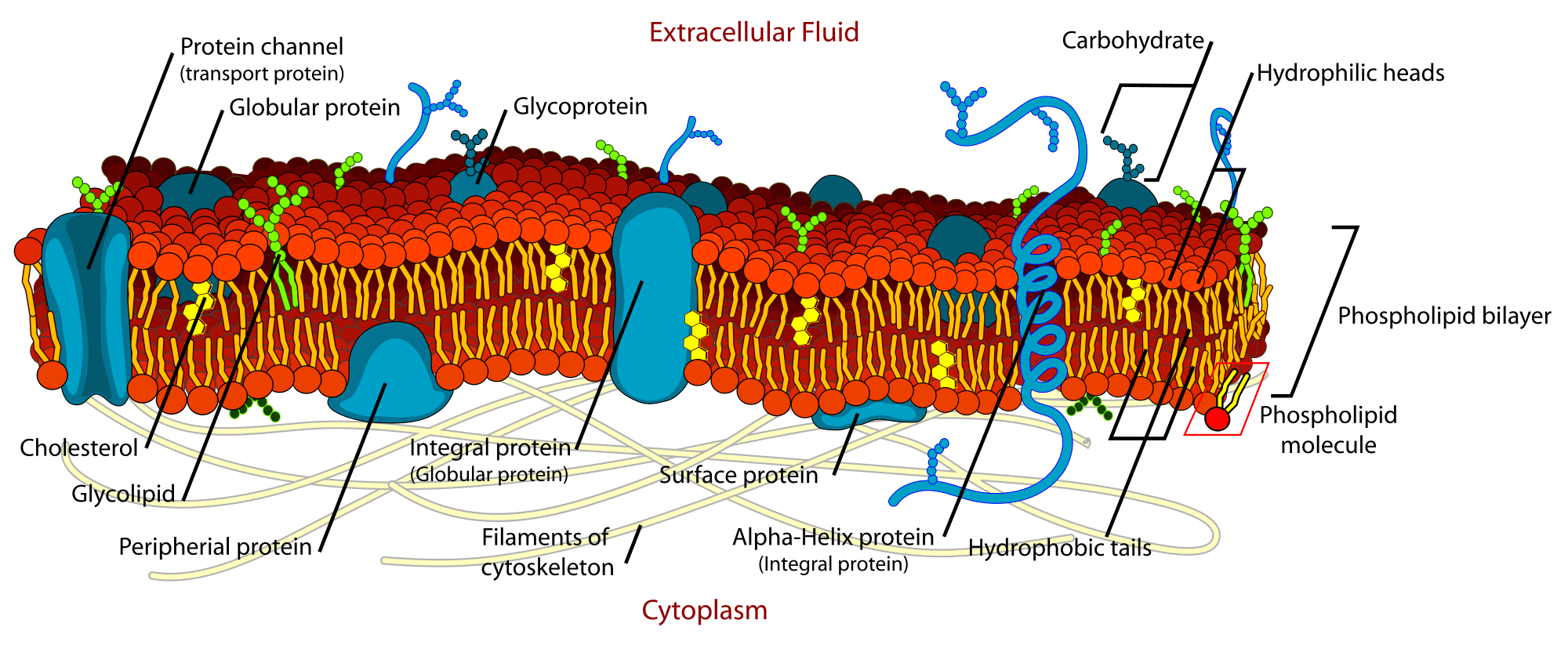
lipids
76.

What specific part of the cell is used in communication?

a)

receptor protein on cell membrane

b)

enzyme on cell membrane

c)

Mitochondria

d)

Transport proteins

77.

Which of the following is the moving of substances from high concentrations to low concentrations?

a)

active transport

b)

passive transport

c)

endocytosis

d)

sodium-potassium pump

78.

Which of the following is the movement of substances from low concentrations to high concentrations using energy?

a)

passive transport

b)

active transport

79.

In ___________________________, small, non polar substances pass directly through the cell membrane

a)

facilitated diffusion

b)

simple diffusion

c)

endocytosis

d)

osmosis

80.
An animal cell placed in a hypertonic (salty) solution will
a)
Shrink
b)
Swell
c)
Stay the same
81.

A cell is placed in a pure water solution. This would be a hypotonic environment. What happens to the cell?

a)

the cell will fill with water

b)

the cell will lose water and shrink

c)

the cell will stay the same size

82.
Osmosis is a form of ______________. 
a)
Passive Transport
b)
Active Transport
83.
Exocytosis
a)
Passive Transport
b)
Active Transport
84.
What are the nucleotides made of?
a)
Sugar, Phosphate, nitrogen base
b)
Phosphate, Adenine, nitrogen base
c)
Thymine, Adenine, Cytomine
d)
Phosphate, Nitrogen, Adenine
85.
Which of the following units are repeatedly joined together to form a strand of DNA? (This is the MONOMER of DNA.) 
a)
amino acids
b)
nucleotides
c)
fatty acids
d)
polysaccharides
86.

DNA is described as _______________ because one strand runs from a 5' to 3' direction while the other runs 3' to 5'

a)

semi conservative

b)

parallel

c)

antiparallel

d)

opposite

87.

Adenine pairs with thymine and cytosine pairs with guanine because

a)

adenine and thymine make 3 hydrogen bonds while cytosine and guanine make 2 hydrogen bonds

b)

adenine and thymine make 2 hydrogen bonds while cytosine and guanine make 3 hydrogen bonds

c)

adenine and thymine make 3 phosphodiester bonds while cytosine and guanine make 2 phosphodiester bonds

d)

adenine and thymine make 2 phosphodiester bonds while cytosine and guanine make 3 phosphodiester bonds

88.

A 100 base pair strand of DNA contains 15 cytosine, how many adenine does it contain?

a)

40

b)

15

c)

35

d)

85

89.
An enzyme that adds complementary nucleotides to the template strand of the unzipped double helix until the entire molecule has been replicated.
a)
RNA Polymerase
b)
Okazaki Fragments
c)
DNA Polymerase
d)
Translation
90.
The processes in which parental strands of DNA separate, serve as templates, and produce DNA molecules that have one strand of parental DNA and one strand of new DNA.
a)
Translation
b)
Replication
c)
Semiconservation Replication
d)
Transcription
91.
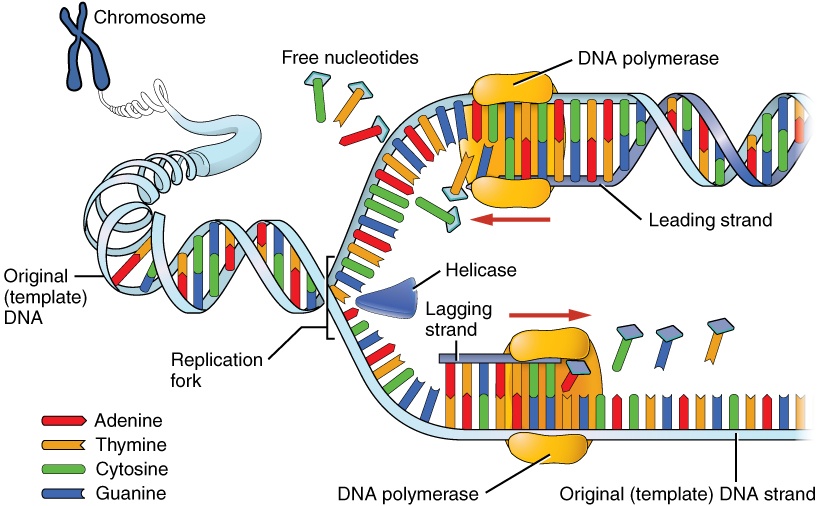
order of replication
a)
3, 2, 1, 4
b)
2, 1, 4, 3
c)
2, 3, 1, 4
d)
3, 4, 1, 2
92.
What is the complement to the DNA strand below:
5'-ATGCCAT-3'
a)
5'-TACGGTA-3'
b)
3'-TACGGTA-5'
c)
3'-ATGGCAT-5'
d)
5'-ATGGCAT-3'
93.
What is the end result of replication?
a)
Two new identical strands of DNA
b)
One parent strand and one daughter strand of DNA
c)
Two new and different strands of DNA
d)
One new strand of DNA
94.
Why is it crucial that living things are able to replicate their DNA?
a)
Each cell must have its own DNA
b)
Less copies of DNA are needed when a new cell is created
c)
A cell needs multiple copies of DNA
d)
Only muscle cells need DNA 
95.
Okazaki fragments form on the:
a)
lagging strand
b)
leading strand
c)
base-pairs
d)
5' end
96.

The ______________ strand of DNA runs in the _____________ direction, where bases are continuously added.

a)

leading; 5' to 3'

b)

lagging; 5' to 3'

c)

leading; 3' to 5'

d)

lagging; 3' to 5'

97.

The _____________ strand of DNA runs in the ___________ direction where the DNA polymerase needs to add nucleotides in fragments called _________________ fragments

a)

leading; 5' to 3'; mini

b)

lagging; 5' to 3'; mini

c)

leading; 3' to 5'; Okazaki

d)

lagging; 3' to 5'; Okazaki

98.
The process to go from DNA to mRNA is _______
a)
translation
b)
transcription
c)
replication
99.
The process to go from mRNA to a protein is called ____
a)
transcription
b)
rRNA
c)
replication
d)
translation
100.
Choose the nucleotide sequence of the RNA strand that would be complementary to the following strand: 
GTAGTCA
a)
UATUAGA
b)
ACGACTG
c)
CAUCAGU
d)
CATCAGT
101.
The main function of tRNA is to...
a)
carry a message that, when translated, forms proteins
b)
form a portion of ribosomes
c)
string together complementary RNA and DNA strands
d)
bring amino acids from the cytoplasm to the ribosomes
102.
What is the location in the cell for translation?
a)
nucleus
b)
mitochondria
c)
ribosome
d)
chloroplast
103.
What is the three base sequence of mRNA that codes for a single amino acid?
a)
Anticodon
b)
Codon
c)
Protein
104.
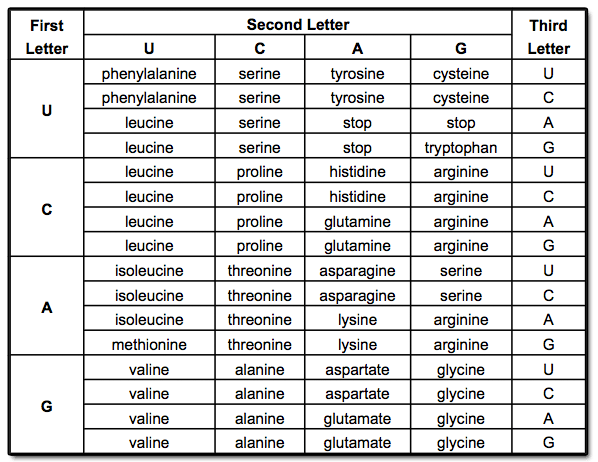
What is the correct amino acid sequence for the mRNA code AUGCCAGUAUGA
a)
Met-Pro-Ala-Val
b)
Met-Pro-Val
c)
Tyr-Gly-His
d)
Tyr-Gly-Arg-His
105.
How many amino acids are coded for by this sequence of nucleotides:
ATG GGA ACT CCA
a)
4
b)
2
c)
6
d)
12
106.

The enzyme that adds and links complementary RNA nucleotides during transcription is called

a)

helicase

b)

DNA polymerase

c)

RNA polymerase

d)

protein

107.

RNA differs from DNA in that RNA

a)

is single stranded

b)

contains a different sugar

c)

contains uracil

d)

all of the above

108.

What process creates 2 identical molecules of DNA?

a)

replication

b)

transcription

c)

translation

109.

What is copied in Transcription?

a)

the entire molecule

b)

a gene

110.

Transcribe the following DNA sequence:


AAT TAG GGC TCG

a)

AAT TAG GGC TCG

b)

TTA ATC CCG AGC

c)

UUA AUC CCG AGC

d)

TTU UTC CCG UGC

111.

Large cells are difficult to maintain. How do cells overcome this problem?

a)

they double their DNA

b)

they take in more nutrients

c)

they coil DNA around proteins

d)

they undergo cell division

112.

What do all cells need to do before they begin to divide?

a)

form a daughter cell

b)

uncoil their DNA

c)

form cell plate

d)

copy their DNA

113.

What are the four stages of mitosis in order?

a)

anaphase, interphase, prophase, telophase

b)

prophase, metaphase, telophase, anaphase

c)

interphase, prophase, anaphase, telophase

d)

prophase, metaphase, anaphase, telophase

114.

during which stage of mitosis do chromosomes line up at the center of the cell?

a)

anaphase

b)

interphase

c)

metaphase

d)

prophase

115.

How does a cell ensure that no mistakes occur in the DNA when the cell is dividing?

a)

Environmental signals influence the cell cycle

b)

Protein signals from nearby cells affect a dividing cell

c)

There is a checkpoint during mitosis

d)

There is a checkpoint before mitosis begins

116.

Growth and division of a cell depend on which two factors?

a)

proteins and chemicals

b)

environmental signals and proteins

c)

chemicals and environmental signals

d)

DNA and RNA

117.

Collectively, the time a cell spends in G1, S and G2 is called

a)

prophase

b)

cell cycle

c)

mitosis

d)

interphase

118.

The cell can only pass through the ______ checkpoint if there are no mistakes in the copied DNA. During the ________checkpoint, the cell makes sure chromosomes are properly attached to the ______________.

a)

G2; M; spindle fibers

b)

G1; S; G2

c)

G2; G1; spindle fibers

d)

M; G2; centromeres

119.

How does cytokinesis differ from mitosis?

a)

in cytokinesis, the nucleus divides in two, whereas in mitosis, the cell enters a resting phase

b)

in cytokinesis, the cell enters a resting phase, whereas in mitosis, the nucleus divides in two

c)

in cytokinesis, the nucleus divides in two, whereas in mitosis, daughter cells are formed

d)

in cytokinesis, daughter cells are formed, whereas in mitosis, the nucleus divides in two

120.

A scientist looks at a plant cell under a microscope and sees a single cell with two nuclei that have visible chromosomes. What stage of cell division did the scientist observe?

a)

anaphase

b)

metaphase

c)

telophase

d)

cytokinesis

121.

How many cell cycle checkpoints are there?

a)

1

b)

2

c)

3

d)

4

122.
This is the cell cycle checkpoint that makes sure environmental conditions are ideal for cell survival.
a)
G1 Checkpoint
b)
G2 Checkpoint
c)
M Checkpoint
d)
I Checkpoint
123.
a)
Cytokinesis
b)
Interphase
c)
Anaphase
d)
Metaphase
124.
a)
Anaphase
b)
Cytokinesis
c)
Telophase
d)
Metaphase
125.
In mitosis, the two resulting cells are
a)
different from the starting cell and identical to each other.
b)
different from the starting cell and different from each other.
c)
identical to the starting cell and different from each other.
d)
identical to the starting cell and identical to each other.
126.
Fruit fly body cells have 8 chromosomes. After mitosis, you would expect a resulting fruit fly daughter cell to have -
a)
16 chromosomes.
b)
46 chromosomes.
c)
8 chromosomes.
d)
4 chromosomes.
127.
Cells of organism must replicate for ?
a)
growth
b)
repair of damaged cells
c)
replacement of dying cells.
d)
All of the above
128.
The cells produced via meiosis are called:
a)
sex cells
b)
somatic cells
c)
body cells
d)
skin cells
129.
Unlike mitosis, meiosis in male mammals results in the formation of
a)
one haploid gamete
b)
three diploid gametes
c)
four diploid gametes
d)
four haploid gametes
130.
If the Diploid number of Carrots is 18, the haploid number is
a)
18
b)
9
c)
27
d)
36
131.
The chromosomes that pair up during meiosis, are called __________ chromosomes.  
a)
homozygous 
b)
asexual
c)
homologous
d)
genes
132.
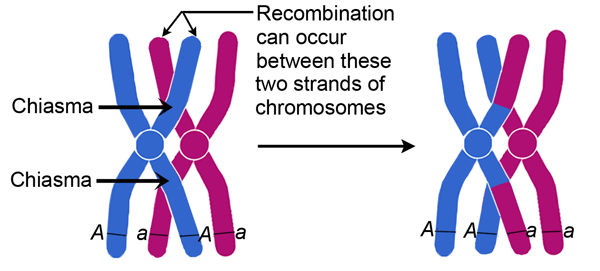
This image shows chromosomes during Prophase 1. Which of the following correctly describes the process shown?
a)
segregation of sister chromatids
b)
condensation and segregation of alleles
c)
mutationin which the DNA content of the gene is altered
d)
crossing - over in which alleles are exchanged
133.
A human zygote should have _____ chromosomes inside.
a)
46
b)
23
c)
92
d)
64
134.

At the end of mitosis you have _____ cells

a)

identical

b)

different

c)

identical twins

d)

variety

135.
products of meiosis are genetically
a)
different
b)
identical
136.
Human eggs and sperm are _____, and each has ____ chromosomes.
a)
diploid, 23
b)
diploid, 46
c)
haploid, 23
d)
haploid, 46
137.
How are your chromosomes inherited?
a)
most of your chromosomes from your mother
b)
most of your chromosomes from your father
c)
a random number of chromosomes from each parent
d)
half your chromosomes from your mother and half from your father.
138.
What is it called when a sperm and egg meet?
a)
meiosis
b)
fertilization
c)
cell division
d)
mitosis
139.
Meiosis makes sperm and egg cells. In humans, sperm and egg cells each have _____ chromosomes. Therefore a fertilized human egg cell (sperm and egg cell combined) would create a cell with _____ chromosomes.
a)
23, 46
b)
46, 23
c)
2, 4
d)
50, 100
140.
What kind of cells are made in MEIOSIS?
a)
Haploid Gametes
b)
Diploid Somatic Cells
c)
Skin Cells
d)
Liver Cells
141.
Which of these cells would be produced through meiosis?
a)
skin cells
b)
liver cells
c)
brain cells
d)
sperm cells
142.
What is another reason we need meiosis?
a)
So the offspring has genes from both parents
b)
So the offspring has genes from one parent
c)
So the offspring has genes from neither parents
d)
So the offspring makes its own genes