
 Worksheets
Biology Staar Review: Cat 4- Biological Processes & Systems
Total questions: 145
Worksheet time: 2hrs 5mins
Name
Class
Date
1.

What body system makes your body move?
a)
Circulatory
b)
Respiratory
c)
Skeletal
d)
Muscular
2.

What body system removes the waste from your body?
a)
Circulatory
b)
Excretory
c)
Digestive
d)
Respiratory
3.

What body system consists of the kidneys?
a)
Circulatory
b)
Excretory
c)
Digestive
d)
Muscular
4.

What body system consists of the heart?
a)
Excretory
b)
Digestive
c)
Circulatory
d)
Respiratory
5.

Muscles help your body _______?
a)
Read
b)
Sit
c)
Sleep
d)
Move
6.

My spinal cord helps _________ travel between my brain and the nerves in my body.
a)
Memories
b)
Blood
c)
Waste
d)
Messages
7.

Arteries carry blood ______ from the heart.
a)
Away
b)
To
c)
Across
d)
Around
8.

Veins carry blood ______ the heart.
a)
Around
b)
Away
c)
To
d)
Across
9.

The skin is the major organ in which system?
a)
Integumentary
b)
Muscular
c)
Endocrine
d)
Immune
10.

Gas exchange between the blood and the outside occurs in which system?
a)
Respiratory
b)
Circulatory
c)
Lymphatic
d)
Integumentary
11.

Which system uses hormones to regulate body activities?
a)
Integumentary
b)
Urinary
c)
Endocrine
d)
Immune
12.

One role of the pancreas is to create enzymes to help breakdown food. This function makes it part of which system?
a)
Endocrine
b)
Digestive
c)
Immune
d)
Urinary
13.

A second function of the pancreas is to make certain hormones, because of this it is also part of what other system?
a)
Endocrine
b)
Digestive
c)
Circulatory
d)
Immune
14.

Which system detects changes in the environment and sends electrical signals in response to these changes?
a)
Nervous
b)
Endocrine
c)
Lymphatic
d)
Reproductive
15.

This system carries oxygen, nutrients and waste around the body.
a)
Lymphatic
b)
Urinary
c)
Respiratory
d)
Circulatory
16.

What is the main function of the respiratory system?
a)
to provide oxygen and remove carbon dioxide from the body
b)
to bring oxygen to the body
c)
to break down food and absorb nutrients
d)
to remove oxygen from the body and deliver carbon dioxide
17.
What is the function of the digestive system?
a)
to break down and absorb nutrients
b)
to support and protect our bodies
c)
to produce vitamin D
d)
to help us move
18.
What function does the heart do?
a)
Protects organs and produces red blood cells.
b)
Generates heat.
c)
Breaks down food into nutrients.
d)
The heart is a pump, which moves the blood. The arteries and veins are the pipes where the blood flows.
19.

What body system consists of the lungs
a)
Respiratory
b)
Circulatory
c)
Muscular
d)
Skeletal
20.

The main function of the excretory system is....
a)
To filter waste from the blood stream and carry it outside of the body.
b)
To transport nutrients to the body.
c)
To break down nutrients for absorption.
d)
To provide structure and support for the body.
21.
Which system produces sperm and egg cells? In females, it also nourishes the fetus.
a)
reproductive
b)
endocrine
c)
nervous
d)
lymphatic
22.
Joints, cartilage, and tendons belong to what system?
a)
Skeletal System
b)
Muscular System
c)
Excretory System
d)
Lymphatic System
23.
The brain and spinal cord belong to what system?
a)
Lymphatic System
b)
Circulatory System
c)
Nervous System
d)
Reproductive System
24.
Glands, Pituitary and thyroid belong to what system?
a)
Endocrine System
b)
Excretory System
c)
Reproductive System
d)
Skeletal System
25.
The mouth, esophagus and large intestine belong to what system?
a)
Nervous System
b)
Digestive System
c)
Integumentary System
d)
Lymphatic System
26.
What part of blood is responsible for fighting infections?
a)
Red Blood Cells
b)
White Blood Cells
c)
Platelets
d)
Plasma
27.
What is the main function of the Endocrine System?
a)
Sends electrical messages to communicate
b)
Regulates body activities using hormones
c)
Maintains homeostasis using the kidneys to filter out wastes
d)
Fights off foreign invaders
28.
These two systems interact to allow our bodies respond to the environment and to maintain homeostasis. (Hint - they both send messages and one is fast, one is slow)
a)
nervous and endocrine
b)
nervous and digestive
c)
endocrine and excretory
d)
respiratory and digestive
29.
Why is blood considered a tissue?
a)
cells working together for a specific purpose
b)
tissues are always red
c)
blood moves through the entire body
d)
blood makes up an organ system
30.
Two or more types of tissues that together can form an _____.
a)
organ
b)
nervous
c)
connective
d)
immune
31.
Which human body systems interact to produce movement of the body?
a)
Nervous and endocrine
b)
Skeletal and muscular
c)
Circulatory and digestive
d)
Excretory and nervous
32.
Which body systems work together to supply the body's cells with oxygen?
a)
Respiratory and immune
b)
Nervous and reproductive
c)
Circulatory and respiratory
d)
Endocrine and muscular
33.
Which two body systems work together to break down food into energy and rid the body of the waste produced during this process?
a)
Skeletal and endocrine
b)
Digestive and excretory
c)
Nervous and immune
d)
Muscular and skeletal
34.
The two body systems that work together to protect you from foreign pathogens are...
a)
Integumentary and immune
b)
Reproductive and muscular
c)
Endocrine and digestive
d)
Respiratory and circulatory
35.
Which body system is the 'slow response' system and uses hormones to bring about a response?
a)
Endocrine
b)
Immune
c)
Muscular
d)
Excretory
36.
How does the Circulatory System help the Muscular System?
a)
Protects muscles
b)
Sends messages to the muscles to contract
c)
Brings oxygen into the body
d)
Delivers nutrients and oxygen to muscle tissue
37.
The skeletal system interacts with the _____ system when it produces red blood cells.
a)
circulatory
b)
excretory
c)
digestive
d)
nervous
38.
The muscular system interacts with the ____ system as it helps break down and move the food we eat through our bodies.
a)
nervous
b)
digestive
c)
excretory
d)
endocrine
39.
Our brain is a part of our ____ system and it interacts with our muscular system to coordinate movements throughout our bodies.
a)
excretory
b)
digestive
c)
eyes
d)
nervous
40.
The muscular system interacts with the ____ system because the heart is a muscle and it pumps blood to every cell in our body.
a)
excretory
b)
endocrine
c)
digestive
d)
circulatory
41.
The circulatory system interacts with the ______ system to remove waste from our blood and produce urine.
a)
nervous
b)
endocrine
c)
excretory
d)
digestive
42.
The endocrine system interacts with the _____ system because most hormones travel throughout our bodies in our blood.
a)
digestive
b)
circulatory
c)
excretory
d)
nervous
43.
The circulatory system interacts with the ____ system when as it surrounds the small intestine. Broken down food (nutrients) is delivered in the blood to all the cells.
a)
digestive
b)
excretory
c)
nervous
d)
skeletal
44.
The immune system interacts with the _____ system because most of the immune cells travel in the blood.
a)
muscular
b)
circulatory
c)
digestive
d)
respiratory
45.
What process does plants go through to create glucose
a)
Cellular Respiration
b)
Photosynthesis
c)
Light Reaction
d)
Calvin Cycle
46.
Which gas is removed from the atmosphere during photosynthesis?
a)
hydrogen
b)
oxygen
c)
nitrogen
d)
carbon dioxide
47.
What are the products of photosynthesis?
a)
water and carbon dioxide
b)
oxygen and glucose
c)
oxygen and carbon dioxide
d)
oxygen and water
48.
What are the reactants of photosynthesis?
a)
water, carbon dioxide, light energy
b)
oxygen and glucose
c)
oxygen and carbon dioxide
d)
oxygen and water
49.
The main function of the leaves of a plants is....
a)
carry out photosynthesis
b)
support the plant
c)
get water to all plant parts
d)
anchor the plant
50.
The function of a ___ is to absorb water, store food, and anchor plants.
a)
phloem
b)
tissue
c)
xylem
d)
root
51.
What is the region of rapid cell division (growth) in plants?
a)
Guard
b)
Stomata
c)
Xylem
d)
Meristem
52.
When water leaves a plants' leaves in the water cycle
a)
evaporation
b)
transpiration
c)
precipitation
d)
condensation
53.
Its job is to support the plant and hold its leaves up to the sun.
a)
root
b)
stem
c)
flower
d)
leaf
54.
The main source of energy for all life comes from ____.
a)
the Earth
b)
the moon
c)
the sun
d)
the food we eat/make
55.
The root performs all of the functions EXCEPT:
a)
stores food
b)
transports water
c)
draws in water
d)
takes in minerals
56.
What is the function of dermal tissues in plants?
a)
protect the outer layer
b)
transport nutrients
c)
grow new flowers
d)
complete photosynthesis
57.
What is the function of vascular tissue?
a)
physical support of the plant
b)
transport water and nutrients
c)
defend against predators
d)
complete photosynthesis
58.
Transports water and nutrients UP from the soil through all parts in the plant. Involved in transpiration.
a)
xylem
b)
phloem
c)
stomata
d)
roothair
59.
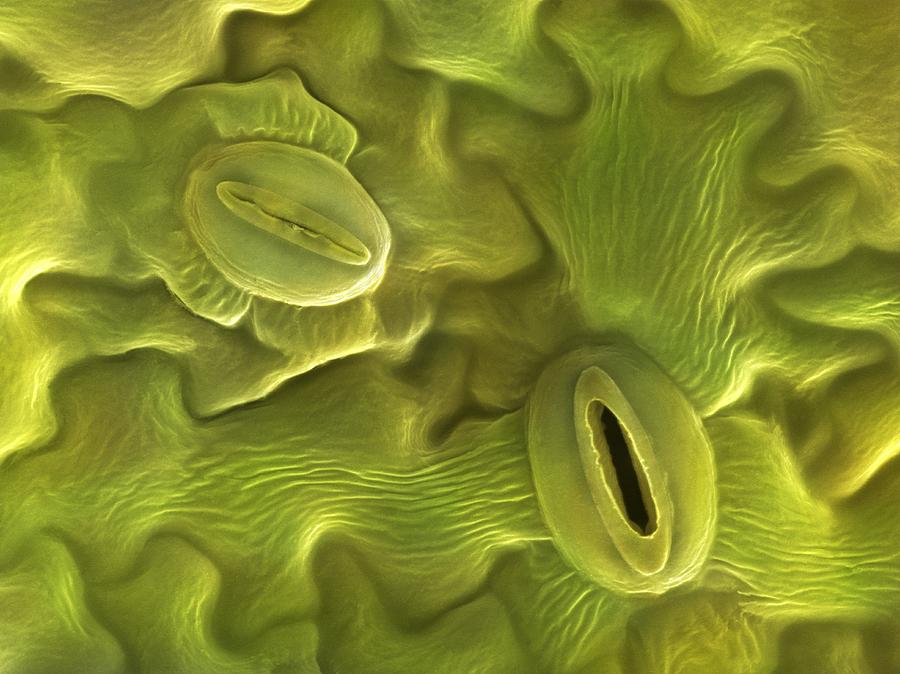
What is the structure in the picture?
a)
Stomata
b)
Leaves
c)
Roots
d)
Vascular tissue
60.
Moves nutrients up and down
a)
Xylem
b)
Phloem
61.
Moves sugar from leaves to roots
a)
Xylem
b)
Phloem
62.
Roots absorb water into the __.
a)
Xylem
b)
Phloem
63.
___ opens and closes the stomata.
a)
Guard cells
b)
Xylem
c)
Roots
d)
Phloem
64.
Which of the following lists these levels in the correct order of organization from the simplest to the most complex?
a)
cells, tissues, organs, organ systems, organisms
b)
organisms, organ systems, organs, tissues, cells
c)
tissues, cells, organs, organisms, organ systems
d)
organs, organ systems, organisms, cells, tissues
65.
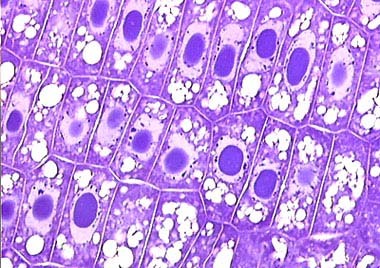
This is a example of ........
a)
cell
b)
tissue
c)
organ
d)
organ system
66.
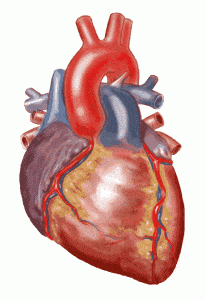
This is a example of ........
a)
cell
b)
organ system
c)
organ
d)
tissue
67.
A group of cells that have similar functions? Examples are nervous, epithelial, muscle and connective
a)
cells
b)
tissues
c)
organs
d)
atoms
68.
A group of tissues that perform a similar function is called_____. (Examples include the heart, lungs or stomach)
a)
cells
b)
tissues
c)
organs
d)
organ system
69.

Which structure is represented by the letter A in the diagram above?
a)
the stamen, a male structure which produces pollen
b)
the pistol, a female structure which collects pollen and passes it to the ovary
c)
the sepal, a modified leaf used for protection of the flower
d)
the petals, decorative structures which attract pollinators
70.
The female structures of the flower
a)
Pistil
b)
Stigma
c)
Stamen
d)
Ovary
71.
The long stalk-like part that supports the stigma.
a)
Filament
b)
Anther
c)
Stigma
d)
Style
72.
The bottom of the style is this part which produces the eggs or ovules through meiosis.
a)
Pollen
b)
Ovary
c)
Stigma
d)
Pistil
73.
The colorful flower structure that attracts pollinators.
a)
sepals
b)
pistils
c)
anthers
d)
petals
74.
The flower structure that contains the anther and pollen.
a)
stamen
b)
pistil
c)
sepal
d)
petal
75.
Which amongst these is NOT a part of PISTIL
a)
stigma
b)
stamen
c)
style
d)
ovary
76.
Which part of flower develops into fruit
a)
ovule
b)
style
c)
stigma
d)
ovary
77.
Male reproductive part of flower
a)
pistil
b)
stamen
c)
petals
d)
sepals
78.
Top most part of pistil
a)
anther
b)
filament
c)
stigma
d)
style
79.
Part which produces pollen
a)
style
b)
stigma
c)
anther
d)
filament
80.
The thin stalk that supports the anther.
a)
Pistil
b)
Stamen
c)
Anther
d)
Filament
81.

a)
B & D are parts of the pistil
b)
A & C are parts of the pistil
82.

a)
A & C are the stamen
b)
B and D are the stamen
83.

a)
B is the stigma
b)
B is the anther
c)
B is the sepal
d)
B is the ovary
84.

What is the sticky part of the flower that catches pollen?
a)
style
b)
stigma
c)
ovary
d)
petal
85.

Which does not belong in the female part of the flower?
a)
style
b)
stigma
c)
filament
d)
ovaries
86.
What does an ovule become when it is pollinated?
a)
a seed
b)
a sprout
c)
a fruit
d)
it stays an ovule
87.
Why is fruit formed around an apple seed?
a)
Fruit is formed around the seed to protect it.
b)
Fruit is not formed around the seed.
c)
Fruit is everywhere.
d)
Fruit is different color.
88.

Which of the following is an organism’s reaction to a change in its surroundings?
a)
response
b)
distraction
c)
stimulus
d)
development
89.

A stimulus is ___________
a)
a change in an organisms surroundings.
b)
process in which organisms grow larger.
c)
a reaction to a change in surroundings
d)
the result of sexual reproduction.
90.

Which of the following responses is a plant growing toward or leaning toward light?
a)
thigmotropism
b)
hydrotropism
c)
phototropism
d)
gravitropism
91.

Plant’s roots grow down, anchoring it into the soil. To what stimulus is the plant responding?
a)
thigmotropism
b)
hydrotropism
c)
phototropism
d)
gravitropism
92.

Which of the following responses is a plant growing toward or leaning toward touch?
a)
thigmotropism
b)
hydrotropism
c)
phototropism
d)
gravitropism
93.

What term refers to a plant growing or moving away from a stimulus?
a)
Touch
b)
Tropism
c)
Dormancy
d)
Development
94.

A vine plant brushes against a fence and wraps itself around the fence. To what stimulus is the plant responding?
a)
phototropism
b)
hydrotropism
c)
thigmotropism
d)
gravitropism
95.
The root of a plant growing down.
a)
Positive Gravitropism
b)
Negative Gravitropism
c)
Thigmotropism
d)
Hydrotropism
96.
What are the products of photosynthesis?
a)
water and carbon dioxide
b)
oxygen and glucose
c)
oxygen and carbon dioxide
d)
oxygen and water
97.
What is the name of the simple sugar that is produced in photosynthesis?
a)
Sucrose
b)
Dextrose
c)
Glucose
d)
Lactose
98.
Which of the following is the correct equation for PHOTOSYNTHESIS?
a)
CO2 + light + H2O --> O2 + glucose
b)
CO2 + glucose + H2O --> O2 + light
c)
O2 + light + H2O --> CO2 + glucose
d)
CO2 + O2 + H2O --> Light+ glucose
99.
How can photosynthesis be related to cellular respiration?
a)
What's produced (made) by one is needed (the reactants) for the other
b)
They both produce the same products
c)
They both have the same reactants (need the same things)
d)
These 2 processes have nothing in common
100.
What type of respiration requires oxygen?
a)
Aerobic
b)
Anaerobic
101.
What is glucose converted to in the mitochondria during cellular respiration?
a)
ATP
b)
ADP
c)
DNA
d)
80p
102.
What is the site of cellular respiration in a cell?
a)
stomata
b)
chloroplast
c)
mitochondria
d)
chlorophyll
103.

In which organelle (part of the cell) does photosynthesis take place?
a)
mitochondria
b)
chloroplast
c)
nucleus
d)
cell membrane
104.
What is the purpose of photosynthesis?
a)
make glucose
b)
make ATP
c)
make light
d)
release carbon dioxide
105.
Cellular Respiration's goal is to
a)
make water
b)
make ATP
c)
make glucose
d)
make oxygen
106.
6Co2 + 6H20 --> C6H12O6 + 6O2 is the chemical equation for ________________.
a)
photosynthesis
b)
cellular respiration
107.
C6H12O6 + 6O2 --> 6CO2 + 6H2O is the chemical equation for ____________ __________.
a)
photosynthesis
b)
cellular respiration
108.

In what organelle does cellular respiration take place?
a)
Cell Wall
b)
Chloroplast
c)
Oxygen
d)
Mitochondria
109.
The following are ______ in the photosynthesis formula?
H2O+CO2+Sunlight
H2O+CO2+Sunlight
a)
Products
b)
Reactants
110.
The following are _____ in the photosynthesis equation?
O2+C6H12O6
O2+C6H12O6
a)
Products
b)
Reactants
111.
The following are _____ in the cellular respiration formula?
H2O+CO2+ATP
H2O+CO2+ATP
a)
Products
b)
Reactants
112.
The following are _____ in the cellular respiration formula?
C6H12O6+O2
C6H12O6+O2
a)
Products
b)
Reactants
113.
Anaerobic Respiration has...
a)
Oxygen
b)
No oxygen
114.
Which one is also known as fermentation?
a)
Aerobic respiration
b)
Anaerobic respiration
115.
What is the correct equation for cellular respiration?
a)
6O2 + C6H12O6 -> 6CO2 + 6H2O + Energy
b)
6O2 + C6H12O6 + Energy -> 6CO2 + 6H2O
c)
6CO2 + 6H2O -> 6O2 + C6H12O6 + Energy
d)
6CO2 + 6H2O + Energy -> 6O2 + C6H12O6
116.
How do enzymes speed up chemical reaction?
a)
Increasing activation energy
b)
Decreasing activation energy
c)
Increasing deactivation energy
d)
Decreasing deactivation energy
117.
What is a substance called if it speeds up a chemical reaction?
a)
reusable
b)
catalyst
c)
specific
d)
fragile
118.
Each enzyme only has 1 substrate that will fit its active site. What is this called?
a)
reusablility
b)
denaturation
c)
specificity
d)
fragility
119.
With what 3 letters do enzymes typically end?
a)
-ose
b)
-ase
c)
-ese
d)
-tic
120.
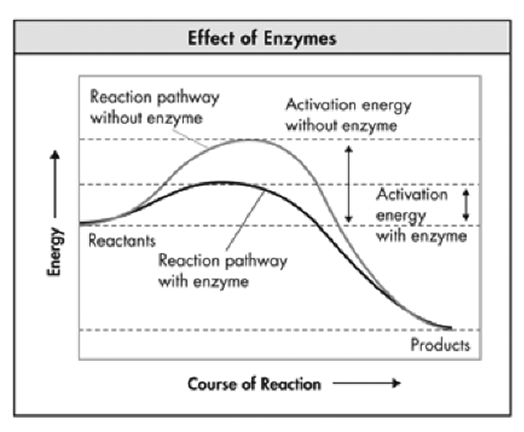
The graph shows how enzymes affect reactions in cells. Which statement best summarizes the information shown in the graph?
a)
Enzymes increase the energy of the reactants.
b)
Enzymes decrease the energy level of the products.
c)
Enzyme decrease the activation energy of the reaction.
d)
Enzymes reverse the direction of the reaction.
121.
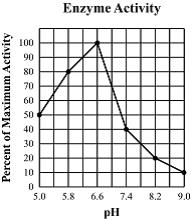
Which of the following conclusions can be drawn from this graph?
a)
The optimum pH of the enzyme is 6.6.
b)
The optimum pH of the enzyme is 5.8
c)
The enzyme’s activity increases as pH increases 5.0 to 9.0
d)
The enzyme’s activity is greater around pH of 8.0 .
122.
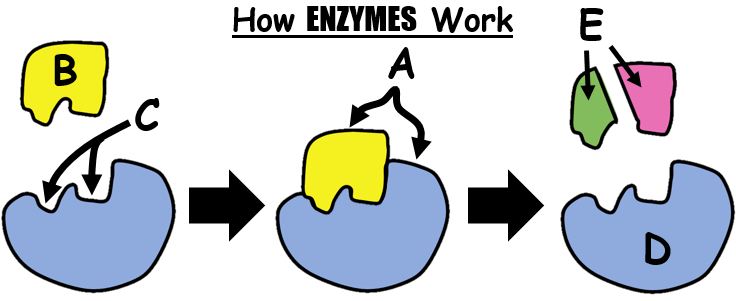
In the diagram, what is letter A?
a)
product
b)
substrate
c)
enzyme-substrate complex
d)
active site
123.
Enzymes are...
a)
nucleic acids
b)
proteins
c)
lipids
d)
carbohydrates
124.
What happens when enzymes are heated to a high temperature?
a)
The enzymes die.
b)
The shapes of the enzyme are altered denature
c)
The enzymes' amino acid sequence changes.
d)
The enzymes remain the same
125.
Which of these is most likely an enzyme?
a)
Sucrose
b)
Galactose
c)
Fructose
d)
Amylase
126.
What is another name for enzymes?
a)
chemical catalysts
b)
microorganisms
c)
biological catalysts
d)
inorganic catalysts
127.
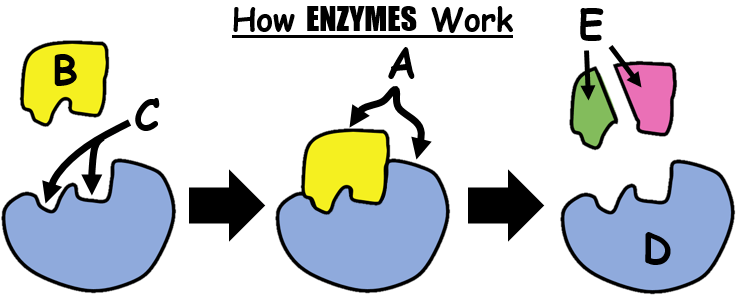
Letter D...
a)
active site
b)
enzyme
c)
substrate
d)
products
128.
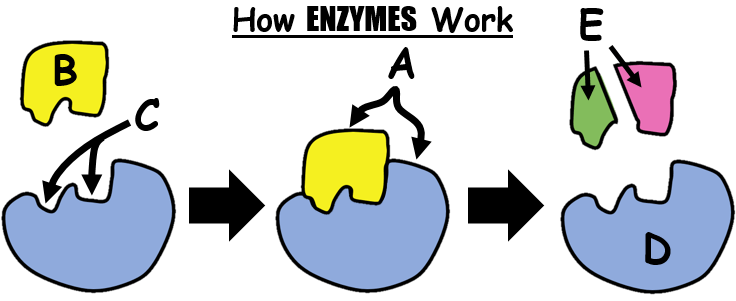
Letter B...
a)
active site
b)
enzyme
c)
substrate
d)
products
129.
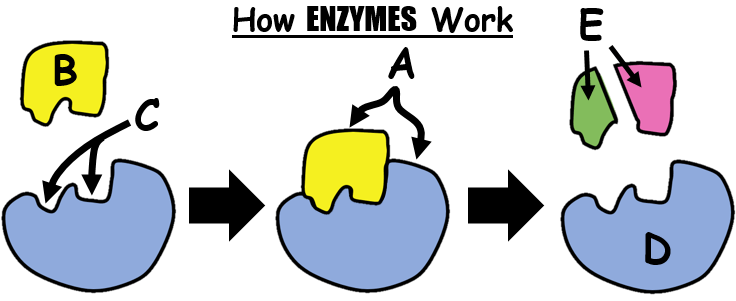
Letter C...
a)
active site
b)
enzymes
c)
substrate
d)
products
130.
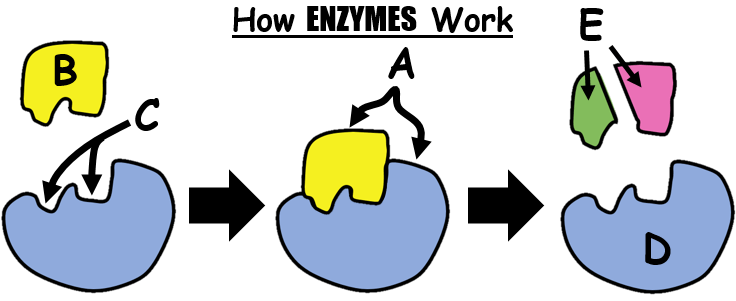
Letter E...
a)
active site
b)
enzyme
c)
substrate
d)
products
131.
What makes an enzyme substrate specific?
a)
Size
b)
Shape
c)
Name
d)
Location it is found in
132.
If the environment gets cold, we will often shiver in order to:
a)
keep body temperature the same as the external temperature
b)
decrease body temperature
c)
increase body temperature
d)
regulate blood pressure
133.
Homeostasis in the human body is often maintained by a:
a)
neutral feedback loop
b)
solar feedback loop
c)
positive feedback loop
d)
negative feedback loop
134.
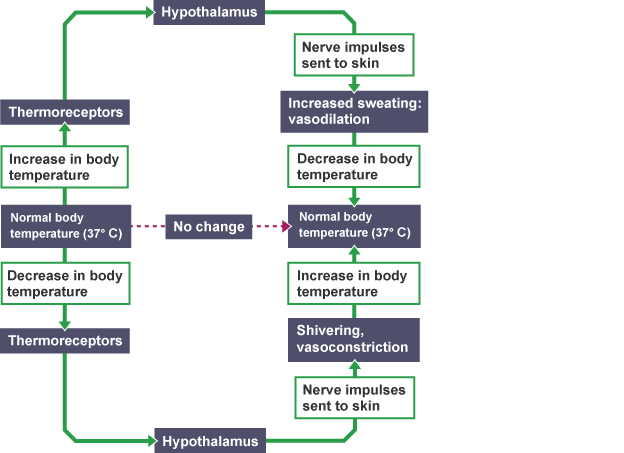
What type of feedback loop is shown?
a)
Positive
b)
Neutral
c)
Negative
135.
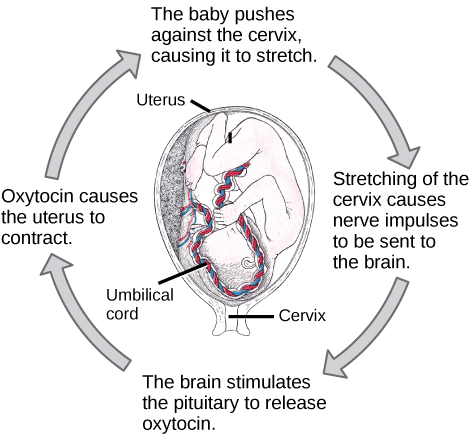
What type of feedback loop is shown?
a)
negative
b)
neutral
c)
positive
136.
Failure to maintain homeostasis could result in:
a)
lack of internal balance
b)
eventual death
c)
difficulty carrying on metabolism
d)
all three
137.
Negative Feedback Loops:
a)
amplify processes
b)
prevent small changes from getting larger
c)
are initiated during childbirth
d)
are found only in plants
138.
The process of childbirth is an example of:
a)
negative feedback loop
b)
positive feedback loop
139.
The two types of feedback systems that help organisms maintain homeostasis are:
a)
positive and negative
b)
receptor and effector
c)
static and dynamic
d)
minor and major
140.
When you get cut, your skin cells release hormones that signal platelets to come and stop the bleeding. Platelets then release more hormones that signal even more platelets to help stop bleeding. The hormone signals continue until the cut is closed.
a)
Positive Feedback Response
b)
Negative Feedback Loop
141.
When glucose levels in the blood rise, your brain sends a signal to your pancreas. The pancreas releases insulin, which opens channels in cell membranes to allow glucose to enter the cell, lowering blood sugar levels.
a)
Positive Feedback Response
b)
Negative Feedback Loop
142.
Rapid growth during puberty causes your body to release more and more growth hormones. As you grow, more and more growth hormones are released until puberty is reached, and then the hormones stop.
a)
Positive Feedback Response
b)
Negative Feedback Loop
143.
If the calcium in your blood decreases below homeostasis levels, a gland in the brain will sense the decrease and send a chemical message to your bones. Your bones will release calcium into the blood, bringing blood calcium levels back up.
a)
Positive Feedback Response
b)
Negative Feedback Loop
144.
As you get dehydrated, your blood becomes thicker and harder to pump. Your kidneys will respond by stopping urine production, sending the water from urine into your bloodstream to thin your blood back to normal level.
a)
Positive Feedback Response
b)
Negative Feedback Loop
145.
Homeostasis
a)
allows for a wildly fluctuating internal environment
b)
is impossible in vertebrates
c)
is the maintenance of a relatively stable internal environment and often incorporates a form of feedback regulation
d)
is the maintenance of a relatively stable external environment and often incorporates a form of feedback regulation
100 %

