wayground logo

Free Printable Worksheets

Font size

S
M
L
XL
Worksheets

Biology SOL Review

Total questions: 150

Worksheet time: 6hrs 6mins

Name
Class
Date
1.
If you wake up on a Saturday morning, and notice you cannot find your phone, you have made a(n)
a)
discovery
b)
law
c)
idea
d)
observation
2.
Science is a continually ongoing process.
a)
True
b)
False
3.
In a hypothesis, you should see the words _____ and then.
a)
if
b)
that
c)
now
d)
when
4.
Qualitative data relies on numbers.
a)
False
b)
True
5.
Which variable do you measure?
a)
Independent
b)
Dependent
6.
Which variable do you change in an experiment?
a)
Dependent
b)
Independent
7.

"If plants are exposed to sunlight, then they will grow taller."

What part of the scientific method is this an example of?

a)

Procedure

b)

Hypothesis

c)

Question

d)

Results

8.

At the end of the scientific method, scientists should always:

a)

share what they learned and their results with other scientists

b)

make a bar graph

c)

celebrate if their hypothesis was correct

d)

keeps their results secret to their ideas do not get stolen

9.
To make sure your experimental results are reliable, you should:
a)
Write more than one hypothesis
b)
Use more than one variable
c)
Only do the experiment one time
d)
Repeat the experiment many times
10.
The experimental group in an experiment should have
a)
Many different variables
b)
 The one variable being changed and tested
c)
All of the normal conditions
d)
Different materials than the control group
11.
The DATA you observe and write down in a chart during an experiment or the condition that results from the change in the experiment is the
a)
Dependent Variable
b)
Independent Variable
c)
Materials
d)
Control
12.
The one thing you CHANGE in an experiment is the
a)
Dependent Variable
b)
Independent Variable
c)
Control
d)
Data
13.
An experiment has 10 plants growing in sunlight and 10 plants growing in red light.  The plant height is measured after one month. What is the INDEPENDENT variable in this experiment? 
a)
The plant height
b)
The plants
c)
The sunlight
d)
The red light
14.
An experiment has 10 plants growing in sunlight and 10 plants growing in red light.  The plant height is measured after one month. What is the dependent variable in this experiment? 
a)
The red light
b)
The sunlight
c)
The plant height
d)
The Plants
15.
An experiment has 10 plants growing in sunlight and 10 plants growing in red light.  The plant height is measured after one month. Which plants are the control group? 
a)
The plants in sunlight
b)
The plants in red light
16.

Look at the Bar Graph "Student Grades". Which grade did the smallest number of students get?

a)

A

b)

B

c)

C

d)

D

17.

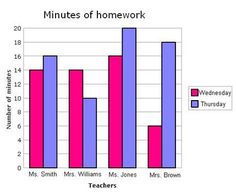
Which day had more minutes of homework?

a)

Wednesday

b)

Thursday

c)

Friday

18.

Which day of the week had the lowest temperature?

a)

Monday

b)

Thursday

c)

Tuesday

d)

Wednesday

19.

On a small island, scientists kept track of the number of wolves and moose over time. Which trend did they record?

a)

A drop in wolf population and a drop in moose population

b)

An increase in wolf population and a drop in moose population

c)

A drop in wolf population and an increase in moose population

d)

An increase in wolf population and an increase in moose population

20.
Zane is making a chart of compounds that are found in the human body. What is the most common compound found in the human body?
a)
H2O   
b)
CO2
c)
Sodium Bicarbonate (baking soda)
d)
NaCl (table Salt)
21.
Carbohydrates are made up of three of the six major molecules found in living things. The general chemical formula for a carbohydrate is CH2O. Which elements combine to make a carbohydrate?
a)
copper and cobalt
b)
chlorine and oxygen
c)
carbon, helium, and oxygen
d)
carbon, hydrogen, and oxygen
22.
When people eat foods high in proteins, such as meat, eggs and cheese, the body breaks down the proteins into smaller molecules. What is supplied to cells when the body breaks down proteins?
a)
amino acids
b)
nucleic acids
c)
phospholipids
d)
carbohydrates
23.
What type of molecule provides immediate energy in cells?  
a)
lipids
b)
proteins
c)
carbohydrates
d)
nucleic acids
24.
Animal cells have four main molecules that keep the body healthy. What type of molecule in animal cells provides a “map” for making proteins?
a)
lipids 
b)
proteins
c)
nucleic acids
d)
carbohydrates
25.
The cells in living things contain four main molecules that allow the cells to function. Which of these molecules cannot mix with water?
a)
lipids
b)
proteins
c)
nucleic acids
d)
carbohydrates
26.
These biomolecules are the main building blocks of you. They are large and complex and special ones do jobs all over your body as catalysts.
a)
Proteins
b)
Carbohydrates
c)
Lipids
d)
Nucleic Acids
27.
Are enzymes substrate specific?
a)
YES!
b)
No...
28.
What are special types of proteins that act as catalysts?
a)
Enzymes
b)
Lipids
c)
Polysaccharides
d)
DNA
29.
Where an enzyme joins with a substrate is called its...
a)
Active Site
b)
Mouth
c)
Substrate
d)
pH
30.
Enzymes make chemical reactions go faster by doing what?
a)
Lowering the activation energy of a reaction
b)
Making energy
c)
Absorbing energy
d)
Having a dance off with other enzymes
31.

Enzymes function to speed up chemical reactions by

a)

Lowering the activation energy

b)

Adding energy to the substrate molecules

c)

Changing the products into reactants

d)

Making reactants more polar and hydrophobic

32.

Water molecules are

a)

polar

b)

nonpolar

c)

positively charged

d)

negatively charged

33.
Substances that dissociate in water and release hydrogen ions (H+)
a)
bases
b)
acids
c)
compounds
d)
ions
34.
Attractions between molecules of the same substance
a)
adhesion
b)
cohesion
c)
mixture
d)
acid
35.
What property of water helps to moderate earth's temperature?
a)
adhesion
b)
chohesion
c)
Specific heat capacity
d)
Latent heat of vaporization
36.

What gives water so many important properties for life?

a)

adhesion and cohesion

b)

the amount of carbon in each molecule

c)

energy released exothermically

d)

hydrogen bonds give it polarity

37.

Which of the following solutions has the highest Hydrogen ion concentration?

a)

a solution with a pH of 1

b)

a solution with a pH of 4

c)

a solution with a pH of 7

d)

a solution with a pH of 10

38.

Activation energy

a)

is the term for the amount of energy in each reactant

b)

helps the enzyme to increase the rate of the reaction

c)

is the term for the amount of energy that needs to be added for a chemical reaction to start

d)

is the term for the amount of energy released by the reaction after it starts

39.
What word describes when water is attracted to other substances?
a)
cohesion
b)
adhesion
c)
capillary action
d)
surface tension
40.
This organelle controls all the functions of the cell
a)
Nucleus
b)
Cell membrane
c)
Golgi apparatus
d)
Mitochondria
41.
What is the outermost part of a plant cell?
a)
Cell wall
b)
Cell membrane
c)
Ribosome
d)
Vacuole
42.
What is the function of cytoplasm?
a)
Contains organelles & is where a lot of chemical reactions happen
b)
Where respiration happens
c)
Contains DNA
d)
Provides energy for the cell
43.
The cell membrane does this
a)
Controls what enters & exits a cell
b)
Stores material
c)
Carry out photosynthesis
d)
Contains the cell's DNA
44.
True or False: Animal cells have a cell wall.
a)
True
b)
False
45.
True or False: Mitochondria, cytoplasm, cell membranes, and vacuoles are all found in both animal cells and plant cells.
a)
True
b)
False
46.
True or False: All living cells come from other living cells.
a)
True
b)
False
47.
True or False: A prokaryotic cell has a nucleus & organelles.
a)
True
b)
False
48.

The function of the mitochondria is to _________.

a)

store DNA

b)

make energy for the cell

c)

make proteins

d)

store water and other nutrients

49.

Which of these could only be found in a plant cell?

a)

nucleus

b)

chloroplasts

c)

mitochondria

d)

cytoplasm

50.

The sites where the cell makes proteins based on genetic instructions are called _____________.

a)

vacuoles

b)

centrioles

c)

ribosomes

d)

lysosomes

51.

Osmosis occurs in living organisms as water moves across the cellular membrane. An environment is hypertonic when the concentration of solutes in the environment is greater than the concentration of solutes inside the cell.


In hypertonic environments, water flows

a)

from the nuclear membrane into the cell membrane

b)

from the cell into the environment

c)

inside and outside the cell at equal rates

d)

from the environment into the cell

52.

Osmosis occurs in living organisms as water moves across the cellular membrane. An environment is hypotonic when the concentration of solutes in the environment is less than the concentration of solutes inside the cell.


In hypotonic environments, water flows

a)

inside and outside the cell at equal rates

b)

from the cell into the environment

c)

from the environment into the cell

d)

from high concentration of solutes to low concentration of solutes

53.
Which organelle breaks down and recycles worn-out cell parts?
a)
lysosome
b)
centriole
c)
vacuole 
d)
nucleus
54.
Eukaryote means...
a)
True Nucleus
b)
No Nucleus
c)
Before Nucleus
d)
Big Nucleus
55.
Prokaryote means...
a)
True Nucleus
b)
Small Nucleus
c)
Before Nucleus
d)
Big Nucleus
56.

Prokaryotic and eukaryotic cells are quite different but there are some features ALL cells share. What are those FOUR things?

a)

Membrane, Cytoplasm, DNA, Ribosomes

b)

DNA, Mitochondria, Cell Wall, Nucleus

c)

Nucleus, DNA, Membrane, Mitochondria

d)

Nucleus, Cytoplasm, Membrane, Flagella

57.
What type of RNA carries the DNA message out of the nucleus to the ribosomes?
a)
mRNA
b)
tRNA
c)
RNA
d)
DNA
58.
What do we call the process of turning DNA into mRNA?
a)
Translation
b)
Transcription 
c)
Replication
59.
When DNA is transcribed to RNA.... 
a)
A pairs with U
b)
C pairs with U
c)
A pairs with T
d)
C pairs with T
60.
When the RNA gets to the ribosomes, which molecule transfers to the mRNA to amino acids?
a)
DNA
b)
mRNA
c)
tRNA
d)
Replicated RNA
61.
Amino acids are the building blocks of... 
a)
DNA
b)
RNA
c)
Atoms
d)
Proteins
62.
What process is occurring in this photo?
a)
Transcription
b)
DNA unwinding
c)
Translation
d)
Transfer RNA is creating bases
63.
What process is occurring in this photo?
a)
Transcription
b)
Translation
c)
mRNA is matching with amino acids
d)
tRNA is transcribing the DNA
64.
What is the correct amino acid sequence for the mRNA code AUGCCAGUAUGA?
a)
 Met-Pro-Val-Stop
b)
Met-Pro-Arg-Stop
c)
 Tyr-Gly-His
d)
Tyr-Gly-Arg-His
65.
Which of the following best describes a DNA molecule? 
a)
contains ribose 
b)
made of amino acids
c)
contains Uracil
d)
double helix
66.
Which RNA bases would pair with TACGAA in transcription? 
a)
AUGCUU 
b)
ATGCTT
c)
GCATCC
d)
GCAUCC
67.
Where does Translation occur?
a)
Proteins
b)
Mitochondria
c)
Ribosomes
d)
Cytoplasm
68.

RNA is

a)

Single Stranded

b)

Double Stranded

69.

Put the following stages of mitosis in order: anaphase, prophase, metaphase, and telophase.

a)

prophase, metaphase, telophase, anaphase

b)

prophase, anaphase, metaphase, telophase

c)

prophase, metaphase, anaphase, telophase

d)

prophase, telophase, metaphase, anaphase

70.

Which phase of Mitosis is shown here?

a)

Anaphase

b)

Cytokinesis

c)

Telophase

d)

Metaphase

71.

Which phase of Mitosis is shown here?

a)

Cytokinesis

b)

Interphase

c)

Anaphase

d)

Metaphase

72.

Humans have ________ pairs of chromosomes.

a)

21

b)

23

c)

46

d)

None of the above

73.

If a somatic (body) cell in a butterfly contains 24 chromosomes, a butterfly egg would contain

a)

3

b)

6

c)

12

d)

24

74.
All Offspring of Asexual reproduction are identical
a)
True
b)
False
75.
Bacteria reproduce this way.
a)
budding
b)
fragmentation
c)
binary fission
d)
vegetative propagation
76.

Name the stage of mitosis that shown in this diagram

(a)  

77.

The DNA is duplicated during which phase of Interphase?

a)

S phase

b)

G1 phase

c)

G2 phase

d)

prophase

78.

Which phase of Mitosis is shown here?

a)

Cytokinesis

b)

Anaphase

c)

Telophase

d)

Prophase

79.

The purpose of meiosis is to form ________ cells.

a)

body

b)

sex

c)

somatic

d)

brain

80.

How many daughter cells are produced at the end of meiosis?

a)

1

b)

2

c)

3

d)

4

81.

Meiosis makes sperm and egg cells. In humans, sperm and egg cells each have _____ chromosomes. Therefore a fertilized human egg cell (sperm and egg cell combined) would create a cell with _____ chromosomes.

a)

23, 46

b)

46, 23

c)

2, 4

d)

50, 100

82.

A male shark has 40 chromosomes in each of its sex cells. How many would be present in its body cells?

a)

20

b)

40

c)

80

d)

160

83.
If alleles look like Aa in a genotype it is said to be
a)
homozygous
b)
heterozygous
c)
incomplete dominant
d)
codominant 
84.
If alleles look like AA in a genotype it is said to be
a)
homozygous
b)
heterozygous
c)
incomplete dominant
d)
codominant
85.
If two heterozygous tall plants are crossed, and tall is dominant. What would be your expected phenotypes?
a)
100% tall
b)
75% tall, 25%short
c)
50% tall, 50%short
d)
25% tall, 75% short
86.
Unattached earlobes (E) is dominant. Attached earlobes (e) is recessive. A woman with the genotype (Ee) and a man with the genotype (ee) have a child. What is the probability that the child is heterozygous?
a)
0%
b)
25%
c)
50%
d)
75%
87.
What is going to be the genotype that is missing?
a)
AABb
b)
AABB
c)
AAbb
d)
aaBB
88.
What does heterozygous mean?
a)
An organism that has the same genes for a trait (TT or tt)
b)
An organism that has different genes for a trait (Tt)
c)
When neither gene is fully dominant; offspring is a mixture of both
d)
the different forms of a trait (hair color--> brown, blonde, red
89.

Squidward has light blue skin, and his genotype for this trait is Bb. Which of the following would describe Squidward?

a)

Purebred

b)

Hybrid

c)

Homozygous

d)

Sex-linked

90.
A calico cat shows both the traits for orange fur and black fur. What kind of allele expression is this?
a)
Incomplete Dominance
b)
Co dominance
c)
Independent assortment
d)
Recessive inheritance
91.
A red flowered plant (RR) breeds with a White flowered plant (WW). The gene for petal color in these plants expresses incomplete dominance.  What percentage of the offspring will have pink (RW) flowers?
a)
0%
b)
25%
c)
50%
d)
100%
92.
This type of inheritance pattern is a MIXTURE of both traits.
a)
incomplete dominance
b)
co-dominance
c)
complete dominance
d)
recessive pattern
93.

A personal with type AB blood has which genotype?

a)

type A

b)

AA

c)

IAIA

d)

IAIB

94.

What is recombinant DNA

a)

DNA from 2 different organisms combined

b)

DNA from 2 different ribosomes

c)

DNA that is separated out from a vector

95.

Which of the following could be used as a vector for a human gene?

a)

Bacterial Plasmid

b)

Bacteria

c)

A mitochondria

d)

mRNA

96.

"transgenic" refers to an animal that:

a)

Has DNA from another organism spliced into its genome

b)

Has undergone DNA modification

c)

Has unique genes for its species

97.

A circular piece of DNA, found in bacteria, is called:

a)

A plasmid

b)

mRNA

c)

Ribosome

d)

Nucleotide

98.
A paramecium is a single celled organism with a nucleus that consumes other organisms for energy. The offspring are genetically different from its parents.
a)
Prokaryotic
b)
Eukaryotic
99.
A mushroom is composed of many cells that have a nucleus
In which domain does a mushroom belong?
a)
Archaea
b)
Eukarya
c)
Bacteria
100.
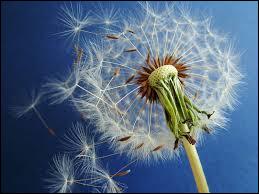
Dandelion, What kingdom does it belongs to?
a)
Plant Kingdom
b)
Animal Kingdom
c)
Fungi Kingdom
d)
Protista Kingdom
101.
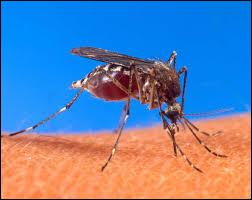
Mosquito  belongs to what kingdom?
a)
Animal Kingdom
b)
Plant Kingdom
c)
Fungi Kingdom
d)
Protista Kingdom
102.
The scientific name of Humans is? 
a)
Homo Sapiens
b)
Homo Habilus 
c)
Canis Latrans
103.
An illustration and a dichotomous key are given. What is the correct classification for this organism?
a)
Class Insecta
b)
Order Amblygygi
c)
Order Araneae
d)
Order Scorpiones
104.
The 8 levels of classification, from most broad to most specific are ...
a)
Domain, Genus, Family, Order, Class, Phylum, Kingdom, Species
b)
Domain, Species, Kingdom, Genus, Phylum, Family, Class, Order
c)
Domain, Kingdom, Phylum, Class, Order, Family, Genus, Species
d)
Order, Kingdom, Species, Domain, Phylum, Family, Class, Genus
105.
A student discovers an arachnid with a segmented abdomen, long legs, and a tail with no stinger. The student uses the dichotomous key below to identify it. Which arachnid has the student found?
a)
Whip Scorpion
b)
Wind Scorpion
c)
Daddy long legs
d)
Scorpion
106.
What is the most primitive organism shown on the cladogram?
a)
chimp
b)
perch
c)
hagfish
d)
salamander
107.
Which organisms pictured on the cladogram have hair?
a)
prosimians only
b)
prosimians and humans
c)
humans only
d)
prosimians and birds
108.
Which group(s) of organisms do not have vertebrae?
a)
lampreys and lancelets
b)
lampreys and tuna
c)
lancelets only
d)
salamanders, tuna, and lampreys
109.
Which organism in the table shown is most closely related to the common dolphin?
a)
human
b)
killer whale
c)
giant kelp
d)
bat star
110.
Which organism in the table is least closely related to the chimpanzee?
a)
human
b)
grey wolf
c)
tiger snake
d)
monarch butterfly
111.

What is insect B?

a)

Bee

b)

Ladybug

c)

Firefly

d)

Dragonfly

112.

Look at the diagram of the food web. The arrows means “eaten by.”


What will happen if the number of snakes goes down?

a)

The owl will eat the grass

b)

The number of frogs will go down

c)

The hawk and owl will have less food

d)

The number of mice and grasshoppers will go up.

113.

What happens to the amount of available energy in the pyramid as it moves up through the different levels?

a)

it increases

b)

it decreases

c)

it remains the same

d)

it decreases, then increases

114.
An organism that lives by breaking apart dead organic matter into simpler parts is...
a)
scavenger
b)
consumer
c)
decomposer
d)
carnivore
115.
This type of consumer only feeds on the bodies of dead animals.
a)
Herbivore.
b)
Decomposer.
c)
Carnivore.
d)
Scavenger
116.
the sun 
a)
abiotic 
b)
biotic 
117.
a dead plant 
a)
abiotic 
b)
biotic 
118.

Which organisms would be the energy for the hawk?

a)

rabbit, shrew, and snake

b)

rabbit, snake, and grasshopper

c)

shrew, snake, and insect eating bird

d)

grass, rabbit, and insect eating bird

119.
Which organism do the owl and the weasel compete for in the food web?
a)
Hawk
b)
Spider
c)
Grasshopper
d)
Shrew
120.
In the energy pyramid here, which organisms have the most energy available?
a)
Producers
b)
Carnivores
c)
Herbivores
d)
Top Predator
121.

autotrophs that get their energy from inorganic substances, such as salt

a)

Chemotrophs

b)

Heterotrophs

c)

Decomposers

d)

Primary Consumers

122.

Far Northern Latitudes, cold, dry, low plant growth, short summer, musk ox, caribou, lichens, moss

a)

Tundra

b)

Desert

c)

Tropical Rainforest

d)

Taiga

123.

near the equator, rains every day, warm, year-long growing season, primates, birds, insects

a)

Tundra

b)

Desert

c)

Tropical Rainforest

d)

Taiga

124.

conifer forest, cold, dry, spruce, fir, wolves, moose, waterfowl, Northern Hemisphere.

a)

Tundra

b)

Desert

c)

Tropical Rainforest

d)

Taiga

125.

temperate, rain all year, 6-month growing season, deer, squirrels, trees lose leaves Maple, Oak.

a)

Deciduous Forest

b)

Desert

c)

Grasslands

d)

Savanna

126.

DRY, hot or cold, succulent plants(cacti), reptiles, insects, mammals

a)

Deciduous Forest

b)

Desert

c)

Grasslands

d)

Savanna

127.

GRASS, some rainfall, hot or cold, grazing animals, predators, much food grown here (grains)

a)

Deciduous Forest

b)

Desert

c)

Grasslands

d)

Savanna

128.

tropical grassland with trees (Africa), BIG animals, predators, btw Desert & TRF

a)

Deciduous Forest

b)

Desert

c)

Grasslands

d)

Savanna

129.

a shallow area where saltwater and freshwater mix.

a)

Estuary

b)

Ocean

c)

Wetland

d)

Stream

130.

an area where land is completely saturated with water (marshes, swamps, and bogs). Can be freshwater or saltwater or BOTH

a)

Estuary

b)

Ocean

c)

Wetland

d)

Stream

131.

Symbiotic relationship in which both species benefit

a)

Parasitism

b)

Commensalism

c)

Mutualism

132.

Symbiotic relationship in which one organism benefits and the other is not helped or harmed.

a)

Parasitism

b)

Commensalism

c)

Mutualism

133.

A relationship in which one organism feeds on the tissues or body fluids of another organism.

a)

Parasitism

b)

Commensalism

c)

Mutualism

134.

What is the process whereby cells break down glucose and get ATP?

a)

photosynthesis

b)

salivation

c)

dehydration synthesis

d)

cellular respriation

135.

Where in the cell does cellular respiration occur?

a)

mitochondria

b)

nucleus

c)

chloroplast

d)

golgi body

136.

Which of the following terms means "without oxygen"

a)

aerobic

b)

oxygenated

c)

dihydrogen monoxide

d)

anaerobic

137.

When oxygen is running low, our bodies resort to __________ for energy.

a)

cellular respiration

b)

lactic acid fermentation

c)

alcoholic fermentation

d)

glycolysis

138.

Which of the following is a PRODUCT of cellular respiration?

a)

glucose

b)

nitrogen

c)

oxygen

d)

carbon dioxide

139.

Which of the following are done by plants?

a)

photosynthesis

b)

cellular respiration

c)

both

d)

neither

140.
This is the organelle that does photosynthesis.
a)
Chloroplast
b)
Mitochondria
c)
Ribosomes
d)
Nucleus
141.
Which of the following formulas represents photosynthesis?
a)
6 H2O + 6 O2 = C6H12O6 + 6 CO2
b)
6 H2O + 6 CO2 = C6H12O6 + 6 O2
c)
 C6H12O6 + + 6 O2 = 6 H2O + 6 CO2
142.

What are the products of photosynthesis?

a)

water and carbon dioxide

b)

oxygen and glucose

c)

oxygen and carbon dioxide

143.

The main source of energy for all life comes from ____.

a)

the Earth

b)

the food we eat/make

c)

the sun

144.
What type of respiration requires oxygen?
a)
Aerobic
b)
Anaerobic
145.
What is the correct equation for cellular respiration?
a)
6O2 + C6H12O6 -> 6CO2 + 6H2O + Energy
b)
6O2 + C6H12O6 + Energy -> 6CO2 + 6H2O
c)
6CO2 + 6H2O -> 6O2 + C6H12O6 + Energy
d)
6CO2 + 6H2O + Energy -> 6O2 + C6H12O6
146.
Plants need ________from the air for photosynthesis
a)
oxygen
b)
soil
c)
carbon dioxide
d)
sugar
147.
After photosynthesis, plants store their energy as _________ .
a)
chlorophyll
b)
pigment
c)
glucose (sugar)
d)
Oxygen
148.
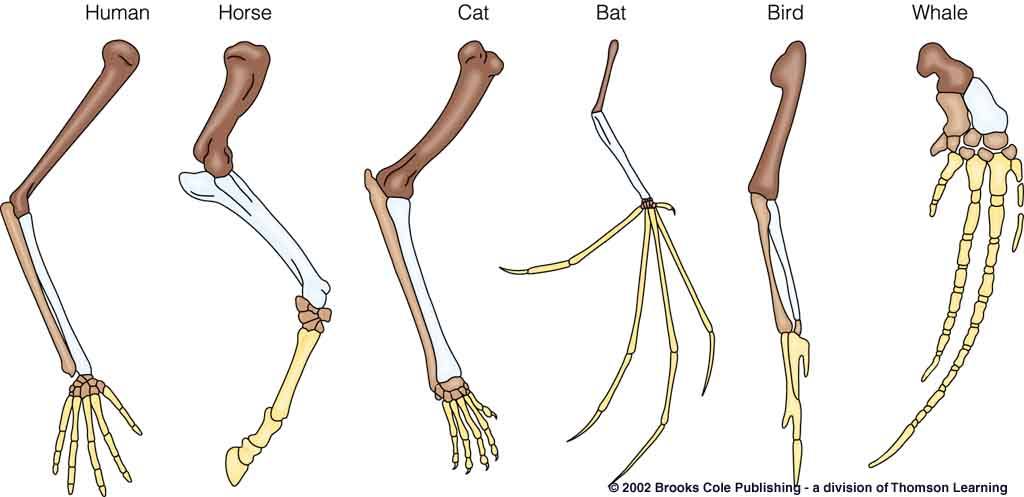
Humans, birds, whales, and lizards all have similar arm bones. What is the reason for this?
a)
The function of these bones is the same in all animals
b)
They live in similar environments
c)
They have a common ancestor
d)
All organisms resemble humans
149.
The structures shown are_________
a)
homologous
b)
heterologous
c)
analogous
d)
vestigial
150.

What

type

of structure?

a)

Homologous

b)

Analogous

c)

Embryological

d)

Vestigial