wayground logo

Free Printable Worksheets

Font size

S
M
L
XL
Worksheets

DNA Structure and Replictation

Total questions: 152

Worksheet time: 3hrs 12mins

Name
Class
Date
1.
Which of the following units are repeatedly joined together to form a strand of DNA?
a)
amino acids
b)
nucleotides
c)
fatty acids
d)
polysaccharides
2.
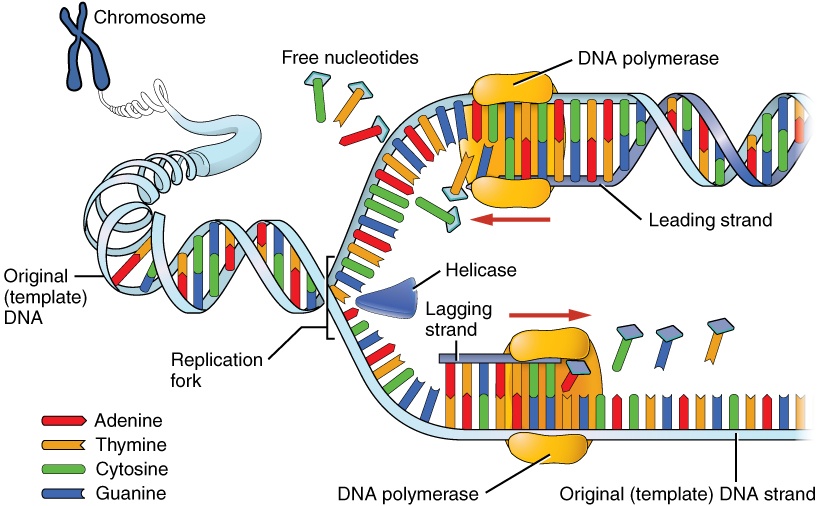
The enzyme that unwinds the DNA to prepare for replication
a)
helicase
b)
replicase
c)
polymerase
d)
synthase
3.

DNA replication results in two DNA molecules, said to "semi-conservative"

a)

each one with two original strands

b)

each one with two new strands

c)

each one with one new strand and one original strand

d)

one with two new strands and the other with two original strands
4.
A process in which DNA has the unique ability to make an exact copy of itself.
a)
Replication
b)
Translation
c)
Transcription
5.
Which enzyme is responsible for adding nucleotides?
a)
Topoisomerase
b)
DNA Polymerase
c)
Ligase
d)
Primase
6.
The process of DNA replication is called semi conservative because it results in
a)
none of these
b)
Two DNA molecules.  One original molecule and one with two new strands
c)
two exact copies with new strands
d)
two identical molecules, each with 1 original strand and one new.
7.
Why does DNA replicate?
a)
To create another copy for the new cell
b)
To create a duplicate copy in case the original gets damaged
c)
To create a new copy to replace the damaged original
8.
Nitrogenous bases are joined by which type of bond?
a)
polar bonds
b)
ionic bonds
c)
covalent bonds
d)
hydrogen bonds
9.
Adenine bonds with ______________.
a)
Guanine
b)
Thymine
c)
Cytosine
d)
Adenine
10.
Guanine bonds with ______________.
a)
Adenine
b)
Guanine
c)
Cytosine
d)
Thymine
11.
Why is DNA important?
a)
it is very small and very complicated
b)
it's in everything
c)
it serves as the blueprint for traits of all living things
d)
because we eat it every day for energy
12.
What are the 4 nitrogen bases?
a)
adenine, thymine, cytoplasm, and guanine
b)
adenine, thymine cytosine, and guanine
c)
adenine, thymine, cytosine, and gylcerol
d)
adenine, thymine, cytosine, and glucose
13.
What does DNA stand for?
a)
Deoxyribonucleic acid
b)
Denitrogenous acid
c)
Deribonucleic acid
d)
Diribonucleic acid
14.

DNA replication creates two strands of DNA from one. If pink is parental DNA and blue is new DNA - which picture demonstrates the accepted model of DNA replication after the SECOND replication cycle?

a)
b)
c)
d)
15.

The picture below shows an enzyme unwinding and unzipping DNA.

​What is the name of this enzyme?

a)

DNA Helicase

b)

DNA Ligase

c)

DNA polyermase

d)

RNA Polymerase

16.

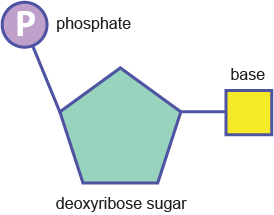
What are the components of a DNA nucleotide? (Mark all that apply)

a)

Deoxyribose

b)

Ligase

c)

Nitrogen Base

d)

Phosphate group

e)

Ribose

17.

What makes up the SIDES of a DNA ladder?

a)

nitrogen bases

b)

sugars & phosphates

c)

genes & chromosomes

d)

RNA

18.

What makes up the rungs (steps) of a DNA ladder?

a)

sugars & phosphates

b)

nitrogen bases

c)

sugars

d)

genes & chromosomes

19.

If one strand of a DNA molecule has the following order of bases, what will be the correct order of bases on the complementary (matching) strand?

AATTGGCC

a)

AATTGGCC

b)

TTAACCGG

c)

GGCCAATT

d)

GACTGACT

20.

Americans spend an estimated $6 BILLION annually on Halloween, making it the ____ commercial holiday.

a)

largest

b)

second largest

c)

third largest

d)

fourth largest

21.
A nucleotide is made up of three parts:  which of these is not one of those parts?
a)
sugar
b)
phosphate
c)
amino acids
d)
base
22.
A strand of DNA that looks like a twisted ladder is called a _____________________
a)
triple twist
b)
corkscrew
c)
double helix
d)
chain reaction
23.
Adenine, Cytosine, Guanine and Thymine are examples of
a)
DNA structure
b)
DNA bases
c)
DNA double helix
d)
Paired bases
24.
The rules of DNA pairing states that Adenine (A) always pairs up with
a)
Thymine
b)
Cytosine
c)
Adenine
d)
Guanine
25.
The rules of DNA pairing states that Cytosine (C) always pairs up with
a)
Thymine
b)
Cytosine
c)
Adenine
d)
Guanine
26.
What holds the DNA bases together?
a)
Hydrogen bonds
b)
DNA bases
c)
Double Helix
d)
Paired bases
27.
DNA is a polymer made of:
a)
Nucleotides
b)
Ribosomes
c)
Purines
d)
Pyrimidines
28.
Why is DNA important?
a)
it is very small and very complicated
b)
it's in everything
c)
it serves as the blueprint for traits of all living things
d)
because we eat it every day for energy
29.
DNA replication results in two DNA molecules,
a)
each one with two original strands
b)
each one with two new strands
c)
each one with one new strand and one original strand
d)
one with two new strands and the other with two original strands
30.
In a molecule of double-stranded DNA, the amount of Adenine present is always equal to the amount of
a)
cytosine
b)
guanine
c)
thymine
d)
uracil
31.
Which organelle is DNA usually found in?
a)
cell membrane
b)
vacuole
c)
ribosome
d)
nucleus
32.
Which 2 molecules form the sides (backbone) of the DNA ladder?
a)
deoxyribose sugar and adenine
b)
deoxyribose sugar and a hydrogen bond
c)
deoxyribose sugar and the nucleus
d)
deoxyribose sugar and phosphate
33.
What will the matching sequence be on a strand that reads AAGCTAT?
a)
AACGATA
b)
TTCGTTA
c)
CCTGATA
d)
TTCGATA
34.
What are the three components of a nucleotide?
a)
sugar, hydrogen, nitrogen base
b)
sugar, oxygen, nitrogen base
c)
sugar, phosphate, nitrogen base
d)
sugar, phosphate, protein
35.
If a strand reads:
3' A A A T T T C 5'
The matching strand would read...
a)
5' T T T A A A G 3'
b)
3' T T T A A A G 5'
c)
5' A A A T T T C 3'
d)
3' U U U A A A G 5'
36.
DNA replication turns one strand of DNA into two new strands of DNA. What percent of each new strand is the old strand?
a)
Half of each new DNA is the old DNA
b)
The old strand of DNA was digested, so none
c)
The new DNA is entirely made up of the old DNA
d)
About every sixth base comes from the old DNA
37.
If a DNA molecule is 18% Guanine which of the following is correct
a)
18% cytosine, 32% adenine, 32% thymine
b)
32% cytosine, 18% adenine, 32% thymine
c)
18% cytosine, 64% adenine, 64% thymine
d)
32% cytosine, 32% adenine, 18% thymine
38.
the process of making a copy of DNA
a)
transcription
b)
double helix
c)
DNA replication
d)
replication fork
39.
Which shows the correct complementary base pairing for DNA?
a)
C-A, T-G
b)
A-G, C-T
c)
C-G, U-A
d)
T-A, G-C
40.
The enzyme that unwinds the DNA to prepare for replication
a)
helicase
b)
replicase
c)
polymerase
d)
synthase
41.

DNA replication results in

a)

2 completely new DNA molecules

b)

2 DNA molecules that each contain a strand of the original

c)

1 new DNA molecule and 1 old

d)

1 new molecule of DNA

42.

The picture below shows an enzyme unwinding and unzipping DNA.

​What is the name of this enzyme?

a)

DNA Helicase

b)

DNA Ligase

c)

DNA polyermase

d)

RNA Polymerase

43.

Which enzyme is responsible for adding the free nucleotides to the replicating DNA? ​

a)

DNA Helicase

b)

DNA Ligase

c)

DNA polyermase

d)

RNA Polymerase

44.
In a molecule of double-stranded DNA, the amount of Adenine present is always equal to the amount of
a)
cytosine
b)
guanine
c)
thymine
d)
uracil
45.
A five-carbon sugar found in DNA.
a)
ribose
b)
guanine
c)
deoxyribose
d)
helicase
46.
Which sequence of DNA bases would pair with this partial strand
ATG TGA CAG
a)
ATG TGA CAG
b)
TAC ACT GTC
c)
GTA AGT GAC
d)
CAT TCA CTG
47.
Which of the following is NOT a part of the DNA nucleotide? 
a)
Dextrose sugar
b)
Phosphate group
c)
Nitrogenous base
d)
Lysine amino acid
48.
What is the goal of DNA replication? (choose the most accurate answer)
a)
To destroy the DNA molecule
b)
To make a new copy of DNA from an existing strand of DNA
c)
To make a totally new DNA molecule from nothing
d)
To copy the DNA into RNA
49.
DNA is a polymer made of:
a)
Nucleotides
b)
Ribosomes
c)
Purines
d)
Pyrimidines
50.
Sometimes, DNA is called "semi-conservative." Why might this be?
a)
The old strand is "conserved" and used to make the new strands
b)
Uracil is "conserved" in that it is only used to make the new strands
c)
ATP is "conserved" via the usage of facilitated diffusion
d)
Ligase is "conserved" in that it is denatured by the process
51.

Which is the first step?

a)

DNA Helicase unwinds original DNA strand

b)

RNA Primase lays down RNA primer for new nucleotide bases.

c)

DNA polymerase builds new strands by bring in new nucleotide bases.

d)

Ligase knits together fragments on lagging strand

52.

Which is the second step?

a)

DNA Helicase unwinds original DNA strand

b)

RNA Primase lays down RNA primer for new nucleotide bases.

c)

DNA polymerase builds new strands by bring in new nucleotide bases.

d)

Ligase knits together fragments on lagging strand

53.

Which is the third step?

a)

DNA Helicase unwinds original DNA strand

b)

RNA Primase lays down RNA primer for new nucleotide bases.

c)

DNA polymerase builds new strands by bring in new nucleotide bases.

d)

Ligase knits together fragments on lagging strand

54.

Which is the fourth step?

a)

DNA Helicase unwinds original DNA strand

b)

RNA Primase lays down RNA primer for new nucleotide bases.

c)

DNA polymerase builds new strands by bring in new nucleotide bases.

d)

Ligase knits together fragments on lagging strand

55.

The directionality of DNA is said to be ___________, because it is side by side by goes in opposite directions.

a)

Anti-directional

b)

Parallel

c)

Anti-parallel

d)

Anti-uniform

56.

What makes up the SIDES (backbone) of a DNA ladder?

a)

nitrogen bases

b)

sugars & phosphates

c)

genes & chromosomes

d)

RNA

57.

What makes up the rungs (steps) of a DNA ladder?

a)

sugars & phosphates

b)

nitrogen bases

c)

sugars

d)

genes & chromosomes

58.

What SHAPE is DNA?

a)

single strand

b)

straight ladder

c)

double helix (twisted ladder)

d)

DNA has no shape

59.

In DNA. what base always pairs with A?

a)

A

b)

T

c)

C

d)

G

60.

If one strand of a DNA molecule has the following order of bases, what will be the correct order of bases on the complementary (matching) strand?

5' -AATTGGCC - 3'

a)

3' - AATTGGCC - 5'

b)

3' - TTAACCGG - 5'

c)

5' - AATTGGCC - 3'

d)

5' - TTAACCGG - 3'

61.

What is DNA made up of?

a)

nucleotides

b)

cytoplasm

c)

RNA

d)

cells

62.
Which of the following best describes a DNA molecule?
a)
double helix
b)
contains ribose
c)
made of amino acids
d)
contains Uracil
63.
Why is DNA important?
a)
it is very small and very complicated
b)

it stores energy

c)
it serves as the blueprint for traits of all living things
d)

because it can catalyze reactions

64.
Nitrogenous bases are joined by which type of bond?
a)
polar bonds
b)
ionic bonds
c)
covalent bonds
d)
hydrogen bonds
65.
Cytosine always pairs with
a)
Adenine
b)
Thymine
c)
Uracil
d)
Guanine
66.
Guanine bonds with ______________.
a)
Adenine
b)
Guanine
c)
Cytosine
d)
Thymine
67.
What is the complement to the DNA strand below:
5'-ATGCCAT-3'
a)
5'-TACGGTA-3'
b)
3'-TACGGTA-5'
c)
3'-ATGGCAT-5'
d)
5'-ATGGCAT-3'
68.

The picture below shows the steps of DNA replication beginning with step one and ending with step three.


​Because you are reusing the old, or parent, DNA strand DNA replication is said to be

a)

Semi- Conservative

b)

Semi-discontinuous

c)

Continuous

d)

Fully-Conserveative

69.

The picture below shows an enzyme unwinding and unzipping DNA.

​What is the name of this enzyme?

a)

DNA Helicase

b)

DNA Ligase

c)

DNA polyermase

d)

RNA Polymerase

70.

Which enzyme is responsible for adding the free nucleotides to the replicating DNA? ​

a)

DNA Helicase

b)

DNA Ligase

c)

DNA polymerase

d)

RNA Polymerase

71.

The directionality of DNA is said to be ___________, because it is side by side by goes in opposite directions.

a)

Anti-directional

b)

Parallel

c)

Anti-parallel

d)

Anti-uniform

72.
DNA replication results in two DNA molecules,
a)
each one with two original strands
b)
each one with two new strands
c)
each one with one new strand and one original strand
d)
one with two new strands and the other with two original strands
73.
A process in which DNA has the unique ability to make an exact copy of itself.
a)
Replication
b)
Translation
c)
Transcription
74.
If a DNA molecule is 18% Guanine which of the following is correct
a)
18% cytosine, 32% adenine, 32% thymine
b)
32% cytosine, 18% adenine, 32% thymine
c)
18% cytosine, 64% adenine, 64% thymine
d)
32% cytosine, 32% adenine, 18% thymine
75.
What are the three components of a nucleotide?
a)
sugar, hydrogen, nitrogen base
b)
sugar, oxygen, nitrogen base
c)
sugar, phosphate, nitrogen base
d)
sugar, phosphate, protein
76.
Adenine, Cytosine, Guanine and Thymine are examples of
a)
DNA structure
b)
DNA bases
c)
DNA double helix
d)
Paired bases
77.
A nucleotide is made up of three parts:  which of these is not one of those parts?
a)
sugar
b)
phosphate
c)
amino acids
d)
base
78.

Choose the correct complementary nucleotide sequence for the following:

GGG - ACT - TTT

a)

CCC - TGA - AAA

b)

AAA - CAG - GGG

c)

TTT - CAT - GGG

d)

GGG - TGA - CCC

79.

Choose the correct complementary nucleotide sequence for the following:

TTT - GTC - CCC

a)

CCC - TGA - AAA

b)

AAA - CAG - GGG

c)

TTT - CAT - GGG

d)

GGG - TGA - CCC

80.

Choose the correct complementary nucleotide sequence for the following:

AAA - GTA - CCC

a)

CCC - TGA - AAA

b)

AAA - CAG - GGG

c)

TTT - CAT - GGG

d)

GGG - TGA - CCC

81.

According to the Base pair rule, if a DNA molecule contains 1500 adenines how many thymine's will it contain?

a)

1500

b)

500

c)

0

d)

1000

82.

Choose the correct complementary nucleotide sequence for the following:

CCC - ACT - GGG

a)

CCC - TGA - AAA

b)

AAA - CAG - GGG

c)

TTT - CAT - GGG

d)

GGG - TGA - CCC

83.

According to the Base pair rule, if a DNA molecule contains 2 cytosine's how many guanines will it contain?

a)

1500

b)

2

c)

0

d)

1000

84.

How many hydrogen bonds are between Adenine and Thymine?

a)

1

b)

2

c)

3

d)

4

85.

How many hydrogen bonds are between Guanine and Cytosine?

a)

1

b)

2

c)

3

d)

4

86.

The sugar-phosphate backbone is held together by _____ bonds. These are _____ bonds.

a)

covalent, strong

b)

hydrogen, strong

c)

covalent, weak

d)

hydrogen, weak

87.

What makes up the SIDES of a DNA ladder?

a)

nitrogen bases

b)

sugars & phosphates

c)

genes & chromosomes

d)

RNA

88.

What makes up the rungs (steps) of a DNA ladder?

a)

sugars & phosphates

b)

nitrogen bases

c)

sugars

d)

genes & chromosomes

89.

What SHAPE is DNA?

a)

single strand

b)

straight ladder

c)

double helix (twisted ladder)

d)

DNA has no shape

90.

In DNA. what base always pairs with A?

a)

A

b)

T

c)

C

d)

G

91.

If one strand of a DNA molecule has the following order of bases, what will be the correct order of bases on the complementary (matching) strand?

AATTGGCC

a)

AATTGGCC

b)

TTAACCGG

c)

GGCCAATT

d)

GACTGACT

92.

What is DNA made up of?

a)

nucleotides

b)

cytoplasm

c)

RNA

d)

cells

93.
Which of the following best describes a DNA molecule?
a)
double helix
b)
contains ribose
c)
made of amino acids
d)
contains Uracil
94.
Why is DNA important?
a)
it is very small and very complicated
b)
it's in everything
c)
it serves as the blueprint for traits of all living things
d)
because we eat it every day for energy
95.
Nitrogenous bases are joined by which type of bond?
a)
polar bonds
b)
ionic bonds
c)
covalent bonds
d)
hydrogen bonds
96.
Cytosine always pairs with
a)
Adenine
b)
Thymine
c)
Uracil
d)
Guanine
97.
Guanine bonds with ______________.
a)
Adenine
b)
Guanine
c)
Cytosine
d)
Thymine
98.
What is the complement to the DNA strand below:
5'-ATGCCAT-3'
a)
5'-TACGGTA-3'
b)
3'-TACGGTA-5'
c)
3'-ATGGCAT-5'
d)
5'-ATGGCAT-3'
99.

The picture below shows the steps of DNA replication beginning with step one and ending with step three.


​Because you are reusing the old, or parent, DNA strand DNA replication is said to be

a)

Semi- Conservative

b)

Semi-discontinuous

c)

Continuous

d)

Fully-Conserveative

100.

The picture below shows an enzyme unwinding and unzipping DNA.

​What is the name of this enzyme?

a)

DNA Helicase

b)

DNA Ligase

c)

DNA polyermase

d)

RNA Polymerase

101.

Which enzyme is responsible for adding the free nucleotides to the replicating DNA? ​

a)

DNA Helicase

b)

DNA Ligase

c)

DNA polyermase

d)

RNA Polymerase

102.

The directionality of DNA is said to be ___________, because it is side by side by goes in opposite directions.

a)

Anti-directional

b)

Parallel

c)

Anti-parallel

d)

Anti-uniform

103.
DNA replication results in two DNA molecules,
a)
each one with two original strands
b)
each one with two new strands
c)
each one with one new strand and one original strand
d)
one with two new strands and the other with two original strands
104.
A process in which DNA has the unique ability to make an exact copy of itself.
a)
Replication
b)
Translation
c)
Transcription
105.
A monomer of DNA is called a(n)
a)
Monosaccharide
b)
Amino Acid
c)
Triglyceride
d)
Nucleotide
106.
Which of the following best describes a DNA molecule?
a)
double helix
b)
contains ribose
c)
made of amino acids
d)
contains Uracil
107.
In a molecule of double-stranded DNA, the amount of Adenine present is always equal to the amount of
a)
cytosine
b)
guanine
c)
thymine
d)
uracil
108.
Which organelle is DNA usually found in?
a)
cell membrane
b)
vacuole
c)
ribosome
d)
nucleus
109.
Nitrogenous bases are joined by which type of bond?
a)
polar bonds
b)
ionic bonds
c)
covalent bonds
d)
hydrogen bonds
110.
Nucleotides are made up of a sugar, phosphate, and..?
a)
nitrogenous base
b)
nucleic acid
c)
cholesterol
d)
fatty acid
111.
A five-carbon sugar found in DNA.
a)
ribose
b)
guanine
c)
deoxyribose
d)
helicase
112.
DNA polymerase is a(n)
a)
lipid
b)
enzyme
c)
sugar
d)
starch
113.
What are the 4 nitrogenous bases in DNA?
a)
adenine, thymine, cytoplasm, and guanine
b)
adenine, thymine cytosine, and guanine
c)
adenine, thymine, cytosine, and gylcerol
d)
adenine, thymine, cytosine, and glucose
114.
What does DNA stand for?
a)
Deoxyribonucleic acid
b)
Denitrogenous acid
c)
Deribonucleic acid
d)
Diribonucleic acid
115.
Which 2 molecules form the sides (backbone) of the DNA ladder?
a)
deoxyribose sugar and adenine
b)
deoxyribose sugar and a hydrogen bond
c)
deoxyribose sugar and the nucleus
d)
deoxyribose sugar and phosphate
116.
The enzyme that unzips the DNA to prepare for replication
a)
helicase
b)
replicase
c)
polymerase
d)
synthase
117.
A process in which DNA has the unique ability to make an exact copy of itself.
a)
Replication
b)
Translation
c)
Transcription
118.
Which of the following units are repeatedly joined together to form a strand of DNA?
a)
amino acids
b)
nucleotides
c)
fatty acids
d)
polysaccharides
119.
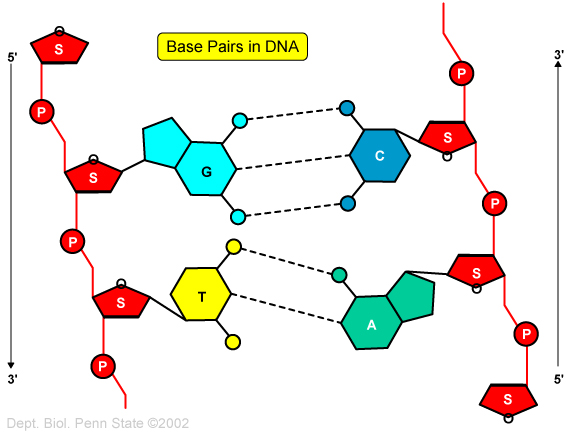
This picture is illustrating the ____ nature of DNA.
a)
anti-parallel
b)
deoxyribosic
c)
helical
d)
radioactive
120.
Polymerase is able to replicate the new DNA ______ along the leading strand.
a)
continuously
b)
only in short fragments
c)
very slowly
d)
prokaryotically
121.
Which enzyme is responsible for adding nucleotides?
a)
Topoisomerase
b)
DNA Polymerase
c)
Ligase
d)
Primase
122.
The enzyme that splits open the DNA creates what's called a fork - where the DNA separates into the lagging strand and the ______ strand.
a)
leading
b)
leveraging
c)
Okazaki
d)
ligase
123.
DNA replication turns one strand of DNA into two new strands of DNA. What percent of each new strand is the old strand?
a)
Half of each new DNA is the old DNA
b)
The old strand of DNA was digested, so none
c)
The new DNA is entirely made up of the old DNA
d)
About every sixth base comes from the old DNA
124.
Sometimes, DNA is called "semi-conservative." Why might this be?
a)
The old strand is "conserved" and used to make the new strands
b)
Uracil is "conserved" in that it is only used to make the new strands
c)
ATP is "conserved" via the usage of facilitated diffusion
d)
Ligase is "conserved" in that it is denatured by the process
125.
DNA replication results in two DNA molecules,
a)
each one with two original strands
b)
each one with two new strands
c)
each one with one new strand and one original strand
d)
one with two new strands and the other with two original strands
126.

direction new nucleotides are synthesized on the new strand

a)

5' to 3' (new nucleotides added to the 3' end)

b)

3' to 5' (new nucleotides added to the 5' end)

c)

3' to 5' (new nucleotides added to the 3' end)

d)

5' to 3' (new nucleotides added to the 5' end)

127.
Which sequence of DNA bases would pair with this partial strand
CAT TCA CTG
a)
ATG TGA CAG
b)
TAC ACT GTC
c)
GTA AGT GAC
d)
CAT TCA CTG
128.
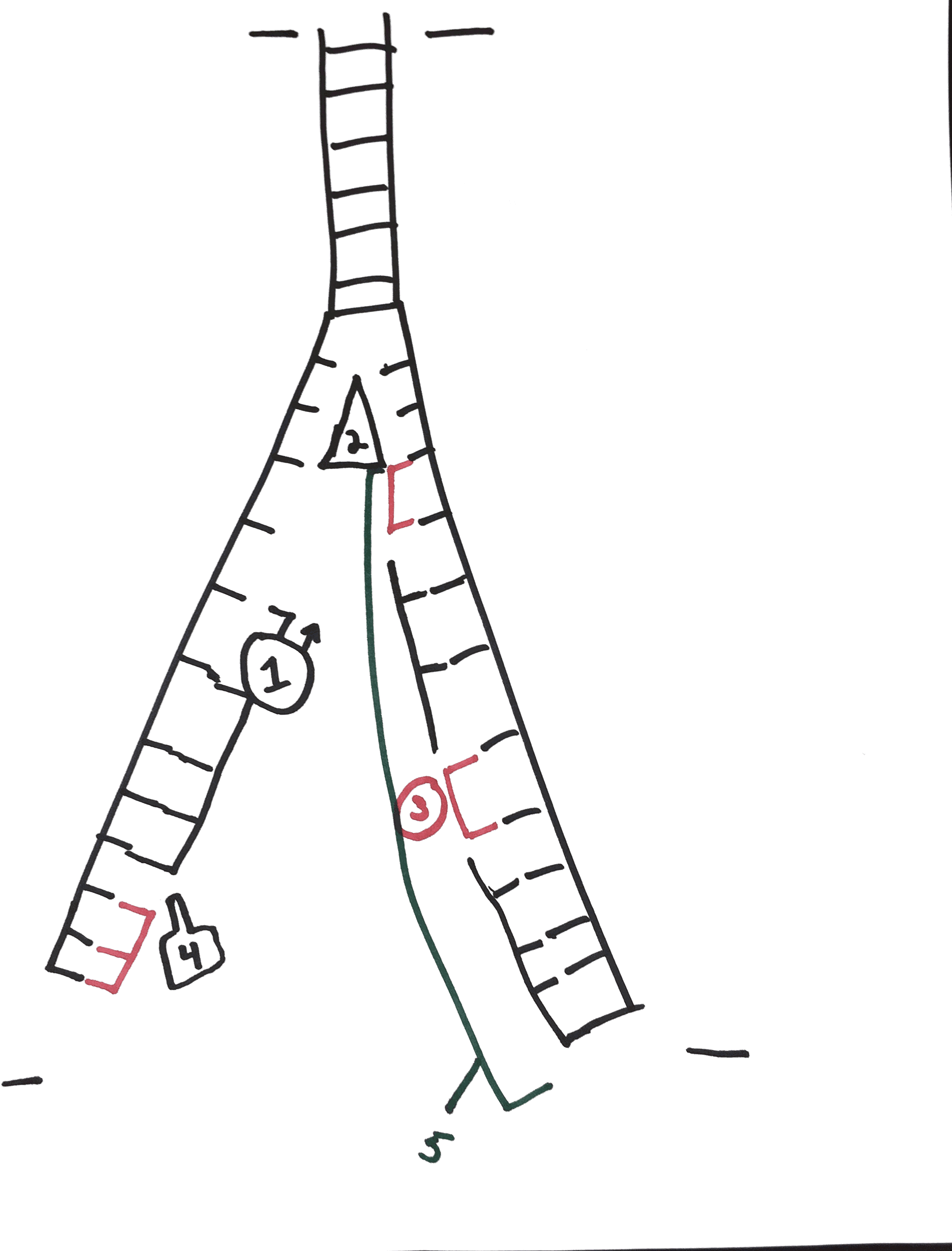
order of replication
a)
3, 4, 2, 1
b)
3, 1, 4, 2
c)
2, 1, 4, 3
d)
3, 4, 1, 2
129.

#3 setting Primers

a)

Ligase

b)

Helicase

c)

Polymerase

d)

Primase

130.
A nucleotide is made up of three parts:  which of these is not one of those parts?
a)
sugar
b)
phosphate
c)
amino acids
d)
base
131.
A strand of DNA that looks like a twisted ladder is called a _____________________
a)
triple twist
b)
corkscrew
c)
double helix
d)
chain reaction
132.
Adenine, Cytosine, Guanine and Thymine are examples of
a)
DNA structure
b)
DNA bases
c)
DNA double helix
d)
Paired bases
133.
The rules of DNA pairing states that Adenine (A) always pairs up with
a)
Thymine
b)
Cytosine
c)
Adenine
d)
Guanine
134.
The rules of DNA pairing states that Cytosine (C) always pairs up with
a)
Thymine
b)
Cytosine
c)
Adenine
d)
Guanine
135.
What holds the DNA bases together?
a)
Hydrogen bonds
b)
DNA bases
c)
Double Helix
d)
Paired bases
136.
DNA is a polymer made of:
a)
Nucleotides
b)
Ribosomes
c)
Purines
d)
Pyrimidines
137.
Why is DNA important?
a)
it is very small and very complicated
b)
it's in everything
c)
it serves as the blueprint for traits of all living things
d)
because we eat it every day for energy
138.
DNA replication results in two DNA molecules,
a)
each one with two original strands
b)
each one with two new strands
c)
each one with one new strand and one original strand
d)
one with two new strands and the other with two original strands
139.
In a molecule of double-stranded DNA, the amount of Adenine present is always equal to the amount of
a)
cytosine
b)
guanine
c)
thymine
d)
uracil
140.
Which organelle is DNA usually found in?
a)
cell membrane
b)
vacuole
c)
ribosome
d)
nucleus
141.
Which 2 molecules form the sides (backbone) of the DNA ladder?
a)
deoxyribose sugar and adenine
b)
deoxyribose sugar and a hydrogen bond
c)
deoxyribose sugar and the nucleus
d)
deoxyribose sugar and phosphate
142.
What will the matching sequence be on a strand that reads AAGCTAT?
a)
AACGATA
b)
TTCGTTA
c)
CCTGATA
d)
TTCGATA
143.
What are the three components of a nucleotide?
a)
sugar, hydrogen, nitrogen base
b)
sugar, oxygen, nitrogen base
c)
sugar, phosphate, nitrogen base
d)
sugar, phosphate, protein
144.
If a strand reads:
3' A A A T T T C 5'
The matching strand would read...
a)
5' T T T A A A G 3'
b)
3' T T T A A A G 5'
c)
5' A A A T T T C 3'
d)
3' U U U A A A G 5'
145.
DNA replication turns one strand of DNA into two new strands of DNA. What percent of each new strand is the old strand?
a)
Half of each new DNA is the old DNA
b)
The old strand of DNA was digested, so none
c)
The new DNA is entirely made up of the old DNA
d)
About every sixth base comes from the old DNA
146.
If a DNA molecule is 18% Guanine which of the following is correct
a)
18% cytosine, 32% adenine, 32% thymine
b)
32% cytosine, 18% adenine, 32% thymine
c)
18% cytosine, 64% adenine, 64% thymine
d)
32% cytosine, 32% adenine, 18% thymine
147.
the process of making a copy of DNA
a)
transcription
b)
double helix
c)
DNA replication
d)
replication fork
148.
Which shows the correct complementary base pairing for DNA?
a)
C-A, T-G
b)
A-G, C-T
c)
C-G, U-A
d)
T-A, G-C
149.
The enzyme that unwinds the DNA to prepare for replication
a)
helicase
b)
replicase
c)
polymerase
d)
synthase
150.

DNA replication results in

a)

2 completely new DNA molecules

b)

2 DNA molecules that each contain a strand of the original

c)

1 new DNA molecule and 1 old

d)

1 new molecule of DNA

151.

The picture below shows an enzyme unwinding and unzipping DNA.

​What is the name of this enzyme?

a)

DNA Helicase

b)

DNA Ligase

c)

DNA polyermase

d)

RNA Polymerase

152.

Which enzyme is responsible for adding the free nucleotides to the replicating DNA? ​

a)

DNA Helicase

b)

DNA Ligase

c)

DNA polyermase

d)

RNA Polymerase