
 Worksheets
1st nine week Review
Total questions: 150
Worksheet time: 2hrs 4mins
Name
Class
Date
1.
Water is what type of compound?
a)
organic
b)
inorganic
c)
toxic
2.
What affects enzyme activity?
a)
Air
b)
Nothing
c)
Temperature and PH
d)
Substrate
3.
Waxes, oils and fats are examples of
a)
Carbohydrates
b)
Lipids
c)
Proteins
d)
Nucleic Acids
4.
Which macromolecule is made of simple and complex sugars?
a)
lipids
b)
proteins
c)
carbohydrates
d)
nucleic acids
5.
All of the following are examples of lipids except:
a)
oil
b)
wax
c)
fatty acid
d)
cellulose
6.
DNA and RNA are examples of...
a)
proteins
b)
nucleic acids
c)
carbohydrates
d)
lipids
7.
Most enzymes:
a)
speed up the chemical reaction
b)
have no effect on the rate of the chemical reaction
c)
slow the rate of the chemical reaction
d)
keep the rate of the chemical reaction the same
8.
When an enzyme is denatured then it will...
a)
work really well
b)
no longer work
9.
What is a single piece of sugar called?
a)
Fructose
b)
Sucrose
c)
Glucose
d)
Glycogen
10.
What the enzyme works on:
a)
catalyst
b)
substrate
c)
product
11.
What is the main (primary) source of energy for the cell.
a)
Carbohydrates
b)
Protein
c)
Lipids
d)
Nucleic Acids
12.
Where is cellulose found?
a)
In caves
b)
In parks
c)
In the cell wall of plants.
d)
In the cell wall of animals.
13.
Where is glycogen found?
a)
In the muscles of animals
b)
In trees
c)
In the ocean
d)
In plants
14.
The monomer of a lipid is
a)
Glycerol+Fatty Acid
b)
Monosaccharide
c)
Amino Acid
d)
Nucleotide
15.

This molecule is a
a)
amino acid
b)
nucleic acid
c)
carbohydrate
d)
lipid
16.

Which macromolecule is shown?
a)
lipid
b)
protein
c)
nucleic acid
d)
carbohydrate
17.

What is this....?
a)
monosaccharide
b)
nucleotide
c)
amino acid
d)
glycerol & fatty acids
18.

Enzymes work by _____ the activation energy
a)
eliminating
b)
maintaining
c)
increasing
d)
lowering
19.
Proteins are among the most diverse molecules because...
a)
they form muscles
b)
they create nucleic acids
c)
amino acids link up in different orders
d)
amino acids are made of more than 20 proteins
20.
DNA....
a)
makes proteins
b)
carries instructions for making proteins
c)
forms cell membrane
d)
makes cholesterol and sex hormones
21.
RNA....
a)
makes cell membrane
b)
makes cholesterol and sex hormones
c)
makes proteins
d)
carries genetic information
22.
How are lipids and enzymes different?
a)
lipids control - enzymes denature proteins
b)
lipids support cells - enzymes change the cell's pH
c)
lipids store energy - enzymes act as biological catalysts to speed up reactions
d)
lipids build structures - enzymes carry substances through the body
23.

What is this a picture of?
a)
chromosomes
b)
amino acids
c)
RNA
d)
DNA
24.
Insulin belongs to which larger group?
a)
lipids
b)
proteins
c)
carbohydrates
d)
nucleic acids
25.
It is the job of insulin to ....
a)
control glucose levels in the blood
b)
act as catalysts
c)
transports oxygen
d)
none of these
26.
Hemoglobin's job is to ...
a)
act as catalysts
b)
regulates (controls) blood sugar
c)
carry oxygen by red blood cells
d)
build proteins
27.
Enzymes USUALLY end in ....
a)
-tion
b)
-ing
c)
-ose
d)
-ase
28.

Which number represents the ENZYME?
a)
1
b)
3
c)
4
d)
5
29.
The place where the enzyme and substrate meet.
a)
lock and key
b)
substrate
c)
enzyme-sustrate complex
d)
active site
30.
One enzyme can act on many different substrates
a)
True
b)
False
31.
Which would a long distance runner eat the night before a race?
a)
a protein because it builds muscle mass
b)
a simple sugar because it gives quick energy
c)
a complex carb because it gives long lasting energy
d)
a protein because it carries oxygen through the body
32.
Which structures are found in every living cell?
a)
cell membrane and cytoplasm
b)
chloroplasts and mitochondria
c)
a cell wall and nucleus
d)
chloroplasts and cell wall
33.
Which cell structure is found in plant and animals cells and controls what can come into or leave a cell?
a)
cell membrane
b)
cytoplasm
c)
nucleus
d)
vacuole
34.
What is the function of the cell nucleus found in both plant and animal cells?
a)
to produce energy
b)
to control cell activity
c)
to remove waste products
d)
to allow molecules to enter the cell
35.
Cell organelles that are responsible for digesting food, worn out organelles and other cellular wastes are called ___________________.
a)
Mitochondria
b)
Vacuoles
c)
Lysosomes
d)
Chlororplasts
36.
What is one basic function of the vacuoles?
a)
circulating oxygen
b)
producing food
c)
controlling cell processes
d)
storing water
37.
Chloroplasts in plant cells allow the plant to perform a function that animal cells cannot do. What is the main function of the chloroplasts found in plant cells?
a)
to absorb light energy and manufacture food
b)
to remove waste materials by active transport
c)
to manufacture chemical energy from food
d)
to control the shape of the cell
38.
All cells need energy to function. Which cell organelle is responsible for producing energy in the cell?
a)
chloroplasts
b)
mitochondria
c)
nucleus
d)
vacuoles
39.
What is the function of a cell wall?
a)
to protect and support the cell
b)
to perform different functions in each cell
c)
to prevent water from passing through it
d)
to prevent oxygen from entering the cell
40.
In what part of the plant cell does the process of photosynthesis take place?
a)
nucleus
b)
mitochondria
c)
chloroplasts
d)
vacuoles
41.
Which of the following is not part of the cell theory?
a)
cells must contain DNA
b)
all living things are made from cells
c)
cells can only come from other cells
d)
cells are the basic unit of life
42.
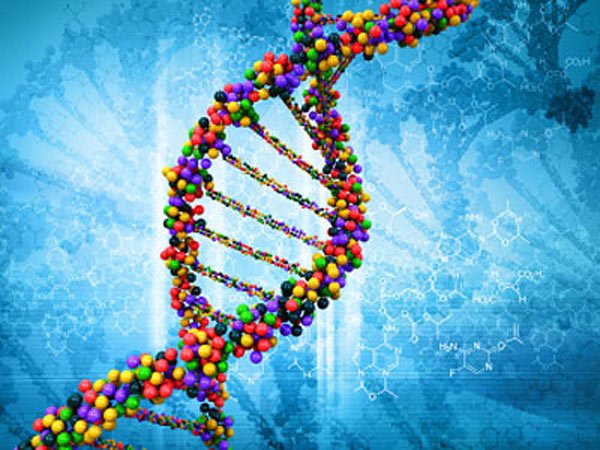
What is the name of the genetic material that is inside the nucleus?
a)
ER
b)
ATP
c)
YOLO
d)
DNA
43.
Where are proteins made?
a)
Golgi body
b)
Mitoichondria
c)
Chromosomes
d)
Ribosomes
44.
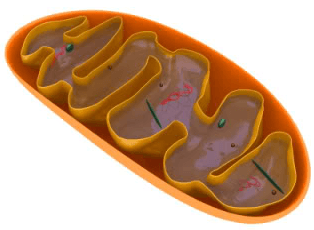
What are tiny organelles that convert glucose into ATP?
a)
Ribosomes
b)
Vesicles
c)
Cytoskeleton
d)
Mitochondria
45.
What is the gel-like substance inside of cells called?
a)
photoplasm
b)
photosynthesis
c)
cytoskeleton
d)
cytoplasm
46.
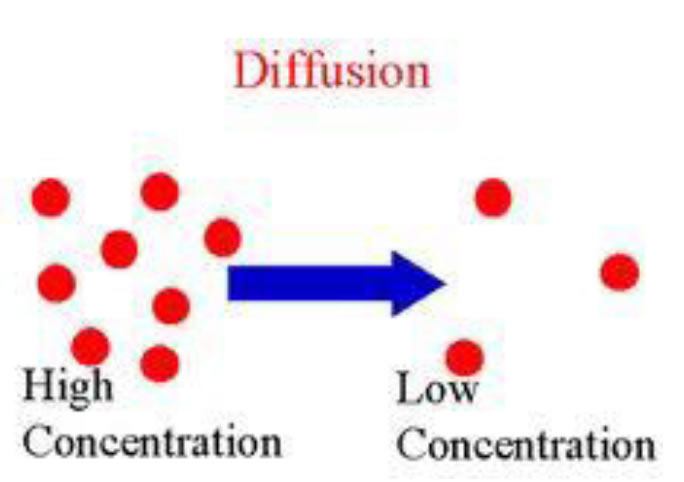
Movement of particles from high to low concentration.
a)
Passive Transport
b)
Active Transport
47.
Osmosis is a form of ______________.
a)
Passive Transport
b)
Active Transport
48.
Solutes move with the concentration gradient, therefore no energy is used.
a)
Passive Transport
b)
Active Transport
49.

a)
Passive Transport
b)
Active Transport
50.
Exocytosis
a)
Passive Transport
b)
Active Transport
51.
Endocytosis
a)
Passive Transport
b)
Active Transport
52.
Low to High
a)
Passive Transport
b)
Active Transport
53.
Solutes move against the concentration gradient, therefore energy is needed.
a)
Passive Transport
b)
Active Transport
54.
This takes substances into a cell
a)
endocytosis
b)
exocytosis
c)
both
55.
What is it called when molecules move across the cell membrane from an area of high concentration to an area of low concentration through a carrier protein?
a)
Diffusion
b)
Osmosis
c)
Active Transport
d)
Facilitated Diffusion
56.
How does a cell maintain homeostasis?
a)
Regulates what enters and leaves the cell
b)
Flexibility
c)
Protective barrier
d)
Structure and support
57.
Another term for equilibrium is...
a)
Not enough
b)
Too little
c)
Homeostasis
d)
Too much
58.
The cell membrane is selectively permeable, which means...
a)
All materials can enter and leave the cell
b)
Certain things can enter while others cannot
c)
The cell manually sorts through all materials
d)
Only certain cells can interact with the cell.
59.
A cell will _____________________ in a hypertonic solution.
a)
swell
b)
shrink
c)
will not change
d)
will explode
60.
A cell will __________________ in a hypotonic solution.
a)
swell and perhaps burst (lyse)
b)
shrink
c)
the size of the cell will not change
d)
the size of the cell will change from large to small and from small to large
61.
Osmosis is the movement of _____ across a membrane.
a)
food
b)
energy
c)
oxygen
d)
water
62.

The cell below is in a _________ solution.
a)
Hypotonic
b)
Hypertonic
c)
Isotonic
63.

The cell below is in a _____________ solution.
a)
Hypertonic
b)
Hypotonic
c)
Isotonic
64.
A cell in an isotonic solution will
a)
swell
b)
shrink
c)
stay the same size
d)
impossible to tell
65.
When a cell is placed in a hypertonic (more concentrated) solution water
a)
moves from the inside of the cell to the solution
b)
moves from the solution to the inside of the cell
c)
moves equally in and out of the cell
d)
none of these
66.
When a cell is placed in a hypotonic solution (less concentrated), water
a)
moves from the inside of the cell to the solution
b)
moves from the solution to the inside of the cell
c)
moves equally in and out of the cell
d)
none of these
67.
During pinocytosis, the cell takes in liquids.
a)
True
b)
False
68.
This type of endocytosis is used by the cell to take in large molecules or tiny organisms.
a)
Pinocytosis
b)
Protein pumps
c)
Phagocytosis
d)
Exocytosis
69.
If there is too much salt in your cells...
a)
you need more water
b)
you need to lose water
70.
What organelle does cellular respiration take place in?
a)
Ribosome
b)
Mitochondria
c)
Nucleus
d)
Golgi
71.
The main purpose of Cellular Respiration is to
a)
make carbon dioxide
b)
make water
c)
make glucose
d)
make ATP
72.
Which of these correctly lists the reactants of cellular respiration?
a)
glucose and oxygen
b)
carbon dioxide and water
c)
ATP and carbon dioxide
d)
water and glucose
73.
Aerobic respiration requires...
a)
spandex
b)
oxygen
c)
no oxygen
d)
a cell without mitochondria
74.
Which cell process is represented by this equation:
C6H12O6 + 6O2 → 6CO2 + 6H2O + ATP
C6H12O6 + 6O2 → 6CO2 + 6H2O + ATP
a)
diffusion
b)
photosynthesis
c)
cell respiration
d)
mitosis
75.
What is an autotroph?
a)
an organism that can make their own food.
b)
an organism that cannot make their own food
c)
Herbivore
d)
Omnivore
76.
What gas is needed for respiration?
a)
Carbon dioxide
b)
nitrogen
c)
Oxygen
d)
hydrogen
77.
The mitochondria is responsible for ...
a)
photosynthesis
b)
anaerobic respiration
c)
aerobic respiration
d)
fermentation
78.
______________ produces the most ATP.
a)
photosnthesis
b)
aerobic respiration
c)
anaerobic respiration
d)
glycolysis
79.
In which way are photosynthesis and cellular respiration different?
a)
Cellular respiration stores ATP, while photosynthesis releases ATP.
b)
Cellular respiration produces oxygen, while photosynthesis uses oxygen.
c)
Photosynthesis releases energy, while cellular respiration stores energy.
d)
Photosynthesis used carbon dioxide, while cellular respiration produces carbon dioxide.
80.
Anaerobic respiration.....
a)
doesn't require CO2
b)
requires CO2
c)
doesn't require oxygen
d)
requires oxygen
81.
Which type of respiration is most efficient?
a)
Aerobic
b)
Anaerobic
82.
What happens to your breathing rate when you exercise?
a)
It increases
b)
It decreases
c)
It stays the same
83.
The reactants of photosynthesis are
a)
sugar and water.
b)
sugar and oxygen.
c)
carbon dioxide and water.
d)
carbon dioxide and oxygen.
84.
Lactic acid fermentation occurs in your muscles after a workout because your cells are struggling to get...
a)
Glucose
b)
Sunlight
c)
Oxygen
d)
Water
85.
Which of the following would increase the rate of photosynthesis?
a)
Increased Oxygen supply
b)
Decreased water supply
c)
Decrease oxygen supply
d)
Increased light energy
86.
What is the purpose of photosynthesis?
a)
Provide plants with energy
b)
Produce oxygen
c)
Produce glucose
d)
Give us something to talk about in biology
87.
What is the energy needed to start a chemical reaction?
a)
start up energy
b)
activation energy
c)
release energy
88.
what are the tiny holes where gases enter and leave during photosynthesis
a)
guard cells
b)
stomata
c)
chloroplasts
89.
Energy is released from ATP when
a)
a phosphate group is added
b)
adenine bonds to ribose
c)
ATP is exposed to sunlight
d)
a phosphate group is removed
90.
Where does glycolysis occur?
a)
mitochondrial matrix
b)
cytoplasm
c)
inner membrane of mitochondria
d)
outer membrane of mitochondria
91.
What pigment absorbs sunlight for photosynthesis?
a)
chloroplast
b)
thylakoid
c)
grana
d)
chlorophyll
92.
Most plants appear green because chlorophyll
a)
absorbs green light.
b)
absorbs violet light.
c)
does not absorb green light.
d)
does not absorb violet light.
93.
Where does the first process in photosynthesis take place?
a)
Stroma
b)
Thylakoids
c)
Calvin Cycle
d)
Dark Reactions
94.
What type of fermentation occurs in your muscles when you run very fast?
a)
Alcoholic fermentation
b)
Oat fermentation
c)
Yeast fermentation
d)
Lactic Acid fermentation
95.
Humans have ________ pairs of chromosomes.
a)
21
b)
23
c)
46
d)
None of the above
96.
The individual strands on duplicated chromosomes are called_____________
a)
Centromeres
b)
daughters
c)
Chromatids
d)
Karyotypes
97.
Uncontrollable cell growth is known as _____
a)
obesity
b)
cancer
c)
diabetes
d)
hepatitis
98.
The ___________ holds the replicated sister chromatids together.
a)
centriole
b)
chromosomes
c)
centromere
d)
cycles
99.
The cell spends most of it's life in ________________.
a)
mitosis
b)
cytokinesis
c)
Interphase
d)
None of the above
100.
In the S stage of interphase_______________
a)
the cell grows
b)
the nucleus divides
c)
the cell membrane divides
d)
the DNA is replicated
101.

The structure labeled A is a(n)
a)
chromatid
b)
centriole
c)
centromere
d)
chromophere
102.

The structures labeled B are
a)
centrioles
b)
chromatids
c)
centromeres
d)
chromopheres
103.
A human cell has 46 chromosomes before mitotic division. How many chromosomes will the daughter cells after mitosis.
a)
12
b)
23
c)
46
d)
92
104.
During what phase of the cell cycle does the cell grow?
a)
G1 phase
b)
S phase
c)
M phase
d)
Cytokinesis
105.
During what phase of the cell cycle does the cell prepare for mitosis?
a)
G1 phase
b)
S phase
c)
G2 phase
d)
M phase
106.
How many stages are in mitosis?
a)
1
b)
2
c)
3
d)
4
107.
Put the following stages of mitosis in order: anaphase, prophase, metaphase, and telophase.
a)
prophase, metaphase, telophase, anaphase
b)
prophase, anaphase, metaphase, telophase
c)
prophase, metaphase, anaphase, telophase
d)
prophase, telophase, metaphase, anaphase
108.
Put the following actions in order: DNA replicates, cell grows, cell divides, cell prepares for mitosis.
a)
DNA replicates, cell grows, cell prepares for mitosis, cell divides
b)
cell grows, cell prepares for mitosis, DNA replicates, cell divides
c)
cell grows, DNA replicates, cell prepares for mitosis, cell divides
d)
DNA replicates, cell prepares for mitosis, cell grows, cell divides
109.
Two Nuclear membranes form around chromosomes and begins to separate.
a)
Anaphase
b)
Telophase
110.
The phase in mitosis where chromosomes move away and are pulled apart by spindles to opposite sides of the cell.
a)
prophase
b)
anaphase
c)
metaphase
d)
telephase
111.

In mitosis, the two resulting cells are
a)
different from the starting cell and identical to each other.
b)
different from the starting cell and different from each other.
c)
identical to the starting cell and different from each other.
d)
identical to the starting cell and identical to each other.
112.

The dark "spider" looking things on opposite sides of the cell are called "Spindle Fibers". What is their job?
a)
Eating the chromosomes
b)
Pulling the chromosomes apart
c)
Putting the chromosomes together
113.
When cells divide they make two ____ cells.
a)
daughter
b)
son
c)
Mom
d)
Dad
114.
The cells produced via meiosis are called:
a)
sex cells
b)
somatic cells
c)
body cells
d)
skin cells
115.
What is it called when a sperm and egg meet?
a)
meiosis
b)
fertilization
c)
cell division
d)
mitosis
116.

Meiosis makes sperm and egg cells. In humans, sperm and egg cells each have _____ chromosomes. Therefore a fertilized human egg cell (sperm and egg cell combined) would create a cell with _____ chromosomes.
a)
23, 46
b)
46, 23
c)
2, 4
d)
50, 100
117.
What causes genetic variation in meiosis?
a)
chromosomes lining up
b)
crossing over of chromosomes
c)
separation of chromosomes
d)
chromosomes pulling apart
118.
Unlike mitosis, meiosis in male mammals results in the formation of
a)
one haploid gamete
b)
three diploid gametes
c)
four diploid gametes
d)
four haploid gametes
119.
The chromosomes that pair up during meiosis, are called __________ chromosomes.
a)
homozygous
b)
asexual
c)
homologous
d)
genes
120.
When homologous chromosomes match up, they form a structure call a ___________.
a)
tetrad
b)
triad
c)
diploid
d)
gamete
121.
Crossing over helps promote
a)
male genotype
b)
genetic variation
c)
DNA replication
d)
mitosis
122.

According to the chromosome theory of inheritance, what are carried from parents to their offspring on chromosomes?
a)
Genes
b)
Spindle Fibers
c)
Centrioles
d)
Cytoplasm
123.
Sperm and egg cells are an example of what?
a)
gametes
b)
chromosomes
c)
meiosis
d)
stages
124.
Which of the following units are repeatedly joined together to form a strand of DNA?
a)
amino acids
b)
nucleotides
c)
fatty acids
d)
polysaccharides
125.
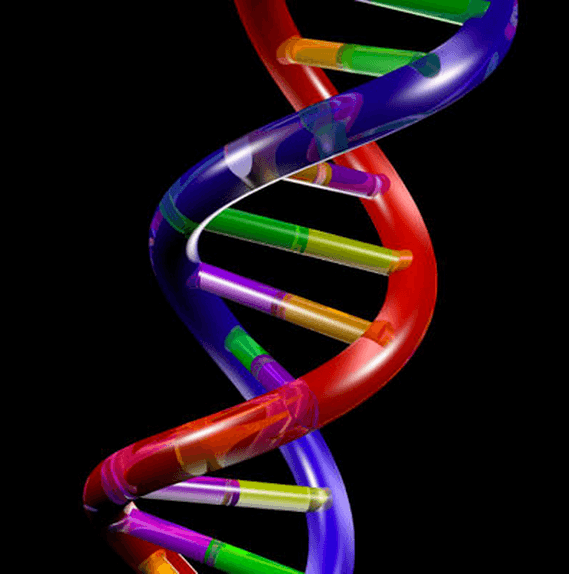
What determines the code, or information, of a DNA molecule?
a)
the shape (structure) of the nitrogen bases
b)
the order (sequence) of the nitrogen bases
c)
the color of the nitrogen bases
d)
the frequency (number) of nitrogen bases
126.
Which 2 molecules form the sides (backbone) of the DNA ladder?
a)
deoxyribose sugar and adenine
b)
deoxyribose sugar and a hydrogen bond
c)
deoxyribose sugar and the nucleus
d)
deoxyribose sugar and phosphate
127.
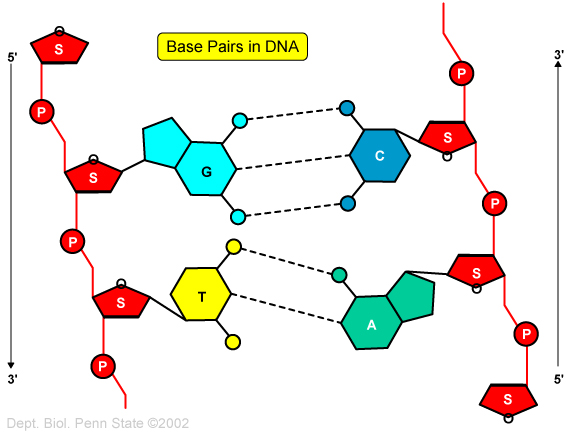
Nitrogenous bases are joined by which type of bond?
a)
polar bonds
b)
ionic bonds
c)
covalent bonds
d)
hydrogen bonds
128.
The enzyme that unzips the DNA to prepare for replication
a)
helicase
b)
replicase
c)
polymerase
d)
synthase
129.
DNA replication results in two DNA molecules,
a)
each one with two original strands
b)
each one with two new strands
c)
each one with one new strand and one original strand
d)
one with two new strands and the other with two original strands
130.

order of replication
a)
3, 2, 1, 4
b)
2, 1, 4, 3
c)
2, 3, 1, 4
d)
3, 4, 1, 2
131.
Where does protein synthesis take place?
a)
Ligase
b)
Ribosomes
c)
Codon
d)
Endoplasmic Reticulum
132.
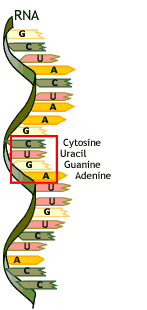
In RNA, Uracil pairs with ______.
a)
cytosine
b)
adenine
c)
guanine
d)
thymine
133.
DNA holds the code for
a)
lipids
b)
carbohydrates
c)
protein
d)
sugar
134.
Does the order of amino acids in a protein matter?
a)
YES!
b)
NO!
135.
What type of mutation occurs, when a base is subtracted from the sequence?
a)
Deletion
b)
Insertion
c)
Substitution
136.
Which process is used to make mRNA from the DNA in the nucleus?
a)
transcription
b)
translation
c)
replication
137.
Which RNA bases would pair with TACGAA in transcription?
a)
AUGCUU
b)
ATGCTT
c)
GCATCC
d)
GCAUCC
138.

The process represented in the diagram produces a molecule that is complementary to the template strand of DNA. What type of molecule is produced?
a)
New DNA
b)
Polypeptide
c)
Messenger RNA
d)
Carbohydrate
139.
what does mRNA do?
a)
carry info from genes to ribosomes
b)
carry amino acids to ribosomes
c)
help with RNA splicing
d)
make up ribosomes
140.
Where does transcription take place?
a)
nucleus
b)
ribosome
c)
cytoplasm
d)
smooth ER
141.
Which of the following best represents the “Central Dogma of Molecular Biology
a)
DNA → RNA → Proteins
b)
DNA → Proteins → RNA
c)
Proteins → RNA → DNA
142.
A mutation which occurs from the addition of a base pair in the DNA sequence
a)
Insertion
b)
Deletion
c)
Substitution
143.
How can a person's muscle cells have the same exact DNA sequences as their nerve cells even though the look and perform completely different?
a)
The two different cells become mutated
b)
The proteins expressed in each cell are different
c)
They actually have different DNA in the two types of cells.
d)
The genome of the different cells changes
144.
How many nucleotides make up a codon?
a)
1
b)
2
c)
3
d)
4
145.
What is the name of this: DNA --> RNA?
a)
transcription
b)
replication
c)
translation
d)
none of these
146.
What is the name for this RNA --> proteins?
a)
translation
b)
transcription
c)
replication
d)
none of these
147.
what does mRNA do?
a)
carry info from nucleus to ribosomes
b)
carry amino acids to ribosomes
c)
help with RNA splicing
d)
make up ribosomes
148.
The five carbon sugar found in RNA
a)
Ribose
b)
Deoxyribose
c)
Glucose
149.
In mRNA, each codon specifies a particular
a)
nucleotide
b)
amino acid
c)
purine
d)
pyrimidine
150.
Some events that take place during the synthesis of a specific protein are listed below.
(A) mRNA attaches to a ribosome.
(B) DNA serves as a template for mRNA production.
(C) tRNA bonds to a specific codon.
(D) Amino acids are bonded together.
(E) mRNA moves from the nucleus to the cytoplasm.
The correct order of these events is _________?
(A) mRNA attaches to a ribosome.
(B) DNA serves as a template for mRNA production.
(C) tRNA bonds to a specific codon.
(D) Amino acids are bonded together.
(E) mRNA moves from the nucleus to the cytoplasm.
The correct order of these events is _________?
a)
B E A C D
b)
B C A C D
c)
D A E C B
d)
C B A E D
100 %

