wayground logo

Free Printable Worksheets

Font size

S
M
L
XL
Worksheets

UT2 Review

Total questions: 138

Worksheet time: 2hrs 23mins

Name
Class
Date
1.
What happens in the first part of Interphase?
a)
Mitosis
b)
Cell Growth
c)
DNA Replication
d)
Anaphase
2.
What part of the cell cycle results in the splitting of the new cells?
a)
Interphase
b)
Mitosis
c)
Metaphase
d)
Cytokinesis
3.
What does DNA Replication mean?
a)
DNA is made.
b)
DNA makes new cells. 
c)
DNA copies itself.
d)
DNA starts the cell cycle.
4.
What phase is this cell in?
a)
Cytokinesis
b)
Mitosis
c)
Prophase
d)
Metaphase
5.
What phase is this cell in?
a)
Mitosis
b)
Interphase
c)
Anaphase
d)
Telophase
6.
What phase is this cell in?
a)
Mitosis
b)
Cytokinesis
c)
Prophase
d)
Telophase
7.
What phase is this cell in?
a)
Mitosis
b)
Interphase
c)
Prophase
d)
Telophase
8.
What part of the cell cycle is this cell in?
a)
Mitosis
b)
Interphase
c)
Telophase
d)
Cytokinesis
9.
What is the longest phase in MITOSIS?
a)
Prophase
b)
Metaphase
c)
Interphase
d)
Anaphase
10.
In what phase do the chromosomes line up in the middle of the cell?
a)
Cytokinesis
b)
Metaphase
c)
Prophase
d)
Telophase
11.
In what phase does chromatin condense to form chromosomes?
a)
Mitosis
b)
Interphase
c)
Prophase
d)
Anaphase
12.
In what phase do the chromosomes get pulled apart into sister chromatid to opposite sides of the cell?
a)
Prophase
b)
Interphase
c)
Metaphase
d)
Anaphase
13.
In what phase do the organelles disperse out into the daughter cells, and the cell prepares for cytokinesis?
a)
Prophase
b)
Interphase
c)
Mitosis
d)
Telophase
14.
What can the cell cycle also be called?
a)
Cell growth
b)
DNA Replication
c)
Preparation for Mitosis
d)
Cell Divison
15.
Cells spend the majority of their lives in
a)
Interphase
b)
Mitosis
c)
Synthesis 
d)
Gap 2
16.

Cells of organisms must go through cell division for?

a)

growth

b)

repair of damaged cells

c)

replacement of dying cells.

d)

All of these

17.

DNA is replicated during ______ of the cell cycle.

a)

Gap 1

b)

Synthesis (S phase)

c)

Gap 2

d)

Gap 0

18.
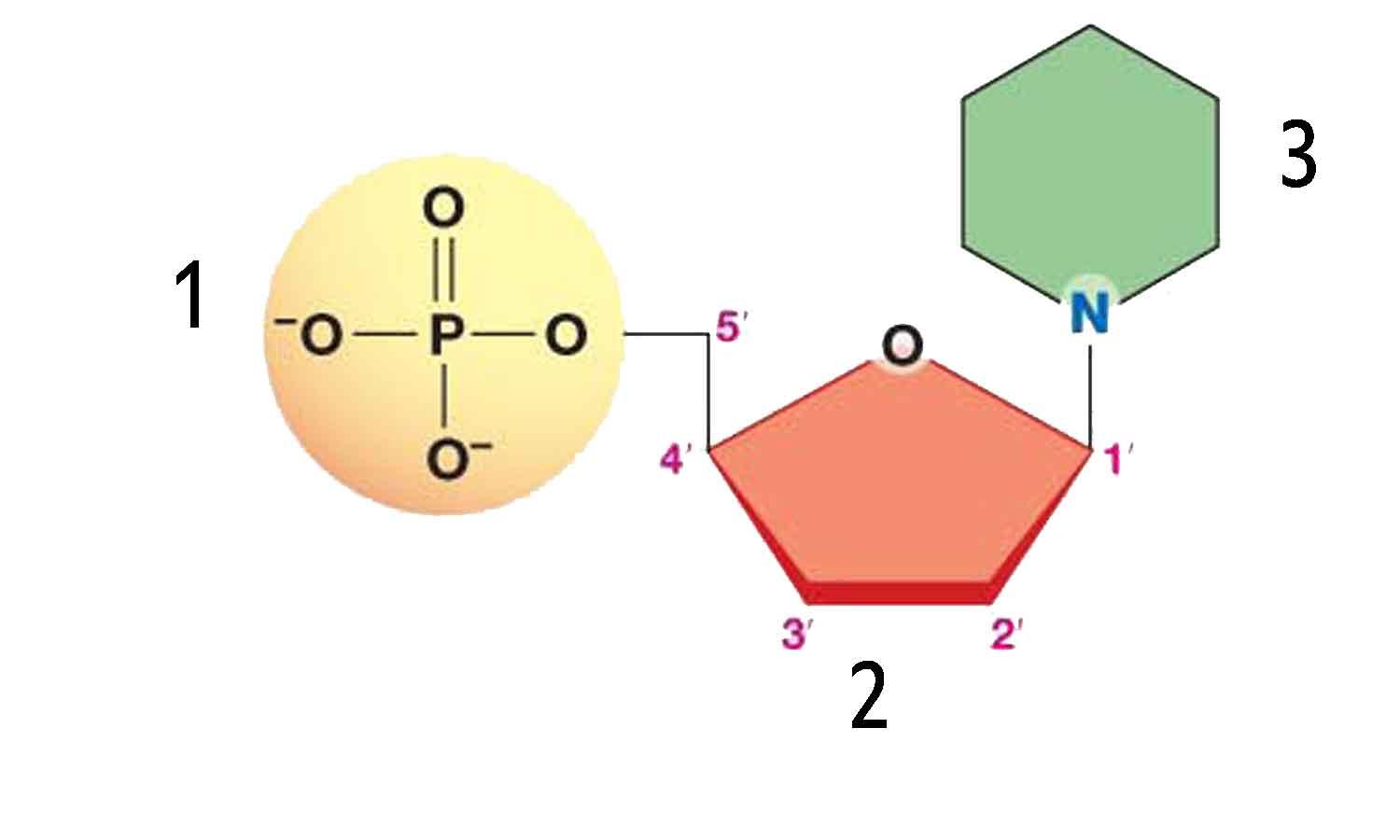
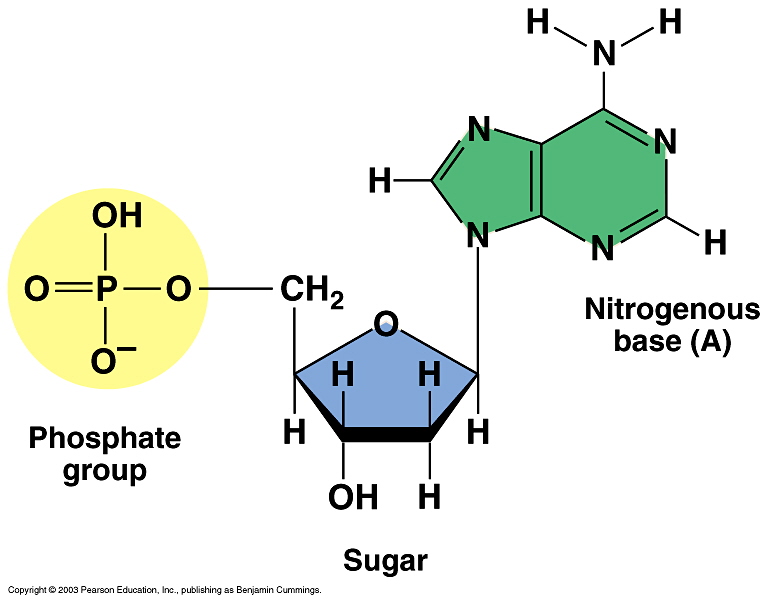
Identify the parts of the nucleotide shown:
a)
1) Ribose Sugar      2) Phosphate 
3)  Nitrogen Base
b)
1) Deoxyribose Sugar
2) Phosphate
3) Nitrogen Base
c)
1) Phosphate
2) Ribose Sugar
3) Nitrogen Base
d)
1)  Phosphate
2) Deoxyribose Sugar
3)  Nitrogen Base
19.
What occurs during G1?
a)
Checkpoint after S phase
b)
Chromosomes line up at the equator.
c)
The cell grows and develops.
d)
Spindle fibers separate chromosomes to opposite poles of the cell. 
20.

When cells go through mitosis repeatedly without entering interphase, this results

a)

arthritis

b)

cancer

c)

mutation

d)

diabetes

21.
Which statement is true about the cell cycle?
a)
It requires carbon dioxide
b)
Eukaryotes do it
c)
It is only for epidermal cells
d)
It is how the body produces sperm
22.
Neuron cells, like the one pictured, rarely replicate. Therefore, we consider them to be in the _____ phase.
a)
G0
b)
G1
c)
S
d)
Delay
23.
At the end of the G1 phase, there's a checkpoint. What is this checkpoint probably checking for?
a)
To see if the cell has grown enough
b)
To see if the DNA was correctly replicated
c)
To make sure the cell does not have cancer
d)
To make sure that the enzymes aren't amalyzed
24.
What stage of the cell cycle follows S phase?
a)
G1
b)
G2
c)
M
d)
Cytokinesis
25.
After mitosis and cytokineses, one cell becomes...
a)
Two identical cells
b)
Two genetically different cells
c)
Four identical cells
d)
Four genetically different cells
26.

Cells need to produce new cells in order to...

a)

replace cells that have died.

b)

create new chromosomes.

c)

obtain energy from sunlight.

d)

release energy from food.

27.
What is the correct order of the stages of mitosis? 
a)
Metaphase, prophase, telophase, anaphase 
b)
Telophase, prophase,  anaphase metaphase, 
c)
Prophase, metaphase, anaphase, telophase
d)
Anaphase,  telophase, metaphase, prophase
28.
What is shown in this picture? 
a)
Chromosome
b)
A single chromatid
c)
Chromatin
29.
Which is Metaphase?
a)
A
b)
E
c)
C
d)
F
30.
Put the following stages of mitosis in order: anaphase, prophase, metaphase, and telophase. 
a)
prophase, metaphase, telophase, anaphase
b)
prophase, anaphase, metaphase, telophase
c)
prophase, metaphase, anaphase, telophase
d)
prophase, telophase, metaphase, anaphase
31.
Put the following actions in order: DNA replicates, cell grows, cell divides, cell prepares for mitosis. 
a)
DNA replicates, cell grows, cell prepares for mitosis, cell divides
b)
cell grows, cell prepares for mitosis, DNA replicates, cell divides
c)
cell grows, DNA replicates, cell prepares for mitosis, cell divides
d)
DNA replicates, cell prepares for mitosis, cell grows, cell divides
32.
Uncontrollable cell growth is known as _____
a)
obesity
b)
cancer
c)
diabetes
d)
hepatitis
33.

Select ALL stages of Interphase

a)

G1

b)

S

c)

G2

d)

Mitosis

34.

In which stage of the cell cycle does the cell grow in size?

a)

G1

b)

S

c)

G2

d)

Mitosis

35.

In which stage of the cell cycle does the DNA replicate?

a)

G1

b)

S

c)

G2

d)

Mitosis

36.
Place these cells in order of mitosis.
a)
A, B, C, D, E
b)
B, E, D, A, C
c)
C, E, A, D, B
d)
B, D, A, E, C
37.
During which part of the cell cycle does the cell divide?
a)
Interphase
b)
Mitosis
c)
S phase
38.
If the Diploid number of Carrots is 18, the haploid number is
a)
18
b)
9
c)
27
d)
36
39.
Diploid Cells are represented by
a)
2n
b)
n
c)
4n
d)
1/2 n
40.
What kind of cells are made in MEIOSIS?
a)
Haploid cells
b)
Diploid Cells
c)
Skin Cells
d)
Liver Cells
41.
What causes genetic variation in meiosis?
a)
chromosomes lining up
b)
crossing over of chromosomes
c)
separation of chromosomes
d)
chromosomes pulling apart
42.

Where does DNA synthesis happen in eukaryotic cells?

a)

cytoplasm

b)

mitochondria

c)

nucleus

d)

Golgi apparatus

43.
_____________________ carries information for inherited traits.
a)
DNA
b)
FBI
c)
RNA
d)
CBS
44.
A strand of DNA that looks like a twisted ladder is called a _____________________
a)
triple twist
b)
corkscrew
c)
double helix
d)
chain reaction
45.
__________________ is a change in the nucleotide base sequence of DNA.
a)
switch
b)
eraser
c)
creation
d)
mutation
46.
DNA is a polymer made of:
a)
Nucleotides
b)
Ribosomes
c)
Purines
d)
Pyrimidines
47.
Why is DNA important?
a)
it is very small and very complicated
b)
it's in everything
c)
it serves as the blueprint for traits of all living things
d)
because we eat it every day for energy
48.
In a molecule of double-stranded DNA, the amount of Adenine present is always equal to the amount of
a)
cytosine
b)
guanine
c)
thymine
d)
uracil
49.
Which organelle is DNA usually found in?
a)
cell membrane
b)
vacuole
c)
ribosome
d)
nucleus
50.
Guanine bonds with ______________.
a)
Adenine
b)
Guanine
c)
Cytosine
d)
Thymine
51.
What determines the code, or information, of a DNA molecule?
a)
the shape (structure) of the nitrogen bases
b)
the order (sequence) of the nitrogen bases
c)
the color of the nitrogen bases
d)
the frequency (number) of nitrogen bases
52.
Which 2 molecules form the sides (backbone) of the DNA ladder?
a)
deoxyribose sugar and adenine
b)
deoxyribose sugar and a hydrogen bond
c)
deoxyribose sugar and the nucleus
d)
deoxyribose sugar and phosphate
53.
What will the matching sequence be on a strand that reads AAGCTAT?
a)
AACGATA
b)
TTCGTTA
c)
CCTGATA
d)
TTCGATA
54.
What are the three components of a nucleotide?
a)
sugar, hydrogen, nitrogen base
b)
sugar, oxygen, nitrogen base
c)
sugar, phosphate, nitrogen base
d)
sugar, phosphate, protein
55.
DNA codes for...
a)
bases
b)
proteins
c)
amino acids
d)
phosphates
56.
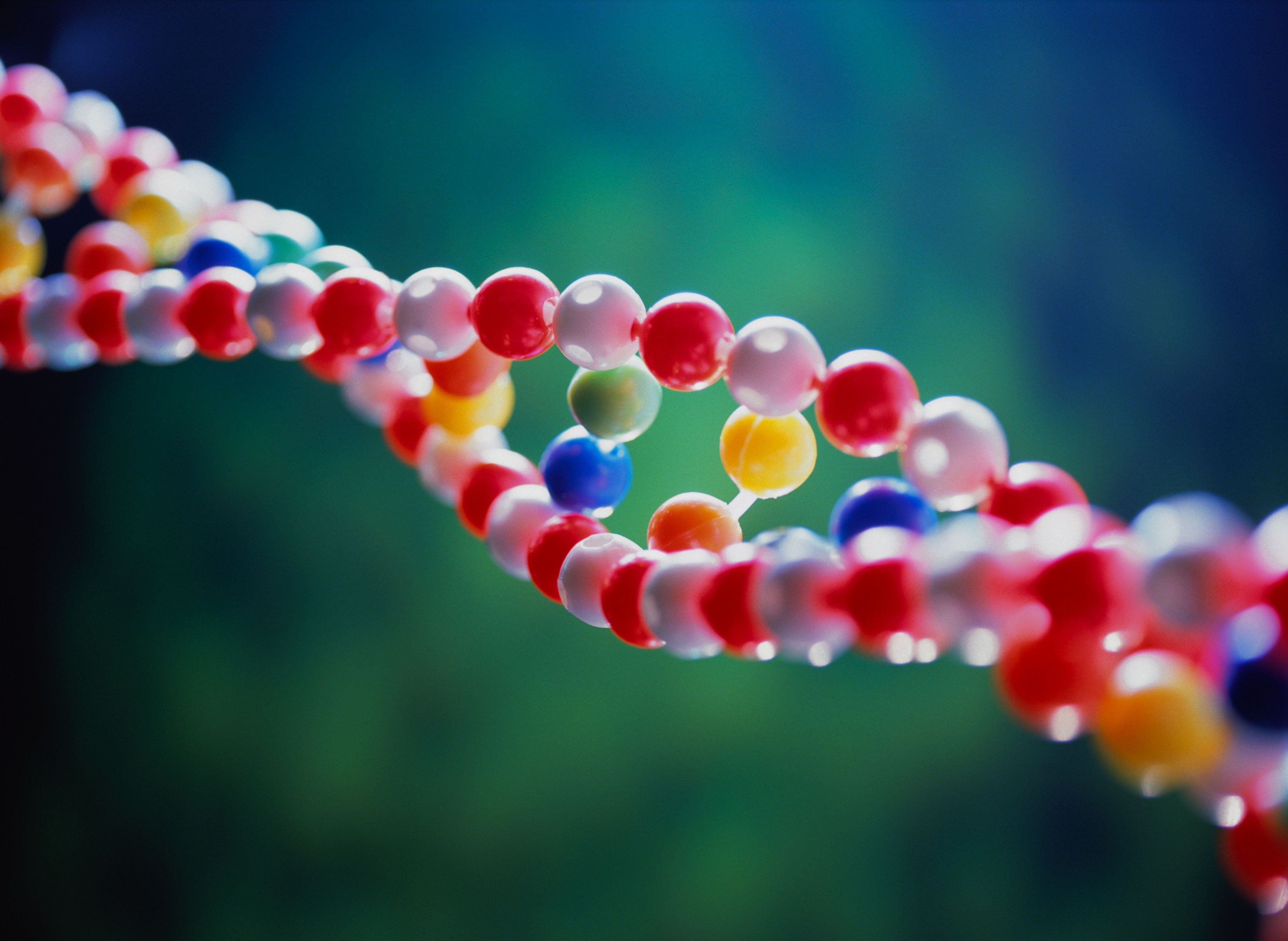
Name this structure
a)
double helix
b)
nucelotide
c)
twisted ladder
d)
hydrogen bond
57.
Which series is arranged in order from largest to smallest in size?
a)
gene, chromosome, nucleus, cell, DNA, nucleotide
b)
cell, nucleus, chromosome, DNA, gene, nucleotide
c)
nucleotide, chromosome, cell, DNA, nucleus
d)
cell, DNA, gene, nucleotide, nucleus, chromosome
58.
Which shows the correct complementary base pairing for DNA?
a)
C-A, T-G
b)
A-G, C-T
c)
C-G, U-A
d)
T-A, G-C
59.
What does DNA stand for?
a)
Deoxyribonucleic acid
b)
Denitrogenous acid
c)
Deribonucleic acid
d)
Diribonucleic acid
60.
The sugar in DNA is ?
a)
sucrose
b)
glucose
c)
deoxyribose
d)
fructose
61.
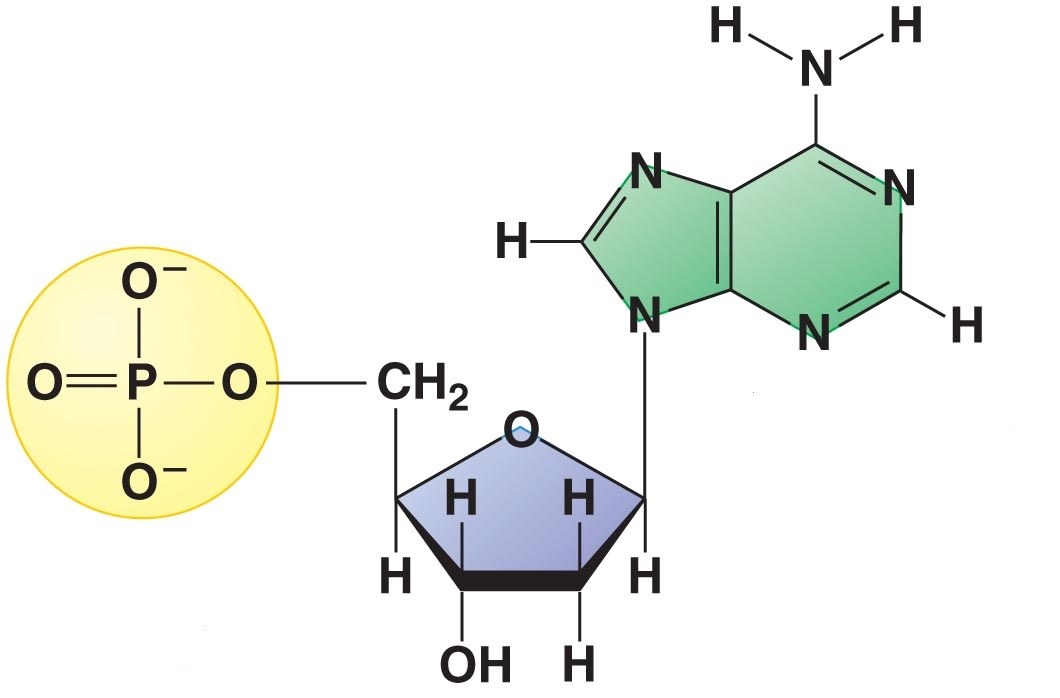
Identify #2.
a)
nitrogen base
b)
phosphate group
c)
deoxyribose sugar
d)
nucleotide
62.
X outlines a(n) ___________.
a)
amino acid
b)
nitrogen base 
c)
nucleotide
d)
nitrogen base pair
63.
A long chain of amino acids is a/an
a)
protein
b)
nucleic acid
c)
tRNA
d)
mRNA
64.
If we think of DNA as a ladder, which parts are the sides of the ladder?
a)
the nitrogenous base pairs
b)
the phosphate-sugar backbone
c)
the genes
d)
the phospholipid bilayer
65.
Nitrogenous bases are joined by which type of bond?
a)
polar bonds
b)
ionic bonds
c)
covalent bonds
d)
hydrogen bonds
66.
What is it called when a sperm and egg meet?
a)
meiosis
b)
fertilization
c)
cell division
d)
mitosis
67.
Which process and type of resulting cells are represented?
a)
mitosis, gametes
b)
mitosis, body cells
c)
meiosis, gametes
d)
meiosis, body cells
68.
A male shark has 40 chromosomes in each of its sex cells. How many would be present in its body cells?
a)
20
b)
40
c)
80
d)
160
69.
Which letter(s) in the diagram correspond to cells that are haploid? 
a)
A
b)
B
c)
C
d)
A and B
70.
Compared to the number of chromosomes contained in a body cell, how many chromosomes would normally be contained in a gamete?
a)
The same number
b)
One-fourth as many
c)
Twice as many
d)
Half as many
71.
What causes genetic variation in meiosis?
a)
chromosomes lining up
b)
crossing over of chromosomes
c)
separation of chromosomes
d)
chromosomes pulling apart
72.
What is one of the advantages, why is it better to reproduce sexually versus asexually?
a)
survival of the fittest
b)
overproduction
c)
genetic variation
d)
cloning
73.
Females have ____ and males have _____ chromosomes.
a)
XX, XY
b)
XY, XX
c)
XX, XX
d)
XY, XY
74.
The cells produced via meiosis are called:
a)
sex cells
b)
somatic cells
c)
body cells
d)
skin cells
75.
Meiosis makes sperm and egg cells. In humans, sperm and egg cells each have _____ chromosomes. Therefore a fertilized human egg cell (sperm and egg cell combined) would create a cell with _____ chromosomes.
a)
23, 46
b)
46, 23
c)
2, 4
d)
50, 100
76.
The process of crossing over occurs in what phase of meiosis?
a)
anaphase 1
b)
prophase 1
c)
prophase 2
d)
telophase 1
77.
Why do we need meiosis?
a)
To double the number of chromosomes going into sex cells
b)
To halve the number of chromosomes going into sex cells
c)
To triple the number of chromosomes going into sex cells
d)
To not change the number of chromosomes going into sex cells
78.

The products of meiosis are genetically...

a)

different.

b)

identical.

79.

Identify a purpose of mitosis. Select all that apply.

a)

Produce gametes for reproduction.

b)

Repair damaged or dead cells.

c)

Reduce the chromosome number.

d)

Growth of organisms from birth to adulthood.
80.

Identify a purpose of meiosis. Select all that apply.

a)

Produce gametes for reproduction.

b)

Repair damaged or dead cells.

c)

Reduce the chromosome number.

d)

Growth of organisms from birth to adulthood.
81.
Which biomolecule is made of nucleotides and contain you DNA?
a)
Carbohydrate
b)
Lipids
c)
Protein
d)
Nucleic Acid
82.
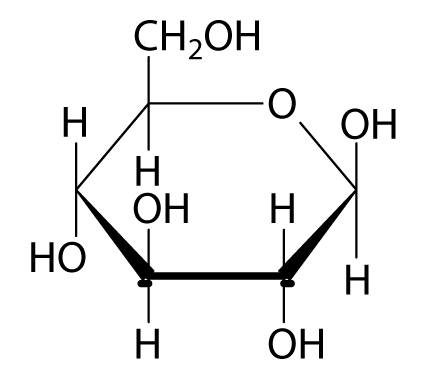
Which biomolecule has sugars and starches?
a)
Lipids
b)
Proteins
c)
Carbohydrates
d)
Nucleic Acid
83.
Which biomolecule functions include enzymes­ which speeds the rate of chemical reactions, structural components in cells, mechanical functions in muscles and cytoskeleton, cell signaling, and immune response; provides structure and helps with chemical reactions 
a)
Protein
b)
Lipids
c)
Carbohydrate
d)
Nucleic Acid
84.
Which biomolecule is important source of energy for humans; glucose for human cells, tissues, and organs; provides fiber, sugar, and starches; provides structural support, cell wall, and cell membrane maker?
a)
Nucleic Acid
b)
Lipid
c)
Carbohydrate
d)
Protein
85.
Which biomolecule includes fats, such as triglycerides, oils, waxes, and steroids (cholesterol); insoluble in water; provides energy storage, insulation, part of cell membrane, and hormones 
a)
Nucleic Acid
b)
Lipids
c)
Carbohydrate
d)
Protein
86.
Identify the biomolecule
a)
Carbohydrate
b)
Lipid
c)
Protein
d)
Nucleic Acid
87.
Identify the biomolecule
a)
Lipid
b)
Protein
c)
Carbohydrate
d)
Nucleic Acid
88.
What is the monomer for a protein?
a)
Monosaccharide
b)
Triglyceride
c)
Amino Acid
d)
Nucleotide
89.
Which biomolecule is responsible for insulation and LONG term energy storage?
a)
Proteins
b)
Nucleic Acids
c)
Lipids
d)
Carbohydrates
90.
Which biomolecule includes sugars and starches? (Hint: simple or complex)
a)
Lipids
b)
Proteins
c)
Carbohydrates
d)
Nucleic Acids
91.
ALL polymers (large molecules) are made up of...
a)
monosaccharides
b)
monomers
c)
proteins
d)
None of these
92.
Which of the following is NOT a biomolecule?
a)
Water
b)
Nucleic Acid
c)
Protein
d)
Lipid
93.
Which 2 molecules contains the elements C-H-O and function pertains to energy?
a)
Lipids and Protein
b)
Carbohydrates and Nucleic Acids
c)
Protein and Carbohydrates
d)
Carbohydrates and Lipids
94.
Which biomolecule is a main source of quick energy?
a)
Nucleic Acid
b)
Protein
c)
Lipid
d)
Carbohydrate
95.

Why are advantageous traits more likely to be passed onto offspring?

a)

Because they are more likely to survive and reproduce.

b)

Because they come from dominant alleles.

c)

Because they come from recessive alleles.

d)

Because the organism knew it needed that trait, survives, and passes it on.

96.

Mutations are a change in what?

a)

DNA

b)

tRNA

c)

protein

d)

rRNA

97.
The differences among a species, like different bird beaks, are called
a)
genes.
b)
variations.
c)
traits.
d)
theories.
98.
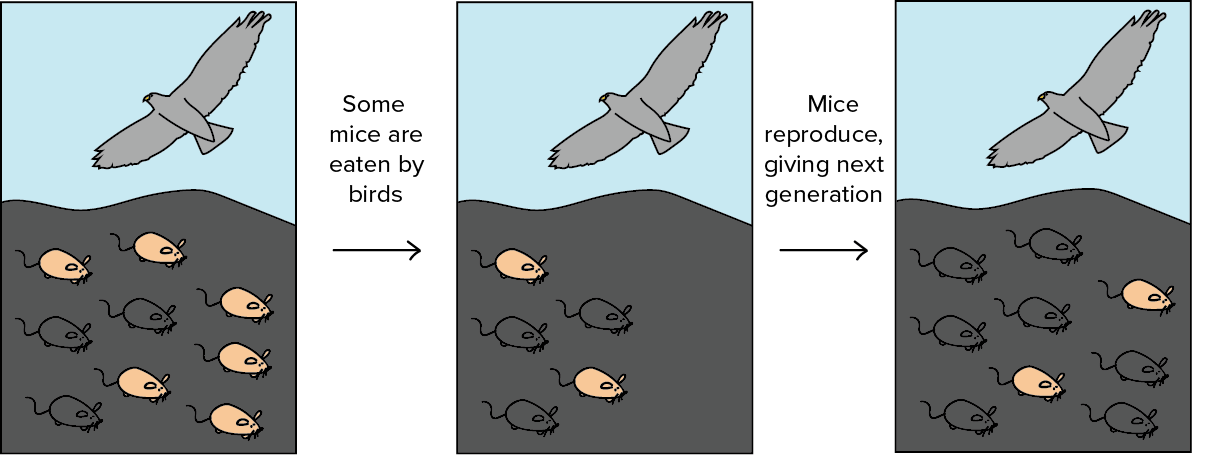
Why is the mouse population changing over time?
a)
The light mice can reproduce more successfully than the dark mice
b)
The hawks eat more dark mice than light mice because the dark mice taste better
c)
The hawks eat more light mice than dark mice because they can see the light mice more easily
d)
The hawks eat more dark mice than light mice because they can see the dark mice more easily
99.
What process is being shown in this image?
a)
Variation
b)
Natural Selection
c)
Selective Breeding
d)
Homeostasis
100.

"Organisms that are better adapted to the environment survive to pass traits to their offspring" is the definition of

a)

Natural Selection

b)

Evolution

c)

Selective Breeding

d)

Artificial Selection

101.

Which best describes the role of mutations in natural selection?

a)

Mutations help an organism to better survive in their environment

b)

An organism may acquire a helpful mutation by interacting with the environment

c)

A mutation may result in a beneficial trait that makes an organism more likely to survive and reproduce

d)

Organisms with certain traits are more likely to win competitions for mutations

102.

The more genetic variation a population has,

the more likely it is for some individuals to

a)

evolve

b)

migrate

c)

survive

d)

mutate

103.
Why do frogs and other organism reproduce so many eggs or offspring?
a)
so that their babies can have friends to play with
b)
the more offspring the more likely the offspring will survive
c)
the more offspring the less likely offspring will survive 
d)
the more offspring the less competition
104.
Do organisms "decide" to evolve and change?
a)
Yes, they know they need to change to survive 
b)
No, they change because of natural selection
105.
Which is not an example of an adaptation?
a)
A bird's beak allows it to crack open hard nuts.
b)
A zebra's stripes allow it to confuse its predators.
c)
A frog's large hind legs allow it to jump from danger.
d)
A cat sleeps on the sofa to avoid the vacuum cleaner.
106.
Any inherited trait that gives an organism an advantage in its environment is called ___.
a)
a mutation
b)
an adaptation
c)
evolution
d)
natural selection
107.
In humans blood type is determined by the A, B, and O alleles. The A and B alleles are codominant to each other and dominant over the O allele. An individual with the AO genotype and an individual with the BO genotype can produce offspring with which of the following phenotypes?
a)
O only
b)
A or B only
c)
A, B, or O only
d)
A, B, AB, or O
108.
A mutation in which types of cells would only affect the organism and not future generations?
a)
Egg cell and liver cell
b)
Sperm cell and egg cell
c)
Nerve cell and brain cell
d)
Sperm cell and lung cell
109.

In cattle the allele for cloven hooves (H) is dominant over the allele for mule-foot hooves (h). The phenotype for each trait is shown in this picture.

a)

0.25

b)

0.5

c)

0.75

d)

1

110.
Which part of a DNA molecule is responsible for the direct coding of specific traits in an organism?
a)
The number of hydrogen bonds that hold the strands of DNA together.
b)
The number of carbons in the DNA molecule.
c)
The sequence of nucleotide bases in the DNA molecule.
d)
The sequences of phosphates along each DNA strand.
111.

A certain mutation in the gene for hemoglobin results in the red blood cells becoming sticky, rigid, and irregularly shaped. These irregularly shaped red blood cells block the flow of blood throughout the body. A single base mutation is responsible for these irregularly shaped blood cells.

a)

Insertion

b)

Deletion

c)

Duplication

d)

Substitution

112.

Facial dimples and free earlobes are both considered dominant human traits. What are the expected phenotypes of the offspring of a female with dimples and free earlobes (DDFf) and a male with no dimples and attached earlobes (ddff)?

a)

50% with dimples and free earlobes and 50% with dimples and attached earlobes

b)

50% with dimples and free earlobes and 50% with no dimples and attached earlobes

c)

75% with dimples and free earlobes and 25% with no dimples and attached earlobes

d)

75% with dimples and attached earlobes and 25% with no dimples and free earlobes

113.

Which of these models of a DNA strand (below) shows bases that are complementary to the ones on the student’s DNA model (above)?

a)
b)
c)
d)
114.

The graphs show the reaction rate for an enzyme across a range of temperatures and pH.


Based on these data, this enzyme functions best at what temperature and pH?

a)

Temperature of 27°C and a pH of 4

b)

Temperature of 37°C and a pH of 6

c)

Temperature of 40°C and a pH of 8

d)

Temperature of 50°C and a pH of 10

115.

The Indian leaf butterfly has traits that allow it to resemble a leaf. The bright colors of the monarch butterfly indicate that the butterfly tastes bad and can be poisonous. How does the appearance of these butterflies help them to survive?

a)

The Indian leaf butterfly is able to avoid predators while the monarch butterfly warns predators away.

b)

The Indian leaf butterfly frightens predators away while the monarch butterfly poisons predators before they can eat it.

c)

Both butterflies rely on camouflage to avoid predation

d)

Both butterflies cooperate with one another to avoid predation.

116.

Scientists can determine relatedness among organisms by comparing partial amino acid sequences. The table shows four partial amino acid sequences from four organisms.


Which organism is the LEAST related to the other three organisms?

a)

Organism 1

b)

Organism 2

c)

Organism 3

d)

Organism 4

117.

What is the role of mRNA in expressing specialized structures?

a)

Making energy available for cellular activities

b)

Creating bonds to form biomolecules

c)

Producing sugars that assist with replication

d)

Providing information to form proteins

118.

The activities in the cell cycle occur during specific phases. In which phase of the cell cycle is DNA replicated?

a)

Mitosis

b)

G phase

c)

G2 phase

d)

S phase

119.

Students are given data from an investigation that identified some of the chemical elements present in four different samples.


Which sample was most likely DNA?

a)

Sample 1

b)

Sample 2

c)

Sample 3

d)

Sample 4

120.

The diagram shows light- and dark-colored beetles that live on a tree.


The diagram shows light- and dark-colored beetles that live on a tree.

a)

The number of light-colored beetles in the population will increase.

b)

There will be more dark-colored beetles than light-colored beetles.

c)

The number of light-colored beetles will decrease.

d)

The dark-colored beetles will move to a different type of tree.

121.

Adaptations that result from natural selection are expected to increase the fitness of an organism. In terms of natural selection, which of the following best describes fitness?

a)

Being able to escape from predators

b)

Being among the strongest organisms in a population

c)

Being able to survive, find a mate, and produce offspring

d)

Being able to survive long enough to reach the adult stage

122.

In the early 1900s, Thomas Hunt Morgan was among the first scientists to contribute to the chromosome theory of heredity. Morgan’s investigations into heredity in fruit flies led him to propose that the event represented in the diagram sometimes occurs


Which statement about the event represented in the diagram is valid?

a)

The event represents RNA translation in the smooth endoplasmic reticulum.

b)

The event takes place in bacterial cells.

c)

The event produces genetically identical daughter cells.

d)

The event provides genetic diversity in eukaryotic cells.

123.

In North American forests, two species of birds, nuthatches and brown creepers, forage on the same trees for insects. Brown creepers feed on insects found near the bottom of the tree trunk, while nuthatches feed on insects in the top part of the tree. The difference in foraging behavior most likely affects the nuthatches and brown creepers by —

a)

allowing the birds to avoid many types of predators

b)

reducing competition between the birds for resources

c)

preventing the birds from interbreeding with each other

d)

establishing dominance between the birds for nesting sites

124.

This model of the cell cycle includes two arrows that each represent a process in the cycle.


What do the two arrows represent?

a)

Arrow 1 represents prophase, and Arrow 2 represents interphase.

b)

Arrow 1 represents mitosis, and Arrow 2 represents meiosis.

c)

Arrow 1 represents interphase, and Arrow 2 represents mitosis.

d)

Arrow 1 represents meiosis, and Arrow 2 represents prophase.

125.

A certain mutation in the gene for hemoglobin results in the red blood cells becoming sticky, rigid, and irregularly shaped. These irregularly shaped red blood cells block the flow of blood throughout the body. A single base mutation is responsible for these irregularly shaped blood cells.


Which of these mutations most likely results in the mutated hemoglobin gene?

a)

Insertion

b)

Deletion

c)

Duplication

d)

Substitution

126.
Genetic variation can aid in the survival of species when the environment changes. Which of the following is the best example of an organism with a genetic variation that could improve survival chances over time?
a)
An ant that is resistant to pesticide
b)
A wasp that is infected with parasites
c)
A cactus that has no spines
d)
A mouse that has learned to avoid mousetraps
127.
Which condition is essential for natural selection to result in a new species?
a)
Unlimited resources
b)
An inherited variation
c)
A static environment
d)
A long life span
128.

Which process and product are represented in the diagram below?

a)

Process transcription; product DNA

b)

Process translation; product tRNA

c)

Process transcription; product mRNA

d)

Process translation; product mRNA

129.

Which process and product are represented in the diagram?

a)

process translation; product mRNA

b)

Process transcription; product protein

c)

Process transcription; product mRNA

d)

Process translation; product protein

130.

What is the product and location of "X" in the diagram?

a)

mRNA in the nucleus

b)

tRNA in the nucleus

c)

mRNA in the cytoplasm

d)

mRNA in the ribosome

131.

RNA contains a nitrogenous base that is different from DNA. What is the name of the nitrogenous base?

a)

Thymine

b)

Uracil

c)

Adenine

d)

Cytosine

e)

Guanine

132.

What is the process called when DNA is made into mRNA.

a)

translation

b)

transcription

c)

transcribe

d)

translate

133.

What type of RNA moves to the ribosome to start protein synthesis?

a)

tRNA

b)

mRNA

c)

rRNA

d)

nRNA

134.

mRNA is read into amino acids during what process?

a)

transcription

b)

transfer

c)

translation

d)

transition

135.

TRANSCRIBE this DNA sequence: TACGTTACT

a)

AUGCAAUGA

b)

ATGCAATGA

c)

AUGGATUGA

d)

TACGTTACT

136.
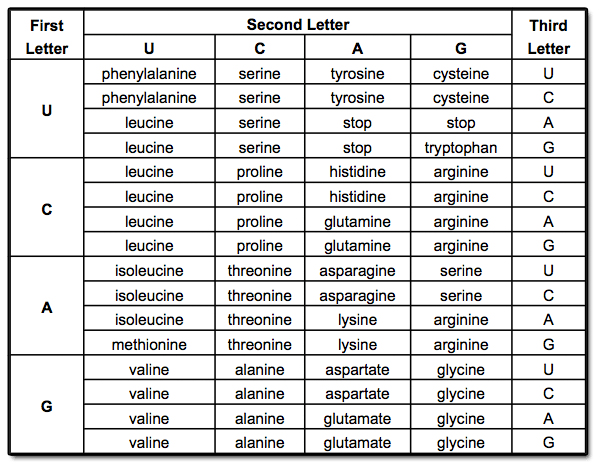
What amino acid is represented by the codon UUA?
a)
Phenylalanine
b)
Tyrosine
c)
Leucine
d)
Stop codon
137.
Transcribe the following sequence of DNA into RNA:
AAG   CTT   TGC
a)
TTC  GAA  ACG
b)
UUC  GAA ACG
c)
TTC  GUU  UCG
d)
UUC  GUU  UCG
138.
What would be the complementary DNA strand for the following nucleotide sequence?
TCG ATA CGA
a)
AGC ATA GCT
b)
AGC TAT GCT
c)
AGC UAU GCU
d)
UGC TUT GCT