
 Worksheets
Biology S2 Study Quiz
Total questions: 134
Worksheet time: 2hrs 41mins


The passing of traits from parents to offspring
genetics
geneology
heredity
allele

The study of heredity is known as
hereditology
genetics
biology
law of heredity
Plants that produce offspring with the same trait are known to be...
cross-pollinated
F1 generation
self-pollinated
true-breeding

Which law of genetics states that factors are seperated?
law of independent assortment
law of segregation
law of Mendel
law of separation
What is an organism's genetic makeup known as?
phenotype
chromosome
DNA
genotype
The physical appearance of the organism is known as the
phenotype
chromosome
nucleictype
genotype
When both alleles of a pair are alike, the organism is said to be
homozygous
heterozygous
homologous
heterologous

This is an example of what?
probability
incomplete dominance
co-dominance
none of the above

What would the genotypes be?
TT, TT, Tt, Tt
TT, Tt, Tt, tt
co-dominance
none of the above


Before the cell divides by mitosis, what process needs to happen to DNA?
transcription
translation
replication
protein synthesis

The process of making mRNA from DNA is called.
replication
transcription
translation
protein synthesis

Where in the cell does transcription take place?
nucleus
ribosome
cytoplasm
smooth ER

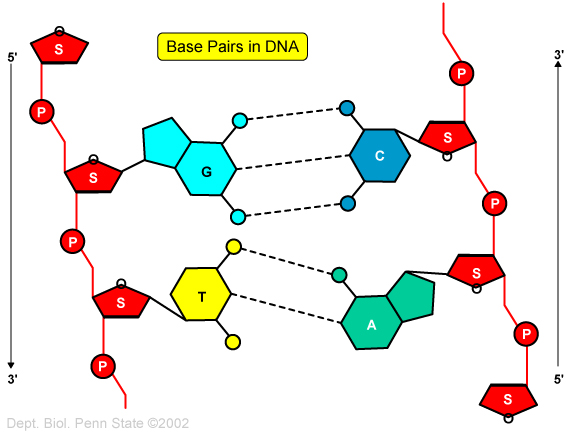
In DNA which is a correct base pairing?
A with G
G with T
A with U
A with T

RNA is different from DNA in what way? (two answers selectable)
RNA is single stranded
RNA has thymine
RNA has the sugar ribose
RNA is found in the nucleus; DNA in the cytoplasm

mRNA stands for
my RNA
messenger RNA
mitosis RNA
mutated RNA

The five carbon sugar found in DNA
ribose
deoxyribose
glucose
dextrose

What are the 3 basic components of a DNA molecule?
Sugar, Base, H2 Bond
Ribose, Base, Phosphate
Deoxyribose, Base, Phosphate
Sugar, Phosphate, Base pair

In a molecule of double-stranded DNA, the amount of adenine present is always equal to the amount of
cytosine
guanine
thymine
uracil

This process is _____
replication
transcription
translation
duplication

This process is _______
transcription
translation
replication
duplication

These 2 scientists won the Nobel prize for determining the structure of DNA.
Watson and Crick
Franklin and Darwin
Einstein and Newton
Degrasse and Tyson

This type of mutation occurs when a nitrogen base is added into a sequence and drastically changes the resulting protein.
point mutation
insertion mutation
deletion mutation
chromosome mutation

The twisted ladder shape of a DNA molecule is referred to as a
extension ladder
twisted helix
single ladder
double helix
In RNA, Adenine pairs up with _____.
uracil
guanine
thymine
cytosine

DNA molecule segment is : TTACGCAAG
The mutated DNA segment is TTCGCAAG. This is an example of ___ mutation.
substitution
deletion
insertion
inversion

What are the building blocks of proteins called?
DNA
RNA
ribosomes
amino Acids

Whom does this X-ray crystolography photo belong to?
Rosey Greer
Dr. Roselind Franklin
Dr. Maurice Wilkins
Watson and Crick
What does a promoter do?
it allows a gene to be transcribed
it creates a DNA segment
it is another word for ribosomes
it is another word for RNA

An illustration of two insects is shown. Which of the paired statements could be used to distinguish the insects, using a dichotomous key?
six legs, eight legs
large hind legs, small hind legs
two pairs of spots on wing cover, three pairs of spots on wing cover
antennae absent, antennae present

A dichotomous key for insects is shown. To what order does an insect with two pairs of scaly wings belong?
Coleoptera
Diptera
Heteroptera
Lepidoptera

An analysis of DNA and RNA sequences can be used to classify organisms. An evolutionary tree, such as the one shown here, is based on molecular data. In theory this represents evolutionary relationships within a group of organisms that are hypothesized to have descended from a common ancestor. Which statement is best supported by the information in this evolutionary tree?
Lesser pandas are more genetically similar to giant pandas than they are to raccoons.
Brown bears are more genetically similar to giant pandas than they are to sun bears.
Lesser pandas are more genetically similar to raccoons than they are to giant pandas.
The bear species are all more genetically similar to dogs than they are to giant pandas.

Theoretically, what does the fossil record show about the history of species of Earth?
Species stay the same over time.
Species evolve from one form to another.
Modern species have no relationship to ancient species.
No species have become extinct in the last 2 million years.
The standardized system for naming organism is known as binomial nomenclature. What two pieces of information are used to name and identify organisms using this system?
genus and species
class and genus
class and species
domain and kingdom
Which naturalist believed that animals that have variation that are not well suited for an environment will not have children and will not pass those variations on to their children?
Lamarck
Darwin
Lyell
Unused structures such as the pelvic bone in whales and snakes and the tailbone in humans are an example of
homologous structures
vestigial structures
analogous structures
Fossils can be found in
amber (the fossilized sap of trees)
moving water
sedimentary rock
fresh dirt
The idea that organisms best suited to their environment reproduce more successfully than other organisms is the definition of
population
natural selection
acquired traits
survival of the weakest

Who organized living things by creating binomial nomenclature?
Carolus Linnaeus
Robert Hooke
Gregor Mendel
Charles Darwin
Which kingdom is autotrophic AND has a cell wall?
bacteria
fungi
plantae
protista

You would find mushrooms in which kingdom?
plantae
protists
fungi
animalia

Members of this kingdom are multicellular and heterotrophic
plantae
protista
animalia
achaebacteria


Which domain contains organisms that are unicellular, prokaryotic, and can cause illness yet also make food such as yogurt.
eukarya
archaea
bacteria

A lion is called Panthera leo. leo is the...
kingdom
phylum
genus
species

A(n) _____ is a virus that enters a bacterial cell.
endospore
decomposer
plasmid
bacteriophage

Nonliving particle that can reproduce within a living cell
endospore
virus
vacuole
nucleus

A virus can be classified by its type of
mitochondria
chromosomes
nucleic acid
carbohydrates

Which of the following is one important difference between a virus and a bacterial cell?
a virus is much larger in size than a bacterial cell
a virus always causes more severe disease than a bacterial cell
a virus can never reproduce on its own, but a bacterial cell can
a virus does not contain genetic material, but a bacterial cell does


Archeabacteria...
are eukaryotic
live in extreme environments
are non-living
live in the soil


All protists are __________________________.
prokaryotic
eukaryotic
unicellular
multicellular

The image shows a paramecium. What structure is utilized by the paramecium for movement?
cilia
flagella
pseudopods
pili

Which of the following would be examples of fungi-like protists?
slime molds & water molds
euglena & algae
amoeba & paramecium
stentor & diatoms

Which protist organelle, seen in the image of a paramecium, removes excess water from the organism/cell?
contractile vacuole
macronucleus
cilia
food vacuole

What is the function of the eyespot, seen in the diagram of a euglena?
detects light
removes excess water
movement
photosynthesis
Which protist makes up between 50% and 80% of the world's oxygen?


Which protist causes malaria?
water mold
amoeba
plasmodium
algae

How do phylum ciliophora move?
they have hairlike projections to propel them
they have pseudopods (false feet)
they have no special structures for
they move using flagella

How do the phylum mastigophora move?
using flagella
using pseudopods (false feet)
using hairlike projections
mastigophora never move

These are the largest colonies of algae, with some species growing over 100 feet long and having air bladders.
red tuna moss
kelp
agar
fire algae

This mastigophora, Trypanosomes, is parasitic and transmitted by Tetse flies, causing this disease in humans.
Leprosy
Malaria
African sleeping sickness
Dengue fever

Which protists are autotrophic?
euglena and volvox
amoeba and euglena
volvox and amoeba
paramecium only

Which protists are heterotrophic?
amoeba and volvox
euglena and paramecium
paramecium and amoeba
euglena and volvox

If this protist encounters an impact, it triggers a chemical reaction that ends in a burst of light.
dinoflagellate
sarcodine
euglenoid
water mold

What protist is abundant in the warmer regions of the oceans and secrete shells of calcium carbonate (CaCO3)?
heliozoans
amoebas
foraminiferans

The plantlike protists that are the cause of red tides are ____.
red algae
dinoflagellates
brown algae
blue-green algae

Term used for the life cycle of organisms that have a haploid stage followed by a diploid stage.
spore
gametophyte
alternation of generations
fragmentation

The diploid form of an ulva that develops from a zygote and produces spores.
gametophyte
protozoan
sporophyte
ciliate
Which Japanese food is made from algae?
tomato soup
rice cakes
nori for sushi
pudding
What is the reason Algal Blooms happen in the world?
depletion of nutrients
sewage and fertilizer run off
excess sunlight along coastal waters
bacterial growth

Many species of dinoflagellates are luminescent. What causes the sudden burst of light?
volcanic activity on tropical islands
sewage and fertilizer
agitation of sudden movements in the water
fishing coastal waters
A fungus is an organism whose cells have
no nuclei
no cell walls
chlorophyll
chitin
_________________ are fungi that that produce the gas that makes bread rise.
Mushrooms
Athletes' foot
Blue Cheese
Yeast
An antibiotic made from a species of thread-like fungus.
lichen
mold
penicillin
aspirin
How do fungi feed?
Photosynthesis
Saprotrophic nutrition (external digestion)
Decomposers
Consumers (internal digestion)
What is unique about the Cordyceps fungus.
It can control the movement of muscles in its insect prey.
In some people it plays a role in the development of dandruff.
It feeds primarily on nematode worms and can be grown easily in the laboratory.
It grows inside the bodies of newly emerged cicadas and causes their abdomens to fall off.


What is it called when a fungus lives in a mutually beneficial relationship with plant roots?
lichen
mycorrhizae
mycelium
hyphae

Structure A is named as
rhizoid
sporangium
hyphae
septum

This fungi is classified under
Phylum Basidiomycota
Phylum Ascomycota
Phylum Zygomycota
Phylum Protista
Which of the following is matched INCORRECTLY?
Basidiomycota – club fungi
Ascomycota – sac fungi
Ascomycota – yeast
Zygomycota – lichens
Fungi are not classified as plants because
they do not have cell walls
they produce asexual spores
they do not produce flowers
they do not have chlorophyll

