
 Worksheets
DNA, RNA, Protein Synthesis, Mutations
Total questions: 133
Worksheet time: 2hrs 42mins
What is the central dogma of biology?
DNA codes for RNA, which guides enzyme synthesis
DNA codes for RNA, which guides protein synthesis
RNA codes for DNA, which guides protein synthesis
RNA codes for DNA, which guides enzyme synthesis
Which two DNA nucleotides are collectively called purines?
adenine & thyamine
adenine & guanine
thytosine & guanine
thyamine & guanine
What are the three types of RNA?
mRNA
tRNA
sRNA
gRNA
tRNA
rRNA
mRNA
tRNA
rRNA
mRNA
aRNA
gRNA
The process of ___ creates mRNA that is later used for protein synthesis.
synthesis
transcription
translation
transcribe
The process of ___ creates polypeptide chains from codons found on mRNA.
RNA
transcription
DNA
translation

A single strand of nucleotides made by DNA that is used to communicate genetic code outside the nucleus.
RNA
DNA
Ribosomes
Amino acid chain

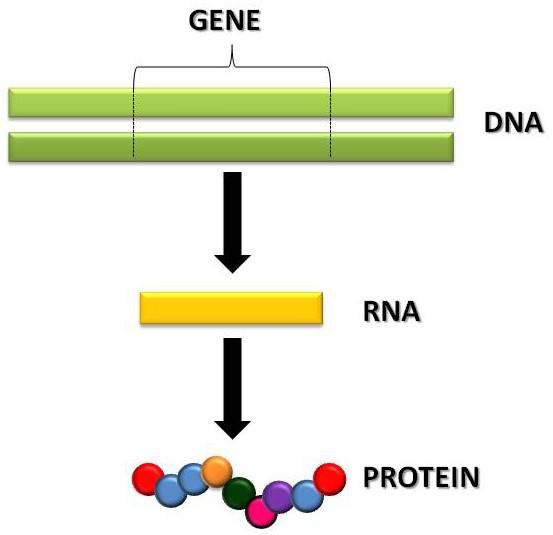
DNA makes RNA → RNA makes proteins →
Proteins make life.
Homeostasis
Mendelian Genetics
Central Dogma
Myocardial Infarction

Double stranded DNA is unzipped, and one strand is used as a template to form Messenger RNA.
Translation
Transcription
Replication
Mitosis

Messenger RNA travels out of the nucleus to ribosomes
and is used as a template to assemble a protein.
Translation
Transcription
Replication
Homeostasis

A single strand of nucleotides coded by DNA
which travels to the ribosomes in the cytoplasm to give instructionsfor building proteins.
tRNA
DNA
mRNA
rRNA

A small section of RNA that transports amino acids
to the ribosome for synthesis into proteins.
tRNA
mRNA
rRNA
DNA

A nucleotide base that takes the place of Thymine in RNA.
Uracil
Thymine
Adenine
uRNA

The enzyme that codes mRNA from DNA instructions.
DNA Polymerase
RNA Polymerase
Helicase
Lipase

A ←→ U
C ←→ G
T → A
Homeostasis
Mitosis
Base Pairing Rules for Replication
Base Pairing Rules for Transcription

The order of the nucleotide bases in DNA or RNA.
Numerical sequence
Amino acid sequence
Base Sequence
Anti codon

Units of 3 nucleotide bases in mRNA which code for a single
amino acid.
Mitosis
Base Pairing
Anti codon
Codon

The reverse codon found on the tRNA.
Codon
Anticodon
Mitosis
Meiosis

A chart that shows the relationship between
codons and the amino acids they code for.
Homeostasis chart
Anticodon
Codon Chart
EKG Chart

Three nucleotide bases that code for the beginning
of a strand of protein.
Uracil
Stop Codon
Anticodon
Start Codon

Three nucleotide bases that code for the end
of a strand of protein.
Anticodon
Start Codon
Stop Codon
tRNA

Most of a ribosome is made of rRNA.
Anticodon
mRNA
tRNA
Ribosomal RNA (rRNA)
It doesn't want RNA to feel left out
Which of the following is NOT a type of point mutation?
Insertiion
Which type(s) of point mutations cause frameshift mutations?
Which comes first?
Translation
Transcription
What is a difference between RNA and DNA?
RNA has Uracil while DNA has Thymine
RNA has 2 stands while DNA has 1
DNA can leave the nucleus while RNA cannot
What is the term for a substitution mutation that does not cause a change to the amino acid sequence in the protein?
Frameshift mutation
Chromosomal mutation
Silent mutation
Loud mutation
What is a section of DNA that codes for a protein called?
Gene
Chromosome
Nucleotide
tRNA
What tRNA anticodon will match up with the following mRNA codon; AUC?
UAG
TAG
UTG
CTA
GAG-CTC-GAC-AGA
Mutant
GAG CTC-CAC-AGA
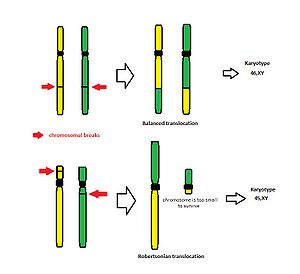
The mutated DNA segment is TTCGCAAG. This is an example of ___ mutation.
Mutation: ATC GCAT
What mutation occurred?

Original DNA: CAT GAT CCA
New DNA: CAT TGA TCC A
What mutation occurred? (one has been added)
deletion
substitution
tranverse
insertion

In RNA the base T is replaced with
U
G
C
A
What combines together to make a protein?
Amino Acid
RNA
Ribosome
DNA
What cell structure is the site of translation?
Nucleus
Ribosome
Mitochondria
Chloroplast

What type of RNA is shown in this image?
rRNA
mRNA
tRNA
GTAGTCA
Which of the following is the site of translation?
vacuole
lysosome
nucleus
ribosome

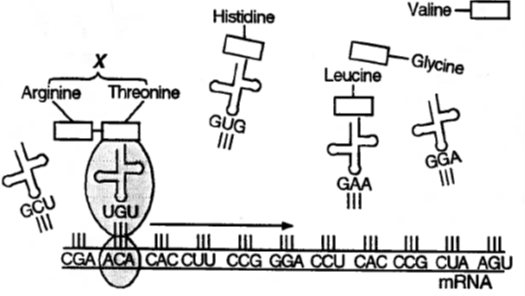
The bottom of the tRNA molecule joins with the mRNA molecule because it has the _________ that complements the _______ on mRNA.
codon, anticodon
anticodon, codon
amino acid, nucleotide
nucleotide, amino acid


Which anticodon would be placed in spot #2
GGC
CCA
GGA
GGT
In DNA replication, if the original sequence reads AATTTGCG, the complementary DNA strand would read?
AAUUUCGC
AATTTGCG
TTAAACGC
UUAAACGC
In which of the following ways does genetic information typically flow in an organism?
trait --> proteins --> RNA --> DNA
RNA --> trait -->protein --> DNA
DNA --> RNA --> protein --> trait
DNA --> protein --> trait--> RNA
What term describes when mRNA is read 3 consecutive letters (bases) at a time and it codes for a single amino acid?
Codon
Anticodon
Polypeptide
Gene
Which choice below correctly summarizes the base-pairing rules in RNA?
A-G
C-T
A-C
T-G
A-U
C-G
A-T
C-G


Which of the following is true regarding the process shown in the image?
The process shown above is known as cloning and involves the production of RNA from protein molecules.
The process shown above is known as replication and involves the production of DNA from RNA.
The process shown above is known as transcription and involves the production of proteins from DNA.
The process shown above is known as translation and involves the production of proteins from RNA.
Which component of the DNA molecule provides instructions for the production of the protein and determines the traits of the organism?
The phosphate group
The sugar molecule
The sequence of nitrogen bases
The hydrogen bonds that hold the sugars to the bases
What is the role of mRNA in expressing specialized structures?
Making energy available for cellular activities
Creating bonds to from biomolecules
Producing sugars that assist with replication
Providing information to form proteins

What is the purpose of the cellular process shown in the image?
Preserving genetic information for future generations
Deleting the information in the sequence produced from the DNA template
Transcribing information in the DNA sequence for use by the cell
Producing more nucleotides for the DNA sequence

If the mRNA codons read ACA-GUA-GAA-UUG-AUC, what amino acids make up the protein sequence?
Cys-Val-Gly-Ser-Stop
Cys-His-Leu-Asn-Stop
Thre-Val-Glu-Leu-Iso
None of the above

What type of biomolecule is being produced in the image?
Carbohydrate
Lipid
Nucleic Acid
Protein
Once the DNA is copied into RNA, it goes to what organelle to begin protein synthesis?
nucleus
rIbosome
cytoplasm
centriole

When using your codon chart, what sequence can you use to find the correct amino acid?
DNA
mRNA
tRNA
Any of these will do

In DNA replication, would the complementary strand of
AATCATGGA be?
Muscle cells differ from nerve cells mainly because they
express different genes.
contain different genes.
use different genetic codes.
have unique ribosomes
T-G-A-C-C-A
T-G-A-G-C-A
A mutation is a _______________ in the nucleotide base sequence of a gene.
wrinkle
change
bump
tumor
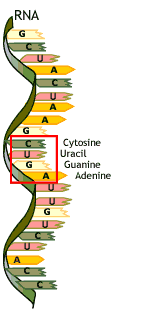
I carry a copy of the Genetic info from the nucleus to the ribosome. Who Am I?
mRNA
tRNA
rRNA
DNA


The following image represents which type of mutation?
Insertion
Deletion
Spontaneous
Point
Sometimes, during replication, nucleotide pairs are added or lost. These errors have serious effects on the protein that is supposed to be created. They can affect the ordering of the codon sequence, causing the creation of a non-functional protein. What type of mutation do these insertions or deletions lead to?
A frameshift mutation
A point mutation
Compare the following DNA sequence: CAT-CAT-CAT
Which of the following represents a point mutation?
CAT-CAG-GTC-AT
CAT-CCA-T
CAT-CAT-CAT
CAT-CCT-CAT

True or False: All of your body cells contain the same genes.
True
False

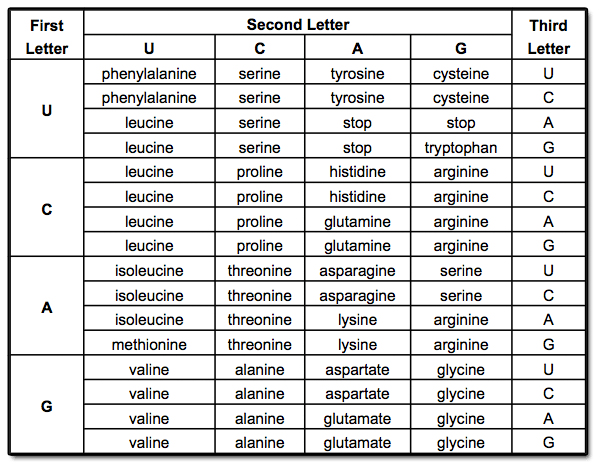
This chart shows which amino acids are produced from different combinations of mRNA.
What is the correct sequence of amino acids produced from a segment of mRNA described by AUG CUA GUG AAA?
Methionine-Leucine-Valine-Lysine
Methionine-Isoleucine-Lysine-Tyrosine
Methionine-Leucine-Alanine-Aspartate
Methionine-Leucine-Methionine-Histidine
A segment of mRNA has the base sequence UGU CAA ACU CGA. What is the base sequence of the original DNA segment?
ACA GUU UGA GCU
TCT GUU UGA GCU
ACA GTT TGA GCT
GAG TCC CTG TAC
Thirty percent of a particular DNA strand is made of adenine. During transcription, a new mRNA molecule is made from this DNA strand. Which is most correct about the mRNA molecule produced?
50% is cytosine
40% is guanine
30% is thymine
30% is uracil
Which most accurately describes the process of protein synthesis?
mRNA --> DNA --> tRNA --> protein
DNA --> mRNA --> tRNA --> protein
translation --> transcription --> DNA --> protein
translation --> transcription --> protein --> DNA
How does DNA help to form proteins?
It creates proteins using nucleotides.
It forms the bonds between amino acids.
It creates reactants for proteins to be made.
It gives instructions for the amino acid sequence.
A chemical is applied to cells which prevents the formation of RNA. A disruption of this process would most likely have a direct impact on which other process within the cell?
ATP production
photosynthesis
DNA replication
protein synthesis
What type of mutation results when a single nucleotide is exchanged for a different nucleotide?
deletion
addition
substitution
translocation
Transcription and Translation are two important processes of protein synthesis. Read through the following descriptions. Which ones occur in Transcription?
Uses DNA as a template to create mRNA
Assembles amino acids into proteins
Occurs in the nucleus
Occurs in the ribosome which is found in the cytoplasm
Occurs in the mitochrondria
Transcription and Translation are two important processes of protein synthesis. Read through the following descriptions. Which ones occur in Translation?
Uses DNA as a template to create mRNA
Assembles amino acids into proteins
Occurs in the nucleus
Occurs in the ribosome which is found in the cytoplasm
Occurs in the mitochrondria
Which characteristic can best distinguish between two different proteins?
the presence of nitrogen in the proteins
the sequence of amino acids in the proteins
the number of amino acids found in the proteins
the location of the peptide bonds in the proteins
In a DNA molecule, the bonds between the nitrogenous bases are much weaker than the bonds joining the phosphate groups to the sugars. Why is this significant to the DNA molecule?
The strength of the bonds determine the type of DNA produced during the process of replication.
This difference in bonding allows the bases to break away from the
phosphate-sugar side chains.
The bonds between the sugars and phosphate maintain the DNA
strand while the base bonds break during replication.
The bonds between the phosphates and the sugars are unbreakable ionic bonds, while the base-to-base bonds are covalent.
Which trait distinguishes DNA from RNA?
DNA contains uracil, while RNA contains thymine.
DNA contains deoxyribose and RNA contains ribose.
DNA is single-stranded, while RNA is double-stranded.
DNA converts glucose to ATP, while RNA directs protein synthesis.
Which best summarizes the process of protein synthesis for all organisms?
DNA replicates and carries the code to tRNA for protein construction.
DNA replicates and carries the code to a ribosome for protein
construction.
DNA serves as the template for mRNA, which carries the code to a
ribosome for protein construction.
DNA serves as the template for a ribosome, which carries the code to mRNA for protein construction.
How does tRNA deliver the appropriate amino acid?
It carries multiple amino acids to the nucleus to build DNA molecules.
It carries multiple amino acids to the nucleus to build the protein.
Its anticodon matches with the codon on mRNA.
Its anticodon matches with the codon on DNA.

This diagram shows the process of translation. Which is best represented by the arrow?
an amino acid chain
a polysaccharide
an anti-codon
a codon
This a section of a mRNA:
AUG CCA UUG GAA ACG CCG
How many codons are found in this strand of mRNA?
3
6
9
18
Which group contains the three main types of RNA that are always used in protein synthesis?
mRNA, miRNA, and rRNA
mRNA, miRNA, and tRNA
mRNA, rRNA, and tRNA
mRNA, tRNA, and RNAi
What is the relationship between nucleic acids and proteins?
Nucleic acids and proteins both contain peptide bonds.
Nucleic acids are the basic building blocks for proteins.
Nucleic acids provide the instructions on how to build proteins.
Nucleic acids store energy used by proteins during chemical reactions.

An original strand of DNA has the sequence: GGC ATG AAC. A point mutation results in a change in the sequence: GGC ATG AAT.
Using the mRNA codon chart above, what is the most likely result from this change?
One amino acid will change to asparagine.
One amino acid will change to phenylalanine.
All three amino acids in the sequence will change.
All three amino acids in the sequence will remain the same.
An amoeba, a single-celled protist, is exposed to a chemical known to cause DNA mutations. A segment of DNA changes from TAC CCC CAT ACG to TAC CCC CCA TACG. What type of mutation was caused by the mutagen?
base substitution
insertion
inversion
deletion
Observe the amino acid sequence below.
Before: METHIONINE – VALINE – PROLINE – LYSINE – LEUCINE
After: METHIONINE – VALINE – PROLINE – SERINE – LEUCINE
What type of mutation is shown above?
deletion
insertion
substitution
frame shift
What is the basic shape of DNA?
Single stranded
Double helix
triple stranded
What are the three structural components of a nucleotide
Phosphate group
Pentose sugar
Oxygen group
nitrogenous base
_____________: The primary physical shape of double-stranded DNA molecules
Double circular
Double Helix
Double straight
The process in which a strand of DNA is copied into an RNA strand for the purpose of protein synthesis
Translation
Replication
Transcription
Mutation
____________: The process by which the sequence of nucleotides in a messenger RNA is converted by a ribosome and transfer RNAs into a polypeptide with a specific sequence of amino acids
Translation
Replication
Transcription
Mutation
_____________: A single linear or circular piece of DNA that contains some or all of an organism’s genes
DNA
Gene
Chromosome
Chromatin
_____________: A change in the DNA sequence of a chromosome
Translation
Replication
Transcription
Mutation
_____________: The process in which a DNA molecule is copied to produce two identical DNA molecules
Translation
Replication
Transcription
Mutation
_____________: A double stranded nucleic acid that holds genetic information; composed of the nucleotides adenine, guanine, cytosine, and thymine
RNA
Chromatin
DNA
Chromosome
_____________: A single stranded nucleic acid that can be used to make proteins; composed of the nucleotides adenine, guanine, cytosine, and uracil
RNA
Chromosome
DNA
Chromatin
_____________: Relaxed form of DNA that is present in the nucleus during interphase of eukaryotic cells
RNA
Chromosome
DNA
Chromatin
_____________: A segment of DNA that encodes a protein or functional RNA
DNA
RNA
Gene
Chromosome

