
 Worksheets
Biology Fall Semester Final Review 2023
Total questions: 134
Worksheet time: 1hrs 23mins
The ability of an organism to maintain a stable internal environment
Photosynthesis
Osmosis
Diffusion
Homeostasis
An educated guess that predicts the outcome of an experiment
Hypothesis
Homeostasis
Controlled Experiment
Independent Variable
The process by which plants convert sunlight, carbon dioxide, and water into glucose and oxygen
Homeostasis
Photosynthesis
Diffusion
Osmosis
Cells without a nucleus and membrane-bound organelles
Prokaryotic Cells
Nucleus
Animal Cells
Plant Cells
Made up of cells, reproduce, grow and develop, obtain and use energy, evolve, contain genetic material, maintain stable internal environment, respond to the environment
Characteristics of Living Things
Chloroplast
Reactants of Photosynthesis
Biological Systems
The variable that is measured and depends on the independent variable
Controlled Experiment
Dependent Variable
Control Variable
Hypothesis
Organic molecules that are the main source of energy for living things
Carbohydrates
Nucleic Acids
Proteins
Lysosome
Molecule with partial charges. Mixes with water.
acids
osmosis
polar
bases
A universal solvent that makes up a large portion of living things
Food Chain
Proteins
Water
Atp
The variable that is changed in an experiment
Control Variable
Hypothesis
Controlled Experiment
Independent Variable
The movement of water from an area of high to low concentration
Diffusion
Homeostasis
Passive Transport
Osmosis
Non-living factors in an ecosystem
Carrying Capacity
Abiotic Factors
Control Variable
Food Web
The control center of the cell that contains genetic material
Golgi Apparatus
Mitochondria
Endoplasmic Reticulum
Nucleus
A double layer of lipids that makes up the cell membrane
endoplasmic reticulum
ribosomes
chloroplast
phospholipid bilayer
Channels in the cell membrane that help move larger molecules
Protein Channels
Mitochondria
Diffusion
Osmosis
Cells with a nucleus and membrane-bound organelles
Cell Membrane
Plant Cells
Animal Cells
Eukaryotic Cells
A diagram that shows the flow of energy through all the organisms in an ecosystem
Trophic Level
Food Chain
Food Web
Energy Pyramid
Stores water, sugar, and other molecules for the cell
Ribosomes
Golgi Apparatus
Mitochondria
Vacuoles
(adenosine triphosphate) main energy source that cells use for most of their work
MITOCHONDRIA
ATP
ADP
WATER
Produces components for the cell
Lysosome
Golgi Apparatus
Endoplasmic Reticulum
Nucleus
monomer of nucleic acids
Proteins
Nucleotide
Amino Acids
Enzyme
A molecule that contains carbon
Plant Cells
Nucleic Acids
Organic Molecule
Enzyme
Cleans up waste in the cell
Ribosomes
Lysosome
Golgi Apparatus
Mitochondria
Organisms that break down dead matter and recycle nutrients back into the environment
Photosynthesis
Consumers
Chloroplast
Decomposers
The variable that remains constant in an experiment
Independent Variable
Biotic Factors
Control Variable
Controlled Experiment
Substances with a pH above 7
Amino Acids
Water
Bases
Acids
An organism that makes its own food
Omnivore
Decomposers
producer
autotroph
Cells with many small vacuoles and lysosomes
Eukaryotic Cells
Plant Cells
Animal Cells
Cell Membrane
The movement of molecules from an area of high to low concentration
Passive Transport
Homeostasis
Diffusion
Osmosis
A component of nucleic acids, energy-carrying molecules such as ATP
Ribosomes
Adenine
Mitochondria
Water
Substances with a pH of 7
Osmosis
Neutral Solutions
Basic Solutions
Acids
Transport of substances across the cell membrane with the use of energy
Food Chain
Active Transport
Osmosis
Diffusion
Each level in a food chain or food web
Food Chain
Carrying Capacity
Trophic Level
Food Web
A network of interconnected food chains in an ecosystem
Energy Pyramid
Trophic Level
Food Chain
Food Web
Glucose and oxygen
Carbohydrates
Water
Osmosis
Products of Photosynthesis
An experiment in which only one variable is changed at a time
Control Variable
Controlled Experiment
Hypothesis
Dependent Variable
An organism that cannot make its own food.
Omnivore
Heterotroph
autotroph
consumers
Creates energy for the cell through cellular respiration
Lysosome
Golgi Apparatus
Mitochondria
Ribosomes
Transport of substances across the cell membrane without the use of energy
Diffusion
Carbohydrates
Passive Transport
Osmosis
Organic molecules that transport substances and perform various functions in cells
Carbohydrates
Lipids
Proteins
Nucleic Acids
Regulates what enters and leaves the cell
Cell Wall
Cell Membrane
Ribosomes
Nucleus
Organic molecules that store and transmit genetic information
Proteins
Amino Acids
Nucleic Acids
Lipids
Organic molecules that store energy and compose cell membranes
Carbohydrates
Nucleic Acids
Lipids
Proteins
An organism that can make its own food.
decomposers
chloroplast
producer
consumers
(Adenosine Diphosphate) The compound that remains when a phosphate group is removed from ATP, releasing energy
ADENINE
ATP
ADP
WATER
building blocks of proteins
nucleic acids
amino acids
lipids
proteins
Substances with a pH below 7
Water
Lipids
Acids
Bases
Specialized structures within a cell that perform specific functions
Proteins
Ribosomes
Nucleus
Organelles
Mutualism, commensalism, parasitism, predator/prey, competition
Characteristics of Living Things
Types of Symbiotic Relationships
Biotic Factors
Mechanisms of Evolution
An organism that obtains energy and nutrients by feeding on other organisms or their remains.
decomposers
producer
mitochondria
consumers
A consumer that eats only plants.
Carnivore
Ribosomes
Herbivore
Omnivore
An animal that eats both plants and animals
Omnivore
Ribosomes
Carnivore
Herbivore
Sun
Products of Photosynthesis
Energy Pyramid
Ultimate Source of Energy in Food Web
Characteristics of Living Things
A membrane that allows some substances to pass while others cannot
Semi-Permeable Membrane
Diffusion
Cell Wall
Cell Membrane
Sorts and packages molecules for transport within the cell
Nucleus
Lysosome
Golgi Apparatus
Mitochondria
Converts sunlight into usable energy through photosynthesis
Mitochondria
Nucleus
Golgi Apparatus
Chloroplast
A biological catalyst that speeds up chemical reactions
Proteins
Nucleus
Enzyme
Nucleotide
Organelles that synthesize proteins
Golgi Apparatus
Lysosome
Ribosomes
Mitochondria
Light intensity, color of light, amount of water, temperature, amount of carbon dioxide
Steps Of Aerobic Respiration
Factors Affecting Photosynthesis
Hypothesis
Photosynthesis Equation
A consumer that eats only animals.
Adenine
Herbivore
Cell Wall
Carnivore
Imagine Olivia, Evelyn, and Sophia are on a thrilling adventure in Canada. They come across a group of grizzly bears. Which of the following would not be used to describe the population of these majestic creatures?
geographic distribution
demographic history
population range
population density
Imagine Oliver, Scarlett, and Hannah are observing a group of rabbits in a field. They notice that the rabbit population seems to be increasing very quickly. Which characteristic of exponential population growth might explain this observation?
The lag phase follows rapid growth.
Initial population growth is rapid.
Growth rate is inversely proportional to population size.
Resources are consumed exponentially during all phases.
Which organism follows an r-strategy for reproduction?
zebra
human
robin
mayfly
Anika, Lily, and Daniel are having a debate about the current human population growth. Anika thinks it's increasing growth and decreasing rate of growth, Lily thinks it's decreasing growth and increasing rate of growth, Daniel thinks it's increasing growth and rate of growth. Who do you think is correct?
Anika: increasing growth and decreasing rate of growth
Lily: decreasing growth and increasing rate of growth
Daniel: increasing growth and rate of growth
None of them
Imagine Nora, Aria, and Noah are on a fun-filled adventure in a deciduous forest. They come across 78 Norway maple trees in every hectare they explore. This scenario is a perfect example of what?
population density
population range
dispersion
Imagine this, Grace, Sophia, and Evelyn spotted twenty gray squirrels scurrying away from their forest home into a new ecosystem. This scenario is an example of what?
emigration
immigration
Imagine this scenario: William, Arjun, and Emma are having a heated debate about the factors contributing to the current human population growth. Can you help them settle the argument?
They agree on improved healthcare, medical advancements, increased agricultural productivity, better sanitation and hygiene, access to education and family planning, and reduced infant mortality rates
They think it's due to improved healthcare, medical advancements, decreased agricultural productivity, poor sanitation and hygiene, limited access to education and family planning
They believe it's because of decreased healthcare, lack of medical advancements, low agricultural productivity, limited access to education and family planning, high infant mortality rates
They suggest it's due to decreased agricultural productivity, lack of access to healthcare, high infant mortality rates, limited education and family planning, poor sanitation and hygiene
How does the introduction of twenty gray squirrels into a new ecosystem impact the existing species?
Increased biodiversity and improved ecosystem stability.
Enhanced cooperation and mutual benefit among species.
Competition for resources and potential decrease in population size or displacement of native species.
No impact on the existing species due to natural adaptation.
Which organism follows an r-strategy for reproduction and what are its characteristics?
The organism that follows an r-strategy for reproduction is a species that produces a large number of offspring with little parental care. Its characteristics include early maturity, short lifespan, small body size, high reproductive rate, and low survival rate of offspring.
The organism that follows an r-strategy for reproduction is a species that produces a large number of offspring with high parental care.
The organism that follows an r-strategy for reproduction is a species that produces a moderate number of offspring with moderate parental care.
The organism that follows an r-strategy for reproduction is a species that produces a small number of offspring with high parental care.
Imagine Kai, Liam, and Benjamin are playing a video game where they have to manage a virtual population. They notice that their population is growing rapidly over time, and the growth rate seems to be proportional to the current population size. What kind of population growth are they experiencing and what could be the implications?
They are experiencing exponential population growth, which is characterized by a rapid increase in population size over time, with the growth rate being proportional to the current population size. Its implications could include resource depletion, environmental degradation, and increased competition for resources in their game.
They are experiencing exponential population growth, which is characterized by a decrease in population size over time, with the growth rate being proportional to the current population size.
They are experiencing exponential population growth, which is characterized by a constant population size over time, with the growth rate being proportional to the current population size.
They are experiencing exponential population growth, which is characterized by a slow increase in population size over time, with the growth rate being proportional to the current population size.
Emigration is
the movement out of an area
the movement into an area
movement in and out of an area
migration
Why don't populations grow indefinitely?
limiting factors
only biotic factors
only abiotic factors
none of the above

What is an example of a density-independent (Abiotic) limiting factor?
food
parasites
disease
pollution

What is the arrow pointing at?
carrying capacity
biotic potential
density-independent
density dependent

parasites, disease, predators, are examples of what type of limiting factors?
density dependent
density independent
survivorship
type 1 curve

What is the carrying capacity mean?
The number of individuals an area can carry
the number of births
The number of deaths an area has
not sure
(Im)migration is ...
the movement into an area
The movement out of an area
The migration process
exponential graph
The exponential graph is a graph that shows us population size increasing quickly, which one below shows us that


One of the factors that can change the size of population is....
Name of schools
Number of dezs
Jobs
Numbers of births
the number of people in a defined area such as a square kilometre
population density
birth rate
death rate
population
2 ATP
52 ATP
4 ATP
38 ATP
During our Unit on Cells we made ______________ (well most of us did).
Mitosis Models
Pop Bottle Rockets
Happy Nappers
Animal Booklets

How many electrons does an atom of magnesium have?
10
11
12
24

How many neutrons does an atom of magnesium have?
10
11
12
24

Lewis makes sugar cookies with different amounts of sugar. He wants to see if cookies with more sugar sell better than cookies with less sugar. He counts the number of cookies sold to find out his answer. What is the dependent variable?
Amount of sugar used
Number of cookies sold
Number of customers
Lewis makes sugar cookies with different amounts of sugar. He wants to see if cookies with more sugar sell better than cookies with less sugar. He counts the number of cookies sold to find out his answer. What is the independent variable?
Amount of sugar used
Number of cookies sold
Number of customers
The number of living organisms that an environment can support
keystone species
carrying capacity
limiting factors
resilience
The living components of an ecosystem
abiotic factors
biotic factors
predator-prey
parasitism

What is the carrying capacity of the graph?
1000
8000
800
600

What happens if a population grows past its carrying capacity?
The population keeps growing
The population starts to die off
The entire species will go extinct
The carrying capacity just increases
The variation of life forms within an ecosystem or across the planet...
population
species
organism
biodiversity
A species that kills and eats other organisms for food...
predation
prey
predator
parasitic


What is the definition of natural selection?
The process in which genes are chosen by humans such as farmers and ranchers
The process in which organisms are chosen by environmental pressures such as climate, available food, predators and habitat.
If an organism changes during their life in order to adapt to its environment, those changes are passed on to its offspring.
The process in which genes are chosen by scientist and academics.

The phrase "Survival of the Fittest" would best describe...
Natural Selection
Artificial Selection
Selective Breeding
Inheritance of Acquired Characteristics
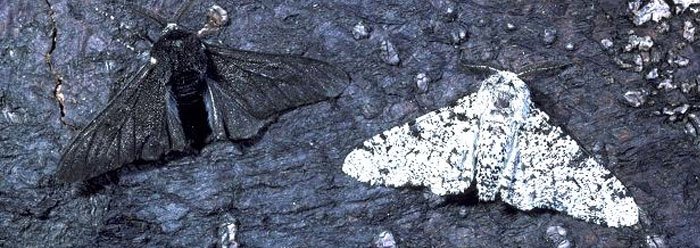
The trees these moths used to live on were white, but have been covered in soot from coal factories. Which moth will be more successful in this new, darker environment?
Dark moth
Light moth
Both will be equally successful
Neither will be successful


The Mayfly is a food source for which 3 organisms?

Al + O2 --> Al2O3

In which eukaryotic organelles does photosynthesis occur?
mitochondria
stomata
xylem
chloroplast



