wayground logo

Free Printable Worksheets

Font size

S
M
L
XL
Worksheets

Unit 6: Inheritance and Genetics

Total questions: 137

Worksheet time: 3hrs 55mins

Name
Class
Date
1.
Who is considered the "Father of Genetics?"
a)
James Watson
b)
Francis Crick
c)
Gregor Mendel
d)
Albert Einstein
2.
What is another name for "true breeding?"
a)
Heterozygous
b)
Homozygous
c)
Hybrid
d)
Cross Pollinating
3.
Gregor Mendel's "P" Generation consisted of plants which were ______________ with opposite traits.
a)
Purebred
b)
Hybrid
c)
Heterozygous
d)
Incompletely Dominant
4.
All offspring plants in the F1 generation had the genotype _____ and were purple because purple is ________________ over white.
a)
Bb, Heterozygous
b)
bb, Homozygous
c)
Bb, Dominant
d)
bb, Recessive
5.
Which of the following describes the flowers in the F1 generation?
a)
Hybrid & heterozygous
b)
True-breeding & homozygous
6.
Gregor Mendel's "P" generation consisted of homozygous purple flower plants crossed with homozygous white flower plants. What were the results of this cross?
a)
100% heterozygous purple flower offspring since purple is dominant.
b)
100% homozygous white flower offspring since white is recessive.
c)
100% homozygous purple flower offspring since purple is dominant.
d)
50% purple flowers and 50% white flowers
7.
Which of the following best explains the offspring results of letting the F1 purple hybrids self pollinate?
a)
100% Purple
b)
100% White
c)
50% Purple, 50% White
d)
75% Purple, 25% White
8.
A __________ is a segment of DNA that codes for a particular protein, which leads to a particular trait.
a)
Gene
b)
Allele
c)
Codon
d)
Nucleotide
9.
The different forms of a gene are known as _____________.
a)
Codons
b)
Proteins
c)
Alleles
d)
Nucleotides
10.
True or False: Mendel's "Law of Dominance" states that dominant alleles mask or are expressed over recessive alleles.
a)
True
b)
False
11.
How many alleles do you get from each parent?
a)
1
b)
2
c)
23
d)
46
12.
Which of Mendel's laws states that alleles are separated during meiosis? (Aa --> A + a) 
a)
Law of Dominance
b)
Law of Segregation
c)
Law of Independent Assortment
d)
Law of Meiosis
13.
According to the Law of Segregation, alleles are separated during the process of _____________.
a)
Mitosis
b)
Meiosis
c)
Osmosis
d)
Translation
14.
Which of Mendel's laws states that alleles for different genes are distributed to gametes independently of one another? 
a)
Law of Dominance
b)
Law of Segregation
c)
Law of Independent Assortment
d)
Law of Meiosis
15.
Which of the following best describes a GENOTYPE?
a)
The allele/genetic makeup of an organism.
b)
The physical expression of a trait.
16.
Which of the following is an example of a GENOTYPE?
a)
25%
b)
Green color
c)
1:2:1
d)
Bb
17.
Which of the following is an example of a PHENOTYPE?
a)
25%
b)
Green color
c)
1:2:1
d)
Bb
18.
Which of the following is an example of a homozygous dominant genotype?
a)
RR
b)
Rr
c)
rr
19.
Which of the following is an example of a homozygous recessive genotype?
a)
RR
b)
Rr
c)
rr
20.
Which of the following is an example of a heterozygous genotype?
a)
RR
b)
Rr
c)
rr
21.
What is the FUNCTION of the visual tool seen in the image?
a)
Identifies the location of a gene.
b)
Determines the DNA sequence of an organism.
c)
Predicts the possible results of a genetic cross.
d)
Tests for the presence of dominant alleles.
22.
Geneticists use ___________ to represent _____________, the different forms of a gene.
a)
Numbers ; Alleles
b)
Letters ; Factors
c)
Letters ; Alleles
d)
Numbers ; Factors
23.
True or False: A phenotype describes the physical expression (characteristics) of a gene. In other words, how something looks.
a)
True
b)
False
24.
The letters on the TOP AND SIDE of a punnett square represent ______________.
a)
The combination of alleles in offspring.
b)
The possible alleles given by the parents following meiosis.
c)
The genotype and phenotype of offspring.
d)
The results of genetic mutations in offspring.
25.
True or False: If a dominant allele is present, the trait will always appear in the organism.
a)
True
b)
False
26.
What is another name for heterozygous?
a)
Hybrid
b)
Purebred
c)
Codominant
d)
Mixed Breed
27.
If a person has a genotype of RR, what do you know about their gametes (sex cells)?
a)
They will all carry the R allele.
b)
They will all carry RR.
c)
Some will carry R, some will carry r.
d)
They will all carry the r allele.
28.
If a person has a genotype of Rr, what do you know about their gametes (sex cells)?
a)
They will all carry the R allele.
b)
They will all carry Rr.
c)
Some will carry R, some will carry r.
d)
They will all carry the r allele.
29.
In certain rats, black fur is dominant over white fur. If two rats, both heterozygous for fur color are mated, their offspring would be expected to have 
a)
four different genotypes and two different colors
b)
two different genotypes and three different colors
c)
three different genotypes and two different colors
d)
three different genotypes and three different colors
30.
Brown fur color is dominant over black fur color. Which of the following is the actual genotype of ALL of the offspring in the next generation of this cross for fur color?
AA x aa
a)
AA
b)
Aa
c)
aa
d)
brown fur
31.
If green is dominant over purple, then what is the genotype for this individual?
a)
Purple
b)
Green
c)
GG
d)
gg
32.
What is the genotype for this organism?
(E= 3 eyes, e= 1 eye)
a)
EE
b)
Ee
c)
ee
d)
EE or Ee
33.
What is the genotype for this organism?
(E= 3 eyes, e= 1 eye)
a)
EE
b)
Ee
c)
ee
d)
EE or Ee
34.
Which is the correct phenotype for this organism?
a)
BB
b)
blue
c)
green
d)
bb
35.
What type of inheritance do two alleles have if their traits blend together? 
a)
Incomplete Dominance
b)
Co-Dominance
c)
Mendelian Inheritance
d)
Homozygous Inheritance
36.
A calico cat shows both the traits for orange fur and black fur. What kind of allele expression is this?
a)
Incomplete Dominance
b)
Co dominance
c)
Independent assortment
d)
Recessive inheritance
37.
A roan cow shows co-dominance in fur color (red and white). What is the phenotype ratio expected if a roan cow and a roan steer mate together?
a)
4: Red and White
b)
1: Red : 1 White
c)
2 Red: 2 Red and White: 0 White
d)
1: Red: 2 Roan: 1 White
38.
How are Incomplete Dominance and Co Dominance different than a normal Mendelian cross?
a)
There is no difference
b)
The heterozygous genotype has a unique phenotype
c)
There is no heterozygous genotype
d)
There is only one phenotype regardless of genotype.
39.
The different forms of a gene are called
a)
traits
b)
pollinators
c)
alleles
d)
hybrids
40.
A breed of chicken shows codominance for feather color. One allele codes for black feathers, another codes for white feathers. The feathers of heterozygous chickens of this breed will be:
a)
all black
b)
all white
c)
all gray
d)
speckled black and white
41.
What does heterozygous mean?
a)
An organism that has the same genes for a trait (TT or tt)
b)
An organism that has different genes for a trait (Tt)
c)
When neither gene is fully dominant; offspring is a mixture of both
d)
the different forms of a trait (hair color--> brown, blonde, red
42.
An allele whose trait only shows up when no dominant allele is present.
a)
hidden allele
b)
dominant allele
c)
recessive allele
d)
present allele
43.
having two of the same genes for the trait (sometimes called purebred).
a)
homozygous
b)
hetrozygous
c)
protein
d)
chromosome
44.
This type of inheritance pattern is a MIXTURE of both traits.
a)
incomplete dominance
b)
co-dominance
c)
complete dominance
d)
recessive pattern
45.
This type of inheritance pattern shows BOTH traits in possible offspring
a)
complete dominance
b)
incomplete dominance
c)
co-dominance
d)
dominant pattern
46.
Snap dragon color is a incomplete dominant trait.  A red flower (RR) is crossed with white flower (rr)? What color are flowers that are Rr?
a)
Red
b)
Red and White
c)
White
d)
Pink
47.
Which of the following is a hybrid?
a)
BB
b)
bb
c)
Bb
48.
Which of the following is purebred?
a)
AA
b)
aa
c)
Aa
d)
Both AA and aa
49.
What genotype is missing from this Punnett Square?
a)
RrYy
b)
RRYY
c)
rryy
d)
RrYY
50.
Based off this punnett square, what fraction of the offspring will have wrinkled, yellow seeds?
a)
9/16
b)
3/16
c)
1/16
d)
16/16
51.
What is the genotype for a pea plant heterozygous for round seeds (R), and homozygous recessive for green seeds (y)?
a)
Ry
b)
RRyy
c)
RrYy
d)
Rryy
52.
Cross Two Homozygous plants
(
RRYY x rryy)
R = round seeds, r  = wrinkled seeds Y = yellow seeds, y = green seeds
What percent will have Round and Yellow seeds? 
a)
0/16
b)
4/16
c)
8/16
d)
16/16
53.
I have 2 X chromosomes. What am I?
a)
Male
b)
Female
54.
How many PAIRS of sex chromosomes do humans have?
a)
23
b)
46
c)
1
d)
2
55.
How many PAIRS of chromosomes do humans have?
a)
23
b)
46
c)
1
d)
2
56.
I have 1 X chromosome and 1 Y chromosome. What am I?
a)
Male
b)
Female
57.
Aa, DD, bB, yy are all examples of
a)
genotypes
b)
phenotypes
58.
What you see, or the physical appearance.
a)
Genotype
b)
Phenotype
c)
Homozygous
d)
Heterozygous
59.
If a man with type AB blood has a child with a woman who is type A (A i) blood, which is NOT a possibility for the child?
a)
A
b)
B
c)
AB
d)
O
60.
Hemophilia is a sex-linked recessive trait found on the x chromosome.  Complete a cross between a woman who has hemophilia and a normal man.
What are the chances of a child having hemophilia?
a)
100%
b)
75%
c)
50%
d)
25%
61.
If a male has an affected x chromosome for a sex-linked trait such as colorblindness, where did he get the chromosome from?
a)
His father
b)
His mother
62.
If a colorblind male marries a woman who is a carrier, what percentage of their FEMALE children will be colorblind?
a)
0%
b)
25%
c)
50%
d)
100%
63.
Hemophilia is a sex-linked recessive trait found on the x chromosome.  Complete a cross between a woman who is a carrier and a man who is normal.
What are the chances, if they have a daughter, that she is a carrier?
a)
100%
b)
75%
c)
50%
d)
25%
64.
Hemophilia is a x-linked disorder.  A woman is a carrier for the disorder.  Which is the correct genotype?
a)
Hh
b)
XHXh
c)
hh
d)
XhXh
65.
Colorblindness is a recessive, X chromosome sex-link disorder. Cross the parents to figure out which percentage of their offspring will be colorblind.
a)
25%
b)
0%
c)
75%
d)
50%
66.
Colorblindness is more common in males than in females because the allele for colorblindness is
a)
dominant and located on the X chromosome.
b)
recessive and located on the Y chromosome.
c)
recessive and located on the X chromosome.
d)
recessive and located on the Y chromosome.    
67.
A parent with the alleles IAIB could produce offspring with which types of blood?
a)
Type A
b)
Type B
c)
Type AB
d)
Type A, Type B, or Type AB
68.
Which of the following is not a polygenic trait?
a)
skin and hair color
b)
eye color
c)
height
d)
colorblindness
69.
Polygenic traits are influenced by _____.
a)
several genes
b)
both by the environment and by genes
c)
linked genes
d)
codominant genes
70.
What is the haploid number for this Karyotype?
a)
26
b)
27
c)
52
d)
54
71.
What chromosome is affected by Down's Syndrome?
a)
23
b)
18
c)
13
d)
21
72.
What is a picture used to examine chromosomes called?
a)
Sonogram
b)
Electrocardiogram
c)
X-Ray
d)
Karyotype
73.
The likely cause of genetic disorders is...
a)
Nondisjunction
b)
Overfertilization
c)
Uncontrolled Meiosis
d)
Translocation
74.
What type of karyotype is shown here?
a)
Male with Turner Syndrome
b)
Male with Klinefelter Syndrome
c)
Female with Down Syndrome
d)
Female with Klinefelter Syndrome
75.
What type of karyotype is shown here
a)
Normal Male
b)
Male with Down Syndrome
c)
Normal Female
d)
Female with Turner Syndrom
76.
What type of karyotype is this
a)
Female with Down Syndrome
b)
Male with Down Syndrome
c)
Male with Klinefelter Syndrome
d)
Female with Turner Syndrome
77.
Which genetic abnormality is shown in this karyotype?
a)
Partial Addition
b)
Partial Deletion
c)
Trisomy 21
d)
Monosomy
78.
How many people in this whole pedigree have the trait/disease?
a)
2
b)
3
c)
4
d)
6
79.
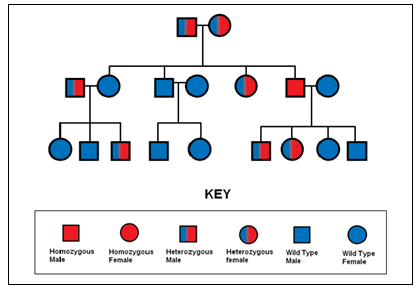
What is the mode of inheritance shown here?
a)
Autosomal Dominant
b)
Autosomal Recessive
c)
Sex Linked Recessive
80.
What is the mode of inheritance shown here?
a)
Autosomal Recessive
b)
Sex Linked
c)
Autosomal Dominant
81.
What is the mode of inheritance shown here?
a)
Autosomal Recessive
b)
Autosomal Dominant
c)
Sex Linked
82.
What is the mode of inheritance shown here?
a)
Autosomal Dominant
b)
Autosomal Recessive
c)
Sex Linked
83.
What is the mode of inheritance shown here?
a)
Autosomal Recessive
b)
Autosomal Dominant
c)
Sex Linked
84.
The genotype of the affected son and daughter at the bottom of this pedigree...
a)
homozygous dominant
b)
homozygous recessive
c)
heterozygous
d)
Can't tell
85.
What do we use pedigrees for?
a)
To look at families
b)
To make determinations about the offspring
c)
To track traits in families
d)
Nothing
86.
In a pedigree, what shape represents a male?
a)
circle
b)
square
c)
triangle
d)
diamond
87.
What gender has an X and a Y chromosome?
a)
male
b)
female
c)
transgender 
d)
all of the above
88.
How many generations are shown in this pedigree?
a)
1
b)
2
c)
3
d)
4
89.
Which individual in the first generation is a carrier?
a)
The male
b)
The female
c)
individual 1
d)
None of the above
90.
How many kids did the mother and father from the first generation have?
a)
2
b)
4
c)
5
d)
6
91.
How many boys did the mother and father from the first generation have?
a)
2
b)
4
c)
5
d)
6
92.
In the second generation-how many people have the disease or display the physical trait?
a)
2
b)
4
c)
5
d)
6
93.
How many individuals are there in the 3rd generation?
a)
2
b)
3
c)
4
d)
6
94.
How many people in this whole pedigree have the trait/disease?
a)
2
b)
3
c)
4
d)
6
95.
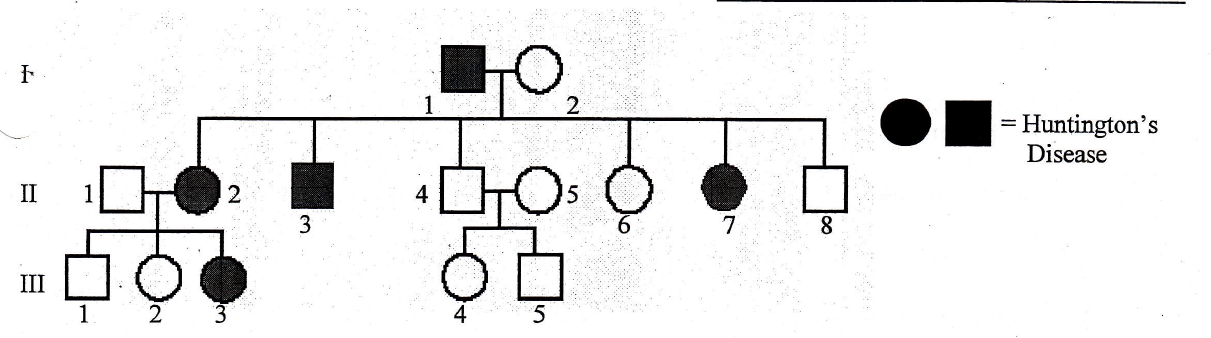
There are no carriers for Huntington's Disease- you either have it or you don't. Is Huntington's disease caused by a dominant or recessive trait?
a)
Dominant
b)
Recessive
96.
How are individuals I-2 and III-5 related?
a)
Grandpa and grandson
b)
Mom and son
c)
Uncle and nephew
d)
Grandma and grandson
97.
Huntington's Disease is a dominant trait.
What is the correct genotype for individual I-2?
a)
HH
b)
Hh
c)
hh
d)
H_
98.
Does this pedigree show a dominant or recessive trait?
a)
Dominant
b)
Recessive
99.
Is this trait (the shaded individuals) dominant or recessive?
a)
dominant
b)
recessive
100.
Is this trait (the shaded individuals) dominant or recessive?
a)
dominant
b)
recessive
101.
What do we use pedigrees for?
a)
To look at families
b)
To make determinations about the offspring
c)
To track traits in families
d)
Nothing
102.
Hemophilia is a recessive sex-linked trait. If H = normal & h = has hemophilia, which genotype represents a male with hemophilia. 
a)
XHY
b)
XHXh
c)
XhXh
d)
Xh
103.
a)
Not Affected Male
b)
Not Affected Female
c)
Affected Male
d)
Affected Female
104.
Imagine the shaded individuals are those WITH a "hitchhikers thumb." What must be the genotype of individual II-1?
a)
TT
b)
tt
c)
Tt
d)
Impossible to tell
105.
This pedigree shows what pattern of inheritance?
a)
Autosomal Dominant
b)
Autosomal Recessive
c)
Sex-linked Dominant
d)
Sex-linked Recessive
106.
What is the genotype of the mother?
a)
BB
b)
bb
c)
Bb
d)
BB or Bb
107.

What is the genotype of the mother?

a)

HH

b)

hh

c)

Hh

108.

What is the inheritance pattern of this trait?

a)

Autosomal dominant

b)

Autosomal recessive

c)

Sex linked recessive

d)

sex linked dominant

109.

What type of inheritance pattern is displayed on the image above?

a)

Autosomal recessive

b)

Autosomal dominant

c)

Sex linked recessive

d)

Sex linked dominant

110.

Is this trait likely to cause early death?

a)

yes

b)

no

111.
In watermelons, green rinds (G) are dominant to striped rinds (g).  What is the genotype of a heterozygous green watermelon?
a)
GG
b)
Gg
c)
gg
d)
green
112.
In cacti, long arms (A) are dominant to short arms (a).  Suppose 2 heterozygous cacti are crossed.  What percentage of their offspring are expected to have short arms?
a)
0%
b)
25%
c)
75%
d)
100%
113.
One of the two forms of a gene is called a(n)
a)
genotype
b)
allele
c)
hybrid
d)
trait
114.
When a person has two different alleles for a gene, they are said to be
a)
heterozygous
b)
homozygous
115.
A __________ allele always shows up in an organism when the it is present.
a)
dominant
b)
hybrid
116.
In this example, the child displays the ________ trait.
a)
dominant
b)
recessive 
117.
How many alleles (letters) do each person carry for a trait?
a)
1
b)
2
c)
3
d)
4
118.
How many alleles (letters) does a child get from each parent for each trait?
a)
1
b)
2
c)
3
d)
4
119.
Dominant alleles are represented by a:
a)
Male gene
b)
lowercase letter
c)
recessive trait
d)
capital letter
120.
Aa, DD, bB, yy are all examples of
a)
genotypes
b)
phenotypes
121.

In pea plants tall stems(T) are dominant over short stems(t) and round seeds(R) are dominant over wrinkled seeds(r). Consider the following cross: TtRr X Ttrr

Next 4 questions will be about this information. Please take notes.


a. Find the number of possible phenotypes

a)

2

b)

4

c)

6

d)

8

122.

b. Find the number of possible genotypes

a)

2

b)

4

c)

6

d)

9

123.

c. What is the chance of having tall, wrinkled seeded plants?

a)

1/4

b)

1/8

c)

3/4

d)

3/8

124.

d. what is the chance of plant to have homozygous recessive genotype?

a)

1/2

b)

1/4

c)

1/8

d)

3/8

125.

Examples include skin color and height (the individual's phenotype exists somewhere along a spectrum)

a)

polygenic inheritance

b)

multiple alleles

c)

linked genes

d)

incomplete dominance

126.

A trait that is located on the X chromosome is called

a)

Multiple alleles

b)

Codominance

c)

Polygenic Inheritance

d)

X-linked traits

127.
What is NOT a possible genotype for someone with type B blood?
a)
BB
b)
AB
c)
BO
128.
What is the genotype of a person with type A blood, who had a father with type O blood?
a)
AB
b)
AO
c)
AA
d)
OO
129.
What are the blood types of the possible children that a woman (type O) and man (type AB) can have?
a)
O and AB
b)
O and A
c)
O and B
d)
A and B
130.
What percentage of the female offspring will be a carrier for this recessive disease?
a)
0%
b)
50%
c)
100%
d)
25%
131.
A woman has type B blood and her husband has type O blood.  What must be the woman's genotype, if they have a child with type O blood?
a)
BO
b)
BB
c)
OO
d)
type B
132.
What pattern of inheritance is shown in this image?
a)
Codominance
b)
Incomplete dominance
c)
Polygenic traits
133.
What type of inheritance is determined by multiple genes located at different loci on different chromosomes and there can be a range of traits?
a)
Codominance
b)
Incomplete dominance
c)
Polygenic traits
134.
Hemophilia is a recessive x-linked disorder.
Which genotype represents a female who is a carrier for hemophilia?
a)
XHXh
b)
XhXh
c)
XHXH
d)
XhY
135.
Hemophilia is a recessive x-linked disorder.
Which genotype represents a male with hemophilia?
a)
XHXh
b)
XhXh
c)
XHY
d)
XhY
136.
Which of the following genotypes belongs in the red box in the Punnett square?
a)
XBXb
b)
XbXb
c)
XbY
d)
XBY
137.
Duchenne muscular dystrophy is a recessive x-linked disorder.
According to the Punnett square, what percentage of male offspring will have the disorder?

a)
0%
b)
25%
c)
50%
d)
100%