wayground logo

Free Printable Worksheets

Font size

S
M
L
XL
Worksheets

2019 Anatomy Midterm Review

Total questions: 133

Worksheet time: 3hrs 31mins

Name
Class
Date
1.
This section is
a)
frontal
b)
transverse
c)
coronial 
d)
sagittal
2.
This section is 
a)
transverse
b)
frontal
c)
sagittal
3.
This section is 
a)
frontal
b)
transverse
c)
sagittal
4.
The cavity that contains the lungs and heart is
a)
pelvic
b)
abdominal
c)
thoracic
d)
spinal
5.
The body cavity that contains the reproductive organs is the 
a)
thoracic
b)
abdominal
c)
cranial
d)
pelvic
6.

Which structure is anterior?

a)

scapula

b)

trachea

c)

ribs

d)

sternum

7.

Which structure is posterior to the sternum?

a)

rib

b)

scapula

c)

vertebra

d)

trachea

8.

Which directional term refers to the middle of the body?

a)

fine

b)

lateral

c)

medial

d)

superior

9.

Which direction term refers to the back of a human body?

a)

posterior

b)

anterior

c)

cepahilc

d)

media

10.

Which directional term refers to a location near the head?

a)

dorsal and cepahic

b)

cephalic and caudal

c)

cephalic and superior

d)

dorsal and superior

11.

The study of body function

a)

anatomy

b)

microbiology

c)

biology

d)

physiology

12.

Which of the following is an example of proximal? Select all that apply

a)

Elbow is proximal to the wrist.

b)

The wrist is proximal to the elbow

c)

Proximal means nearer to the point of attachment of limb to trunk

d)

Proximal means farther from point of attachment of limb to trunk

13.

Which of the following are correct. Select all that apply

a)

The elbow is distal to the wrist.

b)

the wrist is distal to the elbow.

c)

Distal means nearer to the point of attachment of limb to trunk

d)

Distal means farther from point of attachment of limb to trunk.

14.

Which of the following describing ' Anatomical Position'

a)

Body in erect

b)

Anterior surface of head, chest & abdomen are facing forward

c)

Foots are facing backward

d)

Upper and lowe limbs are fully extended

15.
Proteins are made of monomers called ___________
a)
Nucleotides
b)
Monosaccharides
c)
Amino Acids
d)
Glycerol and fatty acids
16.
DNA and RNA are examples of 
a)
Carbohydrates
b)
Lipids
c)
Proteins
d)
Nucleic Acids
17.
Waxes, oils and fats are examples of
a)
Carbohydrates
b)
Lipids
c)
Proteins
d)
Nucleic Acids
18.
The organic compounds that have many structural purposes and are used in many processes within the
cell are called ____________________.
a)
Carbohydrates
b)
Lipids
c)
Proteins
d)
Nucleic Acids
19.
What is the function of nucleic acids?
a)
store genetic information
b)
store energy (long-term)
c)
store energy (short-term)
d)
build skin, hair, nails, muscles
20.
What type of macromolecule are enzymes?
a)
Protein
b)
Carbohydrate
c)
Lipid
d)
Nucleic Acid
21.
Which of the following organic compounds is the main source of energy for living things?
a)
carbohydrates
b)
lipids
c)
nucleic acids
d)
proteins
22.
Which macromolecule stores energy, insulates us, and makes up the cell membrane?
a)
lipids
b)
proteins
c)
carbohydrates
d)
nucleic acids
23.
Is found in the cell membrane as a bilayer. 
a)
lipids
b)
protein
c)
nucleic acid
d)
carbohydrate
24.
What property of water makes it the 'universal solvent'?
a)
it is a polar molecule
b)
it is an ionic compound
c)
it contains hydrogen bonds
d)
it steals electrons from other atoms
25.

Acid is?

a)

A substance that reacts to metals and carbonates, and has a Ph of below 7.

b)

Often used in drain cleaner.

c)

Something that can only be found in a lab

d)

A bitter tasting substance

26.

A base is

a)

A substance that feels slippery, has a higher Ph than 7, and is often used in drain cleaner.

b)

Has a Ph of below 7 and can react to metal and carbonates

c)

Is only found in a lab

d)

Something water can never be

27.
The top layer of the skin is called the _________________.
a)
dermis
b)
oil gland
c)
nerve
d)
epidermis
28.
The basale layer which includes dividing keratinocytes that act as stem cells are located where in the skin?
a)
bottom of the dermis
b)
bottom of the hypodermis
c)
bottom of the epidermis
d)
none of these
29.
Old, dead skin cells fall off the ____________________ of the epidermis.
a)
surface
b)
lowest part
c)
highest part
d)
middle
30.
What is number 9? 
a)
Dermis
b)
Epidermis
c)
hypodermis
d)
stratum basale
31.
What is number 7? 
a)
Dermis
b)
Epidermis
c)
stratum corneum
d)
hypodermis
32.
What layer of epidermis does mitotic division occur?
a)
stratum lucidum
b)
stratum basale
c)
stratum granulosum
d)
stratum corneum
33.
The skin provides protection.  As such, what type of epithelial tissue comprises the epidermis?
a)
simple cuboidal
b)
stratified squamous
c)
simple squamous
d)
pseudo stratified columnar
34.
What is J pointing to?
a)
Adipose Tissue
b)
Sebaceous Glands
c)
Arrector Pilli Muscles
d)
Sweat Gland
35.
What is the purpose of the sebaceous glands?
a)
Secretes oily and waxy matter
b)
Cleans your skin.
c)
Prevents Cancer
d)
Protects from the Sun
36.
What gives your skin color
a)
Epidermis
b)
follicles
c)
dermis
d)
melanin
37.
Which of the following epidermal layers is found on the palms of hands and soles of your feet?
a)
stratum granulosum
b)
stratum lucidum
c)
stratum basale
d)
stratum spinosum
38.
Burn that results in damage to the epidermis and upper dermis and blisters:
a)
1st degree
b)
2nd degree
c)
3rd degree
d)
4th degree
39.
What are the basic functions of the Integumentary system?
a)
protection, regulation of body temperature, communication, excretion of wastes, and vitamin D production
b)
serves no purpose
c)
to make you look good
d)
To absorb sunlight through your pours
40.
What are the three main layers of the skin?
a)
The epidermis, the dermis, and the subcutaneous
b)
The epidermis, the dermis, and the sebaceous
c)
The dermis, the sebaceous, and the sudoriferous
d)
The sudoriferous, the dermis, and the epidermis
41.
Scenario: You and your friends spent a fun day at the beach but forgot your sunscreen. Later that evening you notice blisters across your friend’s back and realize he got sunburned. How bad are the burns?
a)
first-degree
b)
second-degree
c)
third-degree
42.
What is the most painful type of burn?
a)
First-degree burns, because the outer skin is so sensitive
b)
Third-degree burns, because they are the most severe
c)
Second-degree burns, because nerve endings are still intact even though tissue damage is severe
d)
All types of burns are excruciatingly painful
43.

The type of burn caused by wind, brief exposure to steam, and light sunburn is ______________.

a)

First-degree burn

b)

Second-degree burn

c)

Third-degree burn

d)

The most severe burn

44.

What types of Skin Cancer are there?

a)

Melanoma

b)

Bowel

c)

Basal Cell Carcinoma

d)

Squamous Cell Carcinoma

e)

Leukemia

45.

What are some symptoms of skin cancer

a)

A changing mole

b)

Freckles

c)

An unhealing sore

d)

Peeling skin

e)

A scaly patch of skin

46.

Which of the following are protective chemical barriers of the skin?

a)

intact epidermis

b)

keratin

c)

melanin

d)

both melanin and keratin

47.

Which system is responsible for creating red blood cells?

a)

skeletal

b)

muscular

c)

respiratory

d)

nervous

48.

Which of the following best describes the job of the skeletal system?

a)

Gives shape and support to the body.

b)

Sends messages from the stomach to the brain.

c)

Brings in and breaks down all nutrients for the body

49.

The joint with a rounded end of bone fitting snug within another bone.

a)

ball and socket joint

b)

hinge joint

c)

pivot joint

d)

gliding joint

50.

The joint that moves in one direction, like a door

a)

ball and socket joint

b)

hinge joint

c)

pivot joint

d)

gliding joint

51.

This is at the end of a bone, cushions/tough

a)

cartilage

b)

tendon

c)

ligament

52.

This attaches bone to bone

a)

cartilage

b)

tendon

c)

ligament

53.
The human skeleton can be subdivided into two parts, what part is made up of the skull, sternum, vertebral column and rib cage?
a)
appendicular
b)
axial
54.
What type of bone is the scapula?
a)
long bone
b)
short bone
c)
flat bone
d)
sesamoid bone
55.
What type of bone is the femur?
a)
Long bone
b)
Short bone
c)
Flat bone
d)
Irregular bone
56.
What is the name of the collar bone?
a)
Clavicle
b)
Scapular
c)
Sternum
d)
Xiphoid
57.
Name the bone located at number  8.
a)
Humerus
b)
Radius
c)
Fibula
d)
Tibia
58.
Name the bone located at number 12.
a)
Patella
b)
Clavicle
c)
Sternum
d)
Scapula
59.
Name the bone located at number 16.
a)
Clavicle
b)
Humerus
c)
Radius
d)
Ulna
60.
The site of bone growth on a long bone is called
a)
Epiphyseal plate
b)
diaphysis
c)
periosteum
d)
meduary cavity
61.
The shaft of the long bone. 
a)
epphysis
b)
diaphysis
c)
epiphyseal line
d)
growth plate
62.
The shaft of the long bone. 
a)
epphysis
b)
diaphysis
c)
epiphyseal line
d)
growth plate
63.
Toes and fingers are called
_______________________.
a)
bones
b)
carpals
c)
tendons
d)
phalanges
64.
Which of the following is a hinge joint? 
a)
hip
b)
elbow
c)
shoulder
d)
neck
65.
Which of the following is NOT a function of the skeleton?
a)
Production of blood cells
b)
Gives the body form
c)
Protects internal organs
d)
Generates heat
66.
This disease translates to "pourous bone" which is weak, thin and easily breakable bone.
a)
osteoporisis
b)
scoliosis
c)
hyper kyphosis
d)
ankylosing spondylitis
67.

What is the scientific name of the 'jaw bone'?

a)

Maxilla

b)

Mandible

68.

Bone forming cells:

a)

osteocytes

b)

osteoblasts

c)

osteoclasts

d)

osteomasts

69.

Bone destroying cells:

a)

osteocytes

b)

osteoblasts

c)

osteomasts

d)

osteoclasts

70.

Bone tissue composed of small needle-like pieces of bone with open spaces:

a)

lacunae

b)

compact bone

c)

canaliculi

d)

spongy bone

71.

Leah was involved in a motor vehicle accident. She has a bleeding wound on her lower left leg with the ends of the bone showing. What type of fracture is this?

a)

Compound

b)

Dislocation

c)

Greenstick

d)

Simple

72.

John is a toddler and fell on an outstretched arm while running outside. X-rays reveal an incomplete fracture of his radius. What type of fracture does John have?

a)

Comminuted

b)

Compound

c)

Dislocation

d)

Greenstick

73.
Which type of fracture breaks the bone into several fragments?
a)
complete
b)
impacted
c)
comminuted fracture 
d)
spiral
74.
The primary mineral stored by compact bone is
a)
Calcium
b)
Selenium
c)
Zinc
d)
Magnesium
75.
OUTER COVERING OF BONE THAT COVERS DIAPHYSIS AND IS LOCATION WHERE MUSCLES ATTACH
a)
ARTICULAR CARTILAGE
b)
OSTEON
c)
HAVERSIAN CANAL
d)
PERIOSTEUM
76.
 a fracture in which the bone breaks diagonally. 
a)
Oblique Fracture
b)
Fracture
c)
Diagonal Fracture
d)
Horizontal Fracture 
77.
Name this tissue
a)
Skeltal
b)
Cardiac
c)
Smooth
78.
Name this tissue
a)
Skeletal
b)
Cardiac
c)
Smooth
79.
This type of muscle tissue is found in the walls of hollow organs such as the stomach 
a)
Skeletal
b)
Cardiac
c)
Smooth
80.
Muscle tissue
a)
Is tissue that functions in lining, covering, and glandular tissue
b)
Is tissue involved in protecting, supporting, and binding together other body tissues
c)
Is tissue that contracts and shortens to produce movement 
d)
Tissue that receives and conducts electrochemical impulses from one part of the body to another
81.
Which types of muscle tissue are voluntary
a)
Cardiac Muscle
b)
Smooth Muscle
c)
Skeletal Muscle
d)
Skeletal Muscle and Smooth Muscle
82.
Identify the muscle.
a)
Pectorals
b)
Tricep
c)
Bicep
d)
Quadriceps
83.
Identify the muscle.
a)
Quadriceps
b)
Bicep
c)
Pectorals
d)
Gastrocnemius
84.
Identify the muscle.
a)
Hamstring
b)
Pectorals
c)
Abdominals
d)
Quadriceps
85.
Identify the muscle.
a)
Hamstring
b)
Gastrocnemius
c)
Deltoid
d)
Latissimus Dorsi
86.
Identify the muscle.
a)
Bicep
b)
Tricep
c)
Deltoid
d)
Trapezius
87.
Identify the muscle.
a)
Gluteus Maximus
b)
Quadriceps
c)
Hamstrings
d)
Deltoids
88.
Identify the muscle.
a)
Biceps
b)
Triceps
c)
Abdominals
d)
Obliques
89.
Identify the muscle.
a)
Deltoids
b)
Quadriceps
c)
Triceps
d)
Trapezius
90.
Identify the muscle.
a)
Hamstrings
b)
Gastrocnemius
c)
Abdominals
d)
Pectorals
91.
F is pointing to?
a)
H zone
b)
Actin
c)
A band
d)
Sarcomere 
92.

the gap between the motor neuron and the muscle fiber it supplies at the neuromuscular junction

a)

H

b)

Z

c)

synaptic cleft

d)

sarcomere

93.
a neurotransmitter that stimulates skeletal muscles
a)
acetylcholine (Ach)
b)
ATP
c)
cross bridges
d)
neuromuscular junction
94.
the only energy source that can be used to directly power muscle activity
a)
acetylcholine (Ach)
b)
ATP
c)
cross bridges
d)
neuromuscular junction
95.
point where an axon terminals of a nerve cell and the sarcolemma of a skeletal muscle join
a)
acetylcholine (Ach)
b)
ATP
c)
cross bridges
d)
neuromuscular junction
96.
plasma membrane of a muscle cell
a)
sarcolemma
b)
sarcoplasmic reticulum
c)
thick filament
d)
thin filament
97.
myosin protein
a)
sarcolemma
b)
sarcoplasmic reticulum
c)
thick filament
d)
thin filament
98.
actin, contractile protein
a)
sarcolemma
b)
sarcoplasmic reticulum
c)
thick filament
d)
thin filament
99.

skeletal muscles

a)

require energy in order to contract

b)

require energy in order to relax

c)

relax when calcium ions are transported into sarcoplasmic reticulum

d)

all of the above

100.

Muscles that oppose one another are

a)

synergist

b)

hateful

c)

prime movers

d)

antagonists

101.

The nerve cells in your body are called neurons. From the picture which part of the neuron is most likely responsible for carrying signals between the dendrite and axon terminal?

a)

soma

b)

axon

c)

Node of Ranvier

d)

Schwann cell

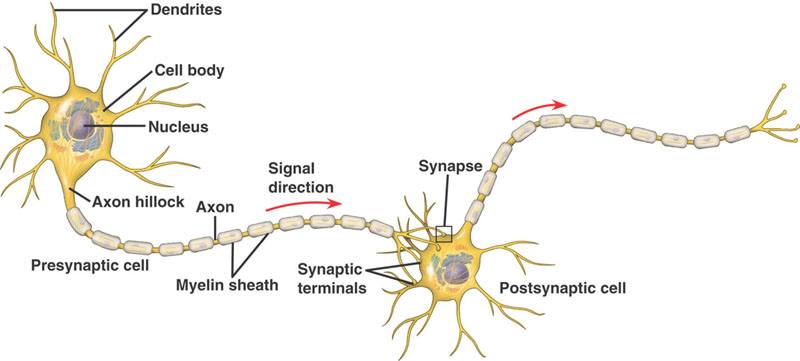
102.
This releases neurotransmitters which are sent into the synaptic cleft for receptors on the dendrite to taste
a)
axon
b)
axon terminal
c)
gene
d)
neuron
103.
This insulating material forms a layer, around the axon of a neuron.  It enables electrical signals to travel down the axon at higher speeds.
a)
neuron
b)
myelin sheath
c)
dendrite
d)
neurotransmitter
104.
What is structure labeled C in the picture?
a)
Dendrite
b)
Axon
c)
Cell Body
d)
Axon Terminal
105.
What is structure labeled B in the picture?
a)
Dendrite
b)
Axon
c)
Cell Body
d)
Axon Terminal
106.
What is structure labeled D in the picture?
a)
Dendrite
b)
Axon
c)
Cell Body
d)
Axon Terminal
107.
Which of the following is the correct order of the direction of a message?
a)
Dendrite-Cell Body-Axon-Synapse
b)
Synapse-Cell Body-Axon-Dendrite
c)
Dendrite-Synapse-Cell Body-Axon
d)
Axon-Cell Body-Dendrite-Synapse
108.
A change or signal in the environment that can make an organism react is called a __.
a)
Cerebrum
b)
Neuron
c)
Response
d)
Stimulus
109.
What is this?
a)
Blood
b)
Bone
c)
Neuron
d)
Adipose
110.
part of a neuron that receives information from other neurons
a)
axon
b)
dendrites
c)
myelin sheath
d)
synapse
111.
a signal molecule that transmits nerve impulses across synapses
a)
neuron
b)
neurotransmitter
c)
nerve
d)
action potential
112.
Which ions are involved in the electrical nerve impulse?
a)
Iodine and Sodium
b)
Potassium and Sodium
c)
Iron and Sodium
d)
Calcium and Iodine
113.
The central nervous system is made up of __________.
a)
the brain and cerebellum
b)
the peripheral and autonomic nervous system
c)
the brain and spinal cord
d)
the cerebrum and the cerebellum
114.
Connective tissues which protect the brain and spinal cord are called the __________.
a)
vertebrae
b)
cranium
c)
meninges
d)
spinal nerves
115.

The diencephalon is composed primarily of ____________.

a)

the cerebellum, brain stem and cerebrum

b)

the brain stem, hippocampus and amygdala

c)

the thalamus, hypothalamus and pituitary gland

d)

the midbrain, pons and cerebrum

116.

Part of the brain stem, serves as a pathway for nerve impulses. It also helps to regulate rate/depth of breathing.

a)

midbrain

b)

pons

c)

medulla oblongata

d)

hippocampus

117.

Automatic reflex centers for the heart rate, blood pressure, breathing, swallowing, and vomiting

a)

Medulla Oblongata

b)

Pons

c)

Hypothalamus

d)

Thalamus

118.

What are the grooves in the brain called?

a)

Gyri

b)

Sulci

c)

Lobes

d)

Fissures

119.
Occipital Lobes are responsible for: 
a)
balance
b)
vision
c)
hearing
d)
movement
120.

If you had one word to describe the function of the parietal lobe it would be:

a)

Movement

b)

Sensory

c)

Balance

d)

Emotions

121.
What does the cerebellum help maintain?
a)
body temperature
b)
emotions
c)
motor output
d)
balance
122.
What letter represents the Parietal Lobe?
a)
A
b)
B
c)
C
d)
E
123.
What letter represents the Temporal Lobe?
a)
B
b)
C
c)
D
d)
F
124.
The 3 layers of meninges from superficial to deep are
a)
dura mater, arachnoid mater, pia mater
b)
pia mater, arachnoid mater, dura mater
c)
arachnoid mater, pia mater, dura mater
d)
dura mater, pia mater, arachnoid mater
125.

Which statement best describes a reflex arc?

a)

Slow response that you have to think about

b)

Rapid response to protect body from harm

126.

_____ neurons carry messages away from the central nervous system and out to muscles or glands. The RED neuron in diagram.

a)

sensory

b)

motor

c)

inter

d)

central

127.

__________ carry messages between sensory neurons and motor neurons.

a)

Active Neurons

b)

Interneurons

c)

Refraction Neurons

d)

Flower Neurons

128.

The part of the PNS that controls involuntary actions

a)

autonomic nervous system

b)

somatic nervous system

c)

organic nervous system

d)

reflexive nervous system

129.
The part of the nervous system that consists of nerves that branch out from the CNS (central nervous system) and connect to other body parts
a)
Sympathetic
b)
Parasympathetic
c)
Autonomic
d)
Peripheral
130.
The "fight or flight" response during threatening situations in the role of the:
a)
sympathetic nervous system
b)
parasympathetic system
c)
somatic nervous system
d)
cerebellum
131.
The _____part of the autonomic nervous system is active during resting.
a)
sympathetic
b)
parasympathetic
c)
somatic
d)
peripheral
132.
Part of the peripheral that controls conscious activities
a)
autonomic
b)
somatic
c)
sympathetic
d)
parasympathetic
133.
Myelinated fibers (tracts) form ________ matter while unmyelinated fibers form ________ matter. 
a)
sensory, motor
b)
gray, white
c)
motor, sensory
d)
white, gray