
 Worksheets
Exam 4 BIOL 1710
Total questions: 132
Worksheet time: 1hrs 6mins
In his transformation experiments, what phenomenon did Griffith observe?
A) Mixing a heat-killed pathogenic strain of bacteria with a living nonpathogenic strain can convert some of the living cells into the pathogenic form.
B) Mixing a heat-killed nonpathogenic strain of bacteria with a living pathogenic strain makes the pathogenic strain nonpathogenic.
C) Infecting mice with nonpathogenic strains of bacteria makes them resistant to pathogenic strains.
D) Mice infected with a pathogenic strain of bacteria can spread the infection to other mice.
Which of the following statements describes the process of transformation in bacteria?
A) A strand of DNA is created from an RNA molecule.
B) A strand of RNA is created from a DNA molecule.
C) Bacterial cells are infected by a phage DNA molecule
D) External DNA is taken into a cell, becoming part of the cell's genome.
A heat-killed, phosphorescent (light-emitting) strain of bacteria is mixed with a living, nonphosphorescent strain. Further observations of the mixture show that some of the living cells are now phosphorescent. Which of the following observations would provide the best evidence that the ability to phosphoresce is a heritable trait?
A) evidence that DNA was passed from the heat-killed strain to the living strain
B) evidence that protein passed from the heat-killed strain to the living strain
C) especially bright phosphorescence in the living strain
D) phosphorescence in descendants of the living cells
Which of the following facts did Hershey and Chase make use of in trying to determine whether DNA or protein is the genetic material?
A) DNA contains sulfur, whereas protein does not
B) DNA contains phosphorus, whereas protein does not.
C) DNA contains nitrogen, whereas protein does not.
D) DNA contains purines, whereas protein includes pyrimidines.
Which of the following investigators was (were) responsible for the discovery that in DNA from any species, the amount of adenine equals the amount of thymine, and the amount of guanine equals the amount of cytosine?
A) Alfred Hershey and Martha Chase
B) Oswald Avery, Maclyn McCarty, and Colin MacLeod
C) Erwin Chargaff
D) Matthew Meselson and Franklin Stahl
) Cytosine makes up 42% of the nucleotides in a sample of DNA from an organism. Approximately what percentage of the nucleotides in this sample will be thymine?
A) 8%
B) 16%
C) 42%
D) 58%
Thymine makes up 28% of the nucleotides in a sample of DNA from an organism. Approximately what percentage of the nucleotides in this sample will be guanine?
A) 8%
B) 16%
C) 22%
D) 72%
It became apparent to Watson and Crick after completion of their model that the DNA molecule could carry a vast amount of hereditary information. Which of the following characteristics of DNA is responsible for this?
A) sequence of bases
B) phosphate-sugar backbones
C) complementary pairing of bases
D) side groups of nitrogenous bases
In an analysis of the nucleotide composition of a molecule of DNA, which of the following combinations of base pairs will be found?
A) A = C
B) A = G and C = T
C) A + C = G + T
D) G + C = T + A
For a science fair project, two students decided to repeat the Hershey and Chase experiment, with modifications. They decided to radioactively label the nitrogen of the DNA, rather than the phosphate. They reasoned that each nucleotide has only one phosphate and two to five nitrogen atoms. Thus, labeling the nitrogen atoms would provide a stronger signal than labeling the phosphates. Why won't this experiment work?
A) There is no radioactive isotope of nitrogen.
B) Radioactive nitrogen has a half-life of 100,000 years, and the material would be too dangerous for too long.
C) Although there are more nitrogens in a nucleotide, labeled phosphates actually have 16 extra neutrons; therefore, they are more radioactive.
D) Amino acids (and thus proteins) also have nitrogen atoms; thus, the radioactivity would not distinguish between DNA and proteins.
Hershey and Chase set out to determine what molecule served as the unit of inheritance. They completed a series of experiments in which E. coli was infected by a T2 virus. Which molecular component of the T2 virus actually ended up inside the cell?
A) protein
B) RNA
C) ribosome
D) DNA
In the polymerization of DNA, a phosphodiester bond is formed between a phosphate group of the nucleotide being added and which of the following atoms or molecules of the last nucleotide in the polymer?
A) the 5' phosphate
B) C6
C) the 3' OH
D) a nitrogen from the nitrogen-containing base
Which of the following statements accurately describes the differences between DNA replication in prokaryotes and DNA replication in eukaryotes?
A) Prokaryotic chromosomes have histones, whereas eukaryotic chromosomes do not.
B) Prokaryotic chromosomes have a single origin of replication, whereas eukaryotic chromosomes have many
C) The rate of elongation during DNA replication is slower in prokaryotes than in eukaryotes.
D) Prokaryotes produce Okazaki fragments during DNA replication, but eukaryotes do not.
What is meant by the description "antiparallel" regarding the two strands that make up the DNA double helix?
A) The double helix structure of DNA creates nonparallel strands.
B) The 5' to 3' direction of one strand runs counter to the 5' to 3' direction of the other strand.
C) Base pairings create unequal spacing between the two DNA strands.
D) One strand contains only purines and the other contains only pyrimidines.
Suppose you are provided with an actively dividing culture of E. coli bacteria to which radioactive thymine has been added. What would happen if a cell replicates once in the presence of this radioactive base?
A) One of the daughter cells, but not the other, would have radioactive DNA.
B) Neither of the two daughter cells would be radioactive.
C) All four bases of the DNA would be radioactive.
D) DNA in both daughter cells would be radioactive.
In E. coli, there is a mutation in a gene called dnaB that alters the helicase that normally acts at the origin of replication. Which of the following events would you expect to occur as a result of this mutation?
A) Additional proofreading will occur.
B) No replication fork will be formed.
C) Replication will occur via RNA polymerase alone
D) Replication will require a DNA template from another source.
In E. coli, which enzyme catalyzes the elongation of a new DNA strand in the 5' → 3' direction?
A) primase
B) DNA ligase
C) DNA polymerase III
D) helicase
Which of the following characteristics of eukaryotic telomeres cause them to replicate differently than the rest of the chromosome?
A) the activity of telomerase enzyme
B) DNA polymerase that cannot replicate the leading strand template to its 5' end
C) gaps left at the 5' end of the lagging strand template
D) gaps left at the 3' end of the lagging strand because of the need for a primer
How does the enzyme telomerase meet the challenge of replicating the ends of linear chromosomes?
A) It adds a single 5' cap structure that resists degradation by nucleases.
B) It causes specific double-strand DNA breaks that result in blunt ends on both strands
C) It catalyzes the lengthening of telomeres, compensating for the shortening that could occur during replication without telomerase activity.
D) It adds numerous GC pairs, which resist hydrolysis and maintain chromosome integrity.
At a specific area of a chromosome, the sequence of nucleotides below is present where the chain opens to form a replication fork: 3' C C T A G G C T G C A A T C C 5' An RNA primer is formed starting at the underlined T (T) of the template. Which of the following represents the primer sequence?
5' G C C T A G G 3'
B) 5' A C G T T A G G 3'
C) 5' A C G U U A G G 3'
D) 5' G C C U A G G 3'
In E. coli, to repair a thymine dimer by nucleotide excision repair, in which order do the necessary enzymes act?
A) nuclease, DNA polymerase, RNA primase
B) helicase, DNA polymerase, DNA ligase
C) DNA ligase, nuclease, helicase
D) nuclease, DNA polymerase, DNA ligase
In E. coli, what is the function of DNA polymerase III?
A) to unwind the DNA helix during replication
B) to seal together the broken ends of DNA strands
C) to add nucleotides to the 3' end of a growing DNA strand
D) to degrade damaged DNA molecules
Which of the following statements correctly describes the difference between ATP and the nucleotides used during DNA synthesis?
A) The nucleotides have the sugar deoxyribose; ATP has the sugar ribose
B) The nucleotides have two phosphate groups; ATP has three phosphate groups.
C) ATP contains three high-energy bonds; the nucleotides have two.
D) ATP is found only in human cells; the nucleotides are found in all animal and plant cells.
Which of the following statements correctly describes the difference between the leading and the lagging strands of DNA during DNA replication?
A) The leading strand is synthesized in the same direction as the movement of the replication fork, and the lagging strand is synthesized in the opposite direction.
B) The leading strand is synthesized by adding nucleotides to the 3' end of the growing strand, and the lagging strand is synthesized by adding nucleotides to the 5' end.
C) The lagging strand is synthesized continuously, whereas the leading strand is synthesized in short fragments that are ultimately stitched together.
D) The leading strand is synthesized at twice the rate of the lagging strand
Why does a new DNA strand elongate only in the 5' to 3' direction during DNA replication?
A) DNA polymerase begins adding nucleotides at the 5' end of the template.
B) The polarity of the DNA molecule prevents addition of nucleotides at the 3' end.
C) Replication must progress toward the replication fork
D) DNA polymerase can add nucleotides only to the free 3' end.
What is the function of the enzyme topoisomerase in DNA replication?
A) relieving strain in the DNA ahead of the replication fork caused by the untwisting of the double helix
B) elongating new DNA at a replication fork by adding nucleotides to the existing chain
C) reattaching the hydrogen bonds between the base pairs in the double helix
D) building RNA primers using the parental DNA strand as a template
What is the role of DNA ligase in the elongation of the lagging strand during DNA replication?
It synthesizes RNA nucleotides to make a primer
B) It joins Okazaki fragments together.
C) It unwinds the parental double helix.
D) It stabilizes the unwound parental DNA.
Which of the following types of molecules help to hold the DNA strands apart while they are being replicated?
A) primase
B) ligase
C) DNA polymerase
D) single-strand DNA binding proteins
Individuals with the disorder xeroderma pigmentosum are hypersensitive to sunlight, and mutations to the DNA in their skin cells are left uncorrected. Why are the mutations not corrected in individuals with this disorder?
A) The disorder makes cells unable to replicate DNA.
B) The disorder causes mitosis to stop during metaphase.
C) The disorder makes cells unable to form chromosomes.
D) The disorder causes cells to be unable to repair thymine dimers
Which of the following characteristics would you expect of a eukaryotic organism that lacks the enzyme telomerase?
A) a high probability of somatic cells becoming cancerous
B) an inability to produce Okazaki fragments
C) an inability to repair thymine dimers
D) a reduction in chromosome length in gametes
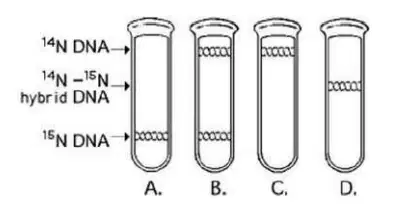
Use the figure to answer the following question.
In the late 1950s, Meselson and Stahl grew bacteria in a medium containing "heavy" (radioactive) nitrogen (13N) and then transferred them to a medium containing 14N (nonradioactive). Which of the results in the figure would be expected after one round of DNA replication in the presence of 14N?
A
B
C
D
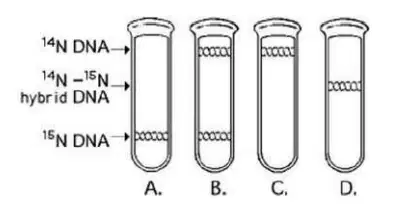
Use the figure to answer the following question.
A space probe returns with a culture of a microorganism found on a distant planet. Analysis shows that it is a carbon-based life-form that has DNA. You grow the cells in 15N medium for several generations and then transfer them to 14N medium. Which pattern in the figure would you expect if the DNA was replicated in a conservative manner?
A
B
C
D
After the first replication was observed in their experiments testing the nature of DNA replication, Meselson and Stahl could be confident of which of the following conclusions?
A) Replication is semi-conservative.
B) Replication is not dispersive.
C) Replication is not conservative
D) Replication is neither dispersive nor conservative.
You briefly expose bacteria undergoing DNA replication to radioactively labeled nucleotides. When you centrifuge the DNA isolated from the bacteria, the DNA separates into two classes. One class of labeled DNA includes very large molecules (thousands or even millions of nucleotides long), and the other includes short stretches of DNA (several hundred to a few thousand nucleotides in length). Which two classes of DNA do these different samples represent?
A) leading strands and Okazaki fragments
B) lagging strands and Okazaki fragments
C) Okazaki fragments and RNA primers
D) leading strands and RNA primers
Within a double-stranded DNA molecule, adenine forms hydrogen bonds with thymine, and cytosine forms hydrogen bonds with guanine. What is the significance of the structural arrangement?
A) It allows variable width of the double helix.
B) It permits complementary base pairing.
C) It determines the tertiary structure of a DNA molecule.
D) It determines the type of protein produced.
Semiconservative replication involves a template. What is the template?
A) single-stranded binding proteins
B) DNA polymerase
C) one strand of the DNA molecule
D) an RNA molecule
In DNA replication, the resulting daughter molecules contain one strand of the original parental DNA and one new strand. What is the explanation for this phenomenon?
A) DNA replication is semiconservative.
B) DNA replication is conservative
C) DNA replication is not conservative.
D) RNA synthesis is conservative.
Who performed classic experiments that supported the semiconservative model of DNA replication?
A) Watson and Crick
B) Meselson and Stahl
C) Hershey and Chase
D) Franklin and Wilkins
DNA contains the template needed to copy itself, but it has no catalytic activity in cells. What catalyzes the formation of phosphodiester bonds between adjacent nucleotides in the DNA polymer being formed during DNA replication?
A) ribozymes
B) DNA polymerase
C) ATP
D) RNA primers
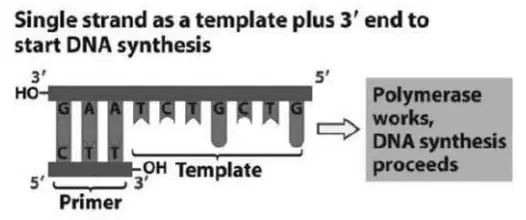
Use the figure to answer the following question.
Referring to the figure, what bases will be added to the primer as DNA replication proceeds?
A) 5′ C, A, G, C, A, G, A 3′
B) 3′ T, C, T, G, C, T, G 5′
C) 5′ A, G, A, C, G, A, C 3′
D) 3′ G, T, C, G, T, C, T 5′
Which of the following statements correctly describes the difference between the leading strand and the lagging strand in DNA replication?
A) The leading strand is synthesized in the 3' → 5' direction in a discontinuous fashion, while the lagging strand is synthesized in the 5' → 3' direction in a continuous fashion.
B) The leading strand is synthesized continuously in the 5' → 3' direction, while the lagging strand is synthesized discontinuously in the 5' → 3' direction.
C) The leading strand requires an RNA primer, whereas the lagging strand does not
D) There are different DNA polymerases involved in elongation of the leading strand and the lagging strand.
What are telomeres?
A) the structures that hold two sister chromatids together
B) enzymes that elongate the DNA strand during replication
C) the sites of origin of DNA replication
D) the ends of linear chromosomes
Telomere shortening puts a limit on the number of times a cell can divide. Research has shown that telomerase can extend the life span of cultured human cells. How might adding telomerase affect cellular aging?
A) Telomerase will speed up the rate of cell proliferation.
B) Telomerase eliminates telomere shortening and retards aging.
C) Telomerase shortens telomeres, which delays cellular aging
D) Telomerase would have no effect on cellular aging.
Which of the following types of cells are affected most by telomere shortening?
A) only prokaryotic cells
B) only eukaryotic cells
C) cells in prokaryotes and eukaryotes
D) only animal cells
Which of the following effects might be caused by reduced or very little active telomerase activity?
A) Cells may become cancerous
B) Telomere lengthens in germ cells.
C) Cells age and begin to lose function.
D) Cells maintain normal functioning.
Researchers found a strain of E. coli bacteria that had mutation rates one hundred times higher than normal. Which of the following statements correctly describes the most likely cause of these results?
A) The single-strand binding proteins were malfunctioning during DNA replication.
B) There were one or more base pair mismatches in the RNA primer.
C) The proofreading mechanism of DNA polymerase was not working properly.
D) The DNA polymerase was unable to add bases to the 3′ end of the growing nucleic acid chain
In a healthy eukaryotic cell, the rate of DNA repair is typically equal to the rate of DNA mutation. When the rate of repair lags behind the rate of mutation, what is a possible fate of the cell?
A) The cell can be transformed into a cancerous cell.
B) RNA may be used instead of DNA as inheritance material.
C) DNA replication will proceed more quickly
D) DNA replication will continue by a new mechanism
Which of the following statements accurately describes the structure of a eukaryotic chromosome?
A) It is composed of a single strand of DNA
B) It is constructed as a series of nucleosomes wrapped around two DNA molecules.
C) It has different numbers of genes in different cell types of an organism
D) It is a single linear molecule of double-stranded DNA plus proteins
If a cell were unable to produce histone proteins, which of the following results would be a likely effect on the cell?
A) There would be an increase in the amount of DNA produced during replication.
B) The cell's DNA could not be packed into its nucleus.
C) Spindle fibers would not form during prophase.
D) Amplification of other genes would compensate for the lack of histones.
Which of the following statements accurately describes one characteristic of histones?
A) Each nucleosome consists of two molecules of histone H1.
B) Histone H1 is not present in the nucleosome bead; instead, it draws the nucleosomes together.
C) The carboxyl end of each histone extends outward from the nucleosome and is called a "histone tail."
D) Histones are found in mammals, but not in other animals or in plants or fungi.
Which of the following molecular characteristics cause histones to bind tightly to DNA?
A) Histones are positively charged, and DNA is negatively charged.
B) Histones are negatively charged, and DNA is positively charged.
C) Both histones and DNA are strongly hydrophobic.
D) Histones are covalently linked to the DNA.
Which of the following lists represents the order of increasingly higher levels of organization of chromatin?
A) nucleosome, 30-nm chromatin fiber, looped domain
B) looped domain, 30-nm chromatin fiber, nucleosome
C) nucleosome, looped domain, 30-nm chromatin fiber
D) 30-nm chromatin fiber, nucleosome, looped domain
Which of the following statements correctly describes the structure of chromatin?
A) Heterochromatin is composed of DNA, whereas euchromatin is made of DNA and RNA.
B) Both heterochromatin and euchromatin are found in the cytoplasm.
C) Heterochromatin is highly condensed, whereas euchromatin is less compact
D) Euchromatin is not transcribed, whereas heterochromatin is transcribed.
Which of the following structural characteristics is most critical for the association between histones and DNA?
A) Histones are small proteins
B) Histones are highly conserved (that is, histones are very similar in every eukaryote)
C) There are at least five different histone proteins in every eukaryote.
D) Histones are positively charged.
In DNA replication in E. coli, the enzyme primase is used to attach a 5 to 10 base ribonucleotide strand complementary to the parental DNA strand. The RNA strand serves as a starting point for the DNA polymerase that replicates the DNA. If a mutation occurred in the primase gene, which of the following results would you expect?
A) Replication would only occur on the leading strand.
B) Replication would only occur on the lagging strand.
C) Replication would not occur on either the leading or lagging strand.
D) Replication would not be affected as the enzyme primase in involved with RNA synthesis.
Hershey and Chase used a DNA-based virus for their work. How might the results have been different if they had used an RNA virus?
A) With an RNA virus, radioactive protein would have been in the final pellet.
B) With an RNA virus, radioactive RNA would have been in the final pellet.
C) With an RNA virus, neither sample would have had a radioactive pellet.
D) With an RNA virus, the protein shell would have been radioactive in both samples.
The lagging strand is characterized by a series of short segments of DNA (Okazaki fragments) that will be joined together to form a finished lagging strand. The experiments that led to the discovery of Okazaki fragments gave evidence for which of the following ideas?
A) DNA polymerase is an enzyme that synthesizes leading and lagging strands during replication only in one direction.
B) DNA is a polymer consisting of four monomers: adenine, thymine, guanine, and cytosine.
C) DNA is the genetic material.
D) Bacterial replication is fundamentally different from eukaryotic replication. The key should not be way longer than the distractors.
Which of the following statements correctly describes Archibald Garrod's hypothesis for how "inborn errors of metabolism" such as alkaptonuria occur?
A) Metabolic enzymes require vitamin cofactors, and affected individuals have significant nutritional deficiencies
B) Enzymes are made of DNA, and affected individuals lack DNA polymerase.
C) Certain metabolic reactions are carried out by ribozymes, and affected individuals lack key splicing factors.
D) Genes dictate the production of specific enzymes, and affected individuals have genetic defects that cause them to lack certain enzymes.
A particular triplet of bases in the template strand of DNA is 5′-AGT-3′. What would be the corresponding codon for the mRNA that is transcribed?
A) 3′-UCA-5′
B) 3′-UGA-5′
C) 5′-TCA-3′
D) 3′-ACU-5′
The genetic code is essentially the same for all organisms. From this, one can logically assume which of the following statements to be true?
A) A gene from an organism can theoretically be expressed by any other organism.
B) DNA was the first genetic material.
C) The same codons in different organisms translate into different amino acids.
D) Different organisms have different types of amino acids.
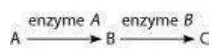
Use the figure to answer the question.
The figure shows a simple metabolic pathway. According to Beadle and Tatum's hypothesis, how many genes are necessary for this pathway?
1
2
3
D) It cannot be determined from the pathway.
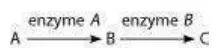
Use the figure to answer the question.
Refer to the metabolic pathway illustrated. If A, B, and C are all required for growth, a strain that is mutant for the gene-encoding enzyme A would be able to grow on medium supplemented with which of the following nutrient(s)?
A) nutrient A only
B) either nutrient B or C
C) nutrient C only
D) nutrients A and C
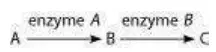
Use the figure to answer the question.
Refer to the metabolic pathway illustrated. If A, B, and C are all required for growth, a strain mutant for the gene encoding enzyme B would be able to grow on medium supplemented with which of the following nutrient(s)?
A) nutrient A only
B) nutrient B only
C) nutrient C only
D) nutrients A and C
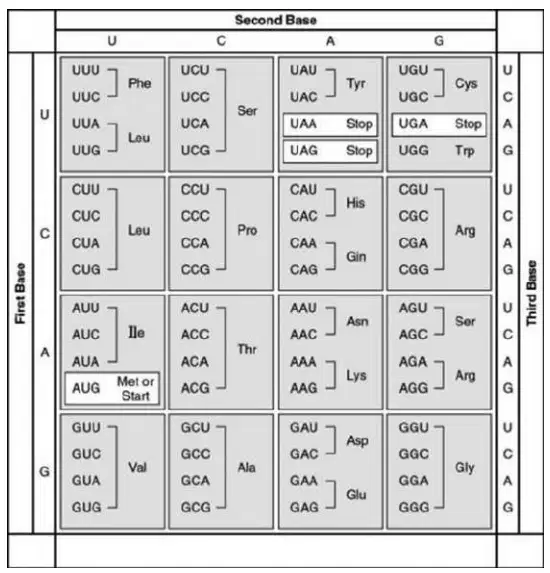
The following question refers to this table of codons.
Which of the following sequences of nucleotides are possible in the template strand of DNA that would code for the polypeptide sequence Phe-Leu-Ile-Val?
A) 5′-TTG-CTA-CAG-TAG-3′
B) 5′-AUG-CTG-CAG-TAT-3′
C) 3′-AAA-AAT-ATA-ACA-5′
D) 3′-AAA-GAA-TAA-CAA-5′
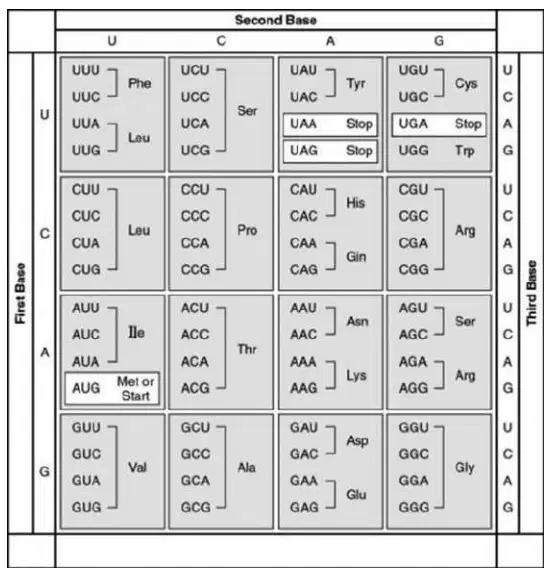
The following question refers to this table of codons.
What amino acid sequence will be generated, based on the following mRNA codon sequence?
5′-AUG-UCU-UCG-UUA-UCC-UUG-3′
A) Met-Arg-Glu-Arg-Glu-Arg
B) Met-Glu-Arg-Arg-Glu-Leu
C) Met-Ser-Leu-Ser-Leu-Ser
D) Met-Ser-Ser-Leu-Ser-Leu
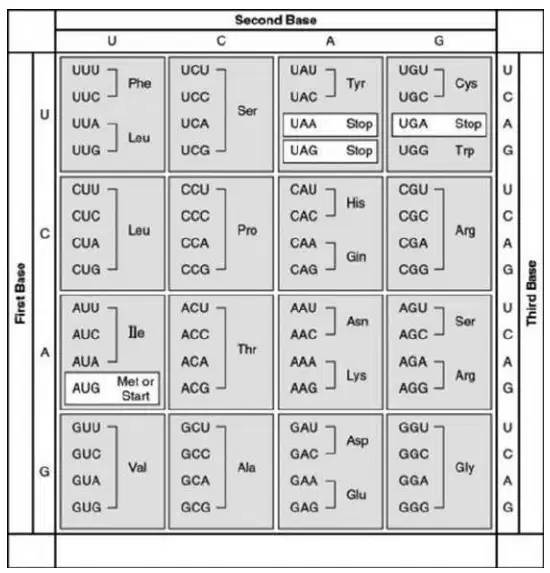
The following question refers to this table of codons.
Which of the triplets below is a possible anticodon for a tRNA that transports proline to a ribosome?
A) 3′-UUC-5′
B) 3′-CCG-5′
C) 3′-GGC-5′
D) 3′-CCC-5′
Which of the following statements supports the one gene-one enzyme hypothesis?
A) A mutation in a single gene can result in a defective protein.
B) Alkaptonuria results when individuals lack multiple enzymes involved in the catalysis of homogentisic acid.
C) Sickle-cell anemia results in normal hemoglobin.
D) Multiple antibody genes can code for different related proteins, depending on the splicing that takes place post-transcriptionally.
Which of the following characteristics is directly related to the coding of a single amino acid during the process of translation?
A) the base sequence of the tRNA
B) the amino acetyl tRNA synthase
C) the three-base sequence of mRNA
D) the complementarity of DNA and RNA
Which of the following processes occurs during transcription?
A) DNA is replicated
B) RNA is synthesized
C) proteins are synthesized
D) mRNA attaches to ribosomes
Which of the following molecular structures contain codons?
A) a protein
B) mRNA
C) tRNA
D) rRNA
The genetic code is redundant. What is meant by this statement?
A) A single codon can specify the addition of more than one amino acid
B) The genetic code is different for different domains of organisms.
C) The genetic code is universal (the same for all organisms).
D) More than one codon can specify the addition of the same amino acid.
Once researchers identified DNA as the molecule responsible for transmitting heritable traits, they asked how information was transferred from the DNA in the nucleus to the site of protein synthesis in the cytoplasm. Which of the following statements correctly describes the mechanism of information transfer in eukaryotes that accomplishes this task?
A) DNA from a single gene is replicated and transferred to the cytoplasm, where it serves as a template for protein synthesis.
B) Messenger RNA is transcribed from a single gene and transfers information from the DNA in the nucleus to the cytoplasm, where protein synthesis takes place.
C) Histone proteins in the chromosomes transfer information from the nucleus to the ribosome, where protein synthesis takes place.
D) Transfer RNA takes information from DNA directly to a ribosome, where protein synthesis takes place.
According to the central dogma, what is the intermediate molecule involved in the flow of information in a cell that should go in the blank? DNA →_____ → Proteins
A) mtDNA
B) rRNA
B) rRNA
D) tRNA
Codons are three-base sequences in mRNA that specify the addition of a single amino acid to the growing protein chain during translation. How do eukaryotic codons and prokaryotic codons compare?
A) Prokaryotic codons usually contain different bases than those of eukaryotes.
B) Prokaryotic codons usually specify different amino acids than those of eukaryotes.
C) The translation of codons is mediated by tRNAs in eukaryotes, but translation requires no intermediate molecules such as tRNAs in prokaryotes.
D) Codons are a nearly universal language among all organisms.
Which of the following processes occurs in prokaryotes but not in eukaryotes?
A) post-transcriptional splicing
B) transcription and translation occur simultaneously
C) translation in the absence of a ribosome
D) gene splicing
Which of the following statements best describes the termination of transcription in prokaryotes?
A) RNA polymerase transcribes through the polyadenylation signal, causing proteins to associate with the transcript and cut it free from the polymerase.
B) RNA polymerase transcribes through the terminator sequence, causing the polymerase to separate from the DNA and release the transcript.
C) Once transcription has initiated, RNA polymerase transcribes until it reaches the end of the chromosome.
D) RNA polymerase transcribes through a stop codon, causing the polymerase to stop advancing through the gene and release the mRNA.
In eukaryotes, there are several different types of RNA polymerase. Which type is involved in transcription of mRNA for a globin protein?In eukaryotes, there are several different types of RNA polymerase. Which type is involved in transcription of mRNA for a globin protein?
A) RNA polymerase I
B) RNA polymerase II
C) RNA polymerase III
D) primase
Transcription in eukaryotes requires which of the following molecules in addition to RNA polymerase?
A) anticodons
B) ribosomes and tRNA
C) several transcription factors
D) aminoacyl-tRNA synthetase
Which of the following statements best describes the significance of the TATA box in the promoters of eukaryotes?
A) It is the recognition site for the binding of a specific transcription factor.
B) It sets the reading frame of the mRNA during translation.
C) It is the recognition site for ribosomal binding during translation.
D) It is the recognition site for ribosomal binding during transcription.
Which of the following processes occurs in eukaryotic gene expression?
A) mRNA, tRNA, and rRNA are translated
B) RNA polymerase binds to the terminator sequence.
C) A cap is added to the 5′ end of the mRNA.
D) RNA polymerase requires tRNA to elongate the molecule
Which of the following statements correctly describes a ribozyme?
A) It is a catalyst that uses RNA as a substrate.
B) It is an RNA with catalytic activity.
C) It is an enzyme that catalyzes the association between the large and small ribosomal subunits
D) It is an enzyme that synthesizes RNA as part of the transcription process.
Which of the following processes correctly describes alternative RNA splicing?
A) It is a mechanism for increasing the rate of translation.
B) It can allow the production of proteins of different sizes and functions from a single mRNA.
C) It can allow the production of similar proteins from different RNAs.
D) It increases the rate of transcription.
In the structural organization of many eukaryotic genes, individual exons may be related to which of the following?
A) the sequence of the intron that immediately precedes each exon
B) the number of polypeptides making up the functional protein
C) the various domains of the polypeptide product
D) the number of start sites for transcription
In an experimental situation, a student researcher inserts an mRNA molecule into a eukaryotic cell after she has removed its 5′ cap and poly-A tail. Which of the following processes would you expect her to find to have occurred?
A) The mRNA is quickly converted into a ribosomal subunit.
B) The cell adds a new poly-A tail to the mRNA.
C) The mRNA attaches to a ribosome and is translated, but more slowly.
D) The molecule is digested by enzymes because it is not protected at the 5′ end.
Use this model of a eukaryotic transcript to answer the following question.
E = exon and I = intron
5′-UTR E1 I1 E2 I2 E3 I3 E4 UTR-3′
Which components of the previous molecule will also be found in mRNA in the cytosol?
A) 5′-UTR I1 I2 I3 UTR-3′
B) 5′-E1 E2 E3 E4-3′
C) 5′-UTR E1 E2 E3 E4 UTR-3′
D) 5′-E1 I1 E2 I2 E3 I3 E4-3′
Which one of the following statements about RNA processing is correct?
A) Exons are cut out before mRNA leaves the nucleus.
B) Ribozymes may function in RNA splicing.
C) RNA splicing can be catalyzed by tRNA
D) A primary transcript is often much shorter than the final RNA molecule that leaves the nucleus
How does the primary transcript in the nucleus of a eukaryotic cell compare to the functional mRNA?
A) the primary transcript is the same size as the mRNA
B) the primary transcript is larger than the mRNA
C) the primary transcript is smaller than the mRNA
D) both the primary transcript and mRNA contain introns
How does the primary transcript in the nucleus of a prokaryotic cell compare to the functional mRNA?
A) the primary transcript is larger than the mRNA
B) the primary transcript is smaller than the mRNA
C) the primary transcript and the mRNA both contain introns
D) the primary transcript is the same size as the mRNA
A particular triplet of bases in the coding sequence of DNA is AAA. The anticodon on the tRNA that binds the mRNA codon is _____.
A) TTT
B) UUA
C) UUU
D) AAA
Accuracy in the translation of mRNA into the primary structure of a polypeptide depends on specificity in the _____.
A) binding of ribosomes to mRNA
B) binding of the anticodon to small subunit of the ribosome
C) attachment of amino acids to rRNAs
D) binding of the anticodon to the codon and the attachment of amino acids to tRNAs
What would be the consequence of a mutation in a bacterial cell that produces a defective aminoacyl-tRNA synthetase that attaches a lysine instead of the normal phenylalanine to tRNAs with the anticodon AAA?
A) None of the proteins in the cell will contain phenylalanine.
B) Proteins in the cell will include lysine instead of phenylalanine at amino acid positions specified by the codon UUU.
C) The cell will compensate for the defect by attaching phenylalanine to tRNAs with lysine-specifying anticodons.
D) The ribosome will skip a codon every time a UUU is encountered.
In bacteria, there are 61 mRNA codons that specify an amino acid, but only 45 tRNAs. Which of the following statements explains this fact?
A) Some tRNAs have anticodons that recognize four or more different codons.
B) The rules for base pairing between the third base of a codon and tRNA are flexible.
C) Many codons are never used, so the tRNAs that recognize them are dispensable.
D) The DNA codes for all 61 tRNAs, but some are then destroyed.
Which of the following processes is the first event to take place in translation in eukaryotes?
A) base pairing of activated methionine-tRNA to AUG of the messenger RNA
B) binding of the larger ribosomal subunit to smaller ribosomal subunits
C) the ribosome reaches a stop codon
D) the small subunit of the ribosome recognizes and attaches to the 5′ cap of mRNA
Which of the following statements correctly describes the function of a signal peptide?
A) It directs an mRNA molecule into the cisternal space of the ER.
B) It terminates translation of messenger RNA.
C) It helps target a protein to the ER.
D) It signals the initiation of transcription.
What is the function of the release factor during translation in eukaryotes?
A) It binds to the stop codon in the A site in place of a tRNA.
B) It releases the amino acid from its tRNA to allow the amino acid to form a peptide bond.
C) It supplies a source of energy for termination of translation.
D) It releases the ribosome from the ER to allow polypeptides into the cytosol.
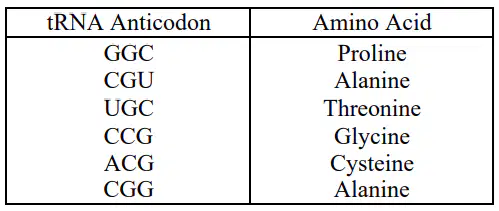
Use the following information to answer the question.
A part of an mRNA molecule with the following sequence is being read by a ribosome: 5′-CCGACG-3′ (mRNA). The following charged transfer RNA molecules (with their anticodons shown in the 3′ to 5′ direction) are available. Two of them can correctly match the mRNA so that a dipeptide can form.
Which of the following dipeptides will form from this mRNA?
A) cysteine-alanine
B) proline-threonine
C) glycine-cysteine
D) alanine-alanine
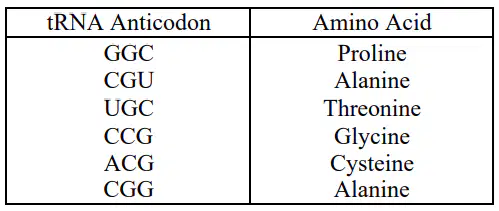
Use the following information to answer the question.
A part of an mRNA molecule with the following sequence is being read by a ribosome: 5′-CCGACG-3′ (mRNA). The following charged transfer RNA molecules (with their anticodons shown in the 3′ to 5′ direction) are available. Two of them can correctly match the mRNA so that a dipeptide can form.
Which of the following anticodons in the first tRNA to bind will complement this mRNA?
A) 3′-GGC-5′
B) 5′-GGC-3′
C) 5′-UGC-3′
D) 3′-UGC-5′
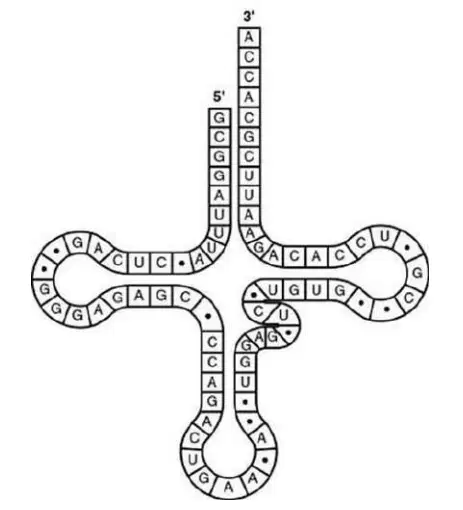
Use the figure to answer the question.
What type of bonding is responsible for maintaining the shape of the tRNA molecule shown in the figure?
A) ionic bonding between phosphates
B) hydrogen bonding between base pairs
C) van der Waals interactions between hydrogen atoms
D) peptide bonding between amino acids
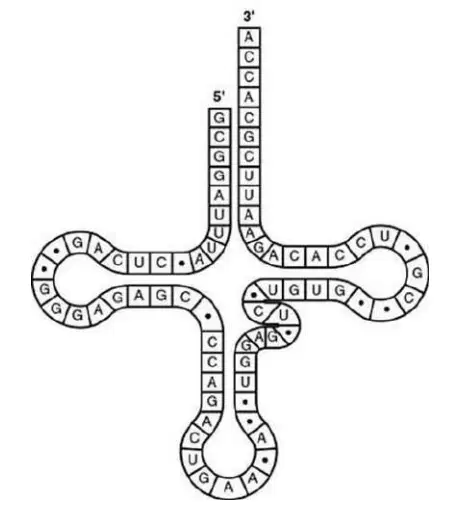
Use the figure to answer the question. 1
The figure represents tRNA that recognizes and binds a particular amino acid (in this instance, phenylalanine). Which codon on the mRNA strand codes for this amino acid?
A) 5′-UGG-3′
B) 3′-GUG-5′
C) 5′-GUA-3′
D) 5′-UUC-3′
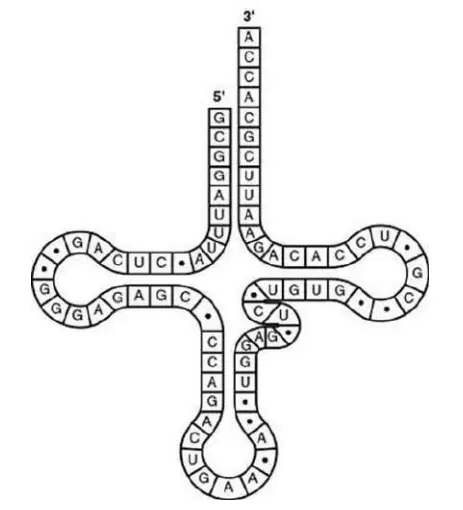
Use the figure to answer the question.
The tRNA shown in the figure has its 3′ end projecting beyond its 5′ end. Which of the following processes will occur at this 3′ end?
A) The amino acid binds covalently.
B) The excess nucleotides (ACCA) will be cleaved off at the ribosome.
C) The small and large subunits of the ribosome will attach to it.
D) The 5′ cap of the mRNA will become covalently bound.
Which of the following properties is associated with a protein that will be secreted from a eukaryotic cell?
A) It must be translated by a ribosome that remains free within the cytosol.
B) Its signal sequence must target it to the ER, after which it goes to the Golgi.
C) Its signal sequence must be cleaved off before the polypeptide can enter the ER.
D) Its signal sequence must target it to the plasma membrane, where it causes exocytosis.
Which of the following molecules are required for the process of translation?
A) mRNA, tRNA, DNA, and rRNA
B) mRNA, DNA, and rRNA
C) mRNA, tRNA, and rRNA
D) mRNA, tRNA, and DNA
During the elongation phase of translation, which site in the ribosome represents the location where a codon is being read?
A) E site
B) P site
C) A site
D) the large ribosomal subunit
Once a peptide bond has been formed between the amino acid attached to the tRNA in the P site and the amino acid associated with the tRNA in the A site, what process occurs next?
A) translocation
B) reading of the next codon of mRNA
C) initiation
D) The codon-anticodon hydrogen bonds holding the tRNA in the A site are broken.
Which one of the following structures, if missing, would usually prevent translation from starting?
A) exon
B) 5′ cap
C) AUG codon
D) poly-A tail
Which of the following processes occurs when termination of translation takes place?
A) The end of the mRNA molecule is reached.
B) A stop codon is reached.
C) The 5′ cap is reached.
D) The poly-A tail is reached.
Post-translational modifications of proteins may include which of the following processes?
A) removal of introns
B) addition of a 5′ cap
C) addition of a poly-A tail
D) addition of carbohydrates to form a glycoprotein
Which of the following statements is true about protein synthesis in prokaryotes?
A) Extensive RNA processing is required before prokaryotic transcripts can be translated.
B) Translation can begin while transcription is still in progress.
C) Prokaryotic cells have complicated mechanisms for targeting proteins to the appropriate cellular organelles.
D) Unlike eukaryotes, prokaryotes require no initiation or elongation factors.
Which of the following types of mutation, resulting in an error in the mRNA just after the AUG start of translation, is likely to have the most serious effect on the polypeptide product?
A) a deletion of a codon
B) a deletion of two nucleotides
C) a substitution of the third nucleotide in an ACC codon
D) a substitution of the first nucleotide of a GGG codon
Which of the following statements correctly describes the effect a nonsense mutation would have on a gene?
A) It changes an amino acid in the encoded protein.
B) It has no effect on the amino acid sequence of the encoded protein.
C) It introduces a premature stop codon into the mRNA.
D) It alters the reading frame of the mRNA.
Which of the following DNA mutations is most likely to damage the protein it specifies?
A) a base-pair deletion
B) an addition of three nucleotides
C) a substitution in the last base of a codon
D) a codon deletion
The most commonly occurring mutation in people with cystic fibrosis is a deletion of a single codon. What is the result of this type of mutation?
A) a base-pair substitution
B) a frameshift mutation
C) a polypeptide missing an amino acid
D) a nonsense mutation
Which of the following statements is the most current description of a gene?
A) a unit of heredity that causes formation of a phenotypic characteristic
B) a DNA subunit that codes for a single complete protein
C) a DNA sequence that is expressed to form a functional product: either RNA or polypeptide
D) a discrete unit of hereditary information that consists of a sequence of amino acids
How might a single base substitution in the sequence of a gene affect the amino acid sequence of a protein encoded by the gene?
A) Only a single amino acid could change, because the reading frame would be unaffected.
B) The amino acid sequence would be substantially altered, because the reading frame would change with a single base substitution.
C) All amino acids following the substitution would be affected, because the reading frame would be shifted.
D) It is not possible for a single base substitution to affect protein structure, because each codon is three bases long.
An original section of DNA has the base sequence AGCGTTACCGT. A mutation in this DNA strand results in the base sequence AGGCGTTACCGT. What type of mutation does this change represent?
A) a missense mutation
B) a point mutation
C) a silent mutation
D) frameshift mutation
A single base substitution mutation is likely to have a less deleterious effect when the base change exhibits which of the following results?
A) a stop codon
B) a codon that specifies the same amino acid as the original codon
C) an amino acid substitution that alters the tertiary structure of the protein
D) an amino acid substitution at the active site of an enzyme
Rank the following one-base point mutations with respect to their likelihood of affecting the structure of the corresponding polypeptide (from most likely to least likely).
1. insertion mutation deep within an intron
2. substitution mutation at the third position of a codon in an exon
3. substitution mutation at the second position of a codon in an exon
4. deletion mutation within the first exon of the gene
A) 1, 2, 3, 4
B) 4, 3, 2, 1
C) 2, 1, 4, 3
D) 3, 1, 4, 2
In his work with pneumonia-causing bacteria and mice, Griffith found that
A) the protein coat from pathogenic cells was able to transform nonpathogenic cells.
B) heat-killed pathogenic cells caused pneumonia.
C) some substance from pathogenic cells was transferred to nonpathogenic cells, making them pathogenic.
D) the polysaccharide coat of bacteria caused pneumonia.
What is the basis for the difference in how the leading and lagging strands of DNA molecules are synthesized?
A) The origins of replication occur only at the 5′ end.
B) Helicases and single-strand binding proteins work at the 5′ end.
C) DNA polymerase can join new nucleotides only to the 3′ end of a pre-existing strand, and the strands are antiparallel
D) DNA ligase works only in the 3′ → 5′ direction.
In analyzing the number of different bases in a DNA sample, which result would be consistent with the base-pairing rules?
A) A = G
B) A + G = C + T
C) A + T = G + C
D) A = C
The elongation of the leading strand during DNA synthesis
A) progresses away from the replication fork.
B) occurs in the 3′ → 5′ direction.
C) produces Okazaki fragments.
D) depends on the action of DNA polymerase.
In a nucleosome, the DNA is wrapped around
A) histones.
B) ribosomes.
C) polymerase molecules.
D) a thymine dimer.
E. coli cells grown on 15N medium are transferred to 14N medium and allowed to grow for two more generations (two rounds of DNA replication). DNA extracted from these cells is centrifuged. What density distribution of DNA would you expect in this experiment?
A) one high-density and one low-density band
B) one intermediate-density band
C) one high-density and one intermediate-density band
D) one low-density and one intermediate-density band
A biochemist isolates, purifies, and combines in a test tube a variety of molecules needed for DNA replication. When she adds some DNA to the mixture, replication occurs, but each DNA molecule consists of a normal strand paired with numerous segments of DNA a few hundred nucleotides long. What has she probably left out of the mixture?
A) DNA polymerase
B) DNA ligase
C) Okazaki fragments
D) primase
The spontaneous loss of amino groups from adenine in DNA results in hypoxanthine, an uncommon base, opposite thymine. What combination of proteins could repair such damage?
A) nuclease, DNA polymerase, DNA ligase
B) telomerase, primase, DNA polymerase
C) telomerase, helicase, single-strand binding protein
D) DNA ligase, replication fork proteins, adenylyl cyclase
In eukaryotic cells, transcription cannot begin until
A) the two DNA strands have completely separated and exposed the promoter.
B) several transcription factors have bound to the promoter.
C) the 5 caps are removed from the mRNA.
D) the DNA introns are removed from the template.
Which of the following is not true of a codon?
A) It may code for the same amino acid as another codon.
B) It never codes for more than one amino acid.
C) It extends from one end of a tRNA molecule.
D) It is the basic unit of the genetic code.
The anticodon of a particular tRNA molecule is
A) complementary to the corresponding mRNA codon.
B) complementary to the corresponding triplet in rRNA.
C) the part of tRNA that bonds to a specific amino acid.
D) catalytic, making the tRNA a ribozyme.
Which of the following is not true of RNA processing?
A) Exons are cut out before mRNA leaves the nucleus.
B) Nucleotides may be added at both ends of the RNA.
C) Ribozymes may function in RNA splicing.
D) RNA splicing can be catalyzed by spliceosomes.
Which component is not directly involved in translation?
A) GTP
B) DNA
C) tRNA
D) ribosomes
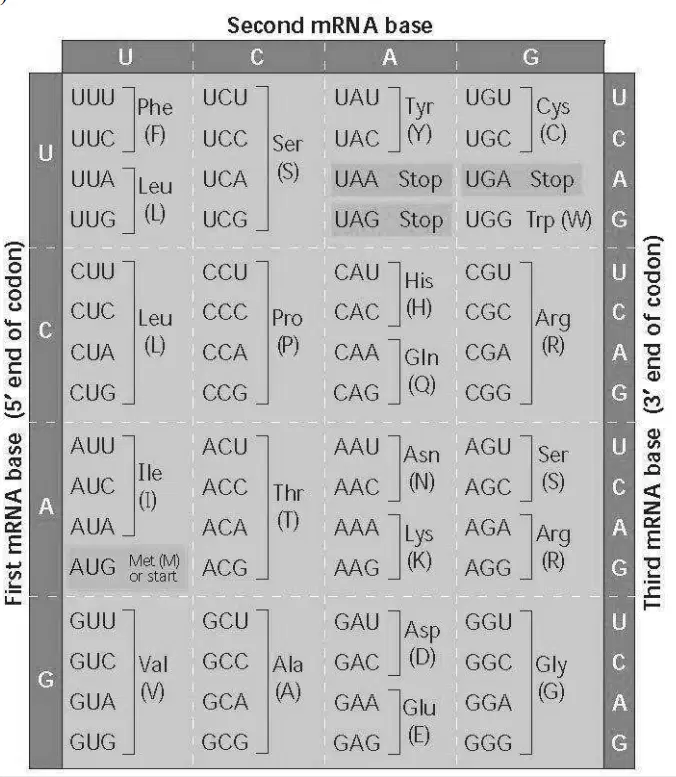
Using Figure 17.6, identify a 5′ → 3′ sequence of nucleotides in the DNA template strand for an mRNA coding for the polypeptide sequence Phe-Pro-Lys.
A) 5-UUUCCCAAA-3
B) 5-GAACCCCTT-3
C) 5-CTTCGGGAA-3
D) 5-AAACCCUUU-3
Which of the following mutations would be most likely to have a harmful effect on an organism?
A) a deletion of three nucleotides near the middle of a gene
B) a single nucleotide deletion in the middle of an intron
C) a single nucleotide deletion near the end of the coding sequence
D) a single nucleotide insertion downstream of, and close to, the start of the coding sequence

