wayground logo

Free Printable Worksheets

Font size

S
M
L
XL
Worksheets

Keystone Review Module B 22-23

Total questions: 143

Worksheet time: 2hrs 47mins

Name
Class
Date
1.
Which stage of the cell cycle is shown in the diagram?
a)
Prophase
b)
Interphase
c)
Anaphase
d)
Telophase
2.
The structure shown in the diagram is a _____________?
a)
chromatid
b)
chromosome
c)
centromere
d)
DNA
3.
Which stage of mitosis is shown in the diagram?
a)
Anaphase
b)
Cytonkinesis
c)
Interphase
d)
Prophase
4.
What is the name of the structure labeled X?
a)
Centriole
b)
Centrosome
c)
Chromatid
d)
Chromosome 
5.
Which stage of mitosis is shown in the diagram?
a)
Cytokinesis
b)
Interphase
c)
Anaphase
d)
Metaphase
6.

How many chromosomes do humans have?

a)

46

b)

21

c)

10

d)

23

7.
Which stage of mitosis is shown in the diagram?
a)
Cytokinesis
b)
Anaphase
c)
Telophase
d)
Prophase
8.
Which stage of mitosis is shown in the diagram?
a)
Anaphase
b)
Cytokinesis
c)
Telophase
d)
Metaphase
9.
How many cells are made in the process of MITOSIS?
a)
one
b)
two
c)
four
d)
eight
10.

Cytokinesis happens at the end of mitosis. That is when

a)

the cell membrane splits

b)

the nucleus splits again

c)

the chromosomes merge

11.
Which stage of cell division is shown in the diagram?
a)
Anaphase
b)
Metaphase
c)
Cytokinesis
d)
Telophase
12.
Why would it be important to replicate DNA before a cell divides in mitosis or meiosis?
a)
In order for genetic information to be transferred into daughter cells.
b)
In order for the cell to be able to increase in size.
c)
In order for the DNA to be contained in the nucleus.
d)
In order for the cell to re-order the DNA sequencing in the new cells.
13.
In mitosis, the two resulting cells are
a)
different from the starting cell and identical to each other.
b)
different from the starting cell and different from each other.
c)
identical to the starting cell and different from each other.
d)
identical to the starting cell and identical to each other.
14.

Highly coiled (condensed) strand of DNA

a)

Chromatin

b)

Chromosome

c)

Sister Chromatid

d)

Centeromere

15.
Chromosomes are copied during which phase of the cell cycle?
a)
M phase
b)
G1 phase
c)
G2 phase
d)
S phase
16.

Where does Mitosis take place?

a)

where growth and repair are happening in body cells

b)

Sex cells

c)

Sperm Cells

d)

Egg Cells

17.

Name the phase:

Hint: Chromosomes are moving apart.

a)

Anaphase

b)

Telophase

c)

Metaphase

d)

Prophase

18.
Where does a cell contain its genetic material?
a)
nucleus
b)
nucleolus
c)
cytoskeleton
d)
chloroplasts
19.
Fruit fly body cells have 8 chromosomes. After mitosis, you would expect a resulting fruit fly daughter cell to have -
a)
16 chromosomes.
b)
46 chromosomes.
c)
8 chromosomes.
d)
4 chromosomes.
20.

Name the structure in the picture labeled A.

a)

Gene

b)

Chromatin

c)

DNA

d)

Chromosome

21.

Mitosis produces

a)

two genetically identical cells

b)

two genetically unique cells

c)

four genetically identical cells

d)

four genetically unique cells

22.

In which phase of mitosis does the nuclear membrane break apart and chromosomes appear visible?

a)

Prophase

b)

Metaphase

c)

Anaphase

d)

Telophase

23.

In which phase of mitosis do chromosomes line up along the equator of the cell and have spindle fibers attach?

a)

Prophase

b)

Metaphase

c)

Anaphase

d)

Telophase

24.

In which phase of mitosis do spindles fibers pull sister chromatids to opposite ends of the elongating cell?

a)

Prophase

b)

Metaphase

c)

Anaphase

d)

Telophase

25.

In which phase of mitosis does a nuclear membrane build around each set of DNA and the center of the cell begin to pinch?

a)

Prophase

b)

Metaphase

c)

Anaphase

d)

Telophase

26.

Which phase serves as preparation for division to make sure the two new cells will be big enough, have a complete set of DNA, and has all organelles/materials needed

a)

Prophase

b)

Metaphas

c)

Cytokinesis

d)

Interphase

27.

What is true about this image?

a)

The chromosomes did not align in homologous pairs

b)

the gametes will be missing genetic information

c)

all gametes have the appropriate amount of genetic information

d)

Metaphase II is correct while Metaphase I is not

28.

What is wrong with this image?

a)

Crossing over happened

b)

The gametes are missing information

c)

The chromosomes are paired incorrectly in metaphase II

d)

Homologous chromosomes shouldn't be paired with opposite colors

29.

How would you explain why this is wrong?

a)

Homologous pairs refers to chromosome length not color

b)

they split incorrectly

c)

The gametes have the incorrect information due to nondisjunction

d)

Crossing over shouldn't be seen here

30.

What vocab word below failed to occur?

a)

crossing over

b)

homologous pairs

c)

nondisjunction

d)

meiosis

31.

Which letter indicates homologous chromosomes?

a)

A

b)

B

c)

C

d)

D

e)

E

32.

Which letter shows homologous pairs?

a)

A

b)

B

c)

C

d)

D

e)

E

33.

Why is creating 4 gametes a benefit in meiosis?

a)

meiosis doesn't make 4 gametes

b)

it increases genetic variation

c)

reduces risk of nondisjunction

d)

increases the likelihood of getting pregnant

34.

How many total chromosomes should be in each gamete?

a)

1

b)

2

c)

23

d)

46

e)

92

35.

What caused this?

a)

crossing over

b)

random alignment of chromosomes

c)

nondisjunction

d)

meiosis

36.

You see diploid daughter cells. What process just completed?

a)

interphase

b)

mitosis

c)

meiosis

d)

crossing over

37.

You see more genetic variation than predicted. What extra event happened that doesn't always?

a)

crossing over

b)

nondisjunction

c)

random alignment of chromosomes in metaphase I

d)

S phase

38.
Different forms of genes:
a)
alleles
b)
phenotype
c)
genotype
d)
homologous chromosomes
39.
The passing of genetic traits from parent to offspring:
a)
allele
b)
gene
c)
heredity
d)
homozygous
40.
What is another way of saying "purebred"?
a)
homozygous
b)
dominant
c)
recessive
d)
heterozygous
41.
An organism's appearance or other observable characteristics:
a)
phentoype
b)
genotype
c)
recessive
d)
dominant
42.
An organism's genetic make-up:
a)
phenotype
b)
genotype
c)
dominant
d)
recessive
43.
Having two of the SAME alleles for a trait (example HH or hh):
a)
homozygous
b)
heterozygous
c)
recessive
d)
dominant
44.
Having two different alleles for a trait (example Hh):
a)
homozygous
b)
heterozygous
c)
dominant
d)
purebred
45.
FF crossed with ff, what is the probability of the DOMINANT PHENOTYPE appearing in the offspring generation?
a)
0%
b)
25%
c)
50%
d)
100%
46.
Two heterozygous parents produce offspring. What is the probability of the RECESSIVE PHENOTYPE appearing in the offspring generation?
a)
75%
b)
25%
c)
50%
d)
100%
47.
Two heterozygous parents produce offspring. What is the probability of the HOMOZYGOUS DOMINANT GENOTYPE appearing in the offspring generation?
a)
75%
b)
25%
c)
50%
d)
100%
48.
Two heterozygous parents produce offspring. What is the probability of the HETEROZYGOUS GENOTYPE appearing in the offspring generation?
a)
75%
b)
25%
c)
50%
d)
100%
49.
In mussels, the allele for brown coloring (B) is dominant, and the allele for blue coloring (b) is recessive. Which parents would have to cross to have a 100% chance of blue offspring?
a)
BbxBb
b)
bbxbb
c)
BBxbb
d)
BBxBB
50.
B=brown eyes
b= blue eyes
What is true about two brothers that have brown eyes?
One has genotype BB the other Bb.
a)
they have same phenotype and genotype
b)
they have different genotypes and phenotypes
c)
they have same phenotype but different genotypes
d)
they have same genotype but different phenotypes
51.
Which of the following is a phenotype?
a)
Aa
b)
red hair
c)
heterozygous
d)
BB
52.
What is another way of saying "hybrid"?
a)
heterozygous
b)
homozygous dominant
c)
homozygous recessive
d)
none of these choices
53.
A recessive trait only shows up when __________.
a)
two dominant alleles are present
b)
one dominant allele is present
c)
two recessive alleles are present
d)
at least one dominant allele is present
54.

A brown rooster and a white chicken produced this speckled offspring:

a)

Incomplete dominance

b)

Codominance

c)

Complete dominance

55.

A black male and white female produced this grey offspring:

a)

Incomplete dominance

b)

Codominance

c)

Complete dominance

56.

The green fish offspring in this image is an example of ---

a)

Incomplete dominance

b)

Codominance

57.

A red flowered plant (RR) is crossed with a white flowered plant (WW). The gene for petal color in these plants expresses incomplete dominance. What percentage of the offspring will have red (RR) flowers?

a)

0%

b)

25%

c)

50%

d)

100%

58.

What percentage of the offspring will be a carrier for this recessive disease?

a)
0%
b)
50%
c)
100%
d)
25%
59.
Hemophilia is a recessive x-linked disorder.
Which genotype represents a female who is a carrier for hemophilia?
a)
XHXh
b)
XhXh
c)
XHXH
d)
XhY
60.

H= normal blood clotting

h=hemophilia


XHXh x XHY


What is the probability that any of their offspring will have hemophilia?

a)

4/4

b)

3/4

c)

2/4

d)

1/4

61.

In the image above, what is the percentage of the offspring has the possibility of inheriting blood type O?

a)

0%

b)

25%

c)

50%

d)

100%

62.
What is NOT a possible genotype for someone with type B blood?
a)
IBIB
b)
IAIB
c)
IB i
63.
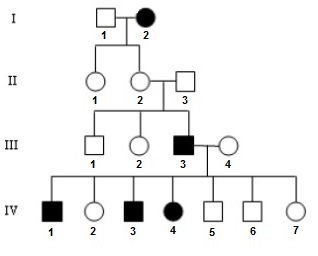
This pedigree represents the inheritance of hemophilia in this family. How many of the females have the hemophilia trait?
a)
8
b)
5
c)
2
d)
3
64.
In the second generation-how many people are carriers of the trait?
a)
2
b)
3
c)
5
d)
6
65.

In this pedigree, which gender can be carriers of colorblindness and not have it?

a)

Just males

b)

Just females

c)

Both genders

66.
If a trait SKIPS a generation, it is an indication that the trait is....
a)
dominant
b)
recessive
c)
incompletely dominant
d)
co-dominant
67.

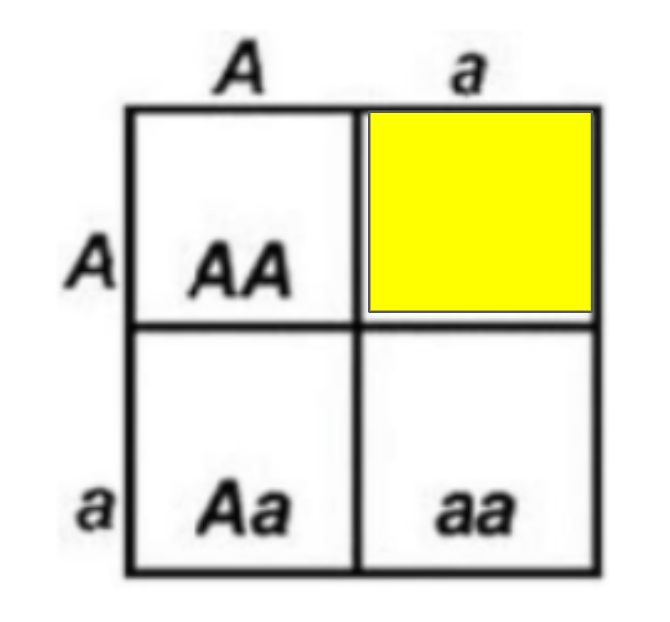
Fill in the Yellow Box

a)

AA

b)

Aa

c)

aa

68.

The blending of two traits is known as ---

a)

incomplete dominance

b)

codominance

69.

A condition in which both alleles for a gene are expressed so that both traits are visible is known as ---

a)

Codominance

b)

Incomplete dominance

70.

What type of inheritance pattern is shown here?

a)

Codominance

b)

Incomplete dominance

71.

A calico cat shows both the traits for orange fur and black fur. What kind of allele expression is this?

a)

Incomplete dominance

b)

Codominance

72.

This is an example of ---

a)

Incomplete dominance

b)

Codominance

73.

A woman with curly hair and a man with straight hair produced a child with wavy hair:

a)

Incomplete dominance

b)

Codominance

c)

Complete dominance

74.
In eukaryotes, molecule 1 is found in
a)
ribosomes
b)
chloroplasts
c)
cytoplasm
d)
the nucleus
75.
Which of the following statements is true?
a)
DNA is single-stranded
b)
RNA is single-stranded
c)
DNA contains uracil
d)
RNA contains deoxyribose
76.

The Process of creating RNA from DNA

a)

Transcription

b)

Translation

c)

Replication

77.

In RNA the base T is replaced with

a)

U

b)

G

c)

C

d)

A

78.

What combines together to make a protein?

a)

Amino Acid

b)

RNA

c)

Ribosome

d)

DNA

79.

What organelle is the site of translation?

a)

Nucleus

b)

Ribosome

c)

Mitochondria

d)

Chloroplast

80.
Which type of RNA takes the instructions from the nucleus to the cytoplasm?
a)
mRNA
b)
tRNA
c)
rRNA
d)
RNA polymerase
81.
If a DNA strand reads ATT CGT CTA, what would the mRNA strand read?
a)
TAA GCA GAT
b)
CGA TGA GUT
c)
UAA GCA GAU
d)
TAA GCA GUT
82.
What is a codon?
a)
a sequence of 3 amino acids
b)
a sequence of three nitrogen bases
c)
a sequence of 3 enzymes
d)
a sequence of 3 proteins
83.
Which correctly outlined the central dogma
a)
DNA --> mRNA --> rRNA
b)
DNA --> tRNA --> protein
c)
DNA --> mRNA --> protein
d)
DNA --> amino acid --> protein
84.
Which of the following best defines a gene?
a)
A diploid cell containing two sets of chromosomes
b)
A unit made up of chromosomes that control for a specific trait
c)
A segment of DNA that codes for a particular protein
d)
All the other answers are correct.
85.
What type of bonds hold the nitrogen bases in the DNA rungs together?
a)
ionic bonds
b)
hydrogen bonds
c)
peptide bonds
d)
james bonds
86.

If you are using the codon chart, what process are you doing?

a)

replication

b)

transcription

c)

translation

d)

mitosis

87.
What process is occurring in this photo?
a)
Transcription
b)
Translation
c)
mRNA is matching with amino acids
d)
tRNA is transcribing the DNA
88.
_______ is made during transcription and ________ is made during translation.
a)
mRNA / a protein
b)
a protein / mRNA
c)
Ribosome / Nucleus
d)
mRNA / tRNA
89.
Which process is used to copy DNA in the nucleus?
a)
replication
b)
transcription
c)
translation
90.
Which of the following units are repeatedly joined together to form a strand of DNA?
a)
amino acids
b)
nucleotides
c)
fatty acids
d)
polysaccharides
91.
The enzyme that unwinds the DNA to prepare for replication
a)
helicase
b)
replicase
c)
polymerase
d)
synthase
92.
DNA replication results in two DNA molecules,
a)
each one with two original strands
b)
each one with two new strands
c)
each one with one new strand and one original strand
d)
one with two new strands and the other with two original strands
93.
Which enzyme is responsible for adding nucleotides?
a)
Topoisomerase
b)
DNA Polymerase
c)
Ligase
d)
Primase
94.
Based on the diagram, the enzyme (represented in gray) is most likely...
a)
DNA polymerase
b)
DNA Ligase
c)
Nuclease
d)
Helicase
95.

A mutation is defined as:

a)

A change in the cell's structure

b)

Anything that changes in an embryo

c)

Any change in the physical features of a human

d)

A change in the DNA sequence

96.

A mutation in which only one nucleotide is altered is called a:

a)

Frameshift Mutation

b)

Deletion Mutation

c)

Point Mutation

d)

Insertion Mutation

97.

Mutations are random.

a)

True

b)

False

98.

Which type of mutation occurs when there is an addition or removal of a base?

a)

missense mutation

b)

nonsense mutation

c)

frameshift mutation

d)

point mutation

99.

What type of mutation is shown in the diagram?

a)

Point mutation - missense

b)

Frameshift Mutation - deletion

c)

Frameshift Mutation - addition

d)

Point mutation - nonsense

100.

What type of mutation is this?

a)

Nonsense mutation

b)

Missense mutation

c)

Silent mutation

d)

Frameshift mutation

101.

Occurs when the DNA change does not alter the amino acid sequence of the polypeptide.

a)

Frameshift Mutation

b)

Insertion

c)

Missense mutation

d)

Silent Mutation

102.
A type of substitution in which one amino acid changes is called 
a)
Nonsense
b)
Missense
c)
Silent
d)
all of the above
103.

If a DNA strand reads ATT CGT CTA, what would the complementary DNA strand read?

a)
TAA GCA GAT
b)
CGA TGA GUT
c)
UAA GCA GAU
d)
TAA GCA GUT
104.

Evolution is can be described as

a)

change in a population over many generations

b)

New organisms are born

c)

sudden change in population

d)

gradual change in environment

105.
Mutation is...
a)
caused by the choices an organism makes
b)
random
c)
always a good thing
d)
always a bad thing
106.
A mutation caused a cat's claws to be longer than normal - it can hunt better now. The mutation will most likely...
a)
will NOT be passed on to the next generation
b)
will NOT have any survival value
c)
will occur in a different population
d)
will be passed on to the next generation
107.
What is an organism that has similar characteristics and can reproduce?
a)
species
b)
organism
c)
embryology
d)
vestigial 
108.
Some species of birds are very similar. Each species lives on different island. Which of the following is the best explanation for why one species has a longer beak than the others?
a)
They need a longer beak for defending itself against predators.
b)
They originated from a different type of bird than the other species.
c)
The longer beak is an adaptation to the food available in the bird’s habitat.
d)
The beak stretched to reach its food and the longer beak was passed down to its offspring.
109.
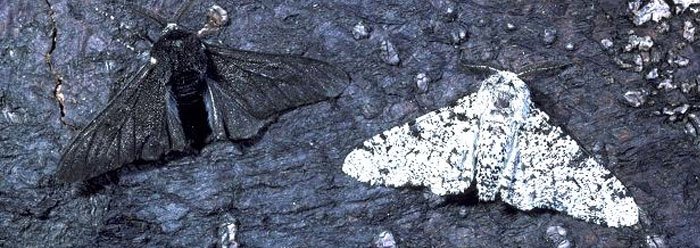
The trees these moths used to live on were white, but have been covered in soot from coal factories. Which moth will be more successful in this environment?
a)
Dark moth
b)
Light moth
c)
Both will be equally successful
d)
Neither will be successful
110.
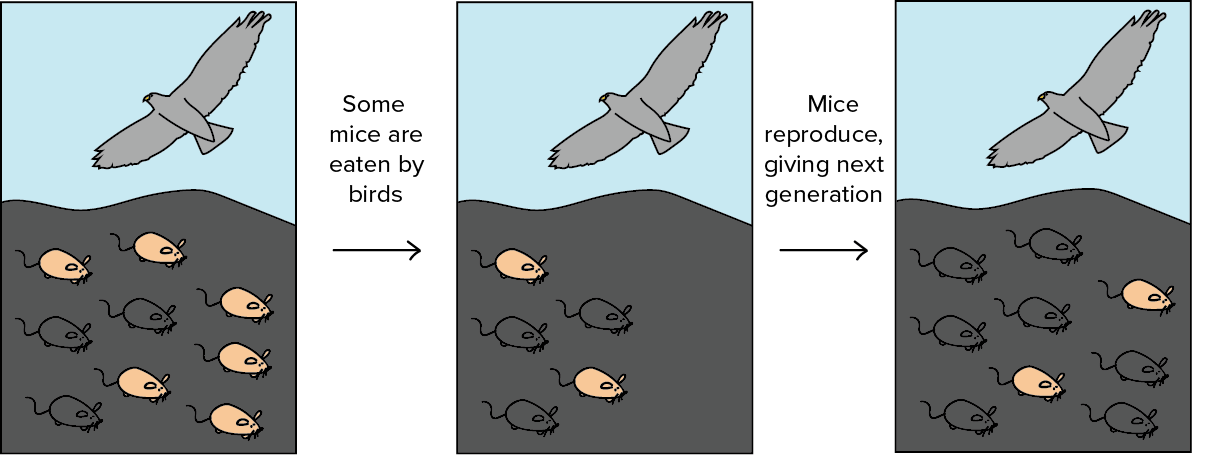
What process is being shown in this image?
a)
Variation
b)
Natural Selection
c)
Selective Breeding
d)
Homeostasis
111.
Why is the mouse population changing over time?
a)
The light mice can reproduce more successfully than the dark mice
b)
The hawks eat more dark mice than light mice because the dark mice taste better
c)
The hawks eat more light mice than dark mice because they can see the light mice more easily
d)
The hawks eat more dark mice than light mice because they can see the dark mice more easily
112.

Which of the following is an example of natural selection?

a)

Bald Eagles are hunted until near extinction, population recovers.

b)

Small group of iguanas floats to an island, starts a new population.

c)

Red fox pups are more likely to survive in a snowy environment if they are born white.

d)

Farmer chooses seeds from largest apples to plant next year. This results in larger apples from year to year.

113.
Ability of an organism to survive and reproduce in its environment
a)
evolution
b)
adaptation
c)
fitness
d)
speciation
114.

Traits have evolved through time because those traits allow an organism to

a)

survive and pass on its genes

b)

migrate

c)

intentionally change to adapt

d)

to make organisms better looking and cuter

115.
This is a process by which organisms inherited advantageous traits that tend to reproduce more successfully than the other organisms do. 
a)
Artificial selection
b)
Natural selection
c)
Populations
d)
Environment
116.
Why are advantageous traits more likely to be passed onto offspring?
a)
Because they are more likely to survive and reproduce.
b)
Because they come from dominant alleles.
c)
Because they come from recessive alleles.
d)
Because the trait is an acquired phenotype.
117.

Two organisms that are closely related would have

a)

very similar DNA sequence

b)

exactly the same DNA sequences

c)

no proteins in common

d)

completely different DNA sequence

118.

When looking at two birds of the same species, you notice that one has darker feathers than the other one. You also notice that one has a beak that is just a little longer. These slight differences within members of the same species are called.....

a)

Fossils

b)

Extinction

c)

Meiosis

d)

Variations

119.

A physical or behavioral trait that helps an organism survive and reproduce in its environment is called a what?

a)

An adaptation

b)

A response to a stimulus

c)

A mutation

d)

Evolution

120.

Anatomical adaptations are body features the organism has that directly help it survive. Which of the following would be an example of an anatomical adaptation?

a)

Penguins leaning back with their feet off the ground to conserve body heat.

b)

Penguins living in groups in order to improve protection.

c)

Penguins having a layer of blubber to keep warm.

d)

Penguins swimming in order to catch food.

121.

The following image of the "whales swimming in a pod" represents which of the following?

a)

Anatomical Adaptation

b)

Behavioral Adaptation

c)

Limiting Factor

d)

Mutation

122.

Resources such as food, water, sunlight, shelter, and space are often called __________.

a)

selective pressure

b)

Anatomical Adaptation

c)

Behavioral Adaptation

d)

Speciation

123.
The differences among a species, like different bird beaks, are called
a)
genes.
b)
variations.
c)
traits.
d)
theories.
124.
Fossils of animals the size of goats were dated at 5 million years old.  Similarly, fossils of larger animals were dated at 3 million years old.  Both animals were similar in body structure to today’s horses.  Using this data, what conclusion can scientists come too?
a)
The animals were probably ancestors of today’s horses
b)
The animals had no relationship to one another
c)
Today’s horses and these animals probably lived together at some time in the past
d)
Today’s horses are faster than these animals were
125.
Polar bears and brown bears are related.  Over time, polar bears and brown bears have developed different appearances.  Which of these MOST LIKELY caused the difference in fur color between the two species?
a)
Polar bears ate less and lost fur color
b)
Brown bears ate food that caused their fur to be brown
c)
Brown bears benefited by growing thicker fur to keep them warm
d)
Polar bears benefited from lighter colored fur and passed it onto their offspring
126.

Select all that are true about mutations.

a)

They can be helpful

b)

They can be harmful

c)

They are random

127.

A forest fire ignites in the Sam Houston State Forest and kills many members of a population of pigmy rattlesnakes.

a)

Gene Flow

b)

Genetic Drift

128.

Select the best answer based on the image.

a)

Gene Flow

b)

Genetic Drift

129.

Select the best answer based on the image.

a)

Gene Flow

b)

Genetic Drift

130.
Which of the following is an example of the bottle neck effect?
a)
Bald Eagles are hunted until near extinction, population recovers.
b)
Small group of iguanas floats to an island, starts a new population.
c)
Red fox pups are more likely to survive in a snowy environment if they are born white.
d)
Farmer chooses seeds from largest apples to plant next year.  This results in larger apples from year to year.
131.

Which of the following is an example of natural selection?

a)

Bald Eagles are hunted until near extinction, population recovers.

b)

Small group of iguanas floats to an island, starts a new population.

c)

Red fox pups are more likely to survive in a snowy environment if they are born white.

d)

Farmer chooses seeds from largest apples to plant next year. This results in larger apples from year to year.
132.
One day a group of scientists collected a small group of brown anole lizards from a large group of the lizards.  Then they placed this small group of lizards on an island that had no brown anole lizards on it.  What is this an example of?
a)
Bottleneck Effect
b)
Hardy Effect
c)
Founder Effect
d)
None of These
133.
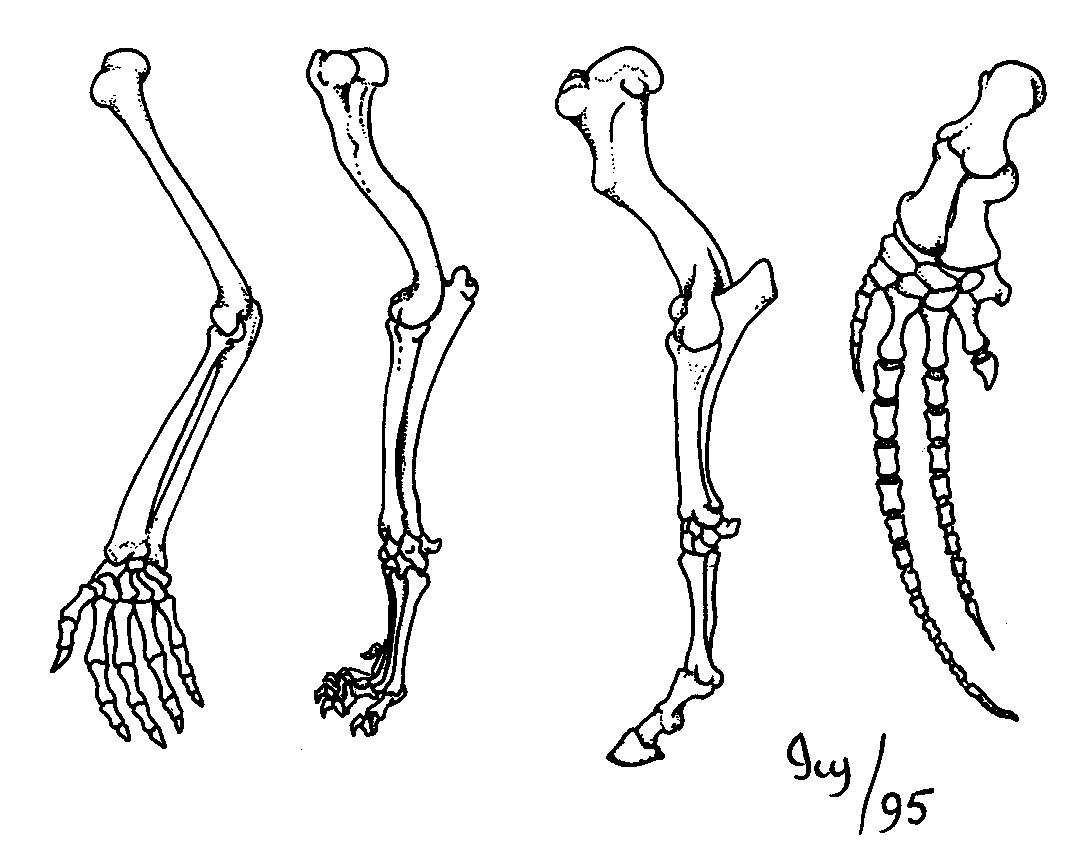
Structures with the same parts have different functions; suggests that organisms share a common ancestry
a)
vestigial structures
b)
homologous structures
c)
adaptive radiation
d)
fossil
134.
Study of embryos of various organisms to show a common ancestor because of similarities in development
a)
natural selection
b)
embryology
c)
speciation
d)
evolution
135.
Some organisms that share a common ancestor have features that have different functions, but similar structures.  These are known as
a)
vestigial structures
b)
analogous structures
c)
homologous structures
d)
fossil structures
136.
How do fossils provide evidence that evolution has happened on Earth?
a)
Fossils show how the sizes of certain animals has changed drastically over millions of years
b)
Fossils show that some species have gone extinct
c)
Fossils show how life forms present today are different than those from the past
d)
Different sedimentary rock layers provide evidence for how the environment has changed over time
137.

What type of selection is depicted in the picture?

a)

stabilizing

b)

directional

c)

disruptive

138.

Robins typically lay fours eggs. If more then four eggs are produced then the baby chicks are malnourished while smaller egg numbers result in no viable (able to live) baby chicks. This is an example of

a)

stabalizing

b)

disruptive

c)

directional

139.
What type of selection?
a)
Directional 
b)
Stabilizing
c)
Disruptive
140.
If finches with large beaks and finches with small beaks increase in a population while finches with average sized beaks decreases, which pattern of natural selection has occurred?
a)
Directional selection
b)
Disruptive selection 
c)
Stabilizing selection
141.
An extreme phenotype is favored causing the alleles to shift toward that phenotype
a)
Disruptive Selection
b)
Directional  Selection
c)
Stabilizing Selection
d)
Artificial Selection
142.

What type of natural selection is this: When a group of deer migrated to a cold mountain, the thin-furred deer and average-furred deer died. The thick-furred deer survived and eventually the population became thicker-furred.

a)

Disruptive Selection

b)

Directional Selection

c)

Stabilizing Selection

143.
Which of the three graphs shows stabilizing selection?
a)
A
b)
B
c)
C