
 Worksheets
Higher Unit 1 Revision
Total questions: 140
Worksheet time: 2hrs 42mins
What does the backbone of DNA consist of?
Sugar and phosphate
Adenine and thymine
amino acids
hydrogen bonds
The basic units of DNA are called...
(a)
Select the 3 components of nucleotides
Bases
Phosphates
Deoxyribose sugar
Mitochondria
Linear chromosomes
What does anti-parallel mean?
Strands of DNA run in opposite directions
DNA strands that persistantly intersect with each other
Base pairing is inverted. (A pairs with G and T pairs with C)
The DNA is stored in circular chromosomes and in the plasmids
Which base pairs with Adenine?
(a)
Which base pairs with Guanine?
(a)
What holds the bases together?
(a)
What is the name of the DNA strand's backbone?
Adenine tri-phosphate backbone
Deoxyribose sugar backbone
Guanine and cytosine backbone
Sugar phosphate backbone
What is determined by the order of bases?
(a)
Which number labels the phosphate ends?
5'
3'
1'
2'
Which number labels the deoxyribose sugar end?
3'
5'
1'
2'
I am a cell which does not contain a nucleus or any organelles, my DNA is stored in chromosomes and plasmids. What am I?
(a)
I'm a cell which has a nucleus and membrane-bound organelles. My DNA is organised as tightly coiled, linear chromosomes in the nucleus. What am I?
(a)
The associated proteins that DNA wraps around to keep it's shape in the nucleus are called
(a)
In which organelles do Eukaryotic animal cells contain circular chromosomes?
Mitochondria
Chloroplast
Nucleus
Ribosomes
In which organelles do Eukaryotic plant cells contain circular chromosomes?
Mitochondria
Chloroplast
Nucleus
Ribosome
Is a yeast cell Prokaryotic?
No
Yes
Why can both strands of DNA not be replicated continuously?
DNA nucleotides can only be added to 3' end of the new DNA strand.
There is not enough space for both strands to be replicated
There is only one enzyme therefore it can't replicate both strands at the same time
In DNA replication, the fragments of DNA which have been replicated discontinuously are joined together using what?
Ligase
DNA polymerase
RNA polymerase
Amylase
What are primers?
Single stranded random sequences of nucleotides
Single stranded sequences of nucleotides which are complementary to a target sequence
Double stranded sequences of nucleotides which are complementary to a target sequence
Replication occurs _______ on the leading strand.
Continuously
Discontinuously
Which enzyme controls the sugar-phosphate bonding of the nucleotides into the DNA strand?
DNA polymerase
Ligase
Amylase
Phosphate
Which is the last step of DNA replication?
RNA Helicase unwinds original DNA strand
DNA Primase lays down RNA primer for new nucleotide bases.
RNA polymerase builds new strands by bring in new nucleotide bases.
Ligase knits together fragments on lagging strand

Which letter in the picture below depicts the leading strand in DNA replication?
A
C
B
None of the above
Which letter in the picture below depicts the lagging strand in DNA replication?
Letter A since it is copied from 5' to 3'
Letter A since it is copied from 3' to 5'
Letter B since it is copied from 3' to 5
Letter B since it is copied from 5' to 3'
DNA replication puts down nucleotides ______' to _____' and is said to be ______________________
5, 3, antiparallel
3, 5, antiparallel
5, 3, parallel
3, 5, parallel
The first stage of Protein Synthesis is...
Transcription
Translation
Which of the following are coding regions of an mRNA transcript?
Introns
Exons
Which of the following is not a form of RNA?
mRNA
tRNA
rRNA
dRNA
ATG TGA CAG?

Where is DNA and RNA made?
nucleus
cytoplasm
mitochondria
ER
RNA contains which sugar?
deoxyribose
Ribose
glucose
fructose
RNA has what base that is instead of thymine?
guanine
adenine
thymine
uracil
A triplet of bases on mRNA is called a
(a)
A triplet of bases on tRNA is called an
(a)
What does one codon code for?
A specific protein
A specific amino acid
A specific nucleotide
A specific polypetide chain
Which of the following is NOT true about tRNA?
has an attachment site for a protein
is single stranded
has an anticodon of 3 bases
contains the base uracil
Ribosomes are made of rRNA and
(a)
Which enzyme controls transcription?
DNA polymerase
RNA polymerase
Ligase
RNA polymerase unwinds the DNA and breaks the (a) bonds between the bases.
What is a primary transcript made up of?
introns
exons
What is a mature transcript made up of?
Introns
exons
What process results in a primary transcript becoming a mature transcript?
DNA replication
RNA splicing
Transcription
RNA Slicing
One gene can result in many genes by because of (a) RNA splicing.
The order of exons from the primary to the mature transcript...
sometimes changes
always stays the same
always changes
How many of the genes in a cell are expressed?
A fraction
About half of them
Most of them
All of them
What is the result of translation?
mature transcript of mRNA
A protein
A polypeptide
Transcription begins and ends at a start and stop (a)
Amino acids are joined together by what type of bond?
Peptide
Hydrogen
Strong Chemical
James
Which bonds help to keep polypeptide chains in the 3-D shape of a protein?
(a)
What do the proteins produced as a result of gene expression determine?
Genotype
Phenotype
Different genes are switched on in muscle cells than in blood cells.

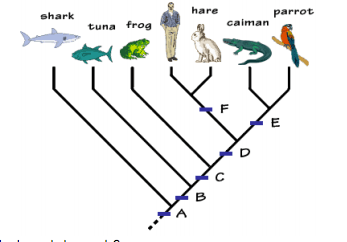
According to this image, which two domains of life are most related?
Bacteria & Archaea
Archaea & Eukarya
Eukarya & Bacteria

Which group of animals on this tree are most closely related to birds?
Saurischian dinosaurs
Ornithischian dinosaurs
Crocodiles
None of these are related to birds
What is a single nucleotide polymorphism (SNP)?
A repeat sequence in a genome
A difference in the genome caused by a substitution mutation
A removal of a base within the genome
A highly conserved sequence in the genome
Which of the following terms describes the study of genomes?
Genomics
Bioinformatics
Phylogenetics
Pharmacogenetics

the graph below shows a molecular clock which compares the amino acid sequences in the protein cytochrome C in various vertebrate groups. From the information in the graph, which vertebrate groups shared a common ancestor most recently?
fish and reptiles
birds and mammals
reptiles and mammals
birds and reptiles
What is meant by the term phylogenetics?
The use of statistics and computer technology to analyse gene sequencing data.
The study of a persons genome to produce personalised medicine
The comparison of the genomes of disease and non disease causing organisms
The study of evolutionary relatedness between organisms
Which of the following is a shortcoming of molecular clocks
Mutations occur too rarely to assign a timescale
The assumption that mutations occur at a constant rate.
Mutations don't occur in all species
They are only based on substitution mutations
What are the three domains of life?
Bacteria Archaea Eukaryotes
Prokaryotes Eukaryotes Archaea
Animals Plants Fungi
Bacteria Archaea Prokaryotes
Which of the following data can be used to provide evidence for the sequence of evolutionary events?
DNA sequence data
Protein sequence data
Fossil evidence
A combination of all the evidence above
What is the correct sequence of evolutionary events?
Prokaryotes, Eukaryotes, Land plants, Animals
Eukaryotes, Prokaryotes, Animals, Land plants
Prokaryotes, Eukaryotes, Animals, Land plants
Prokaryotes, Animals, Land plants, Eukaryotes
Which of these is NOT and example of a model organism?
A mouse that possesses many genes similar to humans
A fruit fly that has many genes in common with those that cause disease in humans
A plant species that has genes that produce a variety of flower colours
A worm that possesses many genes that will allow us to understand nerve functioning and ageing
What is meant by the term Bioinformatics?
The use of statistics and computer technology to analyse gene sequencing data.
The study of a persons genome to produce personalised medicine
The comparison of the genomes of disease and non disease causing organisms
The study of evolutionary relatedness between organisms
What is meant by the term comparative genomics?
The use of statistics and computer technology to analyse gene sequencing data.
The study of a persons genome to produce personalised medicine
Comparing the similarities and differences in genomes between two species e.g. disease and non disease causing organisms
The study of evolutionary relatedness between organisms
What is meant by the term pharmacogenetics?
The use of statistics and computer technology to analyse gene sequencing data.
The study of a persons genome to produce personalised medicine
Comparing the similarities and differences in genomes between two species e.g. disease and non disease causing organisms
The study of evolutionary relatedness between organisms

A segment of DNA that codes for a trait
gene
centromere
chromosome
chromatid


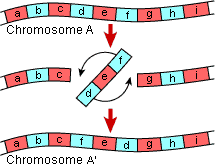
What type of chromosomal mutation is this?
Translocation
Inversion
Deletion
Duplication
Which of the following would result in a frameshift mutation?
Insertions only
Substitution only
Deletion only
Insertions and Deletions
Which of the following is not a type of chromosome mutation
Inversion
Insertion
Deletion
Duplication
Which of the following is not a type of single gene mutation
Substitution
Insertion
Duplication
Deletion
Which of the following mutations causes a single different amino acids to be coded for?
Missense
Insertion
Nonsense
Splice site
Which of the following is NOT an example of non translated RNA?
mRNA
tRNA
rRNA
original chromosome
ABC-DEF
mutated chromosome
AC-DEF
This is a _____________ mutation.
Inversion
Duplication
Deletion
Insertion
Which type of chromosomal mutation has a portion of the chromosome break off and attach to another chromosome?
duplication
translocation
deletion
insertion
If a mutation occurs in an expressed gene, it will most directly affect the structure of a cell's
ATP
Proteins
Membrane
Energy source
Which of the following does NOT describe a feature of all mutations
Harmful
Rare
Random
Spontaneous
The impact of a frameshift mutation on the polypeptide is?
It will change all the amino acids after the mutation
It will change one amino acid
It will lead to a shortened polypeptide due to a premature stop codon
The impact of a nonsesne mutation on the polypeptide is?
It will change all the amino acids after the mutation
It will change one amino acid
It will lead to a shortened polypeptide due to a premature stop codon
Mutations can be negative because
They can cause cancer
They can cause birth defects
They can help an organism thrive in its environment.
They can affect offspring.
Mutations can be negative because
They can cause cancer
They can cause birth defects
They can help an organism thrive in its environment.
They can affect offspring.
Mutations are a change in (a) that results in no protein or an altered protein being synthesised.
Nonsense mutations result in a premature ____ _______ being produced which results in a shorter protein.
(a)
Which of the following could be involved in a splice-site mutation?
introns being removed that shouldn't
introns being retained that shouldn't
exons being removed that shouldn't
exons being retained that shouldn't
introns being retained AND exons being removed at the same time
What type of mutation allows potential beneficial mutations to occur whilst the original gene can still be expressed to produce its protein?
Translocation
Duplication
Inversion
Deletion


Individuals can not evolve.

Which adaptation this organism using?
camouflage
mimicry
hide and seek
use body covering
Why are advantageous traits more likely to be passed onto offspring?
Because they are more likely to survive and reproduce.
Because they come from dominant alleles.
Because they come from recessive alleles.
Because the organism knew it needed that trait, survives, and passes it on.
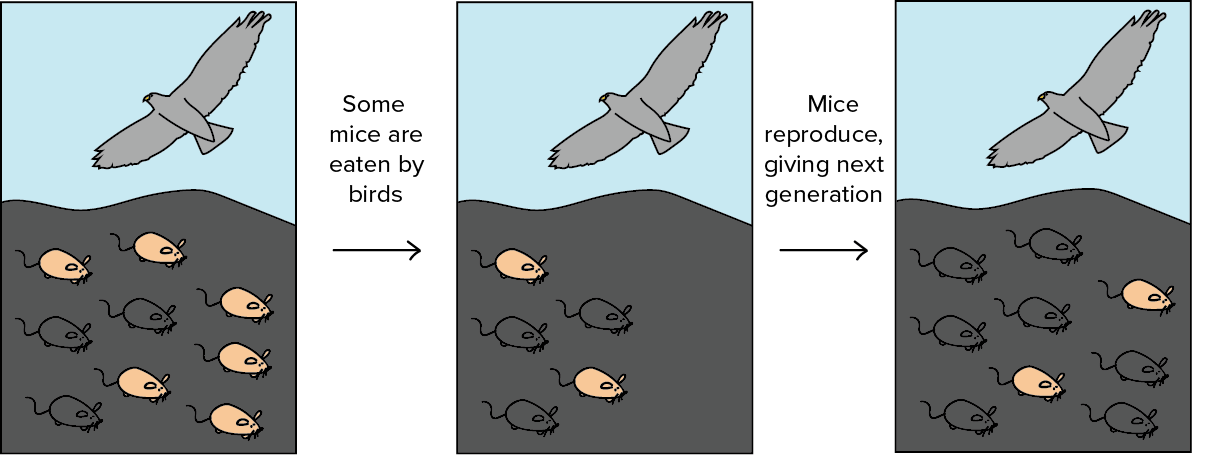

"Organisms that are better adapted to the environment survive to pass traits to their offspring" is the definition of
Natural Selection
Evolution
Selective Breeding
Artificial Selection
Which best describes the role of mutations in natural selection?
Mutations help an organism to better survive in their environment
An organism may acquire a helpful mutation by interacting with the environment
A mutation may result in a beneficial trait that makes an organism more likely to survive and reproduce
Organisms with certain traits are more likely to win competitions for mutations
The more genetic variation a population has,
the more likely it is for some individuals to
evolve
migrate
survive
mutate
Mutations are important because they bring about
death of the organism in which they develop
genetic variation needed for a population to evolve
benefits for the individual, not for the population
changes in genotype, but not phenotype
Why is competition important for natural selection?
It shows which variations are more successful, allowing the organisms with those variations to survive.
It causes organisms, regardless of which traits they have, to die out, reducing the population size.
It causes organisms to get stronger due to having to outcompete other species.
Competition is not important for natural selection.
SELECT ALL THAT APPLY: Which of the following must be true in order for organisms to be considered the same species?
They must be able to mate
They must be able to produce viable offspring
They must have structural similaries
They must have the same bone structure
A new river forms and splits two populations, causing ______________ speciation
Sympatric
Allopatric
Extreme
Convergent
Orcas occur in the same habitat but some are avoiding each other and do not interbreed. They have different diets, vocal behavior, and social structures. What type of speciation is this?
Allopatric
Sympatric
Complex
Covergent
when the organism develops different courtship rituals which do not attract main population this is a part of ____________ speciation.
Allopatric
Sympatric
Simple
Temporal
The emergence of a mountain range is an event that would lead to _______________ speciation
Allopatric
Sympatric
Temporal
Behavioral
When the Grand Canyon in Arizona formed, two populations of one squirrel species were separated by the giant canyon. This is an example of _____________ speciation.
Allopatric
Sympatric
Simple
Divergent


An individuals personal genome sequence can be used to select the most effective drugs and dosage to treat their disease
Genome
Genomic sequencing
Personalised medicine
Pharmacogenetics
The use of genome information in the choice of drugs
Genome
Genomic sequencing
Personalised medicine
Pharmacogenetics
Using computer and statistical analyses to compare sequence data
Genome
Genomic sequencing
Bioinformatics
Pharmacogenetics
The sequence of nucleotide bases can be determined for individual genes and entire genomes
Genome
Genomic sequencing
Bioinformatics
Pharmacogenetics
An organisms entire hereditary information encoded in DNA
Genome
Genomic sequencing
Bioinformatics
Pharmacogenetics
A genome is made up of
Genes only
Genes and other DNA sequences that code for proteins
Genes and other DNA sequences that do not code for proteins
Genes and proteins
What name is given to complete sequences of DNA that do not carry the code to make proteins?
Coding sequences
Introns
Exons
Non-coding sequences

