wayground logo

Free Printable Worksheets

Font size

S
M
L
XL
Worksheets

Enzymes Lesson

Total questions: 137

Worksheet time: 2hrs 52mins
Name
Class
Date
1.
Enzymes are considered to be 
a)
Lipids
b)
Carbohydrate
c)
Protein
d)
Nucleic Acid
2.
What is the purpose  of an enzyme?
a)
give permission for the reaction
b)
raise activation energy
c)
speed up reactions
d)
control how many reactions occur
3.
Where do substrates bind on an enzyme?
a)
voltage-gated channels
b)
surface receptor
c)
calcium channels
d)
active site
4.
How do enzymes increase the speed of chemical reactions?
a)
reducing the number of products   
b)
reducing the activation energy
c)
increasing the temperature of the cell
d)
increasing the concentration of reactants 
5.
What is a substance called if it speeds up a chemical reaction?
a)
reusable
b)
catalyst
c)
specific
d)
fragile
6.
What is the name for the mechanism of enzyme activity?
a)
Lock and key
b)
jigsaw puzzle
c)
hammer and nail
d)
two hands pattern
7.
Any substance that is acted upon by an enzyme is called a(n)?
a)
Coenzyme
b)
Substrate
c)
Vitamin
d)
Polypeptide
8.
After the enzyme and substrate bind together and perform the reaction, what does the substrate become?
a)
a substrate
b)
an enzyme
c)
a product
d)
an active site
9.
can a change in pH alter the active site of an enzyme
a)
yes
b)
no
10.
Which of these is NOT true?
a)
Enzymes can denature (change shape) when the temperature gets too high.
b)
Enzymes can only be used once in a chemical reaction. 
c)
Extreme pH can denature enzymes.
d)
Enzymes speed up chemical reactions. 
11.
What happens when enzymes are heated to a high temperature?
a)
The enzymes die.
b)
The shapes of the enzyme are altered or denatured
c)
The enzymes' amino acid sequence changes.
d)
The enzymes remain the same
12.
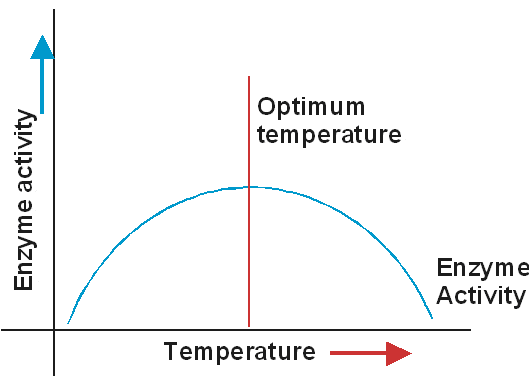
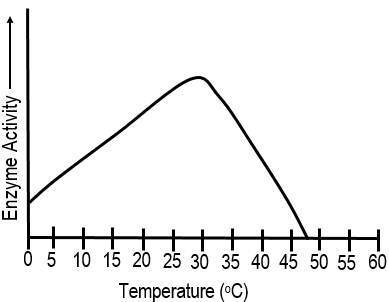
Based on the graph, what temperature does this enzyme work best? 
a)
15 C
b)
40 C
c)
30 C
d)
47 C
13.
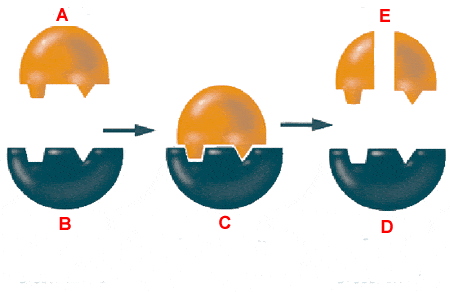
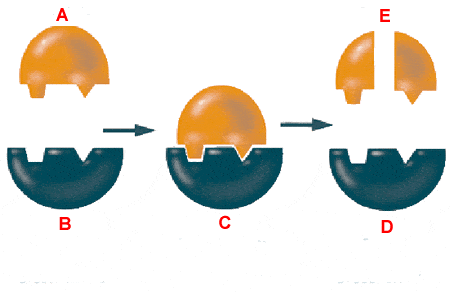
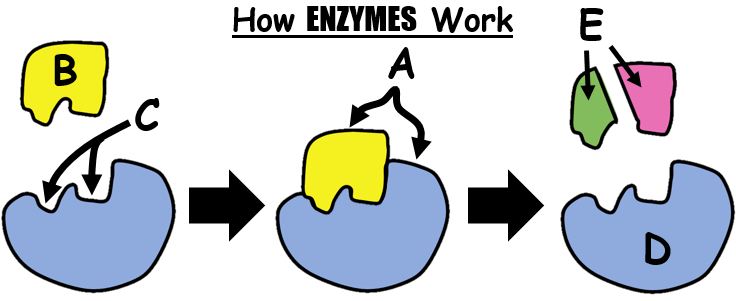
Letter D...
a)
active site
b)
enzyme
c)
substrate
d)
products
14.
Letter B...
a)
active site
b)
enzyme
c)
substrate
d)
products
15.
Letter C...
a)
active site
b)
enzymes
c)
substrate
d)
products
16.
Letter E...
a)
active site
b)
enzyme
c)
substrate
d)
products
17.
What 3 letters do enzymes typically end in?
a)
-ose
b)
-ase
c)
-ese
d)
-tic
18.
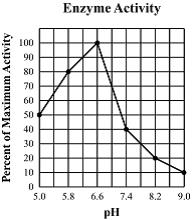
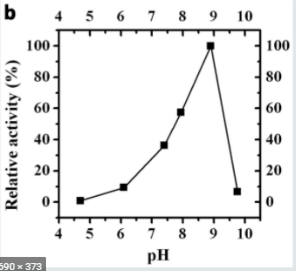
Which of the following conclusions can be drawn from this graph?
a)
The optimum pH of the enzyme is 6.6.
b)
The optimum pH of the enzyme is 5.8
c)
The enzyme’s activity increases as pH increases 5.0 to 9.0
d)
The enzyme’s activity is greater around pH of 8.0 .
19.
What makes an enzyme substrate specific?
a)
Size
b)
Shape
c)
Name
d)
Location it is found in
20.
Each enzyme only has 1 substrate that will fit its active site.  What is this called?
a)
reusable
b)
catalyst
c)
specific
d)
fragile
21.
An enzyme speeds up a reaction by
a)
lowering the activation energy.
b)
raising the activation energy.
c)
releasing energy.
d)
absorbing energy.
22.
An enzyme speeds up a chemical reaction in the cell but can only be used once.  True or False? 
a)
true
b)
false
23.
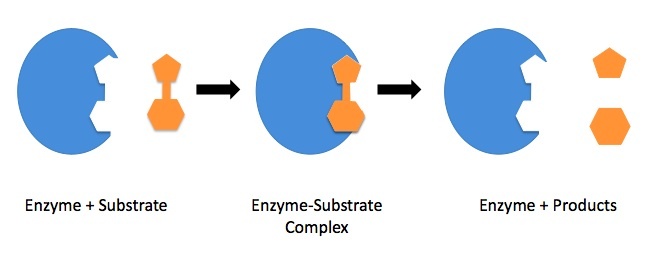
This reaction shows a(n) ____________ reaction
a)
Catabolic
b)
Anabolic
c)
Dehydration Synthesis
d)
Halogenation
24.
The current model of enzyme action is referred to as the:
a)
Induced Fit Model
b)
Lock & Key Model
c)
Singer-Nicolson Model
d)
Davson-Danielli Model
25.
Enzymes catalyze reactions by ___________ Activation Energy.
a)
Increasing
b)
Decreasing
26.
Enzymes speed up reaction rates by changing:
a)
Activation Energy
b)
pH
c)
Hydrogen Bonds
d)
Kinetic Energy
27.
At high temperatures enzyme activity declines because of:
a)
Denaturation
b)
Decreased Kinetic Motion
c)
Increased H-Bonding
d)
Dissociation of Ionic Compounds
28.
When a molecule can occupy the same active site as the substrate, a situation called __________________ can result
a)
Competitive lnhibition
b)
Allosteric Regulation
c)
Non-Competitive Inhibition
d)
Feedback Inhibition
29.
Enzymes are composed of which of the following monomers? 
a)
amino acids
b)
carbohydrates
c)
nucleotides
d)
monosaccharides
30.
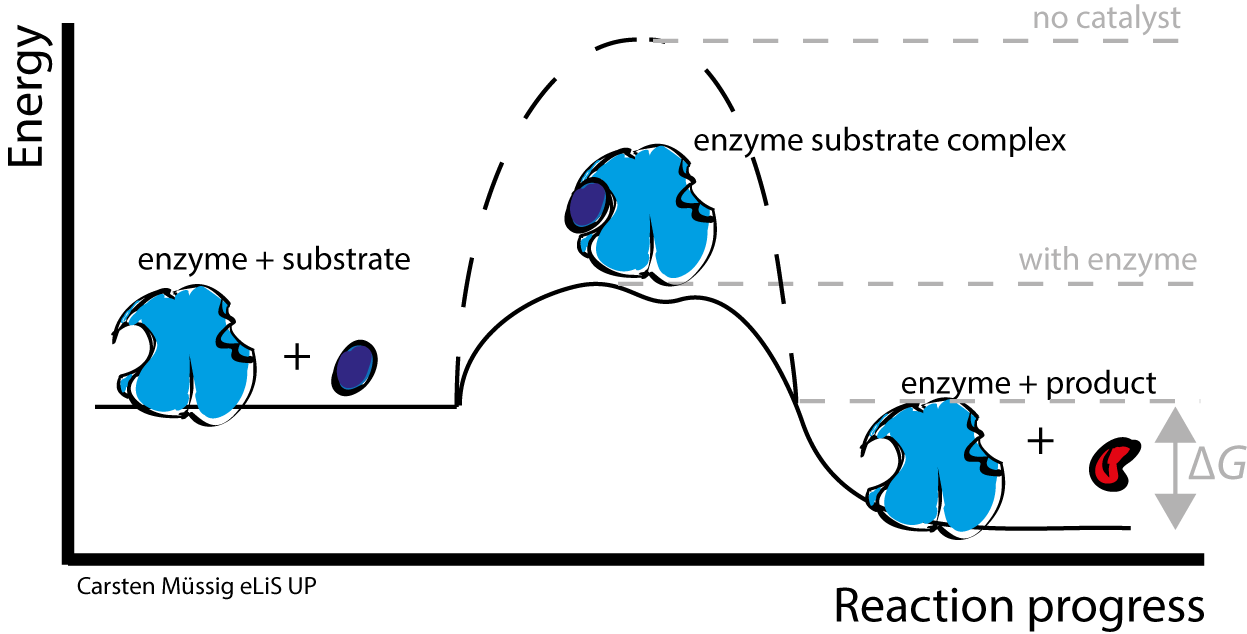
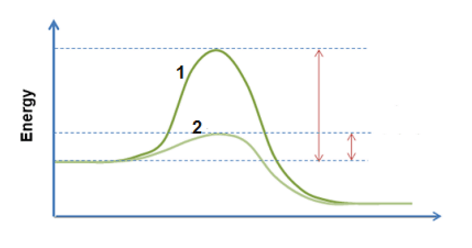
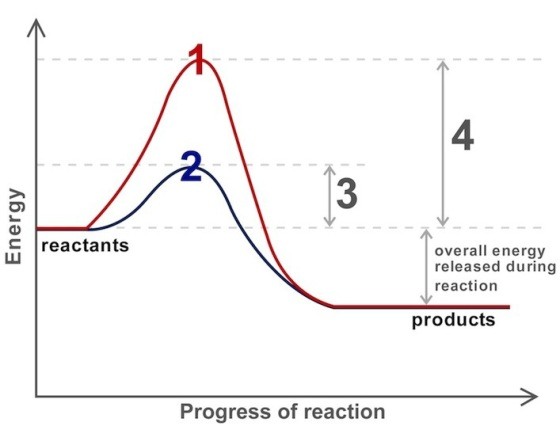
The graph shows how enzymes affect reactions in cells. Which statement best summarizes the information shown in the graph?
a)
Enzymes increase the energy of the reactants.
b)
Enzymes decrease the energy level of the products.
c)
Enzyme decrease the activation energy of the reaction.
d)
Enzymes reverse the direction of the reaction.
31.

Which of the following are true about enzymes? (Choose all that apply)

a)

Enzymes speed up chemical reactions.

b)

Enzymes react best at a specific temperature.

c)

Enzymes only control ONE type of reaction.

d)

Enzymes are made of fatty acids.

32.
What is another name for enzymes?
a)
chemical catalysts
b)
microorganisms
c)
biological catalysts
d)
inorganic catalysts
33.
Which line represents an enzyme-catalyzed reaction? 
a)
Line 1
b)
Line 2
34.
The "lock and key hypothesis" attempts to explain the mechanism of?
a)
Vacuole formation
b)
Pinocytosis
c)
Sharing of electrons
d)
Enzyme specificity 
35.
What is a Cataylst?
a)
A substance that speeds up a rate of chemical reaction.
b)
Molecules that make enzymes work harder and faster 
c)
reaction of an enzyme
d)
A substance that slows down a rate of chemical reaction.
36.
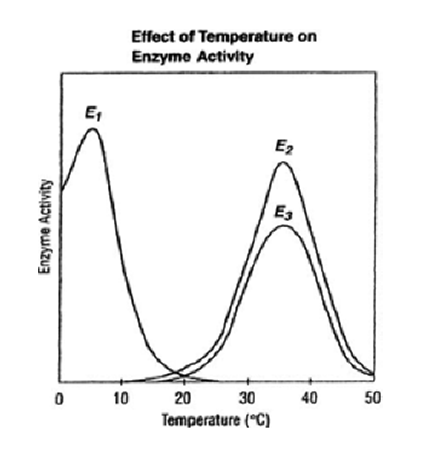
The graph shows the effect of temperature on enzyme action. What characteristic do enzymes E1, E2, and E3 share?
a)
Their activity increases between 20°C and 30°C.
b)
Their activity is greatest between 5°C and 10°C.
c)
Their activity is at a low level between 15°C and 25°C.
d)
Their activity is at a high level between 30°C and 40°C.
37.
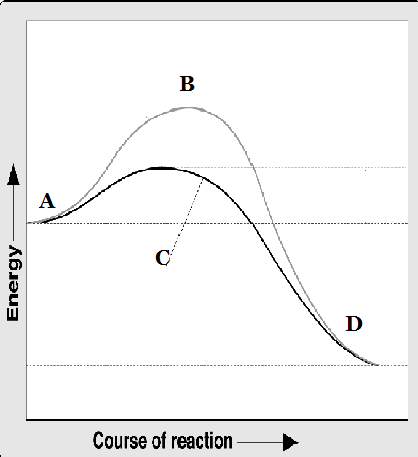
The portion labeled "B" represents the
a)
reaction with enzyme
b)
reaction without enzyme
c)
reactants
d)
products
38.
The portion labeled "D" represents the
a)
reaction with enzyme
b)
reaction without enzyme
c)
reactants
d)
products
39.

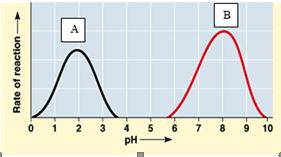
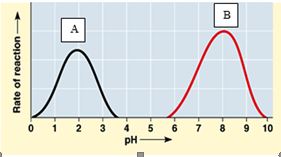
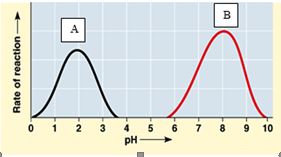
What is the optimal pH of enzyme A?

a)

8

b)

2

c)

5.7-10

d)

10

40.
What is the pH range of enzyme A?
a)
2
b)
0-3.7
c)
3.7
d)
0
41.
Which enzyme is most efficient in a basic solution?
a)
A
b)
B
42.
Some bacteria live in hot springs. Their cells contain enzymes that function best at temperatures of 70 °C or higher. At the temperature of 50 °C, how will the enzymes in these bacterial cells most likely be affected?
a)
The enzymes will be destroyed by lysosomes
b)
The enzymes will lose their bond structure and fall apart.
c)
The enzymes will require less energy to function than at 70 °C.
d)
The enzymes will not increase the rate of reactions as much as they would at 70 °C. 
43.
Which of the following best explains why enzymes are necessary for many cellular reactions?
a)
Enzymes supply the oxygen necessary for the reactions
b)
 Enzymes change reactants from solid to liquids during the reactions.
c)
The reactions take up too much space in the cell if the enzymes are missing.
d)
The reactions are too slow to meet the needs of the cell if enzymes are missing. 
44.
What will most likely happen if an appropriate enzyme is added to a chemical reaction? 
a)
The reaction rate will increase.
b)
The equilibrium of the reaction will be maintained. 
c)
The reaction rate will decrease.
d)
The reaction will stop. 
45.
The human body maintains a temperature of around 98.6 degrees at all times. Enzymes are involved in almost every chemical reaction in the body. Which of the following describes the connection between these two statements? 
a)
 Enzymes function best at a specific temperature.
b)
The body needs to be warm to prevent hypothermia.
c)
The body is kept relatively warm to prevent too much enzyme action.
d)
 There is no connection between the two statements. 
46.
The enzyme lactase will break down the sugar lactose into which of the following components? 
a)
 monosaccharides
b)
nucleic acids
c)
amino acids
d)
phospholipids
47.

As food travels through the digestive system, it is exposed to a variety of pH levels. The stomach has a pH of 2 due to the presence of hydrochloric acid (HCl), and the small intestine has a pH ranging from 7 to 9. HCl converts pepsinogen into pepsin, an enzyme that digests proteins in the stomach. Which of the following most likely happens to pepsin as it enters the small intestine?

a)

 It becomes inactive.

b)

It begins to replicate.

c)

 It's shape changes to engulf large proteins.

d)

It's activity increases to digest more proteins.
48.
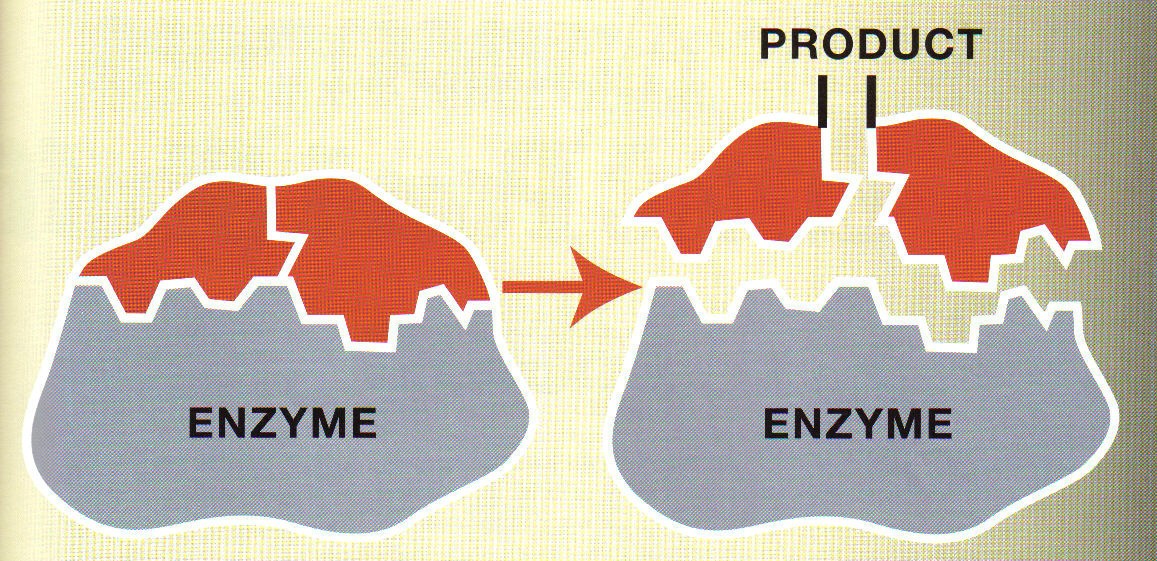
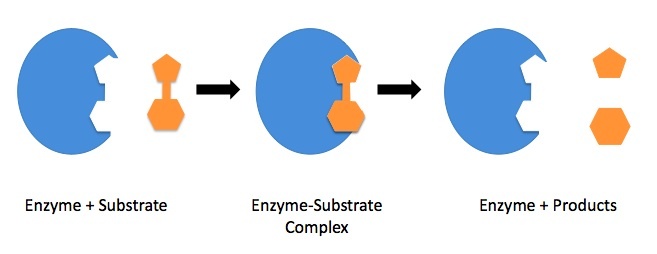
In the diagram, what is letter A? 
a)
product
b)
substrate
c)
enzyme-substrate complex
d)
active site
49.
Which of these is most likely an enzyme?  
a)
Sucrose
b)
Galactose
c)
Fructose
d)
Amylase
50.
Which is NOT true?
a)
Enzymes speed up chemical reactions.
b)
Enzymes react best at a specific temperature.
c)
Enzymes only control ONE type of reaction.
d)
Enzymes are made of fatty acids.
51.
Babies do not have well developed digestive systems for breaking down proteins; therefore baby food is prepared after treatment with which enzyme? 
a)
protease
b)
lipase
c)
carbohydrase
d)
synthase
52.
The pH at which an enzyme is most efficient is called the _________ pH of an enzyme.
a)
neutral
b)
optimum
c)
minimum
d)
experimental 
53.
Enzymes need certain environmental conditions in order to function properly.  What happens when enzymes are heated to a high temperature?
a)
they die
b)
they denature
c)
they change their amino acid sequence
d)
they work better
54.
Which substrate would this enzyme catalyze?
a)
Δ
b)
σ
c)
d)
μ
55.
What factors affect an enzyme's reaction rate?
a)
temperature 
b)
pH
c)
substrate concentration
d)
all of these
56.

What is the optimal pH for this enzyme?

a)

6

b)

10

c)

9

d)

7

57.

The _____________________ mechanism describes how an enzyme changes shape once the substrate is bonded.

a)

hammer and nail

b)

induced fit

c)

jigsaw puzzle

d)

lock and key

58.

Once a new product leaves an enzyme, the enzyme is unchanged and ready for the next substrate. What is this called?

a)

fragile

b)

reusable

c)

specific

d)

catalyst

59.

All of the following affect the functioning of an enzyme EXCEPT:

a)

pH

b)

temperature

c)

metabolism

d)

enzyme concentration, substrate concentration, inhibitor molecules

60.

A baby is locked in the car on a hot day. What is most likely to happen to the child?

a)

The child's body will adjust and cause it to maintain homeostasis

b)

The child's enzymes will denature causing chemical reactions to speed up in the body, which will lead to death.

c)

The child's enzymes will denature causing chemical reactions to slow down in the body, which will lead to death.

d)

The activation energy for chemical reactions will remain unchanged and therefore the child will live.

61.

Enzymes are _______________ that _____________________ chemical reactions by ____________ the amount of activation energy required to start the reaction.

a)

carbohydrates, slow down, lowering

b)

proteins, speed up, increasing

c)

lipids, speed up, lowering

d)

proteins, speed up, lowering

62.

What is the optimal temperature of this enzyme?

a)

60

b)

40

c)

70

d)

30

63.

Which letter represents the product?

a)

A

b)

B

c)

C

d)

D

64.

Which enzyme represents the substrate?

a)

A

b)

B

c)

C

d)

D

65.

Which enzyme represents the substrate?

a)

A

b)

B

c)

C

d)

D

66.
How do enzymes speed up chemical reaction?
a)
Increasing activation energy
b)
Decreasing activation energy
c)
Increasing deactivation energy
d)
Decreasing deactivation energy
67.
Which chemical is classified as an enzyme?
a)
Galactose
b)
Lipid
c)
Protease
d)
Manganese dioxide
68.
How does an enzyme's activity change with increasing concentration of substrate?
a)
decreases
b)
stays the same
c)
no change
d)
increases 
69.
Which of these do NOT affect enzyme activity?
a)
Temperature
b)
pH
c)
Competitive Inhibitors
d)
Carbohydrates
70.

Without proper enzyme regulation you would die

a)

true

b)

false

71.

Which color line represent a reaction with an enzyme present?

a)

Blue

b)

Red

c)

Both

d)

Neither

72.

The enzyme and substrates have

a)

adverse shapes

b)

complementary shapes

c)

contrary shapes

d)

similar shapes

73.

The amount of energy needed to start a chemical reaction.

This is significantly lowered by enzymes, speeding up chemical reactions so life can exist.

a)

Induction Energy

b)

Products

c)

Active Site

d)

Activation Energy

74.

To bend a protein so it no longer functions.

a)

Activate

b)

Enzyme

c)

Denature

d)

Substrate

75.

The measure of acidity in a substance.

a)

pH

b)

Meter

c)

Net neutrality

d)

Oxygen concentration

76.

A pH that is too high or low denatures an enzyme

so the active site cannot bind efficiently with the substrate.

Enzymes are designed to work at specific acid or base levels.

a)

Enzymes and temperature

b)

Excess oxygen

c)

Enzymes and pH

d)

Excess Hydrogen

77.

Too much heat or too much cold denatures the enzyme so the active site cannot bind efficiently with the substrate.

Enzymes are designed to work at specific temperatures.

a)

Enzymes and oxygen

b)

Enzymes and substrate

c)

Enzymes and pH

d)

Enzymes and Temperature

78.

More enzymes speed up chemical reactions.

More substrate speeds up chemical reactions to a point.

a)

Activation energy

b)

Enzymes and pH

c)

Enzymes and Temperature

d)

Enzymes and Substrates

79.

Which 2 factors can affect the rate of enzyme activity?

a)

Light intensity

b)

Temperature

c)

pH

d)

Oxygen concentration

80.

Which of the following denatures an enzyme?

a)

High Temperatures

b)

Incorrect pH

c)

Both

81.
What is a peptide bond?
a)
Bond that holds two amino acids together.
b)
A bond that holds hydrogen and oxygen molecules together.
c)
A bond that holds the phosphate group of one nucleotide and a sugar of a neighboring nucleotide.
d)
A bond that is formed by the sharing of electrons.
82.
What is a protein: 
a)
A polymer composed of many sugars.
b)
A polymer composed of many amino acids. 
c)
A polymer composed of fatty acids. 
d)
A polymer composed of nucleotides. 
83.
The diagram shows the structure of an amino acid. Which type of molecule is formed from amino acids?
a)
lipids
b)
proteins
c)
carbohydrates
d)
nucleic acids
84.
The structure of proteins can be changed by environmental factors such as temperature or pH.
a)
True
b)
False
85.
Amino acids that must be supplied by foods in the diet
a)
essential amino acid
b)
complete protein
c)
emulsion
d)
collagen
86.
The diagram shows a bond forming between two amino acids. What is the name of this reaction?
a)
Dehydration Synthesis
b)
Hydrolysis
c)
Pepysis
d)
Oxidation
87.
When a protein unfolds, it is
a)
Denatured
b)
Building
c)
Adding amino acids
d)
Making food
88.
Each amino acid is different from the other due to....
a)
The R group
b)
The amino group
c)
The carboxyl group
d)
The central carbon
89.
Cells must produce many different enzymes because
a)
enzymes are quickly used up
b)
most cellular reactions require a specific, unique enzyme
c)
They have to have some way to use up the protein that they consume
d)
enzymes are not very effective at speeding up reactions
90.
The polymer which folds into proteins
a)
Polypeptide
b)
Amino Acids
c)
Nucleic Acids
d)
Polynucleotides
91.
What elements make up amino acids?
a)
Carbon, hydrogen and oxygen only
b)
Carbon, hydrogen, oxygen and nitrogen only
c)
Carbon, hydrogen and phosphorus only
d)
Carbon, hydrogen, nitrogen and oxygen; and sometimes also sulfur
92.
What conditions usually do not cause denaturation?
a)
Extreme heat
b)
Extreme pH
c)
Dissolving in water
93.
The reaction used to digest and break the bond in red is:
a)
Hydrolysis
b)
Dehydration Synthesis
c)
Oxidation
d)
Single Displacement
94.
The primary sequence of a protein refers to the:
a)
Order of amino acids
b)
α-Helix or β-Pleated Sheet
c)
Interaction of subunits
d)
Hydrogen Bonding
95.
Enzymes are considered to be 
a)
Lipids
b)
Carbohydrate
c)
Protein
d)
Nucleic Acid
96.
This is one job proteins do NOT have in the body
a)
storing genetic information
b)
structure
c)
speed up chemical reactions
d)
transport things through cell membrane
97.
What is the monomer of proteins?
a)
amino acids
b)
polypeptides
c)
nucleotides
d)
monosaccharides
98.
Which macromolecule is this?
a)
carbohydrate
b)
lipid
c)
protein
d)
nucleic acid
99.
Enzymes are capable of increasing the rate of a chemical reaction within a living cell.  Enzymes accomplish this through which of the following means?
a)
reducing the number of products   
b)
reducing the activation energy
c)
increasing the temperature of the cell
d)
increasing the concentration of reactants 
100.
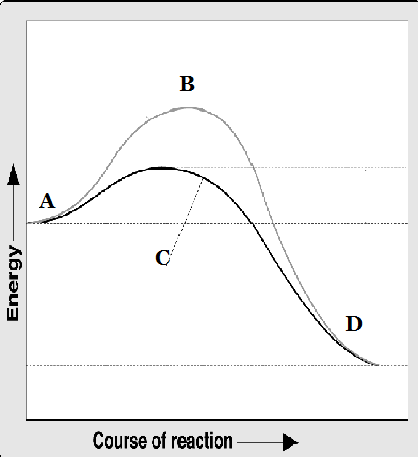
Given the graph below, which statement best describes the role of enzymes?
a)
More energy is released without the presence of enzymes
b)
Less energy is needed to start a reaction when enzymes are present.
c)
A reaction is catalyzed by the lack of enzymes
d)
The presence of enzymes causes reactions to occur at a slower rate.
101.
Which analogy best describes the role enzymes play in cells?
a)
Like walls in buildings, enzymes provide structural support for the cell
b)
Like the person who helps you bag your groceries, enzymes speed up processes in cells
c)
Like books in libraries, enzymes store information that can be used by the cell when needed
d)
Like the fence around a yard, enzymes act as a barrier preventing entry to the cell.
102.

A process that changes one set of chemicals into a new set of chemicals.

a)

chemical reaction

b)

physical reaction

c)

synthetic reaction

d)

chemical production

103.

____ are the elements and compounds that go into a reaction.

a)

Reactants

b)

Products

c)

Molecules

d)

Ingredients

104.

___ are the elements and compounds that are created by a reaction.

a)

Products

b)

Reactants

c)

Molecules

d)

Ingredients

105.

The energy needed to start a reaction is called the

a)

activation energy

b)

starting energy

c)

promoting energy

d)

reacting energy

106.

A catalyst is an enzyme that

a)

A) speeds up the rate of a reaction.

b)

B) reduces the amount of energy needed for a reaction to start.

c)

Both A and B are correct

d)

Neither A nor B are correct

107.

Compare the two pathways, which pathway shows the reaction that has taken place with the help of an enzyme?

a)

Pathway 1

b)

Pathway 2

c)

You cannot tell from these graphs.

d)

Both reactions involved an enzyme.

108.

Which side of the chemical equation represents the reactants?

a)

left side

b)

right side

109.

Which side of the chemical equation represents the product?

a)

left side

b)

right side

110.

Are enzymes used up in chemical reactions?

a)

Yes, they can not be used again for another reaction

b)

No, they can be used again in another reaction

111.

Enzymes are "Specific" which best describes this?

a)

function best under certain environmental conditions

b)

speeds up only one type of reaction. (Like a lock and key!!!) Example: Amylase – only breaks down starches.

c)

can catalyze the same reaction over and over again.

112.

Enzymes are "Sensitive" which best describes this?

a)

function best under certain environmental conditions

b)

speeds up only one type of reaction. (Like a lock and key!!!) Example: Amylase – only breaks down starches.

c)

can catalyze the same reaction over and over again.

113.

How many oxygen atoms will be produced at the end of a reaction starting with 6 oxygen atoms?

a)

12

b)

3

c)

6

d)

0

114.

Amylase is an enzyme that breaks down...

a)

Protein

b)

Lipase (lipids)

c)

Amylose (startch)

115.

Lipase is an enzyme that breaks down...

a)

Lipids (fats)

b)

Amylose (startch)

c)

Protein

116.

Every enzyme has multiple jobs and can create multiple substances.

a)

True

b)

False

117.

Enzymes can be used multiple times.

a)

True

b)

False

118.

The building block (monomer) of proteins is...

a)

Monosaccharides

b)

Fatty Acids

c)

Amino Acids

d)

Nucleotides

119.

Which of the following elements is NOT found in proteins?

a)

Carbon

b)

Hydrogen

c)

Oxygen

d)

Phosphorus

120.
This is one job proteins do NOT have in the body
a)
storing genetic information
b)
structure
c)
speed up chemical reactions
d)
transport things through cell membrane
121.
What happens when enzymes are heated to a high temperature?
a)
The enzymes die.
b)
The shapes of the enzyme are altered or denatured
c)
The enzymes' amino acid sequence changes.
d)
The enzymes remain the same
122.

What is this molecule called?

a)

nucleotide

b)

fatty acid

c)

amino acid

d)

monosaccharide

e)

glycerol

123.

Which colored box highlights the amino group?

a)

Blue (left)

b)

Turquoise (top)

c)

Orange

d)

Red

e)

Purple

124.

Which colored box is different for every amino acid?

a)

Blue (left)

b)

Turquoise (top)

c)

Orange

d)

Red

e)

Purple

125.

Which colored box is the reason this is an organic molecule?

a)

Blue (left)

b)

Turquoise (top)

c)

Orange

d)

Red

e)

Violet

126.

Which colored box highlights the carboxyl?

a)

Blue (left)

b)

Turquoise (top)

c)

Orange

d)

Red

e)

Purple

127.

What is a long chain of amino acids called?

a)

Polysaccharide

b)

Lipid

c)

Carbohydrate

d)

Polypeptide

e)

Nucleic acid

128.

Two amino acids will bond together as the result of _______.

a)

Dehydration synthesis

b)

Hydrolysis

c)

pHolysis

d)

Rehydration synthesis

129.

Which statement about enzymes is FALSE?

a)

They are made from amino acids

b)

They can be used multiple times

c)

They lower the energy needed for reactions

d)

A single enzyme has many different functions

130.

What happens when an enzyme is placed outside it's normal environment?

a)

It functions normally

b)

It functions better

c)

It's function ceases

131.
What is a protein: 
a)
A polymer composed of many sugars.
b)
A polymer composed of many amino acids. 
c)
A polymer composed of fatty acids. 
d)
A polymer composed of nucleotides. 
132.
How many different amino acids are there?
a)
15
b)
20
c)
25
d)
30
133.
The diagram shows a bond forming between two amino acids. What is the name of this reaction?
a)
Dehydration Synthesis
b)
Hydrolysis
c)
Pepysis
d)
Oxidation
134.
Each amino acid is different from the other due to....
a)
The R group
b)
The amino group
c)
The carboxyl group
d)
The central carbon
135.

What is the name of the bond that joins two amino acids together?

a)

Ester bond

b)

Glycosidic bond

c)

Peptide bond

d)

Nucleic bond

136.

All proteins

a)

have a unique structure that determines their unique function.

b)

are exactly the same in function but different in structure.

c)

are exactly the same in structure but different in function.

d)

are enzymes.

137.

Proteins are made of

a)

CHO

b)

CHON

c)

CHONP`

d)

CHONS