wayground logo

Free Printable Worksheets

Font size

S
M
L
XL
Worksheets

DNA and Protein Synthesis

Total questions: 151

Worksheet time: 3hrs 32mins

Name
Class
Date
1.
Which sequence of DNA bases would pair with this partial strand
ATG TGA CAG
a)
ATG TGA CAG
b)
TAC ACT GTC
c)
GTA AGT GAC
d)
CAT TCA CTG
2.
Which of the following best describes a DNA molecule?
a)
double helix
b)
contains ribose
c)
made of amino acids
d)
contains Uracil
3.
Which of the following units are repeatedly joined together to form a strand of DNA?
a)
amino acids
b)
nucleotides
c)
fatty acids
d)
polysaccharides
4.
In a molecule of double-stranded DNA, the amount of Adenine present is always equal to the amount of
a)
cytosine
b)
guanine
c)
thymine
d)
uracil
5.
Why is DNA important?
a)
it is very small and very complicated
b)
it's in everything
c)
it serves as the blueprint for traits of all living things
d)
because we eat it every day for energy
6.
What determines the code, or information, of a DNA molecule?
a)
the shape (structure) of the nitrogen bases
b)
the order (sequence) of the nitrogen bases
c)
the color of the nitrogen bases
d)
the frequency (number) of nitrogen bases
7.
Which 2 molecules form the sides (backbone) of the DNA ladder?
a)
deoxyribose sugar and adenine
b)
deoxyribose sugar and a hydrogen bond
c)
deoxyribose sugar and the nucleus
d)
deoxyribose sugar and phosphate
8.
Which organelle is DNA usually found in?
a)
cell membrane
b)
vacuole
c)
chloroplast
d)
nucleus
9.
Nitrogenous bases are joined by which type of bond?
a)
polar bonds
b)
ionic bonds
c)
covalent bonds
d)
hydrogen bonds
10.
Replicate the following strand of DNA: 
AATCATGGA
a)
AATCATGGA
b)
TTAGTACCT
c)
UUAGUACCU
d)
GGATAUCUA
11.
The enzyme that unzips the DNA to prepare for replication
a)
helicase
b)
replicase
c)
polymerase
d)
synthase
12.
DNA replication results in two DNA molecules,
a)
each one with two original strands
b)
each one with two new strands
c)
each one with one new strand and one original strand
d)
one with two new strands and the other with two original strands
13.
A process in which DNA has the unique ability to make an exact copy of itself.
a)
Replication
b)
Translation
c)
Transcription
14.
What are the three components of a nucleotide?
a)
sugar, hydrogen, nitrogen base
b)
sugar, oxygen, nitrogen base
c)
sugar, phosphate, nitrogen base
d)
sugar, phosphate, protein
15.
RNA contains the sugar
a)
ribose
b)
deoxyribose
c)
glucose
d)
lactose
16.
Which of the following is a base that is NOT contained in DNA?
a)
Adenine
b)
Thymine
c)
Uracil
d)
Guanine
17.
Which of the following statements is true?
a)
DNA is single-stranded
b)
RNA is single-stranded
c)
DNA contains uracil
d)
RNA contains deoxyribose
18.

RNA A pairs with?

a)

g

b)

4

c)

u

d)

t

19.
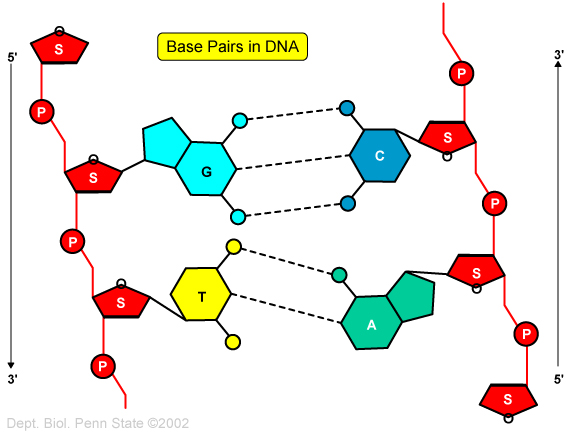
What does this picture represent?
a)
amino acid
b)
base pairing
c)
nucleotide
d)
the DNA molecule
20.
In eukaryotic cells, I travel out of the nucleus to a ribosome.
a)
Both DNA and RNA
b)
DNA
c)
RNA
21.
What is the product of translation?
a)
DNA
b)
mRNA
c)
tRNA
d)
proteins
22.
How many nucleotides make a codon?
a)
1
b)
2
c)
3
d)
6
23.

Transcribe the following DNA strand: CTG AAT

a)

GAC TTA

b)

CTG AAT

c)

GAC UUA

d)

CUG AAU

24.

What combines together to make a protein?

a)

Amino Acid

b)

RNA

c)

Ribosome

d)

DNA

25.

What organelle is the site of translation?

a)

Nucleus

b)

Ribosome

c)

Mitochondria

d)

Chloroplast

26.

What is the order for Protein Synthesis?

a)

Transcription -> Translation -> Protein

b)

Translation - > Transcription -> Protein

c)

Protein -> Transcription -> Translation

d)

Translation -> Protein -> Transcription

27.
The process to go from DNA to mRNA is _______
a)
translation
b)
transcription
c)
replication
28.
The process to go from mRNA to a protein is called ____
a)
transcription
b)
rRNA
c)
replication
d)
translation
29.
The main function of tRNA is to...
a)
carry a message that, when translated, forms proteins
b)
form a portion of ribosomes
c)
string together complementary RNA and DNA strands
d)
bring amino acids from the cytoplasm to the ribosomes
30.
What is the three base sequence of mRNA that codes for a single amino acid?
a)
Anticodon
b)
Codon
c)
Protein
31.
What is the location in the cell for transcription?
a)
nucleus
b)
cytoplasm
c)
ribosome
d)
mitochondria
32.
DNA molecule segment is : TTACGCAAG
The mutated DNA segment is TTCGCAAG. This is an example of ___ mutation.
a)
Substitution
b)
Deletion
c)
Insertion
d)
Inversion
33.
Which type of RNA delivers the genetic code to the ribosome?
a)
rRNA
b)
mRNA
c)
tRNA
d)
dRNA
34.

Where does TRANSCRIPTION occur?

a)

Nucleus

b)

Ribosome

c)

Cytoplasm

d)

Mitochondria

35.

A polypeptide is a sequence of ____________________ held together by a ______________ bond.

a)

amino acids; peptide

b)

fatty acids; ionic

c)

proteins; hydrogen

d)

fatty acids; covalent

36.
What process is going on in this photo? 
a)
Transcription 
b)
Translation 
c)
Replication 
d)
All the above 
37.
The process to go from DNA to mRNA is _______
a)
translation
b)
transcription
c)
replication
38.
The process to go from mRNA to a protein is called ____
a)
transcription
b)
rRNA
c)
replication
d)
translation
39.
Nitrogenous bases are joined by which type of bond?
a)
polar bonds
b)
ionic bonds
c)
covalent bonds
d)
hydrogen bonds
40.
The enzyme that unzips the DNA to prepare for replication
a)
helicase
b)
replicase
c)
polymerase
d)
synthase
41.
These are the "smaller", single ringed bases such as thymine and cytosine
a)
complementary
b)
 cytosine
c)
purine
d)
pyrimidine
42.
These are the "larger", double-ringed bases such as adenine and guanine.
a)
complementary
b)
 cytosine
c)
purine
d)
pyrimidine
43.

What mutation has occurred here?

T-G-A-C-C-A

T-G-A-G-C-A

a)

Substitution

b)

Deletion

c)

Insertion

d)

Frameshift

44.

Which of the following would result in a frameshift mutation?

a)

Insertions only

b)

Substitution only

c)

Deletion only

d)

Insertions and Deletions

45.

DNA molecule segment is : TTACGCAAG

The mutated DNA segment is TTCGCAAG. This is an example of ___ mutation.

a)

Substitution

b)

Deletion

c)

Insertion

d)

Inversion

46.

A mutation is defined as:

a)

A change in the cell's structure

b)

Anything that changes in an embryo

c)

Any change in the physical features of a human

d)

A change in the DNA sequence

47.

ATTTGAGCC- Original

ATTGAGCC - Mutated

The example above is an example of a

a)

Insertion- Frameshift

b)

Deletion- Substitution

c)

Deletion -Frameshift

d)

All of the above

48.

What mutation has occurred here?

T-G-A-C-C-A

T-G-A-G-C-A

a)

Substitution

b)

Deletion

c)

Insertion

d)

Frameshift

49.

A mutation in which only one nucleotide is altered is called a:

a)

Frameshift Mutation

b)

Deletion Mutation

c)

Point Mutation

d)

Insertion Mutation

50.
A type of substitution in which no  amino acids change is called 
a)
Missense
b)
Nonsense
c)
Silent
d)
Deletion
51.
a change in one DNA triplet that may result in a new triplet that codes for a stop codon instead of an amino acid is known as
a)
missense
b)
nonsense
c)
frameshift
d)
silent
52.

The bottom DNA sequence in the image has been altered by this type of mutation

a)

substitution

b)

insertion

c)

deletion

d)

translocation

53.

This is considered the most harmful type of gene mutation. It occurs when the codon reading frame is shifted and creates a chain reaction of errors in amino acids.

a)

Duplication

b)

Frameshift

c)

Insertion

d)

Deletion

54.

This type of mutation occurs when part of a chromosome is added "backwards" meaning the genes would be read in reverse order.

a)

Insertion

b)

Inversion

c)

Translocation

d)

Deletion

55.

This type of mutation occurs when part of a chromosome is broken off and incorrectly added to a different chromosome.

a)

Insertion

b)

Inversion

c)

Translocation

d)

Deletion

56.

Which type of mutation is shown here?

a)

Gene deletion

b)

Chromosomal deletion

c)

Gene insertion

d)

Chromosomal duplication

57.

Which type of mutation is shown here?

a)

Insertion

b)

Deletion

c)

Duplication

d)

Substitution

58.

It is an organism's complete set of genetic instructions. It contains all of the informations needed to build that organism and allows it to develop.

a)

DNA

b)

Genome

c)

Enzymes

59.
Gel electrophoresis enables scientists to
a)
separate DNA fragments.
b)
combine DNA fragments.
c)
count the genes in DNA.
d)
insert DNA in cells.
60.
Genetic engineering has been used to produce
a)
medicines.
b)
food animals.
c)
improved crops.
d)
all of these.
61.
Polymerase chain reaction is used to
a)
determine the sequence of DNA.
b)
make copies of a DNA sequence.
c)
selectively breed plants and animals.
d)
produce mutations in bacteria.
62.
Which is used to cut DNA molecules at specific points?
a)
gel electrophoresis
b)
PCR analysis
c)
a restriction enzyme
d)
recombinant DNA
63.
Which produces offspring from a single cell of an adult?
a)
inbreeding.
b)
mutations.
c)
hybridization.
d)
cloning.
64.
Transgenic organisms contain
a)
genes from other species.
b)
cells of another organism.
c)
genes of only one parent.
d)
one or more human genes.
65.
Genes found on DNA contain the instructions for making  
a)
pyrimidines 
b)
pyrimidines
c)
proteins
d)
purines
66.
Any change or mistake in DNA replication can cause a ________  
a)
cancer cell 
b)
virus
c)
disease
d)
mutation
67.
molecular scissors that "cut' DNA
a)
plasmid
b)
restriction enzymes
c)
recombinant DNA
d)
gene
68.
Mr. Jones was killed in a car accident.  Afterwards, a former girlfriend filed a paternity suit claiming that Mr. Jones was the father of her child, and thus she was entitled to the man’s estate.  Which sample of DNA would have to be from Mr. Jones if he were the child’s father? 
a)
2
b)
3
c)
4
d)
5
69.
Which man is the father of the child?
a)
1
b)
2
c)
3
d)
4
70.
Which two bear species are most closely related?
a)
Bear 1 and Bear 2
b)
Bear 1 and Bear 3
c)
Bear 2 and Bear 3
d)
There’s no way to tell
71.

In preparation for an electrophoresis procedure, enzymes are added to DNA in order to

a)

convert the DNA into gel

b)

cut the DNA into fragments

c)

change the color of the DNA

d)

produce longer sections of DNA

72.
What is the purpose of gel electrophoresis?
a)
helps cut DNA
b)
count the genes in DNA
c)
separates DNA based on size
d)
allows for an exact replicated organism
73.
Why do the fragments of DNA in gel electrophoresis travel away from the negative electrode?
a)
DNA is negatively charged so attracted to the positive end of the unit
b)
DNA is positively charged to attracted to the negative end of the unit
c)
the agarose gel in negatively charged
d)
the agarose gel is positively charged
74.
In gel electrophoresis, the largest DNA fragment will appear
a)
closest to the starting wells
b)
farthest from the starting wells
c)
three quarters away from the starting wells
d)
it depends on how many fragments there are
75.

This laboratory procedure is known as

a)

CLONING

b)

gel electrophoresis

c)

chromatography

d)

use of a dichotomous key

76.

Gel electrophoresis is used to separate DNA fragments on the basis of which property?

a)

size

b)

color

c)

functions

d)

chromosomes

77.

Clones have the exact same:

a)

Personalities

b)

Physical appearances

c)

Intelligence levels

d)

Genetic material

78.
In cloning, what is the purpose of the surrogate mother? 
a)
Donate her DNA
b)
Donate her egg cell
c)
Incubate and carry the baby until birth
d)
Nothing.  She's useless.
79.

When creating a cloned mammal, what structure contains the genetic information the scientist intends to clone?

a)

blastocyst

b)

enucleated oocyte

c)

surrogate mother

d)

somatic cell

80.

What animal was successfully cloned in a research facility in Scotland in 1996 from an adult stem cell?

a)

dog

b)

lizard

c)

chicken

d)

sheep

81.

Cells with the potential to develop into other, more specialized types of cells

a)

Cell Stems

b)

Stem Cells

c)

Seed Cells

d)

Cell Seeds

82.
What term is used to express creating an identical copy of a gene or organism?
a)
hybridization
b)
inbreeding 
c)
cloning 
d)
gene splicing 
83.
What does PCR stand for?
a)
Polymerase Chronic Reagent
b)
Principle Chorionic Reliability
c)
Polymerase Chain Reaction
d)
Probably Cannot React
84.

What is the purpose of polymerase chain reaction (PCR)?

a)

To add nucleotides to a DNA sequence

b)

To produce millions of copies of a specific region of DNA

85.

What was the Human Genome Project?

a)

A project humans made about genes

b)

A project that mapped out genes internationally

c)

A project where humans looked at traits

86.

A mutation is defined as:

a)

A change in the cell's structure

b)

Anything that changes in an embryo

c)

Any change in the physical features of a human

d)

A change in the DNA sequence

87.

Mutations can benefit humans because they can:

a)

Cause illness

b)

Make an organism more suited to live in its environment.

c)

Make organisms live shorter lives

d)

Cause organisms to grow extra limbs.

88.

A mutation in which only one nucleotide is altered is called a:

a)

Frameshift Mutation

b)

Deletion Mutation

c)

Point Mutation

d)

Insertion Mutation

89.

ATTTGAGCC- Original

ATTGAGCC - Mutated

The example above is an example of a

a)

Insertion

b)

Point mutation

c)

Deletion

d)

Substitution

90.
What mutation has occurred here? 
T-G-A-C-C-A
T-G-A-G-C-A
a)
Substitution
b)
Deletion
c)
Insertion
d)
Frameshift 
91.
Which of the following would result in a frameshift mutation?
a)
Insertions only
b)
Substitution only
c)
Deletion only
d)
Insertions and Deletions
92.
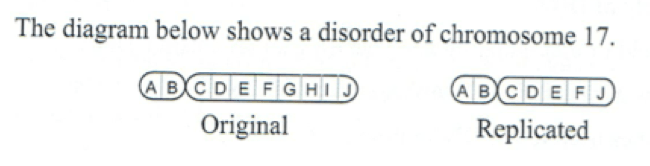
What type of chromosomal mutation has occurred?
a)
substitution
b)
insertion
c)
deletion
d)
nondisjunction
93.
Why are insertion and deletion (frameshift) mutations so harmful?
a)
They change all of the codons from the mutation on down the line, which changes the amino acid sequence
b)
They insert things that an organism doesn't need.
c)
They often delete things that organisms need.
d)
Insertion and deletions are not any more harmful than substitution mutations.
94.

What type of mutation is shown in the diagram?

a)

Point mutation - missense

b)

Frameshift Mutation - deletion

c)

Frameshift Mutation - addition

d)

Point mutation - nonsense

95.

The process of modifying an organism is called...

a)

Transgenic Organism

b)

Genetic Engineering

c)

Gel Electrophoresis

d)

Reproduction

96.
An organism in which foreign genes have been incorporated is called a:
a)
recombinant organism
b)
transgene recombinant
c)
polymorphism
d)
transgenic organism
97.

The combination of DNA from two or more sources is called...

a)

nonrecombinant plasmid

b)

recombinant DNA

c)

binary

d)

selective species

98.

Making an identical copy of an organism

a)

Cloning

b)

Human Genome Project

c)

Gene therapy

d)

DNA fingerprint

e)

Transgenic organism

99.

Sequenced all the DNA in a human cell (determined order of A’s, T’s, C’s and G’s) Goal is to identify and treat diseases and disorders.

a)

Cloning

b)

Human Genome Project

c)

Gene therapy

d)

DNA fingerprint

e)

Transgenic organism

100.

Which individual was not present at the crime scene

a)

Suspect 1

b)

Suspect 2

c)

Both were present

101.
This type of substitution codes for a stop codon
a)
Missense
b)
Nonsense
c)
Silent
d)
Deletion
102.
A type of substitution in which no  amino acids change is called 
a)
Missense
b)
Nonsense
c)
Silent
d)
Deletion
103.
DNA molecule segment is : TTACGCAAG
The mutated DNA segment is TTCGCAAG. This is an example of ___ mutation.
a)
Substitution
b)
Deletion
c)
Insertion
d)
Inversion
104.
Normal-
GAG-CTC-GAC-AGA
Mutant
GAG CTC-CAC-AGA
a)
no mutation
b)
substitution
c)
insertion
d)
deletion
105.
Original: ATC CAT
Mutation: ATC GCAT
What mutation occurred?
a)
deletion
b)
insertion
c)
silent
d)
transverse
106.
Any change in the sequence of DNA is...
a)
transgenic shift
b)
Single Genotype
c)
Monohybrid Trait
d)
Mutation
107.
A mutation that does NOT show up through protein function is called
a)
deletion mutation
b)
inversion mutation
c)
silent mutation
d)
transverse mutation
108.
Identify the chromocomal mutation:
If a portion of the chromosome is flipped, it is called a(n)
a)
Inversion
b)
Translocation  
c)
Deletion
d)
Substitution 
109.
Separation of DNA using electric current is called.....?
a)
Gel Electrophoresis
b)
Chromosome painting
c)
polymerage chain reaction
d)
Restrictive Enzyme Sorting 
110.
Identify the chromosomal mutation
a)
Deletion
b)
Duplication
c)
Inversion
d)
Translocation
111.
Identify the chromosomal mutation
a)
Deletion
b)
Duplication
c)
Inversion
d)
Translocation
112.
Identify the chromosomal mutation
a)
Deletion
b)
Duplication
c)
Inversion
d)
Translocation
113.

A pair of chromosomes that includes the same type of DNA to code for the same type of instructions

a)

Base pairs

b)

Nucleotides

c)

Homologous chromosomes

d)

Interchangeable chromosomes

114.
Which suspect should be charged with the crime?
a)
Suspect 1
b)
Suspect 2
c)
Suspect 3
d)
None of these suspects
115.
What is the enzymatic function of restriction enzymes?
a)
To add new nucleotides to the growing strand of DNA.
b)
To join nucleotides during replication.
c)
To join nucleotides during transcription.
d)
To cleave nucleic acids at specific sites.
116.
The unpaired nucleotides produced by the action of restriction enzymes are referred to as
a)
sticky end.
b)
base sequence.
c)
single strands.
d)
restriction fragments.
117.
A ____________ is required to transfer genes from one organism to another.
a)
vector
b)
reverse transcriptase
c)
transport molecule
d)
genetic probe
118.
What is a cloning vector?
a)
The DNA probe used to locate a particular gene in the genome.
b)
An agent such as plasmid, used to transfer DNA from an in vitro solution into a living cell.
c)
The laboratory apparatus used to clone genes.
d)
An enzyme that cuts DNA into restriction fragments.
119.
In order to insert a human gene into plasmid, both must 
a)
code for the same gene product.
b)
be cut by the same restriction enzyme.
c)
originate from the same type of cell.
d)
have identical sequences.
120.
An organism in which foreign genes have been incorporated is called a:
a)
recombinant organism
b)
transgene recombinant
c)
polymorphism
d)
transgenic organism
121.

A student performed a gel electrophoresis experiment. The results are represented in the diagram

below. Compared to the fragments at the top of the gel, the fragments at the lower end are

a)

larger, and move slower

b)

larger, and move faster

c)

smaller, and move faster

d)

smaller, and move slower

122.

Gel Electrophoresis is a technique used to separate DNA fragments based on ________.

a)

Size

b)

Number of A's and G's

c)

Animal species

d)

Criminal suspects

123.
Based on these results whose blood was found in the blood stain at the crime scene?
a)
Bob
b)
Sue
c)
John
d)
Lisa
124.
Which is the primary purpose of using restriction enzymes in gel electrophoresis?
a)
It allows the strands of DNA to be cut into various lengths for testing
b)
It restricts the number of base pairs that can be tested in a sample
c)
It makes the testing simpler by moving the strands into the gel faster
d)
It charges the DNA strands
125.
DNA fingerprinting works because
a)
Most genes are dominant
b)
Most people have DNA that contains repeats
c)
The most important genes are different among most people
d)
No two people, except identical twins, have exactly the same DNA 
126.
Which two bear species are most closely related?
a)
Bear 1 and Bear 2
b)
Bear 1 and Bear 3
c)
Bear 2 and Bear 3
d)
There’s no way to tell
127.
The purpose of selective breeding is to 
a)
Get bigger animals
b)
get smaller animals
c)
create animals with desirable traits
d)
create animals with bad traits
128.
Which of the following is NOT used in cloning? 
a)
Egg cell
b)
Somatic cell
c)
Sperm cell
d)
Surrogate 
129.
In cloning, what is the purpose of the surrogate mother? 
a)
Donate her DNA
b)
Donate her egg cell
c)
Incubate and carry the baby until birth
d)
Nothing.  She's useless.
130.
Putting the gene for bioluminescence into a fish is an example of...
a)
Genetic Engineering
b)
Selective Breeding
c)
Artificial Selection
d)
Gene Mutation
131.

It is the transfer of genetic material for the purpose of treating human disease.

a)

chemotherapy

b)

gene therapy

c)

gene transfer

d)

gene editing

132.
Gene therapy is the attempt to
a)
fuse cells taken from different species.
b)
treat disease by changing a patient's DNA.
c)
determine a baby's sex before birth.
d)
provide genes to people who have none.
133.
Which is true about embryonic stem cells?
a)
They no longer divide, their cell type is set and cannot change.
b)
They can develop into only one type of cell.
c)
They can become any cell type in the body.
d)
They are found in adults.
134.
Mr. Jones was killed in a car accident.  Afterwards, a former girlfriend filed a paternity suit claiming that Mr. Jones was the father of her child, and thus she was entitled to the man’s estate.  Which sample of DNA would have to be from Mr. Jones if he were the child’s father? 
a)
2
b)
3
c)
4
d)
5
135.
Bob was found dead in his home.  Crime scene analysis showed signs of a struggle.  Blood was collected from the crime scene, the victim, and three suspects.  Which suspect likely committed the crime? 
a)
Sue
b)
Lisa
c)
John
d)
None of these
136.

The parents of a new baby believe they brought the wrong child home from the hospital. Gel electrophoresis was performed using DNA samples from the parents and the child. A section of the gel

electrophoresis results is shown below. Which conclusion is valid based on the gel electrophoresis results?

a)

They have the correct child, because her genetic information is identical to that of the father.


b)

They have the wrong child, because her genetic information does not match that of either parent.

c)

They have the correct child, because her genetic information came from both parents.


d)

They have the wrong child, because her genetic information matches only that of the mother.

137.

The process in which a stem cell is assigned its particular cell type and develops the necessary structures

a)

differentiation

b)

translocation

c)

nondisjunction

d)

gene sequencing

138.

The main issue associated with the use of stem cells is

a)

the destruction of embryos

b)

testing that lead to false positives

c)

we have 100 trillion bad genes to be replaced

d)

genetic discrimination by insurance and employers

139.
The main goal of the Human Genome Project (HGP) was to:
a)
Identify the unique parts of each person's DNA.
b)
Identify genes responsible for human diseases.
c)
Identify genes responsible for human behavior.
d)
Determine the entire sequence of human DNA.
140.
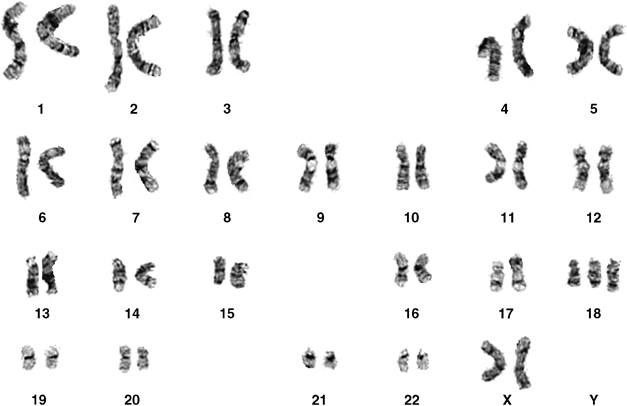
What is the chromosomal condition of the individual whose karyotype is seen in the image?
a)
Monosomy X (Turner's Syndrome)
b)
Trisomy 21 (Down's Syndrome)
c)
Trisomy 13 (Patau Syndrome)
d)
Trisomy 18 (Edwards's Syndrome)
141.

What would you call the failure of one or more pairs of homologous chromosomes or sister chromatids to separate normally during meiosis?

a)

nondisjunction

b)

anaphase I

c)

nondiploidy

d)

karyotype

142.
Determine the sex of the individual whose karyotype is displayed in the image.
a)
female
b)
male
143.

The physical transfer of a gene from the DNA of one organism into another organism in order to produce an organism with desired traits is called

a)

Genetic engineering

b)

Karyotype

c)

Cloning

d)

Selective breeding

144.
An organism that is genetically identical to the organism from which it was produced.
a)
Clone
b)
Carrier
c)
Hybridization
d)
Selective Breeding
145.
The process of selecting a few organisms with desired traits to serve as parents of the next generation.
a)
Gene Therapy
b)
Genome
c)
Selective Breeding
d)
Pedigree
146.
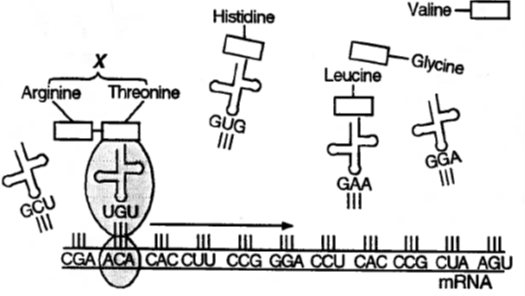
What process is shown in the picture?
a)
Gene therapy
b)
Cloning
c)
DNA Fingerprinting
d)
Gene Splicing
147.
Which two bat species are most closely related?
a)
 Bat 1 and Bat 2
b)
Bat 1 and Bat 3
c)
Bat 2 and Bat 3
d)
There’s no way to tell
148.
GMO stands for
a)
genetically made organism
b)
genetically modified organism
c)
gene manipulated organism
d)
Genetic mutant organism
149.

What is the first cloned mammal?

a)

goat

b)

cat

c)

sheep

d)

cow

150.

A technique for making millions of copies of a specific region of DNA.

a)

DNA ligase

b)

restriction enzymes

c)

gel electrophoresis

d)

polymerase chain reaction

151.

Which two individuals are the most similar based on this image of a completed gel electrophoresis?

a)

W and X

b)

W and Z

c)

X and Y

d)

W and Y