
 Worksheets
Meiosis Review
Total questions: 156
Worksheet time: 2hrs 47mins

What is the scientific term that refers to sex cells?
autosome
gamete
karyotype
chromosome

This term refers to half the normal chromosome number
haploid
2N
diploid
3N

The stage of meiosis where crossing over or the exchange of genetic information happens between pairs of chromosomes
Prophase II
Telophase I
Metaphase II
Prophase I

This term refers to the production of gametes by organisms that reproduce sexually
mitosis
binary fission
meiosis
cloning

The exchange of genetic information that insures that every gamete is unique is referred to as
mitosis
meiosis
reduction division
crossing over

All sperm and egg cells are genetically identical.
TRUE
FALSE

The term that refers to a cell that has its full or complete number of chromosomes is
diploid
N
gamete
haplpoid

At the end of meiosis, how many complete/operational sex cells are created for each original cell?
2 for males; 2 for females
1 for males; 4 for females
4 for males; one for females
1 for males; 1 for females

Crossing over happens when part of the genetic information of one chromosome switches places with the genetic information from another chromosome. Another term for this process is
genetic recombination
genetic reduction
a mutation
nondisjunction

Name the stage: Chromosomes line up in the middle of the cell.
Prophase
Metaphase
Anaphase
Telophase

Name the stage: two nuclei are formed enclosed by nuclear membranes
prophase
metaphase
anaphase
telophase

Name the stage: chromosomes condense and become visible
prophase
metaphase
anaphase
telophase

Name the stage: Chromosomes pull away from each other and move to opposite sides of the cell
Prophase
Metaphase
Anaphase
Telophase

Sea turtles have 56 chromosome in their somatic cells. How many chromosomes are in their gametes?
28
56
112
46

What is another term for body cells?
somatic cells
gamete
stem cell
neural cell
What kind of cells does meiosis produce?
haploid
diploid


What is the purpose of meiosis?
to help the organism grow
to repair damaged cells
to heal injuries
to create diversity in offspring
The daughter cells produced by meiosis are also called __________.
somatic cells
stem cells
germ cells
gametes
Meiosis produces daughter cells that are genetically _________ each other.
identical to
different from
superior to
inferior to
How many daughter cells does meiosis produce?
1
2
3
4
Which part of meiosis produces diversity in gametes?
DNA replication
Prophase
Crossing-over
Cytokinesis
How many cell divisions does meiosis have?
0
1
2
3
If an organism has 24 chromosomes in a body cell, how many will each daughter cell have at the end of meiosis?
6
12
23
24

In humans, the haploid number of chromosomes is ____.
23
46
69
92
Which of the following is the best definition for MEIOSIS?
the process of two haploid cells uniting
the counting of chromosomes within a diploid cell
a two-step process that reduces the number of chromosomes in half such that there is only one copy of all the chromosomes
the equational division of a cell into two identical copies
True or False? Before cells undergo meiosis they pass through interphase first.
true
false
What is unique to Prophase I- is that the duplicated chromosomes pair up to form _______.
a centrosome
a tetrad
the mitotic spindle
sister chromatids
In Anaphase I, the _________ are separated by the pulling of the spindle fibers to opposite poles of the cell.
homologous pairs of chromosomes
sister chromatids
centromeres
centrosomes
Check all of the following that DO occur during Telophase I and cytokinesis.
The separated homologous chromosomes are at opposite poles of the cell.
The cell divides in two.
The chromosomes do not uncoil, since they are getting ready for Meiosis II.
Sister chromatids are pulled away from each other.
At the start of Meiosis II, which of the following is NOT true?
There are two cells.
The cells are haploid.
The chromosomes are paired up as homologues.
DNA is present as two sister chromatids joined at the centromere.
In Metaphase II, _________ line up on equatorial plane.
homologous pairs of chromosomes
single chromosomes (made up of 2 sister chromatids)
tetrads
centrosomes
In Anaphase II, the _________ separate.
Homologues
Sister Chromatids
Tetrads
Centrioles
True or False. In Meiosis II, there are TWO cells that go through each phase at the same time.
true
false
Which of the following does NOT happen during Telophase II?
the nuclei reform
each cell begins to split evenly in two
the chromosomes duplicate
the nuclei contain a haploid number of chromosomes
Which part of MEIOSIS is identical to MITOSIS?
Meiosis I
Meiosis II
The products of MEIOSIS have _______ number of chromosomes.
haploid
diploid
Mitosis is the same as which of the following?
Meiosis I
Meiosis II
Meiosis III
Crossing Over

What phase is this?
Prophase I
Metaphase II
Anaphase I
Telophase II

What phase is this?
Telophase I
Prophase II
Metaphase I
Anaphase II

What phase is this?
Metaphase I
Prophase II
Telophase I
Anaphase II

What phase is this?
Metaphase II
Prophase II
Telophase I
Anaphase I

What phase is this?
Metaphase II
Prophase I
Telophase I
Anaphase II

What phase is this?
Metaphase II
Prophase I
Telophase I
Anaphase I

What phase is this?
Telophase II
Anaphase II
Telophase I
Anaphase I

What phase is this?
Metaphase II
Prophase I
Telophase II
Anaphase I

What phase is this?
Anaphase II
Telophase I
Telophase II
Anaphase I

What phase is this?
Prophase II
Telophase II
Telophase I
Prophase I

What phase is this?
Prophase II
Prophase I
Anaphase II
Anaphase I

What phase is this?
Prophase II
Prophase I
Anaphase II
Anaphase I

What phase is this?
Prophase II
Metaphase I
Anaphase II
Telophase II

What phase is this?
Telophase I
Metaphase I
Metaphase II
Telophase II

What phase is this?
Prophase I
Metaphase I
Metaphase II
Prophase II

What phase is this?
Prophase I
Metaphase I
Metaphase II
Prophase II
A diploid cell...
has 1/2 the amount of chromosomes
has the normal amount of chromosomes (46)
is represented by (n) in meiosis
A haploid cell...
has the complete amount of chromosomes (46)
is represented by (2n)
has 1/2 the amount of chromosomes
Which phrase best describes MEIOSIS?
cell division of somatic cells (normal body cells)
cell division of prokaryotic cells
cell division of gametic cells
When gametes fuse during fertilization, they create a zygote that has_______________ cells.
haploid
diploid
polyploid
One similarity between MITOSIS and MEIOSIS is...
the order of phases (PMAT)
the types of cells that are dividing
where the process is occurring in the organism
Meiosis occurs in the _________________ of organisms.
digestive organs (stomach, intestines)
reproductive organs (testes, ovaries)
sensory organs
(eyes, ears, nose)
How many daughter cells are made at the end of Meiosis l?
2
3
4
6
How many daughter cells are made at the end of Meiosis ll?
2
4
6
8
The daughter cells created in Meiosis are _____________.
identical
non-identical
Crossing over is the process of...
chromosomes separating during Anaphase
tiny pieces being exchanged on two sister chromatids
chromatids lining up in the middle of the cell during Metaphase
During Prophase l of MEISOSI...
the cell is split in two
chromosomes line up in the middle of the cell
crossing over occurs between two chromosomes
If there is a lot of genetic variation in a population,
then there is a greater chance of survival.
TRUE
FALSE
Which is NOT true about sexual reproduction?
only one organism is required to pass on traits
sperm and egg are required for a zygote to form
both parents pass on traits to offspring
Meiosis ensures a constant amount of genetic material in future generations by reducing the number of chromosomes in the daughters cells to ________ that of a parent cell.
1/3
1/4
1/2
Pairs of chromosomes that contain the same genes, but may have different versions are called
chromatids
sister chromatids
homologous pairs
Meiosis is unique in cell division because it can take a ________ parent cell and create _________ daughter cells.
haploid, triploid
diploid, haploid
triploid, haploid
mitotic, meiotic
What is something that is similar between meiosis and mitosis?
the type of daughter cells they make
the amount of genetic material the resulting cells have
the replication of DNA
the location where these two types of cell division take place.
In mitosis, the two resulting cells are
different from the starting cell and identical to each other.
different from the starting cell and different from each other.
identical to the starting cell and different from each other.
identical to the starting cell and identical to each other.
Cells of organism must replicate for ?
growth
repair of damaged cells
replacement of dying cells
all of the answers are right
Before cells can divide, what must be copied?
mitochondria
cytoplasm
DNA
cell wall
The cell spends most of it's life in ________________.
mitosis
cytokinesis
interphase
none of the above
1. Even though humans are approximately 99.9% identical in their genetic makeup, an incredible amount of variation is seen among individuals of the species. This genetic variation is greatly influenced by the process of meiosis.
Of the following events that occur during meiosis, which contributes most to genetic diversity in the human population?
A. Condensation of chromatin during meiosis I
B. Recombination between homologous chromatids during meiosis I
C. Alignment of sister chromatids at the metaphase plate during meiosis II
D. Separation of sister chromatids during meiosis II
. If an organism has an N number of 10 chromosomes (haploid # of 10), how many chromosomes are in a somatic cell (body cell) of this organism (what is the diploid #) ?
a. 20
b. 40
c. 5
d. 100
Which one of the following is a way that Mitosis is different from Meiosis:
a. Meiosis results in 2 daughter cells, while Mitosis produces 4 daughter cells
b. Meiosis results in 4 daughter cells, while Mitosis produces 2 daughter cells
c. Cells produced by meiosis are all genetically different
d. Both b and c are correct
Homologous chromosomes contain genes that code for the same traits, but they carry different versions (alleles) of these genes.
True
false
Homologous chromosomes pair up side-by-side in tetrads along the middle of the cell during what kind of cell division?
a. Mitosis
b. Meiosis
c. Both
d. Neither
During which stage of meiosis do homologous chromosomes separate?
Anaphase I
Anaphase II
Metaphase I
Prophase I
Which of the following best describes the function of telophase in meiosis?
Separation of sister chromatids
Alignment of chromosomes at the cell equator
Reformation of nuclear membranes around chromosomes
Crossing over of genetic material
What is the result of nondisjunction during meiosis?
Decreased genetic diversity
Cells with the correct number of chromosomes
Cells with an abnormal number of chromosomes
Enhanced genetic recombination
What is the difference between sexual and asexual reproduction?
Asexual produces genetically different offspring. Sexual produces genetically identical.
Sexual produces offspring with fewer chromosomes. Asexual produces more.
Sexual produces genetically different offspring. Asexual produces genetically identical.
Sexual reproduction is quicker than asexual.
Which is NOT an Asexual reproduction DISADVANTAGE
No genetic variation
Only need one parent
Bad characteristics are passed on
difficult for organisms to adapt
Combining of egg and sperm
Asexual Reproduction
Sexual Reproduction
Diverse
Uniform
Being different
Asexual Reproduction
Sexual Reproduction
Diverse
Uniform
Which is NOT a Sexual reproduction DISADVANTAGE
High genetic variation
Can be complicated
smaller population
requires courtship or mating
occurs when a second organism develops from an outgrowth of the original.
Vegetative propagation
Budding
Fragmentation
Binary Fission
A type of cell division where the cell divides into two copies
Vegetative propagation
Budding
Fragmentation
Binary Fission
a piece of an organism develops into a fully grown copy.
vegetative propagation
budding
fragmentation
binary fission
What are the male and female gametes in PLANTS sexual reproduction?
Sperm
Ovum
Pollen
Ovules
What are the male and female gametes in ANIMAL sexual reproduction?
Sperm
Ovum
Pollen
Ovules
What is the process called where a sperm and egg make a zygote?
Fertilisation
Budding
Fragmentation
Zygotisation
A cell that results from fertilization is called a _?
gamete
sperm
yolk
zygote

Table 1 shows the stage and number of cells and chromosomes per cell at the end of the stage in a 2n=24 organism. Which of the following statements correctly describes the chromosomes in each daughter cell at the end of meiosis I ?
Each daughter cell contains 12 chromatids. Each chromatid is one of two from a single chromosome with the other one of the pair found in the other daughter cell.
Each daughter cell contains 12 chromosomes, each composed of two chromatids. Since the chromosomes were randomly divided, one daughter cell may contain both of a pair of homologous chromosomes, while the other cell contains both of another pair of homologous chromosomes.
Each daughter cell contains 12 chromosomes, each composed of two chromatids. Each chromosome is one of a pair of homologous chromosomes from the parent cell, with the other homologue found in the other daughter cell.
Each daughter cell contains 24 separate chromatids. Since every two chromatids were originally joined, forming one homologous chromosome, the number of chromatids is divided by two to determine the number of chromosomes.
Both mitosis and meiosis begin with a parent cell that is diploid. Which of the following best describes how mitosis and meiosis result in daughter cells with different numbers of chromosomes?
In mitosis, the chromosomes consist of a single chromatid, which is passed to two haploid daughter cells. In meiosis, the chromosomes consist of two chromatids during the first round of division and one chromatid during the second round of division, resulting in two haploid daughter cells.
In mitosis, synapsis of homologous chromosomes results in four haploid daughter cells after one division. In meiosis, synapsis of homologous chromosomes occurs during the second division and results in four diploid daughter cells.
Mitosis produces one identical daughter cell after one round of division. Meiosis has two rounds of division and doubles the number of chromosomes in the second round of division, producing four diploid cells.
Mitosis produces two identical diploid daughter cells after one round of division. Meiosis produces four haploid daughter cells after two rounds of division.
Saccharomyces cerevisiae is a diploid yeast species that can reproduce either sexually or asexually. An experiment was performed to induce mitotically dividing S. cerevisiae cells in G2 to undergo meiosis. Which of the following best describes the steps these cells will follow to form gametes?
The first division will result in crossing over between homologous chromosomes, and the second division will reduce the original number of chromosomes by half in the daughter cells.
The first division will reduce the number of chromosomes by half for each daughter cell, and the second division will result in each daughter cell having one-fourth of the original number of chromosomes.
The first division will move single chromatids to each daughter cell, and the second division will double the number of chromosomes in each daughter cell.
The first division will reduce the number of chromosomes by half for each daughter cell, and the second division will move single chromatids to each daughter cell.

During prophase I replicated homologous chromosomes pair up and undergo synapsis. What testable question is generated regarding synapsis and genetic variability by Figure 1 ?
Is the distance between two gene loci related to crossover rate?
Does crossing over occur more often in some chromosomes than in others?
Is crossing over inhibited by methylation?
Is crossing over promoted by methylation?

Nondisjunction during meiosis can negatively affect gamete formation. A model showing a possible nondisjunction event and its impact on gamete formation is shown in Figure 1. Which of the following best describes the most likely impact on an individual produced from fertilization between one of the daughter cells shown and a normal gamete?
Because nondisjunction occurred in anaphase I , all gametes will be normal and the resulting individual will be phenotypically normal.
Because nondisjunction occurred in anaphase I , all gametes will have an abnormal chromosome number and the individual will likely exhibit phenotypic evidence of the nondisjunction event.
Because nondisjunction occurred in anaphase II , all gametes will be normal and the resulting individual will be phenotypically normal.
Because nondisjunction occurred in anaphase II , all gametes will have an abnormal chromosome number and the individual will likely exhibit phenotypic evidence of the nondisjunction event.
Which of the following is NOT a source of genetic variation that causes siblings to look different from one another?
Independent assortment
Random fertilization
Crossing Over
Meiosis
All of these are sources of genetic variation

Figure 1 illustrates the X and Y chromosomes during meiosis I and meiosis II of normal spermatogenesis in a mammal species. If the normal spermatogenesis is disrupted, the gametes can have different chromosomes than expected. Which of the following is the most likely cause of one of the four gametes having two X chromosomes and one having neither an X nor a Y chromosome?
Nondisjunction of the chromosomes during meiosis I
Nondisjunction of both the X and Y chromosomes during meiosis II
Nondisjunction of the Y chromosome during meiosis II
Nondisjunction of the X chromosome during meiosis II

Trisomy 21 is a condition in which a child is born with an extra chromosome in pair 21. Researchers assessed the frequency of children born with trisomy 21 by age of the mothers at birth (maternal age) and primary cause of the error leading to trisomy 21. The findings are presented in Figure 1. Based on the data in Figure 1, which of the following is most likely the primary cause of the pattern of frequency of trisomy 21 births in the selected maternal age-groups?
At older maternal ages, there is an increase in the number of errors during mitosis, which leads to an increase in nondisjunction during egg production.
The incidence of nondisjunction errors in meiosis during sperm production is positively correlated with increasing maternal age.
At older maternal ages, the incidence of errors in meiosis during egg production increases, which leads to an increase in nondisjunction.
Errors in meiosis leading to nondisjunction are more likely to occur during meiosis I than during meiosis II
The process of mitosis results in...
four 1N cells
four 2N cells
two 1N cells
two 2N cells
Which of these is NOT part of interphase?
G2
G1
M
S
The process of meiosis results in...
four 1N cells
four 2N cells
two 1N cells
two 2N cells
What is the difference between plant and animal mitosis?
plants use centrioles; animals use a cell plate to split the cell contents
plant cells have a cell plate; animals have a cleavage furrow
animals reduce their chromosome number; plants don't
plants do not go through telophase
A carp, a type of fish, has 52 homologous pairs of chromosomes in its brain cells. How many chromosomes are contained in one of its gametes?
52
13
26
104
The failure of chromosomes to separate during meiosis is known as...
nondisjunction
independent assortment
synapsis
none of these are correct
Mitosis deals with ____ cells, while meiosis deals with the ____.
gametic; somatics
haploid; diploids
somatic; gametes
correct answer is not provided
Cells undergo a round of DNA replication, forming duplicate chromosomes
Interphase
Prophase II
Anaphase II
Prophase I
Each chromosomes pairs with its corresponding homologus chromosome to form a tetrad
Metaphase I
Telophase I & Cytokinesis
Prophase I
Anaphase II
Spindle fibers attach to the chromosomes that are arranged across the middle of the cell
Interphase
Anaphase II
Metaphase I
Telophase II & Cytokinesis
The fibers pull the homologous chromosomes toward opposite ends of the cell
Metaphase I
Prophase I
Anaphase I
Interphase
Meiosis I results in two haploid daughter cells; Meiosis II starts when the cells once again lose their nuclear membranes, chromosomes condense
Metaphase II
Prophase II
Anaphase II
Interphase
The sister chromatids separate and move toward opposite end of the cell
Metaphase I
Prophase II
Anaphase II
Prophase I
In what phase of meiosis does the following occur?
Homologous chromosomes separate and are pulled to opposite sides of the cell by spindle fibers. The sister chromatids of each chromosome remain attached.
Prophase I
Anaphase I
Metaphase I
Telophase I
Prophase II
In what phase of meiosis does the following occur?
Chromosomes are segregated at opposite poles, one group on each side of the cell. Each chromosome consists of two chromatids. (sister chromatids) Cytokinesis begins, forming two daughter cells.
Prophase I
Anaphase I
Metaphase I
Telophase I
Prophase II
In what phase of meiosis does the following occur?
Chromosomes become attached to spindle fibers. Each cell contains one chromosome(sister chromatid) of each type; there are no homologous pairs. 1st phase of Meiosis II
Prophase I
Anaphase I
Metaphase I
Telophase I
Prophase II
In what phase of meiosis does the following occur?
Spindle fibers align the chromosomes (sister chromatids) at the mid-line, or equator, of the cell. The chromosomes are not in pairs.
Prophase I
Anaphase II
Metaphase II
Telophase II
Prophase II
In what phase of meiosis does the following occur?
By the end of meiosis, 4 haploid cells are formed. Each cell has a unique genetic make-up. A nucleus surrounds each set of chromosomes, and the cell carries out normal metabolic activities.
Prophase I
Anaphase II
Metaphase II
Telophase II
Prophase II
In what phase of meiosis does the following occur?
Chromatids (sister chromatids) of the chromosomes separate and are pulled to opposite sides of the cell by spindle fibers.
Prophase I
Anaphase II
Metaphase II
Telophase II
Prophase II

Chromosomes can always be seen in a cell
True
False
A chromosome is composed of two identical sister
centromeres
chromatids
autosomes
somatic cells
The disc shaped protein core that DNA wraps around is called
histone
nucleosome
chromatin
gene
Chromosomes contain genetic information in the form of
DNA
histone
centromere
karyotypes
Sister chromatids are held together by a
histone core
chromatin
nucleosome
centromere
A segment of DNA
nucleosome
gene
histone
chromatin
Made of chromatin and become visible during cell division
chromosomes
histones
mitochondria
nucleosomes
double strand molecule made out of 4 subunits called nucleotides.
Histone
DNA
Chromosome
The loose combination of DNA and proteins
Histone
DNA
Chromosome
Chromatin
Chromatid
One half of the chromosome, contain identical DNA
Histone
DNA
Chromosome
Chromatin
Chromatid
Together the two identical chromatids
Histone
Sister chromatids
Chromosome
Chromatin
Chromatid
prevent the ends of the chromosome from accidently attaching to each other and they help prevent the lost genes.
telomeres
Sister chromatids
Chromosome
Chromatin
Chromatid


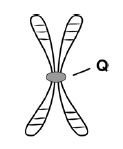
In the picture, Q is pointing to the center of the image. What is Q?
centriole
chromatid
chromatin
centromere

In the following structure, the circled item is a
chromosome
chromatid
centromere
chromatin
DNA is normally found in the...
chloroplast
nucleus
mitochondria
cytoplasm
Most of the time DNA is found as...
chromosomes
chromatin
nucleus
sister chromatids
example: bacteria
Prokaryotic
Eukaryotic
do not have a nucleus
Prokaryotic
Eukaryotic
example plants and animals
Prokaryotic
Eukaryotic
have a nucleus
Prokaryotic
Eukaryotic
Have membrane bound organelles
Prokaryotic
Eukaryotic
Goes through mitosis
Prokaryotic
Eukaryotic

