wayground logo

Free Printable Worksheets

Font size

S
M
L
XL
Worksheets

Cell Division Study Guide

Total questions: 156

Worksheet time: 2hrs 29mins

Name
Class
Date
1.
During what stage does the G1, S and G2 phases happen?
a)
Interphase
b)
M phase
c)
Mitosis
d)
Cytokinesis
2.
During what phase of the cell cycle does cell division occur?
a)
Interphase
b)
M phase
c)
S phase
d)
G2 phase
3.
During what phase of the cell cycle is DNA replicated?
a)
G1 phase
b)
S phase
c)
G2 phase
d)
M phase
4.
During what phase of the cell cycle does the cell grow?
a)
G1 phase
b)
S phase
c)
M phase
d)
Cytokinesis
5.
Put the following stages of mitosis in order: anaphase, prophase, metaphase, and telophase. 
a)
prophase, metaphase, telophase, anaphase
b)
prophase, anaphase, metaphase, telophase
c)
prophase, metaphase, anaphase, telophase
d)
prophase, telophase, metaphase, anaphase
6.
Put the following in order: G2, G1, S, mitosis, cytokinesis. 
a)
G1, G2, S, Mitosis, cytokinesis
b)
G1, S, G2, Mitosis, cytokinesis
c)
G1, G2, S, cytokinesis, mitosis
d)
G1, S, G2, cytokinesis, mitosis
7.
Put the following actions in order: DNA replicates, cell grows, cell divides, cell prepares for mitosis. 
a)
DNA replicates, cell grows, cell prepares for mitosis, cell divides
b)
cell grows, cell prepares for mitosis, DNA replicates, cell divides
c)
cell grows, DNA replicates, cell prepares for mitosis, cell divides
d)
DNA replicates, cell prepares for mitosis, cell grows, cell divides
8.
During which phase of the cell cycle does the cell spend the most time?
a)
Mitosis
b)
Cytokinesis
c)
Interphase
9.
During which parts of the cell cycle does the cell grow?
a)
G1 and G2
b)
G1 and S
c)
M phase and cytokinesis
10.

Uncontrolled cell division which usually leads to tumors and disease is called:

a)

Metaphase

b)

Cytokinesis

c)

Cancer

d)

Diabetes

11.

In which stage of the cell cycle does the cell split into two?

a)

Mitosis

b)

G1

c)

Cytokinesis

d)

S

12.

_____ is the uncontrolled growth of cells, often resulting in a tumor or mass of abnormal cells

a)

Cancer

b)

Apoptosis

c)

Radiation

13.

An abnormal mass/group of cancer cells is called a

a)

tumor

b)

cyst

c)

lesion

d)

polyp

14.

Which type of tumor is being described:


Slow growing Not dangerous Does not spread

a)

Malignant

b)

Benign

15.

Which type of tumor is being described below:


Spreads Dangerous Grows quickly

a)

Benign

b)

Malignant

16.

What is a mutation?

a)

A mistake in DNA which can lead to cancer

b)

A complete copy of DNA

c)

A change in DNA which doesn't cause an issue

d)

A mistake in your body that is caught and removed

17.
All Offspring of Asexual reproduction are identical
a)
True
b)
False
18.

Bacteria reproduce asexually by a process called

a)

replication

b)

meiosis

c)

mitosis

d)

binary fission

19.
In binary fission how does the DNA of the daughter cells compare to the DNA of the parent cell? 
a)
It is only half of the amount of DNA found in the parent.
b)
It is identical.
c)
It is a mix of the parent's DNA.
d)
It has some similarities and some differences.
20.
How many parent(s)are needed for asexual?
a)
4
b)
1
c)
9
d)
100
21.

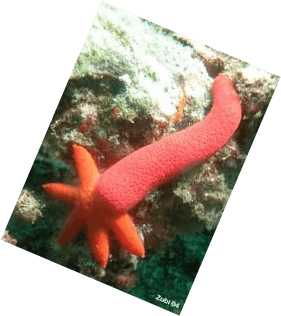
When a starfish grows a new body off a broken arm what type of reproduction is happening?

a)

sexual reproduction

b)

asexual reproduction

22.

What process occurs in order for body cells to reproduce?

a)

mitosis

b)

meiosis

c)

binary fission

d)

budding

23.

Budding, mitosis, and binary fission are all examples of what type of reproduction?

a)

sexual reproduction

b)

asexual reproduction

24.

A cell that has a full set of chromosomes is called a______ cell.

a)

haploid

b)

diploid

c)

triploid

d)

hetrolpoid

25.
A hydra reproduces when an outgrowth, or bud, forms and continues to develop until if falls off of the parent. This is an example of:
a)
Binary Fission
b)
Sporulation
c)
Budding
d)
Vegetative Propagation
26.
a)
budding
b)
sporulation
c)
vegetative propagation
d)
binary fission
27.
What type of asexual reproduction is taking place?
Fishermen work hard to catch and remove all the starfish that get into their favorite shell fishing beds and the “underwater farms” where they raise clams and oysters. In the past, they put the starfish into their boats, cut them up with knives, and then throw the pieces of starfish overboard. They thought this would kill the starfish. What they did not know was that each piece of starfish will grow into a whole new animal.
a)
Regeneration
b)
Vegetative propagation
c)
Budding
d)
Fission
28.
During this type of asexual reproduction,  plants produce genetically identical offshoots (clones) of themselves, which then develop into independent plants?
a)
Binary Fission
b)
Sporulation
c)
Regeneration
d)
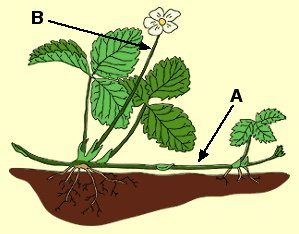
Vegetative Propagation
29.
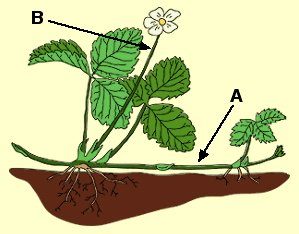
Which of the following asexual reproduction processes includes strawberries, within which strawberries reproduce when the parent organism sends out tendrils which can take root and grow into new organisms.
a)
Tuber
b)
Bulb
c)
Runner
d)
Binary Fission
30.
Which enzyme has the job of unzipping the double helix?
a)
Helicase
b)
Polymerase
c)
Ligase
d)
Primerase
31.
If a strand reads:
3' A A A T T T C 5'
The matching strand would read...
a)
5' T T T A A A G 3'
b)
3' T T T A A A G 5'
c)
5' A A A T T T C 3'
d)
3' U U U A A A G 5'
32.
What is the shape of DNA?
a)
Double helix
b)
Triple helix
c)
Flat, bilayer
d)
Three-pronged rigid ladder
33.
Sometimes, DNA is called "semi-conservative." Why might this be?
a)
The old strand is "conserved" and used to make the new strands
b)
Uracil is "conserved" in that it is only used to make the new strands
c)
ATP is "conserved" via the usage of facilitated diffusion
d)
Ligase is "conserved" in that it is denatured by the process
34.
If the percentage of DNA is made of 30% Thymine, what is the correct percentage of Guanine?
a)
30
b)
15
c)
20
d)
60
35.
Replicate the following strand of DNA: 
AATCATGGA
a)
AATCATGGA
b)
TTAGTACCT
c)
UUAGUACCU
d)
GGATAUCUA
36.
DNA replication results in two DNA molecules,
a)
each one with two original strands
b)
each one with two new strands
c)
each one with one new strand and one original strand
d)
one with two new strands and the other with two original strands
37.
A scientist observes a base sequence of AGCTAGCTAGCT.  Which of the following would be the complimentary strand?
a)
TGCATGCATGCA
b)
TCGATCGATCGA
c)
TAGCTAGCTAGC
d)
TTAAGGCCTTCC
38.
A process in which DNA has the unique ability to make an exact copy of itself.
a)
Replication
b)
Translation
c)
Transcription
39.
The bonds that hold the two strands of DNA together come from...
a)
the attraction of phosphate groups 
b)
strong bonds between  bases and sugars
c)
carbon to carbon bonds in the sugar
d)
weak hydrogen bonds between the bases
40.
What are the 4 nitrogen bases?
a)
adenine, thymine, cytoplasm, and guanine
b)
adenine, thymine cytosine, and guanine
c)
adenine, thymine, cytosine, and gylcerol
d)
adenine, thymine, cytosine, and glucose
41.
Which organelle is DNA usually found in?
a)
cell membrane
b)
vacuole
c)
chloroplast
d)
nucleus
42.
After analyzing a sample of DNA, a scientist recorded the data shown in the table. What percentage of the DNA sample is cytosine?
a)
22%
b)
25%
c)
28%
d)
56%
43.
Name this structure
a)
double helix
b)
nucelotide
c)
twisted ladder
d)
hydrogen bond
44.
Which sequence of DNA bases would pair with this partial strand
CAT TCA CTG
a)
ATG TGA CAG
b)
TAC ACT GTC
c)
GTA AGT GAC
d)
CAT TCA CTG
45.
Which enzyme is responsible for adding nucleotides?
a)
Topoisomerase
b)
DNA Polymerase
c)
Ligase
d)
Primase
46.
The process of DNA replication is called semi conservative because it results in
a)
none of these
b)
Two DNA molecules.  One original molecule and one with two new strands
c)
two exact copies with new strands
d)
two identical molecules, each with 1 original strand and one new.
47.
Place the following in sequential order
1. Recoil
2. Straightens the double helix
3. Breaks Hydrogen bonds
4. Adds Free nucleotides
a)
1, 2, 3, 4
b)
3, 4, 2, 1
c)
3, 2, 4, 1
d)
2, 3, 4, 1
48.
The longest phase of the cell cycle 
a)
prophase
b)
interphase
c)
metaphase
d)
mitosis
49.
A chromatid is attached to a spindle fiber by the
a)
nucleolus
b)
deep furrow
c)
centromere
d)
centriole
50.
The process by which the nuclear material is divided equally between two new cells
a)
mitosis
b)
cancer
c)
spindle
d)
centromere
51.
the uncontrolled division of cells that results in malignant growth 
a)
tissues
b)
cancer
c)
mitosis
d)
anaphase
52.
the two halves of the doubled chromosome structure 
a)
centromeres
b)
sister chromatids
c)
spindle
d)
tissues
53.
the sequence of growth and division of a cell
a)
cell cycle
b)
mitosis
c)
anaphase
d)
cancer
54.
Which of the following produces identical nuclei in cells?
a)
pollination
b)
osmosis
c)
mitosis
d)
fertilization
55.

Most prokaryotic organisms reproduce mainly by the process of

a)

regeneration

b)

binary fission

c)

budding

d)

production of spores

56.

Eukaryotic cells spend most of their cell cycle in which phase?

a)

interphase

b)

prophase

c)

metaphase

d)

anaphase

57.

The process by which the cytoplasm of a eukaryotic cell divides to produce two cells is called

a)

mitosis

b)

cytokinesis

c)

binary fission

d)

telophase

58.

The phase of mitosis during which the nuclear envelope fragments and the nucleoli disappear is called

a)

interphase

b)

prophase

c)

metaphase

d)

telophase

59.

Which of the following occurs during mitotic anaphase?

a)

centromeres of each chromatid divide

b)

sister chromatids separate

c)

daughter chromosmes begin to move towards opposite poles of the cell

d)

all of the above

60.

During which phase of mitosis does the nuclear envelope reform and the nucleoli reappear?

a)

interphase

b)

prophase

c)

metaphase

d)

telophase

61.

Which of the following is a feature of a plant cell division that distinguishes it from an animal cell dividing?

a)

a cell plate forms

b)

a cleavage furrow forms

c)

cytokinesis does not occur

d)

four new cells are present

62.

Which of the following occurs during interphase?

a)

growth of the aster

b)

duplication of chromosomes

c)

cell growth

63.

A benign tumor differs from a malignant tumor in that a benign tumor

a)

is cancerous

b)

spreads from the original site

c)

does not metastisize

d)

never causes health problems

64.

In telophase of mitosis the mitotic spindle disaapears and the nuclear envelope reappear. This is opposite of what happens in

a)

prophase

b)

metaphase

c)

interphase

d)

s-phase

65.

Which of the following is NOT a function of mitosis in humans?

a)

repair of wounds

b)

growth

c)

production of reproductive cells

d)

multiplication of body cells

66.
Identify the phase of mitosis
a)
prophase
b)
metaphase
c)
anaphase
d)
telophase
67.
sequence
a)
C,D, B, A, F, E
b)
D,A,F,C,E,B
c)
B,E,C,F,A,D
d)
C,B,D,A E,F
68.
Which is Metaphase?
a)
A
b)
E
c)
C
d)
F
69.
Which of these lists presents the stages of the cell cycle in the correct order?
a)
interphase, mitosis, cytokinesis
b)
cytokinesis, mitosis, interphase
c)
mitosis, interphase, cytokinesis
d)
interphase, cytokinesis, mitosis
70.
What process does a multi-cellular organism use to replace its damaged body cells?
a)
mitosis
b)
meiosis
c)
replication
d)
transcription
71.
Which of these phases of mitosis take place first?
a)
anaphase
b)
telophase
c)
prophase
d)
metaphase
72.
Matt uses a microscope to look at slides of plant cells.  He sees a cell with two nuclei that have visible chromosomes. In which stage of cell division is this cell?
a)
anaphase
b)
prophase
c)
telophase
d)
interphase
73.
Identify the stage.
a)
interphase
b)
metaphase
c)
anaphase
d)
telophase
74.
Identify the stage of mitosis.
a)
interphase
b)
prophase
c)
metaphase
d)
anaphase
75.
Identify the stage of mitosis.
a)
interphase
b)
prophase
c)
anaphase
d)
cytokinesis
76.
Identify the stage of mitosis. 
a)
interphase
b)
prophase
c)
anaphase
d)
cytokinesis
77.
A new organism is produced from one parent organism.
a)
Sexual Reproduction
b)
Asexual Reproduction
78.
Mitosis is a type of ________________ reproduction.
a)
Sexual
b)
Asexual
79.
Chromosomes duplicate, the cell grows and develops
a)
Metaphase
b)
Telophase
c)
Interphase
d)
Anaphase
80.
Chromatid pairs can be seen, spindle fibers form and nuclear membrane disappears
a)
Metaphase
b)
Telophase
c)
Anaphase
d)
Prophase
81.
How many chromosomes does a human cell have?
a)
42
b)
46
c)
24
d)
64
82.
How many daughter cells are produced in mitosis?
a)
1
b)
2
c)
4
d)
6
83.
Structure (b) is a ____.
a)
chromosome
b)
chromatid
c)
centromere
84.
The organelle that helps in cell division and produces spindle fibers.
a)
Chromosome
b)
Centriole
c)
Cytoplasm
d)
Chloroplast
85.

Variation in the cells/organisms produced...

a)

Mitosis

b)

Meiosis

86.

An exact copy of a cell/organism is produced...

a)

Mitosis

b)

Meiosis

87.

Some bacteria reproduce asexually, so they have...

a)

offspring identical to the parents.

b)

offspring unlike the parents.

88.

Brown Bears reproduce sexually, so all the baby bears are...

a)

different.

b)

the same.

89.

Identical copies are most related to...

a)

Mitosis and Sexual Reproduction

b)

Meiosis and Asexual Reproduction

c)

Mitosis and Asexual Reproduction

d)

Meiosis and Sexual Reproduction

90.

Unique and different offspring is...

a)

Mitosis and Sexual Reproduction

b)

Meiosis and Asexual Reproduction

c)

Mitosis and Asexual Reproduction

d)

Meiosis and Sexual Reproduction

91.

Asexual Reproduction requires...

a)

One Parent only.

b)

Two Parents.

92.

Sexual Reproduction requires...

a)

One Parent only.

b)

Two Parents.

93.

The fact that a baby is different from the parents...

a)

Meiosis.

b)

Mitosis.

94.

If an organism produces offspring identical to itself...

a)

Meiosis.

b)

Mitosis.

95.
a)
Mitosis
b)
Meiosis
96.
Egg and Sperm are most related to...
a)
Mitosis
b)
Meiosis
97.
If a trait was passed from one generation to the next in your family...
a)
Mitosis
b)
Meiosis
98.

How many divisions take place in mitosis?

a)

1

b)

2

c)

3

d)

4

99.

How many divisions take place in meiosis?

a)

1

b)

2

c)

3

d)

4

100.

How many cells are created at the end of mitosis?

a)

1

b)

2

c)

3

d)

4

101.

How many chromosomes are in a cell at the end of mitosis?

a)

23

b)

26

c)

43

d)

46

102.

How many chromosomes are in a cell at the end of meiosis II?

a)

23

b)

26

c)

43

d)

46

103.

Crossing over occurs during Prophase I.

a)

Meiosis

b)

Mitosis

104.
What causes genetic variation in meiosis?
a)
chromosomes lining up
b)
crossing over of chromosomes
c)
separation of chromosomes
d)
chromosomes pulling apart
105.
What kind of cells are made in MEIOSIS?
a)
Haploid cells
b)
Diploid Cells
c)
Skin Cells
d)
Liver Cells
106.
Diploid Cells are represented by
a)
2n
b)
n
c)
4n
d)
1/2 n
107.
If the Diploid number of Carrots is 18, the haploid number is
a)
18
b)
9
c)
27
d)
36
108.
The process of crossing over occurs in what phase of meiosis?
a)
anaphase 1
b)
prophase 1
c)
prophase 2
d)
telophase 1
109.
The chromosomes that pair up during meiosis, are called __________ chromosomes.  
a)
homozygous 
b)
asexual
c)
homologous
d)
genes
110.
When homologous chromosomes match up, they form a structure call a ___________.
a)
tetrad (pair of chromosomes, one from mom and one from dad)
b)
triad
c)
diploid
d)
quad (group of 4 replicated chromosomes, 2 from mom and 2 from dad)
111.
Crossing over creates
a)
male genotype
b)
genetic variation (differences)
c)
DNA replication
d)
mitosis
112.
Which cellular process is shown?
a)
meiosis
b)
endocytosis
c)
mitosis
d)
phagocytosis
113.
Which of the following best describes meiosis?
a)
It is carried out in all tissues theat require cell replacement
b)
It occurs only in cells in the reproductive structures of an organism
c)
It happens in all of the tissues except the brain and spinal cord
d)
It is the first stage of mitosis
114.
What phase is represented?
a)
metaphase 1
b)
metaphase 2
c)
anaphase 1
d)
anaphase 2
115.
What phase is  shown in the picture?
a)
metaphase 2
b)
anaphase 2
c)
metaphase 1
d)
telophase 1
116.
products of meiosis are genetically
a)
different
b)
identical
117.
A human zygote should have _____ chromosomes inside.
a)
46
b)
23
c)
92
d)
64
118.
Meiosis makes sperm and egg cells. In humans, sperm and egg cells each have _____ chromosomes. Therefore a fertilized human egg cell (sperm and egg cell combined) would create a cell with _____ chromosomes.
a)
23, 46
b)
46, 23
c)
2, 4
d)
50, 100
119.
How many daughter cells does Meiosis create?
a)
2
b)
4
c)
8
d)
1
120.

How many chromosomes are in human daughter cells of meiosis?

a)

46

b)

23

121.
In meiosis, Prophase 1 is when chromosomes...
a)
cross over
b)
mutate
c)
hybridize
d)
fertilize
122.
Before mitosis or meiosis can begin, DNA must go through Interphase. This is when...
a)
DNA replicates
b)
DNA splits
c)
DNA forms chromosomes
d)
Chromosomes cross over
123.
What is one reason why we need meiosis?
a)
To double the number of chromosomes going into sex cells
b)
To halve the number of chromosomes going into sex cells
c)
To triple the number of chromosomes going into sex cells
d)
To not change the number of chromosomes going into sex cells
124.
Which of the following cell types is formed by meiosis?
a)
muscle cells
b)
skin cells
c)
sperm cells
d)
blood cells
125.
Which process and type of resulting cells are represented?
a)
mitosis, gametes
b)
mitosis, body cells
c)
meiosis, gametes
d)
meiosis, body cells
126.
Which cellular process is shown?
a)
meiosis
b)
endocytosis
c)
mitosis
d)
phagocytosis
127.
Which statement correctly describes meiosis?
a)
cells divide only once
b)
meiosis does not occur in reproductive cells
c)
the cells produced at the end of meiosis are genetically identical to the parent cell
d)
The cells produced at the end of meiosis contain half the number of chromosomes as the parent cell
128.
Mendel hypothesized that reproductive cells have only one factor for each inherited trait. This hypothesis is supported by the observation that
a)
haploid cells are produced by mitosis
b)
diploid cells are produced by mitosis
c)
haploid cells are produced by meiosis
d)
diploid cells are produced by meiosis
129.
Body cells of fruit flies contain 8 chromosomes.  Scientists used studies of flies to discover how egg and sperm are formed. What did they observe?
a)
Body cell of offspring flies have 16 chromosomes
b)
Sperm cells have 8 chromosomes
c)
Egg cells have 4 chromosomes
d)
Body cells of offspring have 4 chromosomes
130.
A male shark has 40 chromosomes in each of its sex cells. How many would be present in its body cells?
a)
20
b)
40
c)
80
d)
160
131.
Determine the sex of the individual whose karyotype is displayed in the image.
a)
female
b)
male
132.
Determine the sex of the individual whose karyotype is displayed in the image.
a)
female
b)
male
133.
When chromosomes fail to separate correctly during anaphase of meiosis, what can occur?
a)
extra chromosomes are found in the sex cell
b)
chromosomes of the sex cell are doubled
c)
chromosomes of the sex cell are halved
d)
meiosis never completes
134.
Nondisjunction can result in 
a)
trisomy conditions
b)
monosomy conditions
c)
additional sex chromosomes
d)
all of these
135.
A pair of identical chromosomes shown in a karyotype, one inherited from mom, and one inherited from dad are called
a)
sister chromotids
b)
centromeres
c)
homologous chromosomes
d)
autosomes
136.
A sperm contains
a)
Both an X and a Y chromosome
b)
Two X chromosomes
c)
An X OR a Y chromosome
d)
only a Y chromosome
137.
What makes this individual's karyotype not normal?
a)
An extra sex chromosome
b)
An extra autosome
c)
A missing sex chromosome
d)
A missing autosome
138.
What is the sex of this individual?
a)
female
b)
male
139.
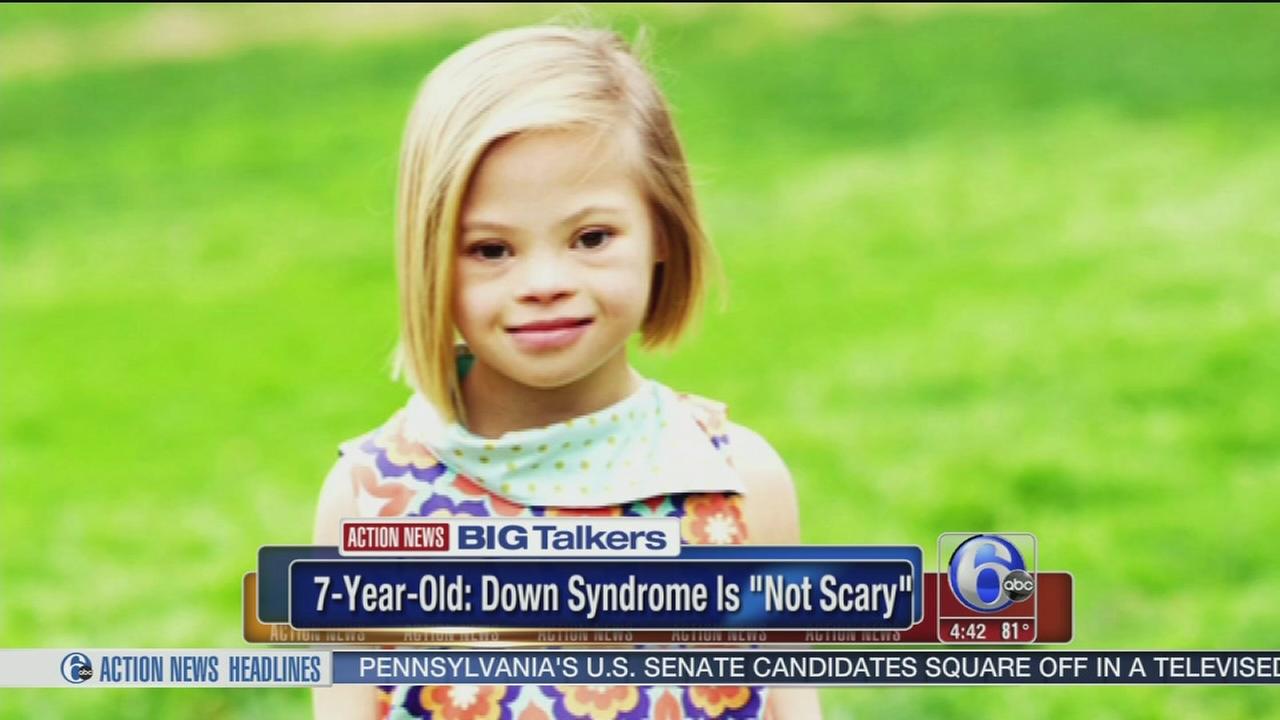
Down's syndrome occurs because of a(n)
a)
missing sex chromosome
b)
extra sex chromosome
c)
additional 21st chromosome
d)
additional 18th chromosome
140.
Turner's Syndrome has a karyotype notation of
a)
47XX+21
b)
47XXY
c)
45XO
d)
44XX
141.
Klinefelter's Syndrome has the karyotype notation of 
a)
47XX+21
b)
47XXY
c)
45XO
d)
44XX
142.
Chromosome pairs 1-22 are referred to as
a)
sex chromosomes
b)
sister chromatids
c)
a karyotype
d)
autsomes
143.
A picture of paired chromosomes is a
a)
sister chromatid
b)
centromere
c)
syndrome
d)
karyotype
144.
A diploid cell of a normal male human contains 
a)
22 autosomes and two Y-chromosomes.
b)
22 pairs of autosomes and two Y-chromosomes.
c)
22 pairs of autosomes, one X and one Y-chromosome
d)
22 autosomes and two X-chromosomes
145.
What chromosome is affected by Down's Syndrome?
a)
23
b)
18
c)
13
d)
21
146.
What would indicate a human male?
a)
XX
b)
X
c)
XY
d)
XXY
147.
A person with Turner syndrome has only one X chromosome. This means one of their gametes was missing a chromosome.
Which of the following is why gametes sometimes lack a complete chromosome?
a)
Incomplete dominance
b)
Nondisjunction
c)
Inversion mutation
d)
Substitution mutation
148.
Females have ____ and males have _____ chromosomes.
a)
XX, XY
b)
XY, XX
c)
XX, XX
d)
XY, XY
149.
A condition in which there is only one of a homologous chromosome pair
a)
Monosomy
b)
Euploidy
c)
Trisomy
d)
Aneuploidy
150.
An abnormal condition in which there are three homologous chromosomes in a set instead of two.
a)
Triploid
b)
Monosomy
c)
Trisomy
d)
Polyploid
151.
By looking at this karyotype you can determine that this person ______ ________.
a)
has Downs Syndrome
b)
has Monosomy X (Turners Syndrome)
c)
is  normal
d)
has Trisomy 13(Patau Syndrome)
152.
What can you  determine about this person based on their karyotype?
a)
They have Downs Syndrome
b)
They have Turner's Syndrome
c)
They have Edward's Syndrome
d)
They are completely Normal
153.
What can you  determine about this person based on their karyotype?
a)
They have Turner's Syndrome (Monosomy X)
b)
They have Downs Syndrome
c)
They are normal
d)
They are male
154.

How many pairs of homologous chromosomes are found in each (body) cell?

a)

46

b)

23

c)

72

d)

10

155.

SELECT ALL THAT APPLY:

a)

Male

b)

Female

c)

No chromosomal abnormalities

d)

Trisomy 21

156.

SELECT ALL THAT APPLY:

a)

Male

b)

Female

c)

No chromosomal abnormalities

d)

Trisomy 21