wayground logo

Free Printable Worksheets

Font size

S
M
L
XL
Worksheets

Evolution Review

Total questions: 159

Worksheet time: 3hrs 21mins

Name
Class
Date
1.
Which of the following is a term for a group of similar organisms that can reproduce fertile offspring?
a)
individual
b)
population
c)
species
d)
fossil
2.

British naturalist who published "On the Origin of Species by Natural Selection" in 1859

a)

Alfred Wallace

b)

Jean-Baptiste Lamarck

c)

Charles Darwin

d)

Biodiversity

3.

the scientific study of Earth and its features

a)

embryology

b)

geology

c)

fossil

d)

gene pool

4.

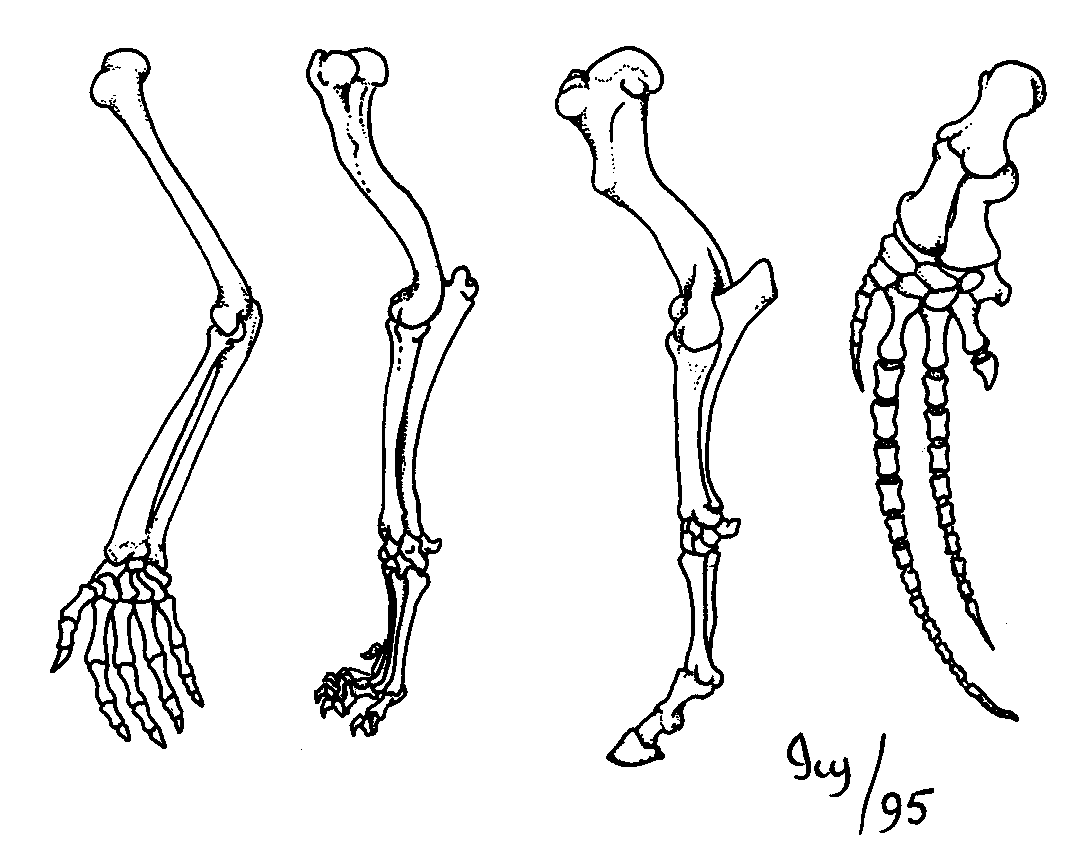
body parts that have a similar function, but not a similar structure

a)

analagous structures

b)

reproductive isolation

c)

vestigal structures

d)

homologous structures

5.

an inability of organisms to interbreed due to geographic barriers

a)

reproductive isolation

b)

biodiversity

c)

analagous structures

d)

radioisotope dating

6.

the process by which a species of organisms change over time

a)

extinction

b)

evolution

c)

generation

d)

speciation

7.

an early stage in the development of an organism

a)

geology

b)

embryo

c)

fossil

d)

speciation

8.

a means of identifying the age of a fossil or rock by comparing it to another fossil or rock

a)

biodiversity

b)

mass extinction

c)

generation

d)

relative dating

9.

refers to the physical and behavioral traits that allow an organism to survive and reproduce

a)

fitness

b)

gene flow

c)

generation

d)

biodiversity

10.

the evolution of a new species from an existing species

a)

extinction

b)

evolution

c)

speciation

d)

generation

11.

an organism's ability to withstand a harmful agent

a)

resistance

b)

antibiotic

c)

speciation

d)

evolution

12.

a scientific theory that explains the process of evolution

a)

mass extinction

b)

vestigal structures

c)

punctuated equilibrium

d)

natural selection

13.

the remains or evidence of a once-living organism

a)

geology

b)

evolution

c)

embryo

d)

fossil

14.

body parts of different organisms that have a similar structure, but may have different functions

a)

vestigial structures

b)

biodiversity

c)

analogous structures

d)

homologous structures

15.

the introduction of genes from one population into the gene pool of another population

a)

gene flow

b)

generation

c)

gene pool

d)

speciation

16.

one step in the line of descent of an organism, from parent to offspring

a)

generation

b)

gene pool

c)

gene flow

d)

speciation

17.

the variety of organisms, their genetic information, and the communities in which they live

a)

relative dating

b)

speciation

c)

mass extinction

d)

biodiversity

18.

measures the age of a material by comparing the amount of radioactive form of an element contained in the material

a)

radioisotope dating

b)

natural selection

c)

vestigial structures

d)

homologous structures

19.

Change in the allele frequency of a population due to RANDOMNESS.

a)

gene pool

b)

biodiversity

c)

mutation

d)

genetic drift

20.

The disappearance of a species from existence

a)

genetic drift

b)

speciation

c)

selective pressure

d)

extinction

21.

A change in the genetic makeup of DNA

a)

gene pool

b)

mutation

c)

adaptation

d)

allele

22.

Small differences of a particular trait

a)

gene pool

b)

mutation

c)

variation

d)

continental drift

23.

the available genetic differences in a population

a)

gene flow

b)

genetic drift

c)

gene pool

d)

speciation

24.

when members of a species are separated by landscape

a)

continental drift

b)

geographic isolation

c)

biodiversity

d)

gene flow

25.

physical or behavioral characteristics that increase chances of survival/reproduction

a)

microevolution

b)

macroevolution

c)

adaptation

d)

allele

26.

physical appearance or observable characteristic or trait

a)

genotype

b)

phenotype

c)

mutation

d)

gene

27.
What is another name for natural selection?
a)
survival of the smartest
b)
survival of the fastest
c)
survival of the biggest
d)
survival of the fittest
28.
What is this an example of?
a)
diversity of species
b)
variation
c)
vestigial structures
d)
DNA studies
29.
a measure of how commonly a particular allele occurs in a population is known as the 
a)
gene pool
b)
allele frequency
c)
mutation rate
d)
phenotype
30.
The struggle for existence against other members of an organisms species is
a)
Competition
b)
Natural Selection
c)
gene flow
d)
genetic drift
31.
Which of the following is an example of the bottle neck effect?
a)
Bald Eagles are hunted until near extinction, population recovers.
b)
Small group of iguanas floats to an island, starts a new population.
c)
Red fox pups are more likely to survive in a snowy environment if they are born white.
d)
Farmer chooses seeds from largest apples to plant next year.  This results in larger apples from year to year.
32.
Which of the following is an example of the founder effect?
a)
Bald Eagles are hunted until near extinction, population recovers.
b)
Small group of iguanas floats to an island, starts a new population.
c)
Red fox pups are more likely to survive in a snowy environment if they are born white.
d)
Farmer chooses seeds from largest apples to plant next year.  This results in larger apples from year to year.
33.

Which of the following is an example of natural selection?

a)

Bald Eagles are hunted until near extinction, population recovers.

b)

Small group of iguanas floats to an island, starts a new population.

c)

Red fox pups are more likely to survive in a snowy environment if they are born white.

d)

Farmer chooses seeds from largest apples to plant next year. This results in larger apples from year to year.

34.
A change in the genetic composition of a population as a result of descending from a small number of colonizing individuals is called:
a)
founder effect
b)
bottleneck
c)
genetic drift
d)
gene flow
35.

Group of organisms all of the same species, living in the same place at the same time.

a)

gene pool

b)

population

c)

species

d)

evolution

36.

Which scientist sailed on the HMS Beagle?

a)

Darwin

b)

Linnaeus

c)

Lamarck

d)

Hutton

37.

Which scientist contributed ideas about natural selection and survival of the fittest?

a)

Linnaeus

b)

Margulis

c)

Darwin

d)

Mendel

38.

Which scientist coined the term Acquired Characteristics and all organisms strive to be perfect?

a)

Lamarck

b)

Einstein

c)

Linnaeus

d)

Malthus

39.

Which scientist explained how Earth's first organic molecules formed?

a)

Hutton

b)

Miller and Lyell

c)

Miller and Urey

d)

St. Nicholas

40.
The gradual change in species over time is...
a)
Evolution
b)
Nucleotide 
c)
Adaptation
d)
Natural Selection
41.
To adjust to a changing environment
a)
Mutation
b)
Adapt
42.
Darwin wrote that organisms with traits that are best suited to the environment will ________________
a)
increase in number
b)
become extinct
43.
What characteristic did Darwin observe about the finches on the Galapagos Islands?
a)
Their feathers 
b)
Genotypes 
c)
Their beaks
d)
Their body sizes
44.
Another word for adapt is ____________.
a)
change
b)
create
45.
Which term refers to the process by which individuals that are better suited to the environment survive and reproduce therefore passing down their genes to their offspring? 
a)
Evolution 
b)
Variation 
c)
Adaptation
d)
Natural Selection 
46.
Darwin referred to this as survival of the fittest. Over time, it results in changes in the inherited characteristics of a population because organisms with adaptations that make them fit for their environment will survive and reproduce better than those without favorable traits.
a)
Natural Selection
b)
Genetic Variation
c)
Survival of the Fittest
47.
What is the advantage of having different shaped beaks?
a)
To look different from other species.
b)
To be able to eat the food readily available in the environment.
c)
To protect itself against predators.
d)
To protect itself against prey.
48.
The struggle for existence against other members of an organisms species is
a)
Competition
b)
Natural Selection
c)
gene flow
d)
genetic drift
49.
A well-tested concept that explains a wide range of observations is called a(an):
a)
hypothesis
b)
experiment
c)
cause and effect
d)
scientific theory
50.
A group of similar organisms that can mate with each other and produce fertile offspring is called a species.  
a)
True  
b)
False
51.

What is speciation?

a)

combining of two species to form one with different traits

b)

isolation that affects mating behavior

c)

timing of mating that prevents normal sexual selection

d)

divergence of two or more species from an existing one

52.

A difference of chemical scents used for mating between two populations is an example of what kind of isolation?

a)

temporal

b)

behavioral

c)

geographic

d)

disruptive

53.

An earthquake causes an ocean channel to open up on an island where a low area previously existed. The island’s lizard population is now separated on the two parts of the island, providing an example of

a)

geographic isolation.

b)

behavioral isolation.

c)

disruptive selection.

d)

temporal isolation.

54.

Which of the following examples illustrates a temporal barrier to mating between populations?

a)

Populations of the same species of seal live on islands too far apart to swim between them for mating.

b)

Species of birds have elaborate courtship dances, and females select the best dancers as mates.

c)

Varieties of oak tree produce pollen during different seasons, so they can’t pollinate one another.

d)

Herds of caribou misinterpret each other’s mating behavior, so they fight instead of mating

55.

What kind of isolation occurs when two populations of birds have different courtship dances?

a)

geographic

b)

sexual

c)

temporal

d)

behavioral

56.

Which of the following processes is considered to be random?

a)

genetic mutation

b)

natural selection

c)

adaptive radiation

d)

coevolution

57.

The American flying squirrel and the flying phalanger of Australia live in similar environments and look very similar. However, they are not closely related. Their resemblance is most likely an example of

a)

sexual selection

b)

temporal isolation

c)

convergent evolution

d)

divergent evolution

58.

The Galápagos Islands in the Pacific Ocean have varied habitats. Divergent evolution is occurring on these islands, meaning that the species that live there

a)

have lived unchanged through long periods of stability.

b)

are becoming more like each other in response to their habitats.

c)

change in response to changes in other species they interact with.

d)

had common ancestors but have become increasingly different.

59.

Like all flowering plants, the snapdragon must be pollinated to reproduce, but its flowers are closed. A bumblebee has just enough weight to open a snapdragon flower by landing on it. This adaptation is an example of

a)

convergent evolution

b)

coevolution

c)

divergent evolution

d)

speciation

60.

Reproductive isolation occurs when

a)

a small number of individuals moves and starts a new population.

b)

some catastrophic event greatly reduces the size of a population.

c)

the gene pools of different populations have become very diversified.

d)

members of different populations can no longer mate successfully.

61.

What type of isolation occurs when the timing of reproduction is different between two populations?

a)

geographic

b)

temporal

c)

behavioral

d)

selective

62.

Coevolution is a process in which species

a)

evolve similar characteristics in different habitats.

b)

become increasingly different from each other.

c)

become extinct and are lost permanently.

d)

evolve in response to changes in each other.

63.

Two species that are closely related become increasingly different through

a)

divergent evolution

b)

disruptive selection

c)

convergent isolation

d)

competitive relationships

64.

When individuals from two populations of squirrels can no longer successfully mate with one another, the chance that speciation will occur

a)

decreases

b)

becomes zero

c)

stays the same

d)

increases

65.

The wings of robins and the wings of dragonflies are examples of

a)

divergent adaptation

b)

convergent evoltuion

c)

adaptive radiation

d)

punctuated equilibrium

66.
 Genetic Drift is more likely to happen in... 
a)
aquatic populations
b)
small populations
c)
terrestrial populations
d)
older populations
67.

This mechanism of evolution occurs when individuals migrate (emigrate, immigrate) between populations.

a)

Extinction

b)

Gene flow

c)

Genetic drift

d)

Natural Selection

68.
A change in the genetic composition of a population as a result of descending from a small number of colonizing individuals is called:
a)
founder effect
b)
bottleneck
c)
genetic drift
d)
gene flow
69.

According to Genetic drift (bottleneck or founder) tends to ___________ genetic variation (diversity).

a)

Increase

b)

Decrease

c)

Stabilize

d)

Exaggerate

70.

Which of the following is an example of the bottleneck effect?

a)

Cheetah populations reach their lowest levels with reduced diversity and as they rebound are so genetically similar they appear to be inbred.

b)

Affected individuals with blue skin can trace their ancestry back to one of the first settlers in the region.

c)

The environment of a fox population changes and over time foxes who are white survive and pass on their genes to their offspring.

d)

Humans choose two dogs they like the characteristics of and breed them together.

71.

Which of the following is an example of the founder effect?

a)

Humans choose two dogs they like the characteristics of and breed them together.

b)

Affected individuals with blue skin can trace their ancestry back to one of the first settlers in the region.

c)

The environment of a fox population changes and over time foxes who are white survive and pass on their genes to their offspring.

d)

Cheetah populations reach their lowest levels with reduced diversity and as they rebound are so genetically similar they appear to be inbred.

72.
A virus killed most of the seals in the North Sea (e.g. dropped the population from    8000 to 800).  In an effort to help preserve the species, scientists caught 20 of the   remaining seals and used them to start a new population in the northwest Pacific   Ocean.  Which of the following statements would accurately describe the new   population?  
a)
The new seal population is genetically less diverse than the original population 
b)
The new seal population is genetically more diverse than the original population
c)
There is equal genetic variety compared  to the original population 
d)
None of the answers
73.

Any change within a populations gene frequency that causes a dramatic reduction (natural disaster, disease, hunting) of a population's size.

a)

Genetic Bottleneck

b)

Founder Effect

c)

Natural Selection

d)

Evolution

74.

During a hike a man accidentally steps on a population of rare beetles that were in the path, leaving just four from the original twenty. This scenario is an example of what type of genetic drift?

a)

Genetic Bottleneck

b)

Fonder Effect

c)

Natural Selection

75.

Hunting reduced the population size of the northern elephant seal to as few as 20 individuals at the end of the 19th century. Their population has since rebounded to over 30,000, but much have less genetic variation than a population of southern elephant seals that were not intensely hunted. How is the lack of genetic variation related to the hunting episodes of the 1800's?

a)

Genetic Drift Occurred/Genetic Bottleneck: the few individuals left behind were the seals that passed on the specific gene pool.

b)

Genetic Drift Occurred/Founder Effect: the few individuals left behind were the seals that passed on the specific gene pool.

c)

Natural Selection Occurred/Survival of the Fittest: only the strongest northern elephant seals survived in the 1800's and that restricted gene pool exists today.

d)

Adaptation Occurred: Some seals were able to adapt to the hunting environment and they survived to pass on their genes.

76.

_____________ is responsible for gene flow and is an important mechanism for genetic variation.

a)

Emigration Only

b)

Immigration Only

c)

Neither Emigration or Immigration

d)

Both Emigration and Immigration

77.

Gene Flow of Animals Cause..

a)

Sub-populations to have different allele frequencies

b)

causes genetic mixing across regions

c)

reduce variations between populations

d)

increases variations between populations

78.

Genetic Drift and Evolution result in the creation of the most fit organism for its environment.

a)

True

b)

False

79.

Genetic Drift and Evolution are processes that happen over time.

a)

True

b)

False

80.
Structures with the same parts have different functions; suggests that organisms share a common ancestry
a)
vestigial structures
b)
homologous structures
c)
adaptive radiation
d)
fossil
81.
If an organism has a vestigial structure, that structure likely once had a function in a(n)
a)
close relative
b)
early ancestor
c)
unrelated organism
d)
embryological stage
82.
Some organisms that share a common ancestor have features that have different functions, but similar structures.  These are known as
a)
vestigial structures
b)
analogous structures
c)
homologous structures
d)
fossil structures
83.
Study of embryos of various organisms to show a common ancestor because of similarities in development
a)
natural selection
b)
embryology
c)
speciation
d)
evolution
84.
Which of the following is an example of a vestigial structure?
a)
the wings of a red-tailed hawk
b)
the hind limbs of a house cat
c)
the fins of sharks
d)
the tailbone of a human
85.
Structures that have the same function but different structures are...
a)
homologous structures
b)
analogous structures
c)
vestigial structures
d)
embryology 
86.
Two organisms that are closely related would have
a)
very similar DNA sequence
b)
exactly the same DNA sequences
c)
no proteins in common
d)
completely different DNA sequence
87.
Which layer is the oldest
a)
B
b)
A
c)
E
d)
C
88.
The diagram shows fossils in different rock layers. Which of these statements about the age of these fossils is most likely correct?
a)
Fossil A and C are the same age
b)
Fossil B is older than fossil C
c)
Fossils A is older than fossil B
d)
Fossil D is older than fossil C
89.
If two organisms have similar traits of DNA they are probably
a)
share a common ancestor
b)
share a common environment
c)
share a common population
d)
speciation
90.
What does Darwin's theory of evolution suggest?
a)
species change over time
b)
extinct species are not related to living species
c)
different species can interbreed
d)
animals that look alike are most closely related
91.
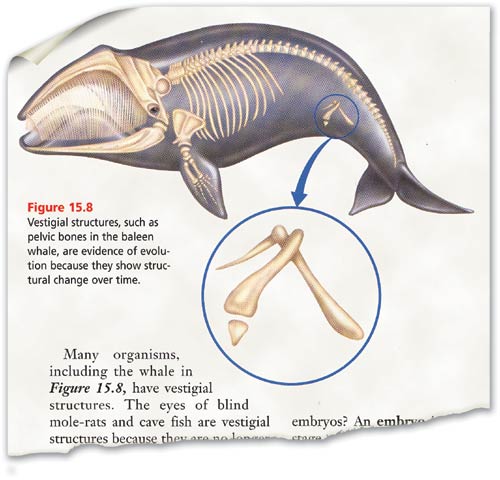
Whales are aquatic mammals that contain a pelvis bone.  Even though it does not aid in its movement, the function must have been used by a common ancestor of the whale.  Thus, the pelvis is referred to as a(n)
a)
vestigial structure
b)
analogous structure
c)
homologous structure
92.
If species A and B have very similar genes and proteins, what is probably TRUE?
a)
species A and B share a relatively recent common ancestor
b)
species A evolved independently of species B for a long period
c)
species A is younger than species B
d)
species A is older than species B
93.
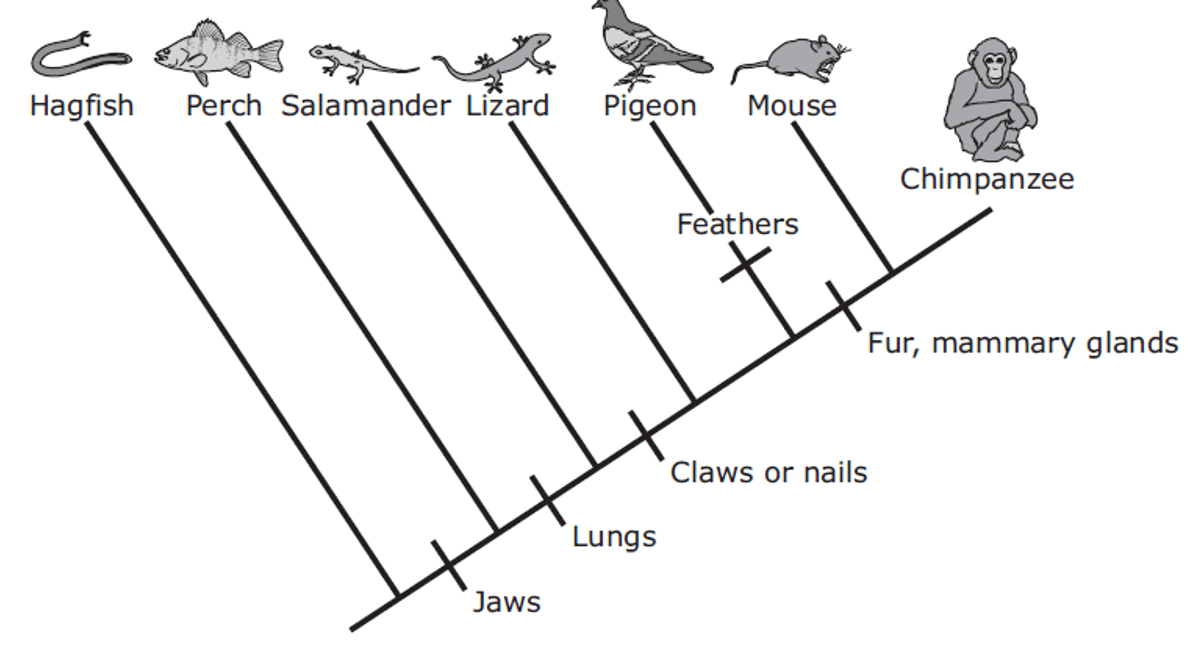
All the animals to the right of the hagfish would have the common characteristic of -
a)
Fur
b)
Claws or nails
c)
Lungs
d)
Jaws
94.
According to this cladogram, birds are LEAST related to -
a)
Amphibians
b)
Sharks
c)
Ray Finned Fish
d)
Crocodiles
95.
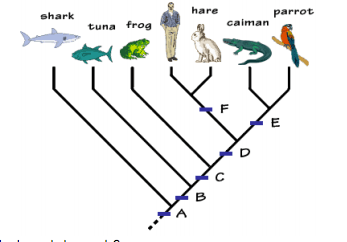
On the cladogram, which organism is the closest relative of the human?
a)
Frog
b)
Hare
c)
Caiman
d)
Parrot
96.
Individuals that are well adapted to their environment will survive and produce:
a)
Fewer mutations
b)
Stronger genes
c)
More offspring
d)
Better traits
97.
Which trait do only humans have, according to the cladogram?
a)
jaws
b)
mammary glands & hair
c)
terrestrial during all life stages
d)
opposable thumbs
98.
According to the cladogram, which organism is most distantly related to the human?
a)
crayfish
b)
rat
c)
perch
d)
frog
99.
According to the diagram, which organism is older: the ammonite or the coral?
a)
ammonite
b)
coral
100.
On this map there are many different geographical barriers, which could be mountains, rivers, or oceans. Animals that do not have a barrier between them have more similarities, which set shows that common ancestry existed?
a)
1 and 2
b)
3 and 4
c)
7 and 8
101.
If an organism has a vestigial structure, that structure likely once had a function in a(n)
a)
close relative
b)
early ancestor
c)
unrelated organism
d)
embryological stage
102.
Which of the following pieces of evolution evidence contain both homologous and vestigial structures?
a)
fossil record
b)
comparing embryology
c)
comparing biochemistry
d)
comparing anatomy
103.
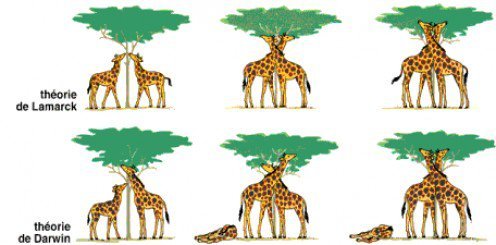
What would happen if the Giraffes never evolve?
a)
they would survive
b)
They would thrive
c)
They would become extinct
d)
They will find another source of food
104.
Human newborns usually weigh between 6-8 pounds
a)
stabilizing selection
b)
directional selection
c)
disruptive selection
d)
sexual selection
105.
The population of peppered moths in England changed from white to black in 50 years
a)
stabilizing selection
b)
sexual selection
c)
directional selection
d)
disruptive selection
106.
Farmers and breeders allowed only the plants and animals with desirable characteristics to reproduce, causing the evolution of farm stock. This is an example of ?
a)
Natural Selection
b)
Oscillating Selection
c)
Artificial Selection
d)
None of the above 
107.
Which statement best describes the modes of selection depicted in the figure?
a)
stabilizing selection, changing the average color of the population over time
b)
directional selection, favoring the average individual 
c)
directional selection, changing the average age color of the population over time
d)
disruptive selection, favoring the average individual
108.
Which agent of change causes genetic variation and has a large effect on allele frequencies when it produces new alleles.
a)
Non-random mating
b)
Gene Flow
c)
Mutation
d)
Genetic Drift
109.
Northern elephant seals have reduced genetic variation. Hunting reduced their population size to as few as 20 individuals at the end of the 19th century. Their population has rebounded to over 30,000 they have much less genetic variation than a population of southern elephant seals that was not so intensely hunted. Which agent of change is this ?
a)
Genetic Drift 
b)
Natural Selection
c)
Gene Flow
d)
Mutation
110.
Domesticated reindeer in western Alaska escape and mate with migrating caribou, adding the alleles for short legs and tame behavior. This is an example of ?
a)
Mutation
b)
Genetic Drift
c)
Gene pool
d)
Gene flow
111.
What does the Hardy-Weinberg equilibrium measure?
a)
changes in allele frequencies
b)
numbers of mutations
c)
goodness of fit
d)
genetic diversity
112.
What type of speciation involves geographic isolation?
a)
Allopatric
b)
Sympatric
c)
Both
113.
What type of speciation involves reproductive isolation?
a)
Allopatric
b)
Sympatric
c)
Both
114.
Which type of speciation occurred when a few finches were blown from the coast of South America to the Galapagos Islands and then evolved into 14 different finch species?
a)
Allopatric
b)
Sympatric
115.
Which type of speciation occurred when maggot flies living on harthorns began to feed on apples?
a)
Allopatric
b)
Sympatric
116.
What is a species?
a)
A group of organisms that can mate with each other and produce fertile offspring. 
b)
A group of organisms that genetically are very different from each other. 
c)
A group of organisms that can mate and produce offspring even if those offspring are infertile.
d)
Indivual organisms that live in the same environment. 
117.
What is geographic isolation?
a)
Members of a population live together within an geographic boundary
b)
Members of a population may become isolated from one another by geographic boundaries
c)
An isolation that is geographic
d)
None of these
118.
What is allopatric speciation?
a)
Occurs when a physical barrier divides one population into two or more populations
b)
Occurs when a reproductive barrier divides one population into two or more populations
c)
Occurs when species evolve into a new species without a physical barrier
d)
Occurs when species into into a new species at random
119.
What is genetic drift?
a)
The movement of genes in/out of a population
b)
A small, random change in the DNA
c)
Any change in the allelic frequencies in a population that is due to chance
d)
›The process in which humans select for or against particular features in organisms
120.
What is founder effect?
a)
Any change in the allelic frequencies in a population that is due to chance
b)
›A small sample of a population settles in a location separated from the rest of the population
c)
  The process in which humans select for or against particular features in organisms
d)
›Members of one sex choose mates with particular features
121.
What type of selection is this?
a)
Directional Selection
b)
Stabilizing Selection
c)
Disruptive Selection
d)
Natural Selection
122.
What type of selection is this?
a)
Directional Selection
b)
Stabilizing Selection
c)
Disruptive Selection
d)
Natural Selection
123.
What type of selection is this?
a)
Directional Selection
b)
Stabilizing Selection
c)
Disruptive Selection
d)
Natural Selection
124.
What type of speciation involves geographic isolation?
a)
Allopatric
b)
Sympatric
c)
Both
125.
Different mating behaviors
a)
temporal
b)
behavioral
c)
geographic
d)
other
126.
Which of the following must occur for speciation to happen?
a)
geographic isolation
b)
reproductive isolation
c)
temporal isolation
d)
behavioral isolation
127.
Which is an example of temporal isolation?
a)
flowers that bloom in different months 
b)
birds that have different mating calls
c)
fruit flies that mate in different locations
d)
squirrels that have different fur colors
128.
Gentoo penguins will present a mate with a pebble that they find to attract a mate. Emperor penguins have a specific call and movement that they make to attract a mate. Which type of isolation do these penguins demonstrate?
a)
temporal isolation 
b)
behavioral isolation
c)
geographical isolation
d)
anatomical isolation
129.
Which of the following is a physical adaptation for the underlined animal?
a)
A snake unhinges its jaw to eat a rabbit it just caught.
b)
A hognose snake rolls over, slows its breathing, and hangs its tongue out to pretend to be dead.
c)
A herd of buffalo encircle their young to protect them from a pack of wolves.
d)
A dung beetle rolls a piece of dung across the desert.
130.
True or false: Having a diet of meat and grass is a physical adaptation.
a)
True
b)
False
131.
Explain how colouration helps an organism survive.
a)
The organism is able to hide against its environment, protecting it from predators.
b)
The organism is able to stay warm in the winter by moving to a warmer climate.
c)
The organism looks like another organism to help it survive.
d)
The organism stores food in the spring so that it can survive a long winter.
132.
A thick layer of ____________ keeps polar bears warm during the cold winter.
a)
Nails
b)
Mimicry
c)
Blubber
d)
Camouflage
133.
The place where an organism lives is its _________.
a)
habitat
b)
abiotic
c)
ecosystem
d)
community
134.
All of the nonliving parts of an ecosystem are _______.
a)
biography
b)
biotic
c)
abiotic
d)
biology
135.
A group of organisms of the same species living in the same area are called a/an ________.
a)
community
b)
habitat
c)
population
d)
ecosystem
136.

Darwin wrote that organisms with traits that are best suited to the environment will ________________

a)

reproduce

b)

become extinct

137.
1. What is an adaptation?
a)
A feature or behavior that helps an animal survie.
b)
The food that an animal eats.
c)
How energy moves in a food web.
138.
This is a period of deep sleep that occurs in some animals when outside temperatures are cold: ______
a)
hibernation
b)
migration
139.
How do adaptations help animals?
a)
To hide from predators
b)
to hunt for food
c)
to survive in their habitats
d)
All of these are correct
140.
An example of a physical adaptation is...
a)
a turtle hiding inside its shell
b)
The spikes on a porcupine fish
c)
a rabbit burrowing underground
d)
a viper biting when threatened
141.
Which adaptation would NOT help a hawk catch a mouse?
a)
Hollow Bones 
b)
Good eye sight
c)
Talons
d)
Camouflage
142.
 Which of these BEST describes how some birds survive when the weather gets cold? 

     
a)
 a.   They store twigs and sticks in their nest 
b)
 b. They migrate to a warmer climate 
c)
 c. They grow more feathers to stay warm in the winter 
d)
 d. They hide in bushes and wait for warm weather 
143.
Which feature of a rose helps it grow without being eaten by large animals?
a)
flowers with bright colors
b)
sharp thorns
c)
small seeds
d)
deep roots
144.
A giraffe has a long neck in order to better reach leaves to eat.  This is an example of _____. 
a)
an adaptation
b)
environment
c)
response
d)
stimulus
145.
Which adaptation (for the underlined animal) serves the function of defense?
a)
A walking stick looks like the twig on which it rests.
b)
A porcupine’s quills cause a predator to seek another meal.
c)
A whale filters plankton and krill from the water in which it swims.
d)
A penguin is dark on top and white below to blend in with the water.
146.
Which of the following is a physical adaptation for the underlined animal?
a)
A butterfly has bright colors to warn predators that it is poisonous.
b)
A hognose snake rolls over, slows its breathing, and hangs its tongue out to play dead.
c)
A herd of buffalo encircle their young to protect them from a pack of wolves.
d)
A dung beetle rolls a piece of dung across the desert.
147.
How do adaptations help animals?
a)
To escape animals
b)
to hunt for food
c)
to survive in their habitats
d)
All of these are correct
148.
Plants with spines and waxy leaves are well suited for life in which environment?
a)
Desert
b)
Temperate forest
c)
Grassland
d)
Tropical Rainfroest
149.
Dandelions have light furry seeds that allow them to spread easily. 
a)
True
b)
False
150.
How an animal protects itself Adaptation: Skunk and its spray
a)
Defense
b)
Hibernation
c)
Locomotion
d)
Migration
151.
The raccoon has hands and feet.  Why would the raccoon need this adaptation?
a)
to fight
b)
to help them find and pick up food
c)
to hang from trees
d)
to dig a tunnel
152.
A Porcupine has sharp quills.  Why would a porcupine need this adaptation?
a)
to protect itself
b)
to keep warm
c)
to kill its prey
d)
to cover its skin
153.
The role an organism plays in its ecosystem
a)
niche
b)
behavior
c)
structure
d)
function
154.
When an organism copies a characteristic of something else in order to better its chances for survival and reproduction
a)
hibernation
b)
camouflage
c)
mimicry
d)
migration
155.
The seasonal movement of an organism from one place to another
a)
camouflage
b)
migration
c)
hibernation
d)
function
156.
The place or environment where an organism naturally lives
a)
function
b)
habitat
c)
community
d)
ecosystem
157.
Behavioral changes of individuals of a species that allow for better survival. (Acquired traits)
a)
Variation
b)
Adaptation
c)
Behavior
d)
Environment
158.

What is an example of a vestigial structure?

a)

human tailbone

b)

alligator humerus bone and human humerus bone

159.

What is a cladogram?

a)

fossils showing different layers of earth

b)

a diagram that shows evolutionary relationship