wayground logo

Free Printable Worksheets

Font size

S
M
L
XL
Worksheets

2018 Final Exam Review Biology

Total questions: 154

Worksheet time: 22hrs 14mins

Name
Class
Date
1.
The main source of energy for all life comes from ____.
a)
the Earth
b)
the moon
c)
the sun
d)
the food we eat/make
2.
The reactants of photosynthesis are
a)
sugar and water.
b)
sugar and oxygen.
c)
carbon dioxide and water.
d)
carbon dioxide and oxygen.
3.
Which statement about photosynthesis is correct?
a)
Plants get the energy they need for photosynthesis from water.
b)
Plants get the energy they need for photosynthesis from soil.
c)
Plants get the energy they need for photosynthesis from sunlight.
d)
Plants do not require energy to perform photosynthesis.
4.
What are the products of photosynthesis?
a)
Carbon dioxide and water
b)
Carbon dioxide and oxygen
c)
Glucose and oxygen
d)
Glucose and water
5.
Which of the following is the correct equation for PHOTOSYNTHESIS?
a)
6CO2 + 6H2O --> 6O+ C6H12O6
b)
6CO+ C6H12O6 + 6H2O --> O
c)
6O2 + 6H2O --> 6CO+ C6H12O6
d)
C6H12O6 + 6O2 ---> 6H2O + 6CO2 
6.
Which gas is removed from the atmosphere during photosynthesis?
a)
hydrogen
b)
oxygen
c)
nitrogen
d)
carbon dioxide
7.
What is the function of NADPH and ATP?
a)
They absorb light
b)
They power the light-dependent reactions
c)
They are light-reflecting pigments
d)
They are short term energy carriers
8.
Use the diagram to answer the question. Between which parts of the molecule must the bonds be broken to form an ADP molecule?
a)
A and B
b)
A and C
c)
B and C
d)
C and D
9.
Which of the following best describes photosynthesis?
a)
Photosynthesis converts radiant energy into chemical energy.
b)
Photosynthesis produces carbohydrates.
c)
Plants need sunlight, carbon dioxide, water, nutrients, and chlorophyll to complete photosynthesis.
d)
Plants use chlorophyll, water, and carbon dioxide to make sugar.
10.
In which  organelle does photosynthesis occur?
a)
mitochondria
b)
stomata
c)
xylem
d)
chloroplast
11.
Animal cells do not have chloroplasts.
a)
TRUE
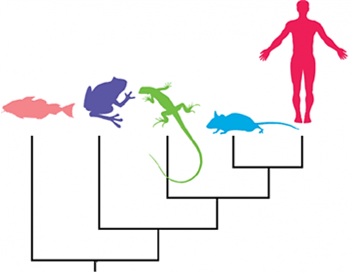
b)
FALSE
12.
Which of these molecules stores the most energy?
a)
NADH
b)
NAD+
c)
ADP
d)
ATP
13.
What organelle does cellular respiration take place in?
a)
Ribosome
b)
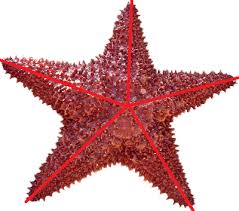
Mitochondria
c)
Nucleus
d)
Golgi
14.
What gas is needed for respiration?
a)
Carbon dioxide
b)
nitrogen
c)
Oxygen
d)
hydrogen
15.
What is an autotroph?
a)
an organism that can make their own food. 
b)
an organism that cannot make their own food
c)
Herbivore
d)
Omnivore
16.
What is the gas we breath out that plants use for photosynthesis?
a)
sulfur
b)
carbon dioxide
c)
oxygen
d)
hydrogen
17.
Another name for sugar is 
a)
ATP
b)
Cellular
c)
Glucose
d)
Fall Out Boy
18.
Which cell process is represented by this equation:
C6H12O6 + 6O2 →          6CO2  +  6H2O +  ATP
a)
diffusion
b)
photosynthesis
c)
cell respiration
d)
mitosis
19.
The main purpose of Cellular Respiration is to
a)
make carbon dioxide
b)
make water
c)
make glucose
d)
make ATP
20.
In which creatures does cell respiration happen?
a)
Animals ONLY
b)
Plants ONLY
c)
Plants AND Animals
21.
In which creatures does cell respiration happen?
a)
Animals ONLY
b)
Plants ONLY
c)
Plants AND Animals
22.
Autotrophs make their own food using photosynthesis, therefore...
a)
They do not need to perform cellular respiration
b)
They perform cellular respiration using the glucose they made during photosynthesis
c)
They eat other organisms in order to perform cellular respiration
23.
Fruit fly body cells have 8 chromosomes. After mitosis, you would expect a resulting fruit fly daughter cell to have ...
a)
16 chromosomes.
b)
46 chromosomes.
c)
8 chromosomes.
d)
4 chromosomes.
24.
The stages of mitosis in order
a)
Metaphase, Anaphase, Prophase, Telophase
b)
Prophase, Anaphase, Metaphase, Telophase
c)
Prophase, Metaphase, Anaphase, Telophase
d)
Anaphase, Prophase, Telophase, Metaphase
25.
Before cells can divide, what must be copied?
a)
mitochondria
b)
cytoplasm
c)
DNA
d)
Cell Wall
26.
In the G1 stage of the cell cycle, the cell
a)
Grows
b)
Matures
c)
Carries on normal activities
d)
All of the above
27.
In the S stage of interphase_______________
a)
the cell grows
b)
the nucleus divides
c)
the cell membrane divides
d)
the DNA is replicated
28.
Cells of organism must replicate for ?
a)
growth
b)
repair of damaged cells
c)
replacement of dying cells.
d)
All of the above
29.
Uncontrollable cell growth is known as _____
a)
obesity
b)
cancer
c)
diabetes
d)
hepatitis
30.
What is a series of events a cell goes through as they grow and divide?
a)
Cell Division
b)
Cell Cycle
c)
Cytokinesis
d)
Mitosis
31.
In mitosis, the two resulting cells are
a)
different from the starting cell and identical to each other.
b)
different from the starting cell and different from each other.
c)
identical to the starting cell and different from each other.
d)
identical to the starting cell and identical to each other.
32.
When cells divide they make two ____ cells.
a)
daughter
b)
son
c)
Mom
d)
Dad
33.
Which sequence of DNA bases would pair with this partial strand
ATG TGA CAG
a)
ATG TGA CAG
b)
TAC ACT GTC
c)
GTA AGT GAC
d)
CAT TCA CTG
34.
Which of the following best describes a DNA molecule?
a)
double helix
b)
contains ribose
c)
made of amino acids
d)
contains Uracil
35.
In a molecule of double-stranded DNA, the amount of Adenine present is always equal to the amount of
a)
cytosine
b)
guanine
c)
thymine
d)
uracil
36.
Adenine bonds with ______________.
a)
Guanine
b)
Thymine
c)
Cytosine
d)
Adenine
37.
Guanine bonds with ______________.
a)
Adenine
b)
Guanine
c)
Cytosine
d)
Thymine
38.
Why is DNA important?
a)
it is very small and very complicated
b)
it's in everything
c)
it serves as the blueprint for traits of all living things
d)
because we eat it every day for energy
39.
What determines the code, or information, of a DNA molecule?
a)
the shape (structure) of the nitrogen bases
b)
the order (sequence) of the nitrogen bases
c)
the color of the nitrogen bases
d)
the frequency (number) of nitrogen bases
40.
Which 2 molecules form the sides (backbone) of the DNA ladder?
a)
deoxyribose sugar and adenine
b)
deoxyribose sugar and a hydrogen bond
c)
deoxyribose sugar and the nucleus
d)
deoxyribose sugar and phosphate
41.
Which organelle is DNA usually found in?
a)
cell membrane
b)
vacuole
c)
chloroplast
d)
nucleus
42.
Replicate the following strand of DNA: 
AATCATGGA
a)
AATCATGGA
b)
TTAGTACCT
c)
UUAGUACCU
d)
GGATAUCUA
43.
DNA replication results in two DNA molecules,
a)
each one with two original strands
b)
each one with two new strands
c)
each one with one new strand and one original strand
d)
one with two new strands and the other with two original strands
44.
A process in which DNA has the unique ability to make an exact copy of itself.
a)
Replication
b)
Translation
c)
Transcription
45.
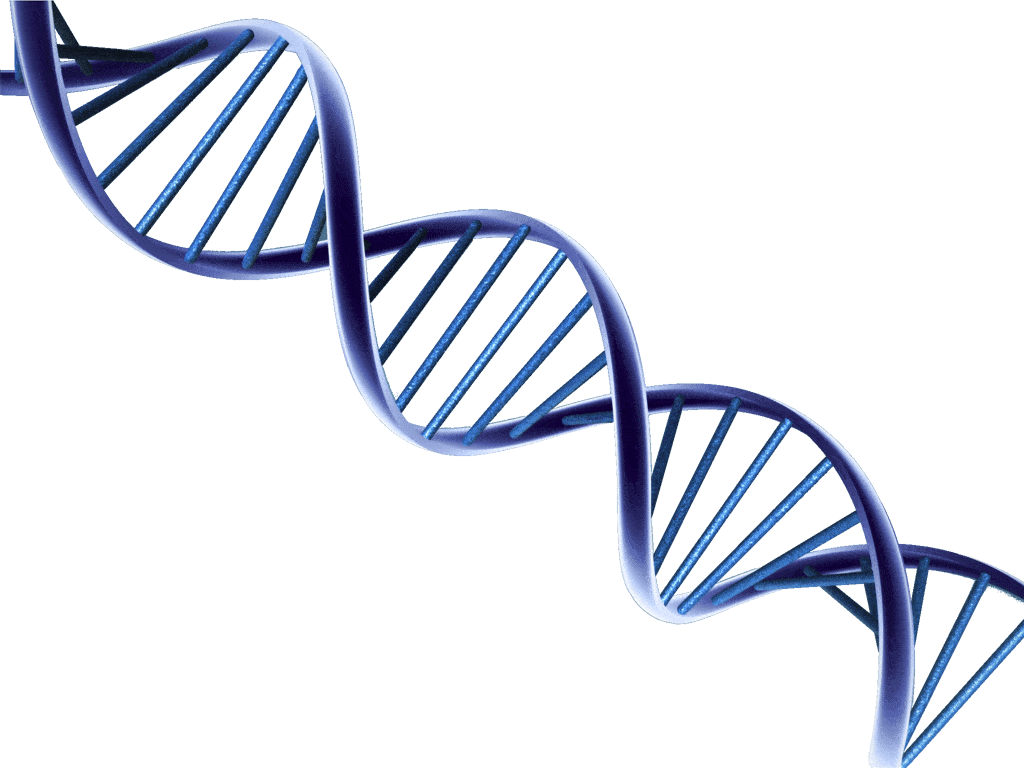
The drawing shows the structure of what molecule?
a)
A DNA molecule
b)
A lipid molecule
c)
A carbohydrate molecule
d)
A protein molecule
46.
What has DNA?
a)
animals
b)
plants
c)
bacteria
d)
all of the above
47.
What are the 4 nitrogen bases of DNA?
a)
adenine, thymine, cytoplasm, and guanine
b)
adenine, thymine, cytosine, and guanine
c)
adenine, thymine, cytosine, and gylcerol
d)
adenine, thymine, cytosine, and glucose
48.
What are the 4 nitrogen bases of RNA?
a)
adenine, uracil, cytoplasm, and guanine
b)
adenine, uracil, cytosine, and guanine
c)
adenine, thymine, cytosine, and uracil
d)
adenine, thymine, cytosine, and uracil
49.
The process of making RNA (i.e. mRNA) from DNA is called
a)
Replication
b)
Transcription
c)
Translation
d)
Protein synthesis
50.
Which  represents the bases of mRNA?
a)
A U C G
b)
A T U G
c)
A T C G
d)
U T C G
51.
Which of these is part of the description of protein?
a)
a folded chain of amino acids
b)
a folded chain of carbohydrates
c)
a branched chain of fatty acids
d)
a branched chain of nucleic acids
52.
Which is true for all organisms?
a)
Replication is when RNA makes RNA.
b)
Duplication is when RNA makes DNA.
c)
Transcription is when DNA makes DNA.
d)
Translation is when RNA makes proteins.
53.
What is the correct sequence?
a)
RNA --> DNA --> Protein
b)
Protein --> RNA --> DNA
c)
DNA --> RNA --> Protein
d)
DNA --> Protein --> RNA
54.
What type of chromosomal mutation is pictured?
a)
Deletion
b)
Substitution
c)
Inversion
d)
Translocation
55.
A type of mutation that changes an entire amino acid sequence in a polypeptide a chain
a)
Subsitituion
b)
Frame shift mutation
c)
Translocation
d)
Inversion
56.
A mutation that involves one nucleotide.
a)
Point mutation
b)
Inversion
c)
Translocation
d)
none of the above
57.
original chromosome
ABC-DEF
mutated chromosome
AC-DEF
This is a _____________ mutation.
a)
frameshift
b)
point
c)
deletion
58.
DNA molecule segment is : TTACGCAAG
The mutated DNA segment is TTACGCAAC. This is an example of ___ mutation.
a)
Substitution
b)
Base Insertion
c)
Base Inversion
d)
Translocation
59.
Any change in the sequence of DNA is...
a)
transgenic shift
b)
Single Genotype
c)
Monohybrid Trait
d)
Mutation
60.
Scientist plan to analyze DNA to identify species.  What technology would they use? 
a)
Gel Electrophoresis
b)
Microscopes and DNA Staining
c)
Spectrometry and Gas Chromatography
d)
Blood Typing 
61.
Separation of DNA using electric current is called.....?
a)
Gel Electrophoresis
b)
Chromosome painting
c)
polymerage chain reaction
d)
Restrictive Enzyme Sorting 
62.
Which is the primary purpose of using restriction enzymes in gel elctrophoresis?
a)
It allows the strands of DNA to be cut into various lengths for testing
b)
It restricts the number of base pairs that can be tested in a sample
c)
It makes the testing simpler by moving the strands into the gel faster
d)
It charges the DNA strands
63.
What type of macromolecule are restriction enzymes?
a)
nucleic acid
b)
carbohydrate
c)
protein
d)
lipid
64.
A method of separating DNA fragments according to their size and charge using an electric current passed through a gel containing the samples a
a)
Chromosome
b)
DNA Probe
c)
Electrophoresis
d)
Restriction Enzyme
65.
Pattern of DNA fragments obtained by examining a person’s unique sequence of DNA base pairs
a)
Chromosome
b)
DNA Probe
c)
DNA Fingerprint
d)
Electrophoresis
66.
Combining DNA from 2 different organisms is called
a)
Bioengineering
b)
Biotechnology
c)
Recombinant DNA
d)
Genetic Engineering
67.
This picture shows how what is made?
a)
Recombinant DNA
b)
PCR
c)
Gel Electrophorisis
d)
Clones
68.
DNA cutting "scissors" are
a)
Bacteriophages
b)
Restriction Enzymes
c)
DNA Enzymes
d)
Plasmids
69.
This image is an example of which DNA Technology process?
a)
PCR
b)
Blotting
c)
Gel Electrophoresis
d)
Cloning
70.
Based on these results whose blood was found in the blood stain at the crime scene?
a)
Bob
b)
Sue
c)
John
d)
Lisa
71.
Which man is the father of child #2 (5th Band)?
a)
Mother (1st Band)
b)
Male #1 (2nd Band)
c)
Male #2 (3rd Band)
d)
Child #1 (4th Band)
72.
B=brown eyes
b= blue eyes
What is true about two brothers that have brown eyes?
One has genotype BB the other Bb.
a)
they have same phenotype and genotype
b)
they have different genotypes and phenotypes
c)
they have same phenotype but different genotypes
d)
they have same genotype but different phenotypes
73.
A dog gives birth to 5 puppies. What percentage of the chromosomes does each puppy share with the mother?
a)
25%
b)
50%
c)
75%
d)
100%
74.
What does heterozygous mean?
a)
An organism that has the same genes for a trait (TT or tt)
b)
An organism that has different genes for a trait (Tt)
c)
When neither gene is fully dominant; offspring is a mixture of both
d)
the different forms of a trait (hair color--> brown, blonde, red
75.
If a heterozygous tall pea plant is crossed with a short pea plant, what are the possible genotypes of the future offspring?
a)
100% Tt
b)
50% Tt, 50% tt
c)
75%Tt, 25%tt
d)
25%TT, 50%Tt, 25%tt
76.
This is an example of what?
a)
Complete dominance
b)
Incomplete dominance
c)
Codominance
d)
None of the above
77.

A heterozygous yellow pea plant's genotype would be:

a)

YY

b)

yy

c)

Yy

d)

Yg

78.
Which process and type of resulting cells are represented?
a)
mitosis, gametes
b)
mitosis, body cells
c)
meiosis, gametes
d)
meiosis, body cells
79.
Which best describes the process shown?
a)
mutation in which the DNA content of the gene is ltered
b)
segregation of sister chromatids
c)
condensation and segregation of the alleles
d)
crossing-over which alleles are exchanged
80.
What is one advantage of sexual reproduction?
a)
offspring are identical to parents
b)
offspring are resistant to viruses
c)
offspring are born live, rather thna from eggs
d)
offspring inherit a wider variety of genetic information
81.
The sex of an offspring is determined by ______________________.
a)
the mother
b)
the father
c)
the mother and the father
d)
by the environment
82.
Incomplete dominance means that the traits are
a)
expressed equally
b)
dominant
c)
recessive
d)
blended
83.
Term for homozygous organisms that display two dominant phenotypes at the same time
a)
codominance
b)
incomplete dominance
c)
multiple alleles
d)
linked genes
84.
What is a phenotype?
a)
The expression of a trait; what you see.
b)
refers to the genetic makeup of an individual
c)
An organism that has the same genes for a trait (ex. TT or tt)
d)
the passing of traits from parent to offspring
85.
What does heterozygous mean?
a)
An organism that has the same genes for a trait (TT or tt)
b)
An organism that has different genes for a trait (Tt)
c)
When neither gene is fully dominant; offspring is a mixture of both
d)
the different forms of a trait (hair color--> brown, blonde, red
86.
The inherited combination of alleles is known as the offspring's
a)
heredity
b)
phenotype
c)
genotype
d)
redigree
87.
An organism's appearance is known as its
a)
heredity
b)
phenotype
c)
genotype
d)
pedigree
88.
What percentage of the offspring will have this recessive disease?
a)
0%
b)
25%
c)
50%
d)
75%
89.
Looking at this pedigree, how many female family members are carriers?
a)
1
b)
3
c)
10
d)
7
90.
Looking at this pedigree, how many family members have the disease?
a)
4
b)
7
c)
All
d)
None
91.
I have 2 X chromosomes. What am I?
a)
Male
b)
Female
92.
I have 1 X chromosome and 1 Y chromosome. What am I?
a)
Male
b)
Female
93.
If a gene is found only on the X chromosome and not the Y chromosome, it is said to be what?
a)
sex-linked trait
b)
polygenic trait
c)
codominant trait
d)
incomplete dominance trait
94.

Duchenne muscular dystrophy is a recessive X-linked disorder.

According to the Punnett square, what percentage of offspring will have the disorder?

a)

0%

b)

25%

c)

50%

d)

100%

95.

What do we use pedigrees for?

a)

To look at families

b)

To make determinations about the offspring

c)

To track traits in families

d)

To find out what type of dog we have

96.

In a pedigree, what is the symbol for an Affected Male (a male with the condition)?

a)

Half Circle

b)

Half Square

c)

Full Shaded Circle

d)

Full Shaded Square

97.
How many affected females are present? 
a)
1
b)
2
c)
3
d)
4
98.
Which gender can be carriers of colorblindness and not have it?
a)
Just males
b)
Just females
c)
Both genders
d)
Neither gender is a carrier
99.
aa is
a)
homozygous dominant
b)
homozygous recessive
c)
heterozygous
100.
Aa is
a)
homozygous dominant
b)
homozygous recessive
c)
heterozygous
101.
AA is
a)
homozygous dominant
b)
homozygous recessive
c)
heterozygous
102.
What is another name for natural selection?
a)
survival of the smartest
b)
survival of the fastest
c)
survival of the biggest
d)
survival of the fittest
103.
What is a change in an organism that allows for it to survive in its environment?
a)
homologous
b)
vestigial
c)
variation
d)
adaptation
104.

What is this an example of? (hint: something that is necessary in order for natural selection to take place)

a)

diversity of species

b)

variation

c)

vestigial structures

d)

DNA studies

105.
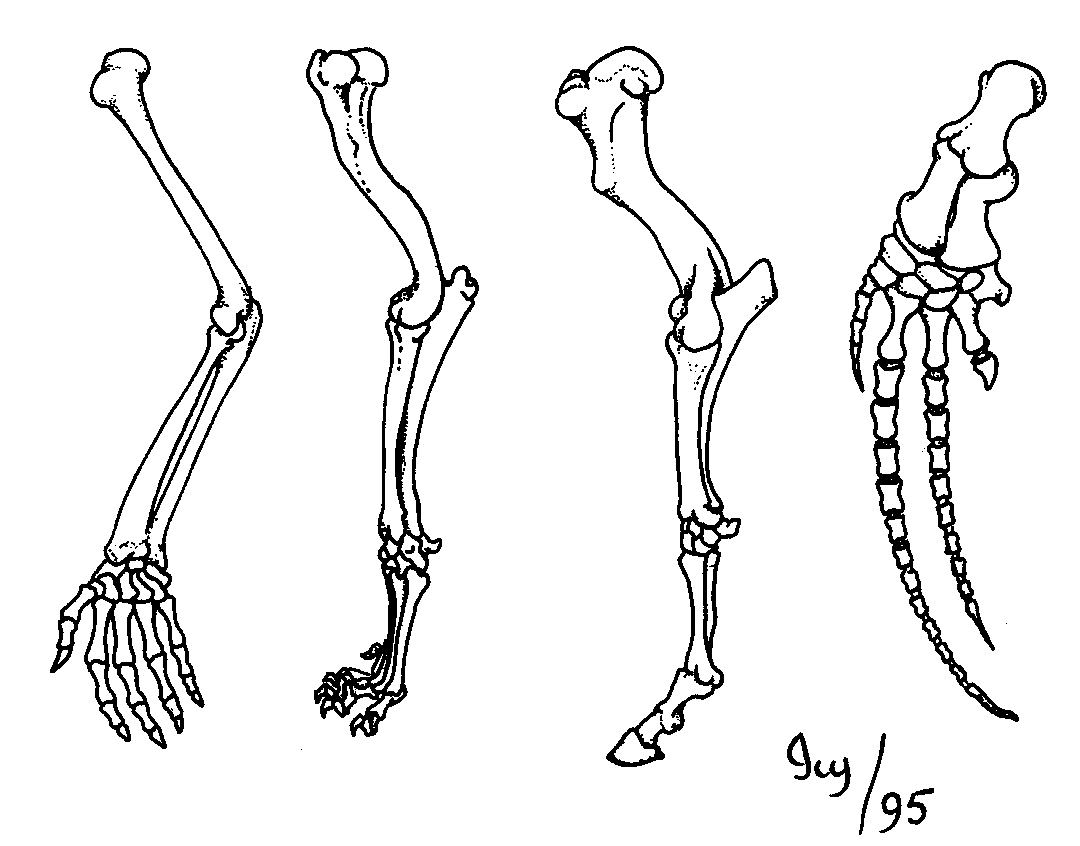
What is this an example of?
a)
vestigial structures
b)
embryology
c)
homologous structures
d)
fossil record
106.
The cause of artificial selection is…
a)
The environment
b)
Humans
c)
Mutation
d)
Gene Flow
107.
Which term refers to the process by which individuals that are better suited to the environment survive and reproduce therefore passing down their genes to their offspring? 
a)
Evolution 
b)
Variation 
c)
Adaptation
d)
Natural Selection 
108.
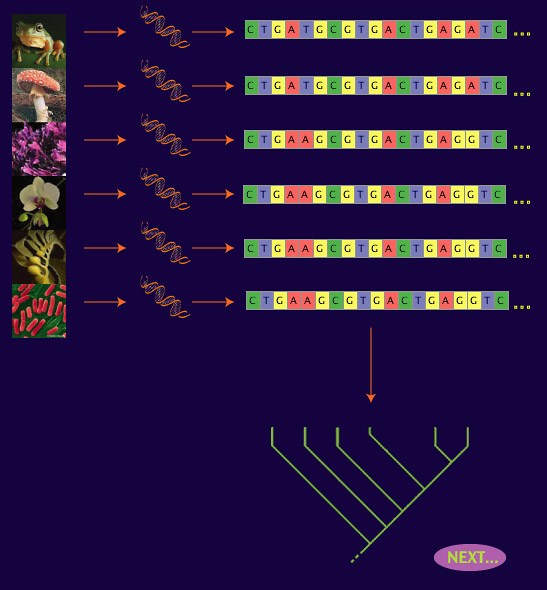
Which species’ DNA is most similar to the DNA of the toothed whale? 
a)
Hippopotamus 
b)
Baleen Whale
c)
Grazing Mammals
d)
Camels
109.
Two organisms that are closely related would have
a)
very similar DNA sequence
b)
exactly the same DNA sequences
c)
no proteins in common
d)
completely different DNA sequence
110.
A remnant or trace of an organism from the past is called a _______.
a)
Ancestor
b)
Skeleton
c)
Fossil
d)
Imprints
111.
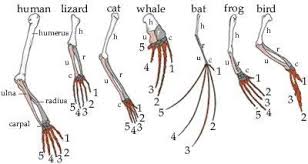
Structures with the same parts have different functions; suggests that organisms share a common ancestry
a)
vestigial structures
b)
homologous structures
c)
adaptive radiation
d)
fossil
112.
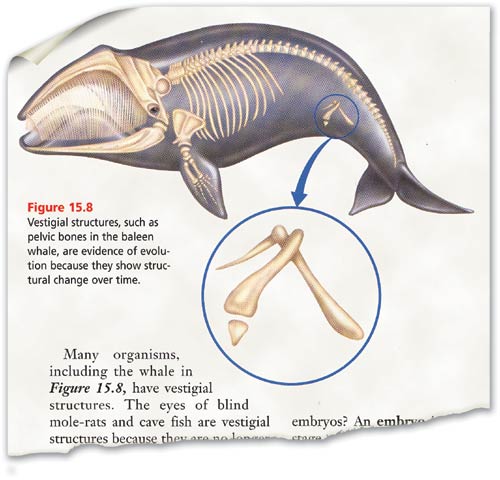
Which of the following is an example of a vestigial structure?
a)
the wings of a red-tailed hawk
b)
the hind limbs of a house cat
c)
the fins of sharks
d)
the tailbone of a human
113.
Why are advantageous traits more likely to be passed onto offspring?
a)
Because they are more likely to survive and reproduce.
b)
Because they come from dominant alleles.
c)
Because they come from recessive alleles.
d)
Because the trait is an acquired phenotype.
114.
The ability of an organism to survive and reproduce in its specific environment 
a)
diversity.
b)
evolution
c)
adaptation
d)
 fitness
115.
Which of the following statements is correct based on the information shown in this cladogram?
a)
the turtle and the frog are more similar to each other than the turtle and the bass
b)
frogs have existed for a longer time that bass
c)
the frog is more closely related to the bass than to the leopard
d)
the bass is exinct
116.
Using the cladogram:  a common ancestor of amphibians and ray-finned fish would have
a)
a bony skeleton
b)
four limbs
c)
scaly skin
d)
eggs with shells
117.

Who is most closely related to Taxidea taxus?

a)

Lutra lutra

b)

Panthera pardus

c)

Canis latrans

d)

Canis lupus

118.

According to this phylogenetic tree, which creature is the least related out of all pictured?

a)

Fish

b)

Frog

c)

Salamander

d)

Human

119.

Which of these animals does not have/produce an amniotic egg?

a)

Turtle

b)

Leopard

c)

Lamprey

d)

All three of these animals produce the amniotic egg

120.

What is the name for the "trait" shown on these tree, such as "egg shells" and "four limbs"?

a)

Derived characteristics

b)

Trait nodes

c)

Branching elements

d)

Harmonious changes

121.

Which group of animals on this tree are most closely related to birds?

a)

Saurischian dinosaurs

b)

Ornithischian dinosaurs

c)

Crocodiles

d)

None of these are related to birds

122.

If a plant has vascular tissue but no seeds, which of the four plant groups here would it fall into?

a)

Ferns

b)

Cone-bearing plants

c)

Mosses

d)

Flowering plants

123.
Do organisms "decide" to evolve and change?
a)
Yes, they know they need to change to survive 
b)
No, they change because of natural selection
124.
A bumble bee has just enough weight to open up the snapdragon flower and get the nectar/pollen inside.  Other insects cannot do this. This adaption is an example of........
a)
convergent evolution
b)
co-evolution
c)
divergent evolution
d)
speciation
125.
Sharks and dolphins both have streamlined bodies that allow them to move through water efficiently, this is an example of which type of evolution?
a)
Divergent
b)
Coevolution
c)
Convergent
d)
Artificial
126.
What type of evolution is demonstrated in this photo?  (Hint: the bee and the flower have evolved in response to each other)
a)
Coevolution
b)
Convergent evolution
c)
Punctuated evolution
d)
Gradualistic evolution
127.

Scientists now know that living things come from

a)

non-living things

b)

other living things

128.

This type of evolution is defined as a change in allele frequencies within a population or species

a)

micro evolution

b)

macro evolution

c)

convergent evolution

d)

red queen evolution

129.

Which of the following is NOT a type of evidence for evolution?

a)

Molecular evidence (like DNA)

b)

Embryology

c)

Fossil evidence

d)

All of the above are evidence for evolution
130.
The scientific name for an organism is made from the:
a)
class and family name
b)
genus and species name
c)
domain and kingdom name
d)
kingdom and phylum name
131.
Term given to describe the 2 name naming system is:
a)
dichotmous key
b)
binomial nomenclature
c)
2 scientific names
d)
binomial key
132.
Cells that do not have a true nucleus are called....
a)
eukaryote
b)
prokaryote
c)
unicellular
d)
multicellular
133.
Cells that have a true nucleus are called....
a)
eukaryotes
b)
prokaryotes
c)
unicellular
d)
multicellular
134.
Which of the following is/are true of animals?
a)
They are multicellular.
b)
They are eukaryotic.
c)
They are heterotrophs.
d)
All choices are correct.
135.
What type of symmetry is displayed in the picture?
a)
asymmetry
b)
bilateral symmetry
c)
radial symmetry
d)
photosynthesis
136.
What type of symmetry is pictured?
a)
bilateral symmetry
b)
radial symmetry
c)
asymmetry
d)
cellular respiration
137.
An organism that produces its own food supply from inorganic compounds is called a(an)
a)
heterotroph
b)
consumer
c)
detritivore
d)
autotroph
138.
Autotrophs make up the _______ level in all ecosystems.
a)
First
b)
Second
c)
Third
d)
Fourth
139.
which symbiosis is this 
a)
parasitism 
b)
mutualism
c)
commensalism
d)
nonalism 
140.
symbiotic relationship in which both organisms benefit
a)
competition
b)
Mutualism
c)
nitrogen fixation
d)
energy pyramid
141.
A living relationship between two species in which one organism is harmed is called...
a)
mutualism
b)
commensalism
c)
parasitism
d)
niche
142.
The image provided is an example of a(n):
a)
Producer
b)
Autotroph
c)
Consumer
d)
Insect
143.
The amount of energy that usually transfers from one trophic level to the next...
a)
10%
b)
20%
c)
80%
d)
50%
144.
Which of the following would be the definition of a detritivore?
a)
Animals that eat insects.
b)
Organisms that feed on rocks, recycling the nutrients back into the ground.
c)
Organisms that eat only pants
d)
Things that feed on dead organisms, recycling the nutrients back into the ground.
145.
The nonliving aspects of an ecosystem.
a)
Abiotic factors
b)
Biotic factors
146.
The living portions of the ecosystem.
a)
Biotic factors
b)
Abiotic factors
147.
A collection of organisms that belong to different populations but all live in the same area and interact with one another.
a)
Population
b)
Ecosystem
c)
Community
d)
Ecosphere
148.
The rabbit in this food web would be considered a:
a)
Decomposer
b)
Producer
c)
Secondary Consumer
d)
Primary Consumer
149.
What is the term for each step in the transfer of energy and matter within a biological community?
a)
energy path
b)
food web
c)
trophic level
d)
food pyramid
150.
As a population grows, it will most likely stop growing at what size?
a)
Growth limit
b)
Exponential limit
c)
Carrying Capacity
d)
It won't stop growing
151.
Which dispersion pattern is described by organisms being spaced out equally?
a)
Uniform
b)
Random
c)
Clumped 
d)
None of these
152.
Which dispersion pattern usually is a result of resources not being evenly spread out in the environment?
a)
Uniform
b)
Random
c)
Clumped
d)
None of these
153.
What will happen to the population when the death rate is larger than the birth rate?
a)
grow
b)
shrink
c)
stay the same
d)
None of these
154.
Which kind of dispersion is #1?
a)
clumped
b)
random
c)
uniform