
 Worksheets
Biology Final Exam Review 2025
Total questions: 150
Worksheet time: 1hrs 15mins
Name
Class
Date
1.
What skill is a scientist using when she listens to the sounds that whales makes.
a)
making a hypothesis
b)
making observations
c)
drawing conclusions
d)
interpreting data
2.
In an experiment, the factor that we measure is called the
a)
controlled variable
b)
independent variable
c)
conclusion
d)
dependent variable
3.
Which statement about the use of an independent variable in a controlled experiment is correct?
a)
a different independent variable should be used each time the experiment is repeated
b)
the independent variable must include time
c)
only one independent variable can be tested at one time
d)
the indoependent variable states the problem being tested
4.
The control group is essential to provide a(n)
a)
example of right and wrong
b)
comparison to determine if the independent variable resulted in an impact
c)
constants
d)
set of data and observations
5.

A student wants to determine the effect of soil type on plant growth. He sets up four pots as shown below. How could this experiment be improved?
a)
All four pots should have the same kind of soil.
b)
All four pots should have the same kind of seed, the same amount of light, and the same amount of water.
c)
The four pots should have different amounts of water.
d)
There is nothing wrong with this experiment.
6.
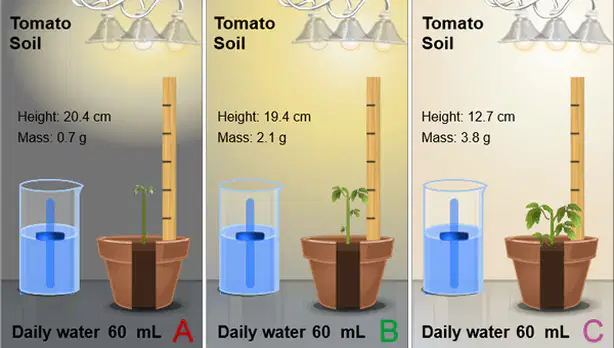
Josie set up an experiment to test the effect of light on tomato plants. The results of her experiment are shown below. What is the best conclusion she could make from this experiment?
a)
No conclusion can be drawn from this experiment because it was not a fair test.
b)
Tomato plants grow heaviest in dim light.
c)
Tomato plants grown in bright light will be shorter but have more mass than tomato plants grown in dim light.
d)
Tomato plants grow tallest in bright light.
7.
An experiment is performed on plants to see how different liquids affect plant growth. Each plant in the experiment is given a different liquid; water, apple juice, or milk. Each plant has the same amount of soil, sunlight, and listens to the same music. In this investigation, what are the controlled variables?
a)
Type of plant, amount of music, and sunlight
b)
Water, apple juice, milk
c)
Plant growth
d)
temperature of water
8.
Which type of data involves numbers that are obtained by counting or measuring?
a)
quantitative
b)
qualitative
c)
inaccurate
d)
observational
9.
Conclusions based on an experiment are most likely to be accepted when
a)
they are consistent with experimental data and observations
b)
they are derived from investigations having many experimental variables
c)
hypotheses are based on one experimental design
d)
scientists agree that only one hypothesis has been tested
10.
A statement that proposes a possible solution is a called a
a)
hypothesis
b)
theory
c)
good idea
d)
conclusion
11.
What happens during photosynthesis?
a)
Heterotrophs consume ATP.
b)
Heterotrophs produce ATP.
c)
Autotrophs consume carbohydrates.
d)
Autotrophs produce carbohydrates.
12.
Plants gather energy with light-absorbing molecules called
a)
pigments.
b)
thylakoids.
c)
chloroplasts.
d)
glucose.
13.
Most plants appear green because chlorophyll
a)
absorbs green light.
b)
absorbs violet light.
c)
does not absorb green light.
d)
does not absorb violet light.
14.
A granum is a
a)
stack of chloroplasts.
b)
stack of thylakoids.
c)
membrane enclosing a thylakoid.
d)
photosynthetic pigment molecule.
15.
The stroma is the region outside the
a)
thylakoids.
b)
chloroplasts.
c)
plant cells.
d)
mitochondria
16.
Where in the chloroplast is chlorophyll found?
a)
in the ATP
b)
in the stroma
c)
in the thylakoid membrane
d)
in the thylakoid space
17.
What is the role of NADP+ in photosynthesis?
a)
electron carrier
b)
high-energy sugar
c)
photosystem
d)
pigment
18.
What makes certain molecules good electron carriers?
a)
They can accept electrons and transfer most of their energy to another molecule.
b)
They are very large molecules, so they have lots of room to carry many electrons.
c)
The can absorb sunlight, which is where all of the high-energy electrons come from.
d)
They are carbohydrates and have a lot of energy, which allows them to carry electrons.
19.
A student is collecting the gas given off from a plant in bright sunlight at a temperature of 27°C. The gas being collected is probably
a)
oxygen.
b)
carbon dioxide.
c)
ATP.
d)
glucose.
20.
What are the products of the light-dependent reactions?
a)
oxygen gas and glucose
b)
ATP, NADPH, and oxygen gas
c)
ATP, carbon dioxide gas, and NADPH
d)
carbon dioxide gas, oxygen gas, and NADPH
21.
The Calvin cycle is another name for the
a)
light-independent reactions.
b)
light-dependent reactions.
c)
photosynthesis reaction.
d)
electron transport chain.
22.
If carbon dioxide is completely removed from a plant's environment, what would you expect to happen to the plant's production of high-energy sugars?
a)
More sugars will be produced.
b)
No sugars will be produced.
c)
The same number of sugars will be produced but without carbon dioxide.
d)
Fewer sugars will be produced at first, but then the plant will recover.
23.
How do organisms get the energy they need?
a)
by burning food molecules and releasing their energy as heat
b)
by breathing oxygen into the lungs and combining it with carbon dioxide
c)
by breaking down food molecules gradually and capturing their chemical energy
d)
by using the sun's energy to break down food molecules and form chemicals
24.
Which of the following is the correct sequence of events in cellular respiration?
a)
glycolysis → fermentation → Krebs cycle
b)
Krebs cycle → electron transport → glycolysis
c)
glycolysis → Krebs cycle → electron transport
d)
Krebs cycle → glycolysis → electron transport
25.
Cellular respiration releases energy by breaking down
a)
food molecules.
b)
ATP.
c)
carbon dioxide.
d)
water.
26.
Glycolysis requires
a)
ATP.
b)
oxygen.
c)
sunlight.
d)
NADP+.
27.
The starting molecule for the Krebs cycle is
a)
glucose.
b)
NADH.
c)
pyruvic acid.
d)
coenzyme A.
28.
The Krebs cycle produces
a)
oxygen.
b)
lactic acid.
c)
carbon dioxide.
d)
glucose.
29.
In the presence of oxygen, glycolysis is followed by
a)
lactic acid fermentation.
b)
alcoholic fermentation.
c)
photosynthesis.
d)
the Krebs cycle.
30.
In eukaryotes, electron transport occurs in the
a)
inner mitochondrial membrane.
b)
nucleus.
c)
cell membrane.
d)
cytoplasm.
31.
Which of the following pass high-energy electrons to the electron transport chain?
a)
NADH and FADH2
b)
ATP and ADP
c)
citric acid
d)
acetyl–CoA
32.
High-energy electrons that move down the electron transport chain ultimately provide the energy needed to
a)
transport water molecules across the membrane.
b)
convert ADP molecules into ATP molecules.
c)
convert carbon dioxide into water molecules.
d)
break down glucose into pyruvic acid molecules.
33.
Cellular respiration uses 1 molecule of glucose to produce approximately
a)
2 ATP molecules.
b)
4 ATP molecules.
c)
13 ATP molecules.
d)
36 ATP molecules.
34.
Lactic acid fermentation occurs in
a)
bread dough.
b)
any environment containing oxygen.
c)
muscle cells.
d)
mitochondria.
35.
The two main types of fermentation are called
a)
alcoholic and aerobic.
b)
aerobic and anaerobic.
c)
alcoholic and lactic acid.
d)
lactic acid and anaerobic.
36.
When the body needs to exercise for longer than 90 seconds, it generates ATP by carrying out
a)
lactic acid fermentation.
b)
alcoholic fermentation.
c)
cellular respiration.
d)
glycolysis.
37.
The energy needed to win a 1-minute footrace is produced mostly by
a)
lactic acid fermentation.
b)
cellular respiration.
c)
using up stores of ATP.
d)
breaking down fats.
38.
Which statement mainly explains why even well-conditioned athletes have to pace themselves for athletic events that last several hours?
a)
Lactic acid fermentation can cause muscle soreness.
b)
Heavy breathing is needed to get rid of lactic acid.
c)
Cellular respiration releases energy more slowly than fermentation does.
d)
Alcoholic fermentation produces carbon dioxide.
39.
During prophase of mitosis the genetic material condenses and coils up. This change is
a)
chromosomes turning in to chromatin
b)
chromatin turning in to chromosomes
c)
chromosomes doubling the chromatids
d)
nothing changes during prophase of mitosis to the DNA
40.
The rate at which wastes are produced by a cell partially depends on the cell's
a)
ratio of surface area to volume.
b)
type of membrane.
c)
volume.
d)
surface area.
41.
All of the following are problems that growth causes for cells EXCEPT
a)
more demands on DNA.
b)
excess oxygen.
c)
obtaining enough food.
d)
expelling wastes.
42.
Compared to small cells, large cells have more trouble
a)
dividing.
b)
producing daughter cells.
c)
storing needed materials and waste products.
d)
moving needed materials in and waste products out.
43.
After cell division, each daughter cell has
a)
a lower surface area/volume ratio than the parent cell.
b)
a higher surface area/volume ratio than the parent cell.
c)
more DNA in its nucleus than the parent cell.
d)
less DNA in its nucleus than the parent cell.
44.
Which of the following happens when a cell divides?
a)
The cell's volume increases.
b)
It becomes more difficult for the cell to get rid of wastes.
c)
Each daughter cell receives its own copy of the parent cell's DNA.
d)
It becomes more difficult for the cell to get enough oxygen and nutrients.
45.
The process by which a cell divides into two daughter cells is called
a)
cell division.
b)
metaphase.
c)
interphase.
d)
mitosis.
46.
An advantage of sexual reproduction over asexual reproduction is that sexual reproduction
a)
takes less time
b)
requires more time
c)
provides genetic diversity
d)
produces identical offspring
47.
Which of the following lists structures from smallest to largest?
a)
chromosome, supercoil, coil, nucleosome, double helix
b)
chromosome, coil, double helix, nucleosome, supercoil
c)
double helix, nucleosome, coil, supercoil, chromosome
d)
nucleosome, coil, double helix, chromosome, supercoil
48.
When during the cell cycle are chromosomes visible?
a)
only during interphase
b)
only when they are being replicated
c)
only during cell division
d)
only during the G1 phase
49.
During which phase in the cell cycle does mitosis happen?
a)
G1 phase
b)
G2 phase
c)
M phase
d)
S phase
50.
Which event occurs during interphase?
a)
The cytoplasm divides.
b)
Centrioles duplicate.
c)
Spindle fibers begin to form.
d)
Centromeres divide.
51.
Which of the following is a correct statement about the events of the cell cycle?
a)
Little happens during the G1 and G2 phases.
b)
DNA replicates during cytokinesis.
c)
The M phase is usually the longest phase.
d)
Interphase consists of the G1, S, and G2 phases.
52.
Which of the following is a phase of mitosis?
a)
cytokinesis
b)
interphase
c)
prophase
d)
S phase
53.
The first phase of mitosis is called
a)
prophase.
b)
anaphase.
c)
metaphase.
d)
interphase.
54.
During which phase of mitosis do the chromosomes line up along the middle of the dividing cell?
a)
prophase
b)
telophase
c)
metaphase
d)
anaphase
55.
Which of the following represents the phases of mitosis in their proper sequence?
a)
prophase, metaphase, anaphase, telophase
b)
interphase, prophase, metaphase, anaphase, telophase
c)
interphase, prophase, metaphase, telophase
d)
prophase, anaphase, metaphase, telophase
56.
What is the role of the spindle fibers during mitosis?
a)
They help separate the chromosomes.
b)
They break down the nuclear membrane.
c)
They duplicate the DNA.
d)
They make the chromosomes visible.
57.
The two main stages of cell division are called
a)
mitosis and interphase.
b)
synthesis and cytokinesis.
c)
the M phase and the S phase.
d)
mitosis and cytokinesis.
58.
One difference between cell division in plant cells and in animal cells is that plant cells have
a)
centrioles.
b)
centromeres.
c)
a cell plate.
d)
chromatin.
59.
What types of cells form a cell plate during cytokinesis?
a)
all eukaryotes
b)
plant cells
c)
animal cells
d)
prokaryotes
60.
When cells are grown in a laboratory, which of the following is a factor that can stop normal cells from dividing?
a)
contact with other cells
b)
growth factors
c)
a cut in the skin
d)
injection of cyclin
61.
The spindle fibers help to
a)
inhibit growth
b)
replicate the chromatids
c)
separate the chromatids
d)
make more centrioles
62.
In eukaryotic cells, the timing of the cell cycle is regulated by
a)
centrioles.
b)
cyclins.
c)
spindle fibers.
d)
the nuclear envelope.
63.
Cyclins are a family of closely related proteins that
a)
regulate the cell cycle.
b)
produce p53.
c)
cause cancer.
d)
work to heal wounds.
64.
Which of the following are external regulators of the cell cycle?
a)
cyclins
b)
growth factors
c)
mitotic spindles
d)
cancer cells
65.
Cancer is a disorder in which some cells have lost the ability to control their
a)
size.
b)
spindle fibers.
c)
growth rate.
d)
surface area.
66.
Cancer cells form masses of cells called
a)
tumors.
b)
cyclins.
c)
growth factors.
d)
p53.
67.
A cell with a defective p53 gene is likely to
a)
stop responding to growth regulators.
b)
stop dividing to produce daughter cells.
c)
generate hormones that combat tumors.
d)
produce cells without a defective p53 gene.
68.
Cancer affects
a)
humans only.
b)
unicellular organisms only.
c)
multicellular organisms only.
d)
multicellular and unicellular organisms.
69.
During early development, all cells in the embryo of a multicellular organism are identical. Later on in development, the cells will become specialized through a process called
a)
apoptosis.
b)
cytokinesis.
c)
differentiation.
d)
interphase.
70.
Each pea-plant gamete has how many alleles for the height gene?
a)
1
b)
2
c)
3
d)
4
71.
The different forms of a gene are called
a)
traits.
b)
pollinations.
c)
alleles.
d)
hybrids.
72.
Gregor Mendel removed the male parts from the flowers of some plants in order to
a)
prevent hybrids from forming.
b)
prevent cross-pollination.
c)
stimulate self-pollination.
d)
control crosses between plants.
73.
If a pea plant has a recessive allele for green peas, it will produce
a)
green peas if it also has a dominant allele for yellow peas.
b)
both green peas and yellow peas if it also has a dominant allele for yellow peas.
c)
green peas if it does not also have a dominant allele for yellow peas.
d)
yellow peas if it does not also have a dominant allele for green peas.
74.
When Gregor Mendel crossed a tall plant with a short plant, the F1 plants inherited
a)
one allele from each parent.
b)
two alleles from each parent.
c)
three alleles from each parent.
d)
four alleles from each parent.
75.
When you flip a coin, what is the probability that it will come up tails?
a)
1
b)
1/2
c)
1/4
d)
1/8
76.
The principles of probability can be used to
a)
predict the traits of the offspring of genetic crosses.
b)
determine the actual outcomes of genetic crosses.
c)
determine which species should be used in genetic crosses.
d)
decide which organisms are best to use in genetic crosses.
77.
Organisms that have two identical alleles for a particular trait are said to be
a)
hybrid.
b)
homozygous.
c)
heterozygous.
d)
dominant.
78.
What principle states that during gamete formation genes for different traits separate without influencing each other's inheritance?
a)
principle of dominance
b)
principle of independent assortment
c)
principle of probabilities
d)
principle of segregation
79.
How many different allele combinations would be found in the gametes produced by a pea plant whose genotype was RrYY?
a)
2
b)
4
c)
8
d)
16
80.
Gregor Mendel's principles of genetics apply to
a)
plants only.
b)
animals only.
c)
pea plants only.
d)
all organisms.
81.
A breed of chicken shows codominance for feather color. One allele codes for black feathers, another codes for white feathers. The feathers of heterozygous chickens of this breed will be
a)
black.
b)
white.
c)
gray.
d)
speckled.
82.
Variation in human skin color is an example of
a)
Mendelian dominance
b)
codominance.
c)
x linked traits
d)
multiple alleles.
83.
Which of the following supports the claim that the environment can affect genetic traits?
a)
Oak trees get taller as they grow.
b)
Hydrangea flower color varies with soil pH.
c)
Dandelion plants are self pollinating.
d)
Pinion trees bear cones every other year.
84.
Mendel's Law of Segregation explains
a)
how genotypes halve (separate) into gametes
b)
independent assortment
c)
the environment alone
d)
codominant alleles
85.
Gametes are produced by the process of
a)
mitosis.
b)
meiosis.
c)
crossing-over.
d)
replication.
86.
What is formed at the end of meiosis?
a)
two genetically identical cells
b)
four genetically different cells
c)
four genetically identical cells
d)
two genetically different cells
87.
Which bacteria killed the mice in Griffith's transformation experiment?
a)
live, harmless bacteria and heat-killed, harmful bacteria
b)
live, harmless bacteria and heat-killed, harmless bacteria
c)
live harmful bacteria and heat-killed, harmless bacteria
d)
live harmless bacteria, and live, harmful bacteria
88.
Griffith called the process he observed transformation because
a)
the mouse had been transformed.
b)
the harmful bacteria had been transformed.
c)
the harmless bacteria had been transformed.
d)
the experiment had been transformed.
89.
What did Avery conclude caused transformation?
a)
DNA was the transforming factor.
b)
A protein was the transforming factor.
c)
A carbohydrate was the transforming factor.
d)
A lipid was the transforming factor.
90.
What happened when Griffith injected mice with the harmless, R-strain bacteria alone?
a)
The bacteria transformed.
b)
The mouse lived.
c)
The mouse died.
d)
The bacteria died.
91.
What property of DNA does bacterial transformation illustrate?
a)
Bacterial DNA cannot move into other bacteria and function.
b)
Bacterial DNA can move into another bacteria and function.
c)
Bacterial DNA uses four nucleotides bases that work in pairs.
d)
Bacterial DNA is found in a circular chromosome.
92.
Griffith's experiments advanced the study of genetics by proving that
a)
there is a chemical that contains genetic information that can be passed from one organism to another.
b)
bacteria can make people sick by infecting them with a chemical that contains genetic information.
c)
the bacteria that can make mice sick are the same bacteria that can be grown in culture dishes in a laboratory.
d)
genetic information can be passed from parents to their offspring during sexual reproduction.
93.
Why did Hershey and Chase label the viral DNA with radioactive phosphorous and not radioactive sulfur?
a)
DNA contains phosphorus and no sulfur.
b)
Proteins contain phosphorus and no sulfur.
c)
DNA contains sulfur and little phosphorous.
d)
Proteins acids contain sulfur and little phosphorous.
94.
What stores information in a cell?
a)
proteins
b)
carbohydrates
c)
lipids
d)
DNA
95.
What happens when a piece of DNA is missing?
a)
Genetic information is stored.
b)
Genetic information is copied.
c)
Genetic information is lost.
d)
Genetic information is transmitted.
96.
In what way is DNA like a book?
a)
DNA has information organized with an kind of index.
b)
DNA has stored information, that can be copied and passed on.
c)
DNA has information wrapped in an identifying cover.
d)
DNA has information that is periodically updated.
97.
In which cells is the accurate transmission of information most important?
a)
nerve cells
b)
skin cells
c)
sex cells
d)
bone cells
98.
DNA makes a good molecule for storing information because
a)
its bases can be joined together in any order, like the letters of the alphabet can be strung to form different words.
b)
each nucleotide within a DNA strand can give a cell different information, and there are many nucleotides in every cell.
c)
it can absorb ultraviolet light, so DNA can help protect cells from the damaging effects of this form of radiation.
d)
it is a type of nucleic acid, and most acids are an important part of information storage within cells.
99.
Which scientist(s) figured out that the shape of a DNA molecule is a double helix?
a)
Hershey and Chase
b)
Griffith
c)
Watson and Crick
d)
Franklin
100.
Which scientist made x-ray diffraction photos of DNA?
a)
Franklin
b)
Chargaff
c)
Watson
d)
Avery
101.
Which of the following forms a base pair with thymine?
a)
deoxyribose
b)
adenine
c)
guanine
d)
cytosine
102.
What did Rosalind Franklin contribute to the effort to identify the structure of DNA?
a)
models made of cardboard and wire showing the shape of DNA
b)
the ratios of the two sets of nucleotide pairs in DNA
c)
radioactive evidence that DNA carried the genetic code
d)
x-ray diffraction photos of the DNA molecule
103.
Watson and Crick discovered the two strands in DNA
a)
run in perpendicular directions.
b)
run in the same direction.
c)
run in opposite directions.
d)
run in random directions.
104.
During DNA replication, a DNA strand that has the bases CTAGGT produces a strand with the bases
a)
TCGAAC.
b)
GATCCA.
c)
AGCTTG.
d)
GAUCCA.
105.
What enzyme works to add DNA to ends of chromosomes in rapidly dividing cells such as those found in an embryo, to prevent genes from being lost during replication?
a)
DNA polymerase
b)
histones
c)
telomerase
d)
chromatin
106.
Which of the following include all the others?
a)
DNA molecules
b)
histones
c)
chromosomes
d)
nucleosomes
107.
In eukaryotes, DNA
a)
is located in the nucleus.
b)
floats freely in the cytoplasm.
c)
is located in the ribosomes.
d)
is circular.
108.
Which would be greater in a eukaryote than in a prokaryote?
a)
The percentage of guanine nucleotides.
b)
The total number of base pairs in a chromosome.
c)
The number of replication forks on a strand of DNA.
d)
The total amount of DNA in a cell.
109.
DNA replication ensures that
a)
the two newly formed cells are robust
b)
the DNA can undergo crossing-over
c)
non-disjunction will not occur
d)
the two newly formed cells have enough DNA
110.
In both prokaryotes and eukaryotes, how many copies of the chromosome are left after replication?
a)
1
b)
2
c)
3
d)
4
111.
In both prokaryotes and eukaryotes, DNA replication happens
a)
before cell division.
b)
in the nucleus.
c)
only to telomeres.
d)
around the histones.
112.
RNA contains the sugar
a)
ribose.
b)
deoxyribose.
c)
glucose.
d)
lactose.
113.
Unlike DNA, RNA contains
a)
adenine.
b)
uracil.
c)
phosphate groups.
d)
thymine.
114.
Which of the following are found in both DNA and RNA?
a)
ribose, phosphate groups, and adenine
b)
deoxyribose, phosphate groups, and guanine
c)
phosphate groups, guanine, and cytosine
d)
phosphate groups, guanine, and thymine
115.
Which of the following is true?
a)
RNA is usually single-stranded.
b)
DNA is usually single-stranded.
c)
DNA contains uracil.
d)
RNA contains thymine.
116.
Which type of RNA brings the information in the genetic code from the nucleus to other parts of the cell?
a)
rRNA
b)
tRNA
c)
mRNA
d)
RNA polymerase
117.
Which of the following is true of transcription?
a)
In eukaryotes, transcription takes place in the cytoplasm and requires many enzymes.
b)
RNA polymerase recognizes and binds to specific regions of the DNA called introns.
c)
RNA editing removes the exons from pre-mRNA, leaving only the introns in the final molecule.
d)
RNA polymerase can make many molecules of RNA from a single DNA sequence.
118.
One key difference between DNA and RNA is
a)
RNA is ONLY found in the nucleus
b)
DNA is single-stranded
c)
DNA can leave the nucleus
d)
RNA can leave the nucleus
119.
Which molecules are involved in protein synthesis?
a)
transfer RNA, introns, and mutagens
b)
messenger RNA, introns, and ribosomal RNA
c)
ribosomal RNA, transfer RNA, and mutagens
d)
messenger RNA, ribosomal RNA, and transfer RNA
120.
What is produced during transcription?
a)
RNA molecules
b)
DNA molecules
c)
RNA polymerase
d)
proteins
121.
During eukaryotic transcription, an RNA molecule is formed that is
a)
complementary to both strands of DNA.
b)
identical to an entire single strand of DNA.
c)
double-stranded and inside the nucleus.
d)
complementary to part of one strand of DNA .
122.
How many nucleotides are needed to specify three amino acids?
a)
3
b)
6
c)
9
d)
12
123.
There are 64 codons and 20 amino acids. Which of the following is true?
a)
Several different codons can specify the same amino acid.
b)
Each codon specifies a different amino acid.
c)
Some amino acids have no link to a codon.
d)
Each amino acid is specified by only one codon.
124.
One difference between DNA and RNA is
a)
the phosphate groups
b)
the sugar
c)
the quantity.
d)
the durability.
125.
Which of the following terms is LEAST closely related to the others?
a)
spindle fiber
b)
tRNA
c)
polypeptide
d)
anticodon
126.
During translation, the type of amino acid that is added to the growing polypeptide depends on the
a)
codon on the mRNA and the anticodon on the rRNA.
b)
anticodon on the mRNA and the anticodon on the tRNA.
c)
anticodon on the rRNA and the codon on the mRNA.
d)
codon on the mRNA and the anticodon on the tRNA.
127.
A protein is being assembled when
a)
DNA is being translated.
b)
RNA is being transcribed.
c)
RNA is being translated.
d)
DNA is being transcribed.
128.
Genes contain instructions for assembling
a)
operons.
b)
nucleosomes.
c)
proteins.
d)
mutagens.
129.
Which is the correct sequence of the transfer of information in most organisms?
a)
protein to DNA to RNA
b)
RNA to DNA to protein
c)
DNA to RNA to protein
d)
RNA to protein to DNA
130.
Which of the following best describes the what happens during gene expression?
a)
A cell reads the instructions in DNA and builds a protein based on those instructions.
b)
A gene is copied many times so that all of a cell's daughter cells will have their own copy.
c)
The nucleus of a cell builds cellular proteins based on the sequence of the mRNA code.
d)
A single gene leaves the nucleus of a cell and travels through the cytoplasm to the membrane.
131.
In eukaryotes
a)
Transcription takes place in the cytoplasm, and translation takes place in the nucleus.
b)
Transcription takes place in the nucleus, and translation takes place in the cytoplasm.
c)
Transcription and translation both take place in the nucleus.
d)
Transcription and translation both take place in the cytoplasm.
132.
A mutation that involves one or a few nucleotides is called
a)
a mutagen.
b)
an inversion.
c)
a point mutation.
d)
a translocation.
133.
Which of the following is a chromosomal mutation?
a)
inversion
b)
insertion
c)
point mutation
d)
substitution
134.
One difference between a gene mutation and a chromosomal mutation is that
a)
A gene mutation affects the DNA of more genes than a chromosomal mutation.
b)
A gene mutation can involve a insertion or deletion, but cannot result in a frameshift.
c)
A chromosomal mutation can change the number of chromosomes in a cell.
d)
A chromosomal mutation is more likely to be passed on to offspring or daughter cells.
135.
When a chromosome undergoes a deletion mutation, information is
a)
repeated.
b)
lost.
c)
reversed.
d)
transferred.
136.
Most mutations
a)
have no effect on an organism.
b)
are fatal to an organism.
c)
are helpful to an organism.
d)
are harmful to an organism.
137.
Which form of RNA makes up the ribosome?
a)
DNA
b)
mRNA
c)
sRNA
d)
rRNA
138.
Chromosomes replicate during which stage of the cell cycle?
a)
M phase
b)
S for synthesis
c)
G1 for replication
d)
G2 for 2 copies
139.
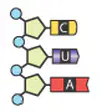
Which tRNA anticodon will complement this mRNA codon?
a)
anticodon A
b)
anticodon B
c)
anticodon C
d)
anticodon D
140.
Which statement best describes the role of mRNA in protein synthesis?
a)
stores the genetic code in the nucleus
b)
is simpler than in prokaryotes.
c)
copies the genetic code from nucleus and brings to ribosome
d)
carries an amino acid
141.
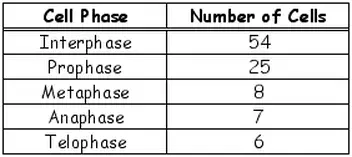
Upon examining a sample consisting of 100 cells, you find the following distribution of cell phases. If you know that the cell cycle for this type of cell takes two hours, how long, on average, does the cell spend in prophase?
a)
8 min.
b)
16 min.
c)
22 min.
d)
30 min.
142.

The two chickens below are bred together.Their feather color is a codominant trait with white being recessive. Which of the following is a possible set of offspring for these parents? red feathers white feathers
a)
one red chicken, one white and three red/white chickens
b)
three red chickens and two white chickens
c)
all red/white chickens
d)
all of the above are possible
143.
Which step of meiosis is depicted below?
a)
prophase I
b)
anaphase I
c)
prophase II
d)
anaphase II
144.

Place the four images in the correct chronological order.
a)
image A, image D, image B, image C
b)
Image C, image D, image B, image A
c)
C, B, A, D
d)
B, C, D, A
145.
If your were to examine a sample of 1000 cells, in which of the phases listed below would you expect to find most of the cells?
a)
interphase
b)
metaphase
c)
anaphase
d)
telophase
146.
If a trait is X linked which statement is true?
a)
males will not have this trait
b)
males will be more likely to have this trait
c)
females will be more likely to have this trait, for males it will depend
d)
females and males can both be carriers
147.

What type of inheritance pattern did Mendel observe with the 7 pea traits?
a)
incomplete dominance
b)
complete dominance
c)
codominance
d)
pleiotropy
148.
What is the name of the pigment protein found in human skin?
a)
melanin
b)
rubisco
c)
protease
d)
RNA
149.
Unlike mitosis, meiosis results in
a)
2 genetically identical daughter cells
b)
4 genetically identical diploid daughter cells
c)
3 genetically unique brother cells
d)
4 non-identical haploid daughter cells
150.
An individual with a blood type phenotype of "AB" is displaying what type of inheritance pattern?
a)
incomplete dominance
b)
complete dominance
c)
codominance
d)
pleiotropy
100 %

