
 Worksheets
Biology EOC Part 2 Review
Total questions: 144
Worksheet time: 12hrs 0mins


What is the correct order for this food chain?
Owl, Mouse, Grasshopper, Grass
Grass, Mouse, Owl, Grasshopper
Grass, Owl, Grasshopper, Mouse
Grass, Grasshopper, Mouse, Owl

Which of these organisms is the secondary consumer?
Owl
Mouse
Grass
Grasshopper

Which of these organisms is the producer?
Owl
Mouse
Grasshopper
Grass
What do omnivores eat?
Animals
Plants and Animals
Plants
Dead Animals
Place the levels of environment in the correct order.
biome, biosphere, population, organism, ecosystem,community
organism, ecosystem, biosphere, population, community, biome
organism, population, community, ecosystem, biome, biosphere
population, community, organism, biome, ecosystem, biosphere

What is the hawk in the food web?
Producer
Primary consumer
Secondary consumer
Tertiary consumer
Volcano erupting would be an example of what type of succession?
Primary
Secondary
Tertiary
What was NOT a part of the water cycle?
Condensation
Precipitation
Decompostition
Evaporation
Group of the same species.
Community
Ecosystem
Population
All of the biotic and abiotic factors.
community
ecosystem
population


Barnacles are animals that cannot move. In order to get food, they attach to whales and catch any floating plankton in the water. The whale is neither helped nor harmed in the interaction. What type of symbiosis is this?
Mutualism
Commensalism
Parasitism
Neutralism

In the wild, some alligators gets their teeth cleaned by birds. The birds gets their food from the alligators' teeth.
What type of symbiosis is this?
Mutualism
Commensalism
Parasitism
Neutralism

In an ecosystem, there are populations of moose, rabbits, grass, and pine trees. Suddenly, a fire blazes through the area, which kills all of the populations. As the months go on, new species of grass begin to take root. This attracts animals, and eventually the ecosystem is restored.
What type of ecological succession happened?
Primary succession
Secondary succession
Tertiary succession
None of the above


A relationship in which both species benefit is called...
Parasitism
Commensalism
Mutualism
Limiting factors ...
are resources that are in short supply and limit the size of a population.
are a cause of too much nitrogen in the water.
are hosts for parasites.
only found in the jungle.


What point on the graph represents the carrying capacity?
A
B
C
D

What is happening at the 'A' on the graph?
the population overshoots above the carrying capacity
the population stops growing
growth begins to slow down due to limited resources
growth is speeding up due to an abundance of resources


Ctenodiscus crispatus (Mud Starfish)


A virus's genetic material is surrounded by
a protein capsid
DNA
a tail fiber
nothing
Which cycle of a virus is most destructive to the host?
lytic cycle
lysogenic cycle

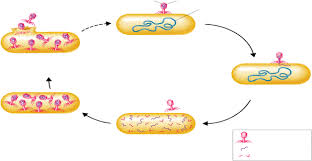
This image represents part of the
lytic cycle
lysogenic cycle
Choose the correct order of lytic cycle steps
attachment, injection, assembly, synthesis, lysis
attachment, injection, synthesis, assembly, lysis
attachment, injection, assembly, lysis, synthesis
attachment, lysis, assembly, synthesis, injection


A process by which bacteria reproduce asexually
binary fission
cellular respiration
pasteurization
decomposers
A process by which bacteria reproduce sexually
conjugation
binary fission
endospore
decomposers

The tubes and support that transport water
and nutrients up, down and around in plants
Vascular System
Shoot System
Root System
Reproductive System

Vascular tissue (tubes) responsible for the transportation of water and minerals up from the roots and around the plant.
Stomata
Transpiration
Phloem
Xylem

Vascular tissue (tubes) responsible for the transportation of glucose down and around in a plant.
Transpiration
Xylem
Phloem
Root Hairs

The process of water movement in plants
due to evaporation out the stomata
and absorption of water through the root hairs
Active Transport
Transpiration
Stomata
Guard Cells

Pores under leaves
that allow for transpiration
and gas exchange
Xylem
Stomata
Phloem
Transpiration

Two cells that regulate the size of the stomata depending on temperature and
water conditions
Phloem
Xylem
Stomata
Guard Cells

The plant hormone response to the
force of gravity
Phototropism
Geotropism
Thigmotropism
Transpiration

The plant hormone response to light
Transpiration
Thigmotropism
Geotropism
Phototropism

The plant hormone response to touch
Thigmotropism
Geotropism
Phototropism
Transpiration

What is the main function of the respiratory system?
It converts food into simpler substances for the body to absorb as nutrients and gives the body energy.
It supplies the blood with oxygen in the lungs, and removes carbon dioxide from the body into the atmosphere.
It allows the body's internal and external organs to move so that they can do their jobs.
It helps the heart communicate with the brain.
What is the point of a feedback loop?
To provide the body with more energy
To provide the body with more food
To make sure the conditions in the body are always changing
To make sure the conditions in the body remain stable

According to the feedback loop, what does high blood sugar promote?
Insulin Release
Glucagon Release
Insulin Uptake
Glycogen Uptake

