wayground logo

Free Printable Worksheets

Font size

S
M
L
XL
Worksheets

Biology first semester review

Total questions: 148

Worksheet time: 2hrs 28mins

Name
Class
Date
1.
In a controlled experiment, the variable that IS changed between groups, is called the 
a)
control variable (s)
b)
independent variable 
c)
dependent variable 
2.
A pair of researchers are wanting to see the effect of carbon dioxide on the growth of plants.  They use a greenhouse to create an environment with an elevated carbon dioxide levels.  In another greenhouse, they monitor the gases to keep carbon dioxide levels to a normal level.  They keep the humidity, the sunlight levels, duration of light,  water, and fertilizer the same between both groups.  The researchers recorded the height, leaf numbers, and change in mass of the plants in each greenhouse.   In this experiment, what is the independent/experimental variable?
a)
the fertilizer
b)
the amount of carbon dioxide
c)
the number of leaves
d)
the amount of oxygen
3.
A pair of researchers are wanting to see the effect of carbon dioxide on the growth of plants.  They use a greenhouse to create an environment with an elevated carbon dioxide levels.  In another greenhouse, they monitor the gases to keep carbon dioxide levels to a normal level.  They keep the humidity, the sunlight levels, duration of light,  water, and fertilizer the same between both groups.  The researchers recorded the height, leaf numbers, and change in mass of the plants in each greenhouse.   In this experiment, what would be the control variable (s) 
a)
amount of water
b)
amount of light 
c)
both the water and the light
d)
neither the water or the light
4.
Homeostasis
a)
allows for a wildly fluctuating internal environment
b)
is impossible in vertebrates
c)
is the maintenance of a relatively stable internal environment and often incorporates a form of feedback regulation
d)
is the maintenance of a relatively stable external environment and often incorporates a form of feedback regulation
5.
There are many criteria that are used to define living things. Living things reproduce, grow, and develop. They respond to stimuli, use materials and energy, and evolve and adapt over time to their environment. What is another criteria used to define living things?
a)
All living things are made of cells.
b)
All living things are intelligent.
c)
All living things are complex.
d)
All living things are able to move.
6.
A _____ is something in the environment that causes an organism to respond.
a)
stimulus
b)
response
c)
cause
d)
effect
7.
When a baby kitten becomes an adult cat, this is an example of...
a)
energy metabolism
b)
growth and development
c)
response to stimuli
d)
having cells
8.

Identify the characteristic: Green plants produce their own food through the process of photosynthesis.

a)

All living things use energy

b)

All living things contain cells

c)

All living things maintain homeostasis

d)

All living things grow

9.
A worm turns away from light is an example of a worm
a)
reproducing
b)
doing cellular respiration
c)
having cells
d)
responding to its environment
10.

The base measurement for mass is...

a)

kilogram

b)

liters

c)

grams

d)

meters

11.

Which of the following is the correct way to set the metric conversion - how many um are in 3.4 mm?

a)
b)
c)
d)
12.
What will be the total magnification if the ocular lens is 10X and the objective lens is 40X?
a)
40X
b)
10X
c)
100X
d)
400X
13.
A covalent bond in which electrons are shared unequally is:
a)
polar
b)
a double bond
c)
ionic
d)
polyatomic
14.

Maximum number of electrons that can be placed in the first electron shell and the second electron shell

a)

2, 8

b)

6, 2

c)

10 in each

d)

8 in each

15.
Which of the following shows the correct hydrogen bonding in water molecules?
a)
A
b)
B
c)
C
16.
Which of the following organic compounds is the main source of energy for living things?
a)
carbohydrates
b)
lipids
c)
nucleic acids
d)
proteins
17.
Animals store glucose in the form of
a)
cellulose
b)
glycogen
c)
wax
d)
lipids
18.
Polymers form through _____________
a)
hydrolysis
b)
dehydration synthesis
c)
ATP synthesis
d)
monomerization
19.
What type of carbohydrate is this?
a)
polysaccharide
b)
disaccharide
c)
monosaccharide
d)
it isn't a carbohydrate
20.
What type of carbohydrate is this?
a)
polysaccharide
b)
disaccharide
c)
monosaccharide
d)
it isn't a carbohydrate
21.
What substances are classified as lipids?
a)
Fats, sugars, phosphates
b)
DNA and RNA
c)
Triphosphates, glyercol-lipids and testosterone.
d)
Fats, oils, waxes, hormones
22.
Which macromolecule is this?
a)
carbohydrate
b)

trigleceride

c)
protein
d)
nucleic acid
23.
The characteristic that all lipids have in common is----
a)
made of lots of double bonds
b)
acidic when mixed with water
c)
no high energy content
d)
do not dissolve in water
24.
This picture shows what type of lipid?
a)
unsaturated fat
b)
wax
c)
saturated fat
d)
steroid
25.
The diagram shows a bond forming between two amino acids. What is the name of the resulting bond?
a)
Peptide Bond
b)
Glycosidic Linkage
c)
Ester Bond
d)
Hydrogen Bond
26.
The primary sequence of a protein refers to the:
a)
Order of amino acids
b)
α-Helix or β-Pleated Sheet
c)
Interaction of subunits
d)
Hydrogen Bonding
27.
The structure of proteins can be changed by environmental factors such as temperature or pH.
a)
True
b)
False
28.
Which group of organic molecules speed up chemical reactions and serve as immune defense mechanisms?
a)
proteins
b)
carbohydrates
c)
nucleic acids
d)
lipids
29.
What is being represented by the letter A in the image?
a)
Substrate
b)
Enzyme
c)
Product
d)
Complex
30.
What is being represented by the letter B in the image?
a)
Substrate
b)
Enzyme
c)
Substrate
d)
Product
31.
If an enzyme becomes over heated what effect, if any, will the heat have on the enzymatic activity? 
a)

The enzyme will not store much chemical energy.

b)

The enzyme will lose its shape and will not be able to catalyze reactions.

c)

The enzyme will lose its net electrical charge.

d)

The enzyme will lose stored genetic information.
32.
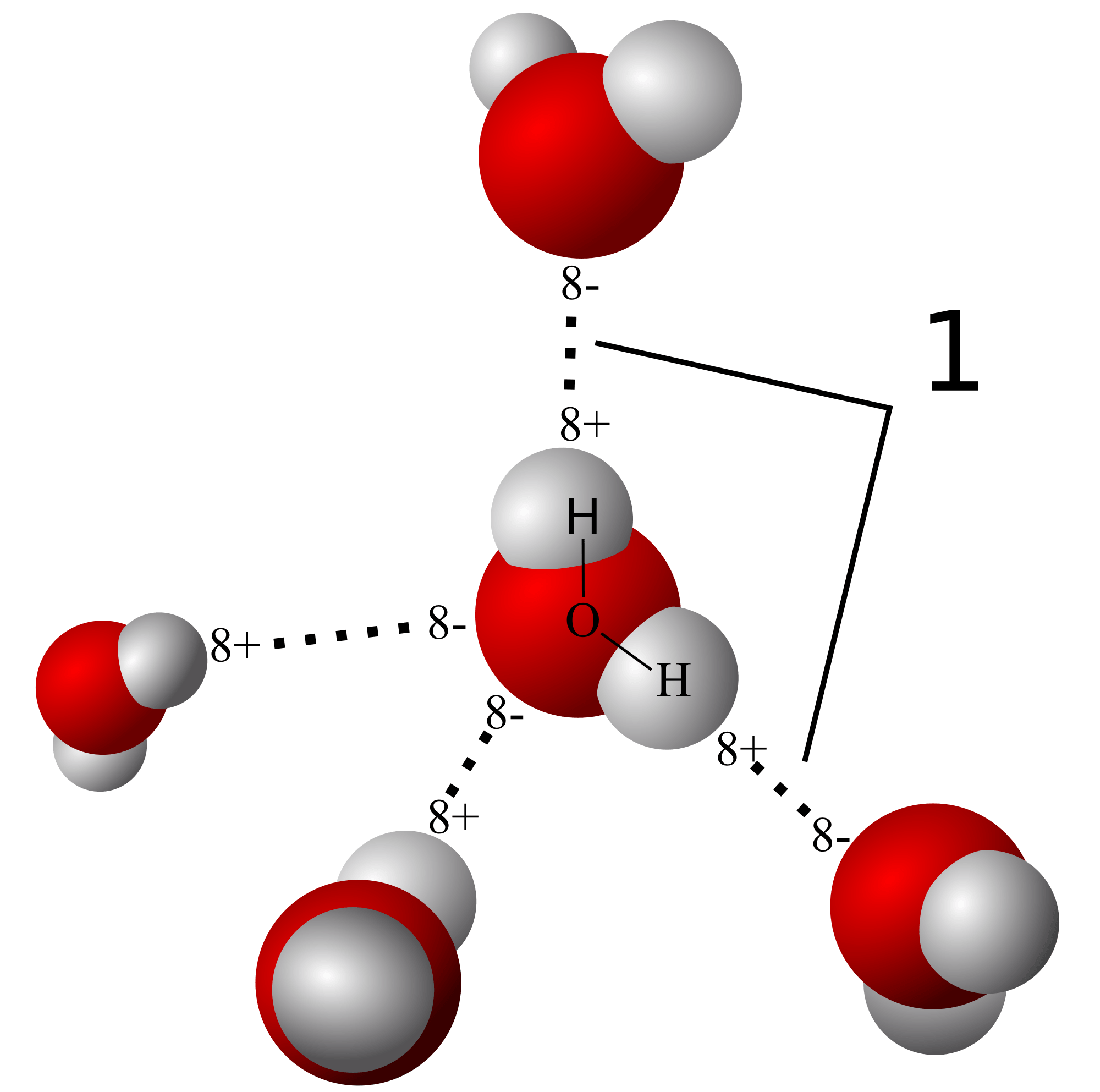
Which statement describes the polarity of a water molecule?
a)
The oxygen end has slight positive charge and the hydrogen end has a slight negative charge
b)
The oxygen end has a slight negative charge and the hydrogen end has a slight positive charge
c)
Electrons are shared evenly between the hydrogens and the oxygen.
d)
The charge on each end of the molecule is balanced.
33.
Attractions between water molecules are called
a)
Covalent bonds
b)
Ionic bonds
c)
Polar bonds
d)
Hydrogen bonds
34.
Identify this molecule
a)
monosaccharide
b)
steroid
c)
disaccharide
d)
fatty acid
35.

If a plant is in nitrogen deprived soil, then what is the most affected?

a)

The production of sucrose

b)

The production of starch

c)

The production of carbohydrates and proteins

d)

The production of proteins and nucleic acids.

36.
Which structure changes in the 20 different amino acids?
a)
#1
b)
#2
c)
#3
d)
#4
37.

What are the monomers of carbs, proteins, and nucleic acids

a)

carbs- monosaccharides; proteins- steroids, nucleic acids- sugars

b)

carbs- fatty acds; proteins- steroids, nucleic acids- sugars

c)

carbs- monosaccharides; proteins- amino acids, nucleic acids- nucleotide

d)

carbs-amino acids; proteins- monosaccharides, nucleic acids- fatty acids

38.
When water molecules stick easily to other water molecules, this is called what?
a)
cohesion
b)
adhesion
c)
solution
d)
polar molecule
39.
The part of the cell that makes protein.
a)
Vacuoles
b)
Ribosomes
c)
Golgi Apparatus
d)
Cytoplasm
40.
Packages proteins into vesicles and ships them out.
a)
Endoplasmic Reticulum
b)
Ribosomes
c)
Golgi Apparatus
d)
Nucleus
41.
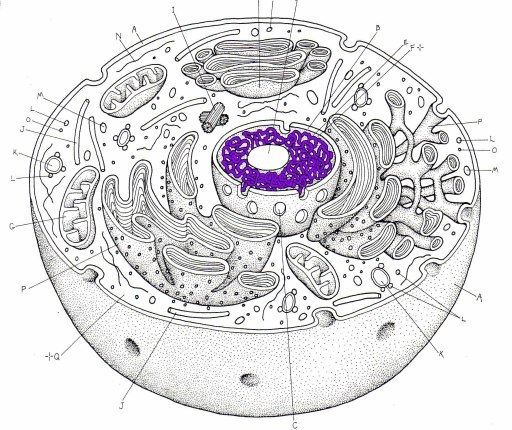
Identify letter G.
a)
Golgi complex
b)
ribosome
c)
cell wall
42.
This contains digestive enzymes. These enzymes can digest materials and cleans the cell
a)
ribosomes
b)
cilia
c)
flagella
d)
lysosomes
43.
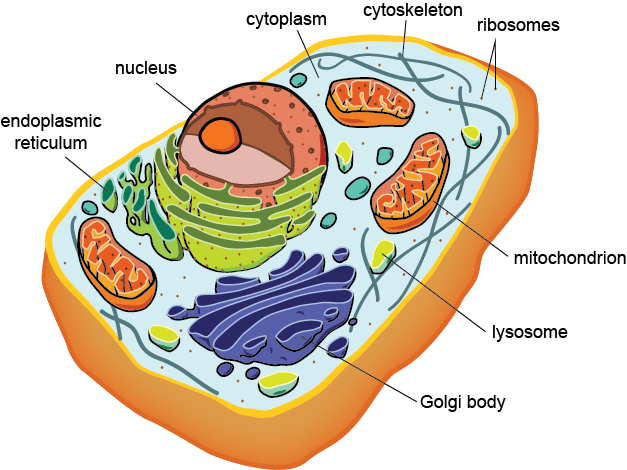
What kind of cell is this?
a)
Eukaryotic
b)
Prokaryotic
44.
True or False:  Mitochondria are found in both plant and animal cells 
a)
True 
b)
False 
45.
Produces hormones and lipid molecules for cells
a)
smooth endoplasmic reticulum
b)
rough endoplasmic reticulum
c)
nucleus
d)
ribosome
46.
In the diagram below, which section represents a cells that has been placed in a hypertonic solution?
a)
A
b)
B
c)
C
47.
The diffusion of water through a semi-permeable membrane is called?
a)
Osmosis
b)
Cell wall
c)
Diffusion
d)
Respiration
48.
Allows large/polar molecules to pass through the cell membrane via facilitated diffusion
a)
Phospholipid bilayer
b)
Transport Protein
c)
Cholesterol
d)
Carbohydrate Chains
49.
Which of the following can pass directly through the phospholipid cell membrane?
a)
Charged particles (Na+)
b)
Large molecules (glucose)
c)
Polar Molecules (H2O)
d)
Small, nonpolar molecules (CO2)
50.
Which cell is in an isotonic environment?
a)
A
b)
B
c)
C
51.
Which cell is in a hypertonic environment?
a)
A
b)
B
c)
C
52.
Active Transport moves molecules from ________ to _________ concentration; it ___________ energy.
a)
high, low; does not require
b)
low, high; does not require
c)
high, low; requires
d)
low, high; requires
53.

This cell part is responsible to assembling ribosomes

a)

Rough ER

b)

Golgi body

c)

nucleolus

d)

nuclear envelope

54.

What important genetic material is also called chromatin?

a)

proteins

b)

DNA

c)

carbohydrates

d)

lipids

55.

Which of the following places the protein manufacturing organelles into the correct order? from start to finish

a)

mitochondria, Nucleus, ribosomes, Golgi, Rough ER

b)

Rough ER, Golgi, Nucleus, ribosomes, smooth ER

c)

nucleus, ribosomes, rough ER, Golgi, transport vesicle

d)

lysosome, ribosome, Golgi, mitochondria

56.
What type of transport is this?
a)
facilitated diffusion
b)
active transport
c)
diffusion
d)
osmosis
57.
A phospholipid has 2 parts. What are they called? 
a)
Hydrophilic Head, Hydrophobic Tail 
b)
Hydrophobic Head, Hydrophilic Tail 
58.
Hydrophobic region of the cell membrane?
a)
E
b)
B
c)
C
d)
59.
Which of the following statements is not part of the cell theory?
a)
Cells are the basic unit of structure and function in all living things.
b)
All cells are produced from other cells.
c)
Only animal cells are composed of cells.
d)
All living things are composed of cells.
60.

When cells are damaged, new cells are created by cell a process called cell division. How does the cell theory support this fact?

a)

It states that all cells have a nucleus which divides.

b)

It states that all living things are made up of one or more cells.

c)

It states that cells come from previously existing cells.

d)

It states that the basic units of structure and function are cells.

61.
Look at the cross section of a cell membrane of a eukaryotic cell. H+ ions are being pumped from a low concentration to a high concentration. 
How do you describe this type of transport across the cell membrane?
a)
active transport
b)
passive transport
c)
facilitated diffusion
d)
co-transport 
62.
What is occurring at part B?
a)
an electron is absorbing light energy
b)
hydrogen ions are being pumped into the thylakoid space
c)
water is being split by an enzyme
d)
ATP is generated from ADP and a phosphate 
63.
Molecule C is 
a)
part of the chlorophyll molecule
b)
part of the electron system that generates ATP 
c)
part of the electron transport system that generates NADPH
d)
part of the ATP synthase
64.
Part B is referring to 
a)
the electron transport system
b)
a collection of chlorophyll molecules 
c)
the ATP synthase
d)
light energy
65.
In which part would you find a high concentration of hydrogen ions?
a)
outside the thylakoid, in the beige area
b)
within the membrane, the orange area
c)
inside the thylakoid, the green area
d)
within the chlorophyll molecules
66.
Which gas is removed from the atmosphere during photosynthesis?
a)
hydrogen
b)
oxygen
c)
nitrogen
d)
carbon dioxide
67.
Chlorophyll absorbs a higher percentage of _____ and _______ light.
a)
purple and green
b)
red and blue
c)
black and orange
d)
yellow and green
68.
Which of the following is the correct equation for PHOTOSYNTHESIS?
a)
6CO2 + 6H2O --> 6O+ C6H12O6
b)
6CO+ C6H12O6 + 6H2O --> O
c)
6O2 + 6H2O --> 6CO+ C6H12O6
d)
C6H12O6 + 6O2 ---> 6H2O + 6CO2 
69.
Where do the light-dependent reactions occur? 
a)
thylakoid membrane
b)
stroma
c)
mesophyll
d)
mitochondria
70.
What is the primary function of the light-dependent reactions of photosynthesis?
a)
To produce glucose
b)
To produce NADPH and ATP
c)
To use ATP
d)
To produce RuBP
71.
What is 4 pointing to?
a)
Stroma
b)
Thylakoid
c)
Granum
d)
Stomata
72.
What is the best description for what is happening at D?
a)
hydrogen ions are being pumped out of the ATP synthase and turned into ATP
b)
Oxygen gas is diffusing through the ATP synthase
c)
hydrogen ions are diffusing through the ATP synthase and powering the generation of ATP from ADP and phosphate
d)
hydrogen ions are diffusing through and NADPH is being generated
73.
What is the first step in the Calvin cycle?
a)
light energy is absorbed by an electron in chlorophyll 
b)
carbon dioxide is fixed/attached to an RuBP molecule
c)
G3P (3 carbon sugar) is used by the plant
d)
ATP and NADPH are used to generate G3P
74.
What is RuBisCo?
a)
an enzyme that attaches CO2 to the RuBP molecule
b)
an enzyme that generates ATP
c)
and enzyme that is responsible for generating NADPH
d)
an enzyme that splits water
75.
What is the function of ATP in living things?
a)
provides energy for cells
b)
stores genetic information
c)
provides structure in the nucleus
76.
Which bond of the ATP molecule is broken in order to release energy?
a)
A
b)
B
c)
C
d)
D
77.
A molecule that blocks ATP synthase would have which effect?
a)
Fewer ATP would be generated because the proton gradient is lost
b)
Fewer ATP would be generated because protons can't diffuse through ATP synthase
c)
Even more ATP can be made through susbstrate level phosphorylation 
d)
More ATP could be generated as electrons donate their energy directly to ADP and Phosphate. 
78.
 Starting with one molecule of glucose, the "net" products of glycolysis are 
a)
2 NAD+, 2 H+, 2 pyruvate, 2 ATP, and 2 H2O. 
b)
2 NADH, 2 pyruvate, 2 ATP,
c)
2 FADH2, 2 pyruvate, 4 ATP, and 2 H2O.
d)
6 CO2, 6 H2O, 2 ATP, and 2 pyruvate. 
79.
What is the correct equation for cellular respiration?
a)
6O2 + C6H12O6 -> 6CO2 + 6H2O + Energy
b)
6O2 + C6H12O6 + Energy -> 6CO2 + 6H2O
c)
6CO2 + 6H2O -> 6O2 + C6H12O6 + Energy
d)
6CO2 + 6H2O + Energy -> 6O2 + C6H12O6
80.
Where does glycolysis occur?
a)
Inner mitochondrial membrane
b)
Mitochondrial Matrix
c)
Cytosol
d)
At a ribosome
81.
Krebs Cycle takes place in the:
a)
Cytoplasm
b)
Matrix
c)
Ribsome
d)
InterMembrane Space
82.
After the Krebs Cycle only a small portion of the energy of glucose has been converted to ATP. At this point the majority of usable energy is contained in
a)
NADH and FADH2
b)
Carbon Dioxide 
c)
Acetyl-CoA
d)
Citrate
83.
site of the krebs cycle
a)
1
b)
2
c)
3
d)
4
84.
If a hole was created in the inner mitochondrial membrane the result would be _________ ATP created from the ETC.
a)
Less
b)
More
85.
During chemiosmosis
a)
H+ ions serve as the final electron acceptor
b)
a concentration gradient is generated when H+ ions are passively transported from the matrix to the intermembrane space of the mitochondrion
c)
energy is released as H+ ions move freely across the mitochondrial membrane
d)
ATP is synthesized when H+ ions move through a channel in ATP synthase
86.
When muscles work at their maximum ability, blood flow is often unable to provide enough oxygen to continue to produce ATP. Which process allows muscles to continue ATP production in this situation? 
a)
beta oxidation 
b)
aerobic respiration 
c)
lactic acid fermentation 
d)
alcoholic fermentation 
87.
Which of the following is not a requirement for glycolysis?
a)
Oxygen
b)
ATP
c)
NAD+
d)
Glucose
88.
How many ATP are produced in Alcoholic respiration?
a)
2
b)
33
c)
4
d)
36
89.
What are the three stages that make up cellular respiration?
a)
light reactions, calvin cycle and electron transport
b)
glycolysis, kreb's cycle and Calvin cycle
c)
Glycolysis, Kreb's cycle and electron transport
d)
Light Reactions, Calvin Cycle and Glycolysis
90.

Which structure in the cell produces ATP by connecting a phosphate onto ADP?

a)

ATP synthase

b)

electron transport chain

c)

Krebs cycle

d)

glycolysis

91.

Why is O2 gas important for cellular respiration?

a)

it will become CO2

b)

it causes the glucose to split in half

c)

it removes the low energy electrons from the ETC

d)

it goes through the ATP synthase to make it spin

92.

Which type of fermentation do animal cell perform?

a)

alcoholic

b)

lactic acid

93.

What is the total net gain of ATP at the end of aerobic respiration?

a)

2 ATP

b)

34 ATP

c)

36-38 ATP

94.

Which letter represents Prophase?

a)

A

b)

B

c)

C

d)

D

95.

Which letter represents Metaphase?

a)

A

b)

B

c)

C

d)

D

96.

Which letter represents Anaphase?

a)

A

b)

B

c)

C

d)

D

97.

Which letter represents Telophase?

a)

A

b)

B

c)

C

d)

D

98.

How many chromosomes will a normal human have after a complete cell cycle?

a)

23

b)

46

c)

47

d)

92

99.
Put the following actions in order: DNA replicates, cell grows, cell divides, cell prepares for mitosis. 
a)
DNA replicates, cell grows, cell prepares for mitosis, cell divides
b)
cell grows, cell prepares for mitosis, DNA replicates, cell divides
c)
cell grows, DNA replicates, cell prepares for mitosis, cell divides
d)
DNA replicates, cell prepares for mitosis, cell grows, cell divides
100.

In which stage of the cell cycle does the cell grow in size?

a)

G1

b)

S

c)

G2

d)

Mitosis

101.

In which stage of the cell cycle does the DNA replicate?

a)

G1

b)

S

c)

G2

d)

Mitosis

102.

The following describes_________________________ during mitosis. The chromatin condenses and spindle fibers form at each side of the cell. The chromosomes begin to form and nuclear membrane disappears.

a)

prophase

b)

anaphase

c)

metaphase

d)

telophase

103.
In what phase do the chromosomes get pulled apart into sister chromatid to opposite sides of the cell?
a)
Prophase
b)
Interphase
c)
Metaphase
d)
Anaphase
104.
Put the following in order: G2, G1, S, mitosis, cytokinesis. 
a)
G1, G2, S, Mitosis, cytokinesis
b)
G1, S, G2, Mitosis, cytokinesis
c)
G1, G2, S, cytokinesis, mitosis
d)
G1, S, G2, cytokinesis, mitosis
105.

At the end of Mitosis, how many cells are there?

a)

1

b)

2

c)

3

d)

4

106.

Where does Mitosis take place?

a)

where growth and repair are happening

b)

in your hair cells only

c)

in your blood cells only

107.

The term, ____________, means having a full set of chromosomes (2n).

a)

haploid

b)

diploid

c)

centromere

108.
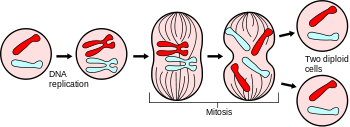
In mitosis, the two resulting cells are
a)
different from the starting cell and identical to each other.
b)
different from the starting cell and different from each other.
c)
identical to the starting cell and different from each other.
d)
identical to the starting cell and identical to each other.
109.

Small cells have a...

a)

Higher SA:V ratio

b)

Smaller SA:V ratio

110.
How many different amino acids are there?
a)
15
b)
20
c)
40
d)
100
111.
What is the function of mRNA?
a)

storage of food

b)

prevents mutations by repairing DNA

c)

provides energy by making ATP

d)

carries genetic message from the nucleus to the ribosome

112.
What is the difference between the sugars found in DNA and RNA?
a)
RNA contains glucose
b)
RNA contains sucrose
c)
RNA contains deoxyribose
d)
RNA contains Ribose
113.

A mutation that does NOT change the amino acid and does not change protein function is called

a)

deletion mutation

b)

inversion mutation

c)

silent mutation

d)

transverse mutation

114.
Which RNA bases would pair with TACGAA in transcription
a)
AUGCUU
b)
ATGCTT
c)
GCATCC
d)
GCAUCC
115.
Where does transcription take place?
a)
nucleus
b)
cytoplasm
c)
ribosome
116.
Translation happens in the - 
a)
Nucleus
b)
Ribosome
c)
Chloroplast
d)
Smooth Endoplasmic Reticulum
117.
A triplet of mRNA is called a
a)
codon
b)
anticodon
c)
amino acid
d)
peptide bond
118.
Which enzyme is responsible for making RNA?
a)
DNA polymerase
b)
RNA enzymase
c)
RNA polymerase
d)
RNA proliferase
119.
On a tRNA molecule, a specific sequence of three nucleotides that is complementary to a codon triplet on mRNA.
a)
Anticodon
b)
Stop codon 
c)
rRNA
d)
Promoter
120.
A mutation which causes a stop codon before the polypeptide is completed
a)
Nonsense
b)
Missense
c)
Silent
121.
A mutation which causes the wrong amino acid to be placed into a polypeptide
a)
Nonsense
b)
Missense
c)
Silent
122.
What is tRNA?
a)
Encodes genetic information from DNA and transports it to ribosomes; where information is translated into amino acid sequences 
b)
functions as an interpreter in translation; picks up amino acid and transfers it to the right codon 
c)
with proteins, makes up ribosomes; most abundant type of RNA
d)
the coding region; the parts of a gene that are expressed
123.

What do we call the process of copying DNA into mRNA?

a)

Translation

b)

Transcription 

c)

Replication

124.
What process is shown in the image?
a)
translation
b)
transcription
c)
DNA Synthesis
d)
DNA Replication
125.
How many amino acids are coded for by this sequence of nucleotides:
ATG GGA  ACT
a)
4
b)
3
c)
6
d)
2
126.
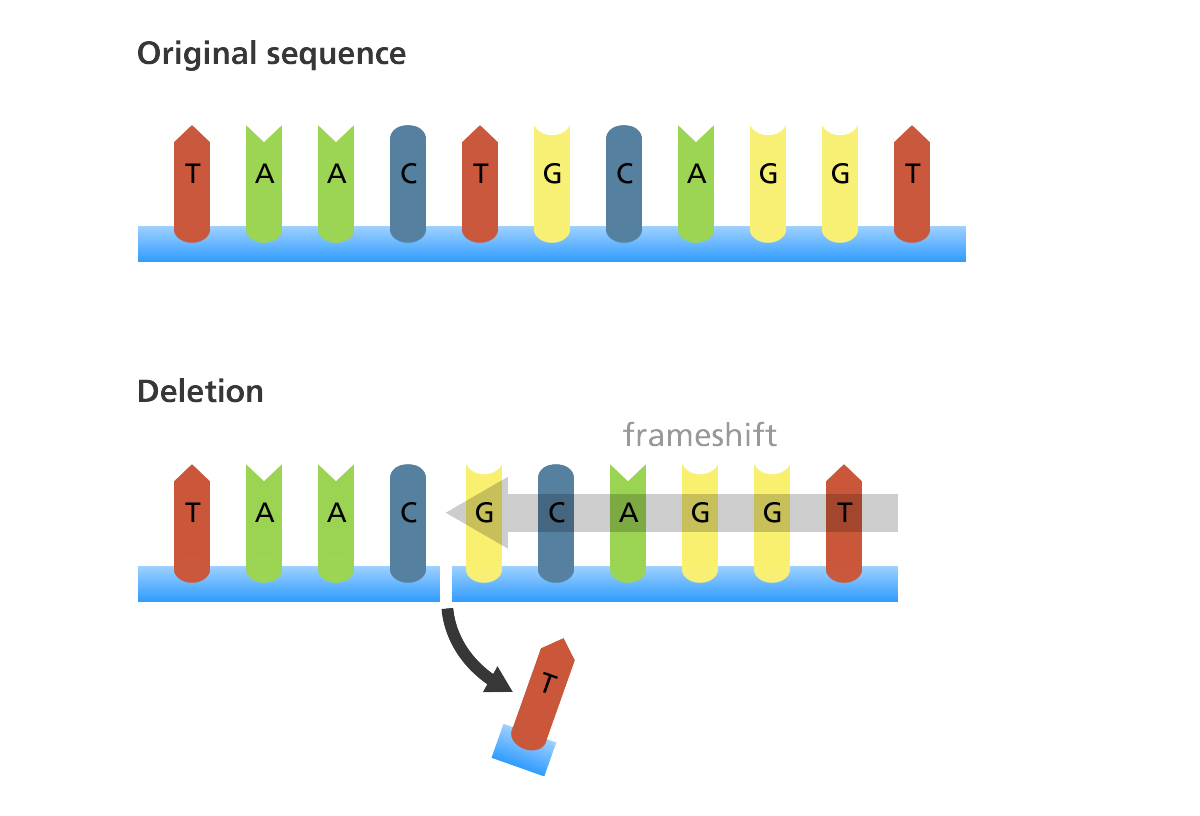
Why are insertion and deletion mutations so harmful?
a)
They change all of the codons from the mutation on down the line, which changes the amino acid sequence
b)
They insert things that an organism doesn't need.
c)
They often delete things that organisms need.
d)
Insertion and deletions are not any more harmful than substitution mutations.
127.
What amino acid sequence will be produced based on the mRNA codon sequence
5'-AUG-UCU-UCG-UUA-UCC-UUG-3'
a)
met-ser-leu-ser-leu-ser
b)
met-ser-ser-leu-ser-leu
c)
met-leu-phe-arg-glu-glu
d)
met-glu-arg-arg-glu-leu
128.

What is the correct sequence of protein synthesis?

A. tRNA brings amino acids to the ribosome

B. DNA molecules serve as the templates for mRNA.

C. mRNA molecules move to ribosomes.

D. Polypeptides are formed on ribosomes.

a)

A-B-C-D

b)

B-C-A-D

c)

C-B-A-D

d)

D-B-A-C

129.

New amino acids enter the ribosome at the ______ site.

a)

A

b)

E

c)

P

d)

S

130.

What is the purpose for anti-codons?

a)

to ensure the correct amino acid is dropped off

b)

to match the strand of DNA

c)

to decode a sequence of 4 nucleotides into an amino acid

d)

to make me hate biology

131.
Which 2 molecules forms the sides (backbone) of the DNA ladder?
a)
deoxyribose and adenine
b)
deoxyribose and a hydrogen bond
c)
sugar and the nucleus
d)
deoxyribose (sugar) and phosphate
132.
Which of the following units are repeatedly joined together to form a strand of DNA? (This is the MONOMER of DNA.) 
a)
amino acids
b)
nucleotides
c)
fatty acids
d)
polysaccharides
133.
Select the proper sequence of events.
a)
DNA Unzips then nucleotides are added, DNA Zips resulting into 2 strands of DNA
b)
DNA makes an exact copy of itself.
c)
New Nucleotides are added and then DNA unzips and becomes single stranded.
d)
Nucleottides are added and then the DNA Unzips. 
134.
When DNA has finished Replication, which of the following has been created?
a)
Four new double stranded DNA molecules.
b)
Two old Stranded DNA Molecules
c)
Two Double Stranded DNA Molecules, each with one old strand and one new strand.
d)
No new DNA is generated.
135.
Which sequence of DNA bases would pair with this partial strand
ATG TGA CAG
a)
ATG TGA CAG
b)
TAC ACT GTC
c)
GTA AGT GAC
d)
CAT TCA CTG
136.
The term used to describe DNA Replication is:
a)
Semi-Conservative
b)
Conservative
c)
AntiParallel
d)
Dispersive
137.

Who determined DNA to be a transforming agent that caused bacteria to “transform” from one type to another?

a)

Crick

b)

Sanger

c)

Fred Griffith

d)

Mullins

138.
If Chargaff found that a sample of DNA has 20% ADENINE, how much GUANINE would he have determined to be there?
a)
30%
b)
20%
c)
80%
d)
60%
139.
The result of Hershey and Chase's T2 experiments showed that the _____ of the virus enters the host where viral replication takes place.
a)
DNA
b)
Protein
c)
Both DNA & Protein
140.
How did Rosalind Franklin's photo 51 affect the work of Watson and Crick?
a)
It was used to determine the physical structure of DNA
b)
It was used to identify the four bases that make up DNA
c)
It was used to determine the theory of independent assortment
d)
It was used to show DNA was the molecule of inheritance
141.
The bond that holds the nitrogenous bases together are WEAK bonds called:
a)
Hydrogen Bonds
b)
Nitrogen Bonds
c)
Carbon Bonds
d)
Phosphodiester Bonds
142.
A nucleotide is made of 
a)
A nitrogen,a ribose sugar, and protein. 
b)
A phosphate, a deoxyribose sugar, and a carbon base.
c)
Adenine, guanine, cytosine, and  thymine.
d)
A phosphate, deoxyribose sugar, and a nitrogen base.
143.

The picture below shows an enzyme unwinding and unzipping DNA.

​What is the name of this enzyme?

a)

DNA Helicase

b)

DNA Ligase

c)

DNA polyermase

d)

RNA Polymerase

144.

Which is the first step?

a)

DNA Helicase unwinds original DNA strand

b)

RNA Primase lays down RNA primer for new nucleotide bases.

c)

DNA polymerase builds new strands by bring in new nucleotide bases.

d)

Ligase knits together fragments on lagging strand

145.

Which enzyme is responsible for adding the free nucleotides to the replicating DNA? ​

a)

DNA Helicase

b)

DNA Ligase

c)

DNA polyermase

d)

RNA Polymerase

146.
If an intestinal cell in a butterfly contains 24 chromosomes, a butterfly egg cell would contain___________.
a)
12 chromosomes
b)
6 chromosomes
c)
3 chromosomes
d)
24 chromosomes
147.
What phase is represented?
a)
metaphase 1
b)
metaphase 2
c)
anaphase 1
d)
anaphase 2
148.
What phase is  shown in the picture?
a)
metaphase 2
b)
anaphase 2
c)
metaphase 1
d)
telophase 1