
 Worksheets
World History Final Exam Review Part 2
Total questions: 95
Worksheet time: 1hrs 1mins
Name
Class
Date
1.

The build-up of a country’s military is called
a)
militarism
b)
isolationism
c)
imperialism
d)
colonialism
2.

Which of the following is a way that imperialism led to World War I?
a)
Countries were competing to gain as many colonies as they could
b)
Countries shared resources and colonies
c)
Countries wanted other nations to become more powerful
d)
Countries helped other nations to industrialize
3.
Which of these is a cause of World War I?
a)
Spain wanted to end Cuba’s liberation movement
b)
Nationalism was increasing throughout Europe.
c)
Hitler broke the Versailles treaty.
d)
Africa was being colonized too quickly.
4.

The event that sparked the beginning of World War I was:
a)
The 1929 stock market crash
b)
The attack on Pearl Harbor
c)
The creation of the League of Nations
d)
The assassination of Archduke Francis Ferdinand
5.
The event that sparked the beginning of World War I was:
a)
The 1929 stock market crash
b)
The attack on Pearl Harbor
c)
The creation of the League of Nations
d)
The assassination of Archduke Francis Ferdinand
6.

The purpose of alliances, such as the Triple Alliance and Triple Entente, was:
a)
To create a mutually beneficial trade union
b)
To provide mutual defense and support in case of war
c)
To cooperatively share resources
d)
To help expand empires in Africa
7.

Which of the following was the first to declare war after their archduke was assassinated?
a)
Austria-Hungary
b)
Great Britain
c)
Russia
d)
France
8.

Once WWI began, what were the two new alliances?
a)
Triple Entente and Central Powers
b)
Allies and Triple Alliance
c)
Allies and Central Powers
d)
Triple Entente and Triple Alliance
9.
Germany did not want to fight Russia and France at the same time because
a)
Germany was not as strong as France or Russia was
b)
Germany promised not to fight
c)
Germany would rather fight Great Britain
d)
Germany would be fighting on both sides of their country
10.

The area between the trenches was called:
a)
The Western Front
b)
No Man’s Land
c)
The League of Nations
d)
The Central Powers
11.

This was a dug out area used for fighting and protection during WWI:
a)
Fire Hole
b)
Trench
c)
No Man’s Land
d)
Tunnel
12.

New weapons and fighting strategies of WWI did which of the following:
a)
Increased the human cost of war (deaths)
b)
Made WWI a quick and easy war
c)
New weapons did not have an impact on WWI
d)
New weapons left Europe untouched/unharmed
13.

As a result of the Russian Revolution, the country was controlled by
a)
Bolsheviks/Socialists
b)
Imperialists/Absolute Monarchs
c)
Germans/Third Reich
d)
The Russian royal family
14.
The United States entered into the war on the side of this alliance:
a)
The Central Powers
b)
The Allies
c)
The Bolsheviks
d)
The Nationalists
15.

Which of the following is a reason the US entered into WWI?
a)
the Zimmerman Telegram
b)
the sinking of the Lusitania
c)
the blockading of European ports
d)
all of the above
16.

At the Treaty of Versailles, why was France interested in punishing Germany?
a)
France wanted to regain Napoleon’s empire by punishing Germany
b)
France wanted the war to continue and was upset that Germany surrendered
c)
France lost many soldiers and civilians and had to rebuild much of their country
d)
France was allied with Germany and was upset that Germany changed sides
17.

At the Treaty of Versailles, the United States was interested in:
a)
Creating peace in Europe through the 14 Points
b)
Paying the entire cost of the war
c)
Blaming France for the war
d)
Ending the revolution in Russia
18.

What was Britain concerned/worried about at the Treaty of Versailles?
a)
That making France pay reparations would hurt their economy
b)
That a harsh punishment would lead to another conflict or war
c)
That Britain would have to get rid of their monarchy
d)
That blaming Austria-Hungary would make Russia upset
19.
What was part of the Treaty of Versailles?
a)
Germany had to eliminate its armed forces entirely
b)
Germany had to pay reparations
c)
Germany became a colony of France
d)
Germany and Austria were merged into one country
20.

The goal or purpose of the League of Nations was to:
a)
Promote international peace
b)
Defeat Germany during WWI
c)
Help Russia with their revolution
d)
Create one European nation
21.
Why was the League of Nations unsuccessful?
a)
Some large nations, like the US, didn’t join
b)
The League had no authority over other nations
c)
The League could not enforce its policies
d)
All of the Above
22.
-Led the Russians in a second Revolution (1917)
-Promised "Peace, Land, and Bread"
-Established New Economic Policy (NEP)
Which leader is being described?
-Promised "Peace, Land, and Bread"
-Established New Economic Policy (NEP)
Which leader is being described?
a)
Czar Nicholas II
b)
Nikita Kruschev
c)
Vladimir Lenin
d)
Mikhail Gorbachev
23.
What was the name of the work camps in Siberia where Stalin would send you if he was not happy with you?
a)
Gulags
b)
Concentration Camps
c)
Internment Camps
d)
Veritags
24.
Russia's pace of industrialization in the early 1900's is best described as being...
a)
...slower than Europe's.
b)
...faster than Europe's.
c)
...the same as Europe's.
25.
The Czar of Russia was unpopular because of his involvement in World War I.
a)
True
b)
False
26.
The White Army...
a)
... opposed the Bolsheviks.
b)
... supported the Bolsheviks.
c)
... supported the U.S.
d)
... opposed the Green Army.
27.

What was one of the elements of the War Communism?
a)
tax in produce
b)
grain confiscation
c)
privatization
d)
kulakization
28.
Which treaty ended Russia's involvement in WWI?
a)
Versailles
b)
Brest-Litovsk
c)
Paris
d)
Tordesillas
29.
What happened to the Czar of Russia?
a)
He and his family escaped to the United States
b)
He was allowed to return to power in the role of a limited monarch.
c)
He and his family were assassinated to keep anyone from having a claim to rule Russia.
d)
He moved to England to avoid being killed.
30.
What incident finally convinced the US that war was necessary?
a)
The sinking of the Lusitania
b)
The Zimmermann Telegram
c)
The Schleiffen Plan
d)
The assassination of Archduke Franz Ferdinand
31.
What is Zionism?
a)
the idea that all religious groups should have their own states
b)
the plan to let Arabs and Jews share the land in Palestine equally
c)
the hope that all governments will be based on religious principles
d)
the belief that Jews deserved to return to a homeland in Zion where they had lived in Biblical times
32.
What was one of Gandhi's main goals for India?
a)
Strengthen the British rule
b)
Religious equality
c)
Independence from British rule
d)
Increase violent opposition against British rule.
33.
What was Gandhi's plan of dealing with British Laws?
a)
Disarmament of British Weapons
b)
Riots and Strikes
c)
Civil Disobedience
d)
None of the above
34.
Which event is a example of civil disobedience by Gandhi against British rule?
a)
Tax riot
b)
Railway march
c)
Salt march
d)
Pepper march
35.
Which statement best describe civil disobedience?
a)
violent opposition against government laws
b)
refusal to comply with certain federal or state laws
c)
start a civil war against government
d)
to start violent riots because of oppressed laws.
36.
The United Nations replaced which of the following organizations?
a)
Treaty of Versailles
b)
European Union
c)
League of Nations
d)
Allied Alliances
37.
Which of the following would be characteristics of the role of the United Nations?
a)
World Peace
b)
Human Rights
c)
Get countries to get along.
d)
All of the above.
38.
Which one of the following statements would best fit the role of the United Nations?
a)
replace national governments with one world government
b)
support the spread of world communism
c)
improve international cooperation
d)
promote domestic disputes in member nations
39.

Mao became one of the founders of the Chinese Communist Party.
a)
True
b)
False
40.

Sun Yat-sen and Chiang Kai-shek were leaders of the Nationalist Party.
a)
True
b)
False
41.

In 30s, Chiang used a series of "extermination campaigns" that nearly wiped out the Communists.
a)
True
b)
False
42.

Mao escaped defeat by leading his followers on the 6,000-mile Long March.
a)
True
b)
False
43.

During the Second World War, Mao spread Communism to millions of Chinese.
a)
True
b)
False
44.
Who did Japan copy to modernize?
a)
China
b)
the west
c)
the east
d)
Russia
45.
Which countries took part in the Sino-Japanese War?
a)
Russia & Japan
b)
China & Japan
c)
Korea & Japan
d)
US & Japan
46.
A primary reason for Japan's involvement in the Sino-Japanese War and the Russo-Japanese War was to
a)
control trade and markets in Southeast Asia
b)
end Japan's policy of isolationism
c)
acquire natural resources in Manchuria and Korea
d)
remove foreign invaders from Japanese soil
47.
an area in which an imperial power has complete rights and privileges in trade or investment
a)
protectorate
b)
colonialism
c)
sphere of influence
d)
imperialism
48.
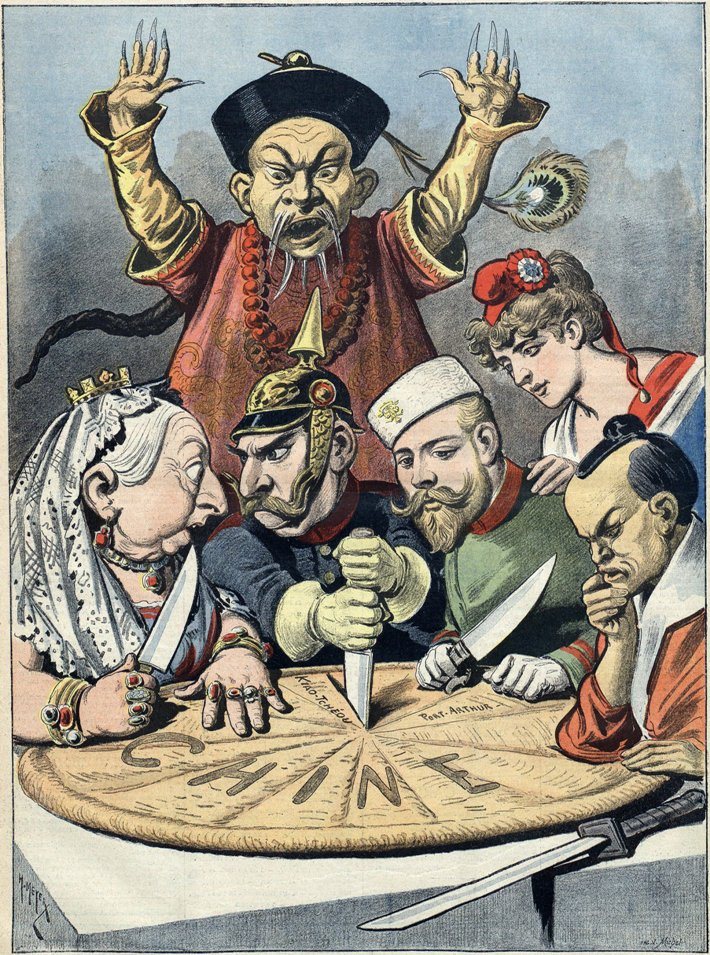
What is the best interpretation of this political cartoon?
a)
China successfully resisted imperialism
b)
Chine modernized and became imperialist
c)
China was divided into spheres of influence by imperialist powers
49.
During the Great Depression, most nations...
a)
cooperated globally to fight the problem, on a scale never seen before
b)
dramatically reduced tariffs in an effort to facilitate international trade
c)
expanded the money supply and undertook public works to provide jobs
d)
dramatically increased tariffs in an effort to protect local industries
50.
The first Five-Year Plan was initiated by...
a)
Lenin
b)
Stalin
c)
Mussolini
d)
Hitler
51.
What was one reason that the Great Depression spread quickly from the United States to other nations?
a)
The United States had been forced to give up its investments in Latin America
b)
The United States tried to collect on war debts owed by France and England
c)
The Soviet Union had cut off all trade with the West
d)
The United States had loaned a lot of money to the West
52.

Which state is BEST supported by the information on this map?
a)
By 1918, militarists had gained power in Japan
b)
Japan looked to China for natural resources it lacked
c)
The Japanese invasion of China was swift and crushing
d)
Japan invaded Korea as a gateway to China
53.
What was the chief appeal of fascism to Italians after World War I?
a)
It promised a strong and stable government
b)
It offered workers hope for socialist reform
c)
It put individual or class interests above national goals
d)
It emphasized the concepts of equality and fraternity
54.
The fascist government in Italy and the communist government in the Soviet Union were most similar in
a)
their economic philosophies
b)
their attitudes toward social classes
c)
the methods they used to ensure loyalty
d)
the status and opportunities they gave to women
55.

This image illustrates the impact on Germany of...
a)
the Great Depression
b)
Hitler's command economy
c)
hyperinflation
d)
socialism
56.
The quotation below best describes what form of government?
"In this form of government, a one-party dictatorship attempts to regulate every aspect of the lives of its citizens."
"In this form of government, a one-party dictatorship attempts to regulate every aspect of the lives of its citizens."
a)
socialist
b)
theocratic
c)
totalitarian
d)
imperialistic
57.
The goal of the Nuremberg Laws was to
a)
turn Germany into a single-party totalitarian dictatorship
b)
combat the effects of the Great Depression in Germany
c)
deprive German Jews of citizenship and other basic rights
d)
force Jews and other "undesirables" to leave Germany
58.
Germany experienced huge inflation because it printed money to pay for WWI. What is inflation?
a)
increase in value of money
b)
decrease in value of money
c)
increase in supply of goods
d)
decrease in supply of goods
59.

What was the cause of Stalin's Great Purge?
a)
Peasants did not want to give up their lands to the state
b)
Central planners did not achieve production goals
c)
Stalin feared rival party leaders
d)
The kuklaks resisted collectivization
60.

Which of the following helped Adolf Hitler gain power in Germany?
a)
The promise of a new democracy
b)
The Great Depression
c)
Big business and labor
d)
The support of the Weimar government
61.

Which of the following statements regarding Germany under Hitler is true?
a)
Most Germans were barely affected by Nazism
b)
The Nazis controlled all aspects of German life
c)
The Nazis controlled the government but had little influence on other German institutions
d)
TheNazis kept firm control over Germany but followed moderate and tolerant policies
62.
Many Germans viewed the Weimar Republic as an illegitimate government because its leaders
a)
came to power in a violent coup.
b)
drew Germany into WWI.
c)
signed the Treaty of Versailles.
d)
supported the Nazi Party.
63.
He was the fascist leader of Germany
a)
Adolf Hitler
b)
Benito Mussolini
c)
Vladimir Lenin
d)
Joseph Stalin
64.
Hitler's first private army were called
a)
Blackshirts
b)
Brownshirts
c)
The Militia
d)
New Kids On The Block
65.
The episode of anti-Jewish violence that took place throughout Germany on November 9, 1938 was known as
a)
Kristallnacht.
b)
Mein Kampf.
c)
the Night of the Long Knives.
d)
SchultzStaffel.
66.
One appeal of fascism to Italians and Germans was
a)
the promise of economic equality.
b)
the promise of individual liberties.
c)
the promise of an independent justice system.
d)
the promise of a stable government.
67.
Which policy, that contributed to the start of WWII, did western nations adopt in the 1930s?
a)
pacifism
b)
appeasement
c)
militarism
d)
fascism
68.
Which best represents facism
a)
Extreme nationalism
b)
Extreme democracy
c)
Extreme support of workers
d)
Extreme internationalism
69.
Which political party was Joseph Stalin a member of?
a)
Bolshevik (communist) party
b)
Blackshirts
c)
Soviet Union Fascist Party
d)
The Lenin Party
70.
The Allied Powers consisted of
a)
Britain, The US, and Russia
b)
Germany, Italy, and Japan
c)
France, Britain, and Russia
71.
The Axis Powers consisted of
a)
Germany, Italy, and Japan
b)
US, Britain, and Russia
c)
Germany, Austria-Hungary, and the Ottoman Empire
72.
A date that will live in infamy refers to
a)
D-Day
b)
Pearl Harbor
c)
V-E Day
73.
The extermination of 11 million people, including 9 million Jews, was called
a)
Holocaust
b)
Reichtag
c)
Third Reich
74.
Germany employed a tactic that used extremely quick attacks. What was this called
a)
blitzkrieg
b)
lebenbaum
c)
leningrad
d)
Trench warfare
75.
Which event marked the turning point in the European front?
a)
Battle of Midway
b)
Battle of Stalingrad
c)
Battle of Britain
d)
Invasion of Poland
76.
Why did Japan attack Pearl Harbor?
a)
Japan wanted to force the US into the war
b)
Japan had an embargo on the US
c)
The US attacked Japan first
d)
Japan wanted to cripple the US Pacific Fleet
77.
In Korematsu v. United States, what was the ruling (or decision) of the Supreme Court?
a)
Putting Japanese people in camps was unnecessary for the war
b)
Putting Japanese people in camps was necessary for the war
c)
Camps were ok for Japanese immigrants, not citizens
d)
They didn't make a ruling
78.
What was the name of the plan to make the atomic bomb?
a)
The Bracero Program
b)
The Manhattan Project
c)
The Bronx Venture
d)
The Brooklyn Enterprise
79.
What was the major turning point in the Pacific War against Japan?
a)
Battle of Iwo Jima
b)
Battle of Midway
c)
Battle of the Bulge
d)
Battle of Okinawa
80.
What was the purpose of the Lend-Lease Act?
a)
Giving aid to the Allies without joining the war
b)
Giving aid to the Axis without joining the war
c)
Sending troops to fight in Europe
d)
Helping China fight the Soviets
81.
What event began World War II?
a)
Assassination of Archduke Franz Ferdinand
b)
Invasion of Poland
c)
Bombing of Pearl Harbor
d)
Munich Conference
82.
This victory brought American forces closer than ever to Japan
a)
Midway
b)
Iwo Jima and Okinawa
c)
D-Day
d)
Pearl Harbor
83.

What did Jewish people in Nazi controlled areas have to wear to identify them as Jews?
a)
a yellow star of David
b)
a sign that said Jew
c)
Black clothes
d)
A yellow cross
84.
By the end of the Holocaust, over __________ Jews had been killed?
a)
2 Million
b)
4 Million
c)
6 Million
d)
8 Million
85.

What does the term "Final Solution" mean?
a)
Germany's plan to send all the Jews to Israel
b)
Hitler's plan to commit suicide
c)
Hitler's plan to kill all the Jews in Germany
d)
Hitler's plan to move all Jews to the U.S.
86.

What was a concentration camp?
a)
a place where large numbers of people, especially political prisoners or members of persecuted minorities, are deliberately imprisoned
b)
A place where prisoners of war are placed
c)
A camp where people go to do work for the government
d)
A camp for students that have a hard time focusing on school
87.

Hostility to or prejudice against Jews is known as
a)
Pro-Judaism
b)
Anti-Judaism
c)
Anti-Jewishism
d)
Anti-Semitism
88.

Trials used to convict criminals who were in charge of the Holocaust.
a)
Nuremberg Trials
b)
Scopes Trials
89.

Who overthrew China during the Cold War and created a Communist government there?
a)
Miguel Gorbachev
b)
Fidel Castro
c)
Mao Zedong
d)
Ho Chi Minh
90.
Under the Truman Doctrine, the US pledged to
a)
refrain from polarizing the world into pro-Soviet and pro-American camps
b)
maintain prosperity in America after World War II
c)
give very limited assistance to nations fighting communism
d)
support those who were resisting subjugation by Communists
91.

The Truman Doctrine's main goal was to:
a)
Contain communism
b)
Provide weapons to democratic countries
c)
Help north Korea
d)
Provide collective security
92.

Why is the Cold War called a "cold" war?
a)
The areas affected were in the polar regions of the world
b)
The war was fought during winter months only
c)
Leaders of the superpowers were sick with coughs and fevers
d)
There was never direct fighting between the two superpowers
93.
Which international organization was formed by the U.S., Canada, and
western European nations in response to the Soviet threat?
western European nations in response to the Soviet threat?
a)
United Nations
b)
Warsaw Pact
c)
European Union
d)
North Atlantic Treaty Organization
94.

What country was the head of the Warsaw Pact?
a)
Germany
b)
Soviet Union
c)
China
d)
North Korea
95.
Which document is most closely associated with the Arab-Israeli conflict?
a)
Kyoto Protocol
b)
Communist Manifesto
c)
Balfour Declaration
d)
Treaty of Nanjing
100 %

