Wayground logo

Free Printable Worksheets

Font size

S
M
L
XL
Worksheets

2nd Semester Final - Earth Science

Total questions: 110

Worksheet time: 2hrs 57mins

Name
Class
Date
1.
Pollution is__________
a)
People have contaminated, or dirtied an area with waste
b)
People have cleaned, or fixed up an area
c)
People have gathered, or collected the trash in the area 
2.
If I hang my laundry out to dry instead of using the dryer I am_______
a)
Reducing energy
b)
Recycling energy
c)
Reusing energy
3.
Students can conserve aluminum by doing which of the following?
a)
Crushing aluminum cans 
b)
Only buying drinks in aluminum cans
c)
Rinsing and then throwing out the aluminum 
d)
Putting the aluminum cans into the recycling bin
4.
Which is true of air pollution and human health? 
a)
Years of research link air pollution to lung diseases.
b)
Air pollution is commonly listed as a cause of death.
c)
None of the health effects of air pollution are reversible.
d)
Healthy adults are most affected by air pollution.
5.
Wastes produced by agriculture, households, industry, mining, and other human activities can end up in ______________.
a)
groundwater
b)
streams and rivers
c)
oceans
d)
All of these choices
6.
What is a renewable resource?


a)
 one that can be replaced quickly 
b)
one that is man-made
c)
one that comes from the sun 
d)
one that will never run out 
7.
Which one BEST describes a nonrenewable resource?

   
a)
It is one that will run out one day and can’t be replaced.
b)
It will last for about 100 years.
c)
  It can be replaced again and again.
d)
It will never run out.
8.
What is one way soil pollution gets into water?
a)
The pollution melts when sunlight hits it
b)
The pollution melts during a forest fire
c)
The pollution is washed from the soil into the water by rain
d)
The pollution is carried into the water by insects
9.
Which of the following would cause the most change to a lake habitat?
a)
people swimming in the water
b)
a frog jumping in the water
c)
Kids throwing rocks into the water
d)
boat motors leaking oil into the water
10.
Choose the action below that does NOT protect the environment.
a)
picking up trash
b)
recycling paper
c)
buying recycled products
d)
spraying plants with pesticide
11.
Coal, oil and gas are examples of
a)
Shell Fuels
b)
Bone fuels
c)
Fossil fuels
d)
Sea fulels
12.

3 things that air pollution causes:

a)

Difficulty breathing

b)

Lung damage

c)

Eyes burning

d)

Oil Spills

13.
Coal is a __________ energy resource.
a)
Renewable
b)
Nonrenewable
14.
Generally, which of the following energy resources are better for the environment?
a)
renewable
b)
nonrenewable
15.
The sun produces energy using _____.
a)
fission
b)
fusion
c)
biomass
d)
geothermal
16.
Energy from deep within the Earth is called  ____ energy.
a)
solar
b)
wind
c)
biomass
d)
geothermal
17.
__________ is an energy resource that WILL run out in the next several hundred years.
a)
Renewable Energy Resource
b)
Nonrenewable Energy Resource
18.
What percentage of our energy use comes from fossil fuels?
a)
25%
b)
45%
c)
61%
d)
86%
19.
Fossil fuels include coal, oil and natural gas. Fossil fuels are classified as nonrenewable because they —
a)
Take many, many years to be replaced
b)
require expensive equipment
c)
Can be found all over Earth's surface
d)
Provide much of the energy we use
20.
What characteristic do all renewable resources share?
a)
Produced by waste products of animals
b)
Form underground from dead organisms
c)
Allow energy to pass through them easily
d)
Replaced in a reasonably short time period
21.
Which of the following statements about all fossil fuels is true?
a)
Fossil fuels are liquids.
b)
Fossil fuels are found only on land.
c)
Fossil fuels are renewable.
d)
Fossil fuels form from the remains of ancient organisms such as plants and animals.
22.
How can people reduce the amount of resources they use?
a)
make more landfills and garbage dumps
b)
buy products with lots of packaging 
c)
use water, electricity, and gas conservatively and recycle metal, paper, and glass
d)
Think only about what you need right now and don’t worry about the future
23.
Why are fossil fuels considered nonrenewable resources if they are still forming beneath the surface today?
a)
They are being formed as a type of methane which we cannot use.
b)
We are depleting the fossil fuels much faster than they can form.
c)
They are being formed too far beneath the surface of the ocean 
d)
The fossil fuels are being broken down by a natural process faster than they can form.
24.
A large tract of land is purchased by a commercial agricultural company. The land is cleared of its native flora (plants), and a single crop is planted instead. What is the effect of this action?
a)
There is an increase in the variety of foods.
b)
The biodiversity of the area is reduced.
c)
There is a reduction in the size of the land
d)
The cost of the planted crop increases
25.
Which human activity would preserve nonrenewable resources?
a)
deforestation
b)
removing carnivores from a forest 
c)
recycling
d)
heating homes with fossil fuels  
26.
Where does most of earth`s energy come from?
a)
The sun
b)
Mars
c)
Wind
d)
Water
27.
what is a non renewable resource?
a)
water
b)
wind
c)
coal
d)
biomass
28.
What law is best described by inertia?
a)
1st
b)
2nd
c)
3rd
29.
F = MxA
a)
1st
b)
2nd
c)
3rd
30.
Acceleration is due to a force put on an objects mass. 
a)
1st
b)
2nd
c)
3rd
31.
Objects tendency to resist change
a)
Friction
b)
Inertia
c)
Force
d)
Gravity
32.

A Push or Pull is an example of:

a)

Friction

b)

Inertia

c)

Force

d)

Gravity

33.
Objects attraction to one another - like us to earth. 
a)
Friction
b)
Inertia
c)
Force
d)
Gravity
34.
"For every action, there is an equal and opposite reaction."
a)
Newton's 1st Law
b)
Newton's 2nd Law
c)
Newton's 3rd Law
d)
Newton's 4th Law
35.
When all the forces on an object are equal and opposite, & the net force is zero, that's...
a)
balanced forces
b)
unbalanced forces
c)
terminal velocity
d)
reaction forces
36.
An archer pulls the bowstring back, then releases the string and the arrow flies forward. Pulling the string back is the...
a)
action force
b)
reaction force
c)
net force
d)
inertia
37.
A cannonball with a mass of 0.5 kg is flying at an acceleration of 10 m/sec/sec. What is it's force?
a)
50 Newtons
b)
5 Newtons
c)
20 Newtons
d)
9.5 Newtons
38.
You push against a wall and the wall is pushing back on you.
a)
Newton's
1st
Law of Motion
b)
Newton's
2nd
Law of Motion
c)
Newton's
3rd
Law of Motion
39.
If an object was accelerating at 10 m/s2, and a force of 10 newtons was required to accelerate it, what was the object's mass?
a)
1 kilogram
b)
10 kilograms
c)
2 kilograms
d)
5 kilograms
40.
The momentum of an object depends on what two factors?
a)
Force and acceleration
b)
Mass and acceleration
c)
Force and velocity
d)
Mass and velocity
41.

2 snowballs are thrown with equal

force, moving at 6 m/s & 2 m/s.

Which one is larger?

a)

the fast one

b)

the slow one

c)

both are the same size

d)

can't tell fro the information given

42.

Which would have the most momentum?

a)

parked truck

b)

rolling marble

c)

thrown football

d)

all have the same momentum

43.

Calculate the momentum of a 6 kg box that is moving with a velocity of 2 m/s

a)

12 kg m/s

b)

8 kg m/s

c)

4 kg m/s

d)

3 kg m/s

44.

Which object would have the lowest momentum?

A punted football, a football on the tee, a football rolling on the ground

a)

punted football

b)

football on the tee

c)

football rolling on the ground

d)

all have the same momentum

45.

A thrown bowling ball continues rolling down the lane...this happens due to which of Newton's laws?

a)

law 1

b)

law 2

c)

law 3

d)

law of momentum

46.

If a 30 kg child moves with a velocity of 1 m/s, how much momentum does he have?

a)

30 x 1 = 30 kg m/s

b)

30 / 1 = 30 kg m/s

c)

30 - 1 = 29 kg m/s

d)

30 + 1 = 31 kg m/s

47.

The law of conservation of momentum says that...

a)

all forces come in pairs

b)

the more mass the more inertia

c)

the more force, the faster the acceleration

d)

the momentum before & after a collision is equal

48.
If a baseball and a cannonball are dropped from the same height at the same time, which ball will hit the ground first?
a)
the cannonball
b)
the baseball
c)
The balls land at the same time.
d)
the ball with the larger volume
49.
What is the resistance of a 120 volt, 3 amp device?
a)
360
b)
40
c)
4
d)
0.025
50.
What is the voltage of a 60 ohm, 2 amp device?
a)
30
b)
0.033
c)
10.95
d)
120
51.
How is electrical pressure measured?
a)
ohm
b)
volts
c)
watts
d)
amps
52.
Resistance is measured in what unit?
a)
ohms
b)
amps
c)
watts
d)
volts
53.
Current is measured in what unit?
a)
ohms
b)
volts
c)
watts
d)
amps
54.
An example of a conductor is :
a)
a glass paperweight
b)
a plastic cap
c)
a metal screw
d)
a wooden handle
55.
The small particles that travel through a circuit are called_____________.
a)
electrons
b)
dust
c)
wires
56.
When socks get stuck to towels in your dryer, this is an example of________________
a)
current electricity
b)
static electricity
57.
Electric charges that are different _______ each other.
a)
Attract
b)
Repel
58.
If a substance has a higher number of electrons than protons on its surface, what type of charge does it have?
a)
A positive charge.
b)
A negative charge.
c)
A neutral charge
d)
No charge at all
59.
What is the major difference between static electricity and current electricity?
a)
Current electricity involves a continuous flow of neutrons; static electricity is a sudden transfer of protons
b)
Current electricity can be deadly; static electricity is almost always safe
c)
In current electricity, there's a single transfer of electrons; in static electricity, there's a steady flow of electrons
d)
Current electricity involves a flow of electrons; static electricity involves a single transfer of electrons
60.

True or False, Lightning is a form of static electricity.

a)

True

b)

False

61.
Walking across a carpet is an example of charge being transferred by
a)
friction.
b)
induction.
c)
contact.
d)
static electricity
62.
The girl's hair and the comb are attracting  one another.  The hair and the comb have
a)
opposite charges
b)
like charges
63.
All matter is made of units called_________. 
a)
atoms
b)
cells
64.
If an object has the same number of positive and negative charges, its electrical charge is...
a)
positive
b)
negative
c)
neutral or no charge
d)
opposite
65.
Calculate the force exerted between two charged objects separated by a distance of 0.6 m. One object has a charge of -5 C and the other has a charge of +2.0 C.
a)
-1.5E-11 N
b)
2.5E-11 N
c)
-2.5E11 N
d)
-7.5E-10 N
66.

What is the electric force between a positive 2.5 C charge and a negative 1.3 C charge when they are separated by a distance of 10 m?

a)

-107,880,000

b)

-292,175,000 N

c)

292,175,000 N

d)

107,880,000

67.
What equation is this:
FE= (k*q1*q2) / r2 
a)
Coulombs law
b)
Ohms law
c)
Newtons law
68.

A repulsive force exists between which two particles?

a)

Two neutrons

b)

An electron and a neutron

c)

An electron and a proton

d)

Two protons

69.
How many Volts would it take to push 1 Amp through a resistance of 1 Ohm
a)
10 volts
b)
1 volt
c)
48 volts
d)
5 volts
70.
What size resistor would produce a current flow of 5 Amps with a battery voltage of 12.6 volts
a)
60 Ohms
b)
2.52 Ohms
c)
1.71 ohms
d)
5.04 Ohms
71.
What is the Voltage of a circuit that has a resistance of 5 Ω and a current of 2 A?
a)
25 V
b)
10 V
c)
2.5 V
d)
0.4 V
72.
If the Voltage stays the same and Resistance is increased, Current will 
a)
Increase
b)
Decrease
c)
Stay the same
d)
X
73.

If the battery produced 12.6 Volts what would be the current flow for a 6 Ohm resistor?

a)

2.1 Amps

b)

2.4 Amps

c)

1.71 Amps

d)

15 Amps

74.

What does an electrical insulator do?

a)

Lets electricity flow in one direction.

b)

Does not let electricity flow through it.

c)

Lets electricity flow through it when light shines on it.

d)

Lets electricity flow through it.

75.

The mathematical relationship among Voltage, Current, and Resistance

a)

Faraday's Law

b)

Tesla's Law

c)

Franklin's Law

d)

Ohm's Law

76.
Which force produces a change in motion?
a)
unbalanced force
b)
balanced force
c)
gravitational force
d)
frictional force
77.
Which has more Inertia? (so need more force to move) 
a)
Truck
b)
Ant
c)
A cat
d)
A skateboard
78.
According to Newton's second law, if you increase the force applied to an object :
a)
it accelerates more
b)
it doesn't move
c)
you get more inertia
d)
it decelerates
79.
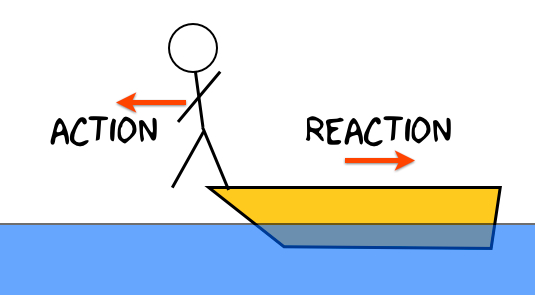
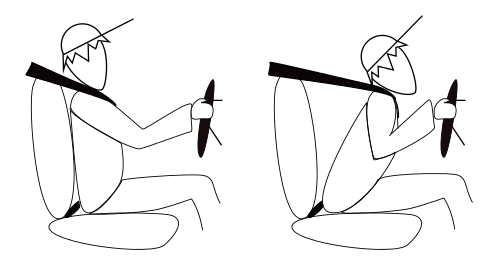
What law of motion does this picture represent?
a)
Newtons 1st law
b)
Newtons 4th law 
c)
Newtons 3rd law 
d)
Newtons 2nd law
80.
What Newtons law does this picture represent
a)
Newtons 2nd law 
b)
Law of gravity 
c)
Newtons 1st law
d)
Newtons 5th law
81.
Acceleration of an object happens when things ________
a)
slow down
b)
go faster
c)
change direction (turn)
d)
All of the above
82.
Forces always act in equal and opposite pairs.
a)
Newton's 1st Law
b)
Newton's 3rd Law
c)
Newton's second law
83.
friction is a force that acts 
a)
in the same direction as the force
b)
opposite to the direction of the force
c)
with the force
d)
towards the direction of the force
84.
A 20 kg bike accelerates at 10 m/s2.  what was the force
a)
25
b)
200 N
c)
20 N
d)
10 N
85.
In the picture, the vehicle will move because of...
a)
Newton's 1st Law
b)
Newton's 2nd Law
c)
Newton's 3rd Law
d)
Newton's 9th Law
86.
A rocket in outer space continues to move.
a)
Newton's
1st
Law of Motion
b)
Newton's
2nd
Law of Motion
c)
Newton's
3rd
Law of Motion
87.
A skater pushes another skater forward, but the one pushing moves backwards.
a)
Newton's
1st
Law of Motion
b)
Newton's
2nd
Law of Motion
c)
Newton's
3rd
Law of Motion
88.
A bus hits a bug and the bug splatters on the windshield, which force is greater?
a)
The Bus
b)
The Bug
c)
They're the same
d)
Gravity acting on the bus
89.
The gravitational force of Earth of an object decreases as the object moves farther from Earth.
a)
True
b)
False
90.
The definition of momentum is
a)
Mass in Motion
b)
The size of an object
c)
The velocity of an object
d)
A comparison between two objects
91.
Which object listed below has the greatest momentum?
a)
A 0.05 kg object rolling at 0.2 m/s.
b)
A 0.15 kg object rolling at 2 m/s.
c)
A 0.15 kg object rolling at 1 m/s
d)
A 0.4 kg object rolling at 2 m/s.
92.
Which object has the least momentum?
a)
a 20 kg object traveling 20 m/s
b)
a 2 kg object traveling 200 m/s
c)
a 25 kg object traveling 20 m/s
d)
a     50 kg object traveling 2 m/s
93.
____________ is the ability to cause change. 
a)
Energy 
b)
Force 
c)
Friction
d)
Motion
94.
Energy due to motion is ____________ energy. 
a)
Potential 
b)
Energy
c)
Kinetic
d)
Friction
95.
The faster an object moves, the ________ kinetic energy it has. 
a)
more
b)
less
c)
none of the above
d)
all of the above 
96.
__________ is stored energy. 
a)
Potential
b)
Kinetic
c)
None of the above 
d)
All of the above 
97.
Gravitational potential energy depends on the ________ and ________ of the object. 
a)
Height and mass
b)
Friction and movement
c)
Mass and Movement
d)
Height and Friction 
98.
What kind of energy is in a moving skateboard?
a)
Potential
b)
Kinetic
99.
What kind of energy is in a rock at the edge of a cliff?
a)
Potential
b)
Kinetic
100.
At which point is potential energy greatest?
a)
W
b)
X
c)
Y
d)
Z
101.
On a roller coaster, where is maximum kinetic energy?
a)
At the bottom of a big hill
b)
When going around a corner
c)
When going upside down
d)
At the top of a big hill
102.
Can matter be created or destroyed?
a)
Yes, it can be created.
b)
Yes, it can be destroyed.
c)
No, matter is always conserved
d)
None of these
103.
Calculate the KE of a moving 4 kilogram object traveling at a velocity of 3 m/s.
a)
18 J
b)
36 J
c)
12 J
d)
6 J
104.
How much KE does a moving 6 kilogram object have if it moves with a velocity of 3 m/s?
a)
27 J
b)
18 J
c)
9 J
d)
2 J
105.
A moving 10 kilogram object has 20 Joules of KE. What is its velocity?
a)
2 m/s
b)
4 m/s
c)
200 m/s
d)
10 m/s
106.
What is the mass of a moving object that has 100 Joules of KE and moves at a velocity of 2 m/s?
a)
50 kg
b)
200 kg
c)
25 kg
d)
100 kg
107.

The formula for calculating potential energy is ____________.

a)

1/2mv2

b)

mvv/2

c)

m x g x h

d)

1/2 mgh

108.

Figure the PE.

mass= 3 kg

gravity= 9.8m/s2

height= 40m

a)

1176

b)

1716 J

c)

1176 J

d)

1761

109.

Solve

PE= 52 J

mass= ?

gravity= 9.8 m/s2

height= 18 m

a)

.29 kg

b)

1.76 m

c)

2.9 kg

d)

176.4 m

110.

Solve for h.

PE= 74 J

mass= 3.8 kg

gravity= 9.8 m/s2

height= ?

a)

1.99 m

b)

199

c)

19.9 m

d)

19 m