wayground logo

Free Printable Worksheets

NEW

Font size

S
M
L
XL
Worksheets

Jackson Finals Gr 7 review

Total questions: 74

Worksheet time: 1hrs 4mins

Name
Class
Date
1.
Each column in the periodic table is called a 
a)
period
b)
group
c)
cluster
d)
unit
2.
The yellow atoms are called 
a)
metals
b)
nonmetals
c)
metalloids
d)
noble gases
3.
Group 18 elements are known as the _____ _____ and have full valence shells.
a)
royal gases.
b)
supreme solids.
c)
noble gases.
d)
legit liquids.
4.
Elements in the same ________ are more chemically similar.
a)
group
b)
period
c)
club
d)
table
5.
Elements which are shiny, conduct electricity and heat are called
a)
metal
b)
nonmetal
c)
metalloid
d)
nonexistent
6.
A horizontal row of elements in the periodic table.
a)
column
b)
group
c)
period
7.
What happens in ALL chemical changes?
a)
Change in state of matter
b)
A new substance is formed
c)
Bubbles are produced
d)
An explosion
8.
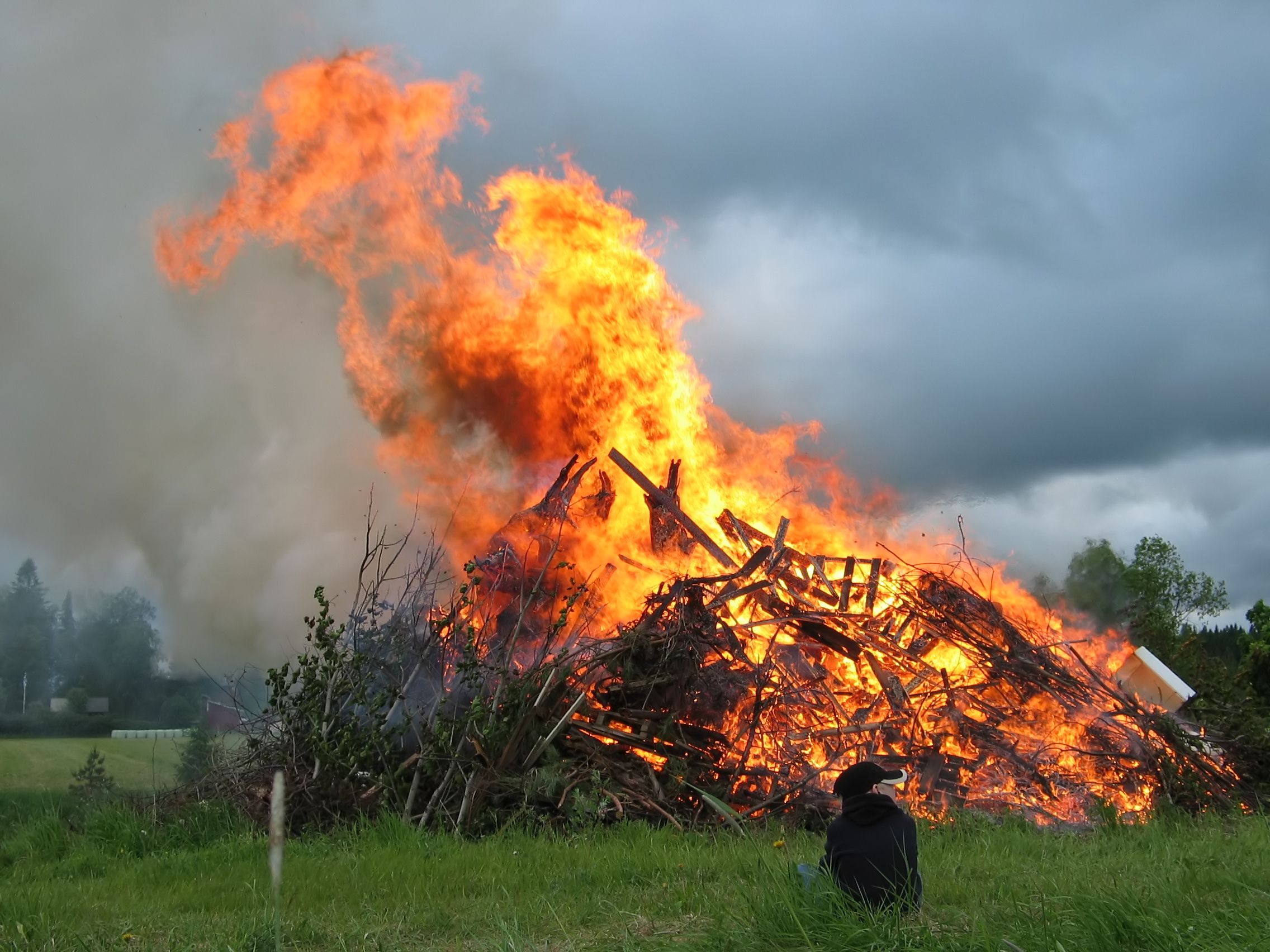
Is wood burning a physical or chemical change?
a)
Physical 
b)
Chemical
9.
Is sharpening a pencil a physical or chemical change?
a)
Physical 
b)
Chemical
10.
Which of the following is NOT an example of a physical change?
a)
crumpled paper
b)
pencil sharpening
c)
shrunken clothing
d)
sour milk
11.
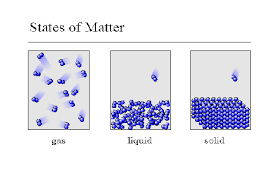
At higher temperatures
a)
particles in an object have less energy
b)
particles in an object move faster
c)
a gas contracts
12.
What is condensation?
a)
gas to solid
b)
gas to liquid
c)
liquid to solid 
d)
solid to liquid 
13.
When the temperature of matter decreases the particles ...
a)
speed up and move farther apart
b)
speed up and move closer together
c)
slow down and move farther apart
d)
slow down and move closer together
14.
The ___ is the thing being dissolved.
a)
solute
b)
solvent
c)
mixture
d)
suspension
15.
How many grams of K2Cr2O7, are soluble in 100 g of water at 95 ºC?
a)
83 grams
b)
75 grams
c)
40 grams
d)
12 grams
16.
Which is an example of a solute?
a)
Egg whites
b)
Sugar
c)
Water
d)
Acetone
17.
Which is an example of a solvent?
a)
Salt
b)
Egg whites
c)
Water
d)
Sugar
18.

Find the Dependent Variable: You experiment to see if a bouncy ball or a tennis ball bounces higher.

a)

Type of ball

b)

Same drop height

c)

Height of bounce

d)

Same surface

19.

Find the Independent Variable: You experiment to see if a bouncy ball or a tennis ball bounces higher.

a)

Type of ball

b)

Same drop height

c)

Height of Bounce

d)

Same surface

20.
Find the IV:  You experiment to see how the noise level in a room affects your ability to memorize random numbers and letters.
a)
Ability to memorize
b)
Noise level in room
c)
Amount of sleep
d)
Age of person
21.
Find the IV:  You experiment to find out if you can blow bigger bubbles when it is hot outside or when it is cold outside.
a)
bubble blowing technique
b)
Type of bubble juice
c)
Size of bubbles
d)
Temperature
22.
The variable that is being measured
a)
independent variable
b)
dependent variable
c)
control variable
23.
What is an earthquake?
a)
A sudden movement of the Earth's crust caused by a release of stress accumulated along geological faults or by volcanic activity.
b)
a.  energy that builds up inside a volcanic mountain
c)
a.  energy being released when erosion occurs
d)
a.  molten rock pushing up through Earth's surface.
24.
Which type of rock is formed by weathering and erosion, then compaction and cementation?
a)
sedimentary rock
b)
metamorphic rock
c)
igneous rock
25.
Heat and Pressure causes which type of rock? 
a)
Sedimentary Rock
b)
Metamorphic Rock
c)
Igneous Rock
26.
How are new islands in Hawaii formed?
a)
wind erosion
b)
volcanic activity
c)
sediment deposits
d)
weathering
27.
Which layer of the earth is the thinnest? 
a)
Mantle
b)
Inner Core
c)
Outer Core
d)
Crust
28.
When magma is cooled and solidified it becomes what type of rock?
a)
igneous
b)
metamorphic
c)
sedimentary
d)
conglomerate
29.
Which of the following explains how mountains are formed?
a)
Plates collide at divergent boundaries causing the crust to push upward.
b)
Plates collide at convergent boundaries causing the crust to push upward.
c)
Plates slide past each other at transform boundaries causing the crust to push upward.
d)
Plates collide at convergent boundaries causing the mantle to push upward
30.
If plates move in the direction show in the picture, what will likely occur?
a)
Mountain Formation
b)
Earthquakes
c)
Trench formation
d)
Volcanic island formation
31.
What type of plate boundary is shown in the picture? 
a)
convergent
b)
divergent
c)
transform
32.
What type of boundary does the picture show and what does it form? 
a)
divergent; mountains
b)
divergent; mid ocean ridge
c)
convergent; mid ocean ridge
d)
transform; earthquake
33.
Why do plates move? 
a)
Convection currents in the mantle cause plates to move.
b)
The outer core spins
c)
The inner core is magnetic
d)
The plates are floating on an ocean
34.

Which type of plate boundary would cause mountains to form?

a)

Transform

b)

Convergent

c)

Divergent

d)

Reform

35.
This layer of Earth is solid Iron and Nickel
a)
Outer Core
b)
Mantle
c)
Inner Core
d)
Crust
36.
The Great Rift Valley in Africa and the Mid-Ocean Ridge were all created by this boundary
a)
Divergent
b)
Convergent
c)
Reform
d)
Transform
37.
What are the two types of crust
a)
continental and oceanic
b)
ocean and upper
c)
lower and upper
d)
pizza and subway
38.
Which layer has convection currents?
a)
Inner Core
b)
Outer Core
c)
Mantle
d)
Crust
39.
The Himalayas in Asia are an example of what type of plate boundary?
a)
divergent
b)
continent-to-continent convergent
c)
ocean-to-continent convergent
d)
transform
40.
Transform boundaries are most likely to produce what phenomenon?
a)
volcanoes
b)
deep sea trenches
c)
underwater mountain ranges
d)
earthquakes
41.
Most volcanoes and earthquakes occur...
a)
along the coast
b)
along tectonic plate boundaries
c)
in the Arctic
d)
in the ocean
42.
What is the name of the plate boundary that slides past each other?
a)
Divergent
b)
Convergent
c)
Transform
d)
Mr. C the Slide Man
43.
The tool used to measure the mass of a substance or object is a ______________.
a)
balance
b)
graduated cylinder
c)
ruler
d)
thermometer
44.
Jack has a rock. The rock has a mass of 14g and a volume of 2cm3. What is the density of the rock?
a)
7 mL
b)
7 g/cm3
c)
28 g/cm3
d)
1/7 g/cm3
45.
What is the volume of Object X?
a)
10.0 cm3
b)
15.0 cm3
c)
20.0 cm3
d)
25.0 cm3
46.
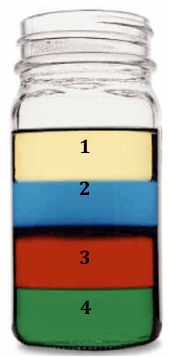
Put the liquids in order from most dense to least dense?
a)
4, 3, 2, 1
b)
1, 2, 3, 4
c)
3, 4, 2, 1, 
d)
4, 3, 1, 2
47.
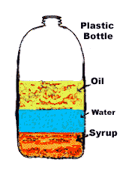
Which liquid is the least dense?
a)
oil
b)
water
c)
syrup 
d)
plastic bottle
48.
Which box has a higher density?  
a)
Box A
b)
Box B
c)
cannot be determined
d)
they are the same
49.
What is the formula for density?
a)
density = mass x volume
b)
density = mass / volume
c)
density = mass + volume
d)
density = mass - volume
50.
Frank has a paper clip. It has a mass of 9g and a volume of 3cm3. What is its density?
a)
3 g/cm3
b)
1/3 g/cm3
c)
27 g/cm3
d)
39 g/cm3
51.
A can of Coke will sink in a bowl of water.  A can of Diet Coke will float in a bowl of water.  What does this tell you about the density of the Diet Coke?
a)
it is bigger than 1
b)
it is smaller than 1
c)
it is equal to 1
d)
it is equal to -1
52.

Why do ice cubes float in a glass of water?

a)

the ice cubes are more dense than the water

b)

the Ice cubes is less dense than water

c)

the water is more dense than the glass

d)

the ice is more dense than the glass

53.
A brick sinks in water while a wooden block of the same size floats.  This is because the brick has a
a)
lower volume than the wooden block
b)
lower density than the wooden block
c)
higher volume than the wooden block
d)
higher density than the wooden block
54.
What is the elevation at sea level?
a)
0
b)
100m
c)
20m
d)
3000m
55.
What do close contour lines represent on a map?
a)
waterfall
b)
steep area
c)
gradual area
d)
river
56.
What do contour lines that are farther apart represent?
a)
waterfall
b)
steep area
c)
gentle slope
d)
river
57.
The youngest rocks on the seafloor are most likely found...
a)
closest to a mid-ocean ridge
b)
farthest from a mid-ocean ridge
c)
near the coastlines
d)
closest to a deep sea trench
58.
Determine the contour interval:
a)
5 m
b)
10 m
c)
15 m
d)
20 m
59.
Determine the contour interval
a)
10 m
b)
20 m
c)
50 m
d)
100 m
60.
An area's height above sea level
a)
topography 
b)
relief
c)
elevation
d)
GIS
61.
The epicenter of an earthquake is
a)
The point below the surface where rock begins to break and the first motion occurs
b)
The seismic station closest to the earthquake
c)
The place where the greatest damage occurs
d)
The point on the surface directly above the focus
62.
The Richter scale measures:
a)
the amount of radon gas released
b)
the movement of plates
c)
the strength of an earthquake
d)
the weight of tectonic plates
63.
Which travels fastest, always being the first detected by seismic stations?
a)
P waves
b)
S waves
64.
An instrument that detects and measures earthquakes is a 
a)
seismogram
b)
focus seismic map
c)
focus
d)
seismograph 
65.
Earthquakes under the water can cause _________________________________.
a)
tornadoes
b)
tsunamis
c)
lightening
d)
hailstorms
66.
Which kind of wave arrives at seismic stations second?
a)
P (primary)
b)
S (secondary)
c)
L (love)
d)
R (rayleigh)
67.

Which kind of waves usually do the most damage in an earthquake?

a)

P waves

b)

Surface waves

c)

Secondary waves

d)

Radio waves

68.
Which one of the following techniques would best be used to separate soil and water?
a)
Decanting
b)
distillation
c)
Filtration
d)
Chromatography
69.
Which one of the following solids is insoluble in water?
a)
sugar
b)
sand
c)
copper sulfate
d)
salt
70.
Two or more substances mingled together, but not chemically combined are known as a
a)
residue
b)
solution
c)
distillate
d)
mixture
71.
The separation technique that involves heating a solution until the liquid changes into a gaseous state, leaving behind a solid is known as
a)
decanting
b)
 evaporation
c)
loading
d)
chromatography
72.
Which one of the following would you use to separate sand from iron filings?
a)
a bar magnet
b)
filter paper
c)
chromatography paper
d)
alum
73.

What is the name given to the layer of water that covers the Earth?

a)

biosphere

b)

hydrosphere

c)

lithosphere

d)

atmosphere

74.

What is the most abundant gas in the atmosphere?

a)

Oxygen

b)

Carbon dioxide

c)

water vapor

d)

Nitrogen