
NEW
Font size
S
M
L
XL
 Worksheets
EES Final Review
Total questions: 70
Worksheet time: 50mins
Name
Class
Date
1.

To enter and live in a new country
a)
Emigration
b)
Immigration
c)
Urbanization
d)
Industrialization
2.

Leaving one's home to live in a new place
a)
Emigration
b)
Immigration
c)
Urbanization
d)
Ruralization
3.
The movement of people from place to place
a)
Migration
b)
Urbanization
c)
Modernization
d)
Industrialization
4.
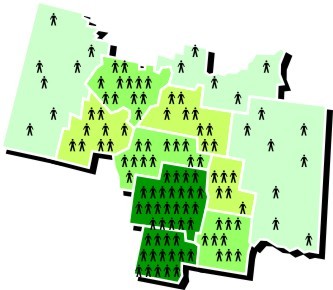
The average number of people per square mile
a)
population distribution
b)
population density
c)
urbanization
d)
population rate
5.

What kind of growth does this countries population pyramid show?
a)
slow
b)
rapid
c)
negative
d)
stable
6.

What kind of growth does this countries population pyramid show?
a)
slow
b)
rapid
c)
stable
d)
negative
7.
If the number of births in a population is the same as the number of deaths in a population, what will happen to the growth of the population?
a)
It will increase.
b)
It will decrease.
c)
It will stay the same.
d)
It will fluctuate.
8.
If the number of births is greater than the number of deaths in a population, what will happen to the growth of the population?
a)
It will increase.
b)
It will decrease.
c)
It will stay the same.
d)
It will fluctuate.
9.
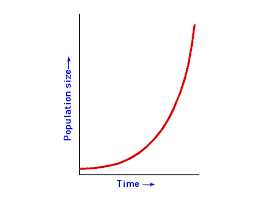
What type of growth is shown in the diagram?
a)
exponential growth
b)
logistic growth
c)
predator-prey cycle
d)
boom-bust curve
10.
Largest number of individuals of a population that the environment can support...
a)
carrying capacity
b)
population crash
c)
lag phase
d)
mutualism
11.

Which type of growth is best illustrated by this rabbit population?
a)
exponential
b)
logistic
c)
S-shaped
d)
predator-prey
12.

What point on the graph represents the carrying capacity?
a)
A
b)
B
c)
C
d)
D
13.

When a population grows past the ecosystem's carrying capacity, what happens to the population?
a)
Continues to grow
b)
The population starts to die off to return to carrying capcity
c)
The population will go extinct due to lack of resources
d)
The population grows then finds a new carrying capacity
14.
Food, water, sunlight, shelter, and space are resources that are often __________.
a)
limiting factors
b)
wet
c)
messy
d)
found in rocks
15.
Natural disasters and weather patterns like earthquakes, floods, and tornadoes, blizzards, and heatwaves are considered ___________ ____________ limiting factors
a)
Density-dependent
b)
Density-independent
16.
Competition, disease, predation, and parasitism are considered ___________ ____________ limiting factors
a)
Density-dependent
b)
Density-independent
17.
Density-dependent limiting factors have a(n) _______________ affect on populations depending on the density of the population.
a)
similar
b)
different
18.
Density-independent limiting factors have a(n) _______________ affect on populations regardless of population density.
a)
similar
b)
different
19.
Exponential growth is representative of a population in an environment with ________________ resources.
a)
limited
b)
plenty of
20.
An organism that can make its own food is called?
a)
Consumer
b)
Producer
c)
Decomposer
d)
Herbivore
21.
A consumer gets energy by doing what?
a)
Making it themselves.
b)
Breaking down biotic wastes and dead organisms and returning raw materials to the ecosystem.
c)
Soaking it up from the ground.
d)
Feeding on other organisms.
22.
The energy role that break down biotic wastes and dead organisms is?
a)
Consumer
b)
Producer
c)
Scavenger
d)
Decomposer
23.
This diagram shows the amount of energy that moves from one feeding level to another in a food web.
a)
Energy Pyramid
b)
Food Web
c)
Ecosystem
d)
Food Chain
24.
This type of consumer obtains all of its energy by eating only producers.
a)
Omnivore
b)
Herbivore
c)
Scavenger
d)
Carnivore
25.
A third-level consumer has to be which type?
a)
Carnviore.
b)
Decomposer.
c)
Producer.
d)
Herbivore.
26.
A __________________ is a type of animal that hunts other animals to eat.
a)
prey
b)
herbivore
c)
predator
d)
producer
27.
A food web consists of?
a)
Many overlapping food chains in an ecosystem.
b)
A series of events in which one organism eats another and obtains energy.
c)
Amount of energy that moves from one feeding level to another.
d)
Many types of insects that are stuck.
28.
_________ percent of energy is lost at each level of the energy pyramid.
a)
90
b)
10
c)
45
d)
0
29.
____________________ are the largest group in an energy pyramid.
a)
producers
b)
consumers
30.

What does biodiversity mean?
a)
Only one species in an area.
b)
The different amount of species in an area
c)
All abiotic life
d)
Nitrogen fixation
31.

A drought has hit this grassland biome. How will this effect the rabbit population?
a)
The rabbits will increase in number.
b)
The rabbit population will stay the same.
c)
The rabbit population will decrease.
d)
The rabbit population will become extinct immediately.
32.
Temperature, light, air, water, and soil are all _____ parts of the environment
a)
alive
b)
biotic
c)
abiotic
d)
living
33.
A living or once-living organisms in an ecosystem is a
a)
population
b)
biotic factor
c)
abiotic factor
d)
community
34.
All energy on Earth ultimately comes from what source?
a)
Water
b)
Sun
c)
Consumers
d)
Oxygen
35.
What is a trophic level?
a)
Each energy/food level within a food chain or web.
b)
Levels of ecosystems that the world is divided into.
c)
Different levels of nutrients present within an organism.
d)
The levels of sunlight an autotroph needs to survive.
36.
How much energy is available to be passed on to the next trophic level in an ecosystem?
a)
100%
b)
10%
c)
50%
d)
75%
37.

The largest group of organisms found in a food web would be:
a)
Primary Consumers
b)
Producers
c)
Decomposers
d)
Tertiary Consumers
38.
Which biome is characterized by low temperatures and low amounts of rainfall?
a)
tundra
b)
desert
c)
temperate deciduous forest
d)
tropical rain forest
39.
Which biome, because of its climate, has the largest number of species of plants and animals?
a)
tundra
b)
desert
c)
tropical rainforest
d)
pine forest
40.
Which type of trees is found in a temperate forest?
a)
deciduous
b)
evergreen
c)
ginko
d)
palm
41.
Which biome contains large populations of grazing herbivores, few species of birds, and deep, rich soil?
a)
taiga
b)
tundra
c)
deciduous forest
d)
grassland
42.
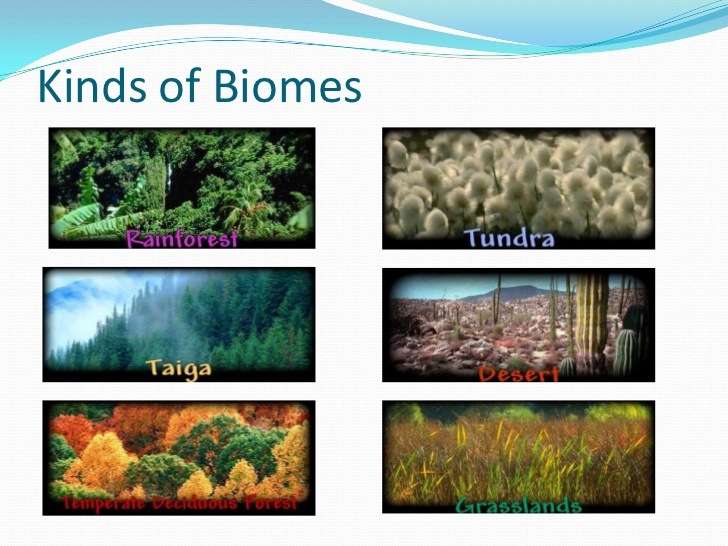
What is the main factor that separates the biomes?
a)
Land
b)
Water
c)
Climate
d)
Longitude
43.
Which of these is an example of precipitation?
a)
snow
b)
air
c)
clouds
d)
vapor
44.
Which is the opposite of condensation?
a)
runoff
b)
evaporation
c)
precipitation
d)
transpiration
45.
About 97% of the water on Earth is ___________________.
a)
fresh water
b)
groundwater
c)
salt water
d)
ice
46.
Most water pollution is the result of __________________.
a)
natural processes
b)
animal waste
c)
human activities
d)
acid rain
47.
____________________ is stored in the spaces between soil and rock beneath the Earth's surface.
a)
Groundwater
b)
Ice
c)
Salt water
d)
Runoff
48.
A farmer is storing the manure from his farm in large piles next to the river. What type of pollution would this cause?
a)
Toxic
b)
Bacterial
49.
Someone drains used car oil and anti-freeze onto the ground. What type of pollution would this cause?
a)
Toxic
b)
Bacterial
50.

The lake in the picture is best described as:
a)
Oligotrophic
b)
Mesotrophic
c)
Eutrophic
d)
Hypereutrophic
51.
What is the relationship between the amount of available dissolved oxygen and level of water quality?
a)
There is more dissolved oxygen in the water when the water quality is high
b)
There is more dissolved oxygen in the water when the water quality is low
c)
There is little dissolved oxygen in the water when the water quality is high
d)
There is more dissolved oxygen in the water when the temperature of the water is warm.
52.

Type of water pollution which comes from a one source.
a)
Point-source pollution
b)
Nonpoint source pollution
c)
both of them
53.

Pesticides runoff: A point source or Nonpoint source pollution?
a)
Point source
b)
Nonpoint source
c)
Both of them
54.
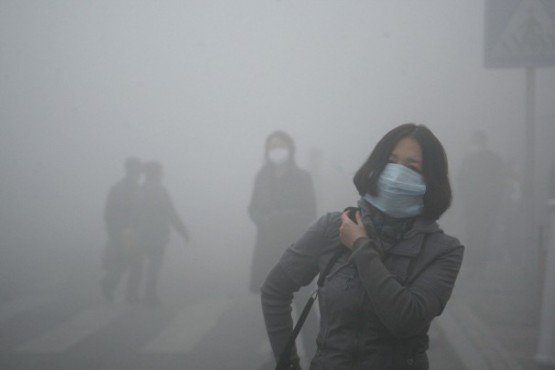
This picture shows people walking through a highly-polluted city in China. From what type of pollution are they protecting themselves based on what they are wearing?
a)
air pollution
b)
water pollution
c)
land pollution
d)
noise pollution
55.
What is a renewable resource?
a)
one that can be replaced quickly
b)
one that is man-made
c)
one that comes from the sun
d)
one that will never run out
56.
1. Which of these could increase average global temperatures?
a)
A. increased use of fossil fuels
b)
A. increased ocean plants
c)
A. decreased carbon dioxide emissions
d)
A. increased numbers of animal species
57.
1. Certain gases in the atmosphere – water vapor, carbon dioxide, methane and nitrous oxide – help maintain the Earth’s temperatures and climate. These are called: __________ .
a)
A. ozone gases
b)
A. solar gases
c)
A. greenhouse gases
d)
A. stomach gases
58.
Something that might happen because of global warming is: __________.
a)
A. melting polar ice caps
b)
A. more reflected sunlight off the ice pack
c)
A. lower sea levels
d)
A. a sale on bathing suits
59.
Hydroelectric power produces electricity using.....
a)
Wind
b)
Sunlight
c)
Moving water
d)
Dung
60.
Petroleum and natural gas form from...
a)
strong winds
b)
cooled magma
c)
radioactive materials
d)
remains of plants and animals
61.
Fossil fuels are classified as nonrenewable because they.......
a)
require expensive equipment
b)
take millions of years to replace
c)
can be found all over
d)
provide all the energy we use
62.
What is biomass?
a)
energy from the sun
b)
energy from water
c)
energy from wind
d)
energy from plant and animal waste
63.
Generators are used to produce electricity from all of these sources EXCEPT _____.
a)
solar
b)
wind
c)
hydroelectric
d)
nuclear
64.
One problem with ____ energy is that it produces radioactive waste.
a)
nuclear
b)
solar
c)
tidal
d)
wind
65.
Define Nuclear energy?
a)
An icotope
b)
The stuff you see in a power plant.
c)
Energy stored in the nucleus of an atom
d)
Energy stored in an objects height
66.

__________ is an energy resource that WILL NOT run out in the next several hundred years.
a)
Renewable Energy Resource
b)
Natural Gas
c)
Forever Fuels
d)
Coal
67.

Energy that uses heat that comes from within the Earth is called what?
a)
Geophysical
b)
Geography
c)
Geothermal
d)
Geographic
68.
Which statements describe global warming?
a)
Global warming can be decreased through deforestation.
b)
Global warming results from the buildup of nutrients in runoff
c)
Global warming is likely increased by humans
d)
Global warming is enhanced by nonnative species
69.

This picture shows which type of alternative energy?
a)
Wind
b)
Solar
c)
Hydroelectric
d)
Geothermal
70.
Industrialization is a contributing factor to climate change.
a)
True
b)
False
Reset

