
 Worksheets
Wave Properties, light and Sound
Total questions: 60
Worksheet time: 58mins
Name
Class
Date
1.
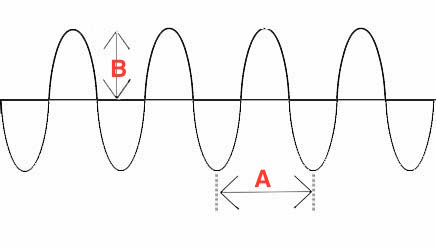
What property of this wave is represented by the letter "A"
a)
amplitude
b)
crest
c)
trough
d)
wavelength
2.
The highest point on a wave is:
a)
the crest
b)
the trough
c)
the top
d)
the coast
3.
The lowest point on a wave is the:
a)
Amplitude
b)
Crest
c)
Trough
d)
Wavelength
4.
The type of waves that require medium to pass:
a)
Mechanical Waves
b)
Electromagnetic Waves
5.

Which vocabulary term is used to identify the distance between points C & G?
a)
Amplitude
b)
Crest
c)
Frequency
d)
Wavelength
6.
When the frequency of a wave increases, what happens to the wavelength?
a)
The wavelength is not directly affected by the frequency of a wave.
b)
The wavelength increases.
c)
The wavelength decreases.
d)
More specific information is needed to form a conclusion about the wavelength.
7.
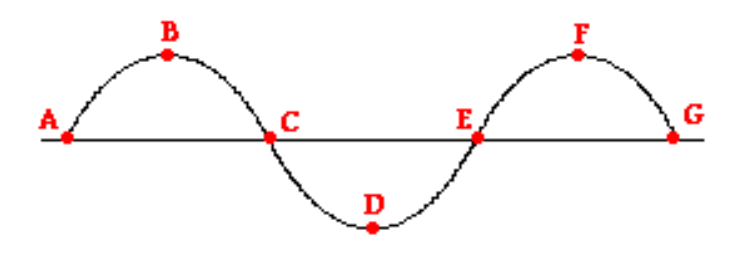
Which letter(s) represent the crest of the wave?
a)
A
b)
B & D
c)
B & F
d)
F
8.
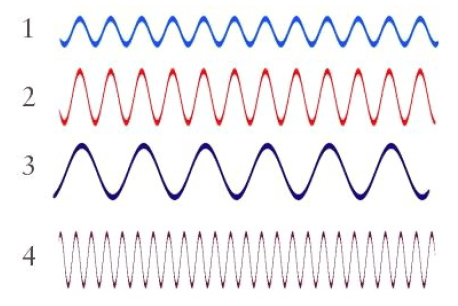
Which wave in the diagram has the greatest frequency?
a)
1
b)
2
c)
3
d)
4
9.
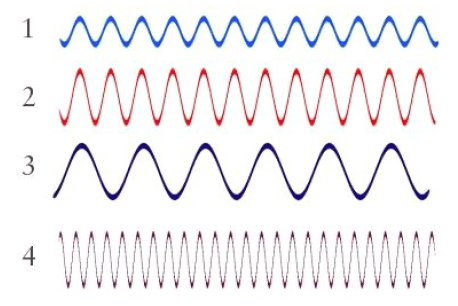
Which wave in the diagram has the greatest wavelength?
a)
1
b)
2
c)
3
d)
4
10.
Which of the following can sound travel through?
a)
solid
b)
liquid
c)
gas
d)
all of the above
11.
crest to crest or trough to trough
a)
crest
b)
trough
c)
amplitude
d)
wavelength
12.
Electromagnetic waves include the following except
a)
radio waves
b)
X-rays
c)
doing the wave at a football game
d)
microwaves
13.
When a wave bends as it passes through at an angle from one medium to another.(example: pencil in a glass of water-)
a)
medium
b)
refraction
c)
reflection
d)
interference
14.
What types of waves have the lowest energy on the electromagnetic spectrum?
a)
infrafed waves
b)
UV waves
c)
gamma rays
d)
radio waves
15.
A wave with a frequency of 20 Hz. has a wavelength of 4 meters. What is the speed of the wave?
a)
50 mph
b)
100 m / s
c)
80 m / s
d)
80 watts
16.
Find the frequency of a wave traveling at 100m / s with a wavelength of 2 meters
a)
50 mph
b)
50 Hz
c)
200 mph
d)
200 m / sa
17.
Visible light:
a)
makes up most of the electromagnetic spectrum
b)
is only a small portion of the electromagnetic spectrum
c)
is half of the electromagnetic spectrum
d)
is not included in the electromagnetic spectrum
18.
Longitudional waves are also called:
a)
mamma rays
b)
heat waves
c)
compression waves
d)
sound waves
19.
Transverse waves:
a)
need a medium to travel through
b)
are not electromagnetic waves
c)
are the same as light waves
d)
are compressional waves
20.
Light bends or refracts when:
a)
it travels through a different medium
b)
it is exposed to carbon dioxide
c)
lreflection occurrs
d)
light cannot bend
21.
What is another name for wave height?
a)
Frequency
b)
Amplitude
c)
Wavelength
d)
Origin
22.
If a wave has a greater frequency, what happens to number of waves per second?
a)
increases
b)
decreases
c)
stays the same
23.
You shine a light on a mirror and the light waves bounce back. Which phenomenon is happening?
a)
constructive interference
b)
refraction
c)
reflection
d)
diffraction
24.
A straw appears bent in a glass of water, entering a new medium. Which phenomenon is happening?
a)
constructive interference
b)
refraction
c)
reflection
d)
diffraction
25.
What do waves carry through objects?
a)
light
b)
sound
c)
water
d)
energy
26.

The image above shows a student using a Slinky to create a wave. The slinky is stretched at one end and the resulting wave travels back and forth. This is an example of a...
a)
Superposition Wave
b)
Refracted Wave
c)
Longitudinal Wave
d)
Transverse Wave
27.
Which of the following best explains the difference between transverse and longitudinal waves?
a)
Only transverse waves vibrate.
b)
Only longitudinal waves can travel through a solid.
c)
Particles only travel in a circular pattern along a longitudinal wave.
d)
Particles only travel perpendicular to the direction the energy travels in a transverse wave.
28.

This is a __________wave
a)
transverse
b)
longitudinal
c)
surface
d)
all of the above
29.

This is a __________wave
a)
transverse
b)
longitudinal
c)
surface
d)
all of the above
30.
Objects that allow some light to pass through are called __________________.
a)
Translucent
b)
Transparent
c)
Opaque
31.
Objects that allow all light to pass through are called ________________.
a)
Translucent
b)
Transparent
c)
Opaque
32.
Objects that do not allow any light to pass through are called______________.
a)
Translucent
b)
Transparent
c)
Opaque
33.
When light strikes a surface & bounces off it is called __________________.
a)
Reflection
b)
Refraction
c)
Transparent
34.
When light strikes a surface & bends or changes direction it is called ________________.
a)
Reflection
b)
Refraction
c)
Transparent
35.
What type of lens bulges in the middle and is thinner around the edges?
a)
Convex
b)
Concave
c)
Conserve
d)
Prism
36.
What type of lens is thin in the middle and thicker around the edges?
a)
Convex
b)
Concave
c)
Conserve
d)
Prism
37.
Emma was playing the violin and wanted to make a high-pitched sound. She decides to tighten the strings. What does this do to the instrument?
a)
It causes the string to get loose
b)
It changes the shape of the violin
c)
Tightening the string makes it vibrate faster
d)
Tightening the string makes it longer
38.
Which has the LONGEST wavelength and, therefore, the lowest frequency/energy
a)
Gamma Rays
b)
Radio Waves
c)
Visible Light
d)
Infrared rays
39.
True or false: as you move along the spectrum, left to right, the wavelengths decrease in size (get smaller)
a)
true
b)
false
40.
Which has the SHORTEST wavelength and, therefore, the highest frequency/most energy
a)
Radio waves
b)
Ultraviolet Rays
c)
Gamma Rays
d)
X-rays
41.
Which section of the spectrum is the ONLY one we can see?
a)
X-rays
b)
Visible Light
c)
Gamma Rays
d)
Ultraviolet Rays
42.
Put the visible light colors in order from longest wavelength to shortest wavelength
a)
Violet, Indigo, Blue, Green, Orange, Yellow, Red
b)
Red, Yellow, Green, Orange, Violet, Blue, Indigo
c)
Red, Orange, Yellow, Green, Blue, Indigo, Violet
43.
Which color has the highest frequency?
a)
red
b)
orange
c)
green
d)
blue
44.
Which color has the least amount of energy?
a)
red
b)
orange
c)
green
d)
blue
45.

_____________________light is the only type of EM wave detected by the human eye.
a)
Red
b)
Gamma
c)
Microwave
d)
Visible
46.

This type of EM wave shows a break in bones.
a)
gamma ray
b)
x-ray
c)
brokenometer
d)
radio wave
47.

________ is an EM wave that has the LEAST energy.
a)
radio
b)
gamma rays
c)
microwaves
d)
visible light
48.
Which part of the electromagnetic spectrum has high enough energy to cause damage to eyes and skin, and sometimes even cancer?
a)
infrared light
b)
visible light
c)
ultraviolet light
d)
microwaves
49.
Which lens represents the path light takes through a concave lens?
a)
b)
c)
d)
50.
Which figure represents the path light takes through a convex lens?
a)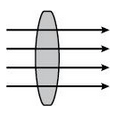
b)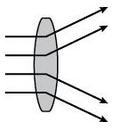
c)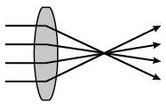
d)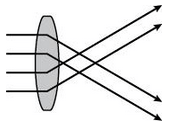
51.
A nearsighted person can see
a)
near
b)
far
52.
If you are nearsighted you need ______ lenses to correct your vision.
a)
concave
b)
convex
53.
If you are farsighted you need ______ lenses to correct your vision.
a)
concave
b)
convex
54.

Which type of spectrum is this?
a)
Emission Spectrum
b)
Absorption Spectrum
c)
Continuous Spectrum
55.

Which of the following type of electromagnetic radiation has the most energy
a)
infrared
b)
ultraviolet
c)
microwaves
d)
radiowaves
56.
If a star is being observed from Earth and it's light has shifted towards the blue side of the electromagnetic spectrum it would be...
a)
Moving towards the Earth
b)
Moving away from the Earth
c)
This is a trick question that cannot be answered
d)
It isn't a star, it is a very large blueberry.
57.
If a star is being observed from Earth and it's light has shifted towards the red side of the electromagnetic spectrum it would be...
a)
Moving towards the Earth
b)
Moving away from the Earth
c)
This is a trick question that cannot be answered
d)
It isn't a star, it is a very large blueberry.
58.
The Sun is an example of a _______.
a)
Planet
b)
Moon
c)
Star
d)
Galaxy
59.
What is the speed of light?
a)
186,000 mi/hr or 300,000 km/hr
b)
186,000 km/hr or 300,000 mi/hr
c)
186,000 mi/sec or 300,000 km/sec
d)
186,000 km/sec or 300,000 mi/sec
60.

______________ is the energy that can travel through space in the form of waves.
a)
telescopes
b)
electromagnetic spectrum
c)
observatory
100 %

