wayground logo

Free Printable Worksheets

Font size

S
M
L
XL
Worksheets

Core Bio Unit 3 Practice

Total questions: 55

Worksheet time: 2hrs 50mins

Name
Class
Date
1.

The study of evolution from a genetic point of view

a)

population genetics

b)

microevolution

c)

gene pool

d)

allele frequency

2.

the total genetic information available in a population

a)

population genetics

b)

microevolution

c)

gene pool

d)

allele frequency

3.

determined by dividing the number of a certain allele by the total number of alleles of all types in the population

a)

population genetics

b)

microevolution

c)

gene pool

d)

allele frequency

4.

The genotype frequencies in a population tend to remain the same from generation to generation unless acted on by outside influence

a)

phenotype frequency

b)

hardy-weinberg genetic equilibrium

c)

gene pool

d)

allele frequency

5.

One of the five assumptions of Hardy-Weinberg genetic equilibrium

a)

No net mutations occur

b)

Population does not produce offspring

c)

population is made up eukaryotic organisms

d)

equal rate of immigration and emigration

6.

One of the five assumptions of Hardy-Weinberg genetic equilibrium

a)

populations have a surplus of food

b)

Individuals neither enter nor leave the population

c)

populations migrate as a herd

7.

One of the five assumptions of Hardy-Weinberg genetic equilibrium

a)

Organisms have more than one offspring

b)

the population are carnivores

c)

The population is large

8.

One of the five assumptions of Hardy-Weinberg genetic equilibrium

a)

Individuals mate randomly

b)

Females pick the strongest males to mate

c)

Males fight each other to mate with females

9.

One of the five assumptions of Hardy-Weinberg genetic equilibrium

a)

Natural selection only occurs on the youngest in a population

b)

Naturals selection does not occur

c)

Natural selection only affect the weakest in the population

10.

Why is genetic drift not a type of natural selection?

a)

It's random; not due to advantages that the individual has

b)

It's due to the environment, rather than chromosomal changes

c)

Humans are involved, making genetic drift artificial selection

11.

What is the only way to create brand new alleles in an isolated population?

a)

Mutation

b)

Natural selection

c)

Genetic drift

d)

Nonrandom mating

12.

In order to have sexual selection occur, which of these must happen?

a)

Nonrandom mating

b)

Genetic drift

c)

Gene flow

d)

Nondisjunction

e)

Binary fission

13.

A volcano explodes and destroys half of an island. Any creature that happened to be on the north part of the island is now dead. This has changed the allele frequencies randomly. This is an example of...

a)

Genetic drift

b)

Gene flow

c)

Natural selection

d)

Volcanic mutation

14.

Which of these can change allele frequencies in a population?

a)

Sexual selection

b)

Genetic drift

c)

Gene flow

d)

Natural selection

e)

All of these can change allele frequencies

15.

If the allele for long fur gives individuals an advantage, what is likely to occur over time?

a)

The frequency of that allele will increase

b)

The frequency of that allele with decrease

c)

Mutations can no longer affect that gene

16.

What is this image depicting?

a)

Gene flow

b)

Nonrandom mating

c)

Genetic drift

d)

Sexual selection

17.
Which of the following is NOT a condition for Hardy-Weinberg Equilibrium?
a)
No mutations
b)
Random Mating
c)
No natural selection
d)
No offspring
18.
When a population is in Hardy-Weinberg equilibrium,  what is NOT happening to the species?
a)
Survival
b)
Reproduction
c)
Death
d)
Evolution
19.
What type of selection does the image represent?
a)
Directional 
b)
Stabilizing
c)
Disruptive
20.
What type of selection does the image represent?
a)
Directional 
b)
Stabilizing
c)
Disruptive
21.
What type of selection does the image represent?
a)
Directional 
b)
Stabilizing
c)
Disruptive
22.
Genetic drift is most likely to impact a population....
a)
That has a low mutation rate
b)
In which natural selection is occurring
c)
That is very small
d)
For which environmental conditions are changing
23.
Disruptive selection will favor...
a)
Both extremes of a trait.
b)
Average traits.
c)
One phenotype over another.
d)
All possible phenotypes
24.
Two groups of chipmunks cannot mate anymore because the grand canyon separates them; this is
a)
Behavioral isolation
b)
Geographic isolation
25.

What is speciation?

a)

combining of two species to form one with different traits

b)

isolation that affects mating behaviors

c)

timing of mating that prevents normal sexual selection

d)

formation of a new species from an existing one

26.
An inherited characteristic that increases an organism's ability to survive and reproduce in its specific environment is called a/an
a)
vestigial structure
b)
adaptation
c)
speciation
d)
analagous structure
27.
What is the best explanation for a population being described as an evolutionary unit?
a)
Population can evolve, not individuals
b)
Natural selection only involves individuals, not populations
c)
Genetic changes only occur in populations
d)
A population's gene pool remains the same throughout time
28.

A group of organisms that share similar characteristics and can reproduce belong to the same...

a)

species

b)

family

c)

genus

d)

order

29.
Which of the following pieces of evolution evidence deals with similar molecules in related individual species?
a)
fossil record
b)
comparative embryology
c)
DNA comparison
d)
comparative anatomy
30.

Which term is defined as the same structure in different species indicating a common ancestor?

a)

homologous structures

b)

vestigial structures

c)

analogous structures

d)

DNA

31.

Which word is defined as a structure without a function in an organism that is functional in a related organism?

a)

homologous structures

b)

vestigial structures

c)

analogous structure

d)

DNA

32.

The forelimbs of penguin, alligator, bat, human are which of the following?

a)

homologous structures

b)

vestigial structures

c)

analogous structures

33.
Two organisms that are closely related would have
a)
very similar DNA sequence
b)
exactly the same DNA sequences
c)
no proteins in common
d)
completely different DNA sequence
34.

The hind leg bones in a whale are examples of

a)

homologous structures

b)

analogous structures

c)

fossils

d)

vestigial structures

35.

Evolution that occurs at a slow constant rate

a)

gradualism

b)

punctuated equilibrium

c)

natural selection

d)

divergent evolution

36.
Nearly all mammals have seven cervical (neck) vertebrae.  This fact implies that
a)
predators prefer to eat animals with either six or eight cervical vertebrae.
b)
all animals can turn their heads the same amount.
c)
all mammals have to stretch their necks to obtain food.
d)
all mammals descended from a common ancestor
37.
Which of the following is best defined as the transfer of genetic information from one population to another?
a)
genetic recombination
b)
natural selection
c)
gene flow
d)
genetic drift
38.

When better adapted organisms survive to pass traits along to offspring.

a)

Evolution

b)

Natural Selection

c)

Extinction

d)

Artificial Selection

39.

Why are advantageous traits more likely to be passed onto offspring?

a)

Because they are more likely to survive and reproduce.

b)

Because they come from dominant alleles.

c)

Because they come from recessive alleles.

d)

Because the trait is an acquired phenotype.

40.

What word describes a trait that helps an organism survive in its environment?

a)

natural selection

b)

mutation

c)

camouflage

d)

adaptation

41.
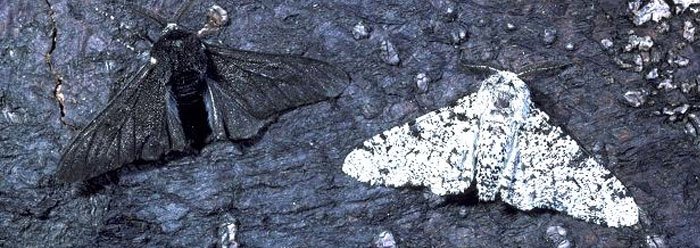
The trees these moths used to live on were white, but have been covered in soot from coal factories. Which moth will be more successful in this environment?
a)
Dark moth
b)
Light moth
c)
Both will be equally successful
d)
Neither will be successful
42.
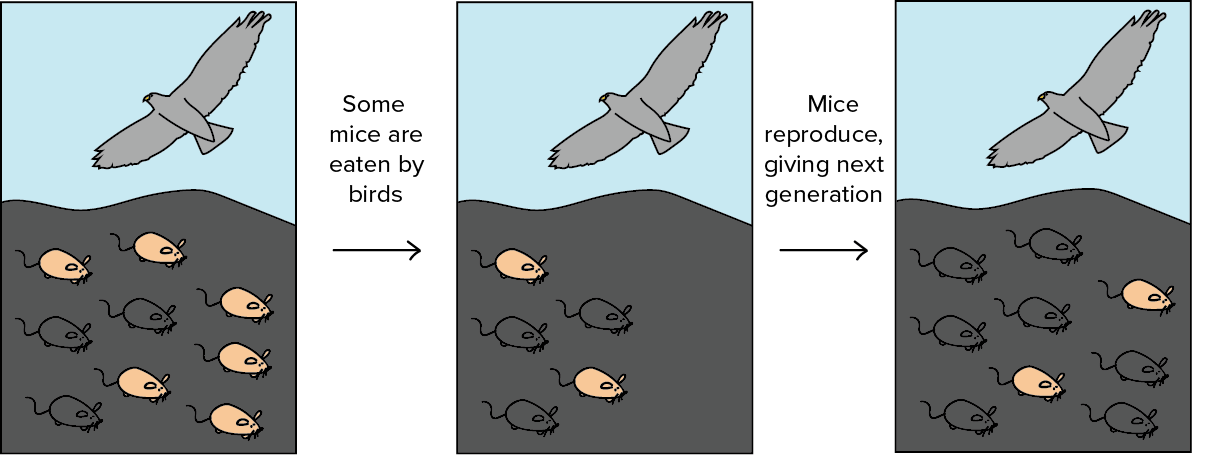
What process is being shown in this image?
a)
Variation
b)
Natural Selection
c)
Selective Breeding
d)
Homeostasis
43.
Why is the mouse population changing over time?
a)
The light mice can reproduce more successfully than the dark mice
b)
The hawks eat more dark mice than light mice because the dark mice taste better
c)
The hawks eat more light mice than dark mice because they can see the light mice more easily
d)
The hawks eat more dark mice than light mice because they can see the dark mice more easily
44.
a measure of how commonly a particular allele occurs in a population is known as the 
a)
gene pool
b)
allele frequency
c)
mutation rate
d)
phenotype
45.
An organism's genetic make-up:
a)
phenotype
b)
recessive
c)
genotype
d)
dominant
46.
An organism's appearance or other observable characteristics:
a)
phenotype
b)
recessive
c)
genotype
d)
dominant
47.
a)
The image shows analogous structures.
b)
The image shows convergent evolution.
c)
The image shows adaptive radiation. 
d)
The image shows organisms that are not closely related.
48.

Flying insects, flying birds, and bats are examples of which of the following?

a)

convergent evolution & homologous structures

b)

convergent evolution & analogous structures

c)

divergent evolution & homologous structures

d)

divergent evolution & analogous structures

49.
Common baboons live on the savanna in breeding groups called troops. While females tend to stay with the troop, younger or less dominant males may leave to join a neighboring troop.
Which of these is a likely outcome of movement by young males? 
a)
Gene flow occurs between the populations
b)
relative genotypic frequencies reach a constant state
c)
Allele frequencies suddenly change
50.
Which Hardy-Weinberg factor represents the frequency of heterozygous individuals in a population?
a)
p2
b)
2pq
c)
q2
d)
p2 + 2pq
51.
In the Hardy-Weinberg Equation, q2 is the frequency of what?
a)
The recessive allele 
b)
the dominant allele
c)
the recessive genotype
d)
the dominant genotype
52.
A population of 150 individuals has an allele frequency of 0.3 for the dominant allele (B) and a frequency of 0.7 for the recessive allele (b). Use the Hardy-Weinberg equation to determine the frequency of the genotype (bb).
a)
0.09
b)
0.42
c)
0.49
d)
0.21
53.

The allele frequency of p=.20 What is the percentage of Heterozygous Dominant genotype?

a)

.80

b)

.04

c)

.32

d)

.64

54.

The allele frequency of p=.20 What is the percentage of recessive genotype?

a)

.80

b)

.04

c)

.32

d)

.64

55.

The allele frequency of p=.20 What is q?

a)

.80

b)

.04

c)

.32

d)

.64