wayground logo

Free Printable Worksheets

NEW

Font size

S
M
L
XL
Worksheets

thomas

Total questions: 40

Worksheet time: 40mins

Name
Class
Date
1.
Atomic nuclei of almost all atoms consist of
a)
only protons
b)
protons and neutrons
c)
protons and electrons
d)
neutrons and electrons
2.
Electrons and protons have the same charge and therefore attract each other.
a)
true
b)
false
3.
Electric charge is neither created nor destroyed, but can be rearranged.
a)
true
b)
false
4.
A material is a good insulator if outer electrons of atoms in the material are free to roam around.
a)
true
b)
false
5.
A positive ions has
a)
one proton
b)
more electrons than protons
c)
more protons than electrons
d)
a +1 charge always
6.
Coulomb's law says that the force between any two charges depends
a)
directly on the magnitude of the charges
b)
inversely on the square of the distance between the charges
c)
both of the above
d)
neither of the above
7.
The electrostatic force between two charges located 2 meters apart is 0.10 N.  What will the force be between these charges when they are located 1 meter apart?
a)
0.40 N
b)
0.20 N
c)
0.10 N
d)
0.05 N
8.
A 2-C charge and a 4-C charge attract each other with 10 N of force.  How much will a 2-C charge and an 8-C charge attract each other when placed the same distance apart?
a)
40 N
b)
20 N
c)
10 N
d)
8 N
9.
In a good insulator, electrons are usually
a)
free to move around
b)
free to move around after an impurity has been added
c)
semi-free to move around
d)
tightly bound in place
10.
Where do electrons go when you rub a balloon on your hair?
a)
Onto the balloon
b)
Into your hair
c)
Nowhere
11.
When a balloon is rubbed on clothes it acquires a charge by ___________
a)
Induction
b)
reduction
c)
friction 
d)
concuction
12.
After you rub a balloon on your hair, what charge does the balloon have?
a)
Positive
b)
Negative
c)
Neutral
13.
After you rub a balloon on your hair, what charge does your hair have?
a)
Positive
b)
Negative
c)
Neutral
14.
What is it called when an object gains a charge without touching a charged object but by being held near the charged object?
a)
Induction
b)
ESD
c)
Conduction
d)
Conducting path
15.
The reason a charged balloon will stick to a wall is that
a)
the charge is slightly sticky and acts like glue
b)
electrons transfer back and forth between the wall and the balloon
c)
induced opposite charges in the wall are closer than other wall charges
d)
balloon material simply sticks to walls
16.
What is the unit of electric charge?
a)
Volts
b)
Amps
c)
Coulombs
d)
Ohms
17.
How is the electric force between two charges affected when both of the charges are doubled?
a)
four times as much
b)
two times as much
c)
half as much
d)
one quarter as much
18.

Which of the following statements is TRUE?

a)

Gravitational forces are attractive and repulsive.

b)

Gravitational forces are stronger than electrical forces.

c)

Electrical forces are attractive only.

d)

Electrical forces are stronger than Gravitational forces

19.

A force between two charges is 500 N. One has a charge of 2x10⁻⁵ and the other has a charge 3x10⁻⁶. What is the distance between the two charges?

a)

.001 m

b)

.03 m

c)

926 m

d)

None of the above

20.

What is the magnitude of the force between the two charged spheres shown? (Hint: You do not need to convert the units.)

a)

1.6

b)

1.4

c)

1.2

d)

1.0

21.

What type of charge(s) created the electric field from left to right?

a)

positive, negative

b)

negative, positive

c)

positive, positive

d)

negative, negative

22.
Two like charges
a)
 neutralize each other.
b)
repel each other. 
c)
must be neutrons. 
d)
attract each other.
23.
What does it mean when the electric field lines are close together?
a)
the field is positive
b)
the field is negative
c)
The field is strong
d)
the field is weak
24.
Charged objects are not attracted to neutral objects
a)
True
b)
False
25.

What direction are the electric field lines around a proton?

a)

towards the charge

b)

away from the charge

26.
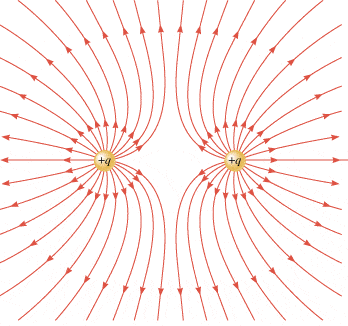
What option best describes this field?
a)
A strong electric field generated by two positive charges. They would attract each other.
b)
A strong electric field generated by two positive charges. They would repel each other.
c)
A weak electric field generated by two opposite charges. They would attract each other.
d)
A weak electric field generated by two positive charges. They would repel each other.
27.
What option best describes this field?
a)
A strong electric field generated by two positive charges. They would attract each other.
b)
A strong electric field generated by two positive charges. They would repel each other.
c)
A weak electric field generated by two opposite charges. They would attract each other.
d)
A weak electric field generated by two positive charges. They would repel each other.
28.
Consider the electric field lines shown in the diagram below. From the diagram, it is apparent that object A is ____ and object B is ____.
a)
+,+
b)
+,-
c)
-,+
d)
-,-
29.
Qand Qare two charges creating an electric field. Based on the electric field lines, we can conclude
a)
Qand Qare both positive
b)
Qand Qare both negative
c)
Qis positive and Qis negative
d)
Qis negative and Qis positive
30.
What variable do Coulombs represent?
a)
Electrostatic Charge
b)
Force
c)
Distance
d)
Mass
31.
What will happen to the Electrostatic Force if the charge of one particle is increased 6 times?
a)
The force will decrease 6 times
b)
The force will increase 6 times
c)
The force will increase 36 times
d)
The force will decrease by 1/6
32.
If the distance doubles, what happens to the force?
a)
Reduced by half
b)
Reduced by 1/4
c)
Stays the same
d)
Quadruples
33.
What is the unit for Electric Force?
a)
Newton
b)
Couloumb
c)
Newtons/Couloumb
d)
Nano
34.
In the diagram below, P is a point near a negatively charged sphere. Which direction best represents the direction of the electric field at point P?
a)
Right
b)
Left
c)
Up 
d)
Down
35.
Which of these options would make an electric field weaker?
a)
Increasing the distance between charges
b)
Increasing the strength of the charges
c)
Decreasing the distance between charges
d)
Adding more charges to the field
36.
The Electric Force is strongest when charges are...
a)
close together
b)
far apart
c)
the electric force is constant everywhere
37.
Which of the following is not a good conductor of electricity?
a)
copper
b)
silver
c)
Glass
d)
aluminum
38.
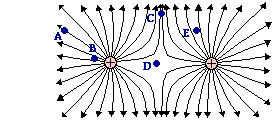
Which of the following labeled points is in the region with the strongest force of electric charge
a)
A
b)
B
c)
C
d)
D
39.

What is the magnitude of the charge, in coulombs, of a lithium nucleus containing three protons and four neutrons?

Remember the elementary charge is e- = 1.6 x 10⁻¹⁹ C or 1C = 6.24 x 10¹⁸ e-

a)

1.12 x 10⁻¹⁸ C

b)

6.4 x 10⁻¹⁹ C

c)

4.8 x 10⁻¹⁹ C

d)

1.6 x 10⁻¹⁹ C

40.

Which diagram correctly shows the electric field lines between two point charges?

a)
b)
c)
d)