
 Worksheets
Fall of Rome and Byzantine Empire Unit Test Review
Total questions: 88
Worksheet time: 51mins
Name
Class
Date
1.
Old Rome or New Rome?
Greek is the official language.
Greek is the official language.
a)
Old Rome
b)
New Rome
2.
Old Rome or New Rome?
The capital city is a peninsula.
The capital city is a peninsula.
a)
Old Rome
b)
New Rome
3.
Old Rome or New Rome?
Barbarians invaded and occupied
Barbarians invaded and occupied
a)
Old Rome
b)
New Rome
4.
Old Rome or New Rome?
The empire that developed first
The empire that developed first
a)
Old Rome
b)
New Rome
5.
Old Rome or New Rome?
People COULD worship icons.
People COULD worship icons.
a)
Old Rome
b)
New Rome
6.
Old Rome or New Rome?
This is where you would find the Hagia Sophia.
This is where you would find the Hagia Sophia.
a)
Old Rome
b)
New Rome
7.
Old Rome or New Rome?
Justinian was one of the greatest rulers.
Justinian was one of the greatest rulers.
a)
Old Rome
b)
New Rome
8.
Old Rome or New Rome?
Most people speak Latin here.
Most people speak Latin here.
a)
Old Rome
b)
New Rome
9.
Old Rome or New Rome?
Historians call this the Byzantine Empire.
Historians call this the Byzantine Empire.
a)
Old Rome
b)
New Rome
10.
Old Rome or New Rome?
Where you will find the Colosseum.
Where you will find the Colosseum.
a)
Old Rome
b)
New Rome
11.
Old Rome or New Rome?
Capital = Constantinople
Capital = Constantinople
a)
Old Rome
b)
New Rome
12.
Old Rome or New Rome?
Where you would find the Hippodrome.
Where you would find the Hippodrome.
a)
Old Rome
b)
New Rome
13.
Which continent was NOT linked by Constantinople?
a)
Asia
b)
North America
c)
Africa
d)
Europe
14.

a)
They were important contributors to the development of the rule of law
b)
They were empire builders who oversaw remarkable technological achievements.
c)
They were Roman emperors who doubled the size of the territory they inherited.
d)
They were great writers and thinkers who advanced the philosophy of individualism.
15.
Question The ideals of democracy, in which citizens participate in their own government, and of republican government, in which the leaders of government are elected by citizens, were first introduced b
a)
Great Britain and the United States
b)
Mesopotamia and Han China
c)
the Judeo-Christian legal tradition
d)
Classical Greece and Rome
16.
Which statement identifies an impact of the fall of Rome on Western Europe
a)
The
Catholic Church was never able to recover its influence.
b)
The
invaders carefully preserved Greco-Roman learning and adopted Roman technology.
c)
Western
Europe divided into a number of separate barbarian kingdoms
d)
Western
Europeans generally continued to speak a common language
17.
What was the primary language of the Byzantine Empire?
a)
Greek
b)
Roman
c)
Latin
d)
Turkish
18.
Constantinople saw natural protection due to its location on a
a)
Mountain
b)
Island
c)
Fjord
d)
Peninsula
19.
Justinian's most famous achievement is the
a)
Wall of Constantine
b)
Holy Crusade
c)
Crowning of Charlemagne
d)
Justinian Code
20.
Constantinople served as a center for what two cultures?
a)
Greece and Rome
b)
Persia and Rome
c)
Phoenicia and Rome
d)
Greece and Hebrew
21.
Where was Constantinople located?
a)
on a strait linking the Mediterranean Sea with the Atlantic Ocean
b)
on a river delta at the northern edge of Africa
c)
on a peninsula at the southeastern end of Europe
d)
on an island in the southern part of the Mediterranean Sea
22.

Which groups had the most influence on the government, culture and beliefs of the Byzantine Empire?
a)
Arians, Huns and Vandals
b)
Muslims and Persians
c)
Jews and Visigoths
d)
Romans, Greeks and Christians
23.

Which of the following would most likely be found in Byzantine art?
a)
woven tapestries of emperors
b)
mosaics of Christian religious figures
c)
portraits of ordinary people
d)
marble statues of Roman gods
24.

What was the capital city of the Byzantine Empire?
a)
Rome
b)
Athens
c)
Constantinople
d)
Italy
25.
Why was Constantinople such a prosperous city?
a)
Trade hub for Europe, Asia, and Africa
b)
Great architecture
c)
Autocratic rulers
d)
The pope lives there
26.
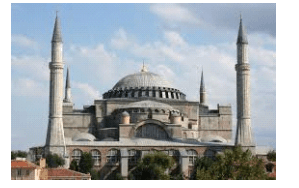
Identify this Byzantine Church that was commissioned by Justinian.
a)
Hagia Sophia
b)
National Cathedral
c)
Notre Dame
d)
Taj Mahal
27.
The Byzantine Empire reached its greatest extent under:
a)
Justinian
b)
Constantine
c)
Vladimir
d)
Diocletian
28.
Which Emperor was responsible for organizing and simplifying old Roman law into a new code?
a)
Constantine
b)
Diocletian
c)
Justinian
d)
Xerxes
29.

In AD 330, what did Emperor Constantine do that led to the beginning of the Byzantine Empire?
a)
He angered Roman nobility, leading to a civil war between the east and the west.
b)
He founded Constantinople and moved the Roman Empire's capital there.
c)
He converted to Christianity and decreed that all other religions were banned.
d)
He divided the Roman Empire into several different kingdoms and empires.
30.

Justinian was the ruler of the Byzantine Empire from 537 AD until 565 AD. He contributed to the field of law by creating the Justinian Code. The Justinian Code was significant because
a)
it stated that the emperor had to follow the same laws that the people did.
b)
it preserved Roman laws and influenced legal systems of the Middle Ages.
c)
it established the principle of separation of church and state.
d)
it was the first written constitution to protect citizens' rights.
31.
What was the Byzantine empire often called?
a)
Eastern Roman Empire
b)
Europa
c)
Persia
d)
World rulers
32.
Theodora and her husband had what famous church built?
a)
Mecca
b)
Cathedral of St. Paul
c)
Kaaba
d)
Hagia Sophia
33.

The Byzantine Empire lasted about __________ years after the fall of the Western Roman Empire.
a)
1000
b)
100
c)
500
d)
5000
34.

All of the following were legacies of Byzantine Empire EXCEPT
a)
Preservation of Roman Laws that would serve as the basis for modern European law
b)
Spread of Christianity throughout Russia and Eastern Europe
c)
Continuation of Greek democratic traditions
d)
Lasting accomplishments in the arts, architecture and literature
35.
Why was Constantinople an important center of trade?
a)
It was guarded on three sides by water.
b)
Ships traveling from the Black Sea to the Mediterranean Sea past by there.
c)
The ancient city of Byzantium was renamed Constantinople in 330.
d)
Many wealthy people lived there.
36.
Which was NOT a contribution made by Justinian to the Byzantine Empire?
a)
Justinian rebuilt the famous cathedral Hagia Sophia.
b)
Justinian conquered North Africa.
c)
The Roman Catholic and Eastern Orthodox churches were united.
d)
Justinian organized the laws of the Romans into a code.
37.

What is this a picture of?
a)
The split of the Roman Empire
b)
Mesopotamia
c)
The split of the New Rome
d)
Roman Republic after the Punic Wars.
38.
Art using small bits of class and rock to form a picture is called.
a)
Finger Paints
b)
Stained Glass
c)
Mosaics
d)
Glossy Works
39.
Who was the first emperor to convert to Christianity?
a)
Justinian
b)
Constantine
c)
Theodora
d)
Diocletian
40.
What rights did Theodora have Justinian give to women?
a)
to become educated
b)
could own property
c)
to serve as regents
d)
All choices
41.
How was the Roman Empire divided by Diocletian?
a)
Greek speaking East and Latin speaking West
b)
Latin speaking East and Greek speaking West
c)
Greek speaking North and Latin speaking South
d)
Latin speaking North and Greek speaking South
42.
What was NOT a reason why Constantinople was considered a strategic location?
a)
It has natural borders
b)
It sat across main trade routes
c)
It was far from Rome
d)
It was near sea coasts
43.
The Byzantine Empire reached its peak under the leadership of...
a)
Theodora
b)
Justinian
c)
Tribonian
d)
Henry IV
44.
Who helped Justinian in managing the affairs of the empire?
a)
His trusted adviser Tribonian
b)
His beloved nephew Justinian
c)
His wife Theodora
d)
No one helped him?
45.
Justinian strengthened Constantinople's defenses using...
a)
Moat
b)
Moat & thick and high walls
c)
Citadel
d)
Thick and high walls
46.
What is the new name of Constantinople?
a)
Persepolis
b)
Persia
c)
Turkey
d)
Istanbul
47.
High taxes and unemployment are considered what kind of reasons for the fall of the empire?
a)
political
b)
economic
c)
foreign invasion
d)
military
48.
When the Romans became very lazy and luxury loving, it was considered what kind of reason for the fall of the empire??
a)
political
b)
economic
c)
foreign invasion
d)
social
49.
In what year did the Roman Empire collapse?
a)
776 BC
b)
776 AD
c)
476 BC
d)
476 AD
50.
What was created by the Romans to transport water into the city of Rome?
a)
aqueducts
b)
domes
c)
standardized law
d)
roads
51.
What language was created by the Romans where many words from today are from?
a)
Portuguese
b)
Italian
c)
Latin
d)
French
52.
The Roman army began to have barbarians fighting for them, which was considered what type of reason for the fall of the empire?
a)
Political
b)
Economic
c)
Foreign Invasion
d)
Military
53.
When prices keep going up, this is occurring:
a)
inflation
b)
unemployment
c)
bartering
d)
taxation
54.
A foreigner who fights for money is known as a _______.
a)
monopoly
b)
monetary
c)
mercenary
d)
mercurial
55.

Arched, elevated waterways which brought water from the countryside into the city of Rome.
a)
Aqueducts
b)
Bridges
c)
Water Wheels
d)
Hadrian's Wall
56.

Capital city of the Roman empire and the center of Roman civilization.
a)
Rome
b)
Alexandria
c)
Byzantium
d)
Cypress
57.

A curved symmetrical structure spanning an opening and typically supporting the weight of a bridge, roof, or wall above it.
a)
Arch
b)
Span
c)
Vault
d)
Cornice
58.

Which of these was not identified as one of the contributors to the decline of the Roman empire?
a)
Strong Trade
b)
Political Instability
c)
Economic Instability
d)
Germanic Invasions
59.

In a span of about 50 years, Rome had 22 different emperors. Most were murdered by the army or by their own bodyguards. This is an example of what?
a)
Political Instability
b)
Economic Instability
c)
Germanic Invasion
d)
A Strong Empire
60.

People had less money to spend. Merchants saw their profits decline, forcing many out of business. Many workers lost their jobs.
This is an example of what?
This is an example of what?
a)
Economic Instability
b)
Political Instability
c)
Germanic Invasions
d)
A Strong Empire
61.

A financial situation that occurs when the value of money goes down while the price of goods and services goes up.
a)
Inflation
b)
Gross income
c)
Net Growth
d)
Diversification
62.

Germanic tribes who asked Rome for protection from the Huns. They then attacked Rome from within.
a)
Visigoths and Vandals
b)
Visioneers and Venison
c)
Violets and Vectors
d)
Vicissitudes and Vaselines
63.

Germanic general who overthrew the last emperor of the Western Roman Empire.
a)
Odoacer
b)
Theodosius
c)
Alabaster
d)
Oracle
64.

The Empire which fell to the German tribes of the North.
It's capital city was Rome.
It's capital city was Rome.
a)
Western Roman Empire
b)
Eastern Roman Empire
65.

The Empire which lasted 1,000 years after Rome fell.
It's capital city was Constantinople.
It's capital city was Constantinople.
a)
Eastern Roman Empire
b)
Western Roman Empire
66.

Northern tribes including the Vandals and the Visigoths who attacked Rome from within the empire are examples of what?
a)
Germanic Invasions
b)
Political Instability
c)
Economic Instability
d)
Strong Empire
67.

Civic Duty, The Rule of Law, Language, Philosophy, Art, Science, Architecture, and Religion are all aspects of Roman civilization that are adopted by modern civilizations like America.
a)
True
b)
False
68.

Which mountain range separates Europe from Asia?
a)
Ural Mountains
b)
Pyrenees Mountains
c)
Alps Mountains
d)
Rocky Mountains
69.

Which mountain range does the Danube and Rhine rivers begin in?
a)
Pyrenees Mountains
b)
Alps Mountains
c)
Rocky Mountains
d)
Ural Mountains
70.

Which body of water can be found to the south of Europe?
a)
Atlantic Ocean
b)
Arctic Ocean
c)
English Channel
d)
Mediterranean Sea
71.
This is an area of extremely fertile land stretching across northern Europe
a)
Scandinavian Peninsula
b)
European Plain
c)
Great Rift Valley
d)
Iberian Peninsula
72.

Spain and Portugal are located on which peninsula?
a)
Iberian Peninsula
b)
Scandinavian Peninsula
c)
English Peninsula
d)
Italian Peninsula
73.

Which country is highlighted on the map?
a)
Germany
b)
Italy
c)
Poland
d)
Ukraine
74.

This country juts out into what body of water?
a)
Atlantic Ocean
b)
Mediterranean Sea
c)
Arctic Ocean
d)
Pacific Ocean
75.

Italy
a)
H
b)
B
c)
D
d)
H
76.

The Alps
a)
D
b)
B
c)
F
d)
G
77.

Ural Mountains
a)
A
b)
H
c)
D
d)
G
78.
Which mountain range does the Danube and Rhine rivers begin in?
a)
Pyrenees Mountains
b)
Alps Mountains
c)
Rocky Mountains
d)
Ural Mountains
79.
What are 2 important facts about the Ural Mountains?
a)
forms a boundary between France and Spain and is located in Russia
b)
Tallest Mountains in Asia
c)
Smallest mountains in Europe
d)
forms the boundary between Europe and Asia and is located in Russia
80.
Describe the European Plain.
a)
is very mountainous
b)
Flat land form that stretches across most of Europe
c)
nothing can grow in this area
d)
contains only small cities
81.
Describe the location of the Alps.
a)
Northern Europe and makes trade easy
b)
Located in northern Italy and makes trade difficult
c)
located in Russia
d)
located in the U.S.
82.

Name the physical feature.
a)
Atlantic Ocean
b)
English Channel
c)
Mediterranean Sea
d)
Arctic Ocean
83.

Name the physical feature.
a)
Iberian Penninsula
b)
Scandinavian Penninsula
c)
European Plain
d)
Alps
84.

Name the physical feature.
a)
Ural Mountains
b)
Alps
c)
European Plain
d)
Pyrenees Mountains
85.

Name the physical feature.
a)
Alps
b)
European Plain
c)
Iberian Penninsula
d)
Scandinavian Penninsula
86.

Name the physical feature.
a)
Ural Mountains
b)
Alps
c)
European Plain
d)
Pyrenees Mountains
87.

Name the country.
a)
United Kingdom
b)
France
c)
Italy
d)
Portugal
88.
Which European country is composed of a boot-shaped peninsula?
a)
Greece
b)
Hungary
c)
France
d)
Italy
100 %

