wayground logo

Free Printable Worksheets

Font size

S
M
L
XL
Worksheets

Earth Science Fall Final Review

Total questions: 85

Worksheet time: 1hrs 16mins

Name
Class
Date
1.
If you are not sure what to do during a lab activity:
a)
guess
b)
change lab partners
c)
ask a teacher
d)
just sit quietly and do nothing
2.
Keeping your work area neat and clean is important because:
a)
My teacher is a neat-freak
b)
I won't lose my supplies in the clutter.
c)
It keeps the room from looking messy.
d)
It helps prevent accidents.
3.
Disrupting other students in the laboratory with horseplay in the lab is:
a)
helpful.
b)
allowed
c)
dangerous.
d)
the quickest way to do a job.
4.

A flat representation of all or parts of the planet.

a)

Great Circle Route

b)

Globes

c)

Maps

d)

Map Projection

5.

A scale model of the Earth that depicts properties such as area, distance,an direction.

a)

Maps Projections

b)

Globes

c)

Great Circle Route

d)

Maps

6.

What do we call Cartographers

a)

Make Maps

b)

Map Maker

c)

Globe Makers

d)

2-D Makers

7.

Most Distortion at the North and South Poles

a)

Polar Projection

b)

Mercator Projection

c)

Robinson Projection

d)

Goode's Projection

8.

Most Accurate at the equator

a)

Robinson Projection

b)

Mercator Projection

c)

Polar Projection

d)

Goode’s Projection

9.
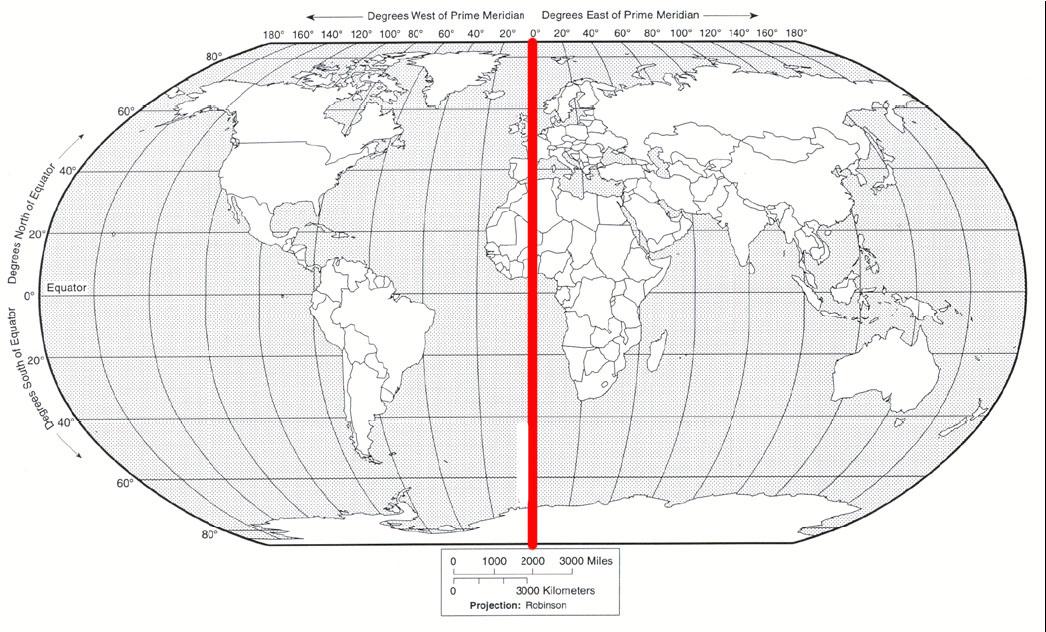
What is the name of the line at zero degrees longitude?
a)
Equator
b)
Prime Meridian
c)
North Pole
d)
South Pole
10.
Latitude and Longitude are measured in______.
a)
kilometers
b)
degrees
c)
miles
d)
hours
11.
Which of the following letter is at approximately 60 degrees S, 40 degrees W? 
a)
A
b)
D
c)
E
d)
H
12.
a)
The map shows lines of longitude.
b)
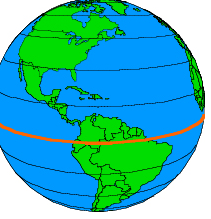
The map shows lines of latitude.
13.
What are the four MAIN directions on the Compass Rose?
a)
North, South, East, and West
b)
Northeast, Southeast, Northwest, Southwest
14.
A set of degrees of latitude and longitude that help you locate a place on a map.
a)
coordinates
b)
positions
c)
hemispheres
d)
locations
15.
What city is located at about 39 degrees North latitude and 108 degrees West longitude?
a)
Durango
b)
Delta
c)
Boulder
d)
Denver
16.
Which cities lie between 80°W and 85°W?
a)
Charleston and Nashville
b)
Little Rock and New Orleans
c)
Atlanta and Talahassee
d)
New Orleans and Jackson
17.
What city is located at 40 degrees North latitude and about 105 degrees West longitude?
a)
Colorado Springs
b)
Boulder
c)
Denver
d)
Durango
18.
What is the profile view to Topographic Map #1? 
a)
A
b)
B
c)
C
d)
D
19.

What is the elevation of point B? (Contour interval is 100m)

a)

800 ft

b)

850 ft

c)

900 ft

d)

1000 ft

20.
A mountaineer is planning an expedition. He wants to follow the easiest possible path, which means he needs to find the most gentle slope up the mountain. Which route should the mountaineer choose?
a)
Route A
b)
Route B
c)
 Route C
d)
Route D
21.
What do close contour lines represent on a map?
a)
waterfall
b)
steep area
c)
gradual area
d)
river
22.
What do contour lines that are farther apart represent?
a)
waterfall
b)
steep area
c)
gentle slope
d)
river
23.
Determine the contour interval
a)
10 m
b)
20 m
c)
50 m
d)
100 m
24.

_________________________ is a type of map that shows changes in elevation.

a)

Topographic map

b)

elevation map

c)

index map

d)

US map

25.

________________________ are a system of curved lines that cover the map, each one representing a specific elevation.

a)

index contours

b)

topographic map

c)

dogs

d)

contour lines

26.

The ___________________________ is the change in elevation between any two contour lines

a)

contour lines

b)

contour intervals

c)

rapidly

d)

smaller and smaller

27.

___________________ are contour lines that are thicker than others and have elevations printed on them.

a)

contour intervals

b)

vegetation

c)

index contours

d)

glaciers

28.
How many protons does lithium have?
a)
3
b)
6.941
c)
1
d)
4
29.
How many neutrons does lithium have?
a)
3
b)
6.941
c)
1
d)
4
30.
This particle is found in the nucleus and has a positive charge
a)
Electron
b)
Proton
c)
Neutron
31.
This particle is found in the nucleus and has no charge
a)
Neutron
b)
Proton
c)
Electron
32.
This is a negatively charged particle found outside the nucleus
a)
Electron
b)
Proton
c)
Neutron
33.
What is the number of protons that the element in this image contain?
a)
14
b)
7
c)
15
d)
18
34.
What is the chemical symbol for the element hydrogen
a)
H
b)
He
c)
h
d)
he
35.
What is the chemical symbol for the element Silicon
a)
S
b)
Si
c)
si
d)
Sl
36.
What is the chemical symbol for the element copper?
a)
co
b)
c
c)
Cu
d)
cu
37.

the softest mineral on Moh's Hardness Scale

a)

talc

b)

diamond

38.

mineral splits easily on a flat surface

a)

cleavage

b)

fracture

39.

the structure of the way crystals form

a)

crystal structure

b)

cleavage

40.

not man-made

a)

naturally occurring

b)

crystallization

41.

mass/volume;

how tightly packed atoms are together

a)

density

b)

luster

42.

when a mineral breaks in an irregular way

a)

cleavage

b)

fracture

43.

the hardest mineral on Moh's Hardness Scale

a)

talc

b)

diamond

44.
The color of a mineral in powder form is called the mineral's 
a)
hardness
b)
specific gravity
c)
luster
d)
streak
45.
The following image shows what mineral property?
a)
Hardness
b)
Streak
c)
Cleavage
d)
Density
46.
Dull, silky, waxy, pearly, and earthy are terms that best describe which property of minerals?
a)
luster
b)
color
c)
streak
d)
cleavage
47.
The solid, geometric form of a mineral produced by a repeating pattern of atoms
a)
crystal
b)
density
c)
element
d)
fracture 
48.
Which mineral smells like rotten eggs?
a)
talc
b)
sulfer
c)
mica
d)
pyrite
49.
Which type of rock results from melting and cooling of magma?
a)
Igneous
b)
Metamorphic
c)
Sedimentary
d)
Extrusive
50.
Which type of rock forms from extreme heat and pressure?
a)
Igneous
b)
Sedimentary
c)
Organic
d)
Metamorphic
51.
A metamorphic rock changes into an igneous rock by what two processes?
a)
Melting and cooling
b)
Extreme heat and pressure
c)
Compaction and cementation
d)
Weathering and erosion
52.
True/False: Igneous rocks can only turn into metamorphic rocks.
a)
True
b)
False
53.
When sediments are pressed together tightly, this is called ____________.
a)
Compaction
b)
Cementation
c)
Weathering
d)
Erosion
54.
This rock started as lava that cooled and then was heated and put under pressure over time. What type of rock is this?
a)
Sedimentar
b)
Igneous
c)
Metamorphic
55.
This rock is made from tiny pieces of other rocks that settled to the bottom of a valley millions of years ago. What type of rock is this?
a)
Sedimentary
b)
Igneous
c)
Metamorphic
56.
The rock shown is GABBRO.  We can tell that it is an ______________ igneous rock that cooled slowly underground because it has large, visible crystals.
a)
extrusive
b)
intrusive
57.
Each rock type can follow only one pathway of the rock cycle.
a)
True
b)
False
58.
The rock shown is basalt.  We can tell that it is an ______________ igneous rock that quickly on the surface of the ground because it has tiny crystals and a fairly uniform texture
a)
extrusive
b)
intrusive
59.
a natural, nonliving substance that makes up rock
a)
mineral
b)
rocks
c)
plasma
d)
lava
60.
Texture is determined by
a)
the chemicals in a rock
b)
the color of a rock
c)
the bumpiness of a rock
d)
the size and shape of  the rock's mineral grains
61.
People who study fossils are called ____.
a)
meterologists
b)
fossilologists
c)
paleontologists
d)
fossil hunters
62.
In order for a fossil to form, which of the following events must happen FIRST?
a)
Slowly, minerals in the water replace the bone.
b)
Sediment covers the bone.
c)
An animal dies.
d)
The bone is no longer a bone, but a rock copy.
63.
Why don't we know what many ancient plants looked like? 
a)
They had too many soft parts.
b)
They were all eaten by dinosaurs.
c)
There weren't ancient plants.
d)
They had too many hard parts.
64.
In what kind of rock can fossils be found?
a)
Sedimentary Rocks
b)
Igneous Rocks
c)
Metamorphic Rocks
d)
Granite
65.
Preserved remains or traces of living things?
a)
fossils
b)
organisms
c)
extinct
d)
rocks
66.
A mold is?
a)
exact copy
b)
like a cast
c)
empty space 
d)
hollow area
67.
Trace fossils are?
a)
foot prints
b)
evidence of activities of ancient organisms
c)
traces of animals
d)
traces of rocks
68.
Remains can be preserved by?
a)
changing over time
b)
staying the same
c)
tar, amber, ice
d)
freezing only
69.
The fossil record shows?
a)
groups of organisms have become extinct
b)
groups of organisms change over time
c)
have died and came back to life
d)
evolved into another species
70.

What book of the Bible gives the Creation account?

a)

Exodus

b)

John

c)

Genesis

d)

Psalms

71.

In 1859 who came up with the theory of evolution?

a)

Charles Barkley

b)

Albert Inestein

c)

Thomas Jefferson

d)

Charles Darwin

72.

This image is a made up image of which theory?

a)

Darwinian Evolution

b)

Creation

73.

If something was created then reason would say that there must be a...

a)

reader

b)

scientist

c)

painter

d)

creator

74.

Where does it state in Genesis that God created all living things to reproduce after it kind? Psst, you can use a Bible for this question:)

a)

Gen. 1:20-25

b)

Gen. 5:20-21

c)

Gen. 3:16

d)

Gen 2: 20-22

75.

Which order of events makes most since according to the Biblical account?

a)

Fall of mankind, creation, global flood, spread of civilizations.

b)

Creation, fall of mankind, global flood, spread of civilizations.

c)

Spread of civilizations, fall of mankind, creation, global flood.

d)

Global flood, spread of civilizations, fall of mankind, creation.

76.

Since no humans were around at the beginning of time we must have __________________ and look at the _______________ around us for answers.

a)

facts; evidence

b)

faith; evidence

c)

hope; faith

d)

science books; facts

77.

The idea that in the beginning everything came from nothing.

a)

Darwinian Evolution

b)

Biblical Creation

78.
The outermost solid layer of the Earth is called the
a)
mantle
b)
outer core
c)
inner core
d)
crust
79.
This layer of the Earth is found between the core and the crust.
a)
mantle
b)
outer core
c)
inner core
d)
crust
80.
Is a layer of week of soft mantle that is made of rock that flows slowly.  Tectonic plates move on top of this layer. 
a)
Inner Core
b)
Asthensophere
c)
Lithosphere
d)
Outer Core
81.
This is the outermost, rigid layer of the Earth, made up of two parts, is divided into pieces call tectonic plates.
a)
Inner Core
b)
Asthensophere
c)
Lithosphere
d)
Outer Core
82.
The solid, dense center of our planet that extends from the bottom of the outer core to the center of the Earth.. 
a)
mantle
b)
outer core
c)
inner core
d)
crust
83.
What are the two kinds of crust that the Earth has?
a)
Oceanic and Crustatious Crust
b)
Oceanic and Continental Crust
c)
Optic and Continental Crust
84.
As scientists explore deeper and deeper into Earth's crust, what have they noticed about temperature and pressure?
a)
both temperature and pressure decrease
b)
both temperature and pressure increase
c)
pressure increases while temperature decreases
d)
temperature increases while pressure decreases
85.
4. What layer is the hottest?
a)
Core
b)
Crust
c)
Mantle