
 Worksheets
Matter & Temperature Review
Total questions: 40
Worksheet time: 40mins
Name
Class
Date
1.
What happens to particles as they cool down?
a)
They slow down
b)
Nothing
c)
They don't move
d)
They speed up
2.
The average kinetic energy of the particles in an object or stubstance is:
a)
mass
b)
temperature
c)
matter
d)
heat
3.
If two objects have different temperatures, heat will flow from the warmer object to the cooler one UNTIL ____________
a)
one reaches a temperature of zero
b)
they both have an equal temperature
c)
one runs out of energy
4.
What is boiling water in Celsius?
a)
212
b)
112
c)
100
d)
50
5.
Heat is the movement of ______.
a)
radiation
b)
thermal energy
c)
cold
d)
fire
6.

Which direction is heat flowing in the picture?
a)
from the hand to the ice
b)
from the ice to the hand
c)
heat is not being transferred
d)
there is no way to tell
7.

Scientists' favorite temperature scale, because it begins at the absolute coldest anything can get.
a)
Celsius
b)
Fahrenheit
c)
Kelvin
d)
All of them
8.

There are 3 main scales by which temperature is measured.
a)
True
b)
False
9.
Temperature at which ALL molecules stop moving.
a)
100ºC
b)
Absolute zero
c)
0ºC
d)
32ºF
10.
The most common temperature scale used in the world where water freezes at 0 degrees and boils at 100 degrees is called the __________________ scale.
a)
Celsius
b)
Fahrenheit
c)
Pound
d)
Kelvin
11.
Which phase of matter has the slowest moving atoms?
a)
solid
b)
liquid
c)
gas
d)
all are slow moving
12.
What is thermal energy?
a)
radiant energy from the sun
b)
the total kinetic energy of the particles in an object
c)
energy that is stored within the bonds of chemicals
d)
energy that is transferred by currents through wires
13.
A measure of the average kinetic energy of the individual particles in an object is called:
a)
thermal energy
b)
conduction
c)
convection
d)
temperature
14.
Energy is measured in units called.....
a)
pounds
b)
meters
c)
horsepower
d)
joules
15.
The liquid in a thermometer ______________ as the temperature increases.
a)
expands
b)
disappears
c)
freezes
d)
explodes
16.
Convert 35⁰F to Celsius
a)
1.6⁰
b)
1.7⁰C
c)
2.0⁰
d)
16.6⁰C
17.
Convert 72⁰F to Celsius
a)
2.2⁰C
b)
222⁰C
c)
22.2⁰C
d)
161.6⁰C
18.
Convert 30°C to Fahrenheit
a)
860°F
b)
86°F
c)
63.8°F
d)
56°F
19.
Convert 0°C to Fahrenheit
a)
0°F
b)
1.8°F
c)
32°F
d)
3.2°F
20.
Which temperature scale has no negative temperatures?
a)
Celsius
b)
Fahrenheit
c)
Joule
d)
Kelvin
21.
Convert 24 oF to Kelvin
a)
90 K
b)
140 K
c)
269 K
d)
250 K
22.
Convert 5900 K to oC
a)
6173 oC
b)
5627 oC
23.
Convert 20oC to Kelvin.
a)
273 K
b)
298 K
c)
293 K
d)
20 K
24.
When a popsicle melts, the particles _____.
a)
gain thermal energy and speed up
b)
there are no particles in popsicles
c)
lose thermal energy and slow down
d)
stay the same
25.
When an object is cooled, its molecules slow down and move closer together, causing the object to _____.
a)
shrink or contract
b)
expand or move apart
c)
squeeze into a solid
d)
become a gas
26.

Describe the substance between letters A and B.
a)
Solid
b)
Liquid
c)
Melting
d)
Evaporating
27.
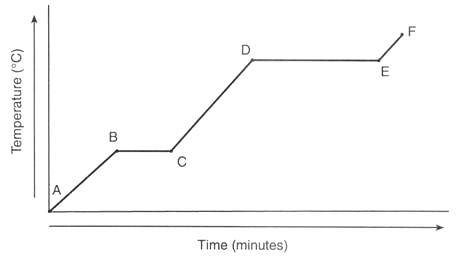
Describe the substance between letters C and D.
a)
Gas
b)
Liquid
c)
Melting
d)
Evaporating
28.

Describe the substance between letters D and E.
a)
Gas
b)
Liquid
c)
Melting
d)
Evaporating
29.

Describe the substance between letters E and F.
a)
Gas
b)
Liquid
c)
Melting
d)
Evaporating
30.
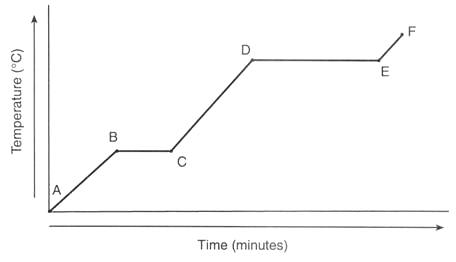
Between which points is the temperature of the substance remaining constant?
a)
A-B only.
b)
A-B, C-D, E-F
c)
B-C only.
d)
B-C, D-E
31.
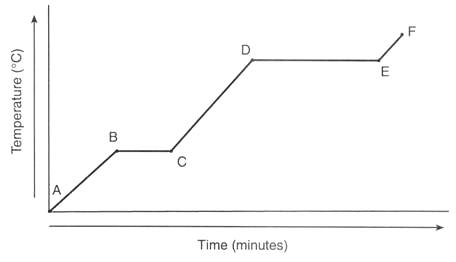
Between which points is the substance changing its state of matter?
a)
A-B only.
b)
A-B, C-D, E-F
c)
B-C only.
d)
B-C, D-E
32.
True or false: melting and freezing occur at the same temperature.
a)
True
b)
False
33.

Looking at the heating curve above, What is occurring at letter B?
a)
Ice is melting to form liquid water.
b)
Liquid water is becoming warmer.
c)
Liquid water is boiling to form steam.
d)
Steam is becoming warmer
34.

This type of graph is called a:
a)
Phase diagram
b)
Heating curve
c)
State of matter
d)
Temperature chart
35.

Describe the substance between letters B and C.
a)
Solid
b)
Liquid
c)
Melting
d)
Evaporating
36.
What is happening at the boiling point?
a)
liquid to gas
b)
gas to liquid
c)
solid to liquid
d)
liquid to solid
37.
When does evaporation happen?
a)
gas to liquid
b)
liquid to solid
c)
solid to liquid
d)
liquid to gas
38.
Do all matter have the same boiling, melting, and freezing points
a)
Yes
b)
No
39.
The temperature at which a substance changes from a liquid to a solid (for water, this is 0 degrees Celsius, 32 degrees Fahrenheit)
a)
freezing point
b)
boiling point
c)
melting point
d)
evaporation
40.

The graph shows a cooling curve for an unknown substance. What is happening during segment DE?
a)
boiling
b)
condensation
c)
freezing
d)
melting
100 %

