Wayground logo

Free Printable Worksheets

Font size

S
M
L
XL
Worksheets

Phase Changes Quiz

Total questions: 88

Worksheet time: 1hrs 23mins

Name
Class
Date
1.
Which of the following terms identifies the change from a liquid to gas?
a)
Vaporization
b)
Condensation
c)
Deposition
d)
Sublimation
2.
Which of the following terms identifies the change from a liquid to solid?
a)
Melting
b)
Condensation
c)
Vaporization
d)
Freezing
3.
When the temperature of matter increases the particles...
a)
speed up and move closer
b)
speed up and move farther apart
c)
slow down and move closer together
d)
slow down and move farther apart
4.
The opposite phase of melting is 
a)
freezing 
b)
sublimation
c)
condensation 
d)
deposition 
5.
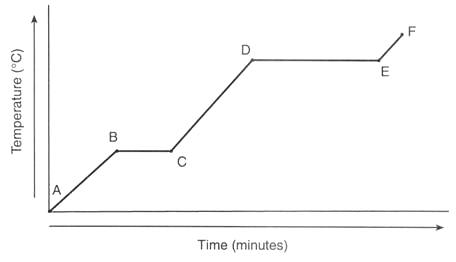
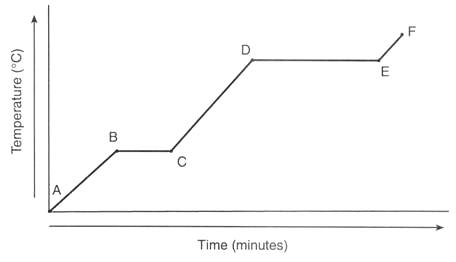
What phase of matter is illustrated in "C"
a)
solid
b)
liquid
c)
gas
d)
melting
6.
What is labelled "B" on the graph?
a)
solids
b)
liquids
c)
gases
d)
a phase change
7.
What is happening at "D" on the graph?
a)
Water is boiling
b)
water is evaporating
c)
water is melting
d)
the sublimation of water
8.
Why does the graph have two flat lines at "b" and "d"?
a)
Those are times when we took the water off the hot plate
b)
Those are phase changes where temperature doesn't change while adding heat
c)
The line is flat because the water is all in the solid or gas phase
d)
The line is flat because temperature increases the most at those locations
9.
Between what two points is the most energy being added to the system
a)
A -B
b)
B-C
c)
C-D
d)
D-E
10.
As substance goes from D to E what happens to the distance between the particles?
a)
particles get closer together
b)
particles disappear
c)
particles get far apart
11.
At what temperature is this substance melting?
a)
50C
b)
100C
c)
0C
12.
How long does it take this substance to change from a liquid to a gas?
a)
1 minute
b)
2 minutes
c)
10 minutes
d)
15 minutes
13.
According to this graph, what is the melting point temperature of this substance?   (in degrees)
a)
40
b)
70
c)
100
d)
140
14.
According to this graph, what is the boiling point temperature of this substance?   (in degrees)
a)
40
b)
70
c)
100
d)
140
15.
Is "sugar dissolves in water" a chemical or physical change?
a)
Chemical change
b)
Physical change
16.
Which of the following does the discoloration of a coin  describe?
a)
Chemical Change
b)
Physical Change
c)
None of the above
d)
Both
17.
Is spoiling food a physical or chemical change?
a)
phyiscal
b)
chemical
18.
A change in the size, shape, or state of matter.
a)
chemical change
b)
physical change
c)
chemical reaction
d)
electron change
19.
You should never ______ chemicals in the lab. 
a)
taste
b)
touch
c)
smell
d)
all of the above
20.
The speed of the molecules determines the _____.
a)
volume
b)
density
c)
pressure
d)
temperature
21.
Which of these conditions is always true for an exothermic process?
a)
They leave the surroundings feeling cold
b)
They release energy into the surroundings.
c)
They absorb energy from the surroundings
d)
The reactants gain energy as they form the products
22.
The graph shows a cooling curve for an unknown substance.  What is happening during segment DE?
a)
boiling
b)
condensation
c)
freezing
d)
melting
23.
In which region(s) of the graph would the substance be a solid only?
a)
Region 1
b)
Region 2
c)
Region 3
d)
Region 4
24.
In which region(s) of the graph does a phase change occur?
a)
Region 1, 3, & 5
b)
Region 2 & 4
c)
Region 1 only
d)
Region 1 & 2
25.

During the process of melting and boiling, a substance's temperature

a)

increases.

b)

decreases.

c)

remains the same.

26.

During which segment is the substance a liquid?

a)

A

b)

B

c)

C

d)

D

27.
Water freezing
a)
Chemical Change
b)
Physical Change
28.
Wood burned in a fireplace
a)
Chemical Change
b)
Physical Change
29.
Cake batter baked in an oven
a)
Chemical Change
b)
Physical Change
30.
Baking soda and vinegar combine to make carbon dioxide
a)
Chemical Change
b)
Physical Change
31.
Shredding a piece of paper
a)
Chemical Change
b)
Physical Change
32.
Boiling point
a)
Physical property
b)
Chemical property
33.
Red color
a)
Physical property
b)
Chemical property
34.
Flammability
a)
Physical property
b)
Chemical property
35.
Reacts with water to form a gas
a)
Physical property
b)
Chemical property
36.
You are in lab and your partner accidentally gets their hair stuck in a triple beam balance. What should have your partner done?
a)
  A. Worn a hat in class
b)
 B. Skipped class
c)
 C. Got a hair cut
d)
D. Tied/pulled their hair back
37.

It is ok to taste chemical substances.

a)

True

b)

False

38.
Which changes of state are endothermic changes?
a)
freezing and evaporation
b)
evaporation and melting
39.
Change of state from a solid directly to a gas is called
a)
deposition
b)
melting
c)
evaporation
d)
sublimation
40.

Which of the following are true?

a)

The independent variable is distance.

b)

The independent variable is time.

c)

The dependent variable is time.

d)

The dependent variable is distance.

41.
What is the independent variable? 
a)
time
b)
distance
c)
speed of sloth
d)
none of the above
42.
In a solid, the particles
a)
vibrate in place
b)
slide past one another
c)
overcome the strong attraction
43.
Which phase change would require the atoms and molecules of a substance to move faster?
a)
Condensation
b)
Evaporation
c)
Freezing
d)
Deposition
44.

Energy an object possess due to its motion.

a)

Kinetic Energy

b)

Thermal Energy

c)

Boiling

d)

Evaporation

45.

Directly proportional to the temperature of an object.

a)

Kinetic Energy

b)

Thermal Energy

c)

Boiling

d)

Vapor

46.
At what point does the substance begin turning from a solid to a liquid?
a)
B
b)
C
c)
D
d)
E
47.
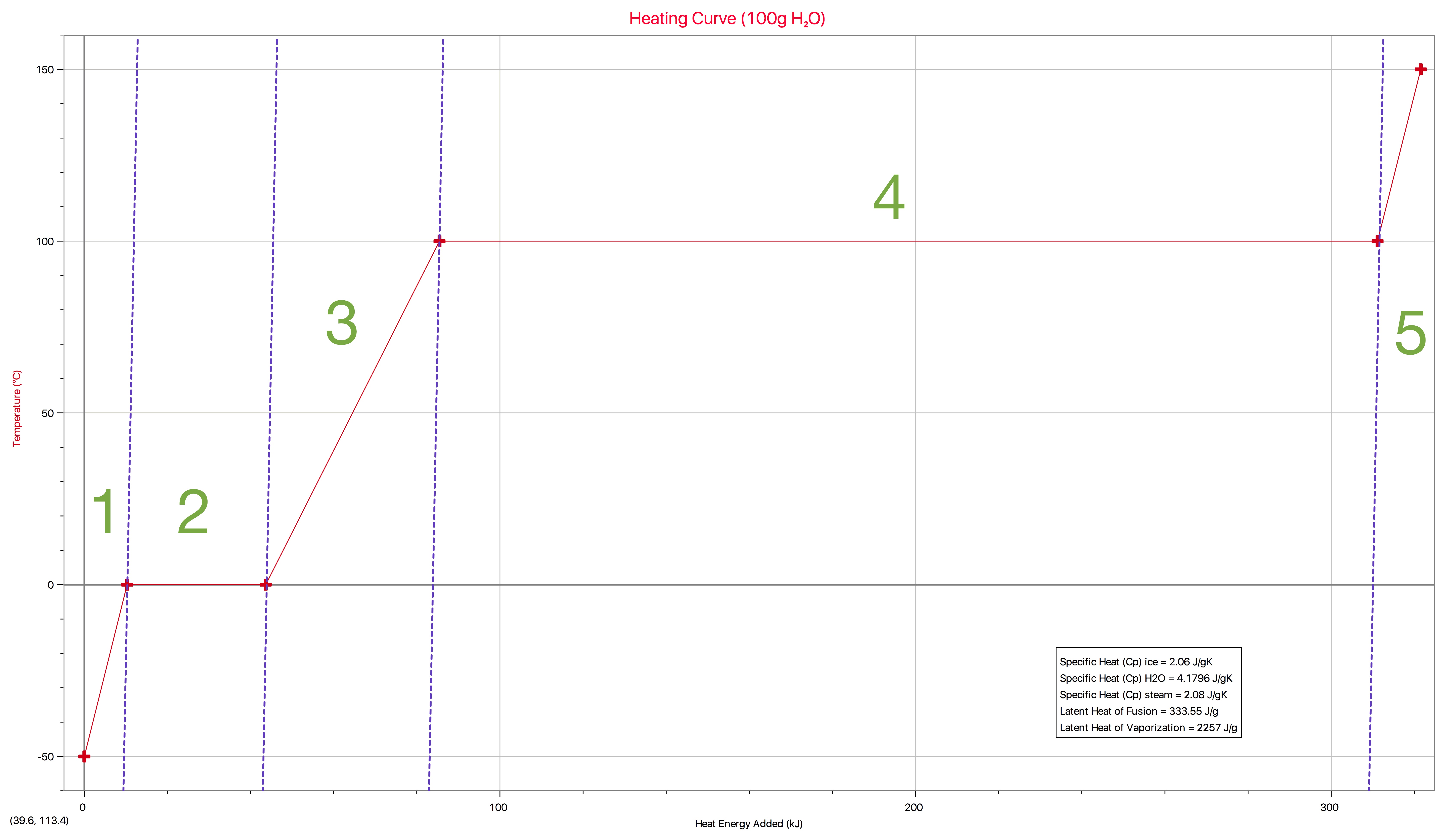
What state of matter is segment 5?
a)
Solid
b)
Liquid
c)
Gas
d)
Plasma
48.
True or false: melting and freezing occur at the same temperature!
a)
True
b)
False
c)
I don't know
49.
A substance's heating curve is shown in the graph.  What is its boiling point?
a)
100 C
b)
60 C
c)
80 C
d)
20 C
50.
A substance has a melting point of 18 C and a boiling point of 77 C.  What state is it at 9 C?
a)
solid
b)
liquid
c)
gas
51.
A solid is
a)
a substance that does not have a definite shape or volume
b)
a substance with a definite volume, but no definite shape
c)
a substance with a definite shape and volume
d)
a substance whose particles glide past one another
52.
A liquid is
a)
a substance that does not have a definite shape or volume
b)
a substance with a definite volume, but no definite shape
c)
a substance with a definite shape and volume
d)
a substance whose particles vibrate
53.
Which states of matter have a definite volume?
a)
solid and gas
b)
solid and liquid
c)
gas and liquid
d)
solid, liquid, and gas
54.
Which of the following is a characteristic of liquids?
a)
molecules are tightly packed
b)
takes the shape of its container
c)
constantly keeps its shape
d)
molecules are spread far apart
55.
A gas is
a)
a substance that does not have a definite shape or volume
b)
a substance with a definite volume, but no definite shape
c)
a substance with a definite shape and volume
d)
a substance whose particles glide past one another
56.
Law of Conservation of Matter states that
a)
the mass of an object will stay the same even if it goes through a change
b)
matter will change mass if it goes through a change
57.
Boiling
a)
liquid to gas
b)
gas to solid
c)
gas to liquid
d)
solid to liquid
58.
Which state of matter has tightly packed molecules?
a)
solid
b)
liquid
c)
gas
59.
Which state of matter has a definite shape?
a)
solid
b)
liquid
c)
gas
60.
What is happening when my ice cream changes from a solid to a liquid?
a)
freezing
b)
melting
c)
burning
d)
evaporation
61.
The speed of the molecules determines the _____.
a)
volume
b)
density
c)
pressure
d)
temperature
62.
The state of matter that has no definite size or shape is
a)
Solid
b)
Liquid
c)
Gas
63.
In which state of matter do the particles spread apart and fill all the space available to them?
a)
crystal
b)
liquid
c)
gas
d)
solid
64.
Definite shape and definite volume
a)
solid
b)
liquid
c)
gas
d)
solid, liquid and gas
65.
Particles slide past each other
a)
solid
b)
liquid
c)
gas
d)
solid, liquid and gas
66.
No definite shape or volume
a)
solid
b)
liquid
c)
gas
d)
solid, liquid and gas
67.
Between which points is the temperature of the substance remaining constant?
a)
A-B only. 
b)
A-B, C-D, E-F
c)
B-C only. 
d)
B-C, D-E
68.
Between which points is the temperature of the substance increasing?
a)
A-B only. 
b)
A-B, C-D, E-F
c)
B-C only. 
d)
B-C, D-E
69.
This type of graph is called a:
a)
Phase diagram
b)
Heating curve
c)
State of matter
d)
Temperature chart
70.
In which segment is the kinetic energy remaining constant?
a)
A-B
b)
B-C
c)
C-D
d)
E-F
71.
The graph shows a cooling curve for an unknown substance.  What is happening during segment DE?
a)
boiling
b)
condensation
c)
freezing
d)
melting
72.

Which segments represents the highest kinetic Energy?

a)

E

b)

D

c)

C

d)

B

73.

Which segment represents the lowest amount of kinetic energy?

a)

A

b)

B

c)

C

d)

D

74.
A substance's heating curve is shown in the graph.  What is its boiling point?
a)
100 C
b)
60 C
c)
80 C
d)
20 C
75.
When the temperature of matter increases the particles...
a)
speed up and move closer
b)
speed up and move farther apart
c)
slow down and move closer together
d)
slow down and move farther apart
76.

In what section of the heating curve can both solid and liquid exist at the same time?

a)

A to B

b)

B to C

c)

C to D

d)

D to E

77.
Point A is a _____? 
a)
solid
b)
liquid
c)
gas
d)
melt
78.
Evaporation is what kind of change?
a)
Endothermic
b)
Exothermic
79.
Condensation and raining are examples of what?
a)
Exothermic
b)
Endothermic
80.
In an endothermic reaction, heat is ,,,
a)
taken in
b)
given out
81.
This type of system does not interact with the world around it. It does all the work by itself
a)
Closed System
b)
Open System
82.
This type of system requires interaction with the environment around it
a)
Closed System
b)
Open System
83.
Students react baking soda & vinegar.
Which of the following would provide the evidence that the number of atoms present before a chemical reaction is equal to the number of atoms present after the chemical reaction?
a)
The mass of the plastic bag, baking soda, and vinegar before the reaction was equal to the mass after the reaction.
b)
Bubbles were produced during the reaction, which meant that a gas was being produced.
c)
The plastic bag did not change in any way, indicating that it was not involved in the reaction.
d)
The mass of the baking soda was exactly equal to the mass of the vinegar used to create the chemical reaction.
84.
Matter can not be created nor destroyed: it can only be
a)
Destroyed a little bit
b)
Invisible
c)
Transformed, changed
d)
None of the above
85.

Suppose a reaction were to happen in an open container in a lab. During the reaction, the scientist observes the chemicals bubble, and produce a gas. During the analysis the scientist notices that the reactants weighed 20 g when he started, and the product weighed 18 g. Explain what happened.

a)

His chemical reaction defied the law of conservation of mass

b)

The product destroyed mass during the reaction

c)

The reactants created matter during the reaction

d)

The gas that was produced was not able to be weighed since the container was open.

86.

From point A to point E, the sample is going through an

a)

exothermic process by releasing heat to the surroundings

b)

exothermic process by absorbing heat from the surroundings

c)

endothermic process by releasing heat to the surroundings

d)

endothermic process by absorbing heat from the surroundings
87.
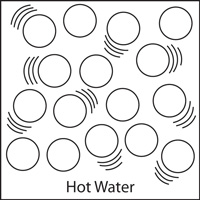
Which state of matter does this molecule diagram represent?
a)
Solid
b)
Liquid
c)
Gas
88.

What would be an exothermic process for this substance.

a)

Going from B to C

b)

Going from C to D

c)

Going from D to E

d)

All of these are exothermic

e)

None of these are exothermic