wayground logo

Free Printable Worksheets

Font size

S
M
L
XL
Worksheets

Intro to Chem Test Review

Total questions: 71

Worksheet time: 2hrs 27mins

Name
Class
Date
1.
K2S
a)
110.3
b)
110
c)
78.2
d)
110.2
2.
What is mass?
a)
the force of an object caused by gravity
b)
the amount of space something takes up
c)
the amount of matter in an object
d)
how fast something is moving
3.
Suppose an astronaut were to visit a planet where the gravity is half that of Earth.  His WEIGHT on that planet would be _______________.
a)
half his Earth weight
b)
the same as his Earth weight
c)
twice his Earth weight
d)
zero
4.
Jack has a rock. The rock has a mass of 14g and a volume of 2cm3. What is the density of the rock?
a)
7 mL
b)
7 g/cm3
c)
28 g/cm3
d)
1/7 g/cm3
5.
What is the volume of Object X?
a)
10.0 cm3
b)
15.0 cm3
c)
20.0 cm3
d)
25.0 cm3
6.
Explaining the color of a chemical would be what kind of observation?
a)
Qualitative 
b)
Quanitative
7.
What is the part of the experiment that is left alone or “natural", and is used to compare back to?
a)
Independent Variable
b)
Dependent Variable
c)
Control Group
d)
Experimental Group 
8.
What is a factor that the experimenter has full control over and changes to see what happens?
a)
Dependent Variable
b)
Independent Variable
c)
Control group 
d)
Hypothesis
9.
Nick wanted to see how high an ice cube would float in different temperatures of water. Identify the DEPENDENT variable
-Amount of water
-Height of Ice cube
-Temperature the ice cube was at its highest height
-Temperature of the water
-Size of the ice cube
a)
Amount of water 
b)
Height of Ice cube
c)
Temperature the ice cube was at its highest height 
d)
Size of the ice cube
10.
The following statement is a hypothesis formed about marsh grass: 
If the amount of nitrogen marsh grass receives is increased, then the height of the grass will increase, because nitrogen is an essential nutrient needed for marsh grass to grow.
What is the independent variable of the statement above? 
a)
Height of grass
b)
Amount of nitrogen
c)
Essential nutrient
d)
Amount of growth
11.
Write 0.00000707 in scientific notation.
a)
7.07 x 10⁻⁶
b)
7.07 x 10⁶
c)
707 x 108
d)
707 x 10-8
12.
Write 2.08 x 10²  in standard form.
a)
208
b)
0.0208
c)
20,800
d)
0.208
13.
Write 6,700 in scientific notation.
a)
6.7 x 10³
b)
6.7 x10⁻³
c)
67 x 102
d)
67 x 10-2
14.
The table shows the mass in grams of one atom of each of several elements. List the elements in order from the least mass to greatest mass per atom.
a)
hydrogen, carbon, oxygen, silver, gold
b)
hydrogen, oxygen, gold, siver, carbon
c)
carbon, oxygen, silver, gold, hydrogen
d)
gold, oxygen, carbon, silver, hydrogen
15.
What is an example of a Chemical change?
a)
Ripped paper 
b)
boiled egg
c)
cracked egg
d)
sugar in water
16.
Which is a physical change?
a)
burning match 
b)
vinegar in baking soda 
c)
melting butter
d)
cooking an egg
17.
Which is a Chemical property?
a)
Thermal Conductivity 
b)
Density
c)
Malleability 
d)
Flammability 
18.
Which of the following is a sign that a chemical reaction has occurred?
a)
change in shape
b)
melting
c)
formation of a gas
d)
dissolving
19.
What characteristic defines all chemical changes?
a)
There is a change of state.
b)
Electricity is produced.
c)
A new material is formed.
d)
Bubbles are produced. 
20.
What is a substance that is dissolved in another substance? 
a)
solution
b)
solute
c)
solvent
d)
compound
21.
air is a 
a)
compound
b)
element
c)
heterogeneous mixture
d)
solution
22.
salt water is a 
a)
compound
b)
element
c)
heterogeneous mixture
d)
solution
23.
Kool-Aid - Powder, sugar, and water
Identify the solvent 
a)
water
b)
powder
c)
sugar
d)
powder and sugar
24.
You know that 12 inches = 1 foot.  Convert 60 inches to feet.
a)
720 feet
b)
5 feet
c)
5 inches
d)
72 feet
25.
How many minutes are in a year?
a)
I can't count that high.
b)
525,600min
c)
52,560min
d)
31,536,000min
26.
The length of a desk is 3.5 feet. How many centimeters is the length? 
(there are 2.54 cm in an inch)
a)
60
b)
120.23
c)
106.68
d)
117.12
27.

How many Periods are on the Periodic Table?

a)

7

b)

11

c)

18

d)

118

28.

Which two elements are in the same Period?

a)

Li and Na

b)

Cu and Au

c)

H and He

d)

K and Mg

29.
What direction are groups on the periodic table?
a)
Vertical
b)
horizontal
c)
sideways
d)
left to right
30.
What happens to the atomic mass as you move down a group of elements?
a)
It increases.
b)
It decreases.
c)
It stays the same.
d)
Nothing
31.
What is the atomic number?
a)
the number of protons
b)
the number of protons and neutrons
c)
the number of neutrons
d)
the number of protons and electrons
32.
The atomic number of Hydrogen is
a)
1
b)
2
c)
3
d)
4
33.
The atomic number of Nitrogen
a)
7
b)
6
c)
8
d)
9
34.
The atomic mass of Zinc is
a)
65
b)
64
c)
63
d)
62
35.
What is the molar mass of sodium?
a)
11
b)
22.990
c)
45.98
d)
3
36.
What is the mass of one mole of aluminum?
a)
26.982 g
b)
13 g
c)
53.985 g
d)
14 g
37.
What is the molar mass of table salt (NaCl)?
a)
116.886 g/mol
b)
35.453 g/mol
c)
22.990 g/mol
d)
58.443 g/mol
38.
What is the molar mass of NaOH?
a)
39.997 g/mol
b)
38.989 g/mol
c)
23.998 g/mol
d)
57.004 g/mol
39.
In chemistry, a "mole" is:
a)
The mass of an atom
b)
a large number used to count particles
c)
based on the volume of a substance
40.
How many atoms of iodine are in a mole of iodine?
a)
53
b)
63.55g
c)
126.9
d)
6.02 x 10²³
41.
What would be the mass of 1.5mol H2O
a)
20
b)
27
c)
32
d)
40
42.
If I need 20.4 moles of sodium chloride, how much should I weigh out?
a)
0.549 g
b)
112 g
c)
1192 g
d)
5077 g
43.
Which has more molecules?
a)
1 mole H2O
b)
1 mole Al(OH)3
c)
1 mole NaCl
d)
There are all the same
44.
How many molecules are in 32.4 grams of phosphorous pentoxide?
a)
1.76 x 10²³ molecules
b)
0.29 moles
c)
1.76 x 10²² molecules
d)
0.29 molecules
45.
What is the Molar mass of one mole of Iron (Fe)?
a)
55.93 amu
b)
55.93 g
c)
111.86 amu
d)
111.86 g
46.
heat always travels from _____ to ______ objects
a)
hot to cold
b)
cold to hot
c)
cold to cold
d)
hot to hot
47.

What property of an object is related to the average kinetic energy of the particles in that object?

a)

specific heat

b)

mass

c)

conducitvity

d)

temperature

48.

Thermal energy depends on an object’s

a)

mass.

b)

phase(solid, liquid, gas)

c)

temperature

d)

all of the above

49.
20 g of water. specific heat of water is 4.18 J/x°C.  temperature changes from 25° C to 20° Chow much heat energy (Q) moves from the water to the surroundings?
a)
418 Joules
b)
209 J
c)
83 J
d)
4.18 J
50.
There are four cups of hot cocoa. The cup sizes are shown. The temperature of the cocoa in each cup is 25 degrees celsius. Which cup has the MOST thermal energy?
a)
Large cup (Trenta)
b)
Small cup (Tall)
c)
Venti
d)
All three are the same temperature so they have same thermal energy
51.
The specific heat of aluminum is 0.21 cal/g°C.  How much heat(Q) is released when a 10 g piece of aluminum foil is taken out of the oven and cools from 100° to 50°?
a)
105 J
b)
10.5 J
c)
1.05 J
52.
A sample of iron receives 50.J of heat energy that raises the temperature of the iron 25.0°C. If iron has a specific heat of .10 J/g°C, what is the mass of the iron sample?
a)
25g
b)
30g
c)
20g
d)
50g
53.
No definite shape but has a definite volume
a)
State
b)
Liquid
c)
Solid
d)
Gas
54.
Movement of thermal energy from a warmer object to a cooler object
a)
Specific Heat
b)
Heat
c)
Freezing Point
d)
Boiling Point
55.
5. What is it called when a solid turns directly into a gas?
a)
Sublimation
b)
Condensation
c)
Liquid
56.
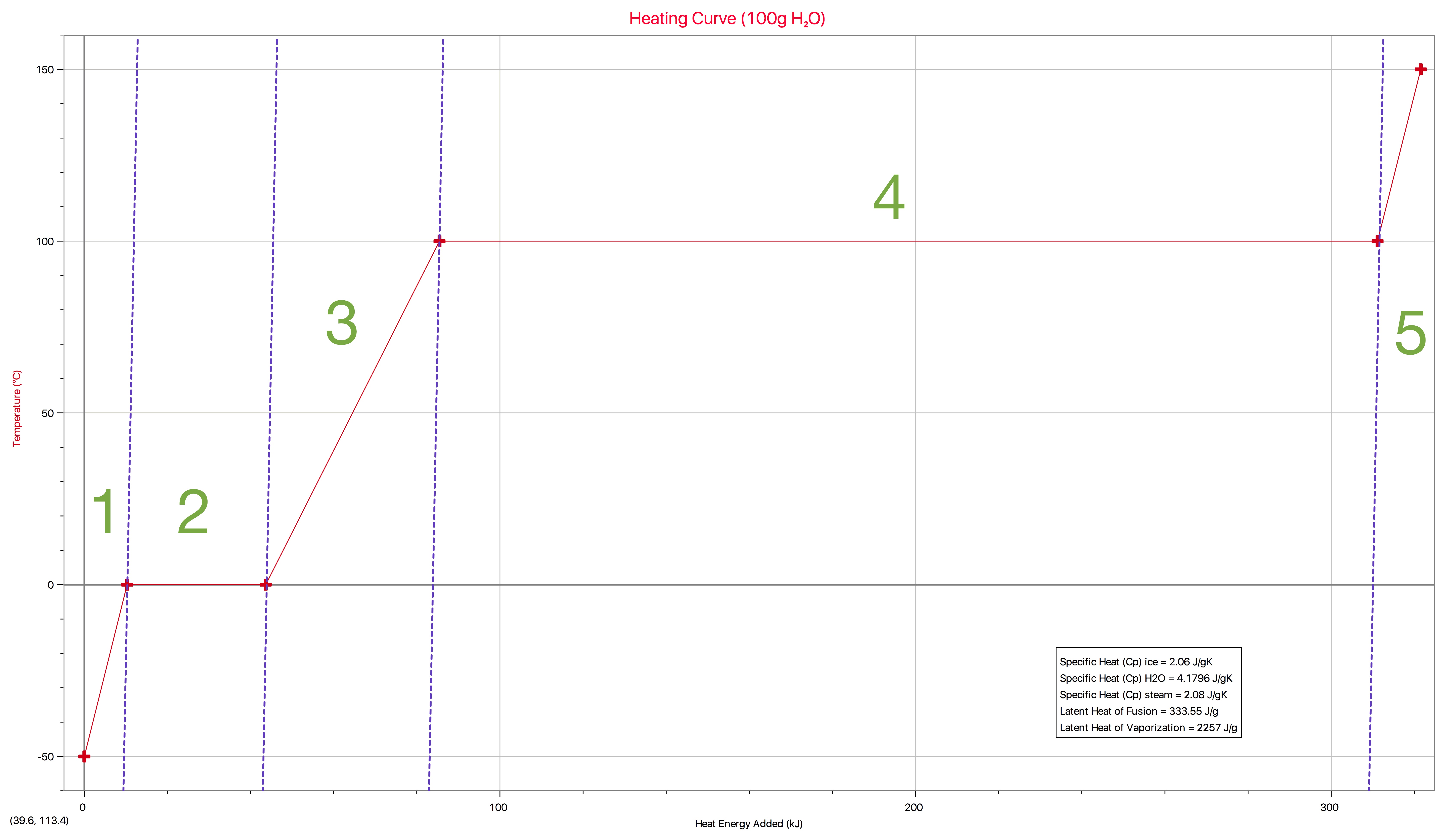
Which segment represents the solid phase? 
a)
1
b)
2
c)
3
d)
4
57.
Which segments have a solid and liquid present at the same time? 
a)
1
b)
3
c)
2
d)
4
58.
Which segment represents melting? 
a)
3
b)
5
c)
1
d)
2
59.
Which set of segments represents periods of potential energy?
a)
1,3,5
b)
2,4
60.
In which region(s) of the graph does a phase change occur?
a)
Region 1, 3, & 5
b)
Region 2 & 4
c)
Region 1 only
d)
Region 1 & 2
61.
In which region(s) of the graph does boiling take place?
a)
Region 2
b)
Region 3
c)
Region 4
d)
Region 5
62.

A sample of iron receives 125J of heat energy that raises the temperature of the iron 32.0°C. What is the mass of the iron sample?

a)

8.70g

b)

14.4 g

c)

20 g

d)

50 g

63.

How much heat is needed to raise the temperature of 2.5g of wood from 50oC to 55oC. (Specific Heat of Wood= 1.75)

a)

34.897J

b)

13.5J

c)

21.875J

d)

4.5

64.

How many Joules of energy are required to make 100 grams of ice at 0 οC completely melt?

a)

200 J

b)

400 J

c)

33,400 J

d)

2,000,000 J

65.

How many joules are required to boil 75 grams of water?

a)

25050J

b)

169500J

c)

31350J

d)

10000J

66.

A substance is condensing. Which formula should you use?

a)

Q= mHf

b)

Q= mTCp

c)

Q= mHv

67.
Water exists as a _____________ at 700 mmHg and 50 °C.
a)
solid
b)
liquid
c)
gas
d)
supercritical fluid
68.
What state of matter is X?
a)
solid 
b)
liquid
c)
gas
d)
supercritical fluid
69.
What change occurs from E to C?
a)
sublimation
b)
freezing
c)
melting
d)
boiling
70.
What change occurs from C to D?
a)
condensation
b)
vaporization
c)
melting
d)
sublimation
71.
At 0.10 atm, what phase(s) can exist?
a)
solid, liquid or gas
b)
liquid or gas
c)
solid only
d)
gas only