Wayground logo

Free Printable Worksheets

Font size

S
M
L
XL
Worksheets

Exam 1 PCA Chemistry Review

Total questions: 100

Worksheet time: 1hrs 22mins

Name
Class
Date
1.
You should never ______ chemicals in the lab. 
a)
taste
b)
touch
c)
smell
d)
all of the above
2.
If you are not sure what to do during a lab activity:
a)
guess
b)
change lab partners
c)
ask a teacher
d)
just sit quietly and do nothing
3.
Keeping your work area neat and clean is important because:
a)
My teacher is a neat-freak
b)
I won't lose my supplies in the clutter.
c)
It keeps the room from looking messy.
d)
It helps prevent accidents.
4.
What is the CORRECT procedure for students to follow if a chemical is spilled?
a)
Stand back and advise the teacher of the spill.
b)
Run madly out of the room.
c)
Splash large amounts of water onto the spill.
d)
Immediately ask to go to the restroom.
5.
You should report accidents to the teacher __.
a)
after the class is over
b)
immediately 
c)
the following day
d)
never
6.

If you do not understand a direction or part of a laboratory procedure, you should

a)

ask the teacher before proceeding.

b)

skip it and go on to the next part.

c)

figure it out as you do the lab.

d)

try several methods until something works.

7.
Long hair in the laboratory must be 
a)
tied back or kept entirely out of the way with a hair band, hairpins, or other confining device
b)
always neatly groomed
c)
held away from the experiment with one hand
d)
cut short
8.
You are heating a substance in a test tube. Always point the open end of the tube 
a)
away from all people
b)
toward another classmate
c)
toward your lab partner
d)
toward yourself
9.
Approved eye protection devices (such as goggles) are worn in the laboratory
a)
 to avoid eye strain
b)
to improve your vision
c)
only if you don’t have corrective glasses
d)
 any time chemicals, heat or glassware are used
10.
When is it OK to eat or drink at the lab tables?
a)
Always
b)
During group work, but not during lab activities
c)
Never
d)
During lab activities
11.
Are safety data sheets the best source of information for chemical regarding the hazards, emergency response
a)
Yes 
b)
NO
12.

which section of the SDS lets us know the type of PPE to use?

a)

First aid measures

b)

health hazard data

c)

exposure control/personal protective equipment

d)

fire fighting measures

13.

I need to know if a chemical is stable in room temperature, if it may react when exposed to other chemicals.

a)

Look at the reactivity section

b)

look in the other information section

c)

look in the chemical ingredients section

d)

look in the toxicological information section

14.

The first aid measures section of the SDS provides information like:

a)

what to do incase of exposure to skin, eyes, or inhilation

b)

how to prevent esposure

c)

what to do in a fire

d)

what to do when trying to burn the chemical

15.
How many significant figures does the following number have: 0.002040
a)
6
b)
4
c)
3
d)
2
16.
How many significant figures does the following number have: 0.998005
a)
9
b)
10
c)
6
d)
5
17.
How many significant figures does the following number have: 100.00210
a)
7
b)
5
c)
10
d)
8
18.
Round 0.010229 to four sig figs
a)
1022
b)
1023
c)
0.01023
d)
0.01022
19.
Round 1009 to three sig figs
a)
100
b)
101
c)
1010
d)
1000
20.
What is the measurement 1042 Liters rounded to 2 significant figures? 
a)
1040 L
b)
1.1 x 10³ L
c)
1.0 x 10³ L
d)
1050 L
21.
What is 78.5 rounded to one significant figure?
a)
79
b)
78.5
c)
70
d)
80
22.
What is 0.658 rounded to 1 significant figure?
a)
0
b)
0.66
c)
0.6
d)
0.658
23.
How many Significant Figures in the number below?
4.56 x 10³
a)
5
b)
4
c)
6
d)
3
24.
How many significant figures does the following number have: 1740200
a)
2
b)
1
c)
3
d)
5
25.
Calculate 12.34 + 1.234 + 0.1234 and give your answer with the correct number of significant figures.
a)
13.6974
b)
13.697
c)
13.70
d)
13.7
26.
Calculate 923 g ÷ 20312 cm3 and give your answer with the correct number of significant figures.
a)
0.04 g/cm3
b)
0.045 g/cm3
c)
0.0454 g/cm3
d)
0.05 g/cm3
27.
Calculate 12.47 m ÷ 3.2 s and give your answer with the correct number of significant figures.
a)
4 m/s
b)
3.9 m/s
c)
3.90 m/s
d)
3.897 m/s
28.
All of the following have one significant figure except:
a)
100 cm
b)
0.0001 cm
c)
2 cm
d)
2.00 cm
29.
Which of the following numbers have four significant figures?
a)
56.75 g
b)
40.01 g
c)
0.6000 g
d)
all of the choices
30.
Jack has a rock. The rock has a mass of 14g and a volume of 2cm3. What is the density of the rock?
a)
7 mL
b)
7 g/cm3
c)
28 g/cm3
d)
1/7 g/cm3
31.
Which units of measurement are used for volume?
a)
grams
b)
centimeters
c)
grams/milliliter
d)
milliliter
32.
Which lab tool might you use to measure the volume of a liquid?
a)
electric scale
b)
bunsen burner
c)
test tube
d)
graduated cylinder
33.
What is the volume of Object X?
a)
10.0 cm3
b)
15.0 cm3
c)
20.0 cm3
d)
25.0 cm3
34.
True or False:  The density of a specific type of material never changes.  
a)
True
b)
False
35.
I have two objects with the same volume but different masses.  Which object will be more dense?
a)
The object with less weight.
b)
The object with more weight.
c)
The object with more mass.
d)
The object with less mass.
36.
What is the formula for density?
a)
density = mass x volume
b)
density = mass / volume
c)
density = mass + volume
d)
density = mass - volume
37.
Frank has an eraser. It has a mass of 4g, and a volume of 2cm3. What is its density?
a)
8 g/cm3
b)
2 g/cm3
c)
1/2 g/cm3
d)
24 g/cm3
38.
Frank has a paper clip. It has a mass of 9g and a volume of 3cm3. What is its density?
a)
3 g/cm3
b)
1/3 g/cm3
c)
27 g/cm3
d)
39 g/cm3
39.
A block has a mass of 54g and a volume of 20cm3.  What is the density of the block?
a)
74 g/cm3
b)
1080 g/cm3
c)
34 g/cm3
d)
2.7 g/cm3
40.
What is the density of a substance that has a mass of 30g and a volume of 6 liters?
a)
24 g/l
b)
5 g/l
c)
36 g/l
d)
180 g/l
41.
The table provided identifies a substance based on its density. A sample of an unknown substance has a mass of 89 grams and a volume of 10 cm3. Based on its density, it could be which of the following substances?
a)
Aluminum
b)
Brass
c)
Copper
d)
Gold
42.
The table provided identifies a substance based on its density. A sample of an unknown substance has a mass of 28.8 grams and a volume of 4 cm3. Based on its density, it could be which of the following substances? 
a)
Gold
b)
Iron
c)
Lead
d)
Tin
43.
If a cube has a mass of 50 grams and a volume of 10cc, what is its density?
a)
10/50 = .2 cc/g
b)
10cc x 50 g = 500 gcc
c)
50g/10cc = 5 g/cc
d)
not enough information
44.
If a cube has a mass of 50 grams and a volume of 10cc, what is its density?
a)
10/50 = .2 cc/g
b)
10cc x 50 g = 500 gcc
c)
50g/10cc = 5 g/cc
d)
not enough information
45.
A key displaces 7 ml of water and has a mass of 59.5 grams. What is its density?
(how could you determine what is it made of??)
a)
D = M/V  59.5g/ 7ml = 8.5 g/ml
b)
D = M/V       7/ 59.5 = .117 ml/g
c)
D = M V =7 x 59416.5 gml
46.
How did Rutherford discover the proton?
a)
Cathode tube ray experiment
b)
Gold Foil Experiment
c)
Planetary Model
d)
Plum Pudding Model
47.
Rutherford's gold foil experiment provided evidence that...
a)
negative and positive charges are spread evenly throughout the atom.
b)
alpha particles have a positive charge.
c)
gold is not a dense as previously thought.
d)
there is a dense positively charged nucleus at the center of an atom.
48.
Which of the following is proposed by Erwin Schrodinger?
a)
Planetary model of the atom
b)
Plum pudding model of the atom
c)
Saturnian model of the atom
d)
Electron cloud model of the atom
49.
Discoverer of the neutron?
a)
Jimmy
b)
Chadwick
c)
Charleston
d)
Rutherford
50.

Which is the correct sequence of the scientists who made major changes in the model of the atom?

1-JJ Thomson

2-Erwin Schrodinger

3-John Dalton

4-Niels Bohr

5-Ernest Rutherford

a)

2, 1, 4, 3, 5

b)

3, 1, 5, 4, 2

c)

5, 3, 2, 1, 4

d)

4, 3, 2, 1, 5

51.

Which scientist saw the atom as a positively charged sphere with negative particles (electrons) embedded within?

a)

J.J. Thomson

b)

Niels Bohr

c)

John Dalton

d)

Ernest Rutherford

52.

Which scientist proposed a model of the atom in which the electrons are orbiting at different levels?

a)

Niels Bohr

b)

James Chadwick

c)

John Dalton

d)

Ernest Rutherford

53.

Order the atomic models below from the oldest to the mot recent.

a)

2, 1, 3, and 4

b)

1, 2, 4, and 3

c)

3, 2, 4, and 1

d)

3, 1, 2, and 4

54.

Discovered electron

a)

Rutherford

b)

Bohr

c)

Thomson

d)

Chadwick

55.
Who is the scientist who proposed the "solar system" model of an atom where the electrons revolve around the nucleus?
a)
Dalton
b)
Niels Bohr
c)
Ernest Rutherford
d)
Democritus
56.
Who is credited with developing the atomic theory?  (Sometimes called the father of atomic theory)
a)
John Dalton
b)
J. J. Thomson
c)
Earnest Rutherford
d)
Niels Bohr
57.
Although all parts of Dalton's atomic theory are important, which one of the postulates is crucial to explain the observations summarized by the Law of Definite Proportions?
a)
Atoms are very small.
b)
Atoms of the same elements have the same properties
c)
Matter is composed of atoms
d)
Atoms chemically combine with other atoms in fixed, whole-number ratios
58.
The atomic number for Oxygen is 8, so
a)
there are 8 protons in the atom
b)
the atomic mass is less than 8
c)
the mass of the atom is 8
d)
the atom is decaying
59.
A tiny but very dense, positively charged portion of the atom that holds most of the atomic mass
a)
Electron Shells
b)
Orbitals
c)
Electron Cloud
d)
Nucleus
60.
Arrangement of elements organized by atomic number
a)
Electron Cloud 
b)
Periodic Table 
c)
Electron Configuration
d)
None of these
61.
Calculation used to find the number of neutrons in an atom
a)
Atomic Mass - Atomic Number
b)
Atomic Number - Atomic Mass
c)
Atomic Mass - Electrons
d)
none of these
62.
This scientist was credited with forming the Atomic Theory, which states that element are made of extremely small particles called atomos.  
a)
Niels Bohr
b)
John Dalton
c)
Ernest Rutherford
d)
J.J. Thomson
63.

Marie Sklodowska Curie was:

a)

the first woman to win the Nobel Prize

b)

the first woman to become a professor at the University of Paris

c)

the first person to win the Nobel Prize twice

d)

all the above answers are correct

64.

Marie Curie discovered:

a)

radioactivity

b)

gravity

c)

polonium and radium

d)

penicillin

65.
The Periodic table of the elements was developed by a scientist named:
a)
Mendeleev
b)
Rutherford
c)
Bohr
d)
Einstein
66.
The periodic table when initially constructed was:
a)
complete and didn't need adjusting
b)
completely replaced because it was not useful
c)
allowed for the discovery of new elements that fit into the table that hadn't been discovered yet
d)
immediately eliminated as a useful chemistry tool
67.
Who discovered the proton and when did they do it?
a)
Rutherford in 1909
b)
Chadwick in 1808
c)
Democritus in 4th century BC
d)
Millikan in 1808
68.
Who discovered the Atomic Theory and when did they do it?
a)
Millikan in 1808
b)
John Dalton in 1790
c)
Democritus in 4th century BC
d)
John Dalton  in 1808
69.
Who discovered the electron and when ?
a)
James Chadwick in 1897
b)
Rutherford in 1909
c)
JJ Thompson in 1897
d)
Marie Lavoisier in 1970
70.
Who discovered the nucleus and when ?
a)
James Chadwick in 1897
b)
Rutherford in 1909
c)
JJ Thompson in 1897
d)
Rutherford in 1911
71.
Who discovered the Law of Conservation of Mass and when?
a)
James Chadwick in 1897
b)
Lavoisier in 1790
c)
JJ Thompson in 1897
d)
Rutherford in 1911
72.
Known as the "Father of Modern Chemistry," this French nobleman and chemist also formulated the law of conservation of matter. 
a)
Galileo Galilei 
b)
Antoine Laurent Lavoisier 
c)
Edward Jenner 
d)
Joseph Priestley 
73.
Moseley discovered that the ________ was the most fundamental property needed for organization.                                                 
a)
atomic mass
b)
mass number
c)
atomic number
d)
number of protons
74.

What is the atomic number?

a)

the number of protons

b)

the number of protons and neutrons

c)

the number of neutrons

d)

the number of protons and electrons

75.

What is the mass number?

a)

the number of protons

b)

the number of protons and neutrons

c)

the number of neutrons

d)

the number of protons and electrons

76.

What is the atomic number of this nucleus?

a)

1

b)

3

c)

4

d)

7

77.

What is the mass number of this nucleus?

a)

1

b)

3

c)

4

d)

7

78.

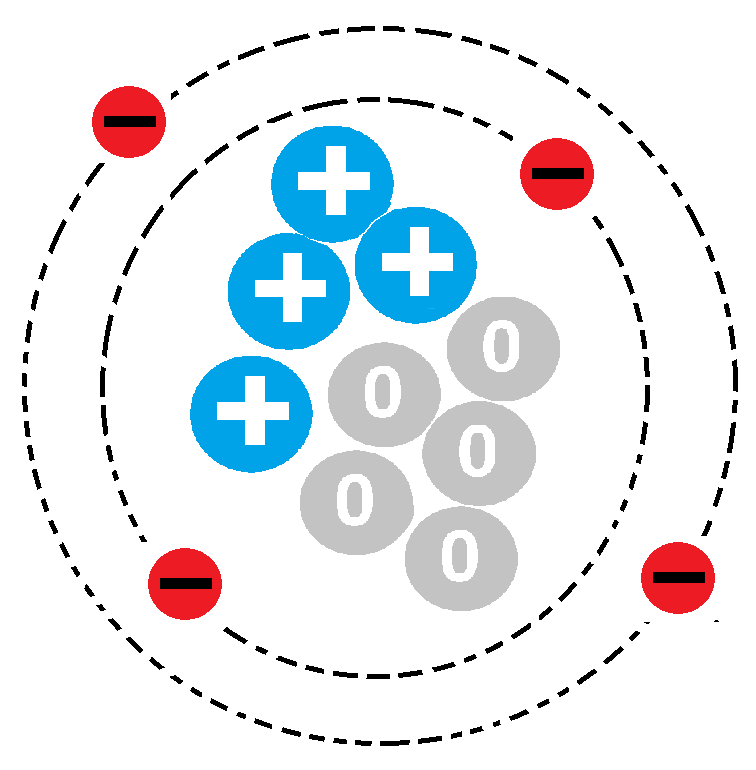
What is the atomic number of this atom?

a)

4

b)

5

c)

9

d)

none of the above

79.

What is the mass number of this atom?

a)

4

b)

5

c)

9

d)

none of the above

80.

What is the atomic number of this atom?

a)

9

b)

10

c)

19

d)

27

81.

What is the mass number of this atom?

a)

2

b)

4

c)

6

d)

none of the above

82.

The atomic number of Hydrogen is

a)

1

b)

2

c)

3

d)

4

83.
The atomic number of Lithium is
a)
3
b)
4
c)
5
d)
6
84.

Because atoms are neutral, the number of protons is always _______ the number of electrons

a)

greater than

b)

less than

c)

equal to

d)

proportional to

85.
A fluorine atom has 9 protons and 10 neutrons. What is the atomic number of fluorine?
a)
9
b)
10
c)
19
d)
1
86.
An atom of argon has 18 protons and 22 neutrons. How many electrons does it have?
a)
18
b)
22
c)
40
d)
4
87.
A phosphorus atom has 15 protons and 16 neutrons. What is the mass number?
a)
15
b)
16
c)
31
d)
1
88.
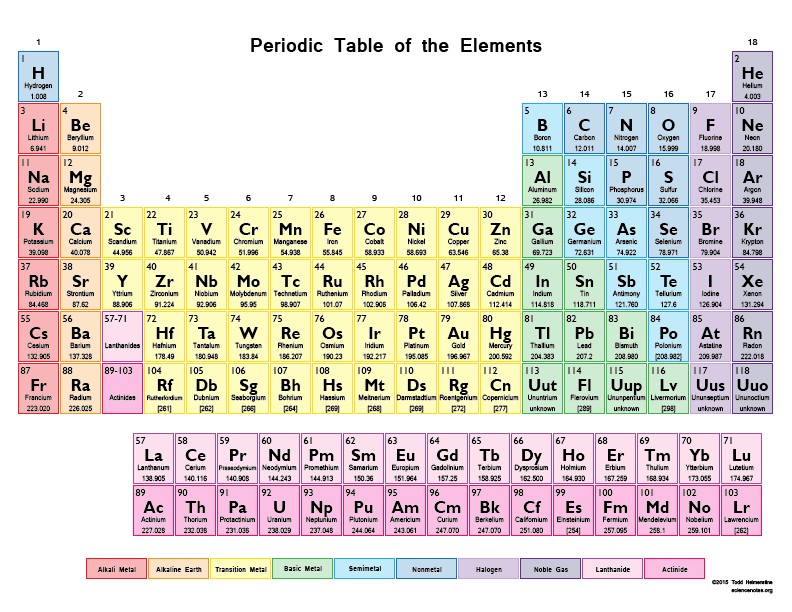
What element has 20 protons? (Use your periodic table.)
a)
Potassium (K)
b)
Calcium (Ca)
c)
Nitrogen (N)
d)
Neon (Ne)
89.
A phosphorus atom has 15 protons and 16 neutrons. What is the mass number?
a)
15
b)
16
c)
31
d)
1
90.

To calculate mass number you should -

a)

Add protons and neutrons

b)

Subtract protons and neutrons

91.

To calculate the number of neutrons you should -

a)

Subtract: Mass Number - Protons

b)

Add: Mass Number + Protons

92.
How many protons are in a sodium atom? (tap to enlarge the periodic table)
a)
Sodium has 1 proton.
b)
Sodium has 3 protons.
c)
Sodium has 11 protons
93.
An element has the mass number 12 and atomic number  6. The number of neutrons in it is:
a)
6
b)
10
c)
4
d)
8
94.
Which subatomic particle has a negative charge in the atom?
a)
proton
b)
neutron
c)
electron
d)
quark
95.
If an atom has 10 electrons, how many protons does it have?
a)
0
b)
1
c)
10
d)
5
96.
How many electrons are in an atom with an atomic number of 50?
a)
5
b)
8
c)
50
d)
2
97.
What is the atomic number of silicon?
a)
14
b)
15
c)
28.08
d)
30.97
98.
What is the atomic number of Nickel?
a)
110
b)
28
c)
46
d)
78
99.
What is the atomic number of Barium?
a)
20
b)
38
c)
56
d)
88
100.
What is the atomic mass of Carbon?
a)
5
b)
6
c)
7
d)
12.01