
 Worksheets
Chemistry CSEC MC
Total questions: 100
Worksheet time: 2hrs 12mins
Ethanol and water can be separated by fractional Distillation because they
are chemically similar
have different densities
are immiscible
have different boiling points
what is an atom
smallest part of the universe
smallest part of a substance
smallest part of anything
smallest part of water


A 3.7 g sample of copper(II) carbonate is added to 25 cm3 of 2.0 mol dm–3 hydrochloric acid. Which volume of gas is produced under room conditions?
A 0.60 dm3
0.72 dm3
1.20 dm3
2.40 dm3

Which sub-atomic particle is responsible for reactions between most atoms?
Proton
Neutron
Electron
None of these
Covalent bonds are bonds between atoms that:
Share electrons
Transfer electrons
Share neutrons
Share protons
three hydrogen (H)
one sulfur (S)
four oxygen (O)



name the group that has a single bond
alkenes
alcohols
alkanes
ethers
the name of this compaund C4H10
METHANE
HEXENE
BUTANOIC ACID
BUTANE
The group made up of alcohols and acids
esters
carbocilic acids
ethers
alkynes
Macromolecule that is made up of repeated structure called monomers
protein
amino acids
polymer
organic polymer can be divided into
synthetic organic polymer
natural organic polymer
all of the above
the type of reaction that occur in alkenes
elimination
substitution
addition


Which diagram gives the skeletal formula of
2-chloropentan-3-ol ?
A
B
C
D
What is a functional group?
Atoms or group of atoms that give specific characteristics to a molecule
Group of molecules that make up a group of atoms
Group of molecules that give specific characteristics to an atom
Group of atoms that give specific characteristics to an element
Which of the following is an organic compound?
CO2
CH3COOH
Na2CO3
NaHCO3
The compounds which contain only carbon and hydrogen are called_____________.
alkanes.
alkenes.
organic compounds.
hydrocarbons.
Which factors increase the rate of a reaction?
increasing temperature
increasing concentration
increasing surface area
all of these

The amount of something; how many particles in a volume of a mixture
Rate
Collision
Catalyst
Concentration
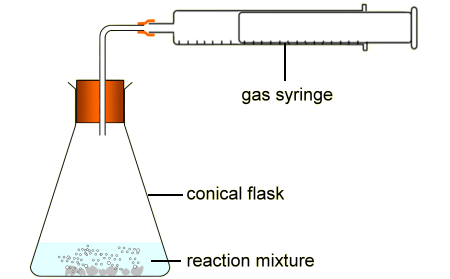
How is this equipment being used to measure the rate of reaction?
The gas syringe measures how much gas is produced in a certain time
The reaction mixture will increase in volume in a certain time
What reaction has the following general formula:
CxHy + O2 −>CO2 + H2O
Combination
Decomposition
Single Replacement
Double Replacement
Combustion
What is the general reaction scheme for a combination reaction?
A + B --> AB
AB --> A + B
A + CD --> C + AD
AB + CD --> CB + AD
CxHy+O2 −> CO2+H2O
What is the general reaction scheme for a double replacement reaction?
A + B --> AB
AB --> A + B
A + CD --> C + AD
AB + CD --> CB + AD
CxHy+O2 −> CO2+H2O
What type of reaction is the following:
Zn + 2HCl −> ZnCl2+H2
Combination
Decomposition
Single Replacement
Double Replacement
Combustion

What is the equation to show what happens to chloride ions at the anode.
Cl- --> Cl + e-
2Cl- --> Cl2 + 2e-
Cl2 + 2e- 2Cl-
Cl2 + 2e- --> 2Cl-
Why ionic compounds can not conduct electricity when they are solid?
their electrons are not free to move
their ions are free to move
their ions are not free to move
their electrons are free to move
What change is observed at cathode during electrolysis of aqueous copper(II) chloride using carbon electrode
Nothing
pink solid deposit
bubbles of green gas
colourless gas
Oxidation is loss of electron. Where does oxidation take place during electrolysis.
At anode
In the solution
At the circuit
At cathode
When silver is being electroplated onto the cup,
the cup is at the anode.
silver is at the anode.
the electrolyte is aqueous gold nitrate

A chemical reaction equation which the number of atoms in the reaction are the same for reactants and products
Electrolysis
Balance
Products
Reactants
It is essential that the electrolyte is a liquid so that...
Charged ions can migrate away from the electrodes.
Charged ions can migrate towards the electrodes.
The solution can move around.
The current can flow through it.
At the negative electrode copper ions get...
reduced
oxidised
melted
excited
_ H2 + O2 -> 2 H2O
_Al +_HCl --> _H2 +_AlCl3
Mg + __HCl ---> MgCl2 + H2
_CF4 + _Br2 -- _CBr4 + _F2
_CH4 + _O2 --> _CO2 + _H2O

Reduction is....
Gain of electrons
Loss of electrons
Both the loss and gain of electrons
None of these

