wayground logo

Free Printable Worksheets

Font size

S
M
L
XL
Worksheets

ATOMIC HISTORY and STRUCTURE, & Isotopic Notation

Total questions: 102

Worksheet time: 26hrs 30mins

Name
Class
Date
1.
Neutrons are found in the...
a)
Nucleus
b)
Electron Cloud
c)
Electrons
d)
Protons
2.
Electrons have a ___________ charge.
a)
Positive
b)
Negative
c)
Neutral
3.
The _____________ determines the identity of an object.
a)
# of Protons
b)
# of Electrons
c)
# of Neutrons
d)
Atomic Mass
4.
Believed that atoms are small, hard particles that were "indivisible"
a)
Democritus
b)
Aristotle
c)
Schrodinger
d)
Greek Philosophers
5.

Did experiments to show that atoms form compounds in set ratios.

a)

John Dalton

b)

Schrodinger

c)

Niels Bohr

d)

JJ Thomson

6.
Believed that all atoms of the same element would be the same.
a)
John Dalton
b)
JJ Thomson
c)
Niels Bohr
d)
Modern Atomic Theory
7.
The following element has _____________ electrons.
a)
114
b)
289
c)
175
d)
403
8.

The following element has _______________ neutrons.

a)

15

b)

16

c)

31

d)

46

9.

Who was the first person to think of an atom?

a)

Democritus

b)

Dalton

c)

Rutherford

d)

Bohr

10.

What does "atomos" mean?

a)

tiny

b)

carbon

c)

uncuttable

d)

invisible

11.

Whose model was a small sphere with a hard shell (billiard ball)?

a)

Democritus

b)

Dalton

c)

Rutherford

d)

Bohr

12.

Who found out atoms are mostly empty space?

a)

Democritus

b)

Thomson

c)

Rutherford

d)

Einstein

13.

What is the dense, positively charged center of an atom called?

(a)  

14.

What is the modern (current) model of the atom called?

a)

Electron Cloud Model

b)

Solar System Model

c)

Plum Pudding Model

d)

Billiard Ball Model

15.

What are the positively charged particles in the nucleus called?

(a)  

16.

What are the particles with no charge called?

(a)  

17.

What are the very small, negatively charged particles called?

(a)  

18.
Who proposed that the atom consists mostly of empty space?
a)
Bohr
b)
Dalton
c)
Rutherford
d)
Chadwick
19.
Which of these statements was made by John Dalton?
a)
A nucleus contains protons and neutrons
b)
Electrons orbit an atom
c)
Atoms combine in whole number ratios
d)
Atoms can be divided
20.
How many neutrons in this species?
a)
146
b)
238
c)
92
d)
148
21.

In Rutherford’s experiment, where would you expect the most alpha particles to strike the screen?

a)

1

b)

2

c)

3

22.
An atom has 14 protons, 15 neutrons and 14 electrons. Its mass number is….
a)
14
b)
15
c)
28
d)
29
23.
A tiny but very dense, positively charged portion of the atom that holds most of the atomic mass
a)
Electron Shells
b)
Orbitals
c)
Electron Cloud
d)
Nucleus
24.
Discovered the nucleus of the atom through the Gold Foil Experiment
a)
Rutherford
b)
Chadwick
c)
Thomson
d)
Dalton
25.

Calculation used to find the number of neutrons in an atom

a)

Mass Number - Atomic Number

b)

Atomic Number - Atomic Mass

c)

Atomic Mass - Electrons

d)

none of these

26.
What subatomic particles are located in the electron cloud?
a)
quarks
b)
protons
c)
electrons
d)
neutrons
27.
Which is an electron?
a)
A
b)
B
c)
C
28.
Which item on this element square is the chemical symbol?
a)
Copper
b)
29
c)
Cu
d)
63.546
29.
What is the number of protons that the element in this image contain?
a)
14
b)
7
c)
15
d)
18
30.
An atom of the element with atomic number 6 always has _____.
a)
six protons in its nucleus
b)
an atomic mass of six
c)
more than six neutrons
d)
six electron clouds
31.
What are subatomic particles? 
a)
the nucleus 
b)
electron cloud
c)
positive charge
d)
electrons, protons, and neutrons
32.
How many protons does an atom with an atomic number of 28 and a mass number of 40 have?
a)
28
b)
68
c)
12
d)
40
33.

Who was the Greek philosopher who called the smallest particle of matter as "atom"?

a)

Democritus

b)

Aristotle

c)

J.J Thompson

d)

Einstein

34.
How many protons does an aluminium atom have? (Use the image to help you)
a)
27
b)
14
c)
40
d)
13
35.
How many neutrons does a sodium atom have? (Use the image to help you)
a)
23
b)
11
c)
12
d)
34
36.
Atoms of the same element must always have the same number of _________
a)
electrons
b)
neutrons
c)
isotopes
d)
protons
37.
The atomic number of an element that has 9 protons, 9 electrons, and 10 neutrons is _____.
a)
9
b)
10
c)
19
d)
28
38.
In order for an atom to be neutral what has to be true?
a)
The atom has more protons than neutrons
b)
The atom has more neutrons than protons
c)
The atom has the same number of protons and neutrons
d)
The atom has the same number of protons and electrons
39.
Believed that atoms are small, hard particles that were "indivisible"
a)
Democritus
b)
Aristotle
c)
Schrodinger
d)
Greek Philosophers
40.
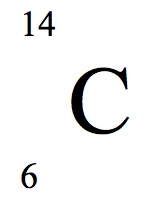
How many neutrons in C-14?
a)
6
b)
7
c)
14
d)
8
41.
Isotopes are atoms of the same element with different #’s of __________ & therefore different __________.
a)
n0 ;  atomic #’s
b)
p+ ; atomic #’s
c)
e- ; atomic masses
d)
n0 ; atomic masses
42.
How many neutrons does the isotope of lithium have?
a)
8
b)
3
c)
4
d)
5
43.
This is the most basic unit of matter:
a)
protons
b)
neutrons
c)
atoms
d)
electrons
44.
Particles that are "below" the size of an atom are referred to as:
a)
extremely small particles
b)
protons
c)
subatomic particles
d)
particles
45.
Which atom structure is responsible for the mass of the atom?
a)
cloud of negativity
b)
nucleus
c)
electron cloud
d)
big cloud of nothing
46.
What subatomic particle controls the identity of an atom?
a)
electrons
b)
protons
c)
neutrons
d)
quark
47.
This neutrally charged particle is located in the nucleus of an atom:
a)
negatron
b)
neutron
c)
proton
d)
electron
48.
Which two subatomic particles are responsible for the average atomic mass of atoms?
a)
protons and electrons
b)
neutrons and electrons
c)
negatrons and quarks
d)
protons and neutrons
49.
What on the periodic table tells me the number of protons and electrons in a neutral atom?
a)
Atomic mass number
b)
chemical symbol
c)
Atomic number
d)
chemical name
50.

Through experimentation, a scientist determined the charge of an electron, which is...

a)

neutral

b)

positive

c)

negative

d)

either positive or negative

e)

either positive or neutral

51.

Which scientist was one of the very 1st atomic theorists...

a)

John Dalton

b)

J.J. Thomson

c)

Aristotle

d)

Democritus

52.

Choose correct characteristics of the nucleus.

*(May choose more than 1 answer)

a)

dense

b)

negatively charged

c)

located anywhere in the atom

d)

positively charged

e)

located in center of the atom

53.

The Gold Foil Experiment utilized alpha particles, which have a _____________ charge.

a)

neutral

b)

positive

c)

negative

d)

depends on source of alpha particles

54.

Conclusions from the Gold Foil Experiment included... (choose all that apply)

a)

Most of the atom is filled with various subatomic particles.

b)

Most of the atom is empty space.

c)

Tightly packed electrons form the center of an atom.

d)

The nucleus is in the center of an atom.

55.

Democritus described “atomos” as ________________ & _______________ .

a)

small, round

b)

indivisible, destructible

c)

indivisible, indestructible

d)

divisible, indestructible

56.

Which choice below accurately describes the location of neutrons and electrons?

a)

neutrons and electrons both outside of nucleus

b)

neutrons and electrons both inside of nucleus

c)

neutrons in nucleus, electrons outside of nucleus

d)

electrons in nucleus, neutrons outside of nucleus

57.
Whose experiment involved shooting small, positively charged alpha particles at a sheet of gold foil?
a)
J.J. Thompson
b)
Max Planck
c)
Ernest Rutherford
d)
Niels Bohr
58.

How many neutrons does an Oxygen-19 isotope have?

a)

19

b)

8

c)

11

d)

10

59.

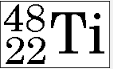
How many protons does this isotope of titanium have?

a)

48

b)

22

c)

26

d)

70

60.

A neutral atom of the isotope 1226Mg_{12}^{26}Mg would consist of

a)

12 protons, 26 neutrons

b)

26 protons, 12 neutrons

c)

26 protons, 14 neutrons

d)

12 protons, 14 neutrons

61.

How many protons are in the nucleus of the element shown?

a)

19

b)

9

c)

10

d)

28

62.

How many neutrons does this isotope of titanium have?

a)

48

b)

22

c)

26

d)

70

63.

An atom has 8 protons, 9 neutrons and 10 electrons what is its mass number.

a)

18

b)

9

c)

19

d)

17

e)

27

64.

How many neutrons are in the nucleus of the element shown here?

a)

19

b)

9

c)

10

d)

28

65.

Which has more protons, Cu-29 or Cu-30?

a)

Cu-29

b)

Cu-30

c)

no way to tell

d)

they have the same number of protons

66.

How many neutrons and protons are in an atom of Neon-21?

a)

10 neutrons, 11 protons

b)

11 neutrons, 10 protons

c)

21 neutrons, 10 protons

d)

11 neutrons, 21 protons

67.
How many protons does He have?
a)
4
b)
2
c)
6
d)
0
68.
Atomic number=
a)
number of neutrons
b)
atomic mass
c)
protons
d)
electrons+protons
69.
The top number in this isotope notation is
a)
the mass number
b)
the atomic number
c)
the atomic mass
d)
the neutron number
70.
The bottom number in this isotope notation is
a)
the mass number
b)
the atomic number
c)
the atomic mass
d)
the neutron number
71.
Cl is the chemical symbol for...
a)
Chlorine
b)
Carbon
c)
Copper
d)
Silicon
72.
Sodium's chemical symbol is...
a)
Na
b)
S
c)
K
d)
Sr
73.
The chemical symbol for mercury is...
a)
Hg
b)
Mc
c)
Mg
d)
Al
74.
O
a)
Oxygen
b)
Nickel
c)
Cobalt
d)
Calcium
75.
Lead
a)
Le
b)
La
c)
L
d)
Pb
76.
Nitrogen
a)
Si
b)
Ni
c)
Al
d)
N
77.
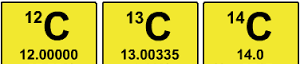
What do these isotopes of carbon all have in common?
a)
neutrons & mass number
b)
atomic number and neutrons
c)
atomic number and electrons
d)
protons, atomic number, and mass number
78.
In a correctly written symbol what would be located in the "A" position?
a)
number of neutrons
b)
atomic number
c)
number of electrons 
d)
mass number
79.
What quantities vary between isotopes of an element?
a)
protons, electrons, and atomic mass
b)
protons, electrons, and atomic number
c)
neutrons and electrons
d)
neutrons and atomic mass
80.
How many neutrons in C-14?
a)
6
b)
7
c)
14
d)
8
81.

How many neutrons does the isotope below have?   3589Kr_{35}^{89}Kr     

a)

54

b)

36

c)

89

d)

125

82.

If X is the symbol for an element, which of the following two symbols represent  isotopes of the same element?  


I. 

 3577X_{35}^{77}X II.  3377X_{33}^{77}X   III.  3781X_{37}^{81}X   IV.  3581X_{35}^{81}X  

a)

I and II

b)

III and IV

c)

I and IV

d)

I and III

83.
How many neutrons does an atom of the isotope Neon-22 have?
a)
12
b)
10
c)
22
d)
20
84.
Four isotopes of lead include lead-204, lead-206, lead-207, and lead-208.  The average atomic mass of lead is 207.2.  Which isotope of lead is likely to be the most abundant.
a)
204
b)
206
c)
207
d)
208
85.
An atom is electrically neutral when
a)
protons and neutrons are the same
b)
protons and electrons are the same
c)
neutrons and electrons are the same
d)
neutrons balance the protons and electrons
86.
What is an isotope? 
a)
A charged atom
b)
An atom with different amounts of neutrons
c)
An atom with different amounts of protons
d)
A neutral atom
87.

The photo above shows the isotopic notation for which isotope?

a)

Carbon-12

b)

Carbon-13

c)

Carbon-14

d)

Carbon-15

88.

How many neutrons does a Sodium-24 isotope have?

a)

12

b)

13

c)

14

d)

15

89.

How many neutrons does a Carbon-13 atom have?

a)

6

b)

5

c)

7

d)

8

90.

How many neutrons does a Calcium-48 isotope have?

a)

16

b)

20

c)

28

d)

12

91.
How many neutrons does an Oxygen-19 isotope have?
a)
19
b)
8
c)
11
d)
10
92.
How many neutrons does an Iodine-133 isotope have?
a)
80
b)
133
c)
53
d)
77
93.
How many neutrons does a Sulfur-32 isotope have?
a)
15
b)
16
c)
32
d)
12
94.
How many neutrons does a Flourine-14 isotope have?
a)
4
b)
5
c)
9
d)
14
95.
What is the name of the pictured isotope?
a)
Chlorine-Schmorine
b)
Chlorine-17
c)
Chlorine-35
d)
Chlorine-18
96.
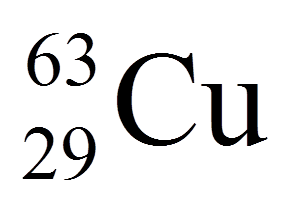
What is the name of the pictured isotope?
a)
Copper-29
b)
Copper-63
c)
Copper-34
d)
CopperWopperHopperBopper
97.

Nickel-59 has how many neutrons?

a)

30

b)

31

c)

32

d)

33

98.

76 protons and 114 neutrons

a)

Osmium-114

b)

Osmium-76

c)

Osmium-190

d)

Osmium-190.23

99.

9 protons and 9 neutrons

a)

Fluorine-18

b)

Fluorine-9

c)

Fluorine-16

d)

Fluorine-18.998

100.

Rubidium has two common isotopes, 85Rb and 87Rb. If the abundance of 85Rb is 72.2% and the abundance of 87Rb is 27.8%, what is the average atomic mass of rubidium?

a)

85.468 amu

b)

37 amu

c)

85.6 amu

d)

86.4 amu

101.

How do you calculate mass number?

a)

Mass x percent

b)

Protons + Electrons

c)

Protons + Neutrons

d)

Neutrons + Protons + Electrons

102.

There are two primary isotopes found in any sample of copper: copper-63 and copper-65. The isotope 65Cu composes 69.2% of the sample and 63Cu comprises the other 30.8%. Based on this data, what is the atomic mass of copper?

a)

29 amu

b)

63.546 amu

c)

64.4 amu

d)

63.6 amu